




CBSE Class 12 Exam Pattern 2027 is expected to follow a subject-wise assessment structure. Marks will be divided between theory, practicals, internal assessments, and project work. Theory and practical/internal assessment marks vary by subject, with common structures including 70 by 30 and 80 by 20 mark distributions. There is no negative marking applicable.
| Direct Link to CBSE Class 12 Exam Pattern 2027 (Expected Soon) |
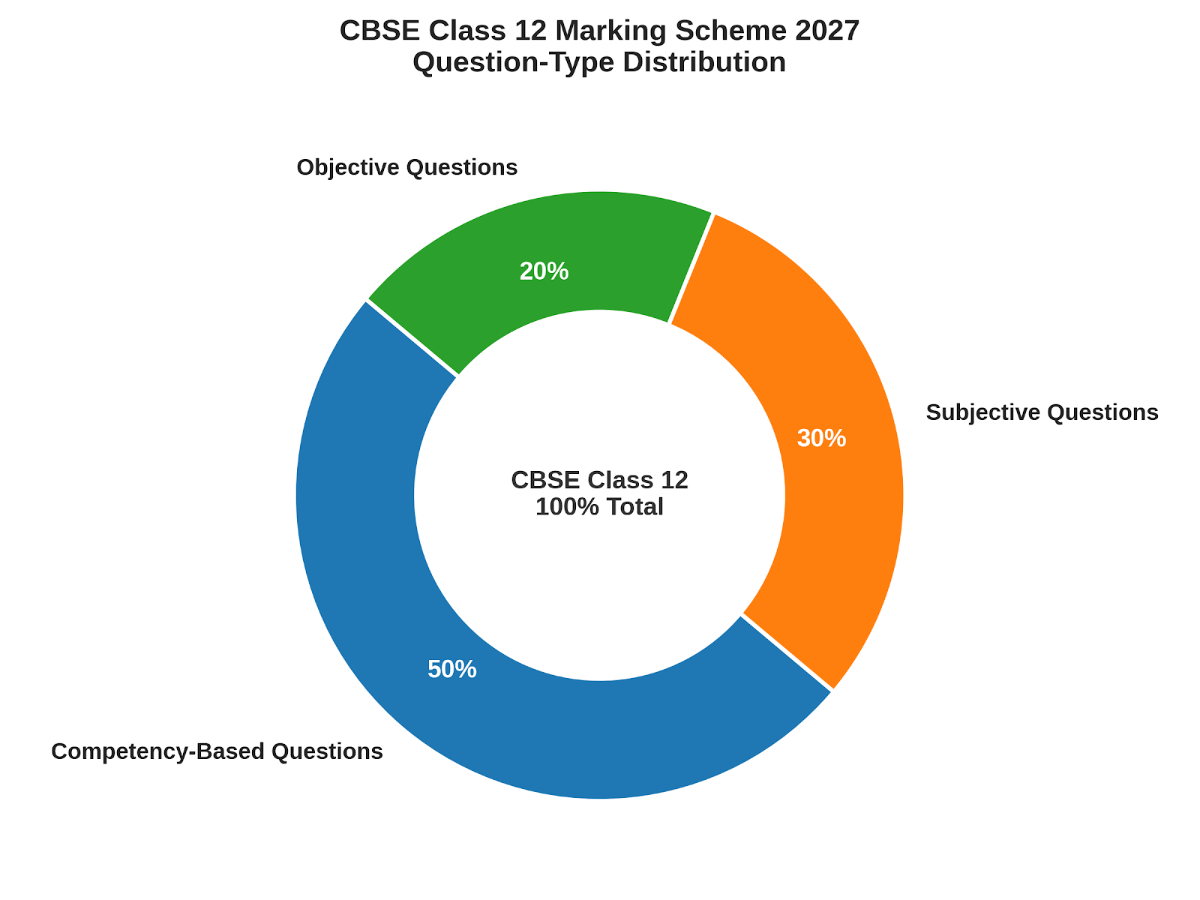
- The paper includes 50% competency-based questions, 20% standalone MCQs, and 30% short- and long-answer questions, testing both application and conceptual understanding.
- Greater focus is placed on NCERT-based concepts, application of concepts, case/source-based situations, and subject-specific problem-solving.
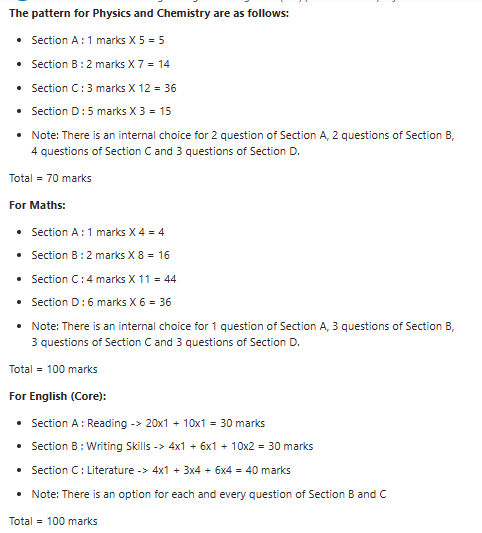
- CBSE Class 12 Physics and Chemistry has 16 MCQs, 5 VSA, 7 SA, 2 case-study questions and 3 long-answer questions.
- The CBSE Class 12 exam pattern has 20 MCQs, 2-mark, 3-mark and 5-mark questions, plus case-study questions.
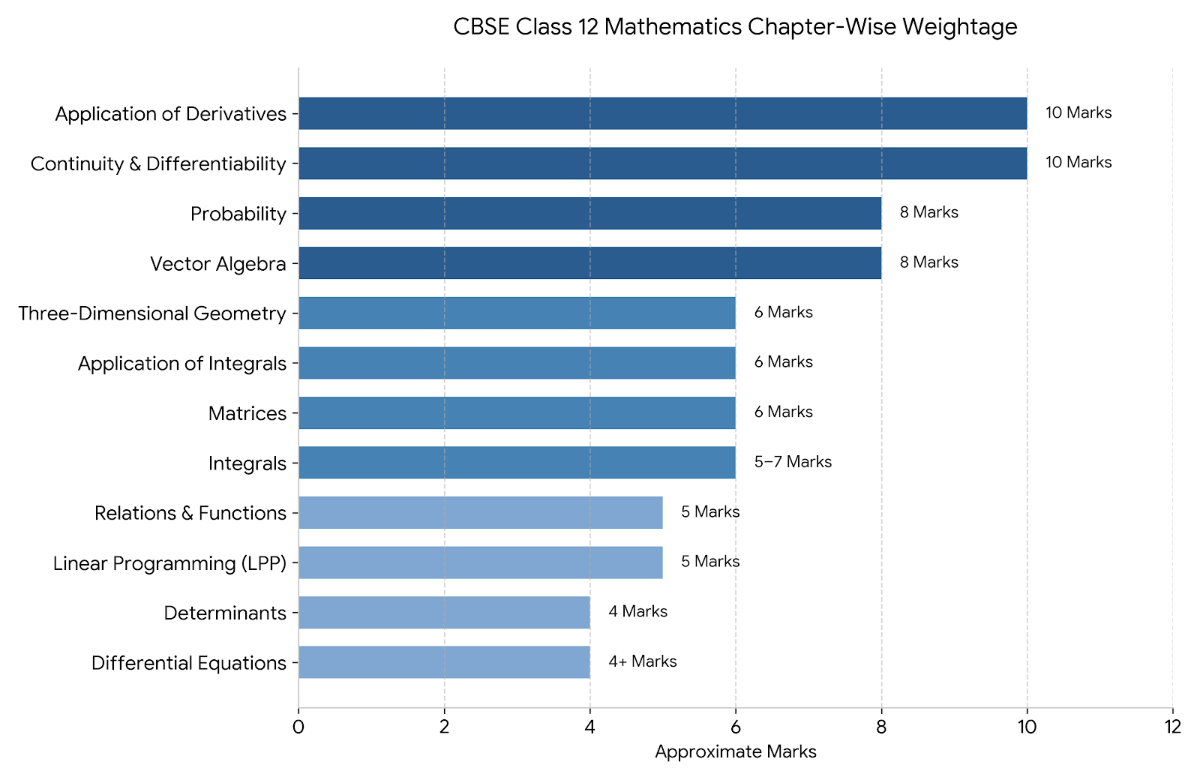
- High weightage topics in Mathematics include Continuity & Differentiability and Application of Derivatives with 10 questions each.
- In CBSE Class 12 Physics, Ray Optics and Optical Instruments (9 marks) and Semiconductor Electronics / Electronic Devices (7 marks) carry most questions.
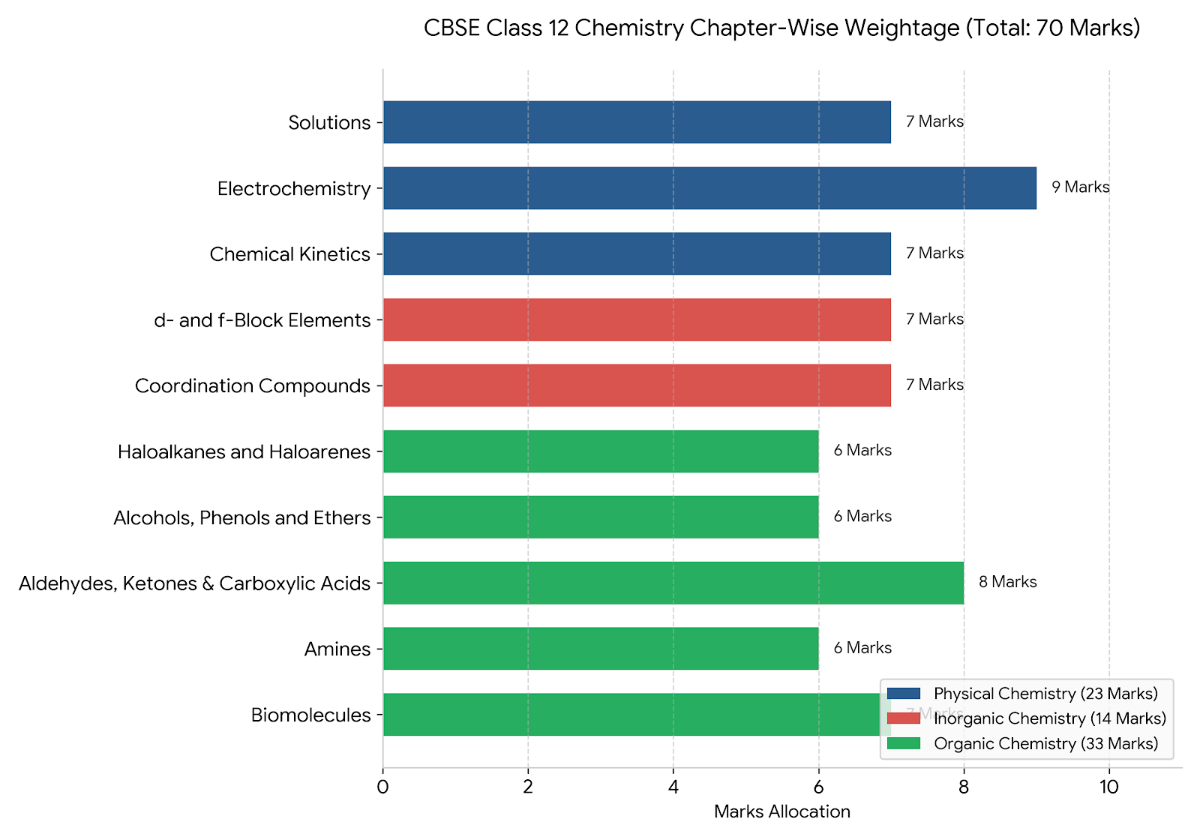
- Electrochemistry and Aldehydes (9 marks), Ketones (8 marks) and Carboxylic Acids are the highest-weightage chapters in Chemistry.
- Students must meet the 33% passing criteria in each subject, including applicable theory and practical/internal components.
Related Links:
- CBSE Class 12 Preparation Tips 2024: Check Subject-Wise Guidelines, Books, Previous Years Papers
- CBSE Class 12 Syllabus- Download PDF, Check Subject-Wise Syllabus
- CBSE Class 12 Chapter-Wise Weightage 2025-26 (Out): Check Weightage and Important Topics
Key Summary
- CBSE Class 12 exams generally follow a subject-wise assessment structure combining theory with practical, internal assessment or project marks.
- The question paper pattern includes competency-based, objective, short-answer, and long-answer questions, depending on the subject.
- Chapter-wise weightage can help students prioritise important topics in subjects such as Mathematics, Physics, Chemistry, Business Studies and Economics.
- Students should understand the subject-wise passing criteria, including separate theory and practical/internal requirements wherever applicable.
CBSE Class 12 Exam Pattern: Overview
The official CBSE Class 12 exam name is the All India Senior School Certificate Examination (commonly abbreviated as AISSCE). The CBSE Class 12 board exam pattern is designed to assess how well students understand concepts rather than just how much they can memorize.
- Each subject is generally evaluated out of 100 marks.
- The marks are divided into the year-end written exam, Internal assessment or practicals, a subject-wise marking scheme, and the question paper pattern.
| Particulars | Details |
|---|---|
| Conducting Body | Central Board of Secondary Education |
| Question Paper Pattern |
|
| Duration | 3 Hours |
| Medium | English / Hindi |
| Mode | Offline |
| Number of subjects | 5 or 6 (as elected by the student) |
| Maximum Marks | 100 (theory + practical)
|
| Passing marks for each subject | 33% |
| Passing marks for the overall exam | Aggregate 33% |
Ques. What is the CBSE Class 12 exam pattern for 2027?
Ans. An offline exam featuring 50% Competency-Based questions, 20% Objective/MCQ questions, and 30% Traditional Subjective questions.
Ques. How many marks are there in the CBSE Class 12 board exam?
Ans. Each subject is evaluated out of a total of 100 marks (combining written theory and school-level practicals/internal assessments).
Related Links:
- NCERT Class 12 Solutions, Notes, Book PDF, Exemplar & Sample Papers 2026-27
- CBSE Class 12 2026: Result, Date Sheet, Syllabus, Exam Pattern and Compartment Exam
CBSE Class 12 Marking Scheme 2027
The CBSE marking scheme for Class 12 focuses on conceptual understanding, application, and structured answers.
- The CBSE 12th total marks for all subjects are 100, combining theory with practical/internal assessment where applicable.
- CBSE 12th total marks for all subjects depend on the number of subjects and their individual assessment structure.
| Question Type | Weightage | What It Tests |
|---|---|---|
| Competency-Based Questions | 50% | Application of concepts through case studies, source-based questions, and real-world or passage-based problems. |
| Objective Questions | 20% | Quick assessment of conceptual clarity through MCQs and other objective-type questions. |
| Subjective Questions | 30% | Short- and long-answer questions that assess explanation, structured writing, calculations, and problem-solving steps. |
Ques. What is the CBSE Class 12 theory and practical marks distribution?
Ans. It is split as either 70 Marks Theory + 30 Marks Practical (for lab sciences and geography) or 80 Marks Theory + 20 Marks Project/Internal Assessment (for commerce, humanities, math, and languages).
Also Check:
- CBSE Class 12 Grading System 2026: Check CGPA, How it Works, Grade Point and Percentage
- CBSE Class 12 Notes: PCMB Chapter-wise Handwritten Notes, NCERT Solutions PDF & Latest Syllabus
CBSE Class 12 Subject-wise Exam Pattern 2027
The CBSE Class 12 exam pattern varies by stream and subject, with marks divided between theory papers and practical, internal assessment, or project work.
- Science subjects generally follow a 70:30 theory-to-practical structure, while most Commerce, Mathematics, Language, and Humanities subjects follow an 80:20 distribution.
- Question formats are varied, including MCQs, short-answer questions, long-answer questions, case studies, and source-based questions.
| Stream | Subject | Theory Marks | Practical / Internal Marks | Key Exam Pattern / Highlights |
|---|---|---|---|---|
| Science | Physics | 70 | 30 | 16 MCQs, 5 VSA, 7 SA, 2 case-study questions and 3 long-answer questions |
| Chemistry | 70 | 30 | 16 MCQs, 5 VSA, 7 SA, 2 case-study questions and 3 long-answer questions | |
| Biology | 70 | 30 | Objective, short-answer, case-study and long-answer questions; emphasis on diagrams, processes and data analysis | |
| Commerce | Accountancy | 80 | 20 | Part A covers Partnership, Companies and Financial Statements; choice available in Part B/C |
| Business Studies | 80 | 20 | Objective questions, 3-mark and 4-mark short answers, and 6-mark long-answer questions | |
| Economics | 80 | 20 | 40 marks from Macroeconomics and 40 marks from Indian Economic Development | |
| Mathematics | Mathematics / Applied Mathematics | 80 | 20 | 20 MCQs, 2-mark, 3-mark and 5-mark questions, plus case-study questions |
| Languages | English Core | 80 | 20 | Reading comprehension, creative writing and literature-based questions |
| Humanities | History | 80 | 20 | Objective, short-answer, source-based and long-answer questions, including 5-mark map work |
| Political Science | 80 | 20 | Objective, analytical short-answer, source/passage-based and long-answer questions |

Source: Quora
Ques. How many marks are required to pass an 80-mark CBSE Class 12 theory paper?
Ans. A minimum of 26 marks out of 80 is required.
Ques. What types of questions are asked in CBSE Class 12 board exams?
Ans. Case studies, source-based integrated passages, assertion-reasoning, standalone MCQs, very short answers, short answers, and long descriptive answer-type questions are asked in CBSE Class 12 board exams.
Also Read:
Changes in CBSE Exam Pattern 2027 Over the Years
Below are the changes seen in the CBSE exam pattern over the last 6-7 years:
- CBSE has progressively increased competency-based and application-oriented questions, reaching around 50% weightage in the current pattern.
- The introduction of internal assessment and project work reduced dependence on the final theory examination.
- CBSE moved from the temporary Term I–Term II system during the pandemic back to a single annual exam, alongside newer digital evaluation methods.
| Period | Major Pattern Change | Impact on Exam Pattern |
|---|---|---|
| 2020 | Internal Assessment Introduced |
|
| 2021–2022 | Term-Wise Examination System |
|
| 2023–2025 | Competency-Based Questions Increased |
|
| Current Era | 50% Competency-Based Assessment |
|
Also Check:
CBSE Class 12 Board Exam Chapter-wise Weightage
CBSE Class 12 Science subject-wise exam pattern 2025-26 along with the marks weightage is provided below.
CBSE Class 12 Mathematics Chapter-Wise Weightage
For students currently scoring low, the transcript recommends first completing the low-practice, high-return chapters such as Matrices, Application of Integrals, Three-Dimensional Geometry, LPP and Determinants.
| Chapter | Approx. Weightage | Practice Level | Key Topics / Focus |
|---|---|---|---|
| Continuity & Differentiability | 10 Marks | High | Continuity, differentiability, derivative-based problems |
| Application of Derivatives | 10 Marks | High | Increasing/decreasing functions, maxima & minima, applications of derivatives |
| Vector Algebra | 8 Marks | Moderate | Vectors, dot product, cross product, applications |
| Probability | 8 Marks | Moderate | Conditional probability, Bayes’ theorem, probability distributions |
| Matrices | 6 Marks | Low | Matrix operations, inverse of matrix, applications |
| Application of Integrals | 6 Marks | Low | Area under curves and applications of integration |
| Three-Dimensional Geometry | 6 Marks | Low | Direction ratios/cosines, lines, planes and distances |
| Linear Programming (LPP) | 5 Marks | Low | Constraints, feasible region, graphical method, optimal solution |
| Relations & Functions | 5 Marks | Moderate | Relations, functions, types of functions and NCERT-based problems |
| Integrals | 5–7 Marks | High | Indefinite/definite integrals and integration techniques |
| Differential Equations | 4+ Marks | Moderate | Formation, order and degree, solutions of differential equations |
| Determinants | 4 Marks | Low | Properties, evaluation, area of triangle and applications |
Ques. What percentage of CBSE Class 12 questions are competency-based?
Ans. Exactly 50% of the total marks in a theory paper are dedicated to competency-focused testing.
Also Check:
| Handwritten Notes for CBSE Class 12 Mathematics | |
|---|---|
| Continuity & Differentiability | Application of Integrals |
| Application of Derivatives | Three-Dimensional Geometry |
| Vector Algebra | Linear Programming (LPP) |
| Probability | Relations & Functions |
| Matrices | Integrals |
| Differential Equations | Determinants |
The video discusses the high-weightage topics, like Calculus, which carries the highest weightage, and Algebra and Geometry, which form the other key areas, covering Matrices, Determinants, Relations & Functions, Vector Algebra, 3D Geometry, Probability, and Linear Programming.
CBSE Class 12 Physics Chapter-Wise Weightage
For maximum score potential, it is recommended to prioritise Ray Optics, Semiconductor Electronics, Current Electricity, Potential & Capacitance, and Alternating Current.
- Students should also prepare the important derivations, numerical problems, and application-based questions highlighted below.
| Chapter | Approx. Weightage | Important Topics to Focus On |
|---|---|---|
| Ray Optics and Optical Instruments | 9 Marks | Lens & mirror formulas, refraction, optical instruments, ray diagrams |
| Semiconductor Electronics / Electronic Devices | 7 Marks | Semiconductor basics, p-n junction, diode, rectifier, logic gates |
| Current Electricity | 6 Marks | Drift velocity, resistivity & temperature dependence, cell combination, Kirchhoff's laws, Wheatstone bridge |
| Electromagnetic Potential & Capacitance | 6 Marks | Potential energy, equipotential surfaces, capacitors and combinations |
| Alternating Current | 6 Marks | LCR circuit, average power, resonance, transformer |
| Moving Charges and Magnetism | 5 Marks | Biot-Savart Law, force between parallel conductors, torque on current loop, galvanometer |
| Dual Nature of Radiation and Matter | 5 Marks | Photoelectric effect, de Broglie wavelength, Einstein's photoelectric equation |
| Electric Charges and Fields | 4 Marks | Coulomb's Law, electric dipole, Gauss's Law and its applications |
| Nuclei | 4 Marks | Nuclear composition, binding energy, radioactivity and nuclear reactions |
| Electromagnetic Induction | 3 Marks | Faraday's Law, Lenz's Law, self-inductance, mutual inductance |
| Magnetism and Matter | 3 Marks | Magnetic properties, diamagnetic, paramagnetic and ferromagnetic materials |
| Electromagnetic Waves | 3 Marks | Displacement current, properties and applications of electromagnetic waves |
| Atoms | 3 Marks | Atomic models, Bohr model, energy levels and spectra |
Ques. How many marks are required to pass a 70-mark CBSE Class 12 theory paper?
Ans. A minimum of 23 marks out of 70 is required.
Also Check:
CBSE Class 12 Chemistry Chapter-Wise Weightage
Below is the topic-wise weightage of Class 12 Chemistry chapters:
- Electrochemistry and Aldehydes, Ketones and Carboxylic Acids are the highest-weightage chapters.
- Organic Chemistry carries the highest branch-wise weightage, followed by Physical Chemistry and Inorganic Chemistry, based on the provided distribution.
| Chemistry Branch | Chapter | Weightage | Crucial High-Yield Topics to Focus On |
|---|---|---|---|
| Physical Chemistry | Solutions | 7 Marks | Raoult's Law, Henry's Law, colligative properties, abnormal molar mass, Van't Hoff factor |
| Electrochemistry | 9 Marks | Nernst Equation, Kohlrausch's Law, molar conductivity and concentration | |
| Chemical Kinetics | 7 Marks | Rate law, order and molecularity, zero/first-order equations, Arrhenius equation, activation energy | |
| Inorganic Chemistry | d- and f-Block Elements | 7 Marks | Transition-element trends, lanthanoid contraction, preparation of K₂Cr₂O₇ and KMnO₄ |
| Coordination Compounds | 7 Marks | IUPAC nomenclature, VBT and hybridisation, CFT splitting patterns | |
| Organic Chemistry | Haloalkanes and Haloarenes | 6 Marks | SN1/SN2 mechanisms, Finkelstein, Swarts, Wurtz reactions, stereochemistry |
| Alcohols, Phenols and Ethers | 6 Marks | Dehydration of alcohols, Kolbe reaction, Reimer-Tiemann reaction, acidity of phenols | |
| Aldehydes, Ketones and Carboxylic Acids | 8 Marks | Nucleophilic addition, Aldol, Cannizzaro, Tollens', Fehling's and Iodoform tests | |
| Amines | 6 Marks | Hoffmann Bromamide, Gabriel Phthalimide, basic strength, diazonium salt coupling | |
| Biomolecules | 7 Marks | Glucose structure, peptide bonds, protein structures, DNA vs RNA, vitamins |
Ques. Which CBSE Class 12 subjects have practical examinations?
Ans. Core practical subjects include Physics, Chemistry, Biology, Computer Science, Informatics Practices, Geography, Home Science, and Physical Education. Other subjects use project work or internal assessments.
Also Check:
| Handwritten Notes for CBSE Class 12 Physics | |
|---|---|
| Solutions | Haloalkanes and Haloarenes |
| Electrochemistry | Alcohols, Phenols and Ethers |
| Chemical Kinetics | Aldehydes, Ketones and Carboxylic Acids |
| d- and f-Block Elements | Amines |
| Coordination Compounds | Biomolecules |
CBSE Class 12 Business Studies Chapter-Wise Weightage
The CBSE Class 12 Business Studies chapter-wise weightage can be grouped according to the marks expected from each chapter as follows:
- Start with Marketing Management, Organising, Directing and Financial Management, then move to the 7-mark chapters. Keep Business Environment, Consumer Protection and Controlling for the later stages of revision.
| Chapter | Expected Weightage | Key Topics to Focus On |
|---|---|---|
| Marketing Management | 11 Marks | 4 Ps, Marketing Philosophies, Product, Price, Place, Promotion |
| Organising | 8 Marks | Functional vs Divisional Structure, Formal vs Informal Structure, Authority, Responsibility, Delegation |
| Directing | 8 Marks | Supervision, Motivation, Leadership Styles, Communication, Barriers to Communication |
| Financial Management | 8 Marks | Investment, Financing & Dividend Decisions, Capital Structure, Capital Budgeting, Working Capital |
| Principles of Management | 7 Marks | Principles of Management and their applications |
| Staffing | 7 Marks | Recruitment, Selection Process, Internal & External Sources, Training & Development |
| Financial Markets | 7 Marks | Money Market, Capital Market, Primary Market, Secondary Market |
| Nature & Significance of Management | 6 Marks | Nature of Management, Levels of Management, Coordination |
| Planning | 6 Marks | Types of Plans, Standing & Single-Use Plans, Planning Process |
| Controlling | 5 Marks | Controlling Process, Measurement of Actual Performance, Principles of Controlling |
| Consumer Protection | 4 Marks | Consumer Rights, Responsibilities, Reliefs, Consumer Protection Act 2019 |
| Business Environment | 3 Marks | Features of Business Environment, External Environment |
Ques. Where can students check the official CBSE Class 12 marking scheme?
Ans. On the official CBSE Academic Portal (cbseacademic.nic.in) under the "Sample Question Paper" tab released for the academic session.
Also Check:
| Handwritten Notes for CBSE Class 12 Business Studies | |
|---|---|
| Marketing Management | Financial Markets |
| Organising | Nature & Significance of Management |
| Directing | Planning |
| Financial Management | Controlling |
| Principles of Management | Consumer Protection |
| Staffing | Business Environment |
CBSE Class 12 Economics Chapter-Wise Weightage
Partnership Firms carries the highest weightage at 36 marks, followed by Accounting for Companies at 24 marks.
- Students choosing Financial Analysis should prioritize Partnership, Companies, Accounting Ratios and Cash Flow Statement.
| Syllabus Part & Unit | Chapters Included | Marks / Weightage | High-Priority Concepts & Problem Types |
|---|---|---|---|
| Part A: Partnership & Companies | Unit 1: Accounting for Partnership Firms | 36 Marks | Past adjustments, Interest on Drawings, Revaluation Account, Partner Capital Accounts, Balance Sheet adjustments, Realisation Account |
| Unit 2: Accounting for Companies | 24 Marks | Pro-rata allotment, forfeiture & reissue of shares, journal entries, loss on issue of debentures, collateral security | |
| Part B: Financial Analysis | Unit 3: Analysis of Financial Statements | 12 Marks | Schedule III Balance Sheet format, liquidity, solvency, turnover and profitability ratios |
| Unit 4: Cash Flow Statement | 8 Marks | Indirect Method, tax provisions, proposed dividend, depreciation and other adjustments | |
| Part B: Computerized Accounting (Alternative) | Overview, Spreadsheets & DBMS | 20 Marks | Accounting database architecture, spreadsheets, DBMS and automation commands |
Ques. Does CBSE release chapter-wise weightage for Class 12 subjects?
Ans. No, CBSE only releases unit-wise weightage guidelines. It does not officially lock individual mark weightages for single chapters.
Ques. Is there negative marking in the CBSE Class 12 board exams?
Ans. No, there is absolutely no penalty or negative marking for incorrect or unattempted questions.
Also Check:
CBSE Class 12 Previous Year Question Paper 2026
Below are CBSE Class 12 Previous Year Question Papers 2026 to help students understand the latest question pattern, marking scheme, question types, and difficulty level:
| CBSE Class 12 Question Paper 2026 | Question Paper PDF | Solution PDF |
|---|---|---|
| CBSE Class 12 Physics Question Paper 2026 (Set 1 - 55/1/1) | Download PDF | Check Solutions |
| CBSE Class 12 Physics Question Paper 2026 (Set 2 - 55/1/2) | Download PDF | Check Solutions |
| CBSE Class 12 Physics Question Paper 2026 (Set 3 - 55/1/3) | Download PDF | Check Solutions |
| CBSE Class 12 Chemistry Question Paper 2026 (Set 1 - 56/1/1) | Download PDF | Check Solutions |
| CBSE Class 12 Chemistry Question Paper 2026 (Set 2 - 56/1/2) | Download PDF | Check Solutions |
| CBSE Class 12 Chemistry Question Paper 2026 (Set 3 - 56/1/3) | Download PDF | Check Solutions |
| CBSE Class 12 Mathematics Question Paper 2026 (Set 1 - 65/1/1) | Download PDF | Check Solutions |
| CBSE Class 12 Mathematics Question Paper 2026 (Set 2 - 65/1/2) | Download PDF | Check Solutions |
| CBSE Class 12 Mathematics Question Paper 2026 (Set 3 - 65/1/3) | Download PDF | Check Solutions |
| CBSE Class 12 Biology Question Paper 2026 (Set 1 - 57/1/1) | Download PDF | Check Solutions |
| CBSE Class 12 Biology Question Paper 2026 (Set 2 - 57/1/2) | Download PDF | Check Solutions |
| CBSE Class 12 Biology Question Paper 2026 (Set 3 - 57/1/3) | Download PDF | Check Solutions |
| CBSE Class 12 Accountancy Question Paper 2026 (Set 1 - 67/1/1) | Download PDF | Check Solutions |
| CBSE Class 12 Accountancy Question Paper 2026 (Set 2 - 67/1/2) | Download PDF | Check Solutions |
| CBSE Class 12 Accountancy Question Paper 2026 (Set 3 - 67/1/3) | Download PDF | Check Solutions |
| CBSE Class 12 Economics Question Paper 2026 (Set 1 - 58/1/1) | Download PDF | Check Solutions |
| CBSE Class 12 Economics Question Paper 2026 (Set 2 - 58/1/2) | Download PDF | Check Solutions |
| CBSE Class 12 Economics Question Paper 2026 (Set 3 - 58/1/3) | Download PDF | Check Solutions |
| CBSE Class 12 Business Studies Question Paper 2026 (Set 1 - 66/1/1) | Download PDF | Check Solutions |
| CBSE Class 12 Business Studies Question Paper 2026 (Set 2 - 66/1/2) | Download PDF | Check Solutions |
| CBSE Class 12 Business Studies Question Paper 2026 (Set 3 - 66/1/3) | Download PDF | Check Solutions |
| CBSE Class 12 Poltical Science Question Paper 2026 (Set 1 - 59/1/1) | Download PDF | Check Solutions |
| CBSE Class 12 Poltical Science Question Paper 2026 (Set 2 - 59/1/2) | Download PDF | Check Solutions |
| CBSE Class 12 Poltical Science Question Paper 2026 (Set 3 - 59/1/3) | Download PDF | Check Solutions |
CBSE Class 12 Sample Papers
Below are the CBSE Class 12 sample papers to attempt:
| Sample Paper | PDF Download |
|---|---|
| CBSE Class 12 Mathematics Sample Paper | Download PDF |
| CBSE Class 12 Physics Sample Paper | Download PDF |
| CBSE Class 12 English Core Sample Paper | Download PDF |
What is the Passing Criteria in CBSE Class 12 Exam Pattern?
The CBSE Class 12 passing criteria depend on both the marks scored in the written paper and the practical/internal component:
- Theory and practical/internal marks are assessed separately wherever separate passing requirements apply; passing one component does not automatically compensate for failing the other.
- Students should aim for at least 33% in every subject and keep track of the CBSE Class 12 marking scheme and subject-wise assessment pattern.
| Passing Requirement | Marks/Criteria | Details |
|---|---|---|
| 70-Mark Theory Subjects | 23/70 in Theory + 10/30 in Practical | Students need 33% separately in theory and practical components |
| 80-Mark Theory Subjects | 26/80 in Theory + 7/20 in Internal/Project | Minimum 33% required in the respective components |
| Overall Aggregate | 33% | Students must meet the applicable overall passing criteria across their main subjects |
| Failure in 1–2 Subjects | Compartment/Supplementary Exam | Students who do not meet the passing criteria may be eligible to appear for the applicable compartment/supplementary examination. |
Ques. What is the passing percentage for CBSE Class 12?
Ans. A minimum of 33% marks is required overall and within individual components.
Ques. Do students need to pass theory and practical exams separately in Class 12?
Ans. Yes, you must secure 33% in the written theory paper and 33% in the practical/internal component separately to pass a subject.
Ques. How is the CBSE Class 12 internal assessment calculated?
Ans. Calculated by your school using a mix of periodic unit tests, subject-specific project work, practical lab files, and viva voce exams.
Ques. What happens if a student fails one or two subjects in CBSE Class 12?
Ans. Failing one subject allows you to clear it via the Compartment (Supplementary) Exam held shortly after the results. Failing two or more core subjects results in an "Essential Repeat" status for the full academic year.



Comments
Found 2 Comments
CBSE class 12th exam pattern consists of the remaining 50 percent syllabus apart from the term 1 syllabus. This term 2 paper will be of two hours and the questions are based on the different formats such as open-ended - short answer/long answer type, and case-based/ situation based. You can check the full syllabus in this article.
Yes, the patterns of term one and term two are different. CBSE class 12th exam pattern consists of the remaining 50 percent syllabus apart from the term 1 syllabus. This term 2 paper will be of two hours and the questions are based on the different formats such as open-ended - short answer/long answer type, and case-based/ situation based.