




The CBSE Class 12 syllabus 2027 is released by the Central Board of Secondary Education (CBSE). The CBSE 12th syllabus 2027 consists of Mathematics, Physics, Chemistry, Biology, Biotechnology, Physical Education, and many more subjects. The CBSE Class 12 syllabus 2027 PDF download link is available at cbseacademic.nic.in.
- The CBSE 12th syllabus 2027 consists of 5 main subjects as compulsory papers and 1 optional subject.
- The CBSE Class 12 syllabus 2027 topics for Maths cover Sets & Functions, Algebra, Coordinate Geometry, Calculus, and Statistics & Probability.
- The CBSE Physics syllabus 2027 important topics are Electromagnetic Waves, Electromagnetic Induction, Alternating Current, and Current Electricity.
- Some of the CBSE Class 12 syllabus 2027 important topics for Chemistry are Electrochemistry, Aldehydes, Ketones, and Carboxylic Acids.
- The Mathematics, English, Hindi, Accountancy, Business Studies, Economics, and Political Science theory paper carries 80 marks, whereas the practical carries 20 marks each.
- The Physics, Chemistry, Biology, Computer Science, and Information Practices theory paper carries 70 marks, and the practical carries 30 marks each.
As per the CBSE Class 12 syllabus, the exam is conducted in a single term. No changes have been announced yet for the CBSE Class 12 syllabus 2027.
Related Links:
- CBSE Class 12 Exam Pattern 2027: Check Marking Scheme, Minimum Qualifying Marks, and Topic Weightage
- CBSE Class 12 Board Exam Date 2027: Official Datesheet, Events List
- CBSE Class 12 Guidelines 2027: Check Latest Instructions
Key Summary
- The CBSE Class 12 study material includes NCERT. The syllabus is important for JEE Main, CUET, NEET, and CLAT exams also.
- The CBSE Class 12 exam 2027 will take place in offline mode for 3 hours.
- The CBSE Class 12 2027 exam contains 50% competency-based questions, 20% select-response types, and 30% constructed response.
- The CBSE Class 12 exam preparation tips include: learning basic concepts of the topics, focusing on high-weightage topics, preparing notes, solving previous year papers, appearing for mock tests, analysing your performance, and learning time management.
CBSE Class 12 Syllabus 2027: Subject-Wise Topics
The CBSE Class 12 Syllabus 2027 for all subjects is shared below. The CBSE syllabus subjects are Mathematics, Physics, Chemistry, Biology, English, Hindi, Political Science, Business Studies, etc.
Check the CBSE Class 12 Subject-Wise Syllabus in Detail:
CBSE Class 12 Maths Syllabus 2027 Topics
The CBSE 12th syllabus 2027 topics for Mathematics include Sets and Functions for 23 marks, Algebra for 25 marks, Calculus for 8 marks, and Coordinate Geometry and Statistics and Probability for 12 marks each.
| Topics | Sub-Topics | Marks |
|---|---|---|
| Sets and Functions | Relations and Functions, Inverse Trigonometric Functions | 23 |
| Algebra | Matrices, Determinants | 25 |
| Coordinate Geometry | Continuity and Differentiability, Applications of Derivatives | 12 |
| Calculus | Integrals, Applications of Integrals, Differential Equations | 8 |
| Statistics and Probability | Probability, Random Variables, and Probability Distributions | 12 |
| Total Theory | 80 | |
| Internal Assessment | 20 |
Related Links:
- CBSE Class 12 2026 Question Paper: Practice Previous Year's Asked Questions
- CBSE Class 12 2025 Question Paper: Direct Download Link, Benefits
- CBSE Class 12 2024 Question Paper: Check Questions with Solutions PDF
CBSE Class 12 Physics Syllabus Topics 2027
The CBSE Class 12 syllabus 2027 for Physics Unit 1 & 2 consists of 16 marks, Unit 3 & 4 carry 17 marks, Unit 5 & 6 carry 18 marks, and Unit 7, 8, & 9 carry 12 marks.
| Units | Topics / Chapters | Marks |
|---|---|---|
| Unit I: Electrostatics | Electric Charges and Fields; Electrostatic Potential and Capacitance | 16 |
| Unit II: Current Electricity | Current Electricity | |
| Unit III: Magnetic Effects of Current and Magnetism | Moving Charges and Magnetism; Magnetism and Matter | 17 |
| Unit IV: Electromagnetic Induction and Alternating Currents | Electromagnetic Induction; Alternating Current | |
| Unit V: Electromagnetic Waves | Electromagnetic Waves | 18 |
| Unit VI: Optics | Ray Optics and Optical Instruments; Wave Optics | |
| Unit VII: Dual Nature of Radiation and Matter | Dual Nature of Radiation and Matter | 12 |
| Unit VIII: Atoms and Nuclei | Atoms; Nuclei | |
| Unit IX: Electronic Devices | Semiconductor Electronics: Materials, Devices, and Simple Circuits | |
| Total Theory | 70 | |
| Practical | Experiments, Activities, Projects, Viva | 30 |
CBSE Class 12 Chemistry Syllabus Topics 2027
The CBSE 2027 Class 12 Chemistry syllabus topics with the highest marks are Electrochemistry with 9 marks, Aldehydes, Ketones, and Carboxylic Acids with 8 marks.
Further, Chemical Kinetics, Solutions, Coordination Compounds, Haloalkanes and Haloarenes, etc. carry 7-6 marks each.
| Topics | Marks |
|---|---|
| Solutions | 7 |
| Electrochemistry | 9 |
| Chemical Kinetics | 7 |
| d- and f-Block Elements | 7 |
| Coordination Compounds | 7 |
| Haloalkanes and Haloarenes | 6 |
| Alcohols, Phenols, and Ethers | 6 |
| Aldehydes, Ketones, and Carboxylic Acids | 8 |
| Amines | 6 |
| Biomolecules | 7 |
| Total Theory | 70 |
| Practical | 30 |
Related Links:
- CBSE Class 12 2023 Question Paper PDF Download Link, Benefits of Solving PYQs
- CBSE Class 12 2022 Question Paper: Download and Practice Old Questions with Solutions
- CBSE Class 12 2021 Question Paper: Practice Questions for Free
CBSE Class 12 Biology Syllabus Topics 2027
The Genetics and Evolution syllabus topic of CBSE Class 12 Biology paper carries the highest marks, that is, 20. Reproduction carries 16 marks, and Biology and Human Welfare and Biotechnology and Its Applications carry 12 marks each.
| Units | Major Topics / Chapters | Marks |
|---|---|---|
| Reproduction | Sexual Reproduction in Flowering Plants, Human Reproduction, and Reproductive Health | 16 |
| Genetics and Evolution | Principles of Inheritance and Variation; Molecular Basis of Inheritance; Evolution | 20 |
| Biology and Human Welfare | Human Health and Diseases; Microbes in Human Welfare | 12 |
| Biotechnology and Its Applications | Biotechnology: Principles and Processes; Biotechnology and Its Applications | 12 |
| Ecology and Environment | Organisms and Populations, Ecosystem, Biodiversity and Conservation | 10 |
| Total Theory | 70 | |
| Practical | Experiments, spotting, projects, records, and viva | 30 |
CBSE Class 12 English Core Syllabus Topics 2027
In CBSE Class 12 English Core, Section C (Literature) carries 40 marks. It is the highly weighted topic of the English paper.
| Sections | Topics | Marks |
|---|---|---|
| Section A: Reading Skills | Unseen descriptive/factual/literary passage; case-based factual passage | 22 |
| Section B: Creative Writing Skills | Notice; Invitation and Reply; Letter Writing; Article/Report Writing | 18 |
| Section C: Literature | Flamingo and Vistas—extracts, short-answer, and long-answer questions | 40 |
| Total Theory | 80 | |
| Internal Assessment | Listening, Speaking, and Project Work | 20 |
Related Links:
- CBSE Class 12 2020 Question Papers with Solutions PDF Direct Link
- Practice the CBSE Class 12 2018 Question Paper, Check Benefits of Practicing Old Questions
- CBSE Class 12 2017 Question Paper: Check PDF Download Link with Solutions
CBSE Class 12 Hindi Core Syllabus Topics 2027
In Hindi, Section C is the highly weighted topic, which alone carries 40 marks. Students must put more emphasis on this section.
| Sections | Topics | Marks |
|---|---|---|
| खंड-क: अपठित बोध | अपठित गद्यांश और पद्यांश | 18 |
| खंड-ख: अभिव्यक्ति और माध्यम | रचनात्मक लेखन, औपचारिक पत्र, prescribed chapters/topics | 22 |
| खंड-ग: आरोह भाग-2 एवं वितान भाग-2 | Poetry, prose, and supplementary reading | 40 |
| Total Theory | 80 | |
| Internal Assessment | श्रवण-वाचन एवं परियोजना कार्य | 20 |
CBSE Class 12 Accountancy Syllabus Topics 2027
Part A of the CBSE Class 12 Accountancy paper consists of 60 marks for two topics: Accounting for Partnership Firms carries 36 marks, and Accounting for Companies carries 24 marks.
| Units | Topics | Marks |
|---|---|---|
| Part A: Accounting for Partnership Firms and Companies | Accounting for Partnership Firms | 36 |
| Accounting for Companies | 24 | |
| Part A Total | 60 | |
| Part B: Financial Statement Analysis | Analysis of Financial Statements | 12 |
| Cash Flow Statement | 8 | |
| Part B Total | 20 | |
| Total Theory | 80 | |
| Project Work / Practical | Project File + Viva | 20 |
Related Links:
- CBSE Class 12 2016 Question and Solution PDF Download Link, Practice for Free
- CBSE Class 12 2015 Question Paper PDF Download Link
CBSE Class 12 Business Studies Syllabus Topics 2027
The CBSE Class 12 Business Studies Part A consists of 50 marks for Nature and Significance of Management, Planning, Business Environment, Directing, etc topics.
Further, Part B consists of 30 marks for Financial Management, Financial Markets, etc topics.
| Units / Chapters | Marks |
|---|---|
| Part A: Principles and Functions of Management | |
| Nature and Significance of Management | 16 |
| Principles of Management | Included in Part A |
| Business Environment | Included in Part A |
| Planning | 14 |
| Organising | Included in Part A |
| Staffing | 20 |
| Directing | Included in Part A |
| Controlling | Included in Part A |
| Part A Total | 50 |
| Part B: Business Finance and Marketing | |
| Financial Management | 15 |
| Financial Markets | Included in Part B |
| Marketing Management | 15 |
| Consumer Protection | Included in Part B |
| Part B Total | 30 |
| Project Work | 20 |
CBSE Class 12 Economics Syllabus Topics 2027
The CBSE Class 12 syllabus 2027 for Economics carries 40 marks each for Part A & B. Part A is Introductory Macroeconomics and Part B is Indian Economic Development.
| Units | Topics | Marks |
|---|---|---|
| Part A: Introductory Macroeconomics | National Income and Related Aggregates | 10 |
| Money and Banking | 6 | |
| Determination of Income and Employment | 12 | |
| Government Budget and the Economy | 6 | |
| Balance of Payments | 6 | |
| Part A Total | 40 | |
| Part B: Indian Economic Development | Development Experience (1947-90) and Economic Reforms since 1991 | 12 |
| Current Challenges Facing the Indian Economy | 20 | |
| Development Experience of India—A Comparison with Neighbours | 8 | |
| Part B Total | 40 | |
| Total Theory | 80 | |
| Project Work | 20 |
CBSE Class 12 Political Science Syllabus Topics 2027
In the CBSE Class 12 Political Science syllabus 2027, Part A, Contemporary World Politics, consists of 40 marks, and Part B, Politics in India Since Independence, consists of 40 marks for different topics.
| Units / Chapters | Marks |
|---|---|
| Part A: Contemporary World Politics | |
| The End of Bipolarity | 6 |
| Contemporary Centres of Power | 6 |
| Contemporary South Asia | 6 |
| International Organisations | 6 |
| Security in the Contemporary World | 6 |
| Environment and Natural Resources | 6 |
| Globalisation | 4 |
| Part A Total | 40 |
| Part B: Politics in India Since Independence | |
| Challenges of Nation-Building | 6 |
| Era of One-Party Dominance | 4 |
| Politics of Planned Development | 2 |
| India's External Relations | 6 |
| Challenges to and Restoration of the Congress System | 4 |
| Crisis of Democratic Order | 4 |
| Regional Aspirations | 6 |
| Recent Developments in Indian Politics | 8 |
| Part B Total | 40 |
| Total Theory | 80 |
A Reddit user asked for help to prepare for the Class 12 board exam 2027.

Answering to that, another Reddit user shared their approach to preparation.
- Some said to follow Old lectures and CBSE Class 12 PYQs
- Others suggested checking videos of a particular teacher online.


Source: Reddit
CBSE Class 12 Computer Science Syllabus Topics 2027
The CBSE Class 12 syllabus 2027 for Computer Science is divided into 3 units. Unit 1 carries 40 marks, Unit 2 carries 10 marks, and Unit 3 carries 20 marks.
| Units | Topics | Marks |
|---|---|---|
| Unit 1: Computational Thinking and Programming – 2 | Python functions, exception handling, text/binary/CSV files, stacks, and programming | 40 |
| Unit 2: Computer Networks | Network evolution, data communication, transmission media, devices, topologies, protocols, web services | 10 |
| Unit 3: Database Management | Database concepts, relational model, SQL, and database connectivity with Python | 20 |
| Total Theory | 70 | |
| Practical | Lab Test, Report File + Viva, Project | 30 |
CBSE Class 12 Information Practices Syllabus Topics 2027
The CBSE Class 12 Information Practices syllabus 2027 topics are divided into 4 units for the theory part. Units 1 & 2 carry 25 marks each, and Units 3 & 4 consist of 10 marks each.
| Units | Topics | Marks |
|---|---|---|
| Unit 1: Data Handling using Pandas and Data Visualization | Pandas Series, Data Frames, CSV files, Matplotlib, line/bar/histogram plots | 25 |
| Unit 2: Database Query using SQL | SQL functions, aggregate functions, Group By, Having, Order By, Equi-Join | 25 |
| Unit 3: Introduction to Computer Networks | Networks, devices, topologies, the Internet, the WWW, websites, browsers | 10 |
| Unit 4: Societal Impacts | Digital footprint, IPR, plagiarism, FOSS, cybercrime, cyber laws, e-waste | 10 |
| Total Theory | 70 | |
| Practical | Pandas/Matplotlib, SQL, Practical File, Project, Viva | 30 |
| Total | 100 |
Related Links:
- CBSE Class 12 Chapter-Wise Weightage 2027: Check Subject-Wise Important Topics
- CBSE Class 12 Exam Analysis 2027: Check Overall and Subject-Wise Previous Year’s Analysis
Ques. From where can we download the CBSE Class 12 syllabus 2027?
Ans. The CBSE Class 12 2027 syllabus PDF download link has been made active by the CBSE on the official portal. Students need to visit the official website and check for the relevant link on the homepage to download it. However, students can use the link shared below to download the CBSE Class 12 syllabus PDF.
How Can We Download the CBSE Class 12 2027 Syllabus PDF?
Check out the steps to download the CBSE 12th syllabus PDF provided below.
- Step 1: Visit the official website of CBSE - cbseacademic.nic.in.
- Step 2: Click on the “CBSE Curriculum 2026-27” available on the homepage.
- Step 3: Then choose the senior secondary school option.
- Step 4: Next, you will have to choose the subject.
- Step 5: Now click on the CBSE Class 12 syllabus 2027 PDF of the respective subject.
- Step 6: The syllabus PDF will be displayed on the screen.
- Step 7: Check and download it.
Related Links:
- CBSE Class 12 Mathematics Sample Paper 2027: Practice Questions for Free
- CBSE Class 12 Physics Sample Paper 2027: Check Mostly Asked Questions & Weightage
- CBSE Class 12 Chemistry Sample Paper 2027: Practice Previous Year Papers
Ques. What are the topics covered under the CBSE Class 12 syllabus 2027?
Ans. The CBSE Class 12 2027 syllabus topics or subjects are Mathematics, Physics, Chemistry, Biology, English Core, Hindi Core, Accountancy, Economics, Business Studies, Political Science, Information Practices, and Computer Science.
What Are the CBSE Class 12 Subjects 2027?
The list of CBSE Class 12 subjects 2027 is provided below. It consists of a total of 12 core subjects.
Students need to choose 5 main subjects and 1 optional subject as part of their CBSE Class 12 board examination.
| English Core | Hindi Core |
| Mathematics | Chemistry |
| Physics | Accountancy |
| Biology | Economics |
| Business Studies | Informatics Practices |
| Computer Science | Political Science |
A Reddit user asked about a preparation strategy for the CBSE Class 12 exam 2027 within 177 days.
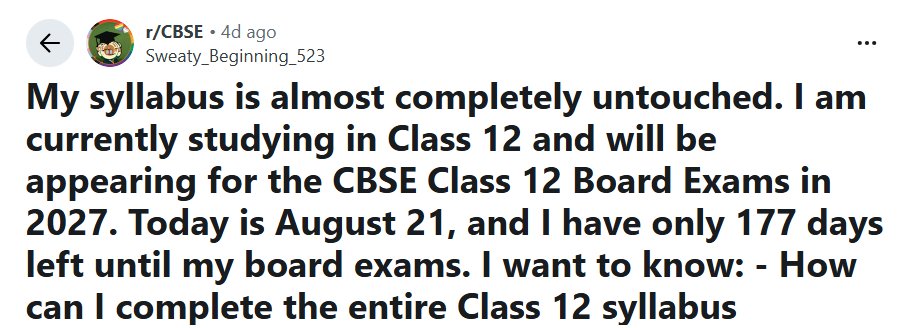
Replying to that, another Reddit user shared that students should prioritize high-weightage topics first, work on formulas, practice numerical questions, and prepare their own notes.

Source: Reddit
Ques. Is the CBSE Class 12 syllabus released by the CBSE board?
Ans. Yes, the CBSE syllabus is released by the official conducting authority, that is, CBSE. The CBSE Class 12 syllabus 2027 PDF has been officially released on the website. Students need to visit the website or can use the direct link shared here to download the subject-wise syllabus PDF.
CBSE Syllabus Class 12 2027: Subject-Wise Weightage
The CBSE syllabus 2027 subject-wise weightage is provided below.
- The average weightage of the theory paper from the listed subjects is 76.4%, and the weightage of the practical paper is 23.6%.
- 7 out of 12 subjects follow the 80:20 theory: practical concept. 80% for the theory paper and 20% for the practical paper.
- Rest 5 subjects (Physics, Chemistry, Biology, Computer Science, and Information Practices) follow the 70:30 pattern.
- The theory paper carries 70% of the weightage, and the practical carries the remaining 30%.
| Subject | Theory Weightage | Practical Weightage |
|---|---|---|
| Mathematics | 80% | 20% |
| Physics | 70% | 30% |
| Chemistry | 70% | 30% |
| Biology | 70% | 30% |
| English Core | 80% | 20% |
| Hindi Core | 80% | 20% |
| Accountancy | 80% | 20% |
| Business Studies | 80% | 20% |
| Economics | 80% | 20% |
| Political Science | 80% | 20% |
| Computer Science | 70% | 30% |
| Informatics Practices | 70% | 30% |

CBSE Class 12 Syllabus 2027 FAQs
Ques. What is the CBSE Class 12 Question Paper Pattern?
Ans. The question paper pattern of the CBSE Class 12 2027 exam is subject-specific. The questions are asked in a combination of different formats. The questions of CBSE Class 12 are designed to assess the students' understanding.
Ques. Is the CBSE Class 12 syllabus 2027 reduced?
Ans. No, the CBSE Class 12 exam syllabus 2027 has not been reduced. No such official notification has been shared by the CBSE yet. The syllabus structure of the CBSE Class 12 exam is the same as in previous years.
Ques. Is there any change in the CBSE Exam Class 12 syllabus 2027?
Ans. The CBSE syllabus 2027 must be covered by students following the official curriculum. As per the CBSE 2026-27 curriculum, competency-based education, experiential learning, and application of knowledge have been highlighted as important principles.
Ques. Which chapters of the CBSE Class 12 have high weightage?
Ans. Some of the high-weightage topics of the CBSE Class 12 exam for the 2027 academic year are Physics, Chemistry, Mathematics, Accountancy, and Biology. It is advised that students should go through the topics of these subjects in detail and do practice previous years' question papers to learn about the exam pattern and expected question format.
Ques. Is the NCERT book enough for the CBSE Class 12 exam 2027 preparation?
Ans. For many of the subjects of the CBSE Class 12 board exam, the NCERT books are enough. But it is advised that students should go for other highly rated resources as well and practice them in detail. Though the questions are mostly covered in the NCERT books, it is important to know all aspects of the topics in detail for better results.



Comments
Found 3 Comments
Although there has been no specific age criteria to register and take CBSE class XII examination, the minimum age is usually considered to be 17 years. I suggest you to visit the school where you want to get admission for detailed information.
Yes, there are some minor changes in the 2022-23 CBSE 12th syllabus. This year there will be only one exam, but there will be a suspension of 30 percent. CBSE has not made any changes in the structure of the exam pattern.
For more information, refer to this link: CBSE Class 12 Syllabus 2022-23
The marking scheme of the CBSE 12th exam depends on each subject from the syllabus. In general, the overall marks for each subject will be 100. These 100 marks are divided into two parts. 80 percent of marks are allotted to the theory paper and the remaining 20 percent is for the practical exam. You can check the marking scheme of each exam individually.