




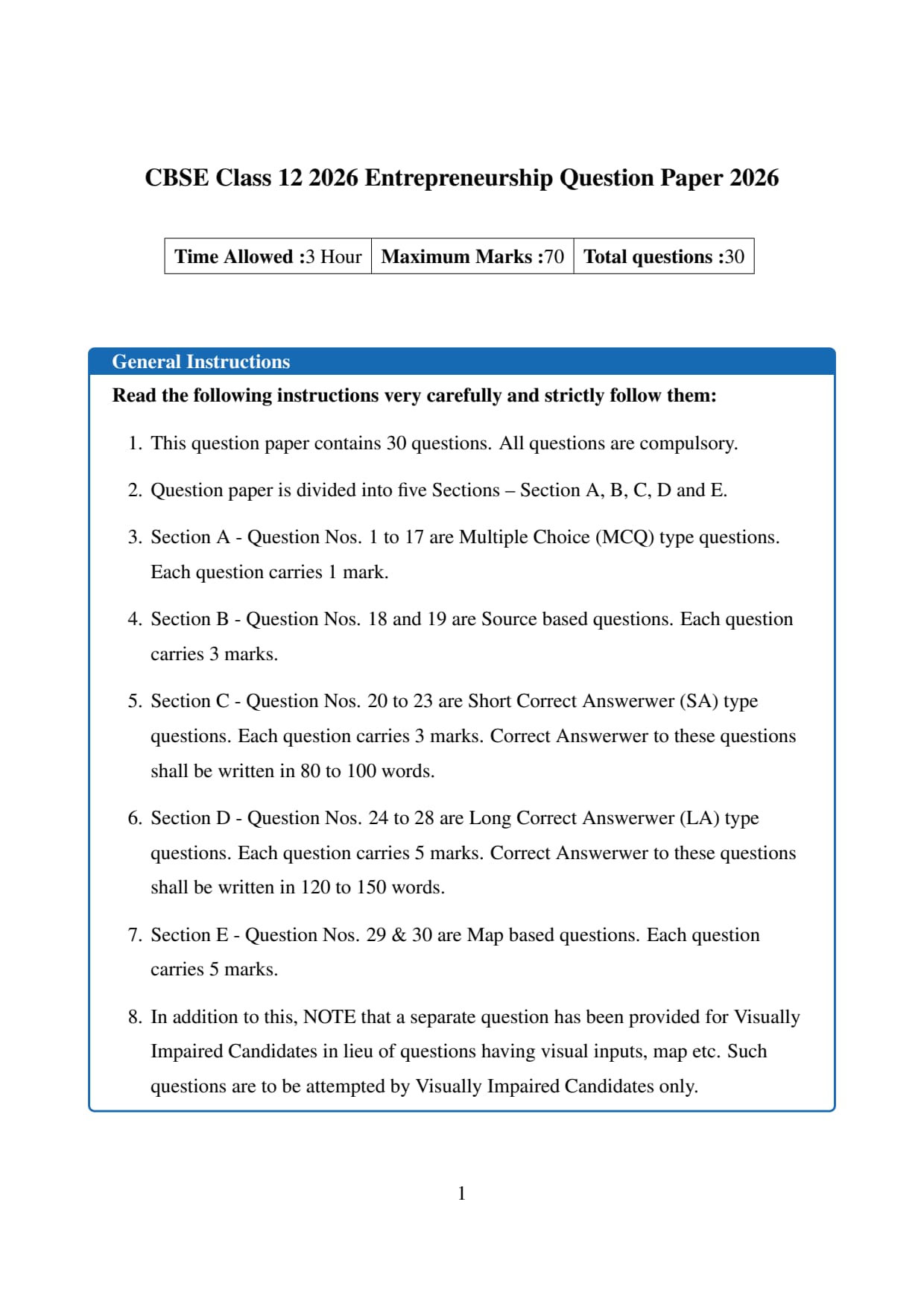
The Central Board of Secondary Education conducted the CBSE Class 12 Entrepreneurship Board Exam 2026 today, February 17, 2026.
CBSE Class 12 Entrepreneurship Question Paper with Solution PDF is available here for download. The theory paper is for 80 marks, while 20 marks are allotted for internal assessment. The question paper will be divided into multiple sections, including MCQs (1 mark each), short-answer questions (2–3 marks each), and long-answer questions (5 marks each).
CBSE Class 12 2026 Entrepreneurship Question Paper 2026 with Solution PDF
| CBSE Class 12 Entrepreneurship Question Paper 2026 | Download | Check Solutions |

Rudra Cafe, a chain of organic cafes in Delhi, wanted to expand its business in other cities too. Due to rising inflation, the cost of organic products, dairy, coffee beans, etc., has risen sharply. At the same time, the Reserve Bank of India has increased interest rates, making bank loans more expensive. The cafe, therefore, delayed its expansion plans until borrowing becomes cheaper. Identify the element of macro environment affecting Rudra Cafe.
View Solution
Step 1: Understanding the macro environment.
The macro-environment involves factors that affect the economy and the business world at large, such as inflation, interest rates, and economic policies.
Step 2: Apply the situation to the cafe.
Rising inflation and increased interest rates by the Reserve Bank of India are key economic factors affecting the business.
These factors are part of the economic environment, which directly influences businesses in terms of costs, borrowing, and investments.
Step 3: Conclusion.
In this case, the economic environment is the main factor influencing Rudra Cafe's decision to delay expansion. Thus, the correct answer is: \[ \boxed{(B) Economic environment} \] Quick Tip: The economic environment includes factors like inflation, interest rates, and economic policies, which impact a business's operational costs, investment decisions, and financing. Changes in these factors can influence business strategies, such as expansion plans, as seen in the case of Rudra Cafe.
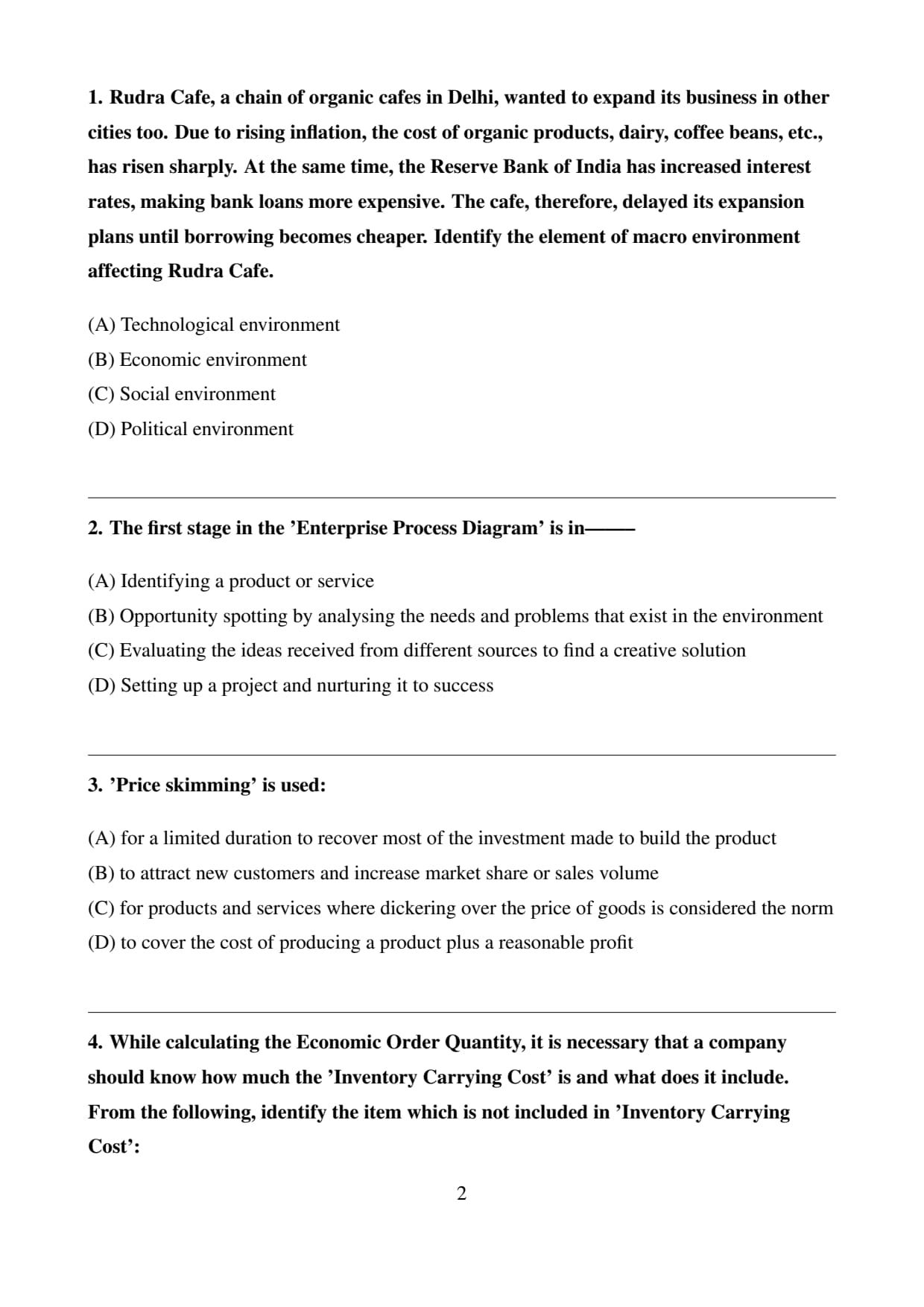
The first stage in the 'Enterprise Process Diagram' is in--------
View Solution
Step 1: Understanding the process diagram.
The 'Enterprise Process Diagram' involves several stages, and the first step is identifying the opportunities that exist based on the needs and problems observed in the environment. This stage helps pinpoint the business areas for potential development.
Step 2: Conclusion.
The first stage involves identifying opportunities by analyzing needs and problems, which corresponds to option (B). Thus, the correct answer is: \[ \boxed{(B) Opportunity spotting by analysing the needs and problems that exist in the environment} \] Quick Tip: In the Enterprise Process Diagram, the first stage is crucial as it focuses on identifying opportunities by analyzing the needs and problems in the environment. This step helps businesses spot areas with potential for growth and innovation.
'Price skimming' is used:
View Solution
Step 1: Understanding price skimming.
Price skimming is a pricing strategy where a company sets a high price initially to "skim" the maximum amount of revenue from the early adopters. This price is gradually reduced over time. The strategy is used to recover a significant portion of the product's development costs in a short period.
Step 2: Conclusion.
Price skimming is typically used when a company wants to recover a large portion of its investment quickly by targeting customers who are willing to pay a premium for the product. Thus, the correct answer is: \[ \boxed{(A) for a limited duration to recover most of the investment made to build the product} \] Quick Tip: Price skimming is a strategy where companies set a high initial price to recover their investment quickly from early adopters. The price is then gradually lowered to attract more price-sensitive customers. It is commonly used for innovative products with high development costs.
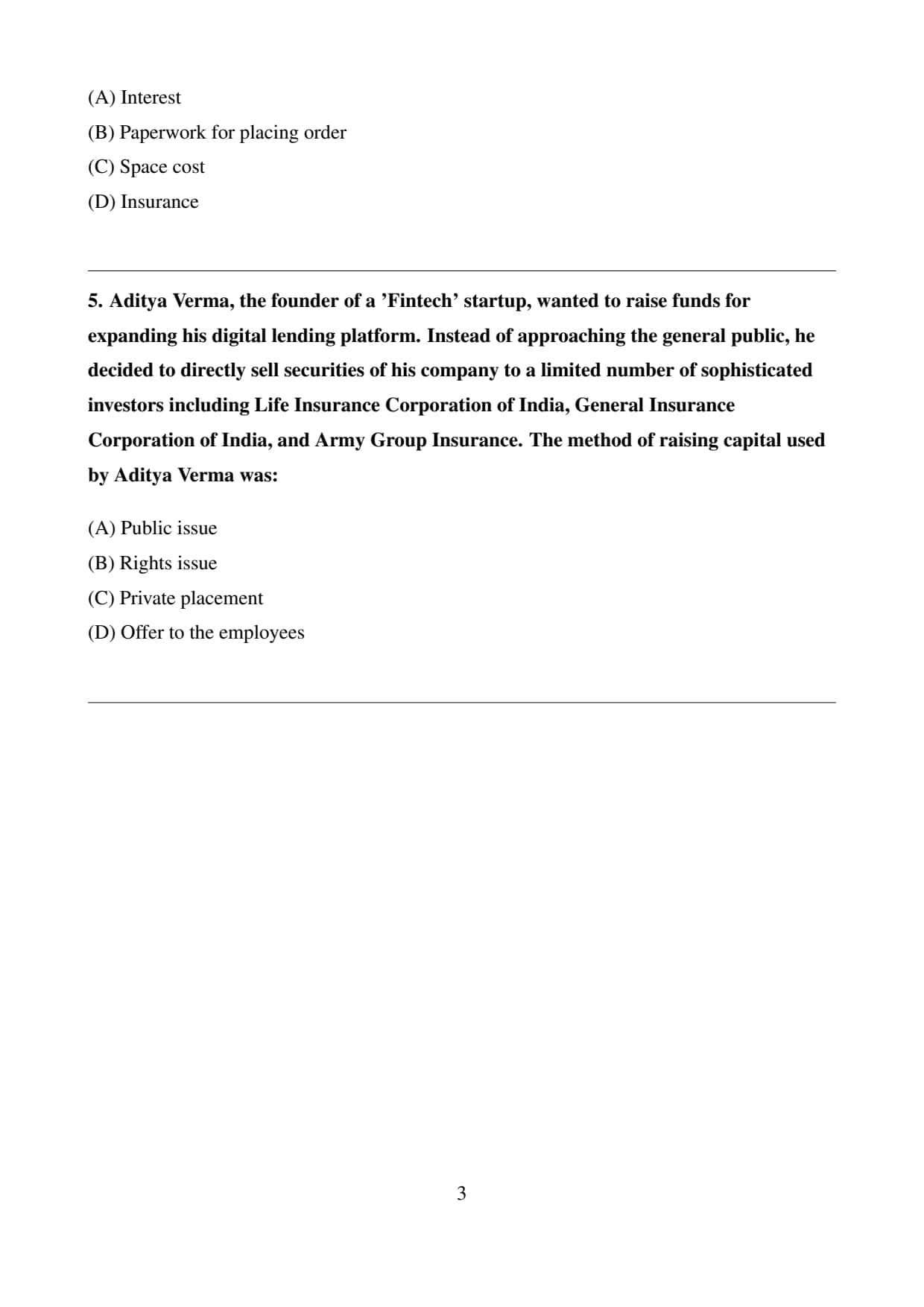
While calculating the Economic Order Quantity, it is necessary that a company should know how much the 'Inventory Carrying Cost' is and what does it include. From the following, identify the item which is not included in 'Inventory Carrying Cost':
View Solution
Step 1: Understanding Inventory Carrying Cost.
Inventory carrying costs are the costs associated with holding inventory over time. These include expenses like storage costs, insurance, interest on capital tied up in inventory, and space costs.
Step 2: Identify the correct option.
Among the given options, "paperwork for placing order" is not considered an inventory carrying cost. It is part of the ordering process and not related to holding or storing inventory.
Step 3: Conclusion.
The item not included in the inventory carrying cost is: \[ \boxed{(B) Paperwork for placing order} \] Quick Tip: When calculating Inventory Carrying Costs, it's important to remember that these costs involve expenses related to holding and storing inventory, such as storage costs, interest on capital, space costs, and insurance. Paperwork for placing orders is typically not included in inventory carrying costs.
Aditya Verma, the founder of a 'Fintech' startup, wanted to raise funds for expanding his digital lending platform. Instead of approaching the general public, he decided to directly sell securities of his company to a limited number of sophisticated investors including Life Insurance Corporation of India, General Insurance Corporation of India, and Army Group Insurance. The method of raising capital used by Aditya Verma was:
View Solution
Step 1: Understanding Private Placement.
Private placement refers to the sale of securities to a small number of sophisticated investors, such as institutional investors or wealthy individuals, rather than to the general public. This method is often used by companies that need to raise capital without going through the more complex and costly process of a public offering.
Step 2: Apply the situation to Aditya Verma's case.
In this case, Aditya Verma is targeting a limited number of investors, including Life Insurance Corporation of India, General Insurance Corporation of India, and Army Group Insurance, which clearly points to a private placement.
Step 3: Conclusion.
The method of raising capital used by Aditya Verma was: \[ \boxed{(C) Private placement} \] Quick Tip: For fundraising, private placement is a popular method for startups and small companies to raise capital. It involves offering shares or securities to a small group of investors, often institutional or accredited investors, instead of going through a public offering.
CBSE Class 12 Subject-Wise Exam Pattern & Marking Scheme 2025-26
The division of total marks for theory and practical as per the updated CBSE Class 12 Exam Pattern 2025-26 is provided in the table below:
| Subject | Marks in Theory | Marks in Practical |
| Physics | 70 | 30 |
| Chemistry | 70 | 30 |
| Biology | 70 | 30 |
| Computer Science | 70 | 30 |
| Mathematics | 80 | 20 |
| English | 80 | 20 |
| Sociology | 80 | 20 |
| Political Science | 80 | 20 |
| History | 80 | 20 |
| Geography | 80 | 20 |
| Economics | 80 | 20 |
| Business Studies | 80 | 20 |
| Accountancy | 80 | 20 |




Comments