




The CBSE Class 12 Engineering Graphics Question Paper 2026 is available for download here of CBSE Board Exam 2026. This CBSE 12th Engineering Graphics solved question paper includes detailed solutions, answer key, and the latest CBSE marking scheme to help students understand the exam pattern and important topics.
By practicing the CBSE Class 12 Engineering Graphics 2026 board exam paper PDF, students can improve answer-writing strategy, time management, and overall exam performance.
CBSE Class 12 Engineering Graphics Question Paper 2026 with Solution PDF
| CBSE Class 12 Engineering Graphics Question Paper 2026 with Solution PDF | Download PDF | Check Solutions |
Question 1:
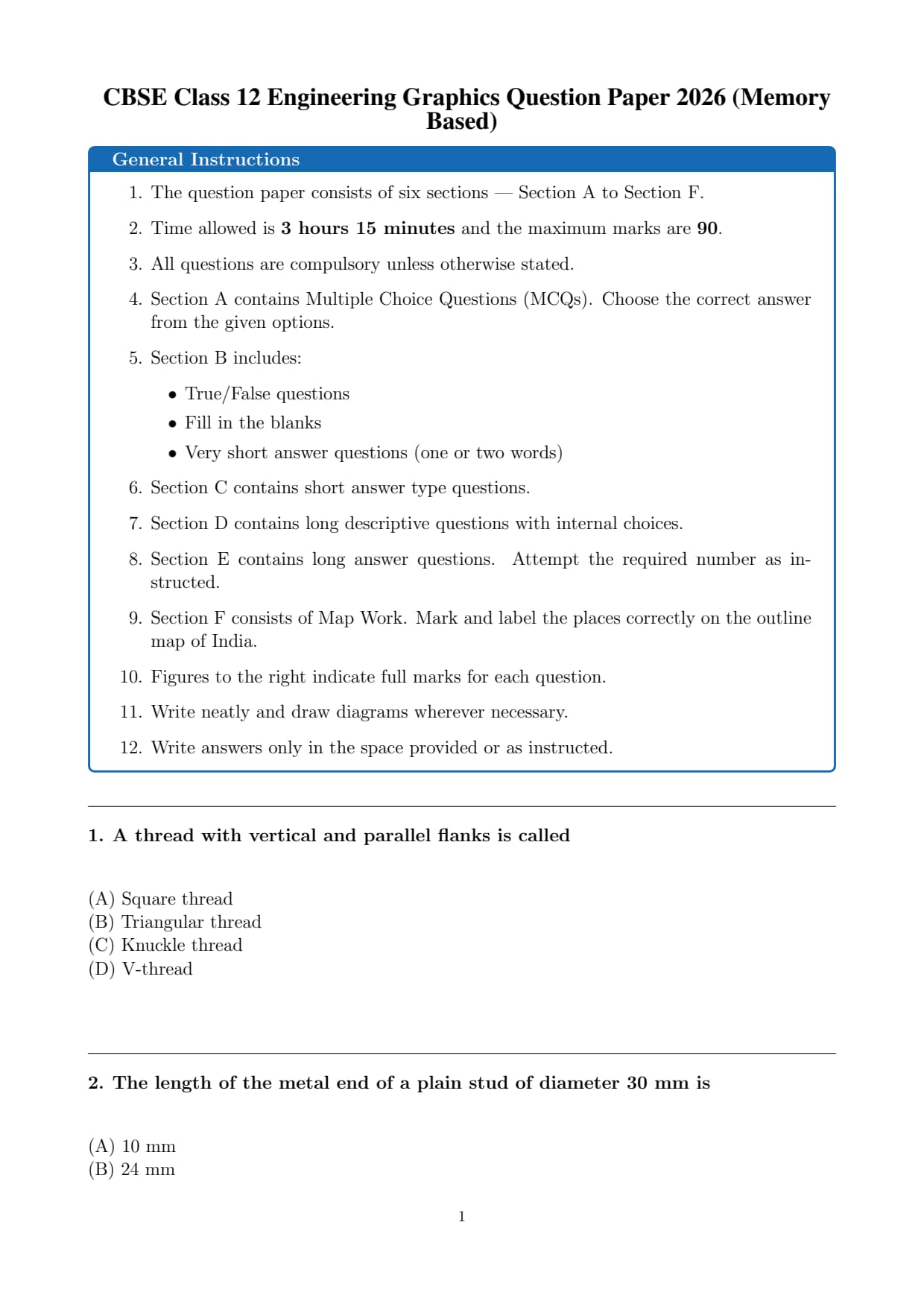
A thread with vertical and parallel flanks is called
View Solution
A square thread is a type of thread with vertical and parallel flanks, which is typically used for applications requiring high efficiency in power transmission, such as in lead screws and clamps.
Step 1: Analyze the options.
- (A) Square thread: Correct — has vertical and parallel flanks.
- (B) Triangular thread: Incorrect — has inclined flanks, not vertical.
- (C) Knuckle thread: Incorrect — designed for durability but does not have vertical flanks.
- (D) V-thread: Incorrect — flanks are at an angle to the axis, not vertical.
Step 2: Conclusion.
Hence, the correct answer is (A).
Final Answer: \[ \boxed{(A) \, Square thread} \] Quick Tip: Square threads provide high efficiency in power transmission due to their vertical flanks.
The length of the metal end of a plain stud of diameter 30 mm is
View Solution
The length of the metal end of a plain stud is typically measured as a standard proportion of the stud diameter. For a 30 mm diameter stud, the metal end length is generally considered to be 24 mm.
Step 1: Analyze the options.
- (A) 10 mm: Incorrect — too short for the given stud diameter.
- (B) 24 mm: Correct — standard measurement for the metal end length.
- (C) 30 mm: Incorrect — too long for the metal end length.
- (D) 66 mm: Incorrect — this measurement is too large for a 30 mm diameter stud.
Step 2: Conclusion.
Hence, the correct answer is (B).
Final Answer: \[ \boxed{(B) \, 24 mm} \] Quick Tip: The length of the metal end for a plain stud is typically around 80% of its diameter.
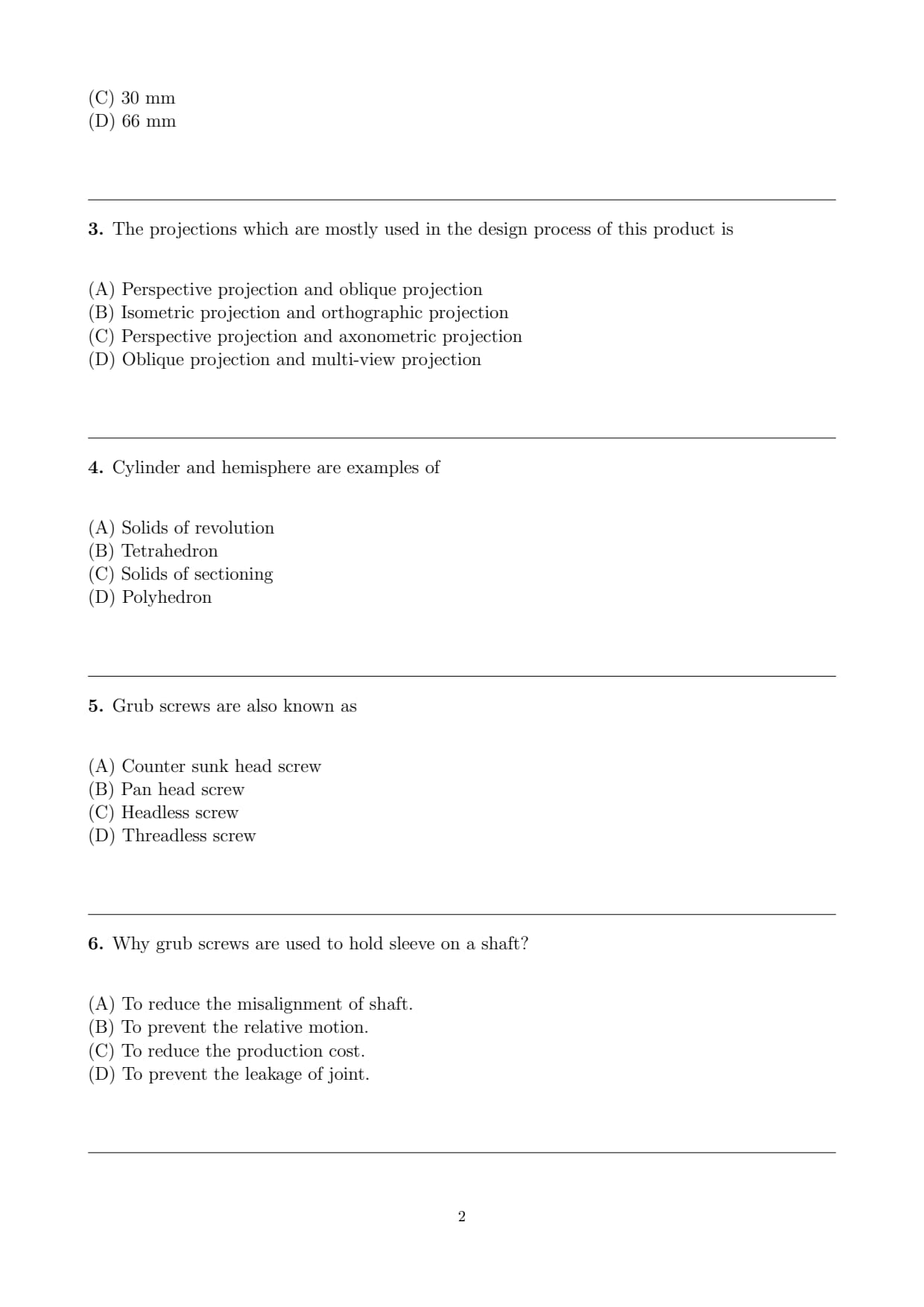
The projections which are mostly used in the design process of this product is
View Solution
In the design process, especially for technical drawings, isometric and orthographic projections are most commonly used. These projections help represent the object in 3D while preserving angles and proportions.
Step 1: Analyze the options.
- (A) Perspective projection and oblique projection: Incorrect — not typically used together for design purposes.
- (B) Isometric projection and orthographic projection: Correct — widely used for representing objects clearly in engineering drawings.
- (C) Perspective projection and axonometric projection: Incorrect — axonometric projections are often preferred for technical drawings over perspective projections.
- (D) Oblique projection and multi-view projection: Incorrect — multi-view projection is a form of orthographic projection, but oblique is not commonly paired with it.
Step 2: Conclusion.
Hence, the correct answer is (B).
Final Answer: \[ \boxed{(B) \, Isometric projection and orthographic projection} \] Quick Tip: Isometric projections represent three-dimensional objects on two-dimensional planes without distortion of angles or proportions.
Cylinder and hemisphere are examples of
View Solution
A cylinder and a hemisphere are both formed by revolving a 2D shape around an axis, making them examples of solids of revolution.
Step 1: Analyze the options.
- (A) Solids of revolution: Correct — formed by revolving a 2D shape around an axis.
- (B) Tetrahedron: Incorrect — a polyhedron with four faces, not formed by revolution.
- (C) Solids of sectioning: Incorrect — refers to solids obtained by sectioning objects, not by revolving them.
- (D) Polyhedron: Incorrect — solids with flat faces, not generated by revolution.
Step 2: Conclusion.
Hence, the correct answer is (A).
Final Answer: \[ \boxed{(A) \, Solids of revolution} \] Quick Tip: Solids of revolution are formed by rotating a 2D shape around an axis, such as cylinders and spheres.
Grub screws are also known as
View Solution
Grub screws are also known as headless screws. They are typically used to secure an object within or against another object, particularly in situations where there is no space for a screw head. These screws do not have a head and are designed to be fully inserted into the part they secure.
Step 1: Analyze the options.
- (A) Counter sunk head screw: Incorrect — has a counter sunk head for a flush fit.
- (B) Pan head screw: Incorrect — has a rounded, flat head.
- (C) Headless screw: Correct — grub screws are headless screws.
- (D) Threadless screw: Incorrect — this is not a common screw type.
Step 2: Conclusion.
Hence, the correct answer is (C).
Final Answer: \[ \boxed{(C) \, Headless screw} \] Quick Tip: Grub screws, also called headless screws, are used when there’s no room for a head to protrude.
Why grub screws are used to hold sleeve on a shaft?
View Solution
Grub screws are used to secure a sleeve onto a shaft by preventing the relative motion between the shaft and the sleeve. This ensures the components do not slip or rotate relative to each other.
Step 1: Analyze the options.
- (A) To reduce the misalignment of shaft: Incorrect — grub screws are not primarily used for alignment.
- (B) To prevent the relative motion: Correct — grub screws hold the sleeve securely to the shaft, preventing relative motion.
- (C) To reduce the production cost: Incorrect — this is not the main function of grub screws.
- (D) To prevent the leakage of joint: Incorrect — grub screws do not serve this purpose.
Step 2: Conclusion.
Hence, the correct answer is (B).
Final Answer: \[ \boxed{(B) \, To prevent the relative motion.} \] Quick Tip: Grub screws are used for preventing relative motion between components, especially when there's no space for a head.





Comments