




CBSE Class 12 Chemistry Question Paper 2026 Set-2 is now available for download along with detailed solutions. CBSE conducted the Class 12 Chemistry examination on February 28, 2026, from 10:30 AM to 1:30 PM. The question paper consists of 33 questions carrying a total of 70 marks. The paper is divided into five sections: Section A contains MCQs, Section B contains very short answer questions, Section C contains short answer questions, Section D contains case-based questions, and Section E contains long answer questions. All sections are compulsory. The Chemistry question paper 2026 was rated moderate but slightly lengthy by students, with a significant focus on NCERT-based organic reactions and physical chemistry numericals.
CBSE Class 12 Chemistry Question Paper 2026 Set-2 with Solution PDF
| CBSE Class 12 Chemistry Question Paper 2026 Set-2 with Solution PDF | Download PDF | Check Solutions |
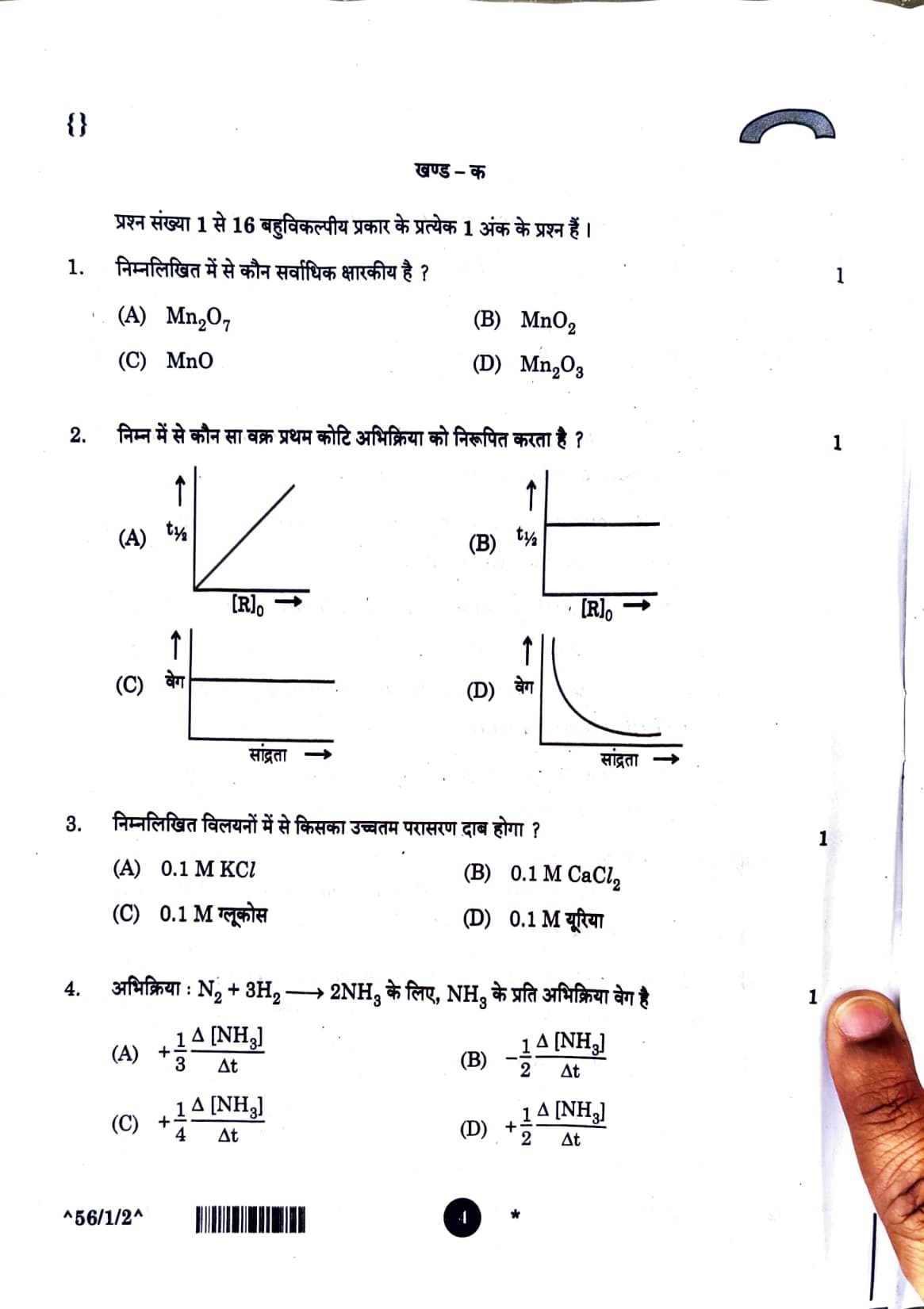
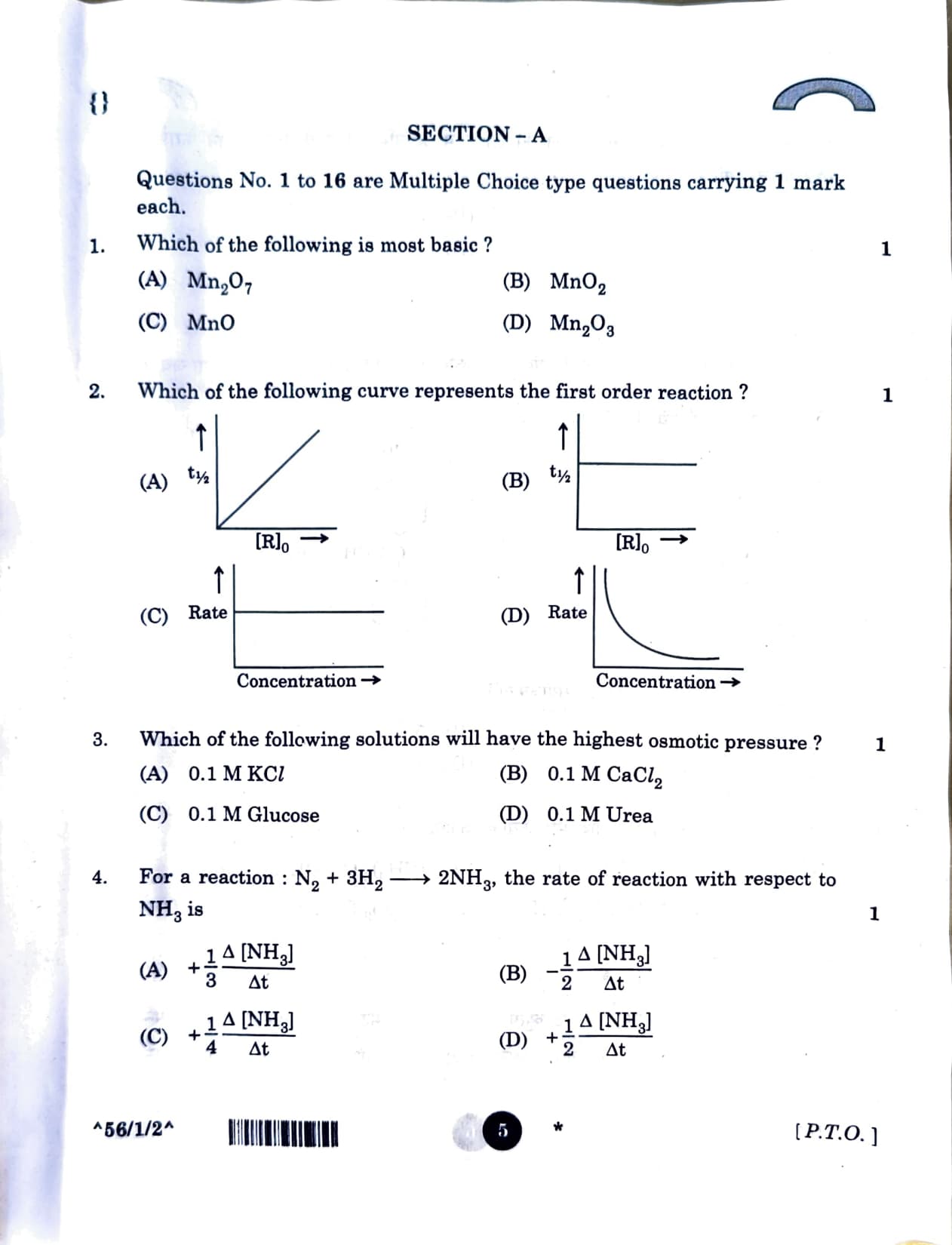
Which of the following is most basic?
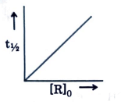
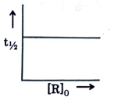
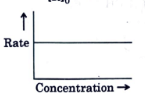
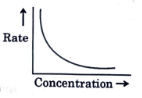
Which of the following curve represents the first order reaction?
- (A)
![]()
- (B)
![]()
- (C)
![]()
- (D)
![]()
Which of the following solutions will have the highest osmotic pressure?
For a reaction : \( N_2 + 3H_2 \rightarrow 2NH_3 \), the rate of reaction with respect to \( NH_3 \) is
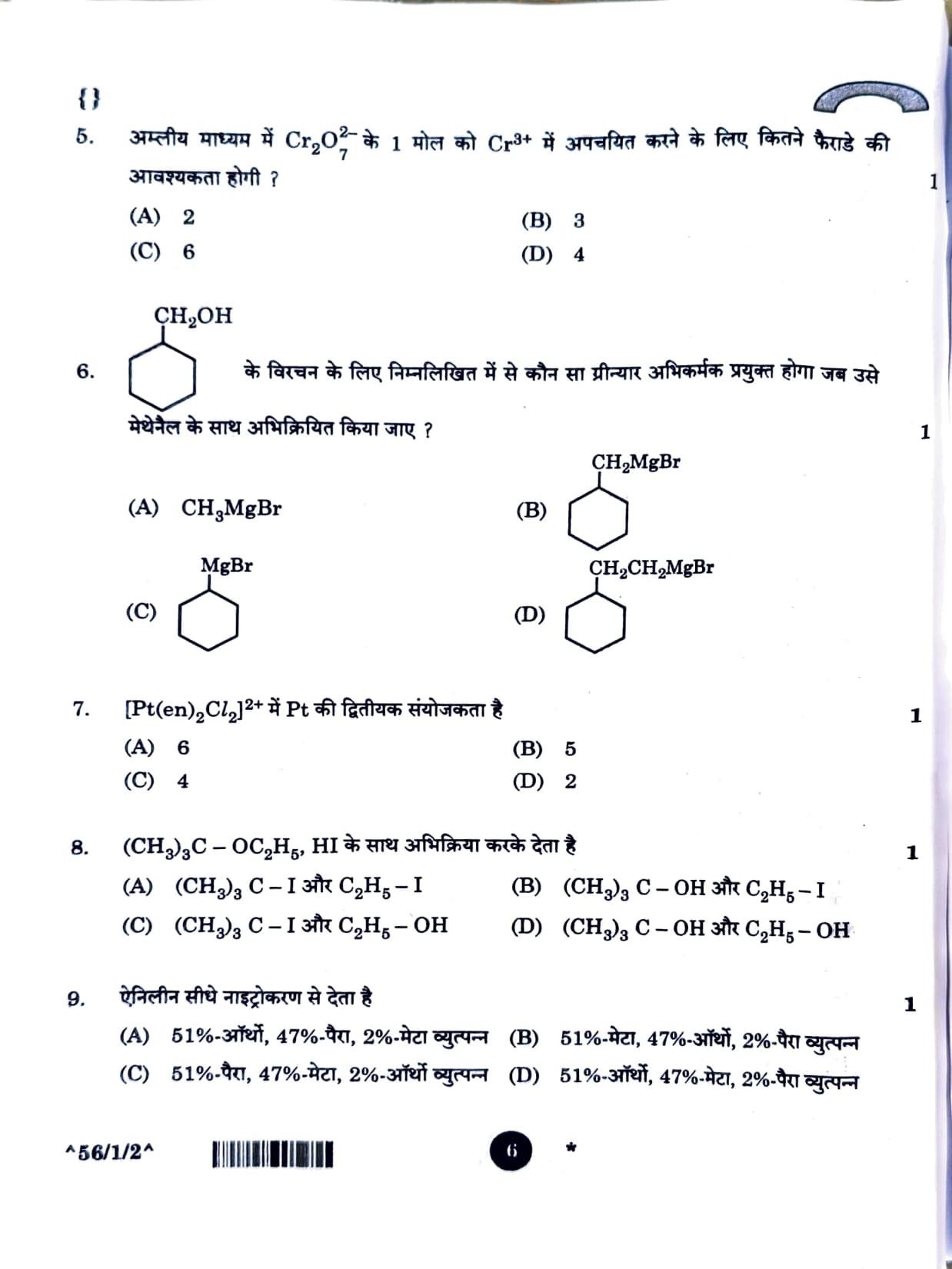
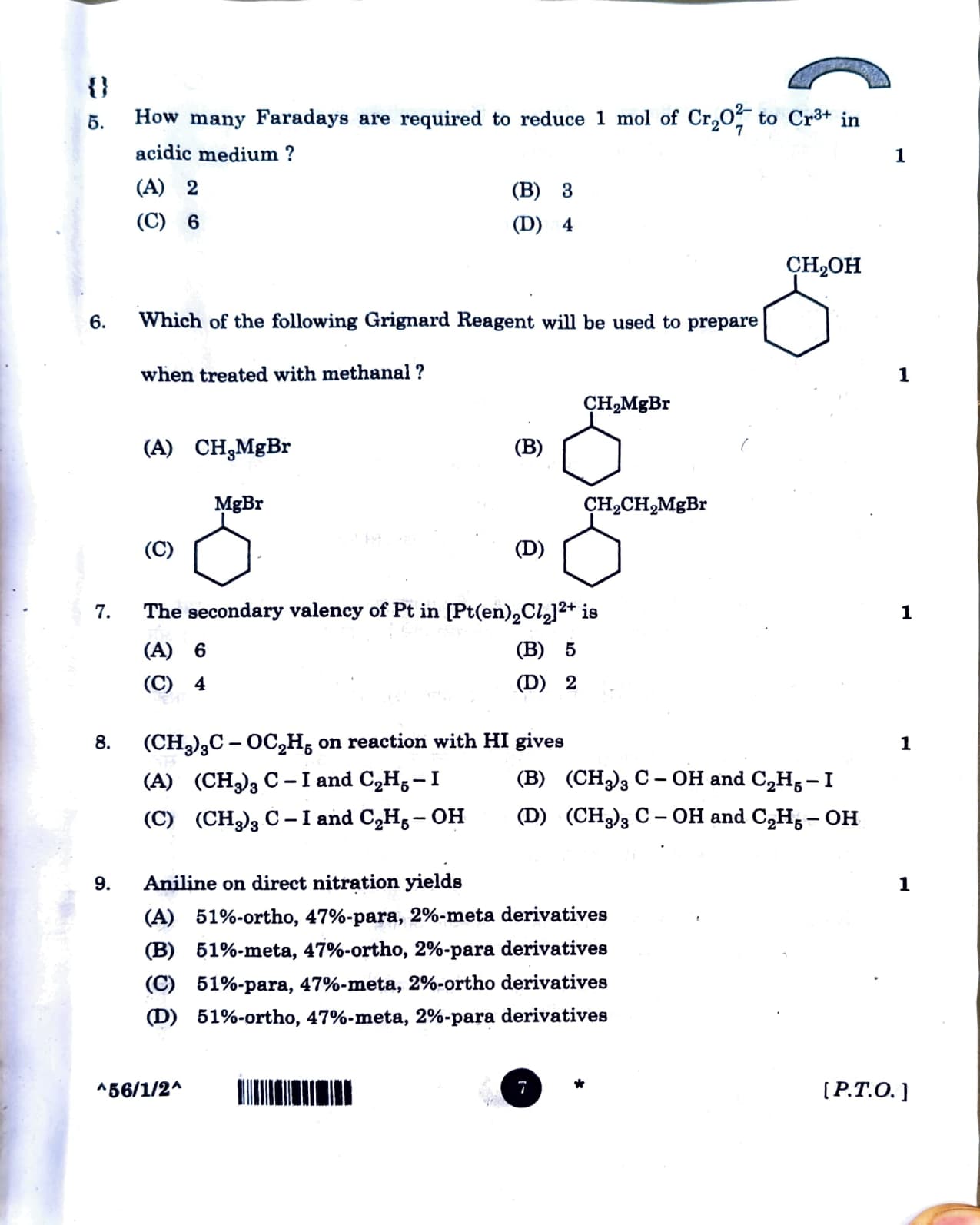
How many Faradays are required to reduce 1 mol of \( Cr_2O_7^{2-} \) to \( Cr^{3+} \) in acidic medium?
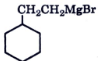
Which of the following Grignard Reagent will be used to prepare cyclohexylmethanol when treated with methanal?

- (A) \( CH_3MgBr \)
- (B)
![]()
- (C)
![]()
- (D)
![]()


The secondary valency of Pt in \( [Pt(en)_2Cl_2]^{2+} \) is
\( (CH_3)_3C - OC_2H_5 \) on reaction with HI gives
Aniline on direct nitration yields
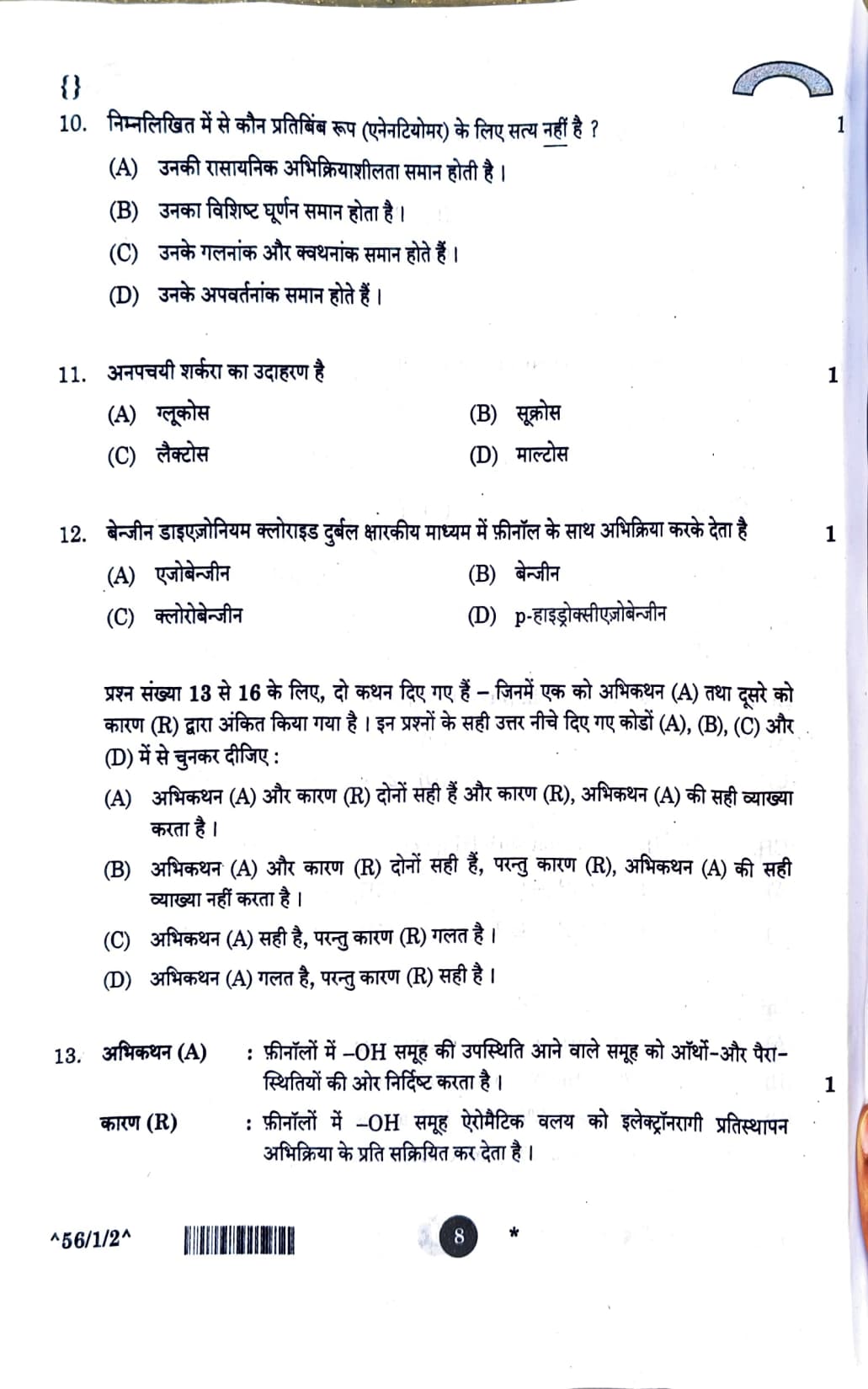
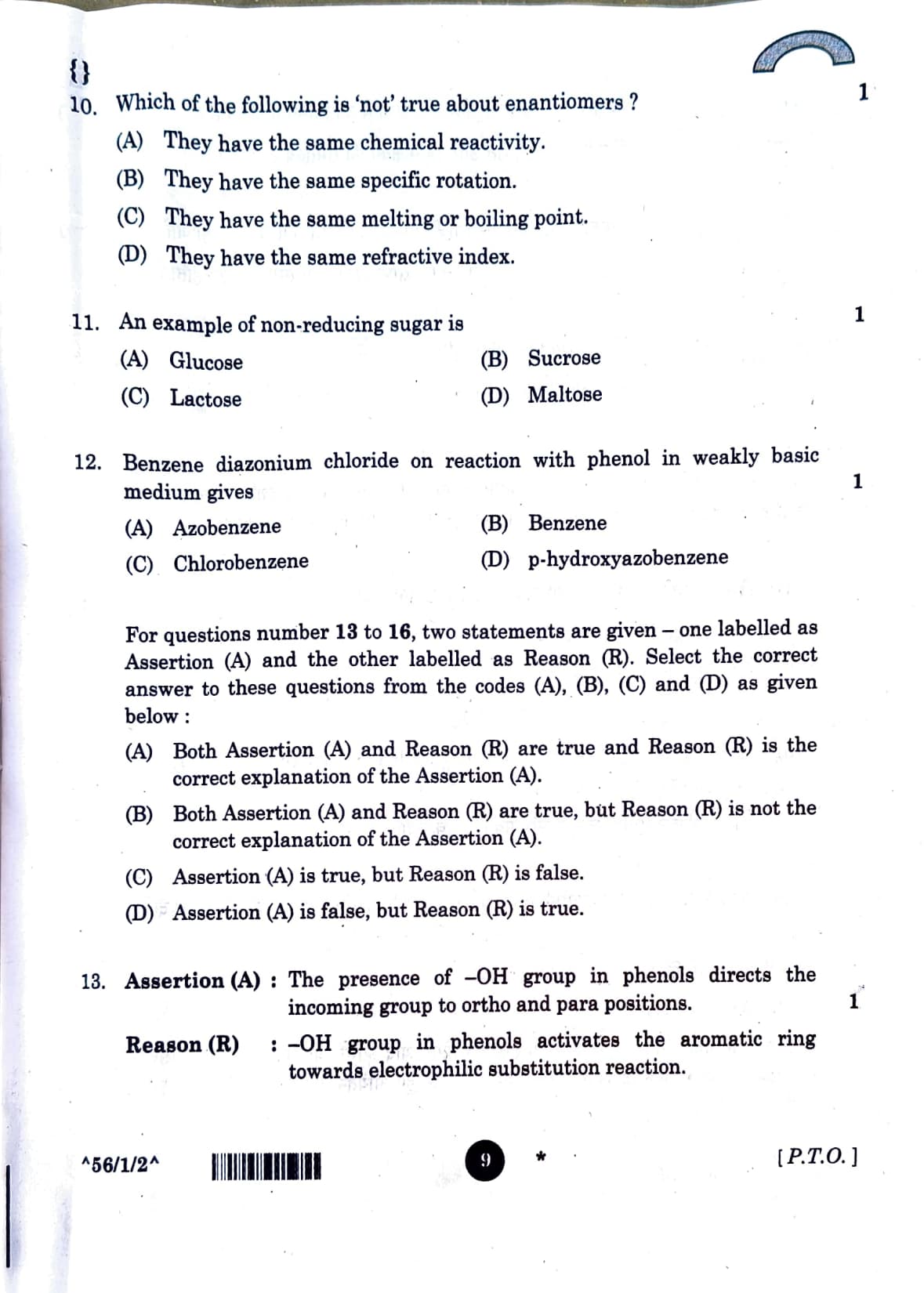
Which of the following is 'not' true about enantiomers?
An example of non-reducing sugar is
Benzene diazonium chloride on reaction with phenol in weakly basic medium gives
Assertion (A) : The presence of \( -OH \) group in phenols directs the incoming group to ortho and para positions.
Reason (R) : \( -OH \) group in phenols activates the aromatic ring towards electrophilic substitution reaction.
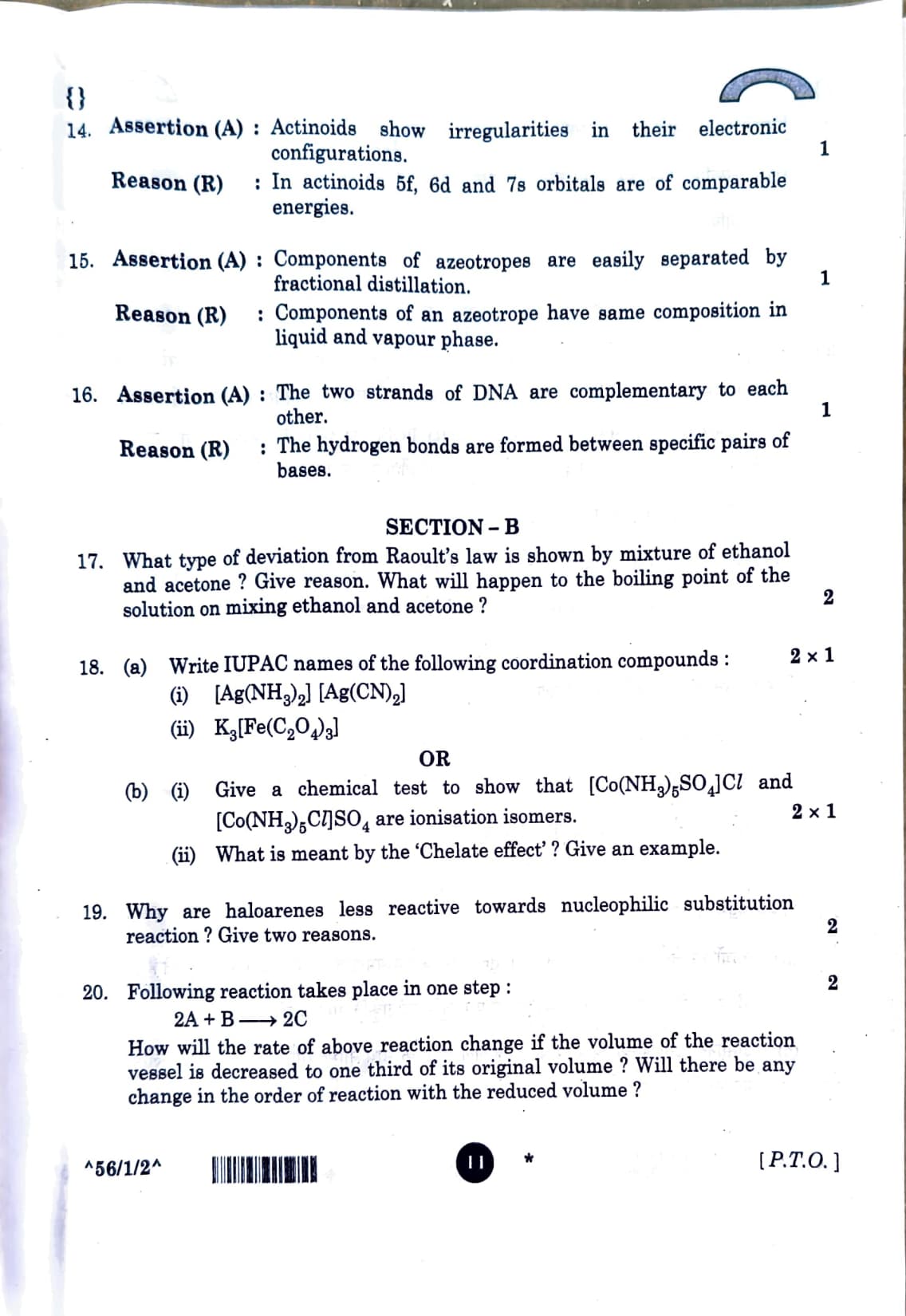
Assertion (A) : Actinoids show irregularities in their electronic configurations.
Reason (R) : In actinoids 5f, 6d and 7s orbitals are of comparable energies.
Assertion (A) : Components of azeotropes are easily separated by fractional distillation.
Reason (R) : Components of an azeotrope have same composition in liquid and vapour phase.
Assertion (A) : The two strands of DNA are complementary to each other.
Reason (R) : The hydrogen bonds are formed between specific pairs of bases.
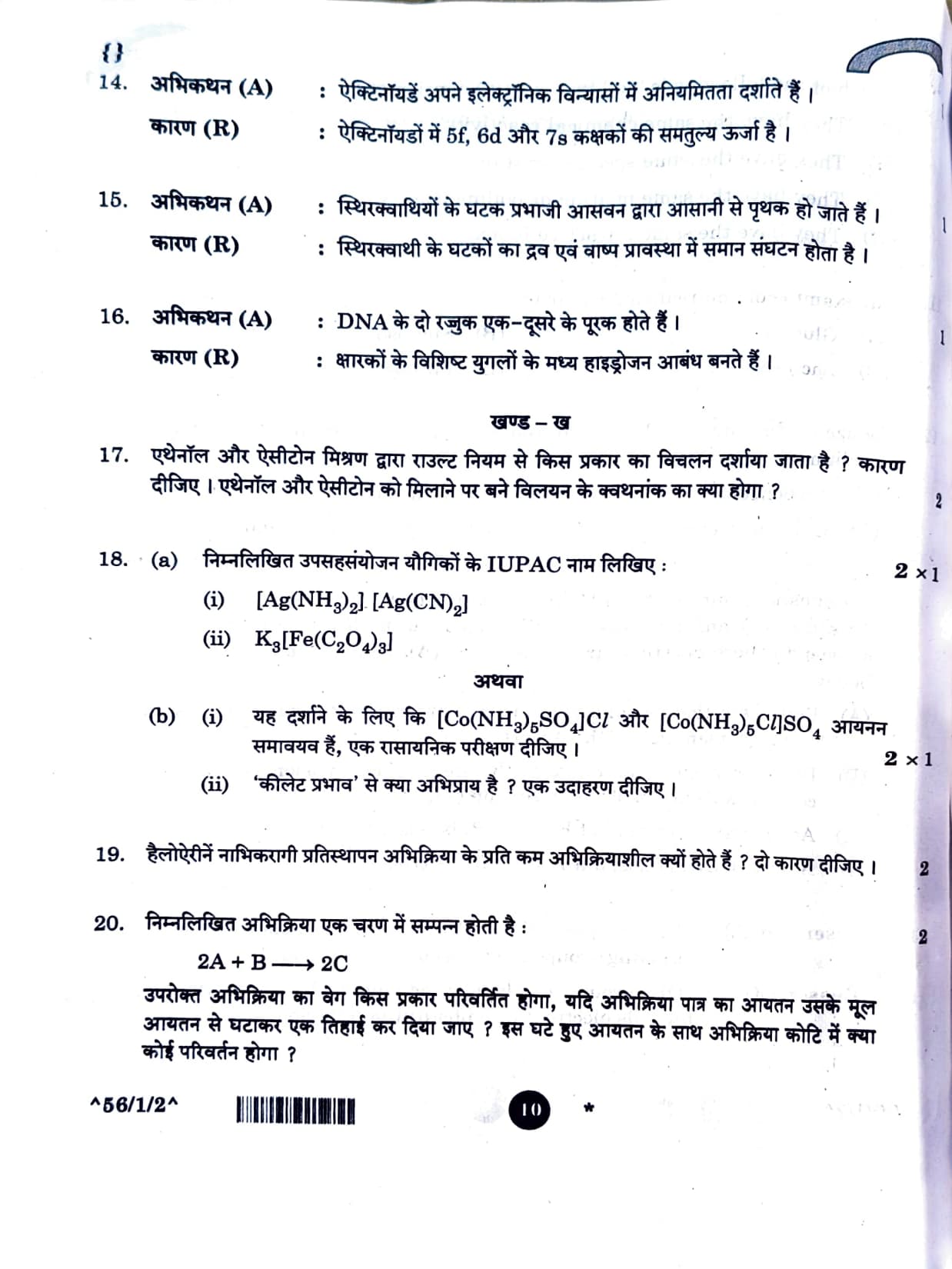
What type of deviation from Raoult’s law is shown by mixture of ethanol and acetone? Give reason. What will happen to the boiling point of the solution on mixing ethanol and acetone?
Write IUPAC names of the following coordination compounds:
(i) \( [Ag(NH_3)_2][Ag(CN)_2] \)
(ii) \( K_3[Fe(C_2O_4)_3] \)
(i) Give a chemical test to show that \( [Co(NH_3)_5SO_4]Cl \) and \( [Co(NH_3)_5Cl]SO_4 \) are ionisation isomers.
(ii) What is meant by the 'Chelate effect'? Give an example.
Why are haloarenes less reactive towards nucleophilic substitution reaction? Give two reasons.
Following reaction takes place in one step :
\( 2A + B \rightarrow 2C \)
How will the rate of above reaction change if the volume of the reaction vessel is decreased to one third of its original volume? Will there be any change in the order of reaction with the reduced volume?
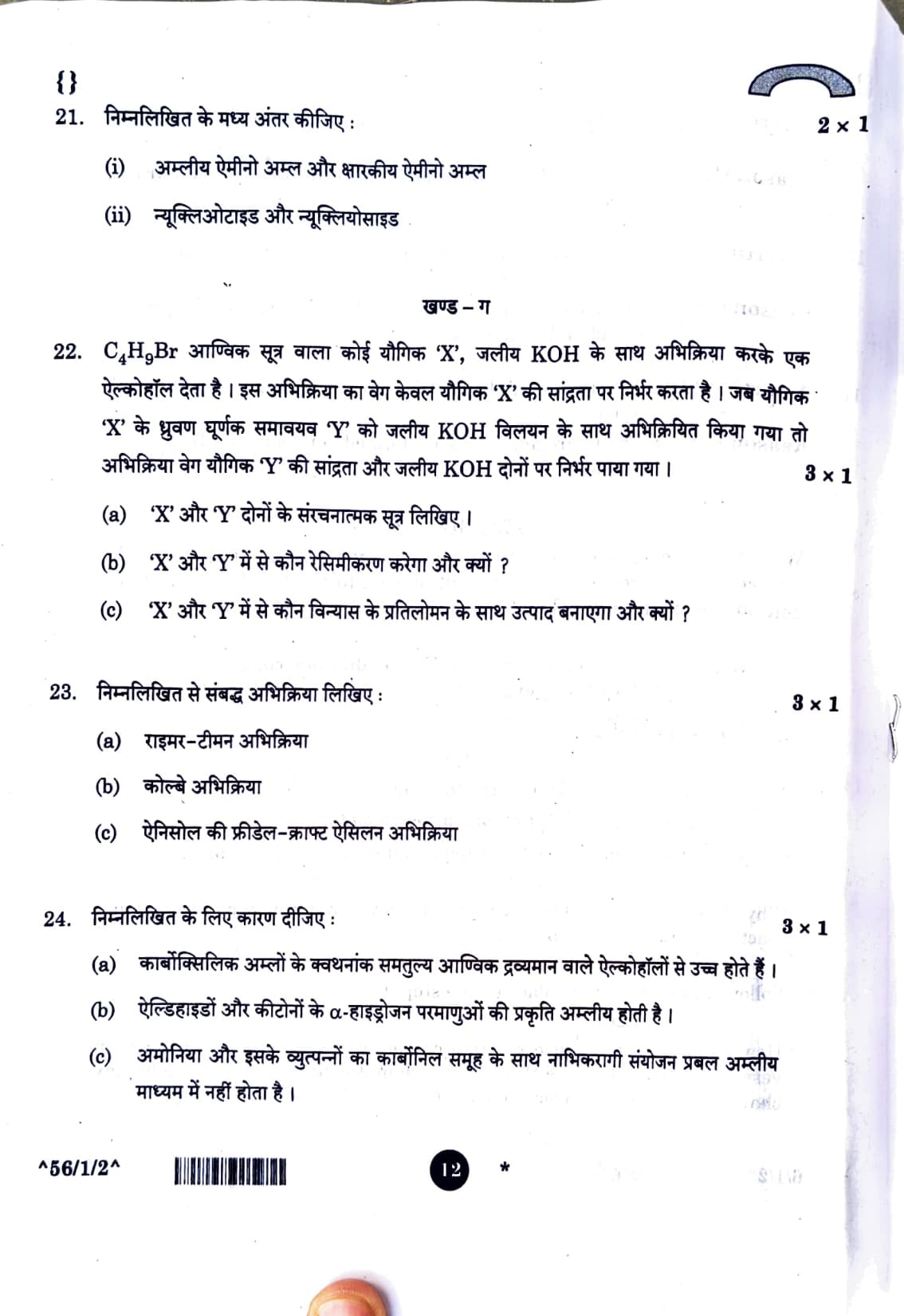
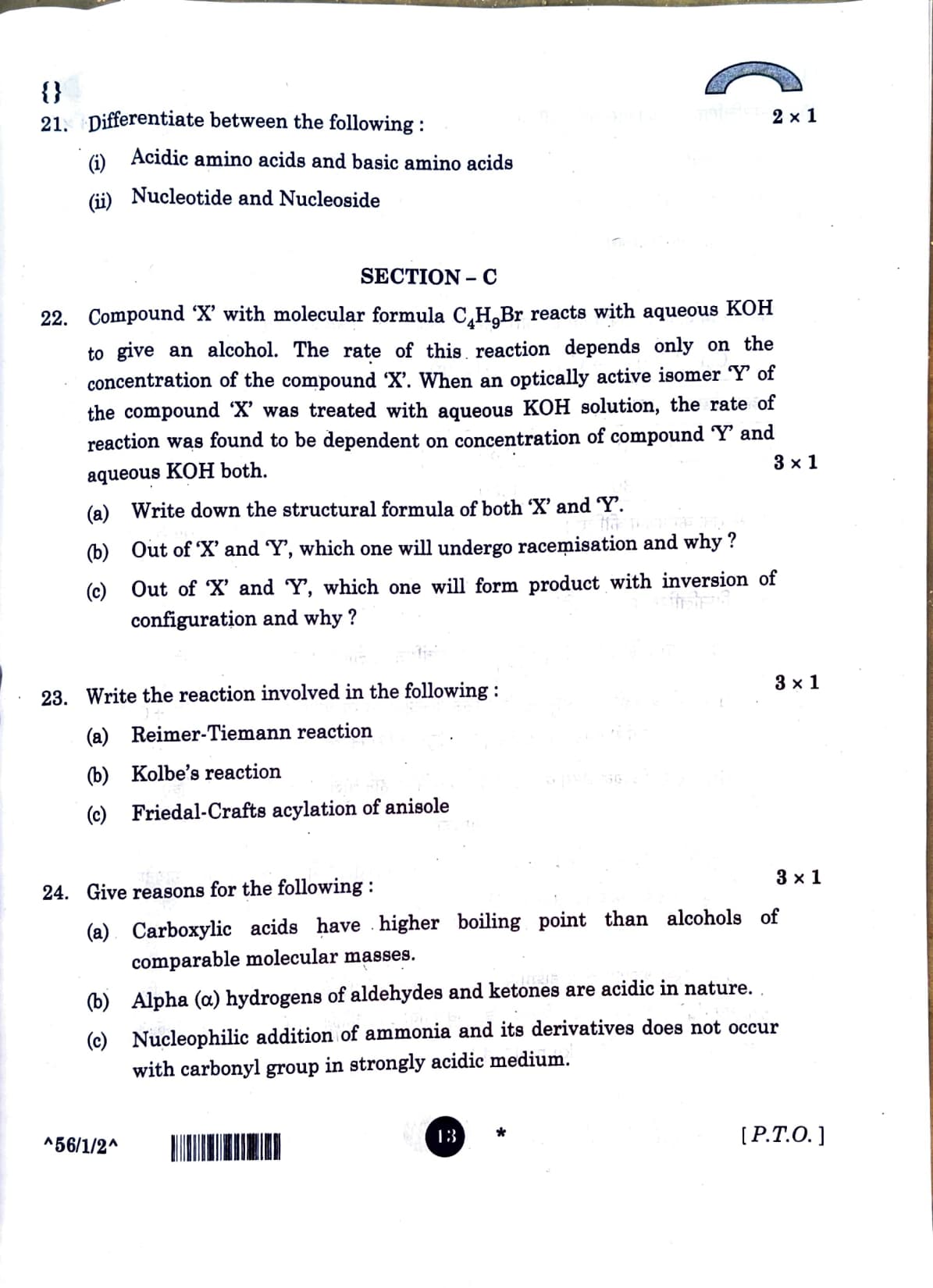
Differentiate between the following :
(i) Acidic amino acids and basic amino acids
(ii) Nucleotide and Nucleoside
Compound ‘X’ with molecular formula \( C_4H_9Br \) reacts with aqueous KOH to give an alcohol. The rate of this reaction depends only on the concentration of compound ‘X’. When an optically active isomer ‘Y’ of the compound ‘X’ was treated with aqueous KOH solution, the rate of reaction was found to be dependent on concentration of compound ‘Y’ and aqueous KOH both.
22(a).
Write down the structural formula of both ‘X’ and ‘Y’.
Out of ‘X’ and ‘Y’, which one will undergo racemisation and why?
Out of ‘X’ and ‘Y’ , which one will form product with inversion of configuration and why?
Write the reaction involved in Reimer-Tiemann reaction.
Write the reaction involved in Kolbe’s reaction.
Write the reaction involved in Friedel-Crafts acylation of anisole.
Give reason of the following
24(a).
Carboxylic acids have higher boiling point than alcohols of comparable molecular masses.
Alpha (\(\alpha\)) hydrogens of aldehydes and ketones are acidic in nature.
Nucleophilic addition of ammonia and its derivatives does not occur with carbonyl group in strongly acidic medium.
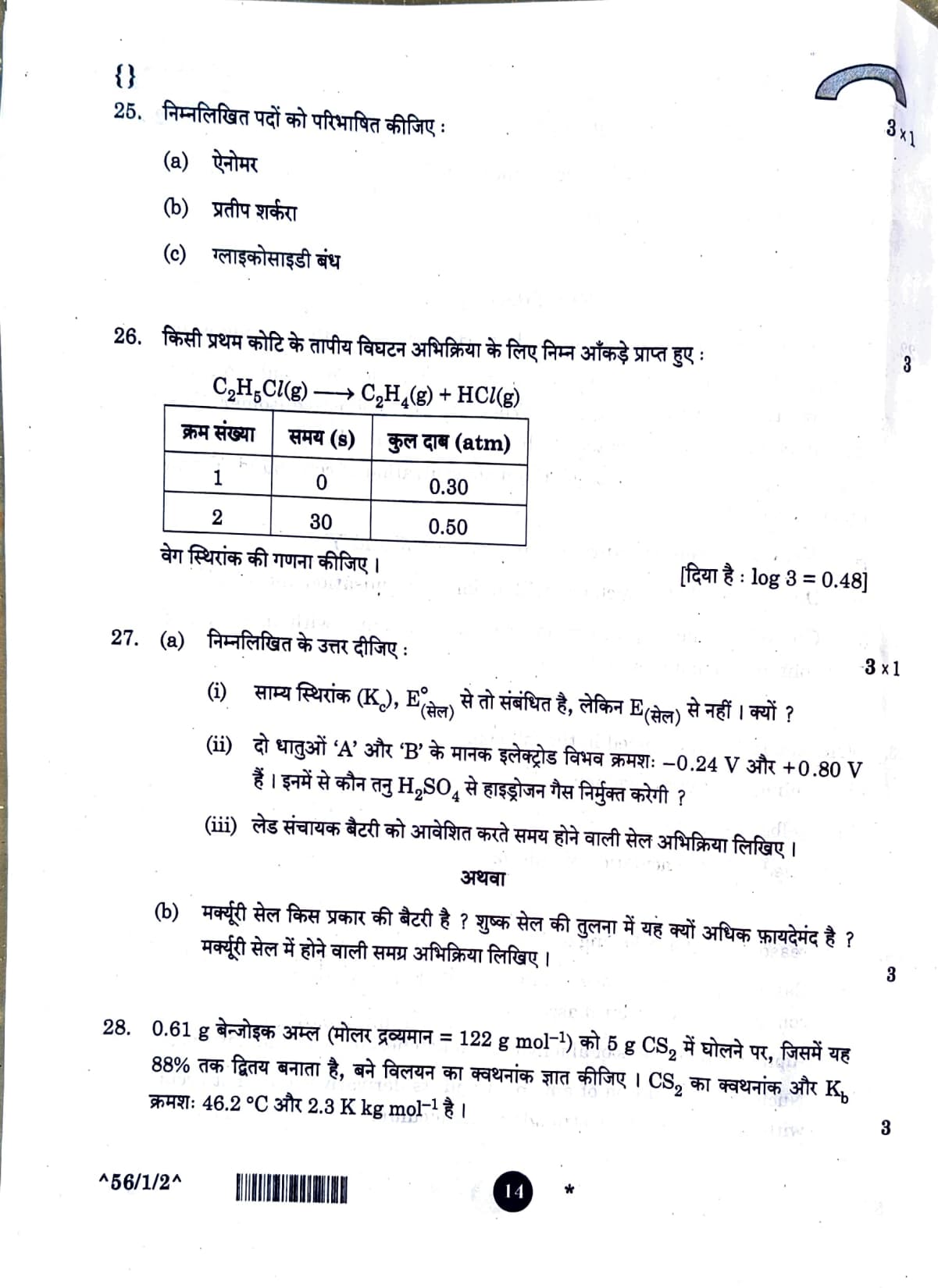
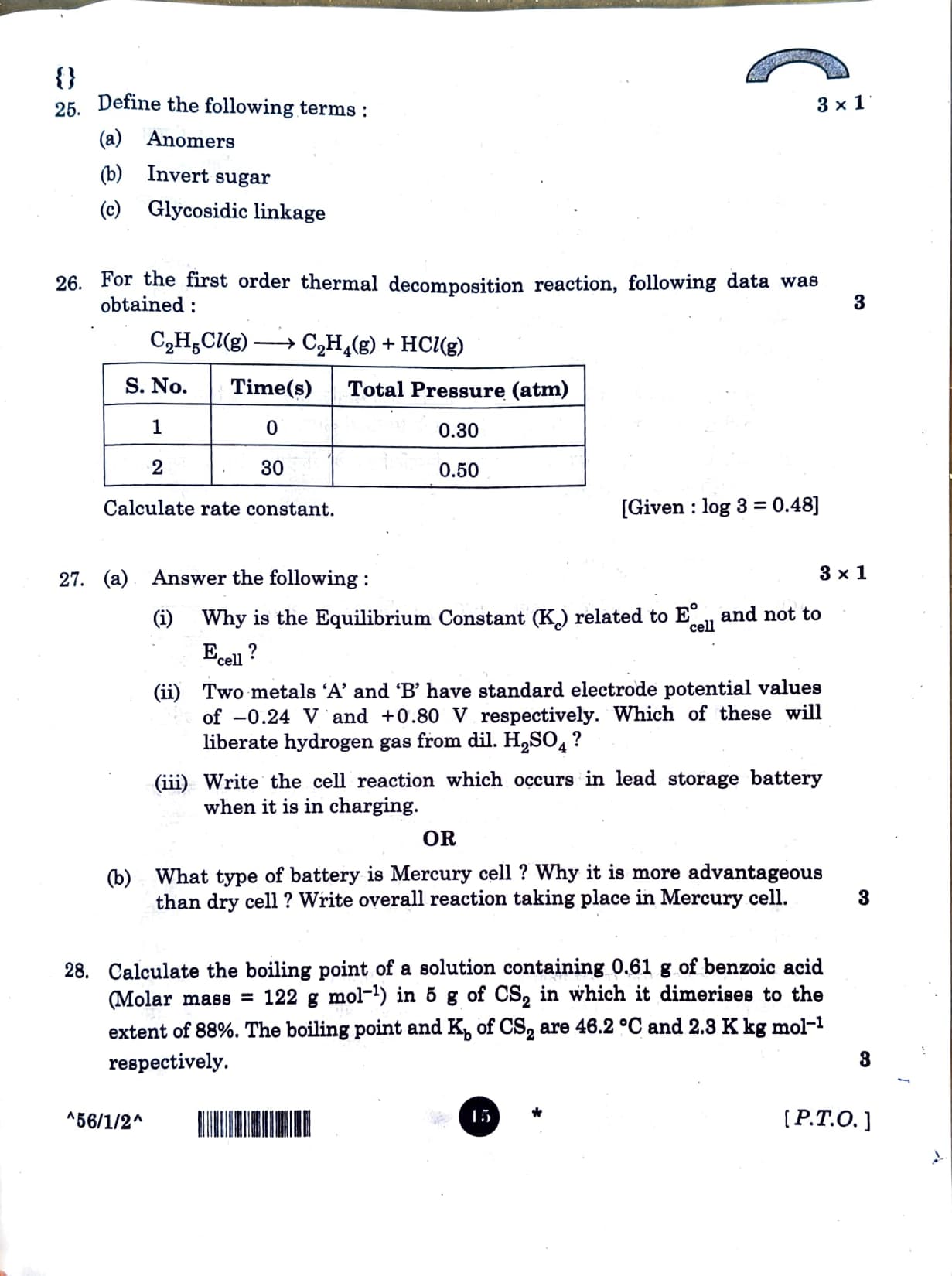
Define the term:
25(a).
Anomers.
Invert sugar.
Glycosidic linkage.
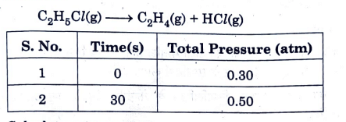
For the first order thermal decomposition reaction, following data was obtained : Calculate rate constant.
[Given : log 3 = 0.48]
Answer the following :
(i) Why is the Equilibrium Constant (\(K_c\)) related to \(E^{\circ}_{cell}\) and not to \(E_{cell}\)?
(ii) Two metals ‘A’ and ‘B’ have standard electrode potential values of \(-0.24\) V and \(+0.80\) V respectively. Which of these will liberate hydrogen gas from dil. \(H_2SO_4\)?
(iii) Write the cell reaction which occurs in lead storage battery when it is in charging.
What type of battery is Mercury cell? Why it is more advantageous than dry cell? Write overall reaction taking place in Mercury cell.
Calculate the boiling point of a solution containing 0.61 g of benzoic acid (122 \( g mol^{-1} \)) in 5 g of \( CS_2 \) in which it dimerises to 88%. \( T_b^\circ(CS_2) = 46.2^\circ C, K_b = 2.3 K kg mol^{-1} \).
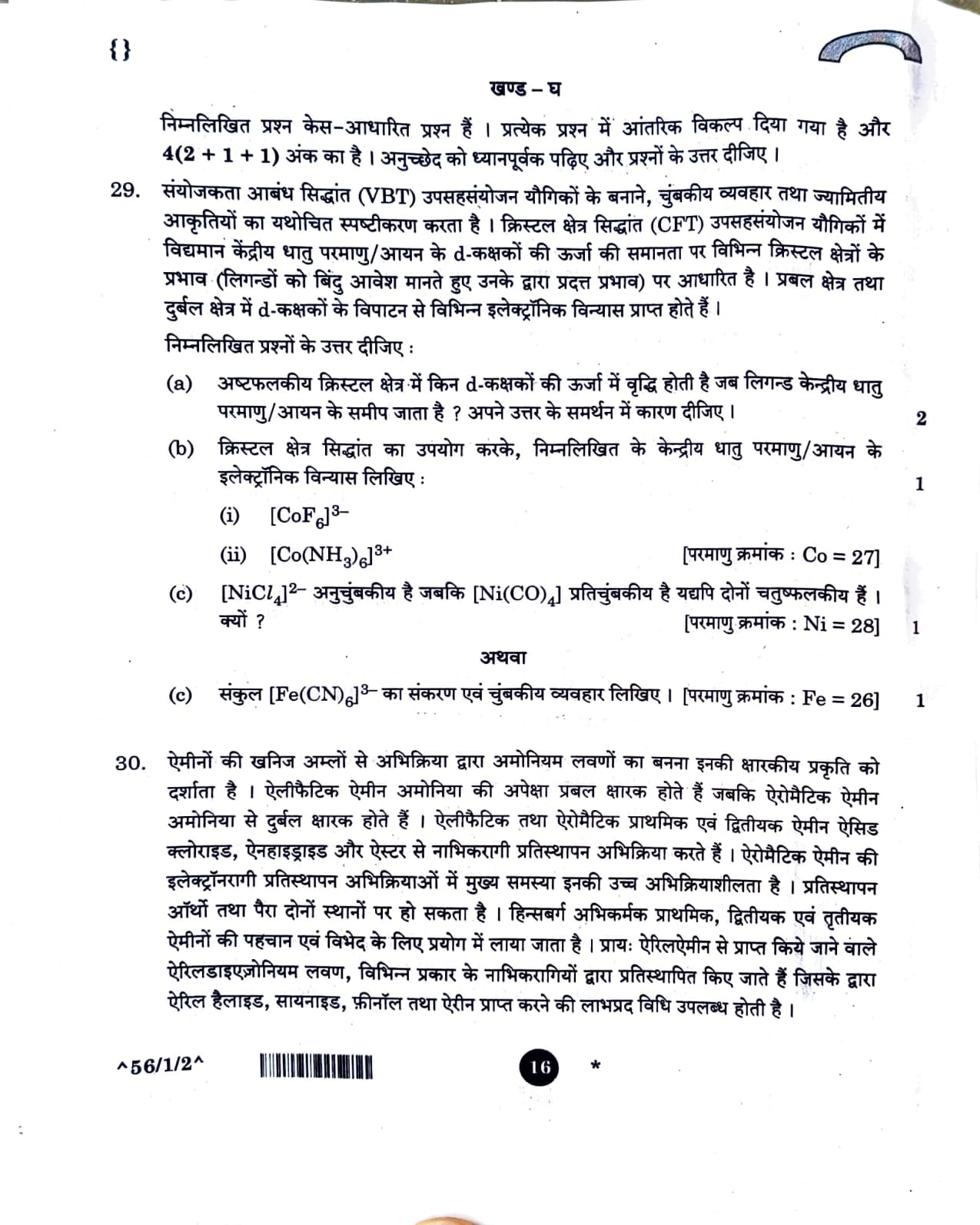
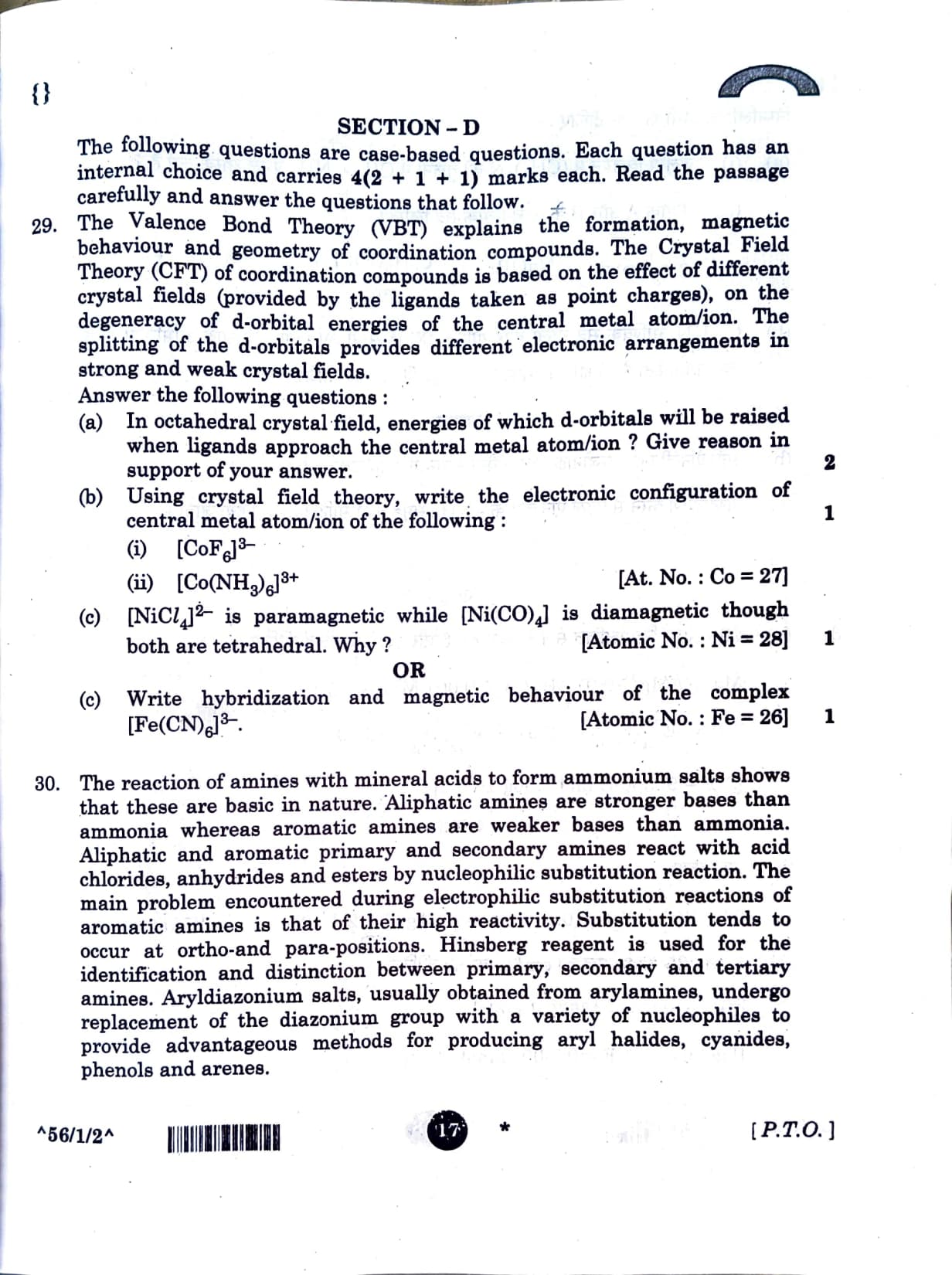
The Valence Bond Theory (VBT) explains the formation, magnetic behaviour and geometry of coordination compounds. The Crystal Field Theory (CFT) of coordination compounds is based on the effect of different crystal fields (provided by the ligands taken as point charges), on the degeneracy of d-orbital energies of the central metal atom/ion. The splitting of the d-orbitals provides different electronic arrangements in strong and weak crystal fields. Answer the following questione
29(a).
In octahedral crystal field, energies of which d-orbitals will be raised when ligands approach? Give reason.
Using CFT, write electronic configuration for: (i) \( [CoF_6]^{3-} \) (ii) \( [Co(NH_3)_6]^{3+} \). [At. No. Co=27]
\( [NiCl_4]^{2-} \) is paramagnetic while \( [Ni(CO)_4] \) is diamagnetic though both are tetrahedral. Why? [At. No. Ni=28]
The reaction of amines with mineral acids to form ammonium salts shows that these are basic in nature. Aliphatic amines are stronger bases than ammonia whereas aromatic amines are weaker bases than ammonia. Aliphatic and aromatic primary and secondary amines react with acid chlorides, anhydrides and esters by nucleophilic substitution reaction. The main problem encountered during electrophilic substitution reactions of aromatic amines is that of their high reactivity. Substitution tends to occur at ortho-and para-positions. Hinsberg reagent is used for the identification and distinction between primary, secondary and tertiary amines. Aryldiazonium salts, usually obtained from arylamines, undergo replacement of the diazonium group with a variety of nucleophiles to provide advantageous methods for producing aryl halides, cyanides, phenols and arenes.
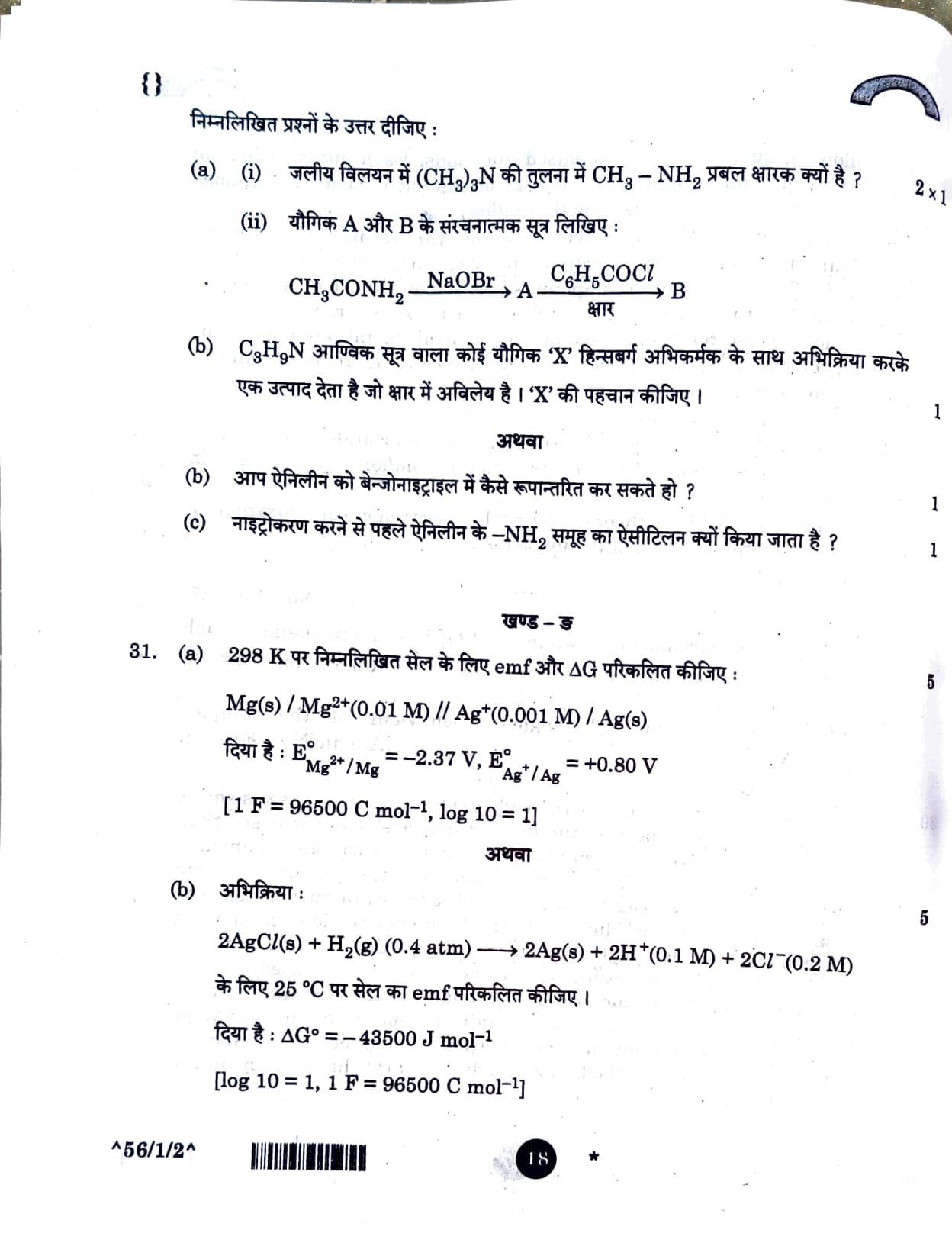
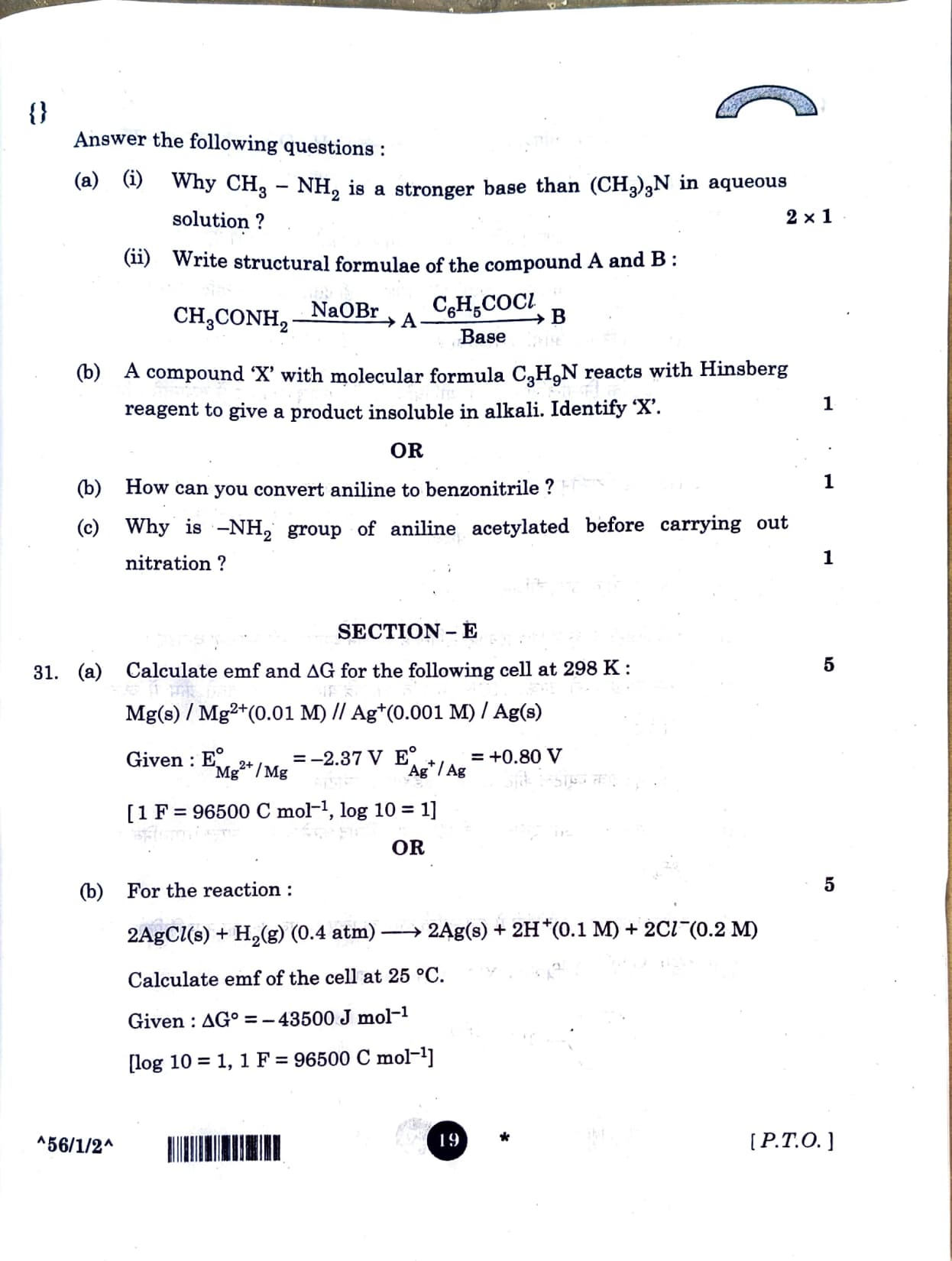
30(a)(i).
Why \(CH_3 - NH_2\) is a stronger base than \((CH_3)_3N\) in aqueous solution?
Write structural formulae of the compound A and B:
\(CH_3CONH_2 \xrightarrow{NaOBr} A \xrightarrow[Base]{C_6H_5COCl} B\)
A compound ‘X’ with molecular formula \(C_3H_9N\) reacts with Hinsberg reagent to give a product insoluble in alkali. Identify ‘X’.
How can you convert aniline to benzonitrile?
Why is \(-NH_2\) group of aniline acetylated before carrying out nitration?
Calculate emf and \(\Delta G\) for the following cell at \(298 K\) :
\(Mg(s) / Mg^{2+}(0.01 M) // Ag^+(0.001 M) / Ag(s)\)
Given : \(E^\circ_{Mg^{2+}/Mg} = -2.37 V\), \(E^\circ_{Ag^+/Ag} = +0.80 V\)
\([1 F = 96500 C mol^{-1}, \log 10 = 1]\)
For the reaction :
\(2AgCl(s) + H_2(g) (0.4 atm) \rightarrow 2Ag(s) + 2H^+(0.1 M) + 2Cl^-(0.2 M)\)
Calculate emf of the cell at \(25 ^\circC\).
Given : \(\Delta G^\circ = -43500 J mol^{-1}\)
\([\log 10 = 1, 1 F = 96500 C mol^{-1}]\)
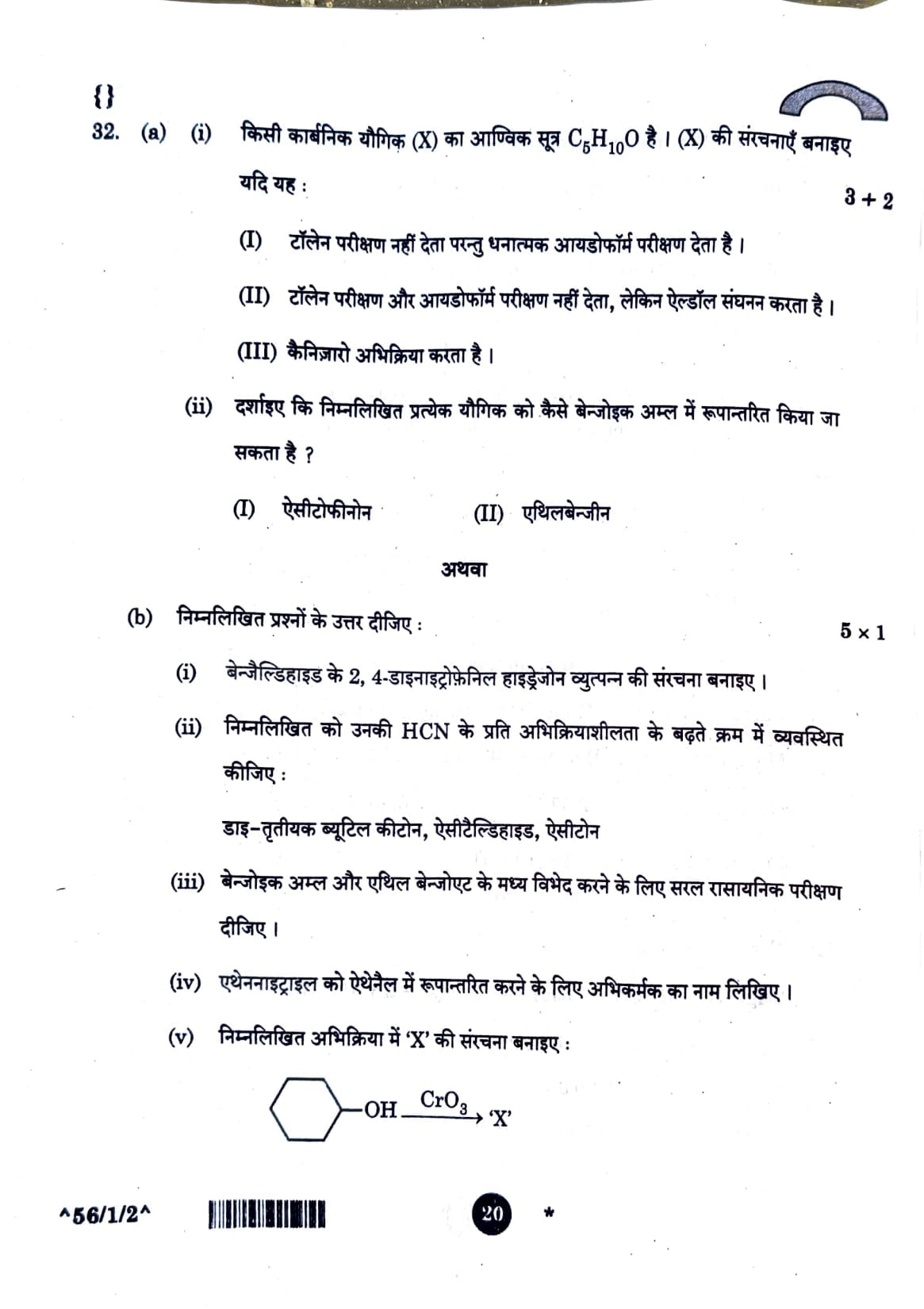
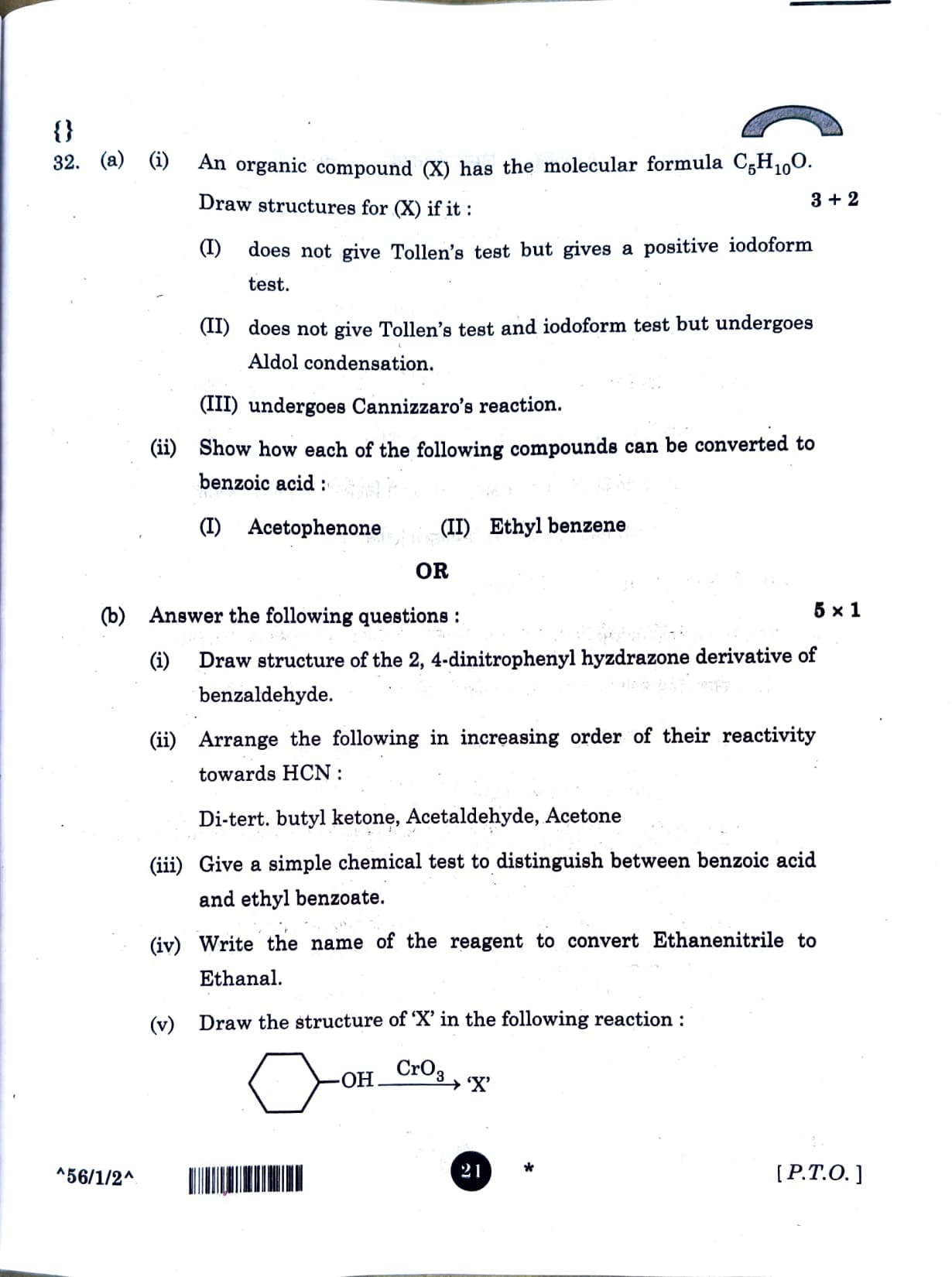
An organic compound (X) has the molecular formula \(C_5H_{10}O\). Draw structures for (X) if it:
(I) does not give Tollen's test but gives a positive iodoform test.
(II) does not give Tollen's test and iodoform test but undergoes Aldol condensation.
(III) undergoes Cannizzaro's reaction.
Show how each of the following compounds can be converted to benzoic acid:
(I) Acetophenone
(II) Ethyl benzene
Draw structure of the 2, 4-dinitrophenyl hydrazone derivative of benzaldehyde.
Arrange the following in increasing order of their reactivity towards HCN:
Di-tert. butyl ketone, Acetaldehyde, Acetone
Give a simple chemical test to distinguish between benzoic acid and ethyl benzoate.
Write the name of the reagent to convert Ethanenitrile to Ethanal.
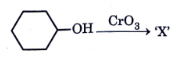
Draw the structure of 'X' in the following reaction:
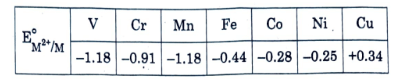
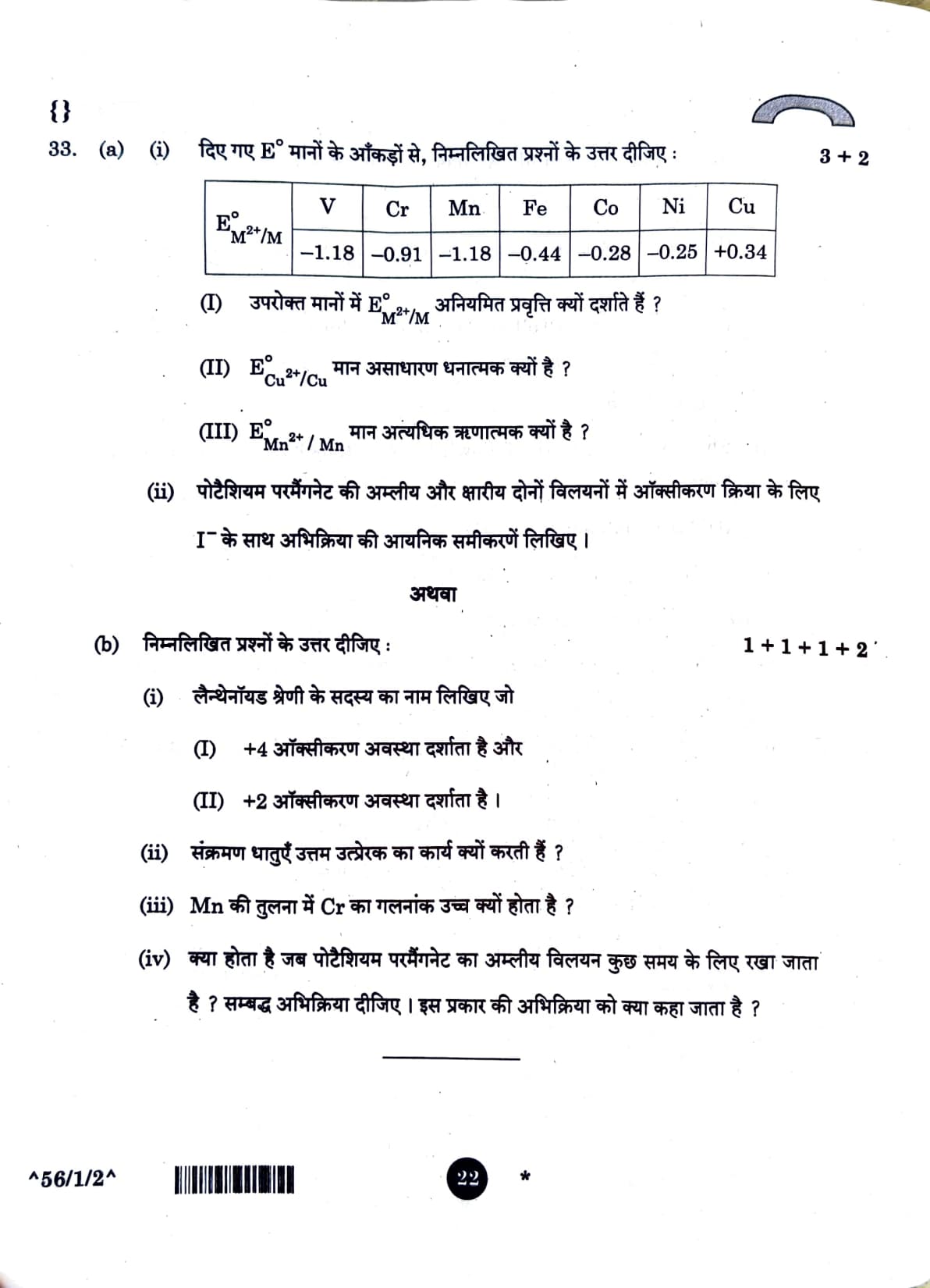
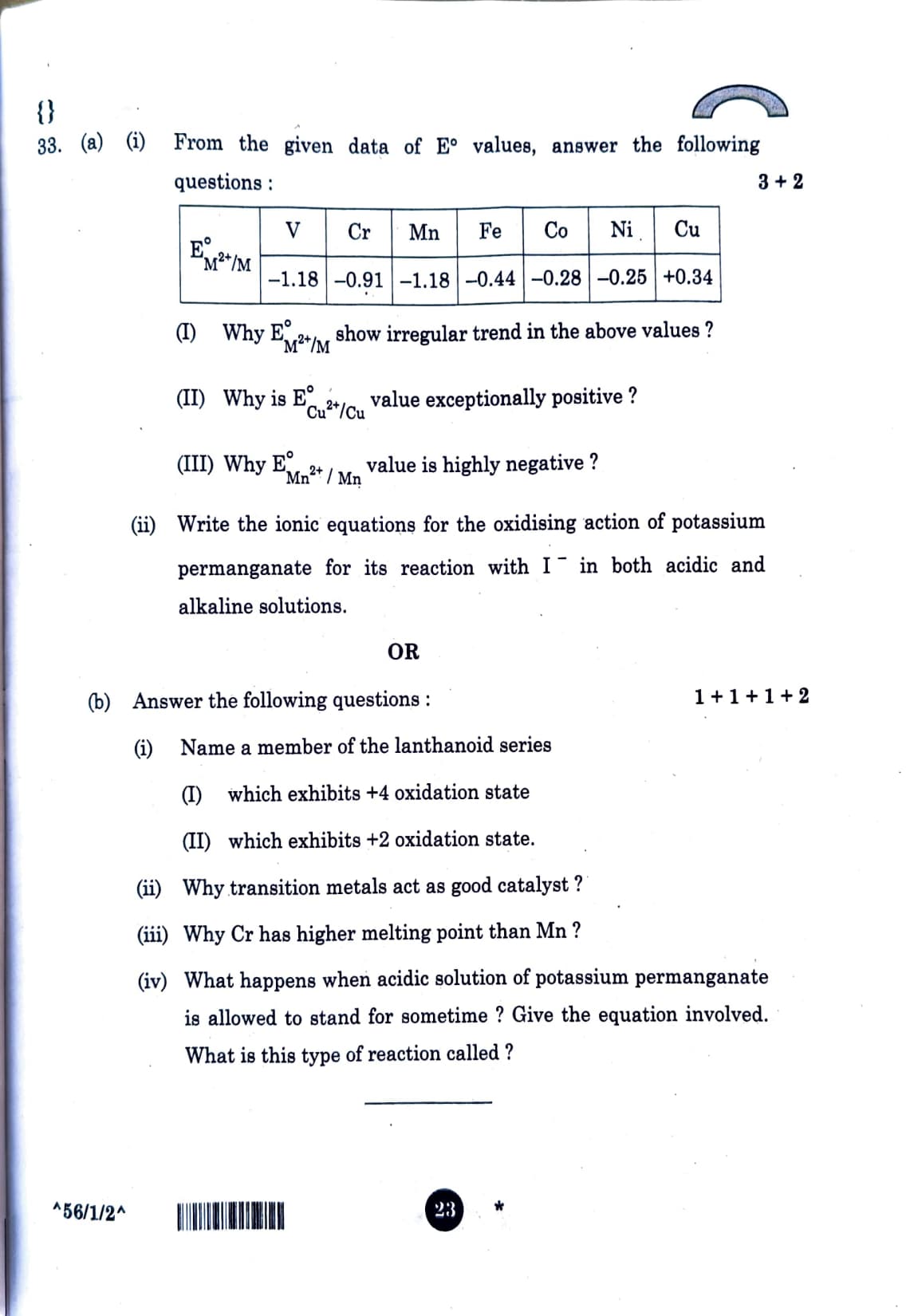
From the given data of \(E^{\circ}\) values, answer the following questions :
(I) Why \(E^{\circ}_{M^{2+}/M}\) show irregular trend in the above values ?
(II) Why is \(E^{\circ}_{Cu^{2+}/Cu}\) value exceptionally positive ?
(III) Why \(E^{\circ}_{Mn^{2+}/Mn}\) value is highly negative ?
Write the ionic equations for the oxidising action of potassium permanganate for its reaction with \(I^-\) in both acidic and alkaline solutions.
Name a member of the lanthanoid series
(I) which exhibits +4 oxidation state
(II) which exhibits +2 oxidation state.
Why transition metals act as good catalyst ?
Why Cr has higher melting point than Mn ?
What happens when acidic solution of potassium permanganate is allowed to stand for sometime ? Give the equation involved. What is this type of reaction called ?



Comments