




JEE Main 2026 B.Planning memory based paper is available here with answer key and solutions PDF. NTA conducted the exam on Jan 29, 2026, from 9 AM to 12 PM.
JEE Main 2026 B.Planning Memory based Paper with Solution PDF
Check JEE Main Jan 29 Answer Key
Based on intitial analysis, JEE Main Jan 28 B.Planning was Moderate to Difficult. Students can access the JEE Main 2026 B.Planning memory-based questions with answer keys here.
Students can check the detailed paper analysis for JEE Main 2026 January 29 B.Planning here.

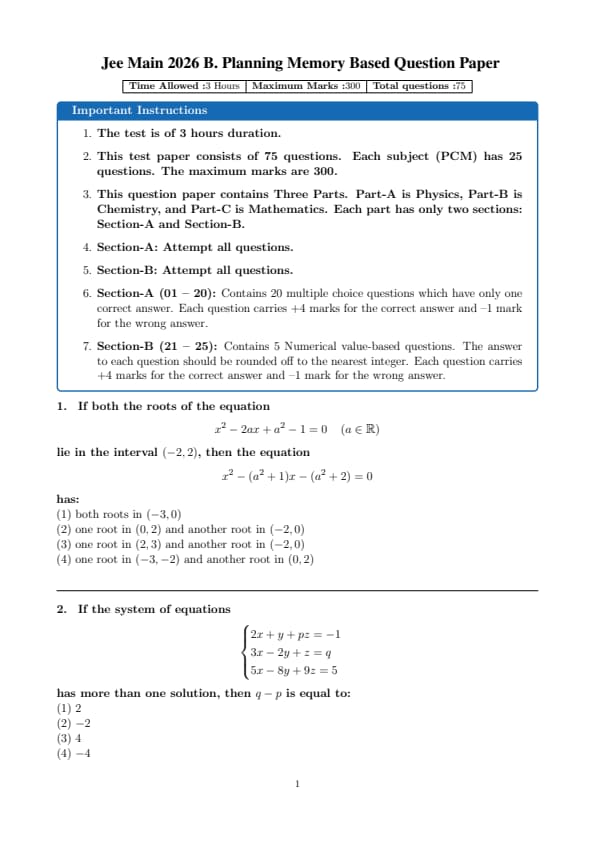
If both the roots of the equation \[ x^2-2ax+a^2-1=0 \quad (a\in\mathbb{R}) \]
lie in the interval \((-2,2)\), then the equation \[ x^2-(a^2+1)x-(a^2+2)=0 \]
has:
View Solution
Step 1: Analyze the first equation
\[ x^2-2ax+a^2-1=0 \]
Rewrite: \[ (x-a)^2=1 \]
So the roots are: \[ x=a\pm 1 \]
Given that both roots lie in \((-2,2)\):
\[ -2
From these: \[ -1
Combining: \[ -1
Step 2: Analyze the second equation
\[ x^2-(a^2+1)x-(a^2+2)=0 \]
Sum of roots: \[ \alpha+\beta=a^2+1>0 \]
Product of roots: \[ \alpha\beta=-(a^2+2)<0 \]
Hence, one root is positive and the other is negative.
Step 3: Locate the roots
Evaluate the polynomial at key points (using \(|a|<1\)):
\[ f(0)=-(a^2+2)<0 \]
\[ f(2)=4-2(a^2+1)-(a^2+2)=-3a^2<0 \]
\[ f(3)=9-3(a^2+1)-(a^2+2)=4-4a^2>0 \]
Thus, the positive root lies in \((2,3)\).
Now check negative side:
\[ f(-2)=4+2(a^2+1)-(a^2+2)=4+a^2>0 \]
Since \(f(-2)>0\) and \(f(0)<0\), the negative root lies in \((-2,0)\).
Final Conclusion:
One root lies in \((2,3)\) and the other lies in \((-2,0)\).
\[ \boxed{Option (3)} \] Quick Tip: When roots are restricted to an interval, first determine the parameter range, then use sign analysis of the polynomial to locate roots in specific subintervals.
If the system of equations \[ \begin{cases} 2x+y+pz=-1
3x-2y+z=q
5x-8y+9z=5 \end{cases} \]
has more than one solution, then \(q-p\) is equal to:
View Solution
For a system of three linear equations to have more than one solution, the determinant of the coefficient matrix must be zero and the system must be consistent.
Step 1: Determinant of coefficient matrix
\[ \begin{vmatrix} 2 & 1 & p
3 & -2 & 1
5 & -8 & 9 \end{vmatrix} =2((-2)\cdot 9-1\cdot(-8)) -1(3\cdot 9-1\cdot 5) +p(3\cdot(-8)-(-2)\cdot 5) \]
\[ =2(-18+8)-1(27-5)+p(-24+10) =-20-22-14p \]
\[ \Rightarrow -42-14p=0 \Rightarrow p=-3 \]
Step 2: Consistency condition
With \(p=-3\), observe that the rows satisfy: \[ -2R_1+3R_2=R_3 \]
For consistency, the constants must satisfy the same relation: \[ -2(-1)+3q=5 \Rightarrow 2+3q=5 \Rightarrow q=1 \]
Step 3: Compute \(q-p\)
\[ q-p=1-(-3)=4 \]
\[ \boxed{4} \] Quick Tip: For infinitely many solutions, ensure both: determinant of coefficient matrix is zero, constants follow the same linear dependence as the equations.
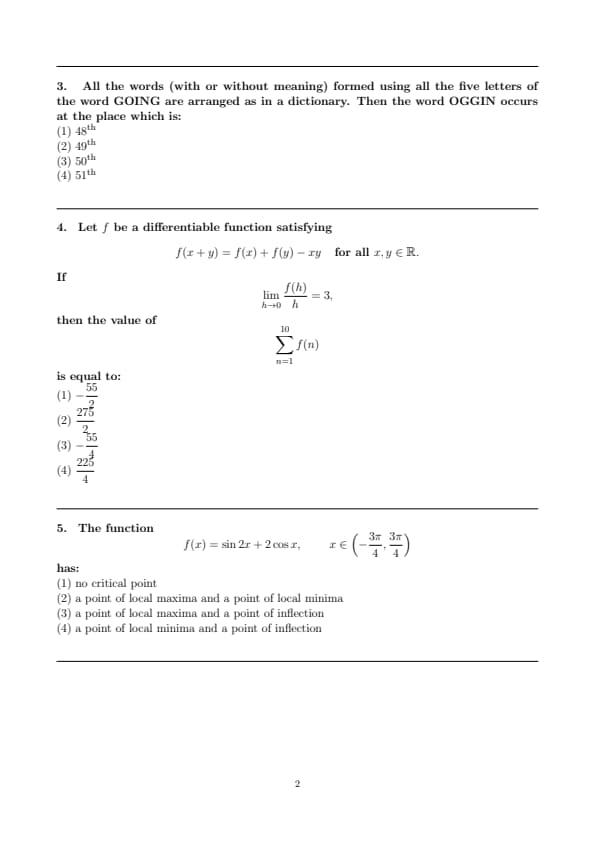
All the words (with or without meaning) formed using all the five letters of the word
\textbf{GOING} are arranged as in a dictionary.
Then the word \textbf{OGGIN} occurs at the place which is:
View Solution
Step 1: Arrange letters in alphabetical order
Letters of the word GOING are: \[ G,\ O,\ I,\ N,\ G \]
Alphabetical order: \[ G,\ G,\ I,\ N,\ O \]
Step 2: Find rank of the word OGGIN
We calculate the number of words that come before OGGIN.
First letter: O
Letters smaller than \(O\) are \(G, G, I, N\).
Number of permutations using remaining 4 letters (with two G’s): \[ \frac{4!}{2!}=12 \]
Number of such letters before \(O\): \(4\)
\[ \Rightarrow 4 \times 12 = 48 \]
Step 3: Remaining letters
After fixing \(O\), the remaining word is GGIN.
This is already the smallest possible arrangement of these letters.
So, no additional words are added.
Step 4: Final rank
\[ Rank = 48 + 1 = 49 \]
\[ \boxed{49^{th}} \] Quick Tip: For rank problems with repeated letters: always divide by factorial of repetitions and count only letters \textbf{strictly smaller} at each position.
Let \(f\) be a differentiable function satisfying \[ f(x+y)=f(x)+f(y)-xy \quad for all x,y\in\mathbb{R}. \]
If \[ \lim_{h\to 0}\frac{f(h)}{h}=3, \]
then the value of \[ \sum_{n=1}^{10} f(n) \]
is equal to:
View Solution
Step 1: Find the general form of \(f(x)\)
Given: \[ f(x+y)=f(x)+f(y)-xy \]
Assume \(f(x)\) is a polynomial of degree \(\le 2\): \[ f(x)=ax^2+bx+c \]
Substitute into the functional equation: \[ a(x+y)^2+b(x+y)+c = ax^2+bx+c + ay^2+by+c - xy \]
Comparing coefficients: \[ 2a=-1 \Rightarrow a=-\frac12 \]
Constant term: \[ c=0 \]
So, \[ f(x)=-\frac{x^2}{2}+bx \]
Step 2: Use the given limit
\[ \lim_{h\to 0}\frac{f(h)}{h} =\lim_{h\to 0}\left(-\frac{h}{2}+b\right)=b \]
Given the limit is \(3\): \[ b=3 \]
Hence, \[ f(x)=3x-\frac{x^2}{2} \]
Step 3: Compute the required sum
\[ \sum_{n=1}^{10} f(n) =\sum_{n=1}^{10}\left(3n-\frac{n^2}{2}\right) \]
\[ =3\sum_{n=1}^{10}n-\frac12\sum_{n=1}^{10}n^2 \]
\[ =3\cdot\frac{10\cdot11}{2}-\frac12\cdot\frac{10\cdot11\cdot21}{6} \]
\[ =165-\frac{385}{2} =\frac{330-385}{2} =-\frac{55}{2} \]
\[ \boxed{-\dfrac{55}{2}} \] Quick Tip: Functional equations involving \(f(x+y)\) often lead to polynomial solutions. Always use the given limit to fix remaining constants.
The function \[ f(x)=\sin 2x+2\cos x,\qquad x\in\left(-\frac{3\pi}{4},\frac{3\pi}{4}\right) \]
has:
View Solution
Step 1: Find the first derivative
\[ f(x)=\sin 2x+2\cos x \]
\[ f'(x)=2\cos 2x-2\sin x \]
Set \(f'(x)=0\): \[ 2(\cos 2x-\sin x)=0 \Rightarrow \cos 2x=\sin x \]
Using \(\cos 2x=1-2\sin^2 x\): \[ 1-2\sin^2 x=\sin x \]
\[ 2\sin^2 x+\sin x-1=0 \]
\[ (2\sin x-1)(\sin x+1)=0 \]
\[ \sin x=\frac12 \quad or \quad \sin x=-1 \]
In the interval \(\left(-\frac{3\pi}{4},\frac{3\pi}{4}\right)\), \[ \sin x=\frac12 \Rightarrow x=\frac{\pi}{6} \]
(\(\sin x=-1\) gives \(x=-\frac{\pi}{2}\), which is a boundary point for critical behaviour.)
Step 2: Second derivative test
\[ f''(x)=-4\sin 2x-2\cos x \]
At \(x=\frac{\pi}{6}\): \[ f''\!\left(\frac{\pi}{6}\right) =-4\sin\frac{\pi}{3}-2\cos\frac{\pi}{6} =-4\cdot\frac{\sqrt3}{2}-2\cdot\frac{\sqrt3}{2}<0 \]
Hence, \(x=\frac{\pi}{6}\) is a point of local maxima.
Step 3: Check for inflection point
At \(x=-\frac{\pi}{2}\), \[ f'(x)=0 \]
but \(f''(x)\) changes sign across this point, hence it is a point of inflection.
Final Conclusion:
The function has a point of local maxima and a point of inflection.
\[ \boxed{Option (3)} \] Quick Tip: A point where \(f'(x)=0\) but no sign change in monotonicity occurs is not an extremum — always check the second derivative or sign of \(f'(x)\).



Comments