




As per the official dates, the JEE Main 2026 Session-1 scorecard has been released on 16 February 2026. Scorecards are released online on the official website. The JEE Main scorecard includes subject-wise and the total NTA scores.
- Your NTA score is your percentile, which represents your relative performance compared to other candidates.
- JEE Main scorecard includes your basic personal details along with your performance in the exam through subject-wise and total percentile.
- AIR and category-wise ranks are not released after the January session. NTA announces ranks after the April attempt.
Also Read:
- JEE Main 2026 State Wise Toppers List Out
- JEE Main 2026 Expected Cutoff Category Wise
- Predict your college based on your JEE Main Scorecard performance
Key Summary
- JEE Main January session scorecard shows subject-wise and total NTA percentile.
- NTA score equals a percentile, which reflects relative performance compared to other candidates.
- Scorecard includes personal details, category, and subject-wise percentiles for Physics, Chemistry, and Mathematics.
- All India Rank and category-wise ranks are released only after the April attempt.
- Percentiles are normalised across multiple shifts to ensure fair comparison.
- Final AIR and category ranks determine JoSAA counselling.
What is Included in the JEE Main Scorecard?
The JEE Main scorecard contains personal information and exam performance of a student, such as their name, roll number, and application number. It also consists of other basic information such as gender, category, and date of birth.
The main part of the JEE Main scorecard focuses on your performance in each subject. For paper 1, it consists of the NTA score for physics, chemistry, and Mathematics.
JEE Main scorecard for the January session doesn’t include AIR and category rank. It also doesn’t include your eligibility qualification for JEE Advanced. This information is released in the scorecard for the April session, after taking the “best of 2” scores into account.
| Component | Description |
|---|---|
| Candidate Details | Name, Roll number, Application number, Gender, Category |
| Subject-wise Percentile | Percentile in Physics, Chemistry, and Mathematics |
| Total NTA score | Overall percentile |
| All India Rank (AIR/CRL) | Common rank list based on total NTA score. Note: The January session scorecard doesn’t include AIR. It is determined after the April attempt by considering the best of the two attempts. |
| Category Rank | Rank within your category (general, OBC, SC, ST). Note: Category rank is also not included in the January session scorecard. |
| Qualifying Status | Whether eligible for JEE Advanced Note: Qualifying status is not included in the January session scorecard |
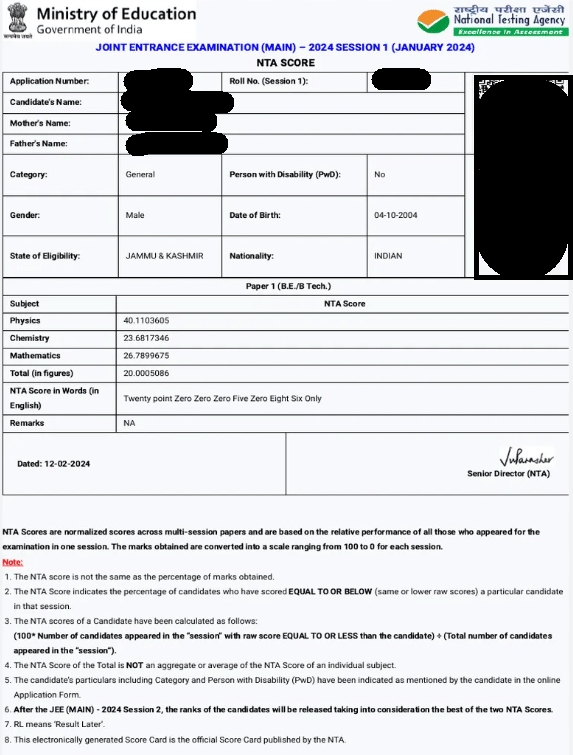
Sample scorecard of JEE Main for the January session
Ques. Does the JEE Main scorecard show my actual marks out of 300?
Ans. No, the JEE Main scorecard doesn’t show raw marks. It displays the percentile, which is relative performance compared to all other test takers.
Ques. Is my category mentioned in the JEE Main scorecard?
Ans. Yes. The JEE Main scorecard displays your category as submitted during registration.
Understanding Percentile in the JEE Main Scorecard?
The percentile is the most important number on the JEE Main scorecard. The percentile is calculated by comparing your performance to that of other candidates. Hitting 95 percentile means you out performed 95% of the students who sat for the exam.
- Each shift's percentiles are calculated separately by NTA, and then they are normalised.
- The JEE Main scorecard shows percentiles for each subject and the total.
- The percentile in your scorecard helps decide your rank.
| Percentiles in the JEE Main Scorecard | What does it mean? |
|---|---|
| 99.9+ | Top performers, very high chance for top NITs |
| 95-99 | Strong score. Good chance for good NITs/IIITs |
| 90-95 | Decent Marks, Possible for mid-tier NITs |
| 80-90 | Average score, may get into private colleges. |
| Below 80 | Chance for reserved categories. Low chance for general |
Ques. How is percentile different from percentage marks in the JEE Main scorecard?
Ans. The percentage is your marks out of the total, while the percentile compares your performance to others. The JEE Main scorecard uses a percentile to compare your performance to other candidates.
What is the NTA Score in the JEE Main Scorecard?
In the JEE Main scorecard, the NTA score is the same as the percentile score. NTA calls it “NTA score,” but it is simply your percentile. The JEE Main scorecard shows the NTA score for each subject and for the total.
The total NTA score is used for ranking. The JEE Main scorecard does not show raw scores.
| Subject | NTA Score (percentile) | Role in JEE Main Scorecard |
|---|---|---|
| Physics | 92.5 | Shows subject strength and affects the total NTA score. |
| Chemistry | 88.0 | Important for tie-breaking in ranks |
| Mathematics | 94.6 | Highest weight in tie-braking rules |
| Total NTA score | 91.5 | The main factor for the All India Rank in the scorecard |
All India Rank in the JEE Main Scorecard
The All India Rank (AIR), also called the Common Rank List, is shown in the Final JEE Main Scorecard. AIR typically is not shown for the January session. It is determined after taking the best of 2 attempts after the April attempt.
However, AIR ranks all candidates across categories based on their total NTA score. A higher NTA score means better AIR in the JEE Main scorecard.
The AIR in the scorecard is used for JoSAA counselling and JEE Advanced eligibility.
| NTA Score (Percentile) | Approximate AIR Range |
|---|---|
| 99+ | Less than ~15300 |
| 98-99 | 15,300-30,700 |
| 95-98 | 30,700-77,000 |
| 93-95 | 77,000-1,19,000 |
| 90-93 | 1,19,000-1,47,000 |
Source: Analysis of rank vs percentile from Marks vs Percentile vs Rank Analysis by Harsh Sir
Category-wise AIR In the JEE Main Scorecard
Category-wise rank is your rank among candidates in your category. Category-wise AIR helps in reserved seat admissions during counselling.
A candidate with 92 percentile may have AIR 1,50,000, but in the category rank, they may be at 40,000 for OBC. This category rank in the JEE Main scorecard improves the chances for reserved seats.
The January session JEE Main scorecard doesn’t include category-wise AIR. It will be calculated after the April attempt by considering the best ofthe two performances.
| Category | Role of Category Rank | Benefit in Admission |
|---|---|---|
| General (Open) | Same as CRL | Open seats |
| EWS | Rank within EWS candidates | 27% reserved seats |
| OBC-NCL | Rank within OBC candidates | 10% reserved seats |
| SC | Rank within SC candidates | 15% reserved seats |
| ST | Rank within ST candidates | 7.5% reserved seats |
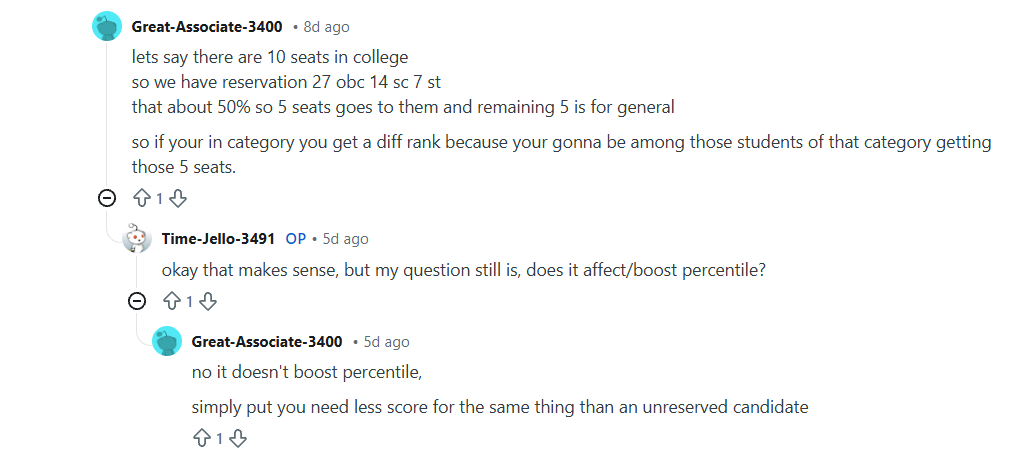
The r/JEENEETards thread on Reddit explains how the category affects your rank in the JEE Main Scorecard. The user explains, “If you are in a category, you get a different rank because you are gonna be among those students of that category. Category doesn’t boost your percentile, but it boosts your rank among the same category students.”
Ques. Why is category-wise AIR important on the JEE Main scorecard?
Ans. It improves your chances for reserved seats at NITs and IIITs. Even if your AIR is high, a good category rank in the JEE Main scorecard can get you a good college.
Ques. What is the difference between AIR and category rank in the JEE Main scorecard?
Ans. AIR is the all-candidates' performance combined. Category rank is only within your category on the JEE Main scorecard.
The JEE Main scorecard explains your performance in the exam. It includes subject-wise and overall percentiles. Always check the official NTA website for your JEE Main scorecard and latest updates.



Comments