




JEE Main 2025 28 Jan Shift 2 Question Paper is now available for download with Solution PDF. NTA conducted the exam successfully on 28 Jan 2025 from 03:00 PM to 06:00 PM.
You can also match your JEE Main 2025 solutions with Collegdunia’s JEE Main 2025 Question Paper Solutions pdf for free and analyse your expected JEE Main Marks Vs Percentile in JEE Main Session 1.
| JEE Main 2025 Jan 28 Shift 2 Question Paper with Solution |  Download Download |
Check Solution |
Also Check
- Download JEE Main 2025 PYQ for all shifts
- Download JEE Main Last 10 Year Question Papers for all shifts

Check – JEE Main 2025 Jan 28 Shift 1 Question Paper Solutions Pdf
JEE Main 2025 Jan 28 Shift 2 Questions with Solution
The square of the distance of the point \(\left( \frac{15}{7}, \frac{32}{7}, 7 \right)\) from the line \(\frac{x+1}{3} = \frac{y+3}{5} = \frac{z+5}{7}\) in the direction of the vector \(\mathbf{i} + 4\mathbf{j} + 7\mathbf{k}\) is:
If \[ \sum_{r=1}^{13} \frac{1}{\sin \frac{\pi}{4} + (r-1) \frac{\pi}{6}} \sin \frac{\pi}{4} + \frac{\pi}{6} = a \sqrt{3} + b, \quad a, b \in \mathbb{Z}, \text{ then } a^2 + b^2 \text{ is equal to:} \]
Let \( f : \mathbb{R} \setminus \{0\} \to (-\infty, 1) \) be a polynomial of degree 2, satisfying \( f(x)f\left( \frac{1}{x} \right) = f(x) + f\left( \frac{1}{x} \right) \). If \( f(K) = -2K \), then the sum of squares of all possible values of \( K \) is:
If \( \alpha + i\beta \) and \( \gamma + i\delta \) are the roots of the equation \( x^2 - (3-2i)x - (2i-2) = 0 \), \( i = \sqrt{-1} \), then \( \alpha\gamma + \beta\delta \) is equal to:
Bag \( B_1 \) contains 6 white and 4 blue balls, Bag \( B_2 \) contains 4 white and 6 blue balls, and Bag \( B_3 \) contains 5 white and 5 blue balls. One of the bags is selected at random and a ball is drawn from it. If the ball is white, then the probability that the ball is drawn from Bag \( B_2 \) is:
The area of the region bounded by the curves \( x(1 + y^2) = 1 \) and \( y^2 = 2x \) is:
Let \( A = \left[ \begin{array}{cc} \frac{1}{\sqrt{2}} & -2
0 & 1 \end{array} \right] \) and \( P = \left[ \begin{array}{cc} \cos \theta & -\sin \theta
\sin \theta & \cos \theta \end{array} \right], \theta > 0. \) If \( B = P A P^T \), \( C = P^T B P \), and the sum of the diagonal elements of \( C \) is \( \frac{m}{n} \), where gcd(m, n) = 1, then \( m + n \) is:
Two equal sides of an isosceles triangle are along \( -x + 2y = 4 \) and \( x + y = 4 \). If \( m \) is the slope of its third side, then the sum of all possible distinct values of \( m \) is:
If the components of \( \vec{a} = \alpha \hat{i} + \beta \hat{j} + \gamma \hat{k} \) along and perpendicular to \( \vec{b} = 3\hat{i} + \hat{j} - \hat{k} \) respectively are \( \frac{16}{11} (3\hat{i} + \hat{j} - \hat{k}) \) and \( \frac{1}{11} (-4\hat{i} - 5\hat{j} - 17\hat{k}) \), then \( \alpha^2 + \beta^2 + \gamma^2 \) is equal to:
Let the coefficients of three consecutive terms \( T_r \), \( T_{r+1} \), and \( T_{r+2} \) in the binomial expansion of \( (a + b)^{12} \) be in a G.P. and let \( p \) be the number of all possible values of \( r \). Let \( q \) be the sum of all rational terms in the binomial expansion of \( \left( 4\sqrt{3} + 3\sqrt{4} \right)^{12} \). Then \( p + q \) is equal to:
If \( A \) and \( B \) are the points of intersection of the circle \( x^2 + y^2 - 8x = 0 \) and the hyperbola \( \frac{x^2}{9} - \frac{y^2}{4} = 1 \), and a point \( P \) moves on the line \( 2x - 3y + 4 = 0 \), then the centroid of \( \triangle PAB \) lies on the line:
For positive integers \( n \), if \( 4 a_n = \frac{n^2 + 5n + 6}{4} \) and \[ S_n = \sum_{k=1}^{n} \left( \frac{1}{a_k} \right), \text{ then the value of } 507 S_{2025} \text{ is:} \]
Let \( f \) be a real-valued continuous function defined on the positive real axis such that \( g(x) = \int_0^x t f(t) \, dt \). If \( g(x^3) = x^6 + x^7 \), then the value of \( \sum_{r=1}^{15} f(r^3) \) is:
Let \( [x] \) denote the greatest integer less than or equal to \( x \). Then the domain of \( f(x) = \sec^{-1}(2[x] + 1) \) is:
Let \( f : \mathbb{R} \to \mathbb{R} \) be a twice-differentiable function such that \( f(2) = 1 \). If \( F(x) = x f(x) \) for all \( x \in \mathbb{R} \), and the integrals \( \int_0^2 x F'(x) \, dx = 6 \) and \( \int_0^2 x^2 F''(x) \, dx = 40 \), then \( F'(2) + \int_0^2 F(x) \, dx \) is equal to:
Let \( S \) be the set of all the words that can be formed by arranging all the letters of the word GARDEN. From the set \( S \), one word is selected at random. The probability that the selected word will NOT have vowels in alphabetical order is:
Let \( f: [0, 3] \to A \) be defined by \( f(x) = 2x^3 - 15x^2 + 36x + 7 \) and \( g: [0, \infty) \to B \) be defined by \( g(x) = \frac{x}{x^{2025} + 1}. \) If both functions are onto and \( S = \{ x \in \mathbb{Z} : x \in A \text{ or } x \in B \} \), then \( n(S) \) is equal to:
If \[ f(x) = \int \frac{1}{x^{1/4} (1 + x^{1/4})} \, dx, \quad f(0) = -6, \text{ then } f(1) \text{ is equal to:} \]
If the midpoint of a chord of the ellipse \( \frac{x^2}{9} + \frac{y^2}{4} = 1 \) is \( \left( \sqrt{2}, \frac{4}{3} \right) \), and the length of the chord is \( \frac{2\sqrt{\alpha}}{3} \), then \( \alpha \) is:
Let A, B, C be three points in the xy-plane, whose position vectors are given by \( \sqrt{3} \hat{i} + \hat{j} \), \( \hat{i} + \sqrt{3} \hat{j} \), and \( a\hat{i} + (1-a) \hat{j} \) respectively with respect to the origin \( O \). If the distance of the point C from the line bisecting the angle between the vectors \( \overrightarrow{OA} \) and \( \overrightarrow{OB} \) is \( \frac{9}{\sqrt{2}} \), then the sum of all possible values of \( a \) is:
The number of natural numbers, between 212 and 999, such that the sum of their digits is 15, is ______.
Let \[ f(x) = \lim_{n \to \infty} \sum_{r=0}^{n} \left( \frac{\tan \left( \frac{x}{2^{r+1}} \right) + \tan^3 \left( \frac{x}{2^{r+1}} \right)}{1 - \tan^2 \left( \frac{x}{2^{r+1}} \right)} \right) \] Then, \( \lim_{x \to 0} \frac{e^x - e^{f(x)}}{x - f(x)} \) is equal to:
The interior angles of a polygon with \( n \) sides, are in an A.P. with common difference 6°. If the largest interior angle of the polygon is 219°, then \( n \) is equal to:
Let A and B be the two points of intersection of the line \( y + 5 = 0 \) and the mirror image of the parabola \( y^2 = 4x \) with respect to the line \( x + y + 4 = 0 \). If \( d \) denotes the distance between A and B, and \( a \) denotes the area of \( \Delta SAB \), where \( S \) is the focus of the parabola \( y^2 = 4x \), then the value of \( (a + d) \) is:
If \( y = y(x) \) is the solution of the differential equation, \[ \sqrt{4 - x^2} \frac{dy}{dx} = \left( \left( \sin^{-1} \left( \frac{x}{2} \right) \right)^2 - y \right) \sin^{-1} \left( \frac{x}{2} \right), \] where \( -2 \leq x \leq 2 \), and \( y(2) = \frac{\pi^2 - 8}{4} \), then \( y^2(0) \) is equal to:
The magnetic field of an E.M. wave is given by: \[ \vec{B} = \left( \frac{\sqrt{3}}{2} \hat{i} + \frac{1}{2} \hat{j} \right) 30 \sin \left( \omega \left( t - \frac{z}{c} \right) \right) \] The corresponding electric field in S.I. units is:
The ratio of vapour densities of two gases at the same temperature is \( \frac{4}{25} \), then the ratio of r.m.s. velocities will be:
Earth has mass 8 times and radius 2 times that of a planet. If the escape velocity from the earth is 11.2 km/s, the escape velocity in km/s from the planet will be:
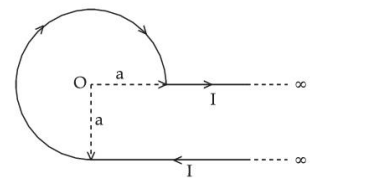
An infinite wire has a circular bend of radius \( a \), and carrying a current \( I \) as shown in the figure. The magnitude of the magnetic field at the origin \( O \) of the arc is given by:
A balloon and its content having mass \( M \) is moving up with an acceleration \( a \). The mass that must be released from the content so that the balloon starts moving up with an acceleration \( 3a \) will be:
Match List - I with List - II. \[ \begin{array}{|c|c|} \hline \textbf{List - I} & \textbf{List - II}
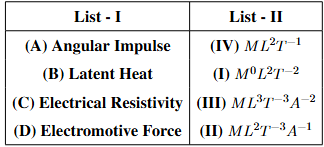
Choose the correct answer from the options given below:
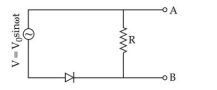
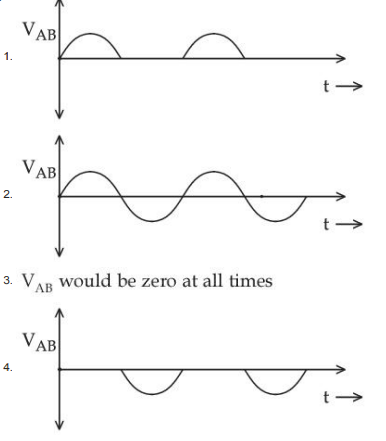
In the circuit shown, assuming the threshold voltage of the diode is negligibly small, then the voltage \( V_{AB} \) is correctly represented by:
The kinetic energy of translation of the molecules in 50 g of CO\(_2\) gas at 17°C is:
In a long glass tube, a mixture of two liquids A and B with refractive indices 1.3 and 1.4 respectively, forms a convex refractive meniscus towards A. If an object placed at 13 cm from the vertex of the meniscus in A forms an image with a magnification of \(-2\), then the radius of curvature of the meniscus is:
A parallel plate capacitor of capacitance 1 μF is charged to a potential difference of 20 V. The distance between plates is 1 μm. The energy density between the plates of the capacitor is:
The frequency of revolution of the electron in Bohr’s orbit varies with \( n \), the principal quantum number as:
Given below are two statements. One is labelled as Assertion (A) and the other is labelled as Reason (R). Assertion (A): Knowing initial position \( x_0 \), and initial momentum \( p_0 \) is enough to determine the position and momentum at any time \( t \) for a simple harmonic motion with a given angular frequency \( \omega \).
Reason (R): The amplitude and phase can be expressed in terms of \( x_0 \) and \( p_0 \). In the light of the above statements, choose the correct answer from the options given below:
A uniform rod of mass 250 g having length 100 cm is balanced on a sharp edge at the 40 cm mark. A mass of 400 g is suspended at the 10 cm mark. To maintain the balance of the rod, the mass to be suspended at the 90 cm mark is:
A uniform magnetic field of \( 0.4 \) T acts perpendicular to a circular copper disc \( 20 \) cm in radius. The disc is having a uniform angular velocity of \( 10\pi \) rad/s about an axis through its center and perpendicular to the disc. What is the potential difference developed between the axis of the disc and the rim? (\(\pi = 3.14\))
Which of the following phenomena cannot be explained by the wave theory of light?
A 400 g solid cube having an edge of length \(10\) cm floats in water. How much volume of the cube is outside the water? (Given: density of water = \(1000 \text{ kg/m}^3\))
A body of mass \(4\) kg is placed at a point \(P\) having coordinates \( (3,4) \) m. Under the action of force \( \mathbf{F} = (2\hat{i} + 3\hat{j}) \) N, it moves to a new point \(Q\) having coordinates \( (6,10) \) m in \(4\) sec. The average power and instantaneous power at the end of \(4\) sec are in the ratio:
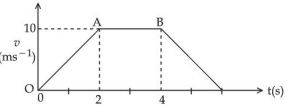
The velocity-time graph of an object moving along a straight line is shown in the figure. What is the distance covered by the object between \( t = 0 \) to \( t = 4s \)?
A concave mirror produces an image of an object such that the distance between the object and image is 20 cm. If the magnification of the image is \( -3 \), then the magnitude of the radius of curvature of the mirror is:
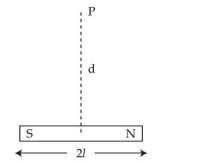
A bar magnet has total length \( 2l = 20 \) units and the field point \( P \) is at a distance \( d = 10 \) units from the centre of the magnet. If the relative uncertainty of length measurement is 1%, then the uncertainty of the magnetic field at point P is:
A thin transparent film with refractive index 1.4 is held on a circular ring of radius 1.8 cm. The fluid in the film evaporates such that transmission through the film at wavelength 560 nm goes to a minimum every 12 seconds. Assuming that the film is flat on its two sides, the rate of evaporation is: % Given answer Answer: \( \pi \times 10^{-13} \, \text{m}^3/\text{s} \)
An electric dipole of dipole moment \(6 \times 10^{-6} \) Cm is placed in a uniform electric field of magnitude \(10^6\) V/m. Initially, the dipole moment is parallel to the electric field. The work that needs to be done on the dipole to make its dipole moment opposite to the field will be ______ J.
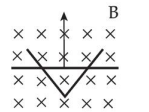
A conducting bar moves on two conducting rails as shown in the figure. A constant magnetic field \( B \) exists into the page. The bar starts to move from the vertex at time \( t = 0 \) with a constant velocity. If the induced EMF is \( E \propto t^n \), then the value of \( n \) is ______.
The volume contraction of a solid copper cube of edge length 10 cm, when subjected to a hydraulic pressure of \( 7 \times 10^6 \) Pa, would be ______ mm\(^3\). (Given bulk modulus of copper = \( 1.4 \times 10^{11} \) N m\(^{-2}\))
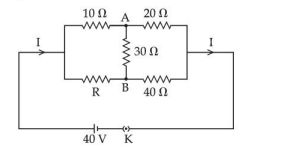
The value of current \( I \) in the electrical circuit as given below, when the potential at \( A \) is equal to the potential at \( B \), will be ______ A.
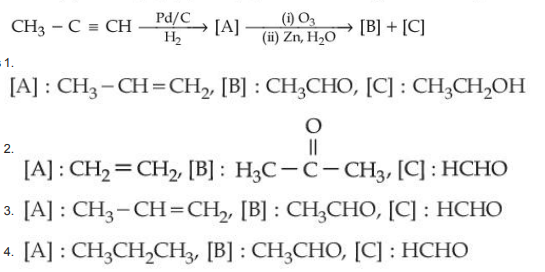
Identify product [A], [B], and [C] in the following reaction sequence.
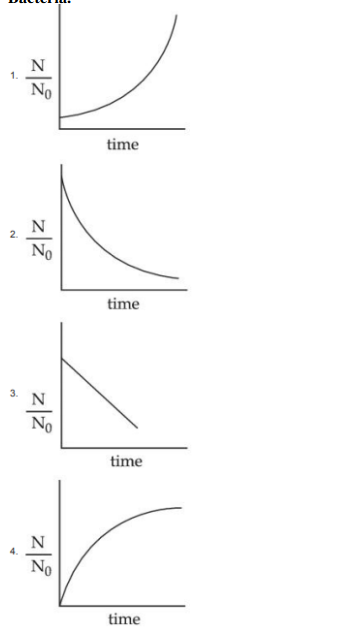
For bacterial growth in a cell culture, growth law is very similar to the law of radioactive decay. Which of the following graphs is most suitable to represent bacterial colony growth? Where \( N \) - Number of Bacteria at any time, \( N_0 \) - Initial number of Bacteria.
The product B formed in the following reaction sequence is: \[ \text{C}_6\text{H}_5\text{CN} \xrightarrow{\text{HCl}} (A) \xrightarrow{\text{AgCN}} (B) \]
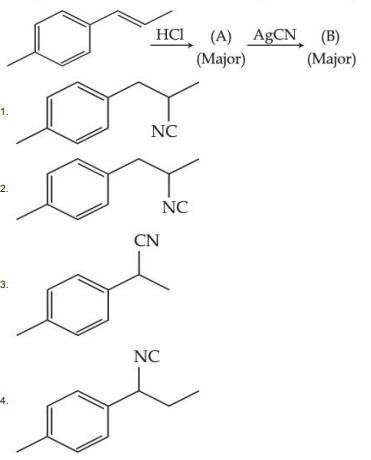
(3)
Given below are two statements: Statement (I): According to the Law of Octaves, the elements were arranged in the increasing order of their atomic number.
Statement (II): Meyer observed a periodically repeated pattern upon plotting physical properties of certain elements against their respective atomic numbers. In the light of the above statements, choose the correct answer from the options given below:
Identify the inorganic sulphides that are yellow in colour:
(A) \( (\text{NH}_4)_2\text{S} \)
(B) \( \text{PbS} \)
(C) \( \text{CuS} \)
(D) \( \text{As}_2\text{S}_3 \)
(E) \( \text{As}_2\text{S}_5 \)
Choose the correct answer from the options given below:
Identify correct conversion during acidic hydrolysis from the following: (A) Starch gives galactose.
(B) Cane sugar gives equal amount of glucose and fructose.
(C) Milk sugar gives glucose and galactose.
(D) Amylopectin gives glucose and fructose.
(E) Amylose gives only glucose.
Choose the correct answer from the options given below:
Match List - I with List - II. \[ \begin{array}{|c|c|} \hline \textbf{List - I (Complex)} & \textbf{List - II (Hybridisation)}
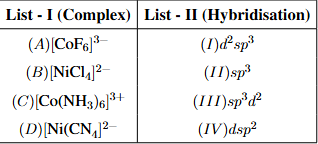
Choose the correct answer from the options given below:
An ideal gas undergoes a cyclic transformation starting from point A and coming back to the same point by tracing the path A→B→C→D→A as shown in the three cases below.
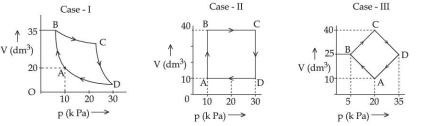
Choose the correct option regarding \(\Delta U\):
Identify correct statements: (A) Primary amines do not give diazonium salts when treated with \(\text{NaNO}_2\) in acidic condition.
(B) Aliphatic and aromatic primary amines on heating with \(\text{CHCl}_3\) and ethanolic \(\text{KOH}\) form carbylamines.
(C) Secondary and tertiary amines also give carbylamine test.
(D) Benzenesulfonyl chloride is known as Hinsberg’s reagent.
(E) Tertiary amines react with benzenesulfonyl chloride very easily.
Choose the correct answer from the options given below:
Consider an elementary reaction: \[ A(g) + B(g) \rightarrow C(g) + D(g) \] If the volume of the reaction mixture is suddenly reduced to \( \frac{1}{3} \) of its initial volume, the reaction rate will become \( x \) times of the original reaction rate. The value of \( x \) is:
The purification method based on the following physical transformation is: \[ \text{Solid} \xrightarrow{\text{Heat}} \text{Vapour} \xrightarrow{\text{Cool}} \text{Solid} \]
The major product of the following reaction is:
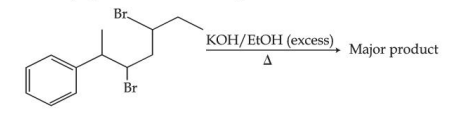
Given below are two statements: Statement (I): 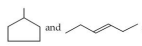 are isomeric compounds.
Statement (II):  are functional group isomers.
In the light of the above statements, choose the correct answer from the options given below:
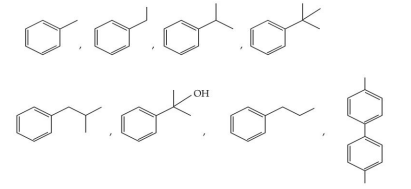
The total number of compounds from below when treated with hot KMnO4 giving benzoic acid is:
Match List - I with List - II. \[ \text{List - I (Saccharides)} \quad \text{List - II (Glycosidic-linkages found)} \] \[ \text{(A) Sucrose} \quad \text{(I) } \alpha 1-4 \] \[ \text{(B) Maltose} \quad \text{(II) } \alpha 1-4 \text{ and } \alpha 1-6 \] \[ \text{(C) Lactose} \quad \text{(III) } \alpha 1-\beta 2 \] \[ \text{(D) Amylopectin} \quad \text{(IV) } \beta 1-4 \] Choose the correct answer from the options given below:
Which of the following is/are correct with respect to the energy of atomic orbitals of a hydrogen atom? (A) \( 1s < 2s < 2p < 3d < 4s \)
(B) \( 1s < 2s = 2p < 3s = 3p \)
(C) \( 1s < 2s < 2p < 3s < 3p \)
(D) \( 1s < 2s < 4s < 3d \) Choose the correct answer from the options given below:
Arrange the following in increasing order of solubility product: \[ \text{Ca(OH)}_2, \text{AgBr}, \text{PbS}, \text{HgS} \]
Concentrated nitric acid is labelled as 75% by mass. The volume in mL of the solution which contains 30 g of nitric acid is: Given: Density of nitric acid solution is 1.25 g/mL.
Assume a living cell with 0.9% (\(w/w\)) of glucose solution (aqueous). This cell is immersed in another solution having equal mole fraction of glucose and water. (Consider the data up to first decimal place only) The cell will:
The spin-only magnetic moment (\(\mu\)) value (B.M.) of the compound with the strongest oxidising power among \(Mn_2O_3\), \(TiO\), and \(VO\) is ______ B.M. (Nearest integer).
Consider the following data: - Heat of formation of \( CO_2(g) \) = -393.5 kJ mol\(^{-1}\) - Heat of formation of \( H_2O(l) \) = -286.0 kJ mol\(^{-1}\) - Heat of combustion of benzene = -3267.0 kJ mol\(^{-1}\) The heat of formation of benzene is ______ kJ mol\(^{-1}\) (Nearest integer).
Total number of molecules/species from the following which will be paramagnetic is ______. \[ O_2, O_2^+, O_2^-, NO, NO_2, CO, K_2[NiCl_4], [Co(NH_3)_6]Cl_3, K_2[Ni(CN)_4] \]
A group 15 element forms \( d\pi - d\pi \) bond with transition metals. It also forms a hydride, which is the strongest base among the hydrides of other group members that form \( d\pi - d\pi \) bonds. The atomic number of the element is ______.
Electrolysis of 600 mL aqueous solution of NaCl for 5 min changes the pH of the solution to 12. The current in Amperes used for the given electrolysis is ______. (Nearest integer).


Also Check: Good Score in JEE Main 2025
JEE Main 28th Jan Shift 2 Paper Analysis- Check Difficulty Level and Good Score
The question paper consisted of a total of 75 questions, divided equally across the three subjects:
- The Mathematics section in JEE Main 2025 28th Jan Shift 2 Question Paper was Tough with 9 questions coming majorly from topics like Integration, Probability, etc.
- Physics was Moderate with 14 questions coming majorly from topics like Ray Optics, Gravity, Magnetism, etc.
- Chemistry was Moderate with 8 questions coming majorly from topics like Organic Chemistry, Physical Chemistry, etc.
Each section included a mix of multiple-choice questions (MCQs) and numerical value-based questions, offering a balanced challenge for students.
Check: JEE Main 28th Jan Shift 1 Question Paper
JEE Main 2025: Shift-Wise Analysis
| Session | Shift | Difficulty Trend (Physics, Chemistry, Mathematics) |
Overall Difficulty |
|---|---|---|---|
| January | 22nd January Shift 1 |
|
Moderate |
| January | 22nd January Shift 2 |
|
Moderate |
| January | 23rd January Shift 1 |
|
Moderate |
| January | 23rd January Shift 2 |
|
Moderate |
| January | 24th January Shift 1 |
|
Moderate |
| January | 24th January Shift 2 |
|
Moderate |
| January | 28th January Shift 1 |
|
Tough |
| January | 28th January Shift 2 |
|
Tough |
| January | 29th January Shift 1 |
|
Moderate to Tough |
| January | 29th January Shift 2 |
|
Moderate to Tough |



Comments