




JEE Main 2024 6 April Shift 1 Physics question paper with solutions and answers pdf is available here. NTA conducted JEE Main 2024 6 April Shift 1 exam from 9 AM to 12 PM. The Physics question paper for JEE Main 2024 6 April Shift 1 includes 30 questions divided into 2 sections, Section 1 with 20 MCQs and Section 2 with 10 numerical questions. Candidates must attempt any 5 numerical questions out of 10. The memory-based JEE Main 2024 question paper pdf for the 6 April Shift 1 exam is available for download using the link below.
Related Links:
- JEE Main 2025 Question Paper pdf with solutions
- JEE Main Previous Years Question Paper with Solution PDF
JEE Main 2024 6 April Shift 1 Physics Question Paper PDF Download
| JEE Main 2024 6 April Shift 1 Physics Question Paper with Solutions PDF | Download PDF | Check Solutions |
JEE Main 6 April Shift 1 2024 Physics Questions with Solution
A particle of mass \( m \) is situated on the earth's surface. Find the minimum kinetic energy required so that it can escape from the earth's surface.
View Solution
Step 1: Escape velocity formula.
The escape velocity \( V_e \) is given by the formula: \[ V_e = \sqrt{\frac{2GM}{R}} \]
Step 2: Kinetic energy required.
The minimum kinetic energy required for the particle to escape is given by: \[ KE = \frac{1}{2} mv_e^2 \]
Substituting the value of \( V_e \), we get: \[ KE = \frac{1}{2} m \times \frac{2GM}{R} = \frac{GMm}{R} \]
Step 3: Conclusion.
Thus, the minimum kinetic energy required for the particle to escape the earth’s surface is \( \frac{GMm}{R} \).
Quick Tip: Escape velocity is the minimum velocity an object needs to escape from a celestial body’s gravitational influence, and it is derived from the gravitational potential energy and kinetic energy balance.
Which of the following does not explain the wave theory of a particle?
Which of the above phenomena represent particle nature?
In a prism, the ratio of minimum deviation and prism angle is \( \sqrt{3} \), and the refractive index of the prism is \( \sqrt{3} \). Find the prism angle \( A \).
Speed of wave in a medium is \( 1.5 \times 10^8 \, m/s \). Relative permittivity of medium \( (\epsilon_r) \) is 2. Find the value of relative permeability.
There is a pulley block system where \( m_1 > m_2 \) and the acceleration of block \( m_1 \) is \( \frac{g}{\sqrt{2}} \) upward. Find the ratio of \( m_1 \) to \( m_2 \).
View Solution
Step 1: Write the equation for acceleration.
The acceleration of the block is given by the formula: \[ a = \frac{(m_2 - m_1)}{(m_1 + m_2)} g \]
Step 2: Substitute the given values.
We are given that the acceleration of block \( m_1 \) is \( \frac{g}{\sqrt{2}} \). So, we substitute \( a = \frac{g}{\sqrt{2}} \) into the equation: \[ \frac{g}{\sqrt{2}} = \frac{(m_2 - m_1)}{(m_1 + m_2)} g \]
Step 3: Simplify the equation.
Canceling \( g \) from both sides: \[ \frac{1}{\sqrt{2}} = \frac{(m_2 - m_1)}{(m_1 + m_2)} \]
Step 4: Rearrange to solve for \( \frac{m_1}{m_2} \).
Cross-multiplying: \[ 1 = \sqrt{2} - \sqrt{2} \left( \frac{m_1}{m_2} \right) \]
Simplifying: \[ 1 + \frac{m_1}{m_2} = \sqrt{2} - \sqrt{2} \left( \frac{m_1}{m_2} \right) \]
Step 5: Solve for the ratio \( \frac{m_1}{m_2} \).
Solving this gives us: \[ \frac{m_1}{m_2} = \frac{\sqrt{2} - 1}{\sqrt{2} + 1} \]
Step 6: Conclusion.
The ratio of \( m_1 \) to \( m_2 \) is: \[ m_1 : m_2 = 3 - 2\sqrt{2} \] Quick Tip: In pulley systems, the acceleration depends on the relative masses of the blocks. By applying Newton's laws, you can derive a relationship between the masses and the acceleration.
A particle is performing SHM with amplitude \( A = 0.6 \) m and time period \( T = \pi \). Find the maximum velocity.
View Solution
Step 1: Use the time period formula.
The time period \( T \) is related to the angular frequency \( \omega \) by the formula: \[ T = \frac{2\pi}{\omega} \]
Given that \( T = \pi \), we substitute this value into the equation: \[ \pi = \frac{2\pi}{\omega} \]
Step 2: Solve for \( \omega \).
Rearranging the equation: \[ \omega = 2 \, rad/s \]
Step 3: Find the maximum velocity.
The maximum velocity \( v_{max} \) in SHM is given by: \[ v_{max} = \omega A \]
Substituting the values of \( \omega = 2 \, rad/s \) and \( A = 0.6 \, m \), we get: \[ v_{max} = 2 \times 0.6 = 1.2 \, m/s \]
Step 4: Conclusion.
Thus, the maximum velocity is \( 1.2 \, m/s \).
Quick Tip: The maximum velocity in SHM is directly proportional to the amplitude and angular frequency.
Find the ratio of the shortest wavelength of the Lyman series to the shortest wavelength of the Balmer series.
The initial velocity of a particle is 100 m/s. After some time it changes to 40 m/s. What is the percentage change in its kinetic energy? The mass of the particle is 40 gm.
View Solution
Step 1: Use the formula for percentage change in kinetic energy.
The percentage change in kinetic energy is given by: \[ % \Delta K = \frac{K_f - K_i}{K_i} \times 100 \]
Step 2: Write the kinetic energy formula.
The kinetic energy is given by \( K = \frac{1}{2} mv^2 \). So, the initial and final kinetic energies are: \[ K_i = \frac{1}{2} m v_i^2 \quad and \quad K_f = \frac{1}{2} m v_f^2 \]
Thus, the percentage change becomes: \[ % \Delta K = \frac{\frac{1}{2} m v_f^2 - \frac{1}{2} m v_i^2}{\frac{1}{2} m v_i^2} \times 100 \]
Step 3: Simplify the expression.
\[ % \Delta K = \left( \frac{v_f^2}{v_i^2} - 1 \right) \times 100 \]
Step 4: Substitute the given values.
Substitute \( v_i = 100 \, m/s \) and \( v_f = 40 \, m/s \): \[ % \Delta K = \left( \frac{(40)^2}{(100)^2} - 1 \right) \times 100 = \left( \frac{1600}{10000} - 1 \right) \times 100 \]
Step 5: Final Calculation.
\[ % \Delta K = \left( \frac{4}{25} - 1 \right) \times 100 = \left( -\frac{21}{25} \right) \times 100 = -84% \]
Step 6: Conclusion.
Thus, the percentage change in kinetic energy is \( -84% \), indicating a decrease in kinetic energy.
Quick Tip: When calculating percentage change in kinetic energy, ensure to square the velocities and take the difference before calculating the percentage.
In the circuit below, the potential at B and the potential at D are the same. Find the value of resistance \( x \).

View Solution
Step 1: Use Wheatstone Bridge condition.
Since the potential at B and D are the same, this is a Wheatstone bridge. In a Wheatstone bridge, the following condition holds: \[ R_{AB} \times R_{CD} = R_{BC} \times R_{AD} \]
Step 2: Substituting known values.
From the circuit, we have: \[ R_{AB} = 6 \, \Omega, \quad R_{BC} = \frac{1}{2} \, \Omega, \quad R_{CD} = 0.5 \, \Omega \]
Let \( R_{AD} = x + 3 \, \Omega \), as given in the problem. Substituting these values into the Wheatstone bridge condition: \[ 6 \times 0.5 = 0.5 \times (x + 3) \]
Step 3: Simplify the equation.
\[ 3 = 0.5 \times (x + 3) \]
Multiplying both sides by 2: \[ 6 = x + 3 \]
Step 4: Solve for \( x \).
\[ x = 3 \, \Omega \]
Step 5: Conclusion.
Thus, the value of \( x \) is \( 3 \, \Omega \).
Quick Tip: In a Wheatstone bridge, the condition for balanced bridge is \( \frac{R_1}{R_2} = \frac{R_3}{R_4} \).
There are 3 infinite sheets of charge density \( -\sigma \), \( -2\sigma \), and \( \sigma \) respectively. Then find the electric field at point P (as shown in figure) [Sheets are non-conducting].

View Solution
Step 1: Understanding the problem.
The electric field due to an infinite sheet of charge with surface charge density \( \sigma \) is given by: \[ E = \frac{\sigma}{2 \epsilon_0} \]
For a non-conducting sheet, the electric field points away from the sheet if the charge density is positive, and towards the sheet if the charge density is negative.
Step 2: Electric field contributions.
The electric field due to the three sheets at point \( P \) can be determined by considering the contributions from each sheet individually. The field due to each sheet is constant and directed as follows:
- The sheet with charge density \( -\sigma \) produces an electric field directed towards the sheet.
- The sheet with charge density \( -2\sigma \) produces an electric field directed towards the sheet (but stronger).
- The sheet with charge density \( \sigma \) produces an electric field directed away from the sheet.
Step 3: Calculating the total electric field.
At point \( P \), the electric field due to each sheet adds up according to the principle of superposition:
\[ E_{net} = E_1 + E_2 + E_3 \]
Where: \[ E_1 = \frac{\sigma}{2 \epsilon_0}, \quad E_2 = \frac{2\sigma}{2 \epsilon_0}, \quad E_3 = \frac{\sigma}{2 \epsilon_0} \]
Adding these contributions: \[ E_{net} = \frac{\sigma}{2 \epsilon_0} + \frac{2\sigma}{2 \epsilon_0} + \frac{\sigma}{2 \epsilon_0} = \frac{4\sigma}{2 \epsilon_0} = \frac{2\sigma}{\epsilon_0} \]
Step 4: Conclusion.
Thus, the net electric field at point \( P \) is: \[ E_{net} = \frac{2\sigma}{\epsilon_0} \] Quick Tip: The electric field due to an infinite sheet of charge is constant in magnitude and direction, regardless of the distance from the sheet. The direction depends on the sign of the charge density.
He gas and O\(_2\) gas are at the same temperature. Find the ratio of their rms speed of molecules.
View Solution
Step 1: Use the formula for rms speed.
The root mean square (rms) speed \( v_{rms} \) of molecules is given by: \[ v_{rms} = \sqrt{\frac{3RT}{M}} \]
where \( R \) is the gas constant, \( T \) is the temperature, and \( M \) is the molar mass of the gas.
Step 2: Relationship between rms speeds of He and O\(_2\).
Since both gases are at the same temperature, the ratio of their rms speeds is: \[ \frac{v_{rms, He}}{v_{rms, O_2}} = \sqrt{\frac{M_{O_2}}{M_{He}}} \]
Step 3: Substituting the molar masses.
The molar mass of \( O_2 \) is \( 32 \, g/mol \), and the molar mass of He is \( 4 \, g/mol \). So: \[ \frac{v_{rms, He}}{v_{rms, O_2}} = \sqrt{\frac{32}{4}} = \sqrt{8} = 2\sqrt{2} \]
Step 4: Conclusion.
Thus, the ratio of the rms speeds is \( \sqrt{2} \).
Quick Tip: For gases at the same temperature, the rms speed is inversely proportional to the square root of the molar mass.
Which of the following materials is not a semiconductor?
If the 4 masses \( m, \frac{m}{2}, 2m, 4m \) have the same momentum, which of the following will have maximum kinetic energy?
Match the column. \[ Quantity \quad Dimensional Formula
(i) Torque \quad (a) [M L^2 T^{-2}]
(ii) Magnetic field \quad (b) [M A^{-1} T^{-2}]
(iii) Magnetic moment \quad (c) [M L^2 T^0 A]
(iv) Permeability \quad (d) [M L^3 T^{-2} A^{-2}] \]
View Solution
Step 1: Torque.
The dimensional formula for torque is \( [M L^2 T^{-2}] \), which corresponds to option (a).
Step 2: Magnetic field.
The dimensional formula for magnetic field is \( [M A^{-1} T^{-2}] \), which corresponds to option (b).
Step 3: Magnetic moment.
The dimensional formula for magnetic moment is \( [M L^2 T^0 A] \), which corresponds to option (c).
Step 4: Permeability.
The dimensional formula for permeability is \( [M L^3 T^{-2} A^{-2}] \), which corresponds to option (d).
Step 5: Conclusion.
Thus, the correct matching is: \[ (i) \to (a), \, (ii) \to (b), \, (iii) \to (c), \, (iv) \to (d) \] Quick Tip: To match quantities with their dimensional formulas, remember that torque, magnetic field, and magnetic moment all have specific units that relate to mass, length, time, and current.
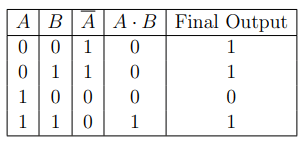
Find out the truth table.

View Solution
The circuit contains the following logic gates:
- Inverter (NOT gate) on input \( A \),
- AND gate for \( A \) and \( B \),
- OR gate for the output of the NOT gate and the AND gate.
Step 1: Truth Table Analysis.
For \( A = 0 \) and \( B = 0 \),
- \( A = 0 \),
- \( \overline{A} = 1 \),
- \( A \cdot B = 0 \),
- Final output = \( 1 \).
For \( A = 0 \) and \( B = 1 \),
- \( A = 0 \),
- \( \overline{A} = 1 \),
- \( A \cdot B = 0 \),
- Final output = \( 1 \).
For \( A = 1 \) and \( B = 0 \),
- \( A = 1 \),
- \( \overline{A} = 0 \),
- \( A \cdot B = 0 \),
- Final output = \( 0 \).
For \( A = 1 \) and \( B = 1 \),
- \( A = 1 \),
- \( \overline{A} = 0 \),
- \( A \cdot B = 1 \),
- Final output = \( 1 \).
Step 2: Truth Table.
 Quick Tip: In logic circuits, the output of the NOT gate is the opposite of the input, the AND gate outputs 1 only when both inputs are 1, and the OR gate outputs 1 when at least one input is 1.
Given \( T = 2\pi \sqrt{\frac{m}{K}} \), if \( m \) decreases by 1% and time period \( T \) increases by 2%, find the percentage change in \( K \).
View Solution
Step 1: Given relation.
The time period is given by: \[ T = 2\pi \sqrt{\frac{m}{K}} \]
Step 2: Differentiation with respect to time.
Differentiating both sides with respect to time: \[ \frac{dT}{T} = \frac{1}{2} \left( \frac{dm}{m} - \frac{dK}{K} \right) \]
Step 3: Substitute given values.
We are given that \( m \) decreases by 1% and \( T \) increases by 2%. So: \[ \frac{dm}{m} = -1% \quad and \quad \frac{dT}{T} = +2% \]
Substitute these into the equation: \[ 2% = \frac{1}{2} \left( -1% - \frac{dK}{K} \right) \]
Step 4: Solve for \( \frac{dK}{K} \).
\[ 2% = -\frac{1}{2} \left( 1% + \frac{dK}{K} \right) \]
Simplifying: \[ 2% = -\frac{1}{2} \times 1% - \frac{1}{2} \times \frac{dK}{K} \] \[ 2% + \frac{1}{2} \times 1% = -\frac{1}{2} \times \frac{dK}{K} \] \[ 2% + 0.5% = -\frac{1}{2} \times \frac{dK}{K} \] \[ 2.5% = -\frac{1}{2} \times \frac{dK}{K} \] \[ \frac{dK}{K} = -5% \]
Step 5: Conclusion.
Thus, \( K \) decreases by 5%.
Quick Tip: When calculating percentage changes in variables like \( m \), \( K \), or \( T \), use the method of differentiation to find the relationship between changes in variables.
A train starting from rest first accelerates up to speed 80 km/h for time \( t \), then it moves with a constant speed for time \( 3t \). The average speed of the train for this duration of journey will be:
A big drop is made out of 1000 small drops, if the ratio of total surface energy of droplets and surface energy of the big drop is \( 10/x \), then find the value of \( x \).
View Solution
Step 1: Understand the relationship between the radii.
The surface energy of a droplet is proportional to the square of its radius. If a big drop is made from 1000 small drops, the ratio of surface energy is related to the ratio of the radii. We can write: \[ \frac{1000 \times \frac{4}{3} \pi r^2}{\frac{4}{3} \pi R^2} = \frac{10}{x} \]
Step 2: Simplify the equation.
\[ \frac{r^3}{R^3} = \frac{10}{x} \]
Given that the big drop radius \( R = 10r \), we can substitute this into the equation: \[ \left( \frac{r}{R} \right)^3 = \left( \frac{1}{10} \right)^3 \]
Thus: \[ R = 10r \]
Step 3: Surface energy comparison.
Now, we calculate the ratio of the surface energies: \[ \frac{surface energy final}{surface energy initial} = \frac{T(4 \pi R^2)}{1000 \times T(4 \pi r^2)} = \frac{10}{x} \]
Substituting the value for \( R \), we get: \[ \frac{(10r)^2}{1000 r^2} = \frac{10}{x} \]
Simplifying further: \[ \frac{100}{1000} = \frac{10}{x} \]
Thus, \[ x = 100 \]
Step 4: Conclusion.
Therefore, \( x = 100 \).
Quick Tip: When combining small droplets into a bigger droplet, the radius of the larger droplet increases, but the total surface area does not increase proportionally due to the surface energy relationship.
The frequency of the electron in the first Bohr orbit in the H-atom is:
While measuring the diameter of a wire using a screw gauge, the following readings were noted:
- Main scale reading is 1 mm,
- Circular scale reading is equal to 42 divisions.
Pitch of screw gauge is 1mm and it has 100 divisions on the circular scale.
Find the diameter of the wire. The value of \( x \) is:
A hydrogen atom having energy \( E \) in the ground state, when it is revolving at a radius of orbit \( r = 8.48 \, Å \). Its energy becomes \( \frac{E}{x} \). Find the value of \( x \).
Energy incident on metal surface is 2.48 eV and the stopping potential is 0.5 V. Find the work function.
View Solution
Step 1: Use the photoelectric equation.
The energy of the incident light is related to the work function \( \varphi \) and the maximum kinetic energy of the emitted electrons by the equation: \[ E = K.E_{max} + \varphi \]
where \( E \) is the incident energy and \( K.E_{max} \) is the maximum kinetic energy of the electrons.
Step 2: Use the stopping potential.
The maximum kinetic energy \( K.E_{max} \) is related to the stopping potential \( V_s \) by: \[ K.E_{max} = eV_s \]
Substitute \( V_s = 0.5 \, V \) into the equation: \[ K.E_{max} = (0.5) \, eV = 0.5 \, eV \]
Step 3: Solve for the work function.
Substitute into the photoelectric equation: \[ 2.48 \, eV = 0.5 \, eV + \varphi \]
Solving for \( \varphi \): \[ \varphi = 2.48 \, eV - 0.5 \, eV = 1.98 \, eV \]
Step 4: Conclusion.
Thus, the work function is \( \varphi = 1.98 \, eV \).
Quick Tip: The work function is the minimum energy required to release an electron from the surface of a metal. It can be calculated using the energy of incident light and the stopping potential.
Statement 1: Inductor has maximum current at resonance frequency.
Statement 2: Current in a purely resistive circuit can never be less than the current in series in an LRC circuit.
Which of the following is correct?
View Solution
Step 1: Statement 1 - Inductor at resonance frequency.
In an LRC circuit, at the resonance frequency, the inductive reactance (\(X_L\)) and capacitive reactance (\(X_C\)) are equal and cancel each other out. Hence, the current is maximum at this frequency because the total impedance is at its minimum. Therefore, Statement 1 is correct.
Step 2: Statement 2 - Current in purely resistive circuit.
In a purely resistive circuit, the current is determined solely by the resistance, and it cannot be less than the current in a series LRC circuit where the total impedance is greater due to the inductive and capacitive reactance. Therefore, Statement 2 is also correct.
Step 3: Conclusion.
Thus, both statements are correct, and the correct answer is option (3).
Quick Tip: In an LRC circuit, resonance occurs when the inductive reactance equals the capacitive reactance, resulting in maximum current at resonance frequency.
A thin spherical shell (conducting) having charge density \( \sigma \). Find the electric field at the surface of the shell.
Also Check:
| JEE Main 2024 Paper Analysis | JEE Main 2024 Answer Key |
| JEE Main 2024 Cutoff | JEE Main 2024 Marks vs Rank |
JEE Main 2024 6 April Shift 1 Physics Question Paper by Coaching Institute
| Coaching Institutes | Question Paper with Solutions PDF |
|---|---|
| Aakash BYJUs | Download PDF |
| Vedantu | Download PDF |
| Reliable Institute | To be updated |
| Resonance | To be updated |
| Sri Chaitanya | To be updated |
| FIIT JEE | To be updated |
JEE Main 2024 6 April Shift 1 Physics Paper Analysis
JEE Main 2024 6 April Shift 1 Physics paper analysis is updated here with details on the difficulty level of the exam, topics with the highest weightage in the exam, section-wise difficulty level, etc.
JEE Main 2024 Physics Question Paper Pattern
| Feature | Question Paper Pattern |
|---|---|
| Examination Mode | Computer-based Test |
| Exam Language | 13 languages (English, Hindi, Assamese, Bengali, Gujarati, Kannada, Malayalam, Marathi, Odia, Punjabi, Tamil, Telugu, and Urdu) |
| Sectional Time Duration | None |
| Total Marks | 100 marks |
| Total Number of Questions Asked | 30 Questions |
| Total Number of Questions to be Answered | 25 questions |
| Type of Questions | MCQs and Numerical Answer Type Questions |
| Section-wise Number of Questions | 20 MCQs and 10 numerical type, |
| Marking Scheme | +4 for each correct answer |
| Negative Marking | -1 for each incorrect answer |
Read More:
- JEE Main 2024 question paper pattern and marking scheme
- Most important chapters in JEE Mains 2024, Check chapter wise weightage here



Comments