



Education Journalist | Study Abroad Lead
Maltose, a disaccharide, is formed from two units of glucose molecules. It is also known by other names like Cextromaltose, Maltobiose, Maltodiose, or D-Maltose. Maltose appears in the form of white powder or crystals. It is a reducing sugar. This article will deal with the important sub-topics of maltose such as its structure, properties, uses, and also some previous years’ questions asked on this topic.
| Table of Content |
Key Terms: Glucose, Fructose, Sucrose, Maltose, Sugar, Starch, glycosidic, carbon, Cextromaltose, Maltobiose, Maltodiose, D-Maltose
What is Maltose?
[Click Here for Sample Questions]
Maltose is a disaccharide, made up of two α-D-glucose units linked by glycosidic linkage. Here, glucose units are linked by 1 and 4 carbons of the glucose units (i.e. 1st carbon of one glucose unit and 4th carbon of another glucose unit). A free aldehyde group is produced at 1st carbon of the second glucose unit. The presence of this free aldehyde group makes maltose a reducing sugar.
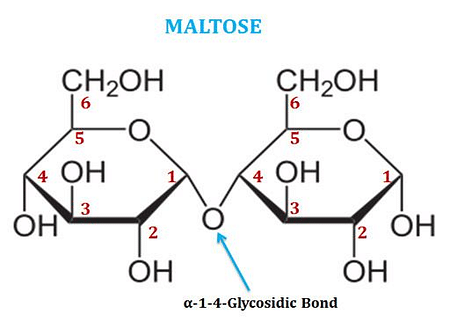
Maltose having a glycosidic bond
Read More:
| Chapter Related Concepts | ||
|---|---|---|
| Carbohydrate Metabolism | RNA and DNA | |
| Cellulose | Saturated and Unsaturated Fat | Sucrose |
Formula and Structure of Maltose
[Click Here for Sample Questions]
As stated above maltose is a disaccharide made up of two α-D-glucose units and the formula of maltose is: C12H22O11
Structure of Maltose (C12H22O11)
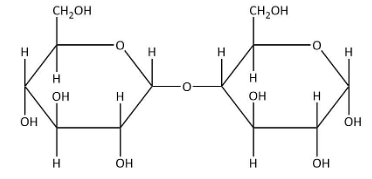
Maltose Structure
Production of Maltose
[Click Here for Sample Questions]
The name maltose is derived from the word ‘malt’. The suffix ‘ose’ was added to describe that maltose belonged to the sugar category, the important biochemical series of glucose chains. The preparation of maltose is done in the presence of the enzyme diastase by the hydrolysis of starch. Starch is also heated for several minutes with a strong acid and it breaks down to form two molecules of glucose. The maltase enzyme is used for the process in living beings.
Physical and Chemical Properties of Maltose
[Click Here for Sample Questions]
- Maltose is a reducing sugar because one of its glucose units has a free aldehyde group.
- Maltose appears in the form of white powder or crystals.
- On reaction with sulphuric acid maltose results in the formation of carbon dioxide, water, and sulphur dioxide:
C12H22O11 + 24H2SO4 → 12CO2 + 35H2O + 24SO2
- Hydrolysis of maltose results in the formation of ethanol and carbon dioxide:
C12H22O11 + H2O → 4C2H5OH + 4CO2
- Maltase enzyme acts as a catalyst and results in hydrolysis of maltose into glucose:
C12H22O11 + H2O → 2C12H22O11
- Some other properties of maltose -
- Molar mass: 342.297 g.mol-1
- Density: 1.54 g.cm-3
- Solubility in Water: 1.080 g/mL (at 20 °C)
- Melting Point: 160-165 °C
- Chiral Rotation: +140.7° [α]D
- Odour: No odour
- Heat Capacity: 298.15K
- Taste: Sweet taste (30 – 60% as sweet as sugar)
- Detection Test: Woehik test or Fearon’s test
Uses of Maltose
[Click Here for Sample Questions]
- Maltose is used as a low-cost sugar source in the form of corn syrup.
- For making beer, maltose is used in the malting process of barley, the malting process adds sweetness to the beer.
- Due to its caramel-like taste, it is used in bakeries, soft drinks, sweets, alcoholic drinks, and infant food, and also added to sugar-free products.
- During the germination of seeds, maltose is synthesized by an enzyme called amylase, which hydrolyzes starch to disaccharide for the new plants.
- Starch is partially transformed into maltose by amylase during digestion and maltase secreted by the intestine converts maltose into glucose, this glucose is either utilized by the body or gets stored in the liver as glycogen.
Structural Difference Between Sucrose, Lactose and Maltose
[Click Here for Sample Questions]
Sucrose, lactose, and maltose are all disaccharides made up of glucose units. They differentiate from each other based on their structure:
- Two molecules of glucose form maltose.
- A molecule of fructose and a molecule of glucose combine to form sucrose.
- A molecule of galactose and a molecule of glucose combine to form lactose.
Difference between Cellobiose and Maltose
Cellobiose and Maltose are both formed by glucose and both of them are linked by C1 of one glucose and C4 of the other one. However, they both are different from each other as in cellobiose the first glucose unit is the beta anomer while in maltose it’s the alpha anomer of glucose.
Things to Remember
- Maltose is a disaccharide made up of two units of α-D-glucose.
- The two units of glucose in maltose are connected by glycosidic linkage.
- The formula of maltose is : C12H22O11
- The presence of the free aldehydic group makes maltose a reducing sugar.
- The presence of maltose can be tested by Fehling’s solution or Tollen’s reagent test.
- It is used in the process of beer preparation and also in sugar-free items (due to its low sugar content).
- Maltose plays an important role in the germination and digestion process.
Also Read:
Sample Questions
Ques. Name the product formed during the hydrolysis of maltose? (1 mark)
Ans. Maltose on hydrolysis in the presence of maltase forms two molecules of glucose.
C12H22O11 + H2O → 2C12H22O11
Ques. Give an example of reducing and non-reducing sugars. (2 marks)
Ans. Reducing sugar: Maltose or Lactose,
Non-reducing sugar: Sucrose.
Ques. What is glycosidic linkage? (2 marks)
Ans. When two monosaccharide units are joined together, an oxide linkage is formed by the loss of a water molecule. This linkage between two monosaccharide units through an oxygen atom is called glycosidic linkage.
Ques. What is essentially the difference between the α-form of glucose and the β-form of glucose? Explain. (2 marks)
Ans. Glucose is found to exist in two different crystalline forms which are named α and β. The two forms differ from each other in the orientation of the -OH group at C-1. Moreover, the α-form is obtained by crystallization from a concentrated solution of glucose at 303K while the β-form is obtained by crystallization from hot and saturated solution at 371K.

Ques. How can reducing and non-reducing sugars be distinguished? Mention the structural features characterizing reducing sugars. (3 marks)
Ans. Reducing sugars- The sugars which reduce Fehling’s solution and Tollen’s reagent are called reducing sugars, e.g. all monosaccharides containing free aldehyde or Ketone groups are reducing sugars. So, the presence of a free aldehyde or ketone group is the main feature of reducing sugars.
Non-reducing sugars- The sugars which do not reduce Fehling’s solution or Tollen’s reagent are called non-reducing sugars, e.g. sucrose. In non-reducing sugars, reducing groups of monosaccharides, i.e. aldehydic or ketonic groups are bonded.
Ques. Name the products of hydrolysis of lactose. (2 marks)
Ans. On hydrolysis with dilute acids, lactose gives an equimolar mixture of D-glucose and D-galactose.

For Latest Updates on Upcoming Board Exams, Click Here: https://t.me/class_10_12_board_updates
Check-Out:



Comments