



Content Curator
Brown ring test is a commonly used experiment in order to evaluate the level of nitrate ion in a particular solution. Since almost all nitrates are soluble in water, hence determining the presence of nitrate by wet chemistry is more difficult than testing for other anions. As nitrate anion can be referred to as an oxidizer, a lot of nitrate anion test depends on this feature. The presence of any other analyte may lead to an inaccurate reading.
| Table of Content |
Keyterms: Brown ring test, Nitrate ion, Nitrate anion, Nitrate, Oxidizer, Analyte, Nitric acid, Nitro-glycerine, Trinitrotoluene, Ammonium nitrate, Fertilizers, Nitro compounds
Read More: Uses of Amines
Uses of Nitric Acid in Brown Ring Test
[Click Here for Sample Questions]
- Nitric acid is most commonly used in the production of ammonium nitrate for fertilizers and other nitrates for explosives and pyrotechnics.
- Nitro-glycerine, trinitrotoluene, and other organic nitro compounds can also be made with it.
- Pickling stainless steel, etching metals, and as an oxidizer in rocket fuels are some of the other important applications.
Also Read:
| Related Articles | ||
|---|---|---|
| Sulphonation | Diazotisation | Group 15 Elements |
| Nitro Compounds | Amide | Azo Compound |
Brown Ring Test Description
[Click Here for Sample Questions]
The presence of nitrate ions is detected by the production of a brown ring at the junction of two layers of the solution, as the name suggests. The development of brown-colored iron complexes, also known as brown ring complexes, results in the formation of this brown-colored ring. For up to 2.5 micrograms and a concentration of 1 in 25,000 parts, this test is useful.
- It's done by gently adding concentrated sulfuric acid to a nitrate solution, then slowly adding iron(II) sulfate until the acid forms a layer below the aqueous solution.
- The existence of the nitrate ion will be shown by the formation of a brown ring at the junction of the two layers.
- The overall reaction involves the reduction of the nitrate ion by iron (II), which is then reduced to iron (I), as well as the production of the nitro sodium complex, in which nitric oxide is oxidized to NO+.
- The brown ring test for nitrates is based on Fe2+'s capacity to convert nitrates to nitric oxide, which then interacts with Fe2+ to produce a brown-colored complex. The presence of nitrate ions in the solution is shown by a brown ring at the interface between the solution and sulphuric acid layers.
- Pentaaqua nitrosyl iron sulfate is the chemical generated during the brown ring test.
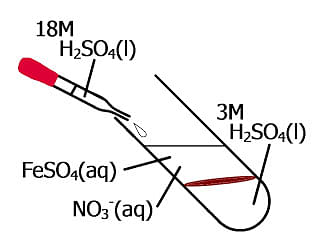
Brown Ring Test
Example of a Brown Ring Test
[Click Here for Sample Questions]
Materials Required
Test tubes, freshly made iron sulfate solution, and strong sulphuric acid.
Principle
The nitrate ion functions as an oxidizing agent; hence the test is based on that fact. Iron (II) reduces the nitrate ion in the reaction mixture, and iron (II) is oxidized to iron (III). When nitric oxide is reduced to NO-, nitrosonium complex is formed, which creates a brown ring at the intersection of two layers.
Procedure for the Brown Ring Test: Nitrate Ion Test
The following steps can be used to conduct a brown ring test for nitrate ions. –
- In a test tube, place a sample in which you suspect nitrate is present.
- Make a new solution of iron sulfate.
- In the sample, mix newly made iron sulfate solution.
- With the test tube tilted, add concentrated sulphuric acid solution along the side to the bottom of the test tube containing the mixture of sample and freshly made iron sulfate solution. Concentrated sulphuric acid is added to the aqueous solution in such a way that it forms a layer beneath it.
- At the intersection of two layers (one layer of iron sulfate solution + sample solution and the second layer of concentrated sulphuric acid solution), a brown ring forms.
Read More: Hofmann bromamide reaction
Observation of Brown Ring Test
[Click Here for Sample Questions]
The presence of nitrate in the sample is confirmed by the development of a brown ring.
Application of Brown Ring Test
[Click Here for Sample Questions]
- You're undoubtedly adding nitrates to the soil when you fertilize plants. What happens to the nitrates, though? Plants use many of them for growth, but others get soaked into the soil. There may be significant amounts of nitrates in the groundwater when there are high quantities of nitrates in the soil. Because high quantities of nitrates are harmful to people, well water should be analyzed to see if the nitrates are above the permissible range.
- Nitrates cannot be tasted, smelled, or seen in the water. If your water has high quantities of sulfur, you will notice it long before it becomes harmful because it will taste and smell bad. However, because nitrates have no taste or odor, we are unaware that we are drinking poisoned water.
- The nitrate level in well water should be examined on a regular basis, and there are numerous techniques for doing so. The Brown Ring Test is the most used test; however, there is also Devarda's diphenylamine, and copper turning tests. These tests merely show whether nitrates are present or not.
- Also, it is used to detect nitrate in a variety of food samples, as well as soil and water. Food sickness is caused by excessive levels of nitrate in food, and high levels of nitrate in the soil make it very acidic, which is damaging to plants and farming. If there are more than 10 milligrams of nitrate compounds per liter in the water, it is not drinkable.
Brown Ring Test Chemical Reaction
[Click Here for Sample Questions]
The nitrate ion is reduced by iron (II), which is subsequently oxidized to iron (III), and a nitrosonium complex is produced, which reduces the nitric oxide to NO.
- 2HNO3 + 3H2SO4 + 6FeSO4 → 3Fe2 (SO4)3 + 2NO + 4H2O: Chemists assumed that nascent oxygen is created in this stage, and that [O] performs the oxidation. Finally, FeSO4 exists in an aqueous solution as [Fe (H2O)6] SO4, which interacts with NO.
- [Fe(H2O)]SO4 + NO → [Fe (H2O)5(NO)]SO4 + H2O: Iron (|||) Penta aqua nitrosyl sulfate is formed in this stage which is a brown colored complex.
- [Fe(H2O)5(NO)]SO4: The brown ring complex. In the 'brown ring' complex, iron has an oxidation state of +3, i.e., Fe(III), and nitrosyl has an oxidation state of +1, simply put, anti-ferromagnetic coupling occurs in the complex between these two ions (Mössbeur Spectroscopy gives total spin= 5/2).
Also Read:
Things to Remember
- The Brown Ring Test is accurate to 2.5 micrograms.
- Sulphuric acid should be added with the test tube tilted.
- The chemicals should be added slowly otherwise wrong reactions can occur.
- Because Barium nitrate has a very poor dissolvability at standard temperature and pressure, it will precipitate as a white-colored residue and will not give a ring test. You will not be able to complete the test if the residue remains in your test tube.
Sample Questions
Ques 1. Explain the Brown Ring Test. (2 marks)
Ans. With the addition of Iron (II) sulfate, the brown ring test can be performed. It should be added to a solution of nitrate and then carefully add H2SO4. This should be added in a way that it becomes a layer below the aqueous solution. The nitrate ion can be determined through the formation of a brown ring at the intersection point of the two layers. This reaction leads to the reduction of iron ion from (II) to (I) and the oxidization of nitric oxide from nitric oxide to Nitrosodium complex (NO+).
Ques 2. The brown ring test is done for the qualitative detection of what? (2 marks)
(a) Bromides
(b) Iodises
(c) Nitrates
(d) Phosphates
Ans. c. Nitrates
NO3-+ 3Fe2+ + 4H+ → NO + 3Fe3+ +2H2O
[Fe(H2O)]2+ + NO → [Fe(H2O)5NO]2+ + H2O
Nitrate ion gets oxidized from (II) to (I) by the addition of ferrous sulfate. It tends to become complex when sulphuric acid is added to it. The brown ring that forms is the complex which can also be denoted as [Fe(H2O)5NO]2+
Ques 3. FeSO4 solution gives a brown-colored ring during the test for nitrates or nitrites. This is due to the formation of: (1 mark)
A. [Fe(H2O)5NO ]+2
B. [Fe(H2O)5NO2]+2
C. [Fe(H2O)4NO2]+2
D. [Fe(H2O)4NO]+2
Ans. A. [Fe(H2O)5NO ]+2
Ques 4. What causes the brown color in the brown ring reaction? (2 marks)
Ans. [Fe(H2O)5NO]2+
A brown ring takes place when the nitrate salt-containing aqueous solution is treated with the ferrous sulfate which has been freshly prepared and concentrated H2SO4. The brown ring forms at the intersection point of the two liquids.
Ques. 5 What is the brown ring test dependant on? (1 mark)
Ans. The brown ring in the brown ring test is dependant on the pentaaquanitrosonim ion. In this reaction, Fe2+ causes a reduction reaction on the nitrate.
For Latest Updates on Upcoming Board Exams, Click Here: https://t.me/class_10_12_board_updates
Do Check Out:



Comments