





The JEE Mains 2027 syllabus with weightage PDF has not been released yet by the National Testing Agency (NTA).
Based on the current pattern, students should expect the syllabus to closely follow the JEE Main 2026 syllabus, which covers Physics, Chemistry, and Mathematics from the Class 11 and Class 12 NCERT curriculum.
NTA usually releases the official syllabus PDF along with the information brochure, expected around October 2026.
- The syllabus is expected to remain the same as JEE Main 2026, since no fresh deletions have been announced.
- Mathematics carries the highest weightage from Calculus, Algebra, and Coordinate Geometry, which together make up close to 40% of the paper.
- The official syllabus PDF will be available at jeemain.nta.ac.in once released.
- NTA had reduced the syllabus in 2024 by removing several chapters to align it with the current NCERT pattern, and this reduced structure is expected to continue for 2027.
Check Out:
- JEE Main Eligibility Criteria- Category-wise, Age Limit, Minimum Marks, Number of Attempts and Reservation
- JEE Main B.E / B.Tech Paper Pattern, Marking Scheme, Sample Questions, Tips, Career Scope
Key Summary
- The JEE Mains 2027 syllabus with weightage PDF is expected to be the same as the JEE Main 2026 syllabus.
- The exam has 3 subjects across Paper 1 (B.E./B.Tech), Paper 2A (B.Arch), and Paper 2B (B.Planning).
- Mathematics has the highest combined weightage (~35-40%) from Calculus, Algebra, and Coordinate Geometry.
- The official syllabus PDF will be available at jeemain.nta.ac.in once NTA releases the 2027 information brochure.
JEE Main Syllabus 2027: Overview
The National Testing Agency conducts JEE Main for admission to NITs, IIITs, and other centrally funded technical institutions.
- JEE Main Paper 1 covers Physics, Chemistry, and Mathematics, based on the Class 11 and Class 12 NCERT curriculum.
- The exam is held in computer-based mode across two sessions, January and April.
- Each subject in Paper 1 carries 25 questions worth 100 marks, taking the total paper to 300 marks. Paper 2A (B.Arch) tests Mathematics, Aptitude, and Drawing, while Paper 2B (B.Planning) tests Mathematics, Aptitude, and Planning. Physics and Chemistry are not part of Paper 2A or Paper 2B.
Ques. Is NCERT enough for JEE Main 2027 preparation?
Ans. NCERT builds the concept base, especially for Chemistry, but you should also solve reference books and previous year papers for numerical practice.
Related Articles:
- Best Books for JEE Main Physics, Chemistry and Mathematics, NCERT PDF Download
- JEE Main B. Arch Exam Pattern, Marking Scheme, Syllabus, Weightage, Career Scope
JEE Main Syllabus 2027: Important Dates
Below are the key dates the students can look forward to for the JEE Main 2027 exam:
- Syllabus expected in October 2026: The official JEE Main 2027 syllabus and information brochure are likely to be released in October 2026.
- Registration starts alongside the syllabus: Session 1 registrations are also expected to begin in October 2026, giving candidates time to complete the application soon after reviewing the syllabus.
- Two exam sessions: JEE Main 2027 is expected to be conducted in two sessions: the last week of January 2027 and early April 2027, allowing students a second attempt to improve their scores.
- Short gap between sessions: With Session 2 registration expected in February 2027, candidates can quickly apply after Session 1 and prepare based on their first-attempt performance.
| Event | Expected Date |
|---|---|
| Syllabus and information brochure release | October 2026 |
| Session 1 registration begins | October 2026 |
| Session 1 exam dates | Last week of January 2027 |
| Session 2 registration begins | February 2027 |
| Session 2 exam dates | Early April 2027 |
| Result declaration | Within 10 days of each session |
Ques. How should I cover the full JEE Main syllabus in one year?
Ans. Complete Class 12 topics first since they carry higher weightage, then move to Class 11 chapters, and dedicate the last 2-3 months to revision and mock tests.
Check Out:
- JEE Main and JEE Advance Difference Explained: Difference in Syllabus, Exam pattern, Difficulty, Eligibility
- JEE Main Chapter Wise Weightage 2026: Check Chemistry, Physics, and Maths Weightage Last 10 Years
JEE Main Syllabus 2027: Any Expected Changes?
NTA has not announced any changes to the JEE Main syllabus for 2027 so far. The syllabus is expected to remain the same as that of JEE Main 2026, which itself continued the reduced structure introduced in the 2024 revision.
The topics mentioned below are deleted from the syllabus in the 2024 revision:
- Physics: Communication Systems
- Mathematics: Mathematical Induction, Mathematical Reasoning
- Chemistry: States of Matter, Surface Chemistry, Environmental Chemistry, Polymers.
| Topic / Chapter | Subject |
|---|---|
| Communication Systems | Physics |
| Mathematical Induction | Mathematics |
| Mathematical Reasoning | Mathematics |
| States of Matter, Surface Chemistry | Chemistry |
| Environmental Chemistry, Polymers | Chemistry |
Ques. Is Communication Systems part of the JEE Main Physics syllabus?
Ans. No, Communication Systems was removed from the Physics syllabus in the 2024 revision and remains excluded.
JEE Main Physics Syllabus 2027
The JEE Main Physics syllabus is expected to have 19-20 units spread across Class 11 and Class 12, plus a section on experimental skills. High-weightage chapters include Current Electricity, Modern Physics, Mechanics, and Optics, based on the past 5-year question paper trends.
Class 11 Physics Units:
- Highest-weightage topics: Units and Measurements, Kinematics, Laws of Motion, Rotational Motion, Thermodynamics, and Oscillations & Waves carry the highest estimated weightage (4–5% each).
- Moderate-weightage topics: Work, Energy and Power and Properties of Solids and Liquids contribute around 3–4% each.
- Lowest-weightage topics: Gravitation and Kinetic Theory of Gases have the lowest estimated weightage (2–3% each).
| Unit / Chapter | Topics Covered | Approx. Weightage (%) |
|---|---|---|
| Units and Measurements | Dimensional analysis, error analysis, significant figures | 4-5% |
| Kinematics | Motion in a straight line, motion in a plane, projectile motion | 4-5% |
| Laws of Motion | Newton's laws, friction, circular motion | 4-5% |
| Work, Energy and Power | Work-energy theorem, conservation of energy, collisions | 3-4% |
| Rotational Motion | Moment of inertia, torque, angular momentum | 4-5% |
| Gravitation | Kepler's laws, escape velocity, satellite motion | 2-3% |
| Properties of Solids and Liquids | Elasticity, surface tension, viscosity, fluid mechanics | 3-4% |
| Thermodynamics | Laws of thermodynamics, heat engines, entropy | 4-5% |
| Kinetic Theory of Gases | Gas laws, degrees of freedom, mean free path | 2-3% |
| Oscillations and Waves | SHM, wave motion, superposition of waves | 4-5% |
Class 12 Physics Units:
- Highest-weightage topics: Current Electricity and Optics are the most important chapters, with an estimated 6–7% weightage each. Electrostatics also carries high importance at 5–6%.
- Moderate-weightage topics: Magnetic Effects of Current and Electromagnetic Induction contribute around 4–5% each. These chapters are conceptually linked and are tested through numerical and application-based questions.
- Lowest-weightage topics: Dual Nature of Matter and Radiation, Atoms and Nuclei, and Electronic Devices have the lowest estimated weightage at 3–4% each.
| Unit / Chapter | Topics Covered | Approx. Weightage (%) |
|---|---|---|
| Electrostatics | Coulomb's law, electric field, potential, capacitance | 5-6% |
| Current Electricity | Ohm's law, circuits, Kirchhoff's laws, meter bridge | 6-7% |
| Magnetic Effects of Current | Biot-Savart law, Ampere's law, moving coil galvanometer | 4-5% |
| Electromagnetic Induction | Faraday's law, Lenz's law, AC circuits | 4-5% |
| Optics | Ray optics, wave optics, interference, diffraction | 6-7% |
| Dual Nature of Matter and Radiation | Photoelectric effect, de Broglie wavelength | 3-4% |
| Atoms and Nuclei | Bohr model, nuclear physics, binding energy | 3-4% |
| Electronic Devices | Semiconductors, diodes, logic gates | 3-4% |
Ques. How should I cover the full JEE Main syllabus in one year?
Ans. Complete Class 12 topics first since they carry higher weightage, then move to Class 11 chapters, and dedicate the last 2-3 months to revision and mock tests.
Check Out:
- JEE Main Physics Preparation: Check Monthly Preparation Plan, Way to Score 100+, Weightage & Books
- JEE Main Physics Mock Test- Attempt Free Physics test, Question Paper (2024-2011), JEE Main PYQ
JEE Main Chemistry Syllabus 2027
The JEE Main Chemistry syllabus is divided into Physical Chemistry, Organic Chemistry, and Inorganic Chemistry, covering both Class 11 and Class 12 NCERT topics. Most questions in this section are directly based on the NCERT text, so you should revise the textbook thoroughly.
- Highest-weightage topics: Chemical Bonding and General Organic Chemistry carry the highest estimated weightage (5–6% each).
- Moderate-weightage topics: Mole Concept and Stoichiometry, Thermodynamics and Thermochemistry, Equilibrium, Electrochemistry, Coordination Compounds, and Periodic Table and P-Block Elements each contribute around 4–5%.
- Lowest-weightage topics: Atomic Structure, Chemical Kinetics, Hydrocarbons, and Aldehydes, Ketones and Carboxylic Acids have an estimated weightage of 3–4% each.
| Unit / Chapter | Topics Covered | Approx. Weightage (%) |
|---|---|---|
| Mole Concept and Stoichiometry | Atomic mass, molar mass, equivalent concept, titrations | 4-5% |
| Atomic Structure | Bohr model, quantum numbers, electronic configuration | 3-4% |
| Chemical Bonding | VSEPR theory, hybridisation, molecular orbital theory | 5-6% |
| Thermodynamics and Thermochemistry | Enthalpy, entropy, Gibbs free energy, Hess's law | 4-5% |
| Equilibrium | Chemical and ionic equilibrium, pH, buffer solutions | 4-5% |
| Electrochemistry | Nernst equation, conductance, electrolysis | 4-5% |
| Chemical Kinetics | Rate law, order of reaction, Arrhenius equation | 3-4% |
| Coordination Compounds | Nomenclature, isomerism, crystal field theory | 4-5% |
| Periodic Table and P-Block Elements | Periodic trends, group-wise properties | 4-5% |
| General Organic Chemistry | Isomerism, inductive and resonance effects, reaction mechanisms | 5-6% |
| Hydrocarbons | Alkanes, alkenes, alkynes, aromatic compounds | 3-4% |
| Aldehydes, Ketones and Carboxylic Acids | Nomenclature, preparation, reactions | 3-4% |
Ques. Is Communication Systems part of the JEE Main Physics syllabus?
Ans. No, Communication Systems was removed from the Physics syllabus in the 2024 revision and remains excluded.
Also Check:
- JEE Main Chemistry preparation: Check Preparation Plan, Syllabus, Weightage, Mock tests & Books
- JEE Main Reduced Syllabus 2026: Deleted Chapters, Old Syllabus Vs. New Syllabus and Important Topics
JEE Main Mathematics Syllabus 2027
The Mathematics syllabus has 14 units combining Class 11 and Class 12 topics. Calculus, Coordinate Geometry, and Algebra are the highest-weightage chapters and together account for close to 40% of the paper, so you should prioritise these first.
- Coordinate Geometry dominates the Mathematics section, with an estimated 10–12% weightage, making it the single most important unit. It is followed by 3D Geometry & Vector Algebra (6–8%) and Integral Calculus (6–7%).
- Lower-weightage chapters such as Sets, Relations and Functions, Quadratic Equations, Permutations and Combinations, and Binomial Theorem contribute only 2–3% each.
| Unit / Chapter | Topics Covered | Approx. Weightage (%) |
|---|---|---|
| Sets, Relations and Functions | Set operations, types of relations, domain and range | 2-3% |
| Complex Numbers | Algebra of complex numbers, argand plane, De Moivre's theorem | 3-4% |
| Matrices and Determinants | Matrix operations, properties of determinants, adjoint and inverse | 4-5% |
| Quadratic Equations | Nature of roots, relations between roots and coefficients | 2-3% |
| Permutations and Combinations | Fundamental counting principle, arrangements, selections | 2-3% |
| Binomial Theorem | General term, middle term, properties of coefficients | 2-3% |
| Sequences and Series | AP, GP, HP, special series | 3-4% |
| Limits, Continuity and Differentiability | Standard limits, continuity conditions, differentiability | 5-6% |
| Integral Calculus | Indefinite and definite integrals, area under curves | 6-7% |
| Differential Equations | Order and degree, formation, solving methods | 3-4% |
| Coordinate Geometry | Straight lines, circles, parabola, ellipse, hyperbola | 10-12% |
| 3D Geometry and Vector Algebra | Direction cosines, vector products | 6-8% |
| Statistics and Probability | Mean deviation, variance, conditional probability | 4-5% |
| Trigonometry | Identities, trigonometric equations, inverse functions | 4-5% |
Ques. Is the syllabus different for JEE Main Paper 2A and Paper 2B?
Ans. Yes, Paper 2A (B.Arch) covers Mathematics, Aptitude, and Drawing, while Paper 2B (B.Planning) covers Mathematics, Aptitude, and Planning. Physics and Chemistry are not included in either paper.
Related Links:
- JEE Main Maths Preparation - Check 60 Days Study Plan, Important Books, Mock Tests and PYQs
- JEE Main Mock Test Series
JEE Main Syllabus 2027: Chapter-Wise Weightage
This section of the JEE Mains 2027 syllabus with weightage PDF covers which chapters carry the most marks. Not all chapters carry equal weightage in JEE Main. You should prepare high-weightage chapters first, since they consistently generate the most questions across sessions.
- Around 10-12 questions are asked from Physics, constituting a total of about 40-48 marks.
- Chemistry also includes about the same 10-12 number of questions, resulting in about the same score of 40-48.
- Maths comprises around 10-11 questions with a score range of 40-44.
| Subject | High-Weightage Chapters | Questions (Approx) | Marks |
|---|---|---|---|
| Physics | Current Electricity, Modern Physics, Mechanics, Optics | 10-12 | 40-48 |
| Chemistry | Coordination Compounds, Chemical Bonding, Electrochemistry, Organic Chemistry mechanisms | 10-12 | 40-48 |
| Mathematics | Calculus, Coordinate Geometry, Algebra | 10-11 | 40-44 |
Ques. How many units are in the JEE Main Mathematics syllabus?
Ans. The Mathematics syllabus has 14 units combining Class 11 and Class 12 topics.
Related Links:
- How to Prepare for JEE Main Aptitude Test for B. Planning?
- JEE Main Attempts 2026: Attempts Allowed, Good Score, Eligibility Criteria and Affiliated Institutes
Best Books for JEE Main 2027
Refer the following study material and books for JEE Main 2027 exam for effective preparation:
- Start with NCERT textbooks to build strong conceptual understanding and cover the official JEE Main syllabus.
- Use standard reference books after completing NCERT to strengthen problem-solving and application-based concepts.
- Focus on subject-specific resources that are widely recommended by JEE toppers and experienced faculty.
- Practice chapter-wise questions regularly to improve speed, accuracy, and exam readiness.
| Subject | Book Name | Author / Publisher | Why This Book |
|---|---|---|---|
| Physics | NCERT Physics Class 11 and 12 | NCERT | Base for concept clarity, directly referenced in questions |
| Physics | Concepts of Physics | H.C. Verma | Strong for mechanics and modern physics practice |
| Chemistry | NCERT Chemistry Class 11 and 12 | NCERT | Most Chemistry questions are directly NCERT-based |
| Chemistry | Organic Chemistry | O.P. Tandon | Detailed reaction mechanisms and practice problems |
| Mathematics | NCERT Mathematics Class 11 and 12 | NCERT | Covers formula base and fundamental problem types |
| Mathematics | Objective Mathematics | R.D. Sharma | Chapter-wise objective questions for speed practice |
Ques. Is NCERT enough for JEE Main 2027 preparation?
Ans. NCERT builds the concept base, especially for Chemistry, but you should also solve reference books and previous year papers for numerical practice.
Related Links:
- High weightage chapter for JEE Main 2027 Maths of Class 11 and 12
- Best Books for JEE Main Mathematics
How to Download JEE Main Syllabus 2027 PDF
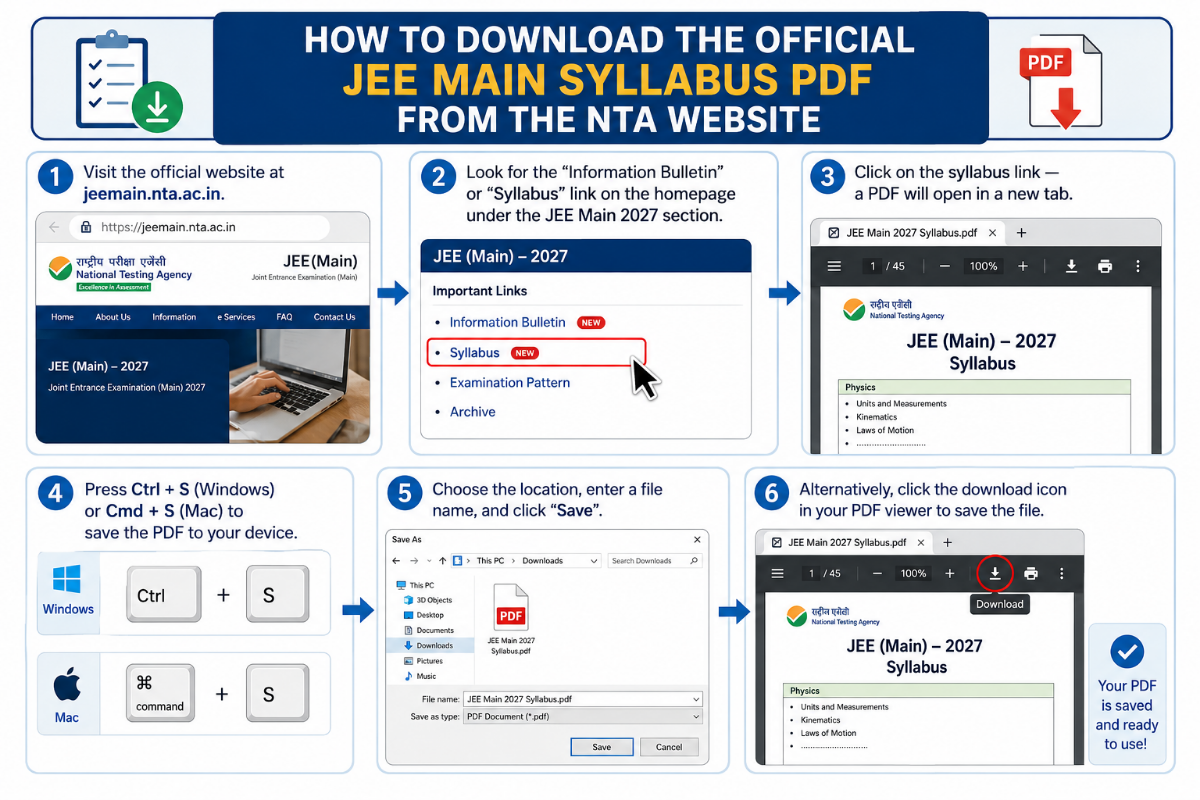
Follow these steps to download the official JEE Main syllabus PDF from the NTA website once it is released.
- Visit the official website at jeemain.nta.ac.in.
- Look for the "Information Bulletin" or "Syllabus" link on the homepage under the JEE Main 2027 section.
- Click on the syllabus link; a PDF will open in a new tab.
- Press Ctrl + S (Windows) or Cmd + S (Mac) to save the PDF to your device.
- Alternatively, click the download icon in your PDF viewer to save the file.
Check Out:
- List of BE/B.Tech Colleges in India Accepting JEE Main Based on 2026 Ranking
- NCERT Solutions for Class 6 to 12
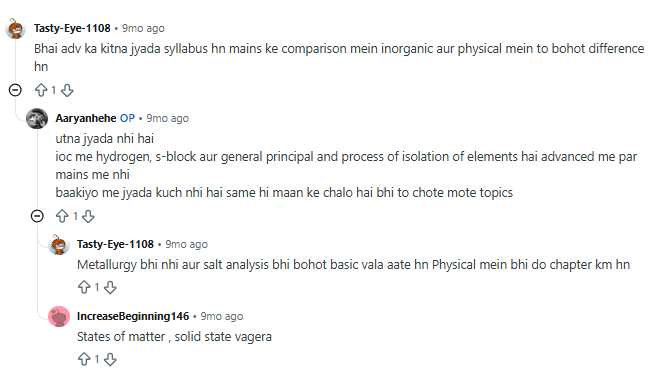
JEE Mains Syllabus 2027 — A Reddit Discussion
As per the Reddit discussion for JEE Mains syllabus, below are the important points to acknowledge:
- Students advise against skipping deleted topics completely, noting that concepts from removed chapters may still appear indirectly in questions linked to other chapters.
- The syllabus reduction from JEE Advanced to JEE Main is considered limited, with users mentioning that only a few topics from Inorganic and Physical Chemistry have been removed.
- Topics like Metallurgy, Salt Analysis, States of Matter, and Solid State are commonly cited by students as chapters with reduced or removed importance in JEE Main.
- The overall community consensus is to prioritize the official syllabus but retain a basic understanding of deleted topics, especially if they support fundamental concepts tested elsewhere.
Ques. Which chapters carry the highest weightage in JEE Main 2027?
Ans.
- Physics: Modern Physics, Current Electricity, Optics, Kinematics, and Gravitation.
- Chemistry: Chemical Bonding, Coordination Compounds, General Organic Chemistry (GOC), and Electrochemistry.
- Mathematics: Vectors & 3D Geometry, Matrices & Determinants, Coordinate Geometry, and Definite Integration.
Ques. How should I prepare high-weightage chapters for JEE Main 2027?
Ans.
Step 1: Build a theory base using NCERT or standard textbooks (H.C. Verma/Cengage).
Step 2: Solve 30–40 Previous Year Questions (PYQs) from recent exam sessions (2023–2026).
Step 3: Take chapter-wise timed mock tests to improve your problem-solving speed.
Step 4: Maintain a short-notes register for rapid formula and mechanism revision.
Ques. How many questions are usually asked from high-weightage chapters in JEE Main?
Ans.
- Physics: 10–12 questions out of 30 (around 40–48 marks).
- Chemistry: 10–12 questions out of 30 (around 40–48 marks).
- Mathematics: 10–11 questions out of 30 (around 40–44 marks).
Ques. When is the expected release date of the JEE Main 2027 information bulletin?
Ans. The National Testing Agency (NTA) is expected to release the bulletin in October 2026.



Comments