




JEE Mains 2027 high weightage chapters, based on past-year trends, cover nearly 65-70% of the entire exam, with Mechanics, Organic Chemistry, and Algebra & Calculus contributing the largest share of questions.
- For Physics, Chemistry, and Mathematics, the weightage varies by chapter, with Mechanics (25-30%), Organic Chemistry (30-35%), and Algebra (30-35%) being the highest-scoring units.
- The JEE Mains 2027 high weightage chapter list also includes Class 11 topics like GOC, Chemical Bonding, and Sequences & Series forming the foundation for advanced Class 12 concepts.
- JEE Mains 2027 high weightage chapters have been identified by analysing previous years' question papers, subject-wise question distribution, and topic repetition trends.
Also Check:
- Best Books for JEE Main Physics, Chemistry and Mathematics, NCERT PDF Download
- JEE Main Eligibility Criteria- Category-wise, Age Limit, Minimum Marks, Number of Attempts and Reservation

Key Summary
- High-weightage chapters account for nearly 65–70% of JEE Main, with Mechanics, Organic Chemistry, Algebra, and Calculus contributing the largest share of questions across all three subjects.
- Physics is led by Mechanics (25–28%), Electrodynamics (20–23%), and Modern Physics (14–17%), while Organic Chemistry, Coordination Compounds, and Equilibrium remain the highest-priority areas in Chemistry.
- Mathematics scoring is concentrated in Algebra, Calculus, and Coordinate Geometry, with chapters like Matrices, Sequences & Series, Definite Integration, AOD, and Vector & 3D Geometry appearing consistently in recent papers.
What are the JEE Mains 2027 High Weightage Chapters
Based on past trends, these are the most important chapters for students targeting JEE Mains 2027. It covers 65-70% of the entire JEE Main paper.
- Mechanics, Organic Chemistry, and Mathematics Algebra, Calculus are the most widely asked topics. Together, it contributes nearly half of their respective subject questions.
- Modern Physics and Optics in Physics, along with Coordination Compounds, Chemical Bonding, and Electrochemistry in Chemistry, are high-scoring topics with comparatively less syllabus coverage.
- Students should prioritize chapters carrying 25%+ weightage first, then strengthen medium-weightage units (10–15%) to maximize overall score while ensuring balanced subject coverage.
| Subject | High-Weightage Chapters | Weightage | Approximate Questions |
|---|---|---|---|
| Physics | Current Electricity | 6-8% | 1-2 Questions |
| Modern Physics | 10-12% | 3-4 Questions | |
| Mechanics | 25-30% | 7-8 Questions | |
| Optics | 8-10% | 2-3 Questions | |
| Chemistry | Coordination Compounds | 5-6% | 1-2 Questions |
| Chemical Bonding | 4-5% | 1-2 Questions | |
| Electrochemistry | 4-5% | 1-2 Questions | |
| Organic Chemistry mechanisms | 30-35% | 8-9 Questions | |
| Mathematics | Calculus | 28-32% | 8-9 Questions |
| Coordinate Geometry | 12-15% | 3-4 Questions | |
| Algebra | 30-35% | 9-11 Questions |
Ques. Can I score 99+ percentile by studying only high-weightage chapters?
Ans. No. High-weightage chapters get you a 97–98 percentile. To cross a 99+ percentile, you need to cover at least 85–90% of the entire syllabus to answer the easy questions from lower-weightage topics.
Ques. Which chapters are repeated most frequently in JEE Main?
Ans.
- Physics: Modern Physics, Current Electricity, Kinematics & Gravitation.
- Chemistry: Coordination Compounds, Chemical Bonding, GOC, Aldehydes & Ketones.
- Mathematics: Vectors & 3D Geometry, Matrices & Determinants, Definite Integration.
Related Articles:
- JEE Main B. Arch Exam Pattern, Marking Scheme, Syllabus, Weightage, Career Scope
- JEE Main B.E / B.Tech Paper Pattern, Marking Scheme, Sample Questions, Tips, Career Scope
What are the JEE Mains 2027 High-Weightage Chapters for Physics?
Focusing on the highest-weightage Physics units first can help you cover nearly two-thirds of the JEE Main Physics paper with targeted preparation:
- Mechanics carries the highest weightage (25–28%), making it the most important Physics unit. Mastering rotational motion, work-energy concepts, and gravitation can account for nearly one-fourth of the Physics section.
- Electrodynamics and Modern Physics together contribute around 34–40% of the paper, making them essential scoring areas. While Electrodynamics emphasizes conceptual application, Modern Physics is relatively formula-based and quicker to revise.
- Optics and Heat & Thermodynamics offer high scoring potential despite lower weightage. Together, they contribute 4–5 questions, and topics like YDSE, TIR, thermodynamic processes, and kinetic theory are frequently repeated in JEE Main.
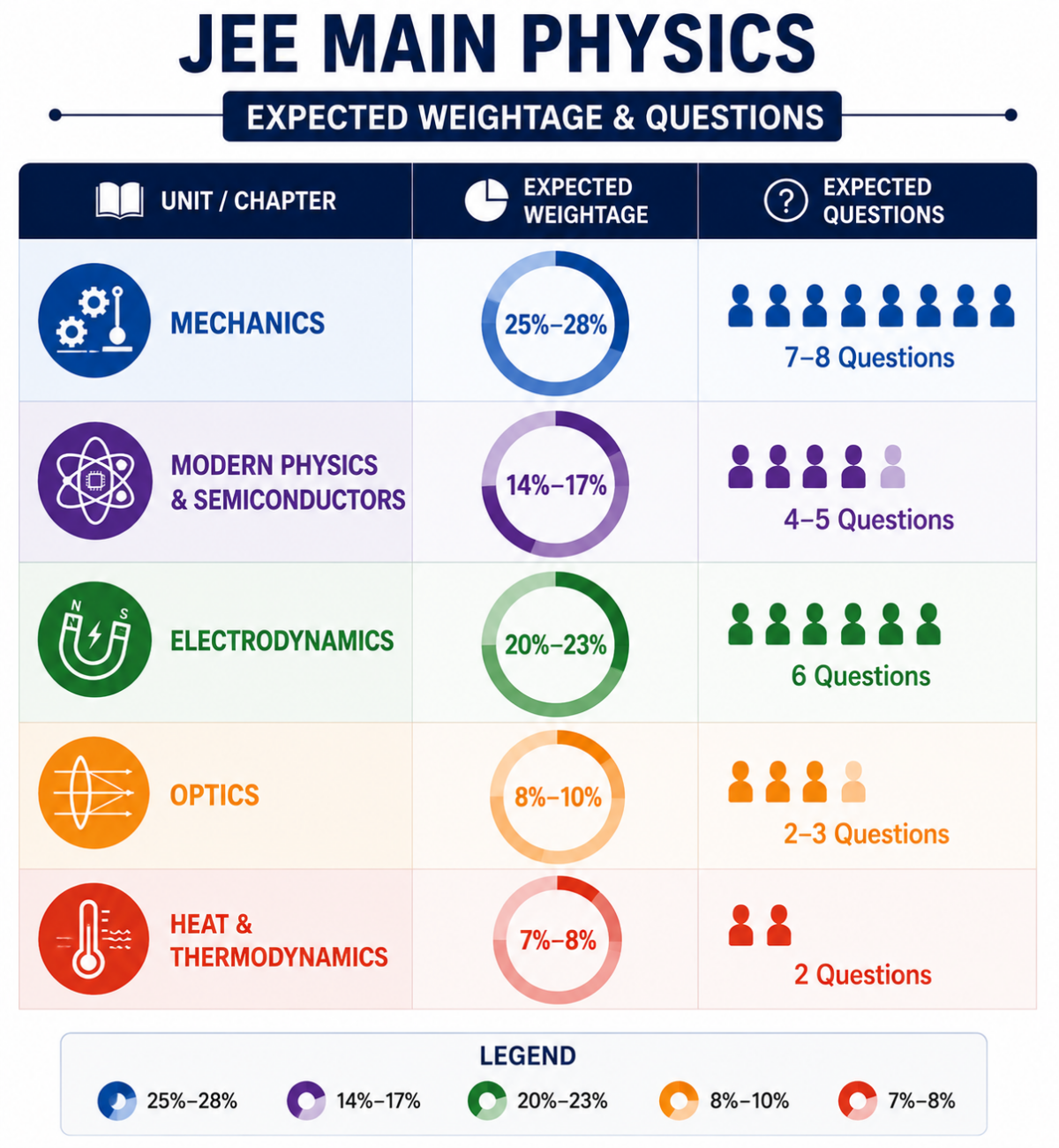
| Unit / Chapter | Expected Weightage | Expected Questions | Most Important Sub-Topics |
|---|---|---|---|
| Mechanics | 25%–28% | 7–8 Questions |
|
| Modern Physics & Semiconductors | 14%–17% | 4–5 Questions |
|
| Electrodynamics | 20%–23% | 6 Questions |
|
| Optics | 8%–10% | 2–3 Questions |
|
| Heat & Thermodynamics | 7%–8% | 2 Questions |
|
Ques. Is Mechanics enough to score well in JEE Main Physics?
Ans. No, Mechanics makes up only 25–28% of the paper as it is highly conceptual and time-consuming. You must pair it with Modern Physics and Electrodynamics to score well.
Ques. Which Modern Physics topics are most important for JEE Main?
Ans. Photoelectric Effect, Bohr's Atomic Model, De Broglie Wavelength, and Nuclear Physics are the most important JEE Mains questions from Modern Physics.
Check Out:
- JEE Main Physics Preparation: Check Monthly Preparation Plan, Way to Score 100+, Weightage & Books
- JEE Main Physics Mock Test- Attempt Free Physics test, Question Paper (2024-2011), JEE Main PYQ
What are the JEE Mains 2027 High Weightage Chapters for Chemistry?
Prioritizing the high-weightage chapters can cover a significant portion of the Chemistry section while strengthening concepts that are frequently repeated in JEE Mains.
- Organic Chemistry contributes the highest number of expected questions, with General Organic Chemistry (GOC), Hydrocarbons, and Carbonyl Compounds forming the foundation for many reaction-based problems.
- Physical Chemistry focuses on numerical and formula-based questions, especially from Chemical & Ionic Equilibrium, Electrochemistry, and Chemical Kinetics, making regular problem practice essential.
- Coordination Compounds remain the most important Inorganic Chemistry chapter, with questions commonly testing CFSE, hybridization, isomerism, and IUPAC nomenclature.
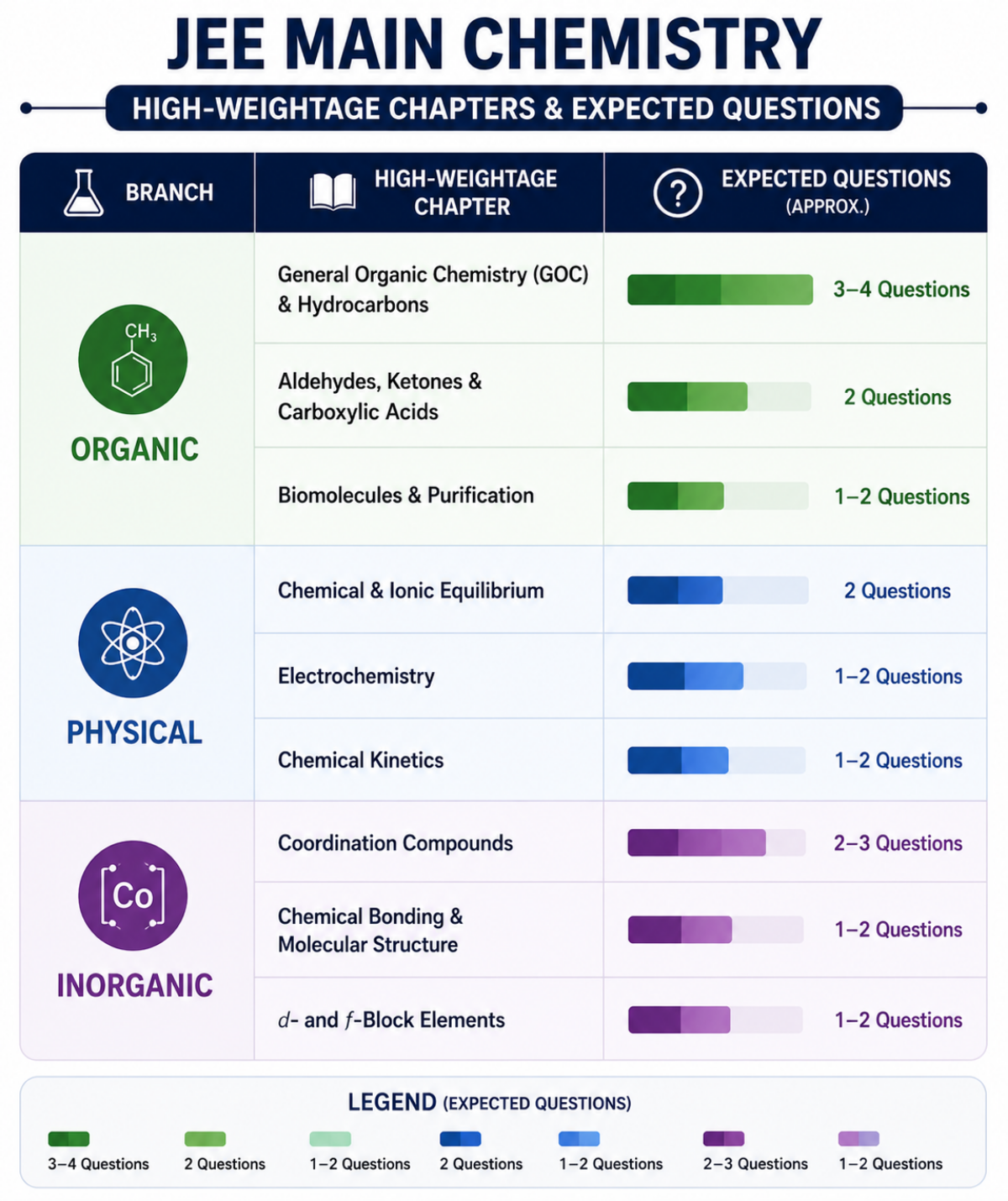
| Branch | High-Weightage Chapter | Expected Questions | Most Important Sub-Topics (High Yield) |
|---|---|---|---|
| Organic | General Organic Chemistry (GOC) & Hydrocarbons | 3–4 Questions |
|
| Aldehydes, Ketones & Carboxylic Acids | 2 Questions |
|
|
| Biomolecules & Purification | 1–2 Questions |
|
|
| Physical | Chemical & Ionic Equilibrium | 2 Questions |
|
| Electrochemistry | 1–2 Questions |
|
|
| Chemical Kinetics | 1–2 Questions |
|
|
| Inorganic | Coordination Compounds | 2–3 Questions |
|
| Chemical Bonding & Molecular Structure | 1–2 Questions |
|
|
| d- and f-Block Elements | 1–2 Questions |
|
Ques. Which Organic Chemistry reactions are asked most frequently?
Ans. Aldol Condensation & Cannizzaro Reaction, Ozonolysis of Alkenes and Alkynes, Friedel-Crafts Alkylation and Acylation, Hoffmann Bromamide Degradation and Gabriel Phthalimide Synthesis, Nucleophilic Substitutions mechanisms, etc, are the most asked reactions from Organic Chemistry.
Also Check:
- JEE Main Chemistry preparation: Check Preparation Plan, Syllabus, Weightage, Mock tests & Books
- JEE Main Reduced Syllabus 2026: Deleted Chapters, Old Syllabus Vs. New Syllabus and Important Topics
What are the JEE Mains 2027 High Weightage Chapters for Mathematics?
Below are the high weightage chapters, testes in the JEE Mains exam in the previous years. Mastering these chapters and their core sub-topics can help cover a significant portion of the Mathematics section while improving accuracy in frequently tested concepts.
- Algebra contributes the largest share of Mathematics questions, with Matrices & Determinants, Sequences & Series, and Probability appearing consistently across JEE Main papers.
- Coordinate Geometry remains a reliable scoring area, especially Vector & 3D Geometry and Conic Sections, where most questions are based on standard formulas and direct applications.
- Calculus demands strong conceptual understanding, with Definite Integration, Differential Equations, and Application of Derivatives (AOD) frequently testing theorem-based and analytical problem-solving skills.
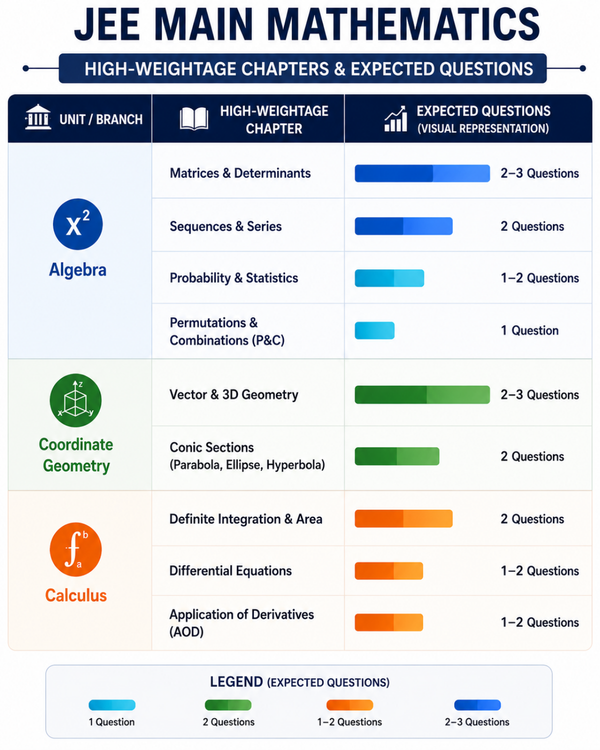
| Unit / Branch | High-Weightage Chapter | Expected Questions | Most Important Sub-Topics (High Yield) |
|---|---|---|---|
| Algebra | Matrices & Determinants | 2–3 Questions |
|
| Sequences & Series | 2 Questions |
|
|
| Probability & Statistics | 1–2 Questions |
|
|
| Permutations & Combinations (P&C) | 1 Question |
|
|
| Coordinate Geometry | Vector & 3D Geometry | 2–3 Questions |
|
| Conic Sections (Parabola, Ellipse, Hyperbola) | 2 Questions |
|
|
| Calculus | Definite Integration & Area | 2 Questions |
|
| Differential Equations | 1–2 Questions |
|
|
| Application of Derivatives (AOD) | 1–2 Questions |
|
Ques. Should I study Algebra before Calculus for JEE Main?
Ans. Yes, Calculus relies heavily on algebraic tools. You must master Quadratic Equations, Sequences & Series, and Functions before beginning Calculus.
Related Links:
- JEE Main Mock Test Series
- JEE Main Maths Preparation - Check 60 Days Study Plan, Important Books, Mock Tests and PYQs
What are Important Class 11 Topics for JEE Mains 2027 Preparation?
Class 11 topics form the foundation of Class 12, with chapters like Mechanics, GOC, Chemical Bonding, and Algebra supporting advanced JEE Main concepts.
- Physics should begin with Mechanics (Rotational Motion, WEP, Kinematics, Gravitation), followed by Thermodynamics/KTG and SHM & Waves.
- Chemistry centers on GOC & Hydrocarbons (Organic), Chemical Bonding & Periodic Trends (Inorganic), and Equilibrium, Mole Concept & Atomic Structure (Physical).
- Mathematics is led by Algebra (Sequences & Series, P&C, Binomial, Quadratics), supported by Coordinate Geometry (Conics, Lines, Circles) and Calculus (Limits, Derivatives, Trigonometry).
| Subject | Unit / Branch | High-Priority Chapters | Most Important Topics |
|---|---|---|---|
| Physics | Mechanics | System of Particles & Rotational Motion, Work, Energy & Power; Laws of Motion & Kinematics; Gravitation |
|
| Heat & Thermodynamics | Thermodynamics; Kinetic Theory of Gases (KTG) |
|
|
| Waves & Oscillations | Simple Harmonic Motion (SHM); Waves |
|
|
| Chemistry | Organic Chemistry | General Organic Chemistry (GOC); Hydrocarbons |
|
| Inorganic Chemistry | Chemical Bonding & Molecular Structure; Classification of Elements |
|
|
| Physical Chemistry | Equilibrium; Mole Concept; Atomic Structure |
|
|
| Mathematics | Algebra | Sequences & Series; Permutations & Combinations; Binomial Theorem; Quadratic Equations |
|
| Coordinate Geometry | Conic Sections; Straight Lines & Circles |
|
|
| Calculus & Trigonometry | Limits & Derivatives; Trigonometric Functions |
|
Ques. Which Coordinate Geometry topics are most important?
Ans. Condition of Tangency, Parabola, and Circles are the most important topics in Coordinate Geometry.
Related Links:
- JEE Main Chapter Wise Weightage 2026: Check Chemistry, Physics, and Maths Weightage Last 10 Years
- JEE Main and JEE Advance Difference Explained: Difference in Syllabus, Exam pattern, Difficulty, Eligibility
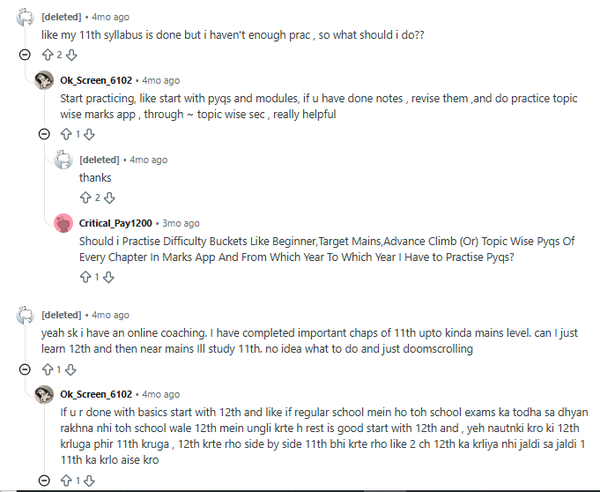
What are Most Important Topics for JEE Mains 2027? — Reddit Discussion
Based on the Reddit discussion thread r/JEENEETards, below are the important topics and preparation strategies students can imply:
- A common recommendation among aspirants is to complete Class 12 alongside regular revision of Class 11, rather than postponing Class 11 entirely. Students who delay it often struggle during revision.
- Once high-priority Class 11 chapters are covered, the next focus shifts to practice, especially chapter-wise PYQs, coaching modules, and topic-wise question sets, instead of learning new theory.
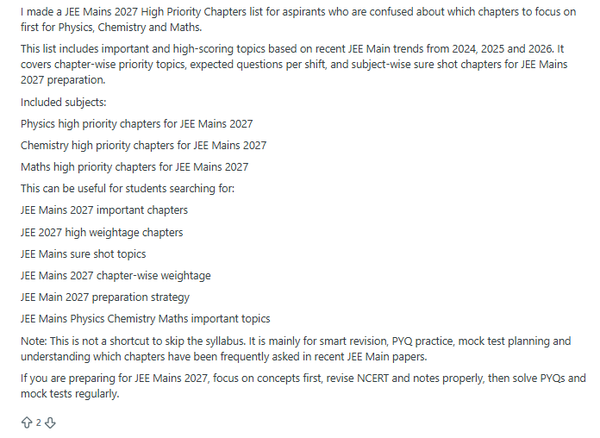
- The chapter list is positioned as a revision and PYQ-planning resource, not a shortcut to skip the syllabus. It helps identify chapters with the highest question frequency in recent JEE Main papers.
Related Links:
- High weightage chapter for JEE Main 2027 Maths of Class 11 and 12
- Best Books for JEE Main Mathematics
Ques. Which Inorganic Chemistry chapters should I study first?
Ans.
- Periodic Classification: Builds the framework for atomic trends and exceptions.
- Chemical Bonding: Crucial for understanding molecular structures, hybridisation, and shapes.
- Coordination Compounds: Highly scoring, independent, and heavy exam weightage.
Ques. How many PYQs should I solve for each high-weightage chapter?
Ans. Target 70 to 100 PYQs per chapter. Focus specifically on the last 5 years of online shift papers (2022–2026), as they align perfectly with the current exam pattern.
Ques. How many Calculus questions can I expect in JEE Main?
Ans. You can expect 8 to 9 questions out of 30 in Maths, which accounts for roughly 28% to 32% of the Mathematics section.
Ques. Are mock tests more important than chapter-wise practice?
Ans. Both are critical at different stages. Chapter-wise practice builds your foundational concept accuracy. Full-syllabus mock tests are more important in the final 3 months to build speed, stamina, and time management.



Comments