





JEE Main 2026 April 5 Shift 2 physics question paper is available here with answer key and solutions. NTA conducted the second shift of the day on April 5, 2026, from 3:00 PM to 6:00 PM.
- The JEE Main Physics Question Paper contains a total of 25 questions.
- Each correct answer gets you 4 marks while incorrect answers gets you a negative mark of 1.
Candidates can download the JEE Main 2026 April 5 Shift 2 physics question paper along with detailed solutions to analyze their performance and understand the exam pattern better.
JEE Main 2026 April 5 Shift 2 Physics Question Paper with Solution PDF
Also Check:


Question 1:
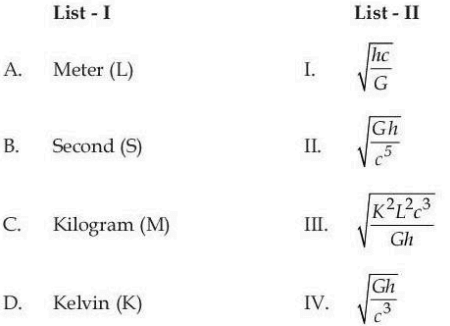
Match List - I with List - II (where h is Planck's constant, G is gravitational constant and c is speed of light):
In an experiment to determine the resistance of a given wire using Ohm's law, the voltmeter and ammeter readings are noted as 10 V and 5 A, respectively. The least counts of voltmeter and ammeter are 500 mV and 200 mA, respectively. The estimated error in the resistance measurement is :
A mass of 1 kg is kept on a inclined plane with \(30^\circ\) inclination with respect to horizontal plane and it is at rest initially. Then the whole assembly is moved up with constant velocity of 4 m/s. The work done by the frictional force in time 2 s is \dots J. (Take \(g = 10 m/s^2\))
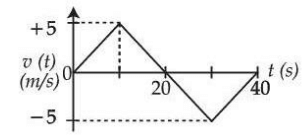
The velocity (\(v\)) versus time (\(t\)) plot of a particle is shown in the figure,for a time interval of 40 s. The total distance travelled by the particle and the average velocity during this period are, respectively :
A wheel initially at rest is subjected to a uniform angular acceleration about its axis. In the first 2 s it rotates through an angle \(\theta_1\) and in the next 2 s it rotates through an angle \(\theta_2\). The ratio \(\frac{\theta_2}{\theta_1}\) is :
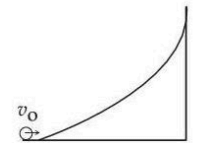
An object of uniform density rolls up the curved path with the initial velocity \(v_o\) as shown in the figure. If the maximum height attained by an object is \(\frac{7v_o^2}{10 g}\) (\(g=\) acceleration due to gravity), the object is a \dots
A body of mass \(m\) is taken from the surface of earth to a height equal to twice the radius of earth (\(R_e\)). The increase in potential energy will be \dots (\(g\) is acceleration due to gravity at the surface of earth)
Eight mercury drops, each of radius \(r\), coalesce to form a bigger drop. The surface energy released in this process is \dots (\(S\) is the surface tension of mercury).
An ideal gas at pressure \(P\) and temperature \(T\) is expanding such that \(PT^3 =\) constant. The coefficient of volume expansion of the gas is \dots
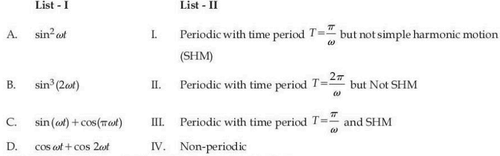
Match List - I with List - II.
A metal rod of length \(L\) rotates about one end at origin with a uniform angular velocity \(\omega\). The magnetic field radially falls off as \(B(r) = B_o e^{-\lambda r}\); \(\lambda\) being a positive constant. The emf induced (neglecting the centripetal force on electrons in the rod) is :
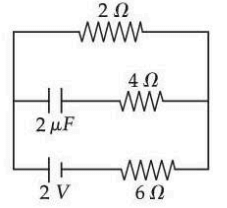
Under steady state condition the potential difference across the capacitor in the circuit is \dots V.
A particle of charge \(q\) and mass \(m\) is projected from origin with an initial velocity \(\vec{v} = \left( \frac{v_o}{\sqrt{2}} \hat{x} + \frac{v_o}{\sqrt{2}} \hat{y} \right)\). There exists a uniform magnetic field \(\vec{B} = B_o \hat{z}\) and a space varying electric field \(\vec{E} = E_o e^{-\lambda x} \hat{x}\) within the region \(0 \le x \le L\). After travelling a distance such that \(x\)-coordinate has changed from \(x=0\) to \(x=L\), the change in the kinetic energy is \dots
Given below are two statements : one is labelled as Assertion (A) and the other is labelled as Reason (R).
Assertion (A) : The electromagnetic wave exerts pressure on the surface on which they are allowed to fall.
Reason (R) : There is no mass associated with the electromagnetic waves.
In the light of the above statements, choose the correct answer from the options given below :
A thin convex lens and a thin concave lens are kept in contact and are co-axial. Which of the following statements is correct for this combination of two lenses ?
An object AB is placed 15 cm on the left of a convex lens P of focal length 10 cm. Another convex lens Q is now placed 15 cm right of lens P. If the focal length of lens Q is 15 cm, the final image is \dots
The maximum intensity in a Young's double slit experiment is \( I_o \). Distance between the slits (\( d \)) is \( 5\lambda \), where \( \lambda \) is the wavelength of light used. The intensity of the fringe, exactly opposite to one of the slits on the screen, placed at \( D = 10d \) is \dots
An electron is travelling with a velocity \( v \) in free space and when it enters a medium, its velocity is reduced by 20%. The de Broglie wavelength of electron in the medium is \( \alpha\lambda_o \), where \( \lambda_o \) is its de Broglie wavelength in free space. The value of \( \alpha \) is \dots
Assuming the experimental mass of \( {}^{12}_{6}C \) as 12 u, the mass defect of \( {}^{12}_{6}C \) atom is \dots MeV/\( c^2 \).
(Mass of proton = 1.00727 u, mass of neutron = 1.00866 u, 1 u = 931.5 MeV/\( c^2 \))
In a semiconductor p-n diode, the doping concentrations on p-side and n-side are \( 10^{15} atoms/cm^3 \) and \( 10^{18} atoms/cm^3 \), respectively. Which one of the following statements is true?
A copper wire of length 3 m is stretched by 3 mm by applying an external force. The volume of the wire is \( 600 \times 10^{-6} m^3 \). The elastic potential energy stored in the wire in stretched condition would be \dots J. (Given Young's modulus of copper = \( 1.1 \times 10^{11} N/m^2 \))
The heat extracted out of \( x \) gram of water initially at \( 50^\circC \) to cool it down to \( 0^\circC \) is sufficient to evaporate \( (1000-x) \) gram of water also initially at \( 50^\circC \). The value of \( x \) (closest integer) is \dots
(Take latent heat of water 2256 kJ/kg, specific heat capacity of water 4200 J/kg\(\cdot\)K)
A series LCR circuit with \( R = 20\ \Omega, L = 1.6 H and C = 40\ \muF \) is connected to a variable frequency a.c. source. The inductive reactance at resonant frequency is \dots \(\Omega\).
When an external resistance of 5 \(\Omega\) is connected across terminals of a cell, a current of 0.25 A flows through it. When the 5 \(\Omega\) resistor is replaced by a 2 \(\Omega\) resistor, a current of 0.5 A flows through it. The internal resistance of the cell is \dots \(\Omega\).
A circular loop of radius 20 cm and resistance 2 \(\Omega\) is placed in a time varying magnetic field \( \vec{B} = (2t^2 + 2t + 3) T \). At \( t=0 \), for the plane of the loop being perpendicular to the magnetic field and, the induced current in the loop at \( t = 3 s \) is \( \alpha/50 A \). The value of \( \alpha \) is \dots (Take \( \pi = 22/7 \))
JEE Main 2026 Physics Exam Pattern
| Particulars | Details |
|---|---|
| Exam Mode | Online (Computer-Based Test) |
| Paper | B.E./B.Tech |
| Medium of Exam | 13 languages: English, Hindi, Gujarati, Bengali, Tamil, Telugu, Kannada, Marathi, Malayalam, Odia, Punjabi, Assamese, Urdu |
| Type of Questions | Multiple Choice Questions (MCQs) + Numerical Value Questions |
| Total Marks | 100 marks |
| Marking Scheme | +4 for correct answer & -1 for incorrect MCQ and Numerical Value-based Questions |
| Total Questions | 25 Questions |



Comments