




JEE Main 2026 April 5 Shift 1 Question Paper is available here with answer key and solution pdf. NTA conducted the first shift on April 5, 2026, from 9:00 AM to 12:00 PM. The JEE Main 2026 Paper 1 (B.E./B.Tech) question paper includes the following:
- 75 questions in a 3-hour CBT Mode: 25 each from Mathematics, Physics and Chemistry
- Section A: 20 multiple choice questions (MCQs) per subject, 4 marks each
- Section B: 5 numerical value questions per subject, 4 marks each (integer answer)
- Marking: +4 for a correct answer, -1 for an incorrect answer, 0 for an unattempted question
JEE Main 2026 April 5 Shift 1 Question Paper with Solution PDF
| NTA Official PDF | CD PDF | CD PDF with Solutions |
|---|---|---|
| Download official PDF 2.17 MB | Download Collegedunia PDF 0.79 MB | Download solutions PDF 0.71 MB |
Also Check:


JEE Main 2026 April 5 Shift 1 Questions with Solutions
Mathematics - Section A (Q1 - Q20)
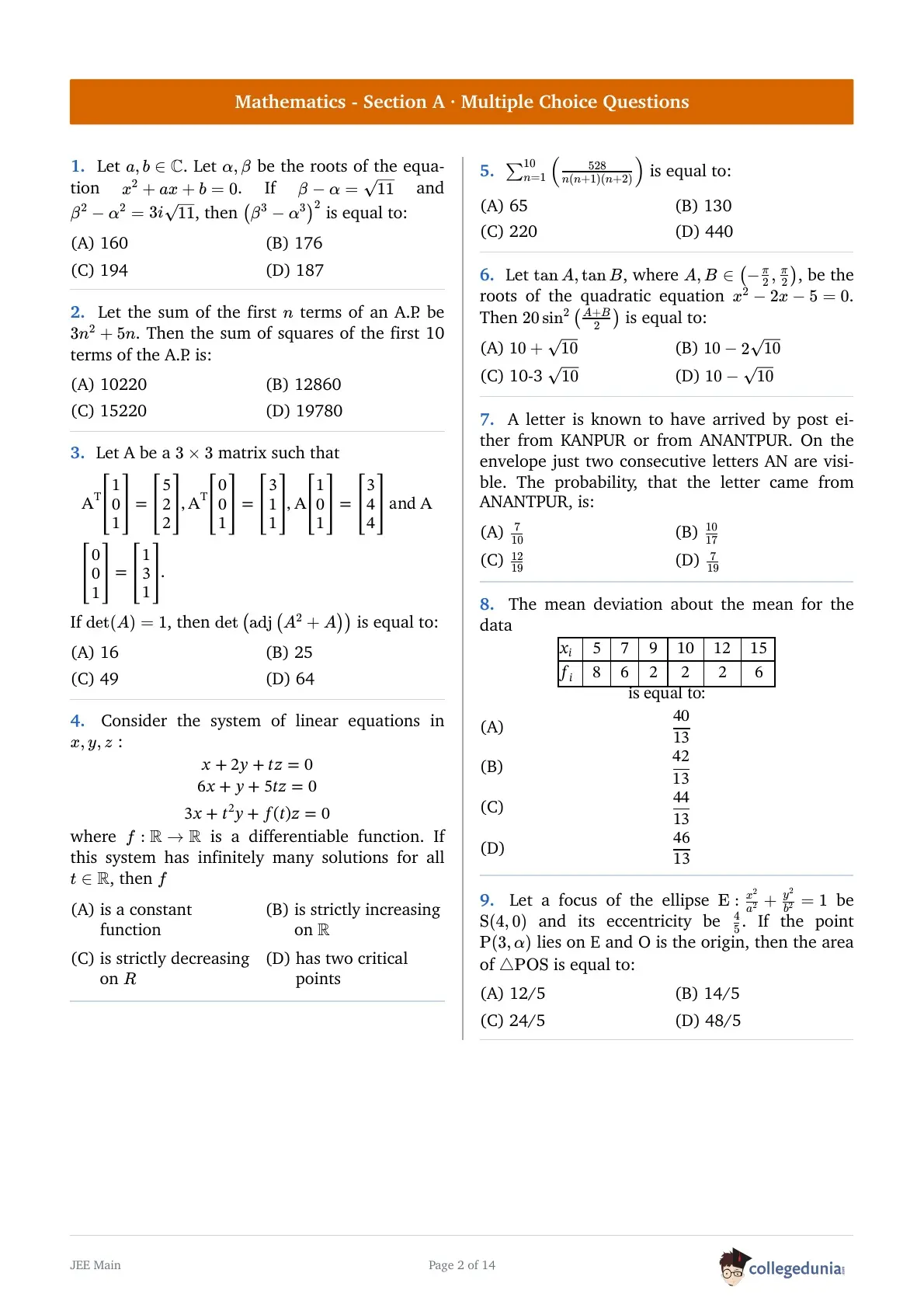
Let a, b \(\in\) C. Let \(\alpha, \beta\) be the roots of the equation \(x^2 + ax + b = 0\). If \(\beta-\alpha =\sqrt{11}\) and \(\beta^2-\alpha^2 = 3i\sqrt{11}\), then \((\beta^3 - \alpha^3)^2\) is equal to:
Let the sum of the first n terms of an A.P. be \(3n^2 + 5n\). Then the sum of squares of the first 10 terms of the A.P. is:
Let A be a 3 x 3 matrix such that
\(A^T \begin{pmatrix} 1
0
1 \end{pmatrix} = \begin{pmatrix} 5
2
2 \end{pmatrix}\), \(A \begin{pmatrix} 0
0
1 \end{pmatrix} = \begin{pmatrix} 3
1
1 \end{pmatrix}\), \(A \begin{pmatrix} 1
0
1 \end{pmatrix} = \begin{pmatrix} 3
4
4 \end{pmatrix}\) and \(A \begin{pmatrix} 0
0
1 \end{pmatrix} = \begin{pmatrix} 1
3
1 \end{pmatrix}\)
If det(A) = 1, then det(adj(\(A^2\) + A)) is equal to:
Consider the system of linear equations in x, y, z:
x+2y+tz = 0,
6x + y + 5t z = 0,
3x + y + f(t) z = 0,
where f: R\(\rightarrow\) R is a differentiable function. If this system has infinitely many solutions for all t \(\in\) R, then f
The sum \(\sum_{n=1}^{10} \frac{528}{n(n+1)(n+2)}\) is equal to:
Let tan A, tan B, where A, B \(\in \left(-\frac{\pi}{2}, \frac{\pi}{2}\right)\), be the roots of the quadratic equation \(x^2 - 2x - 5 = 0\). Then \(20 \sin^2\left(\frac{A+B}{2}\right)\) is equal to:
A letter is known to have arrived by post either from KANPUR or from ANANTPUR. On the envelope just two consecutive letters AN are visible. The probability, that the letter came from ANANTPUR, is:
The mean deviation about the mean for the data

is equal to:
Let a focus of the ellipse E: \(\frac{x^2}{a^2} + \frac{y^2}{b^2} = 1\) be S(4, 0) and its eccentricity be \(\frac{4}{5}\). If the point P(3, \(\alpha\)) lies on E and O is the origin, then the area of \(\Delta\)POS is equal to:
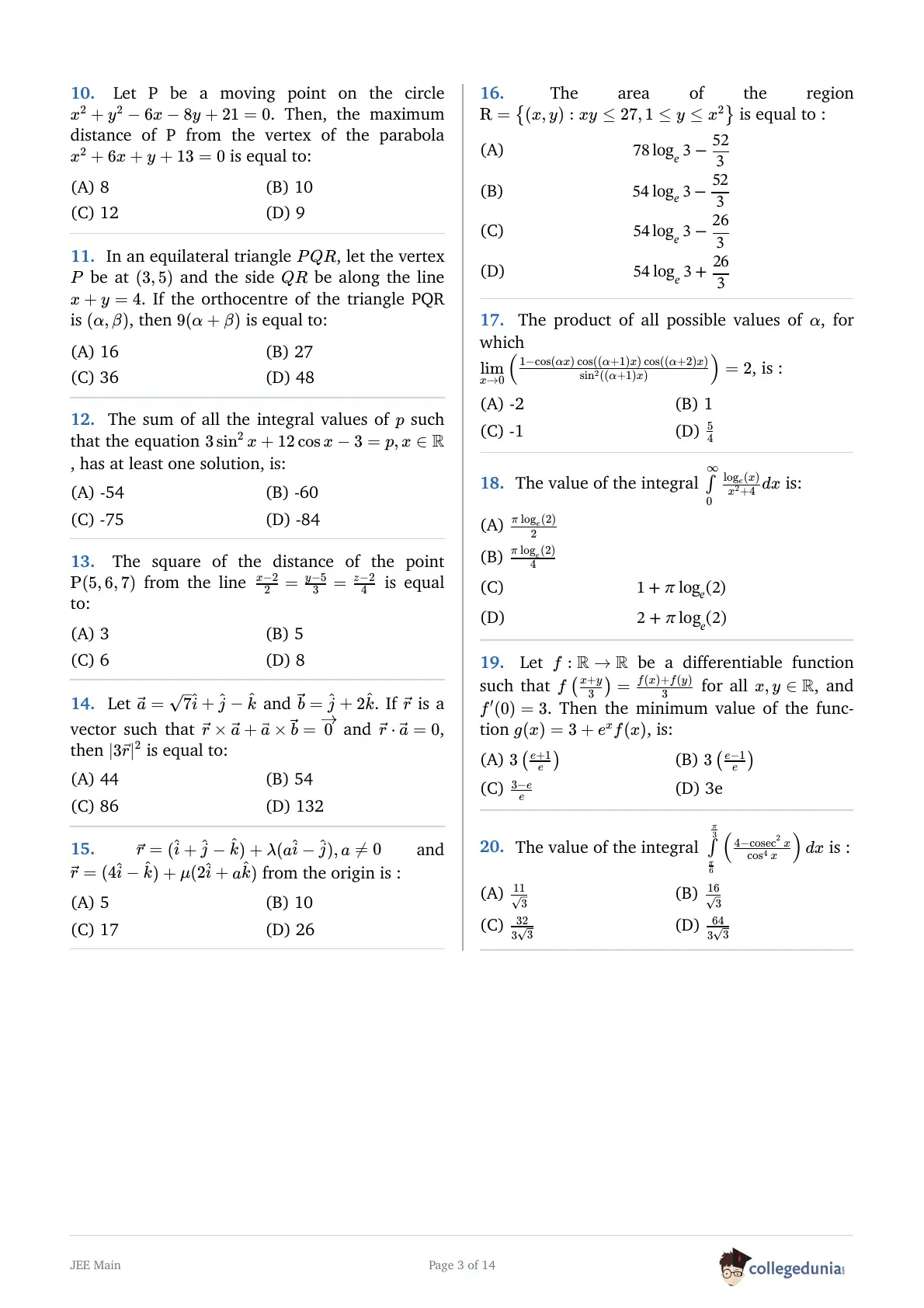
Let P be a moving point on the circle \(x^2 + y^2-6x-8y + 21 = 0\). Then, the maximum distance of P from the vertex of the parabola \(x^2 + 6x + y + 13 = 0\) is equal to:
In an equilateral triangle PQR, let the vertex P be at (3, 5) and the side QR be along the line x + y = 4. If the orthocentre of the triangle PQR is (\(\alpha, \beta\)), then 9(\(\alpha + \beta\)) is equal to:
The sum of all the integral values of p such that the equation \(3\sin^2x + 12\cos x - 3 = p, x \in \mathbb{R}\), has at least one solution, is:
The square of the distance of the point P(5, 6, 7) from the line \(\frac{x-2}{2} = \frac{y-5}{3} = \frac{z-2}{4}\) is equal to:
Let \(\vec{a} = \sqrt{7}\hat{i}+\hat{j}-\hat{k}\) and \(\vec{b} = \hat{j} + 2\hat{k}\). If \(\vec{r}\) is a vector such that \(\vec{r} \times \vec{a} + \vec{a} \times \vec{b} = \vec{0}\) and \(\vec{r} \cdot \vec{a} = 0\), then \(|3\vec{r}|^2\) is equal to:
The square of the distance of the point of intersection of the lines \(\vec{r} = (\hat{i} + \hat{j} - \hat{k}) + \lambda(a\hat{i} - \hat{j})\), \(a \neq 0\) and \(\vec{r} = (4\hat{i} - \hat{k}) + \mu(2\hat{i} + a\hat{k})\) from the origin is:
The area of the region R = { (x, y): xy \(\le\) 27, 1 \(\le\) y \(\le\) \(x^2\)\ is equal to:
The product of all possible values of \(\alpha\), for which \(\lim_{x \to 0} \frac{1-\cos(\alpha x)\cos((\alpha+1)x)\cos((\alpha+2)x)}{\sin^2((\alpha+1)x)} = 2\), is:
The value of the integral \(\int_0^\infty \frac{\log_e (x)}{x^2 + 4} dx\) is:
Let \(f : \mathbb{R} \to \mathbb{R}\) be a differentiable function such that \(f \left( \frac{x+y}{3} \right) = \frac{f(x)+f(y)}{3}\) for all \(x, y \in \mathbb{R}\), and \(f'(0) = 3\). Then the minimum value of the function \(g(x) = 3 + e^x f(x)\), is:
The value of the integral \(\int_{\pi/6}^{\pi/3} \left( \frac{4 - \csc^2 x}{\cos^4 x} \right) dx\) is:
Mathematics - Section B (Q21 - Q25)
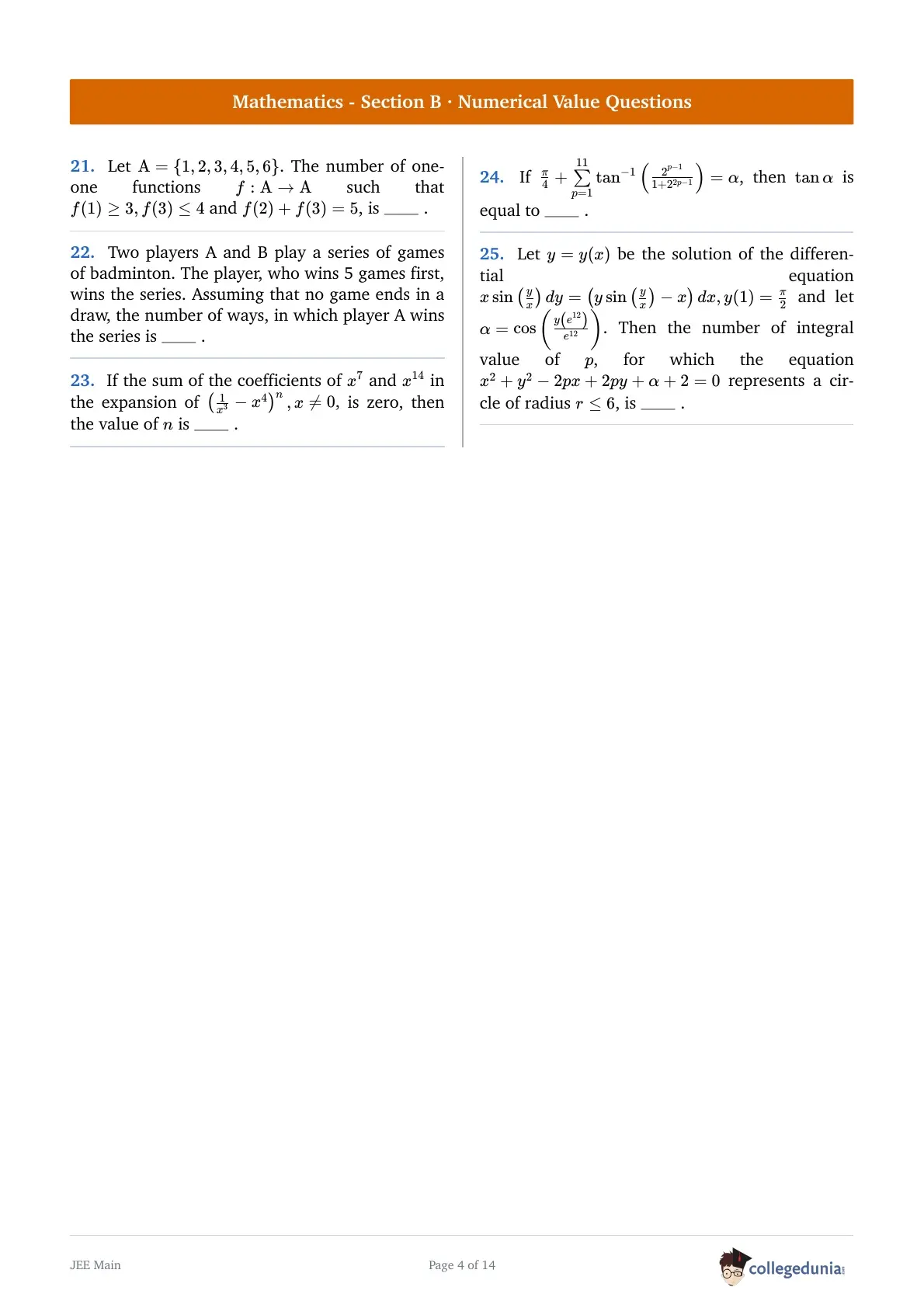
Let \(A = \{1, 2, 3, 4, 5, 6\}\). The number of one-one functions \(f: A \to A\) such that \(f(1) \ge 3, f(3) \le 4\) and \(f(2) + f(3) = 5\), is _________.
Two players A and B play a series of games of badminton. The player who wins 5 games first, wins the series. Assuming that no game ends in a draw, the number of ways in which player A wins the series is _________.
If the sum of the coefficients of \(x^7\) and \(x^{14}\) in the expansion of \(\left( \frac{1}{x^3} - x^4 \right)^n, x \neq 0,\) is zero, then the value of \(n\) is _________.
If \(\frac{\pi}{4} + \sum_{p=1}^{11} \tan^{-1} \left( \frac{2^{p-1}}{1 + 2^{2p-1}} \right) = \alpha\), then \(\tan \alpha\) is equal to _________.
Let \(y = y(x)\) be the solution of the differential equation \(x \sin \left( \frac{y}{x} \right) dy = \left( y \sin \left( \frac{y}{x} \right) - x \right) dx, y(1) = \frac{\pi}{2}\) and let \(\alpha = \cos \left( \frac{y(e^{12})}{e^{12}} \right)\). Then the number of integral values of \(p\), for which the equation \(x^2 + y^2 - 2px + 2py + \alpha + 2 = 0\) represents a circle of radius \(r \le 6\), is _________.
Physics - Section A (Q26 - Q45)
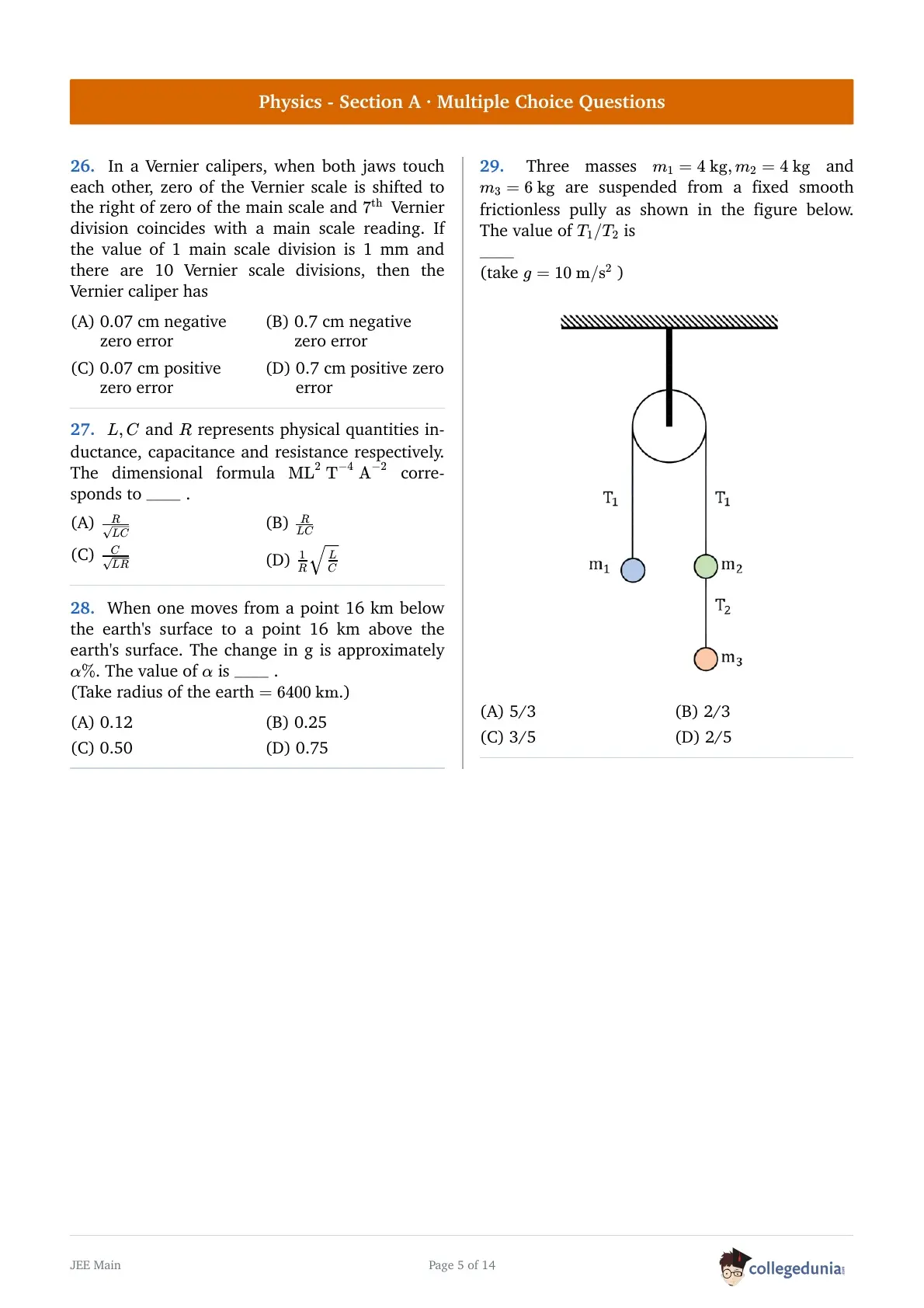
In a Vernier calipers, when both jaws touch each other, zero of the Vernier scale is shifted to the right of zero of the main scale and \(7^{th}\) Vernier division coincides with a main scale reading. If the value of 1 main scale division is 1 mm and there are 10 Vernier scale divisions, then the Vernier caliper has:
\(L, C\) and \(R\) represents physical quantities inductance, capacitance and resistance respectively. The dimensional formula \(M L^2 T^{-4} A^{-2}\) corresponds to _________.
When one moves from a point 16 km below the earth's surface to a point 16 km above the earth's surface. The change in \(g\) is approximately \(\alpha % \). The value of \(\alpha\) is _________. (Take radius of the earth = 6400 km.)
Three masses \(m_1 = 4\) kg, \(m_2 = 4\) kg and \(m_3 = 6\) kg are suspended from a fixed smooth frictionless pulley as shown in the figure below. The value of \(T_1/T_2\) is: (take \(g = 10 m/s^2\))

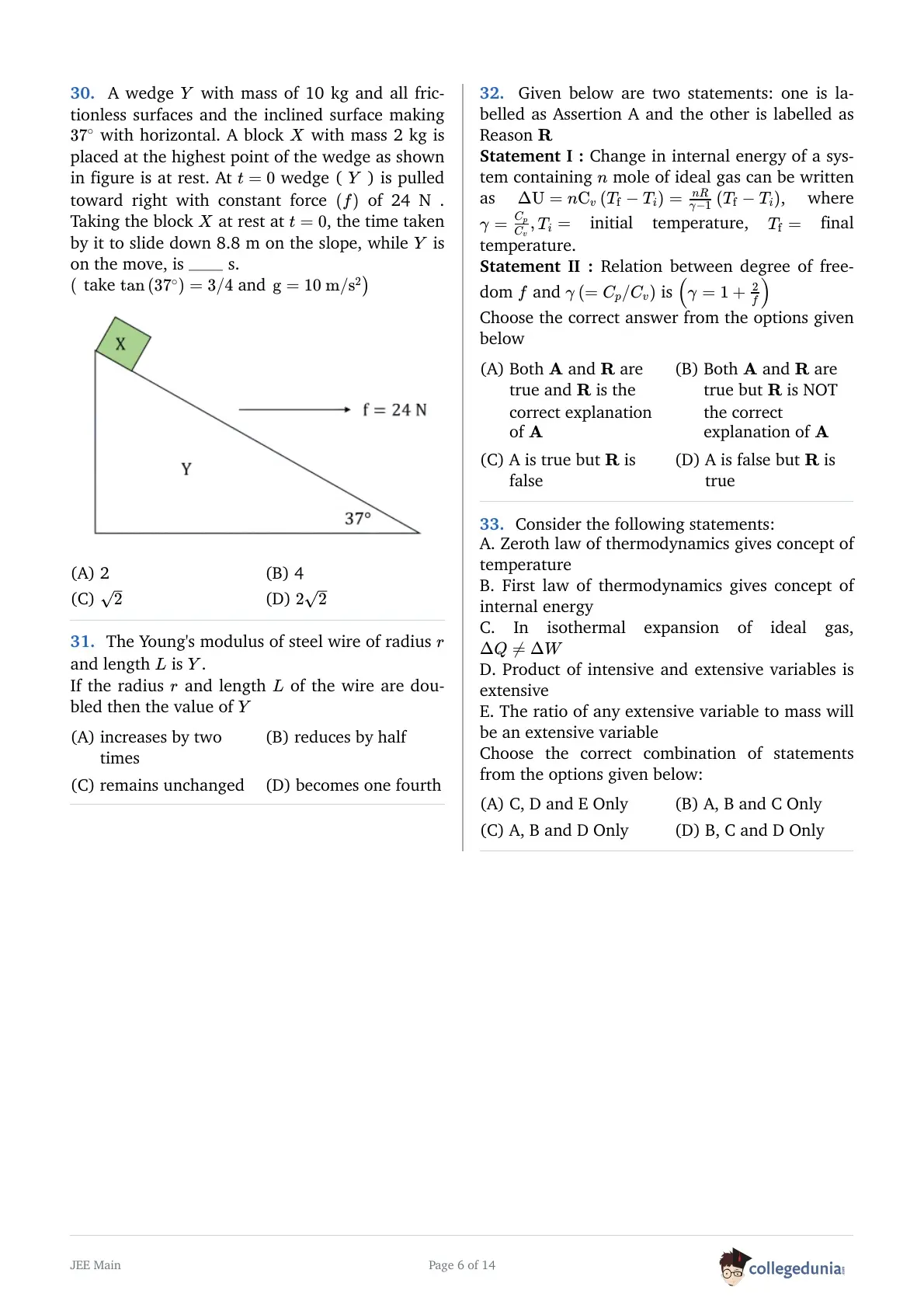
A wedge \(Y\) with mass of 10 kg and all frictionless surfaces and the inclined surface making \(37^\circ\) with horizontal. A block \(X\) with mass 2 kg is placed at the highest point of the wedge as shown in figure is at rest. At \(t = 0\) wedge (\(Y\)) is pulled toward right with constant force (\(f\)) of 24 N. Taking the block \(X\) at rest at \(t = 0\), the time taken by it to slide down 8.8 m on the slope, while \(Y\) is on the move, is ________s.

(take \(\tan (37^\circ) = 3/4\) and \(g = 10 m/s^2\))
The Young's modulus of steel wire of radius \(r\) and length \(L\) is \(Y\). If the radius \(r\) and length \(L\) of the wire are doubled then the value of \(Y\):
Given below are two statements: one is labelled as Assertion A and the other is labelled as Reason R
Statement I: Change in internal energy of a system containing \(n\) mole of ideal gas can be written as \(\Delta U = n C_v (T_f - T_i) = \frac{nR}{\gamma - 1}(T_f - T_i)\), where \(\gamma = \frac{C_p}{C_v}, T_i = initial temperature, T_f = final temperature\).
Statement II: Relation between degree of freedom \(f\) and \(\gamma (= C_p/C_v)\) is \(\gamma = 1 + \frac{2}{f}\)
Choose the correct answer from the options given below
Consider the following statements:
A. Zeroth law of thermodynamics gives concept of temperature
B. First law of thermodynamics gives concept of internal energy
C. In isothermal expansion of ideal gas, \(\Delta Q \neq \Delta W\)
D. Product of intensive and extensive variables is extensive
E. The ratio of any extensive variable to mass will be an extensive variable
Choose the correct combination of statements from the options given below:
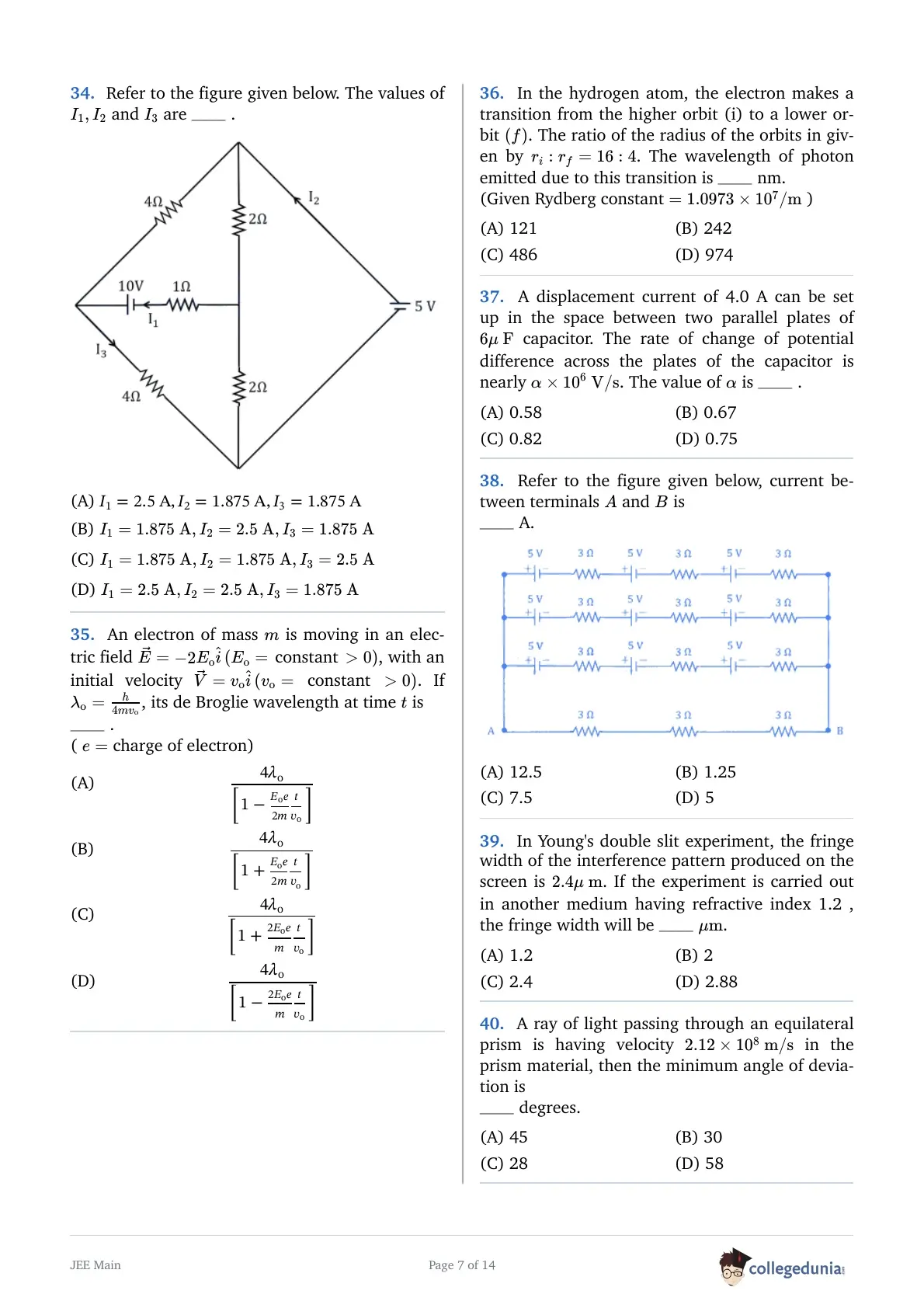
Refer to the figure given below. The values of \(I_1, I_2\) and \(I_3\) are ______

An electron of mass \(m\) is moving in an electric field \(\vec{E} = -2E_0 \hat{i}\) (\(E_0 = constant > 0\)), with an initial velocity \(\vec{v} = v_0 \hat{i}\) (\(v_0 = constant > 0\)). If \(\lambda_0 = \frac{h}{4mv_0}\), its de Broglie wavelength at time \(t\) is:
In the hydrogen atom, the electron makes a transition from the higher orbit (\(i\)) to a lower orbit (\(f\)). The ratio of the radius of the orbits in given by \(r_i : r_f = 16 : 4\). The wavelength of photon emitted due to this transition is _________ nm. (Given Rydberg constant \(= 1.097 \times 10^7 /m\))
A displacement current of 4.0 A can be set up in the space between two parallel plates of \(6 \mu F\) capacitor. The rate of change of potential difference across the plates of the capacitor is nearly \(\alpha \times 10^6 V/s\). The value of \(\alpha\) is _________.
Refer to the figure given below, current between terminals \(A\) and \(B\) is _____

In Young's double slit experiment, the fringe width of the interference pattern produced on the screen is \(2.4 \mu m\). If the experiment is carried out in another medium having refractive index 1.2, the fringe width will be _______ \(\mu m\).
A ray of light passing through an equilateral prism is having velocity \(2.12 \times 10^8 m/s\) in the prism material, then the minimum angle of deviation is _______ degrees.
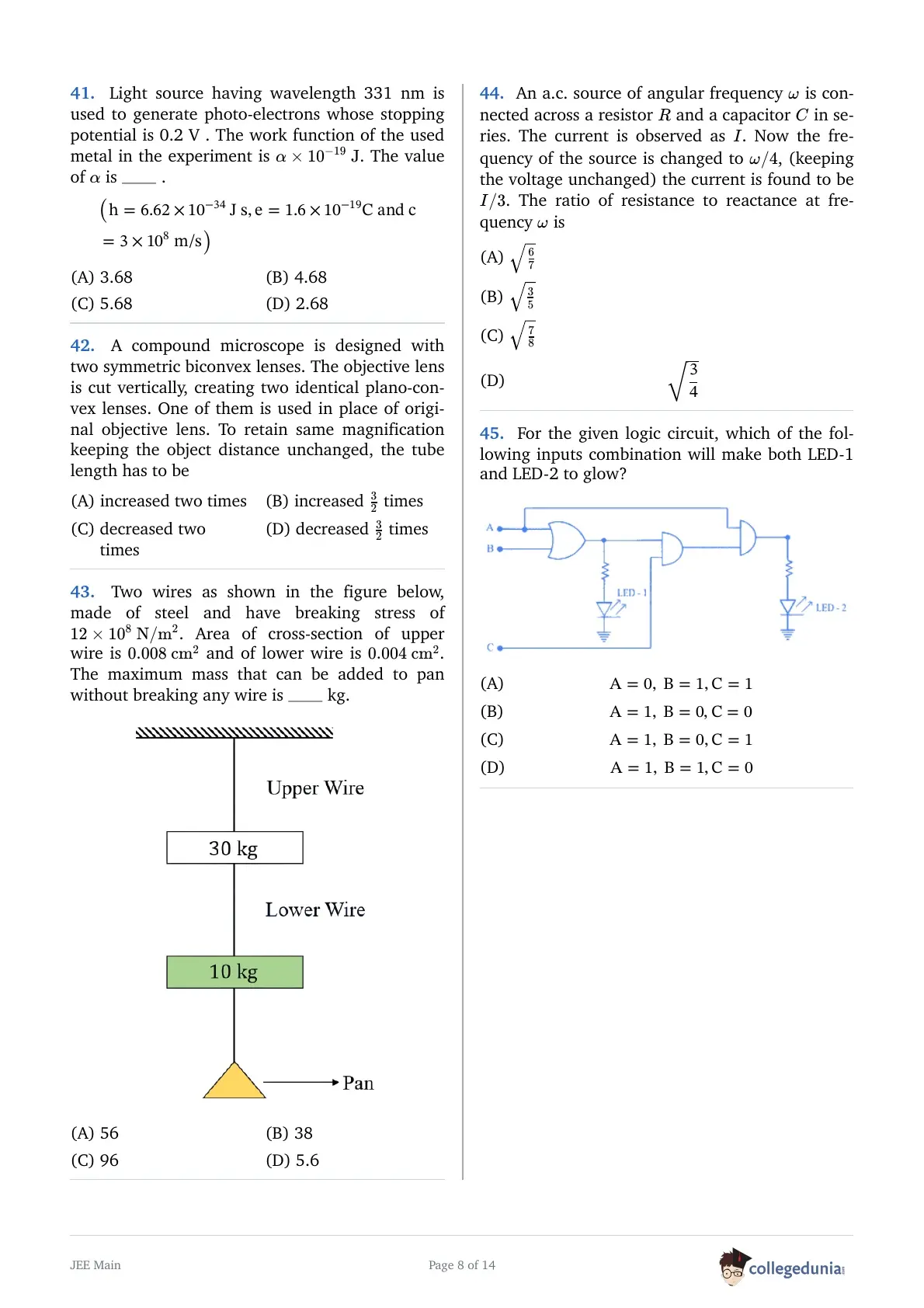
Light source having wavelength 331 nm is used to generate photo-electrons whose stopping potential is 0.2 V. The work function of the used metal in the experiment is \(\alpha \times 10^{-19} J\). The value of \(\alpha\) is ______. (\(h = 6.62 \times 10^{-34} Js, e = 1.6 \times 10^{-19} C and c = 3 \times 10^8 m/s\))
A compound microscope is designed with two symmetric biconvex lenses. The objective lens is cut vertically, creating two identical plano-convex lenses. One of them is used in place of original objective lens. To retain same magnification keeping the object distance unchanged, the tube length has to be:
Two wires as shown in the figure below, made of steel and have breaking stress of \(12 \times 10^8 N/m^2\). Area of cross-section of upper wire is \(0.008 cm^2\) and of lower wire is \(0.004 cm^2\). The maximum mass that can be added to pan without breaking any wire is _________ kg. (take \(g = 10 m/s^2\))

An a.c. source of angular frequency \(\omega\) is connected across a resistor \(R\) and a capacitor \(C\) in series. The current is observed as \(I\). Now the frequency of the source is changed to \(\omega/4\), (keeping the voltage unchanged) the current is found to be \(I/3\). The ratio of resistance to reactance at frequency \(\omega\) is:
For the given logic circuit, which of the following inputs combination will make both LED-1 and LED-2 to glow?

Physics - Section B (Q46 - Q50)
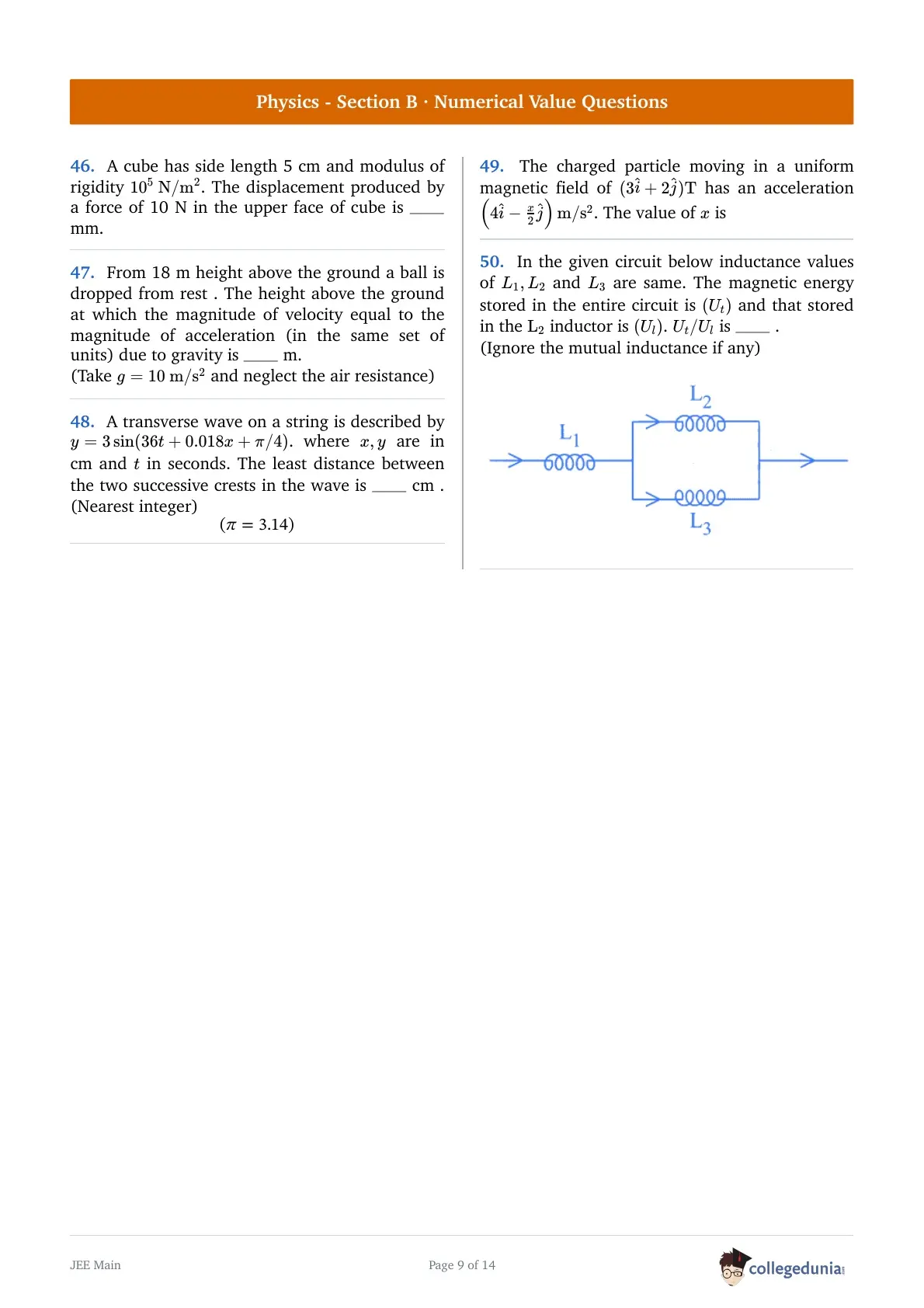
A cube has side length \(5 cm\) and modulus of rigidity \(10^5 N/m^2\). The displacement produced by a force of \(10 N\) in the upper face of the cube is ____ \text{mm.
From \(18 m\) height above the ground a ball is dropped from rest. The height above the ground at which the magnitude of velocity equal to the magnitude of acceleration (in the same set of units) due to gravity is ____ m. (Take \(g = 10 \text{ m/s^2\) and neglect air resistance)
A transverse wave on a string is described by \(y = 3\sin(36t + 0.018x + \pi/4)\), where \(x, y\) are in cm and \(t\) in seconds. The least distance between the two successive crests in the wave is ____ \text{cm. (Nearest integer) (\(\pi = 3.14\))
The charged particle moving in a uniform magnetic field of \((3\hat{i} + 2\hat{j}) T\) has an acceleration \((4\hat{i} - \frac{x}{2}\hat{j}) m/s^2\). The value of \(x\) is ____.
In the given circuit below inductance values of \(L_1, L_2\) and \(L_3\) are same. The magnetic energy stored in the entire circuit is \((U_t)\) and that stored in the \(L_2\) inductor is \((U_j)\). \(U_t / U_j\) is ____. (Ignore the mutual inductance if any).

Chemistry - Section A (Q51 - Q70)
How many grams of residue is obtained by heating \(2.76 g\) of silver carbonate? (Given : Molar mass of C, O and Ag are 12, 16 and \(108 g mol^{-1}\) respectively)
Arrange the following atomic orbitals of multi electron atoms in order of increasing energy.
A. \(n=3, l=2, m=+1\)
B. \(n=4, l=0, m=0\)
C. \(n=6, l=1, m=0\)
D. \(n=5, l=1, m=+1\)
E. \(n=2, l=1, m=+1\)
Identify the correct statements from the following :
A. Heisenberg uncertainty principle is applicable to electrons.
B. The size of \(2p_x\) orbital is less than the size of \(3p_x\) orbital.
C. The energy of \(2s\) orbital of H atom is equal to the energy of \(2s\) orbital of Li.
D. The electronic configuration of Cr is \([Ar] 3d^5 4s^1\)
What is the mole fraction of water in \(10%\) by weight (w/w) of aqueous urea solution? [Given: Molar mass of H, O, C and N are 1, 16, 12 and \(14 g mol^{-1}\) respectively.]
\(M_3A_2\) is a sparingly soluble salt of molar mass \(y g mol^{-1}\) and solubility \(x g L^{-1}\). The ratio of the molar concentration of the anion (\(A^{3-}\)) to the solubility product (\(K_{sp}\)) of the salt is:
Arrange the following resultant mixtures in increasing order of their pH values
A. \(10 mL 0.2 M Ca(OH)_2 + 25 mL 0.1 M HCl\)
B. \(10 mL 0.01 M H_2SO_4 + 10 mL 0.01 M Ca(OH)_2\)
C. \(10 mL 0.1 M H_2SO_4 + 10 mL 0.1 M KOH\)
First order gas phase reaction \(A \to B + C\). \(p_i = initial pressure of gas A\), \(P_t = total pressure of the reaction mixture at time t\). Expression of rate constant (k) is
Given below are two statements:
Statement I: The correct order of electronegativity of fluorine, oxygen and nitrogen is \(F > O > N\).
Statement II: The oxidation state of oxygen in \(OF_2\) is \(+2\) and in \(Na_2O\) is \(-2\).
Correct statements from the following are:
A. Nitrogen in oxidation states from \(+1\) to \(+4\) disproportionates in acid medium.
B. Nitrogen has the ability to form \(d\pi - p\pi\) multiple bonds with itself and other elements with small size and high electronegativity.
C. N-N single bond is stronger than P-P single bond.
D. Nitrogen has highest density in its group due to small size.
E. The maximum covalency of nitrogen is four since it has only four valence orbitals for bonding.
Which of the following is NOT a physical or chemical characteristic of interstitial compounds?
The correct statements about metal carbonyls are:
A. The metal-carbon bonds in metal carbonyls possess both \(\sigma\) and \(\pi\) character.
B. Due to synergic bonding interactions between metal and CO ligand, the metal-carbon bond becomes weak.
C. The metal-carbon \(\sigma\) bond is formed by the donation of lone pair of electrons on the carbonyl carbon into a vacant orbital of metal.
D. The metal-carbon \(\pi\) bond is formed by the donation of electrons from filled d-orbital of metal into vacant \(\pi^*\) orbital of CO.
Given below are two statements:
Statement I: Each electron in \(e_g\) orbitals destabilizes the orbitals by \(+0.6 \Delta_o\) and each electron in the \(t_{2g}\) orbitals stabilizes the orbitals by \(-0.4 \Delta_o\) in an octahedral field on the basis of crystal field theory.
Statement II: All the d-orbitals of the transition metals have the same energy in their free atomic state but when a complex is formed the ligands destroy the degeneracy of these orbitals on the basis of crystal field theory.
Given below are two statements:
Statement I: On the basis of inductive effect, the order of stability of alkyl carbanions is \(CH_3^- > CH_3-CH_2^- > (CH_3)_2CH^- > (CH_3)_3C^-\).
Statement II: Allyl and benzyl carbanions are more stabilised by inductive effect and not by resonance effect.
"P" is a hydrocarbon of molecular formula:- \(C_8H_{14}\). On ozonolysis, "P" forms "Q". "Q" on treatment with alkali under reflux condition produces "R", which on treatment with \(I_2 / NaOH\) gives a yellow precipitate. Acidification of the solution gives "S". The structure of "S" is given below:-
The correct structure of "P" is
- (A)
![]()
- (B)
![]()
- (C)
![]()
- (D)
![]()


For the following Friedel Craft's alkylation reaction, which of the statements are correct?

A. Major product is n-propyl benzene.
B. iso-propyl carbocation intermediate is also generated.
C. Multiple substitution is inevitable.
D. Introducing electron-donating substituent on benzene will not produce any alkyl benzene.
Benzyl isocyanide can be obtained from

Consider compounds A, B and C with following structural formulae
\(A = CH_3 - CH_2 - CH_2 - CH_2 - CH_2 - OH\)
\(B = CH_2 = CH - CH_2 - CH_2 - CH_3\)
\(C = HO - CH_2 - CH_2 - CH(OH) - CH_3\)
For the conversion of B from A, reagent (D) required is ____ and structural formula of product (E) obtained when C undergoes same reaction using excess reagent (D) is ____.
- (A)
![]()
- (B)
![]()
- (C)
![]()
- (D)
![]()


Identify the incorrect statements.

Identify the correct statements.
A. Glucose exists in two anomeric forms.
B. Anomers of glucose differ in configuration at C-1 in cyclic hemiacetal structure.
C. Melting point of \(\alpha\)-anomer of glucose is greater than \(\beta\)-anomer.
D. Specific rotation of \(\alpha\)-anomer is \(+19^\circ\) while for \(\beta\)-anomer is \(+112^\circ\).
E. \(\alpha\) and \(\beta\) anomers of glucose are prepared by crystallization of saturated glucose solution at \(303 K\) and \(371 K\) respectively.
Given below are two statements:
Statement I: Sodium dichromate and potassium dichromate are classified as primary standards in titrimetric analysis.
Statement II: Phenolphthalein is a weak base, therefore it dissociates in acidic medium.
Chemistry - Section B (Q71 - Q75)
Consider the following species:
\(BrF_5, XeF_5^-, BF_4^-, ICl_4^-, XeF_4, SF_4, NH_4^+, ClF_3, XeF_2, ICl_2^-\)
Number of species having \(sp^3d\) hybridized central atom is ____.
In an estimation of sulphur by Carius method \(0.2 g\) of the substance gave \(0.6 g\) of \(BaSO_4\). The percentage of sulphur in the substance is ____ %.
(Given molar mass in \(g mol^{-1}\) S : 32, \(BaSO_4 : 231\))
One mole of phenol is treated with dilute \(HNO_3\) at \(298 K\) to give a mixture of products. The mixture is separated by steam distillation. The steam volatile compound (X) is separated. The increase in percentage of oxygen in (X) with respect to phenol is ____ \(\times 10^{-1}\) %.
(Given molar mass in \(g mol^{-1}\) H:1, C:12, N:14, O:16)
The values of pressure equilibrium constant recorded at different temperatures for the following equilibrium reaction have been given below:
\(A(g) \rightleftharpoons B(g) + C(g)\)

The magnitude of \(\frac{\Delta H^\circ}{R}\) calculated from the above data is ____. (Nearest integer)
If the half life of a first order reaction is \(6.93 minutes\) then the time required for completion of \(99 %\) of the reaction will be ____ minutes.
(Given : \(\log 2 = 0.3010\))
JEE Main 2026 Exam Pattern and Marking Scheme
| Particulars | Details |
|---|---|
| Exam Mode | Online (Computer-Based Test) |
| Paper | B.E./B.Tech |
| Medium of Exam | 13 languages: English, Hindi, Gujarati, Bengali, Tamil, Telugu, Kannada, Marathi, Malayalam, Odia, Punjabi, Assamese, Urdu |
| Duration | 3 hours (180 minutes) |
| Type of Questions | Multiple Choice Questions (MCQs) + Numerical Value Questions |
| Total Marks | 300 marks |
| Subjects | Mathematics, Physics, Chemistry |
| Marking Scheme | +4 for correct answer & -1 for incorrect MCQ and Numerical Value-based Questions |
| Total Questions | 75 Questions |
| Eligibility | Passed or appearing in Class 12 with Physics, Chemistry, and Mathematics |



Comments