





JEE Main 2026 April 4 Shift 1 physics question paper is available here with answer key and solutions. NTA conducted the first shift of the day on April 4, 2026, from 9:00 AM to 12:00 PM.
- The JEE Main Physics Question Paper contains a total of 25 questions.
- Each correct answer gets you 4 marks while incorrect answers gets you a negative mark of 1.
Candidates can download the JEE Main 2026 April 4 Shift 1 physics question paper along with detailed solutions to analyze their performance and understand the exam pattern better.
JEE Main 2026 April 4 Shift 1 Physics Question Paper with Solution PDF

Also Check:
Question 1:
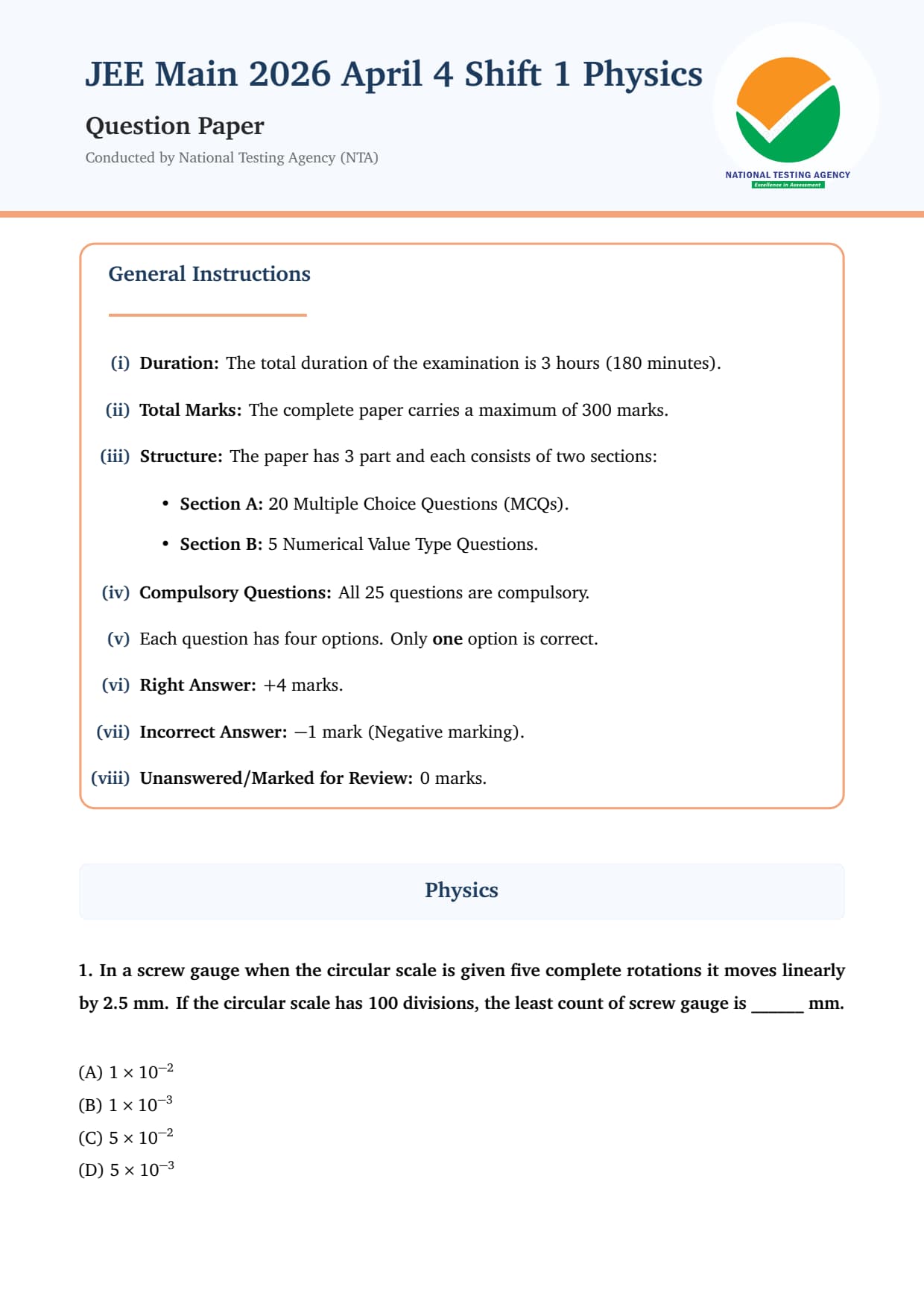
In a screw gauge when the circular scale is given five complete rotations it moves linearly by 2.5 mm. If the circular scale has 100 divisions, the least count of screw gauge is ______ mm.
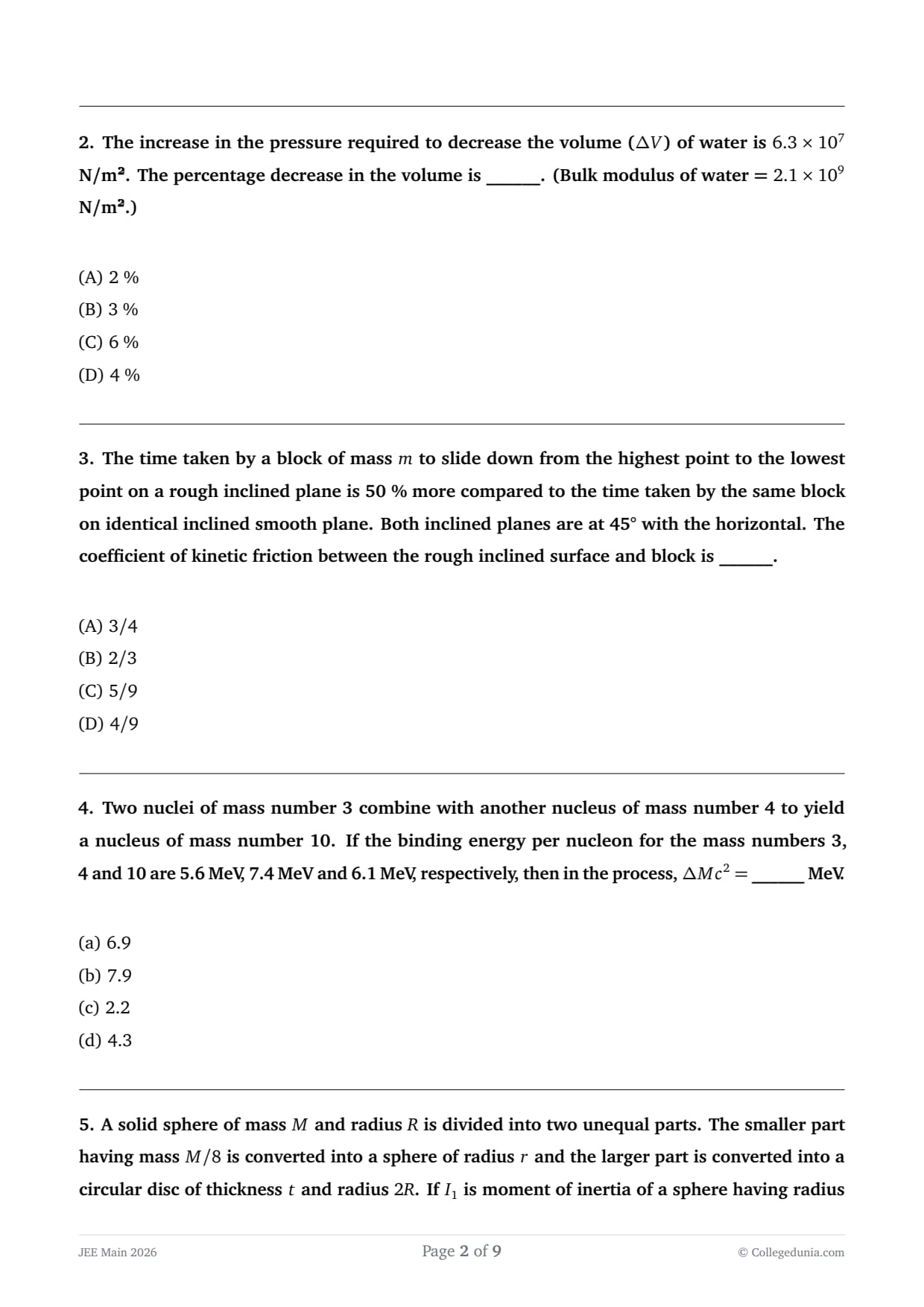
The increase in the pressure required to decrease the volume (\(\Delta V\)) of water is \(6.3 \times 10^7\) N/m². The percentage decrease in the volume is ______. (Bulk modulus of water = \(2.1 \times 10^9\) N/m².)
The time taken by a block of mass \(m\) to slide down from the highest point to the lowest point on a rough inclined plane is 50 % more compared to the time taken by the same block on identical inclined smooth plane. Both inclined planes are at 45° with the horizontal. The coefficient of kinetic friction between the rough inclined surface and block is ______.
Two nuclei of mass number 3 combine with another nucleus of mass number 4 to yield a nucleus of mass number 10. If the binding energy per nucleon for the mass numbers 3, 4 and 10 are 5.6 MeV, 7.4 MeV and 6.1 MeV, respectively, then in the process, \(\Delta Mc^2 =\) ______ MeV.
A solid sphere of mass \(M\) and radius \(R\) is divided into two unequal parts. The smaller part having mass \(M/8\) is converted into a sphere of radius \(r\) and the larger part is converted into a circular disc of thickness \(t\) and radius \(2R\). If \(I_1\) is moment of inertia of a sphere having radius \(r\) about an axis through its centre and \(I_2\) is the moment of inertia of a disc about its diameter, the ratio of their moment of inertia \(I_2/I_1 =\) ______.
The two projectiles are projected with the same initial velocities at the 15° and 30° with respect to the horizontal. The ratio of their ranges is 1:x. The value of \(x\) is
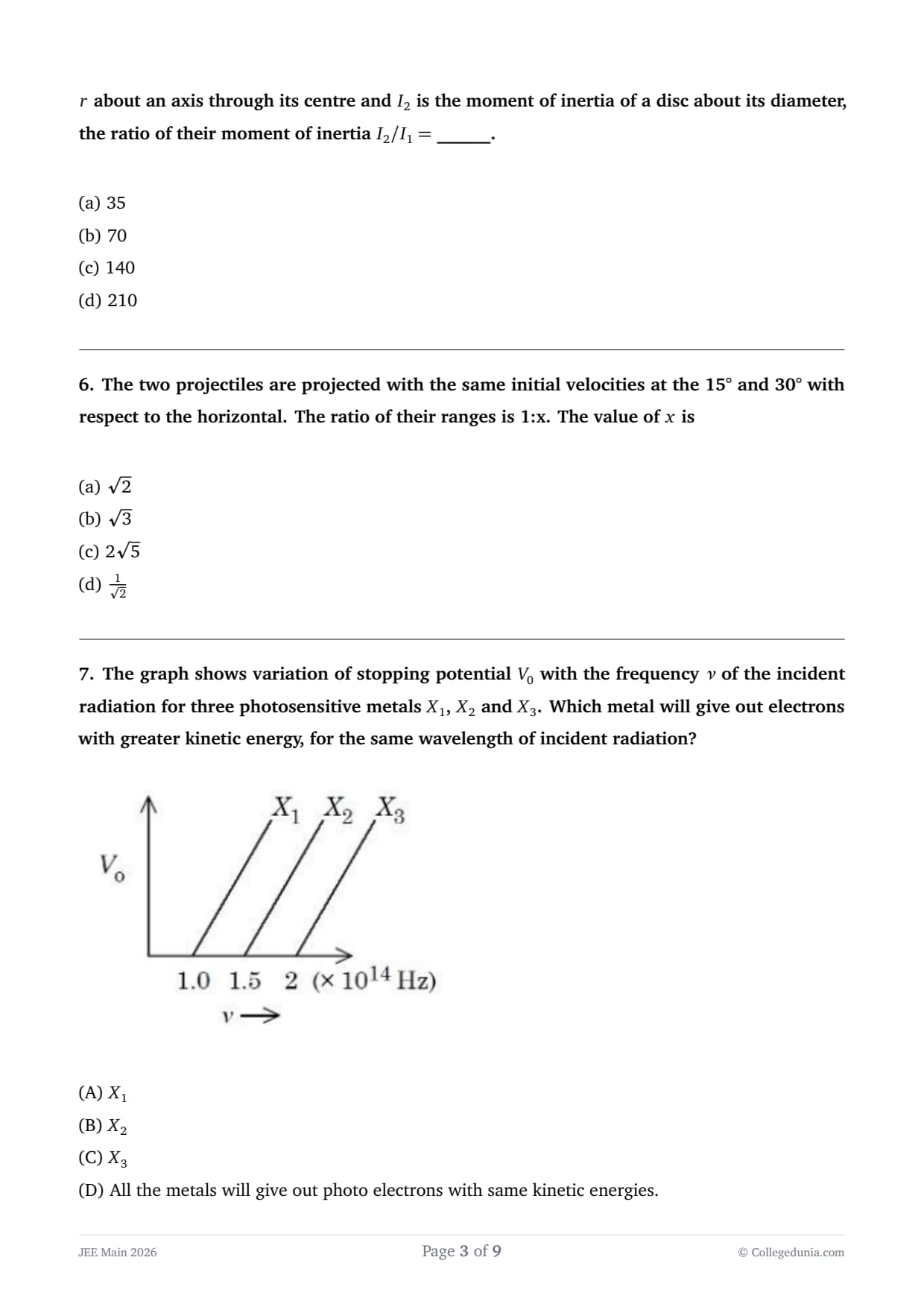
The graph shows variation of stopping potential \(V_0\) with the frequency \(\nu\) of the incident radiation for three photosensitive metals \(X_1\), \(X_2\) and \(X_3\). Which metal will give out electrons with greater kinetic energy, for the same wavelength of incident radiation?

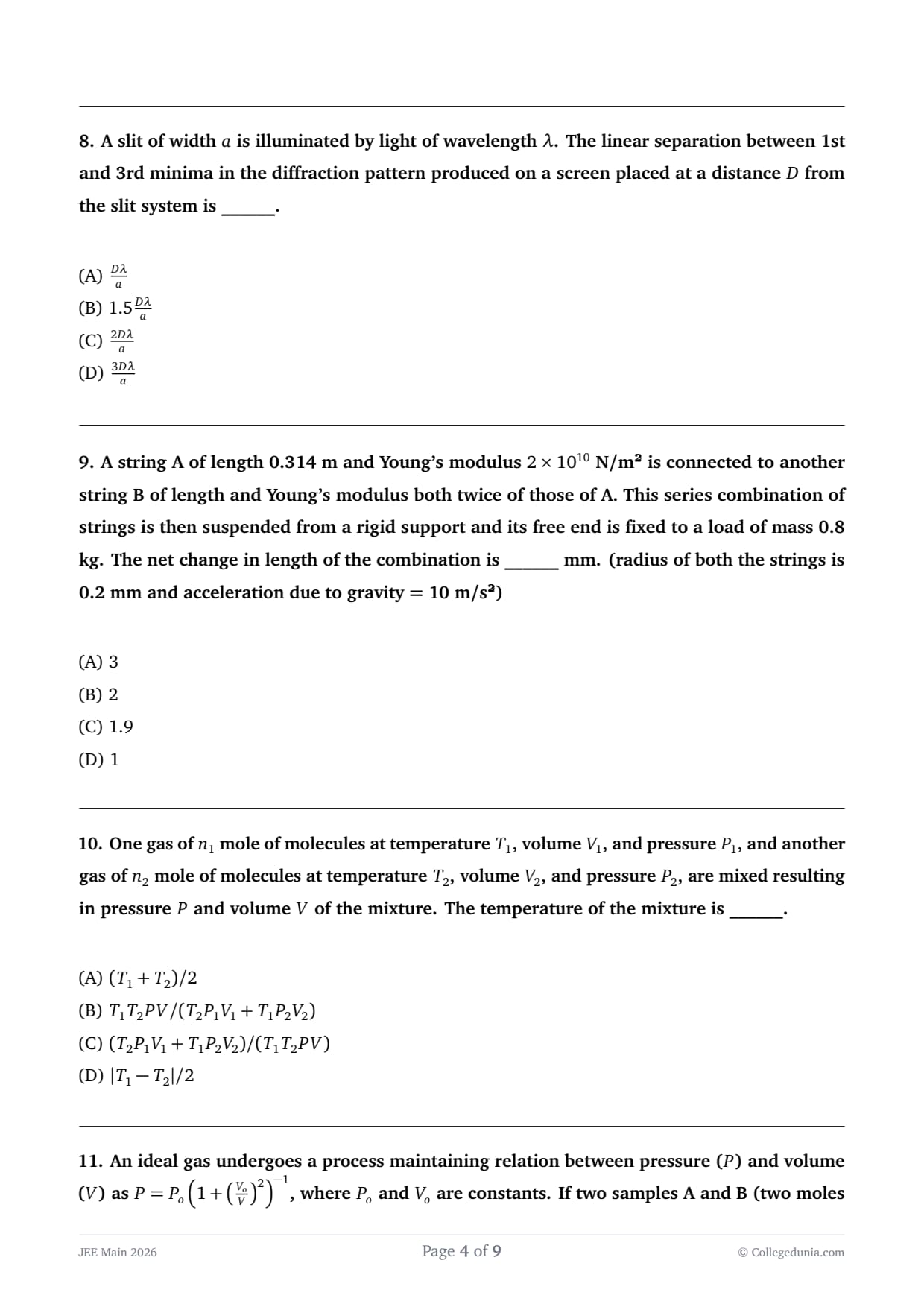
A slit of width \(a\) is illuminated by light of wavelength \(\lambda\). The linear separation between 1st and 3rd minima in the diffraction pattern produced on a screen placed at a distance \(D\) from the slit system is ______.
A string A of length 0.314 m and Young's modulus \(2 \times 10^{10}\) N/m² is connected to another string B of length and Young's modulus both twice of those of A. This series combination of strings is then suspended from a rigid support and its free end is fixed to a load of mass 0.8 kg. The net change in length of the combination is ______ mm. (radius of both the strings is 0.2 mm and acceleration due to gravity = 10 m/s²)
One gas of \(n_1\) mole of molecules at temperature \(T_1\), volume \(V_1\), and pressure \(P_1\), and another gas of \(n_2\) mole of molecules at temperature \(T_2\), volume \(V_2\), and pressure \(P_2\), are mixed resulting in pressure \(P\) and volume \(V\) of the mixture. The temperature of the mixture is ______.
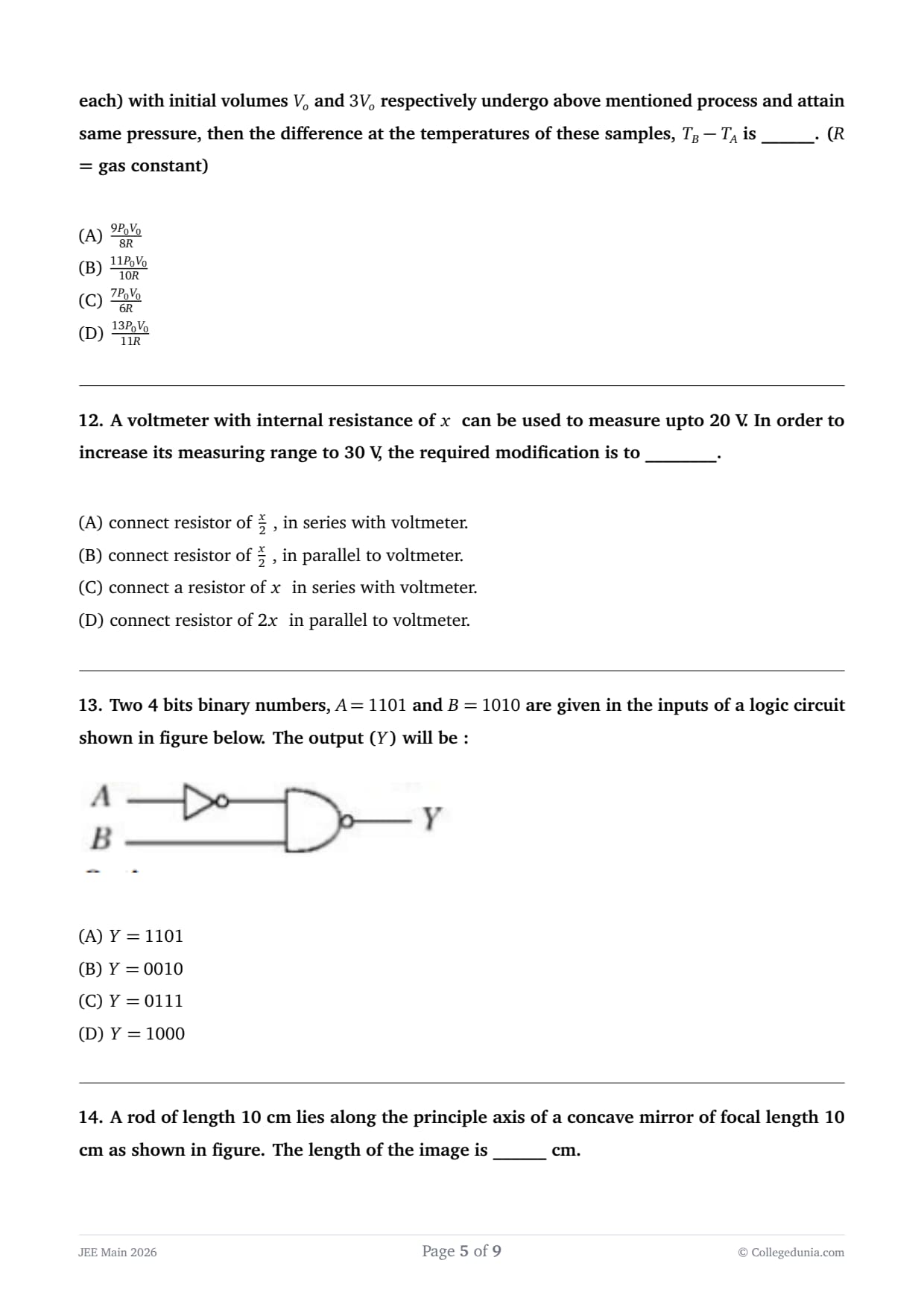
An ideal gas undergoes a process maintaining relation between pressure (\(P\)) and volume (\(V\)) as \(P = P_o \left(1 + \left(\frac{V_o}{V}\right)^2\right)^{-1}\), where \(P_o\) and \(V_o\) are constants. If two samples A and B (two moles each) with initial volumes \(V_o\) and \(3V_o\) respectively undergo above mentioned process and attain same pressure, then the difference at the temperatures of these samples, \(T_B - T_A\) is ______. (\(R\) = gas constant)
A voltmeter with internal resistance of \(x\) Ω can be used to measure upto 20 V. In order to increase its measuring range to 30 V, the required modification is to ________.
Two 4 bits binary numbers, \(A = 1101\) and \(B = 1010\) are given in the inputs of a logic circuit shown in figure below. The output (\(Y\)) will be :

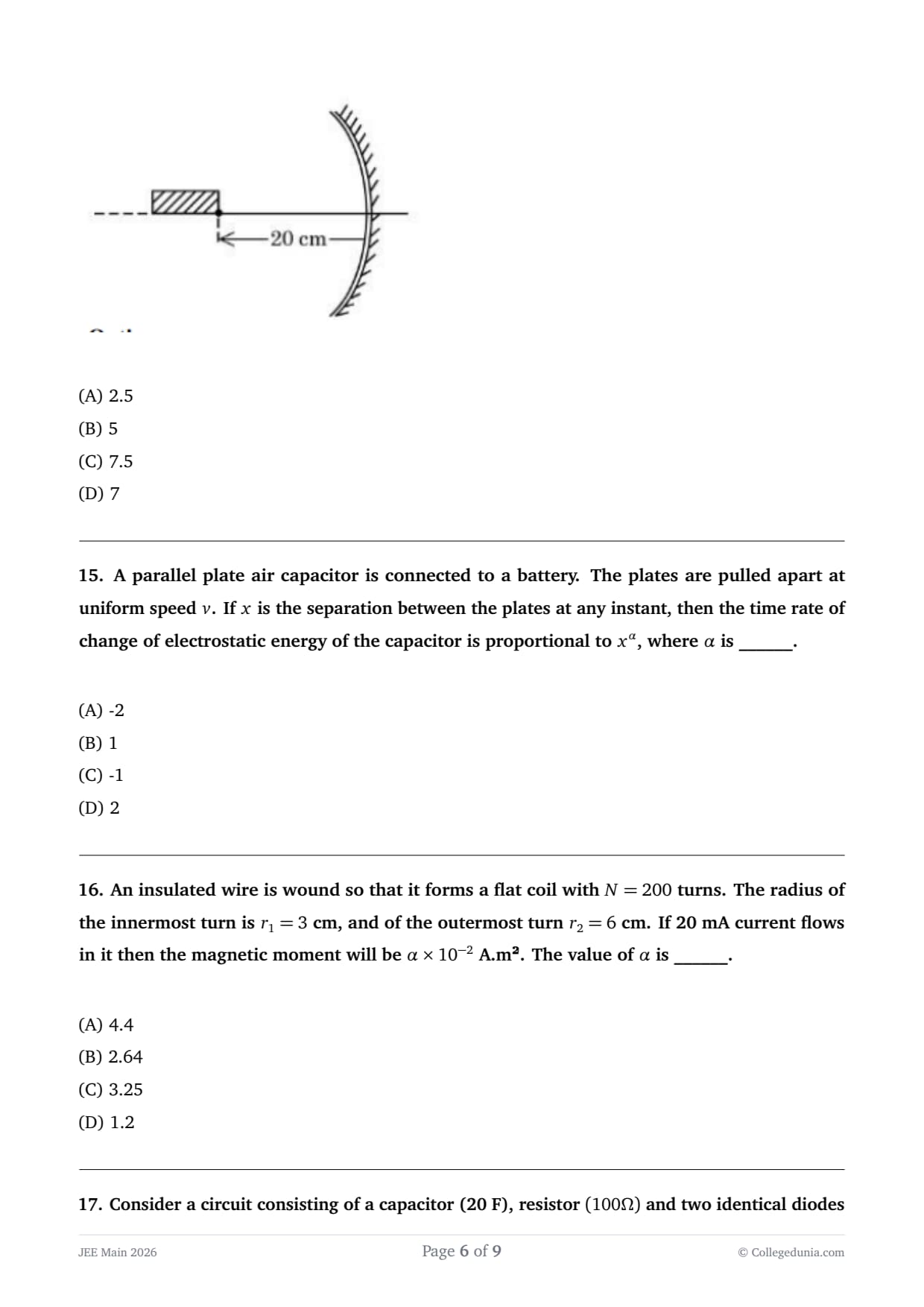
A rod of length 10 cm lies along the principle axis of a concave mirror of focal length 10 cm as shown in figure. The length of the image is ______ cm.

A parallel plate air capacitor is connected to a battery. The plates are pulled apart at uniform speed \(v\). If \(x\) is the separation between the plates at any instant, then the time rate of change of electrostatic energy of the capacitor is proportional to \(x^\alpha\), where \(\alpha\) is ______.
An insulated wire is wound so that it forms a flat coil with \(N = 200\) turns. The radius of the innermost turn is \(r_1 = 3\) cm, and of the outermost turn \(r_2 = 6\) cm. If 20 mA current flows in it then the magnetic moment will be \(\alpha \times 10^{-2}\) A.m². The value of \(\alpha\) is ______.
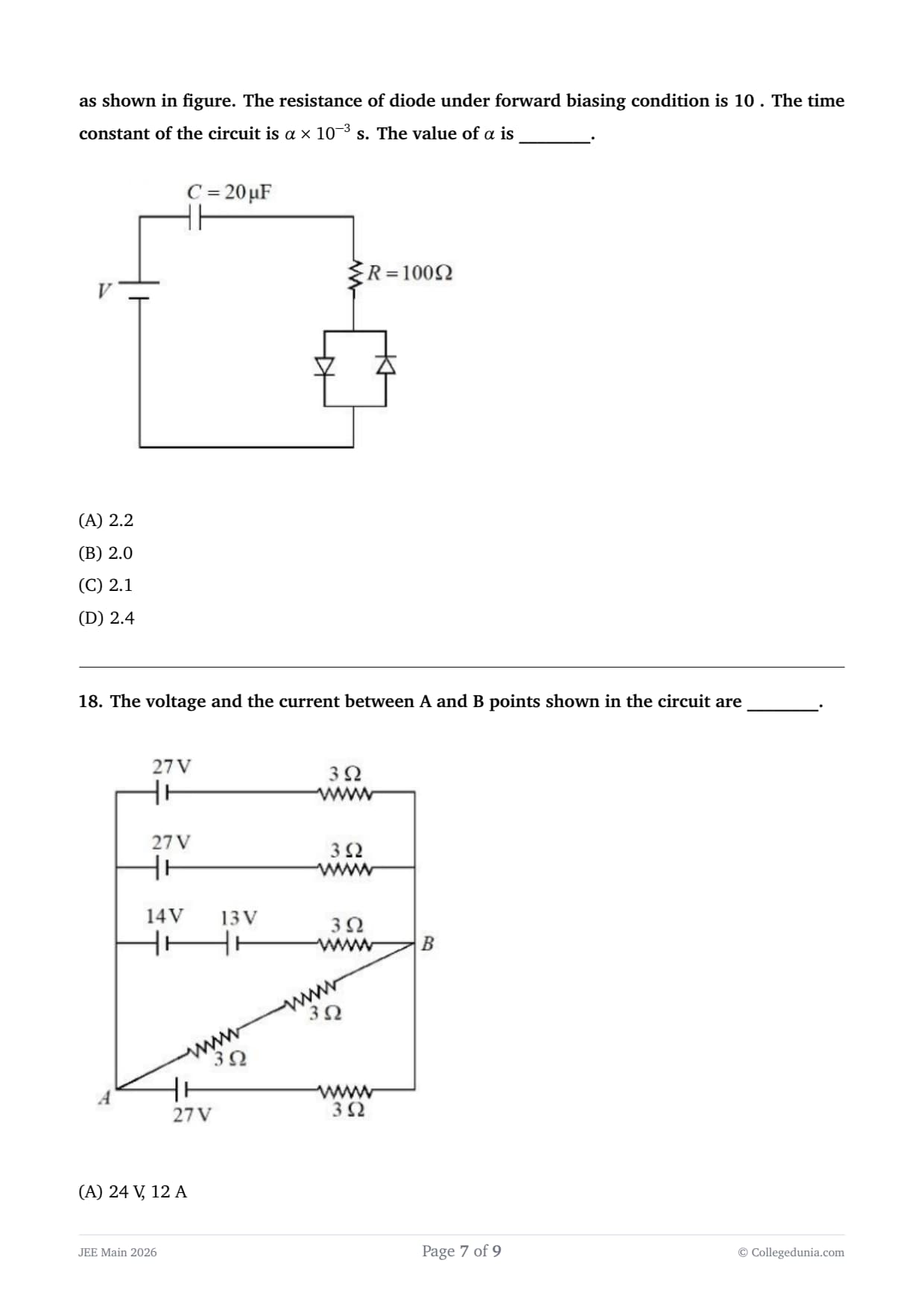
Consider a circuit consisting of a capacitor (20 μF), resistor \((100 \Omega)\) and two identical diodes as shown in figure. The resistance of diode under forward biasing condition is 10 Ω. The time constant of the circuit is \(\alpha \times 10^{-3}\) s. The value of \(\alpha\) is ________.

The voltage and the current between A and B points shown in the circuit are ________.

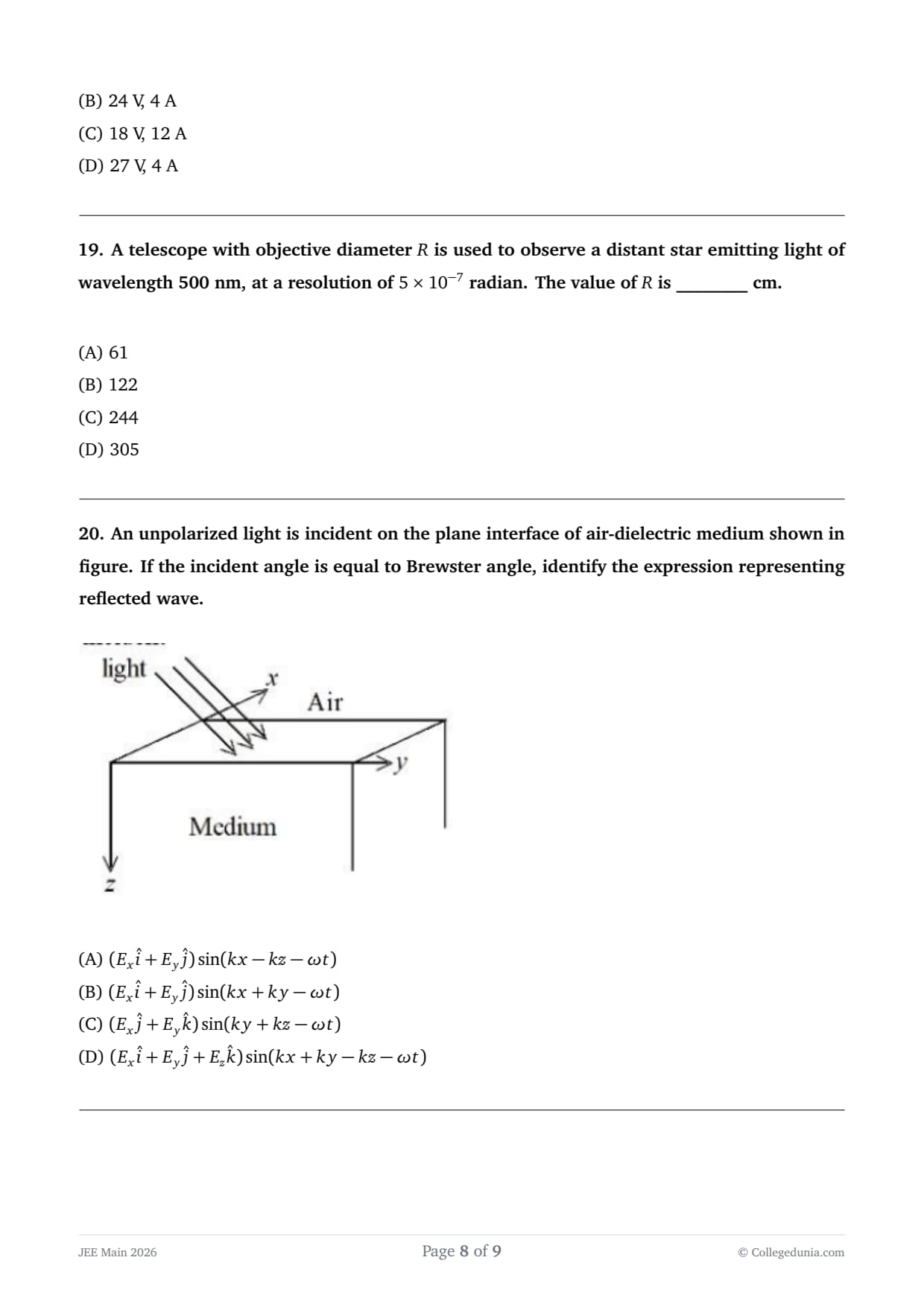
A telescope with objective diameter \(R\) is used to observe a distant star emitting light of wavelength 500 nm, at a resolution of \(5 \times 10^{-7}\) radian. The value of \(R\) is ________ cm.
An unpolarized light is incident on the plane interface of air-dielectric medium shown in figure. If the incident angle is equal to Brewster angle, identify the expression representing reflected wave.

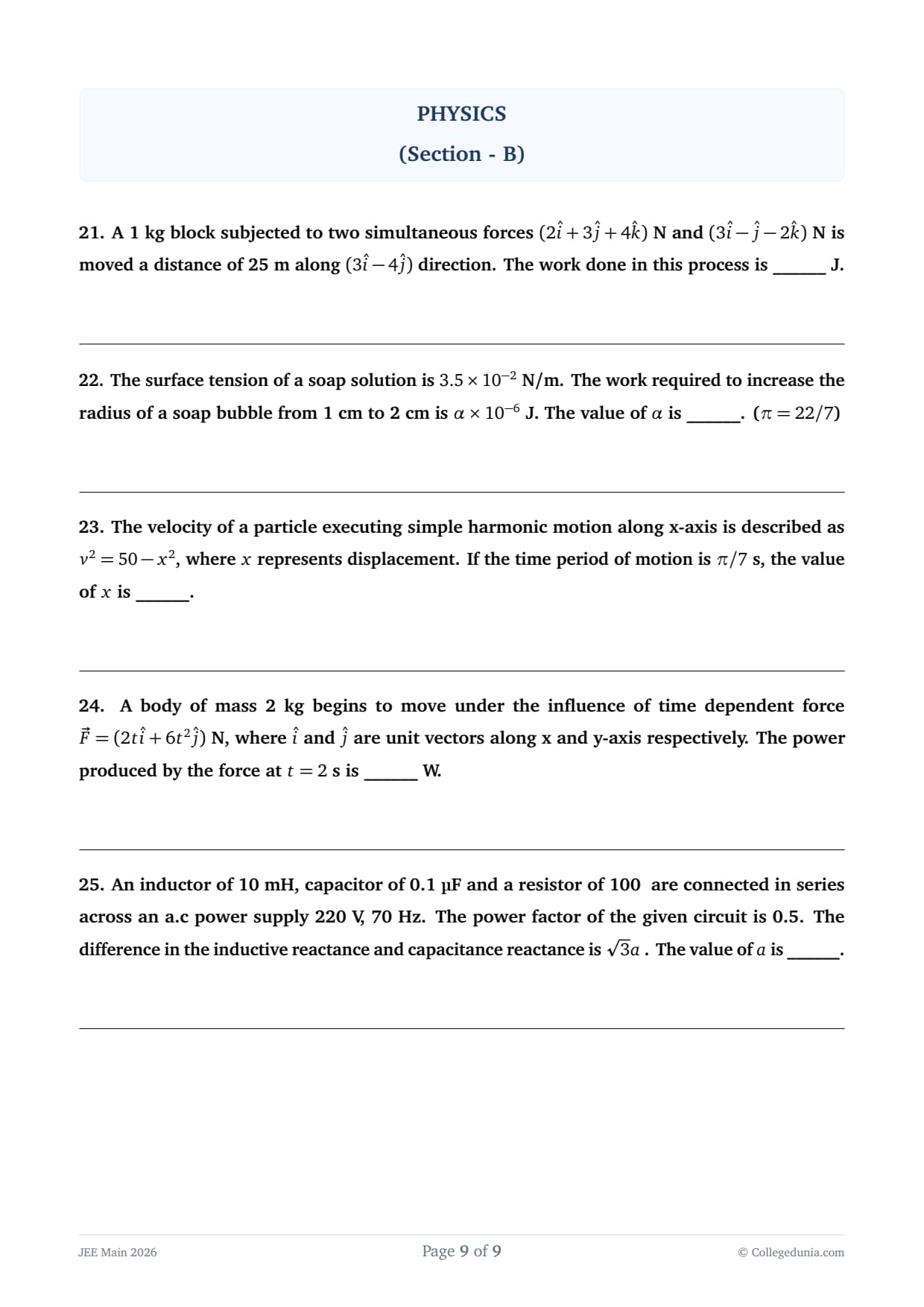
A 1 kg block subjected to two simultaneous forces \((2\hat{i} + 3\hat{j} + 4\hat{k})\) N and \((3\hat{i} - \hat{j} - 2\hat{k})\) N is moved a distance of 25 m along \((3\hat{i} - 4\hat{j})\) direction. The work done in this process is ______ J.
The surface tension of a soap solution is \(3.5 \times 10^{-2}\) N/m. The work required to increase the radius of a soap bubble from 1 cm to 2 cm is \(\alpha \times 10^{-6}\) J. The value of \(\alpha\) is ______. (\(\pi = 22/7\))
The velocity of a particle executing simple harmonic motion along x-axis is described as \(v^2 = 50 - x^2\), where \(x\) represents displacement. If the time period of motion is \(\pi/7\) s, the value of \(x\) is ______.
A body of mass 2 kg begins to move under the influence of time dependent force \(\vec{F} = (2t \hat{i} + 6t^2 \hat{j})\) N, where \(\hat{i}\) and \(\hat{j}\) are unit vectors along x and y-axis respectively. The power produced by the force at \(t = 2\) s is ______ W.
An inductor of 10 mH, capacitor of 0.1 µF and a resistor of 100 Ω are connected in series across an a.c power supply 220 V, 70 Hz. The power factor of the given circuit is 0.5. The difference in the inductive reactance and capacitance reactance is \(\sqrt{3} a\) Ω. The value of \(a\) is ______.
JEE Main 2026 Physics Exam Pattern
| Particulars | Details |
|---|---|
| Exam Mode | Online (Computer-Based Test) |
| Paper | B.E./B.Tech |
| Medium of Exam | 13 languages: English, Hindi, Gujarati, Bengali, Tamil, Telugu, Kannada, Marathi, Malayalam, Odia, Punjabi, Assamese, Urdu |
| Type of Questions | Multiple Choice Questions (MCQs) + Numerical Value Questions |
| Total Marks | 100 marks |
| Marking Scheme | +4 for correct answer & -1 for incorrect MCQ and Numerical Value-based Questions |
| Total Questions | 25 Questions |



Comments