





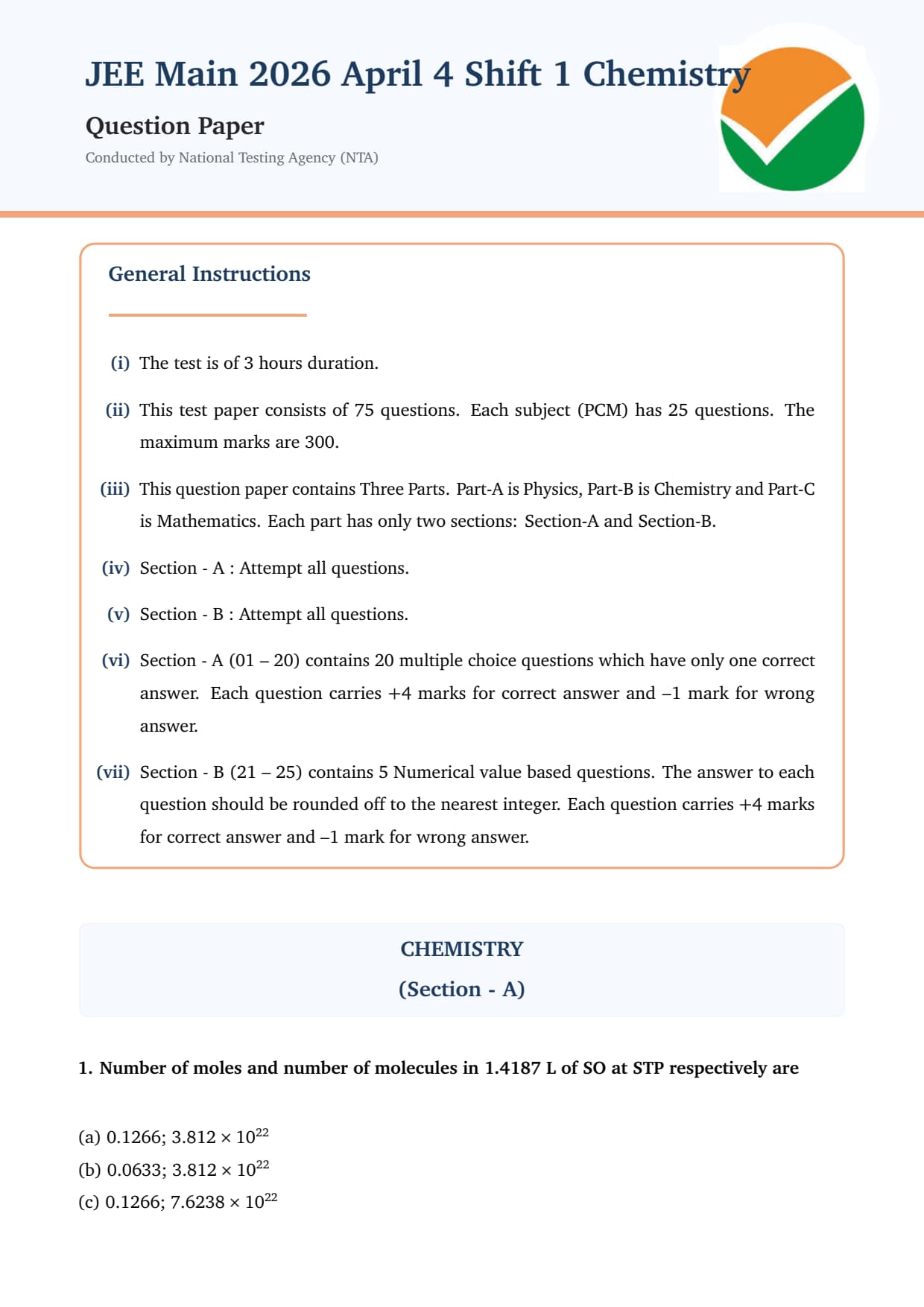
JEE Main 2026 April 4 Shift 1 chemistry question paper is available here with answer key and solutions. NTA conducted the first shift of the day on April 4, 2026, from 9:00 AM to 12:00 PM.
- The JEE Main Chemistry Question Paper contains a total of 25 questions.
- Each correct answer gets you 4 marks while incorrect answers gets you a negative mark of 1.
Candidates can download the JEE Main 2026 April 4 Shift 1 chemistry question paper along with detailed solutions to analyze their performance and understand the exam pattern better.
JEE Main 2026 April 4 Shift 1 Chemistry Question Paper with Solution PDF

Also Check:

Question 1:
Number of moles and number of molecules in 1.4187 L of SO₂ at STP respectively are
What is the ratio of wave number of first line (lowest energy line) of Balmer series of H atomic spectrum to first line of its Brackett series?
Which of the following is correct set of 4 quantum numbers of 19th electron in Chromium (Atomic number = 24) in accordance with Aufbau principle?
Statement I: For an ideal gas, heat capacity at constant volume is always greater than the heat capacity at constant pressure.
Statement II: In a constant volume process, no work is produced and all the heat withdrawn goes into the chaotic motion and is reflected by a temperature increase of the ideal gas.
In the light of the above statements, choose the correct answer:
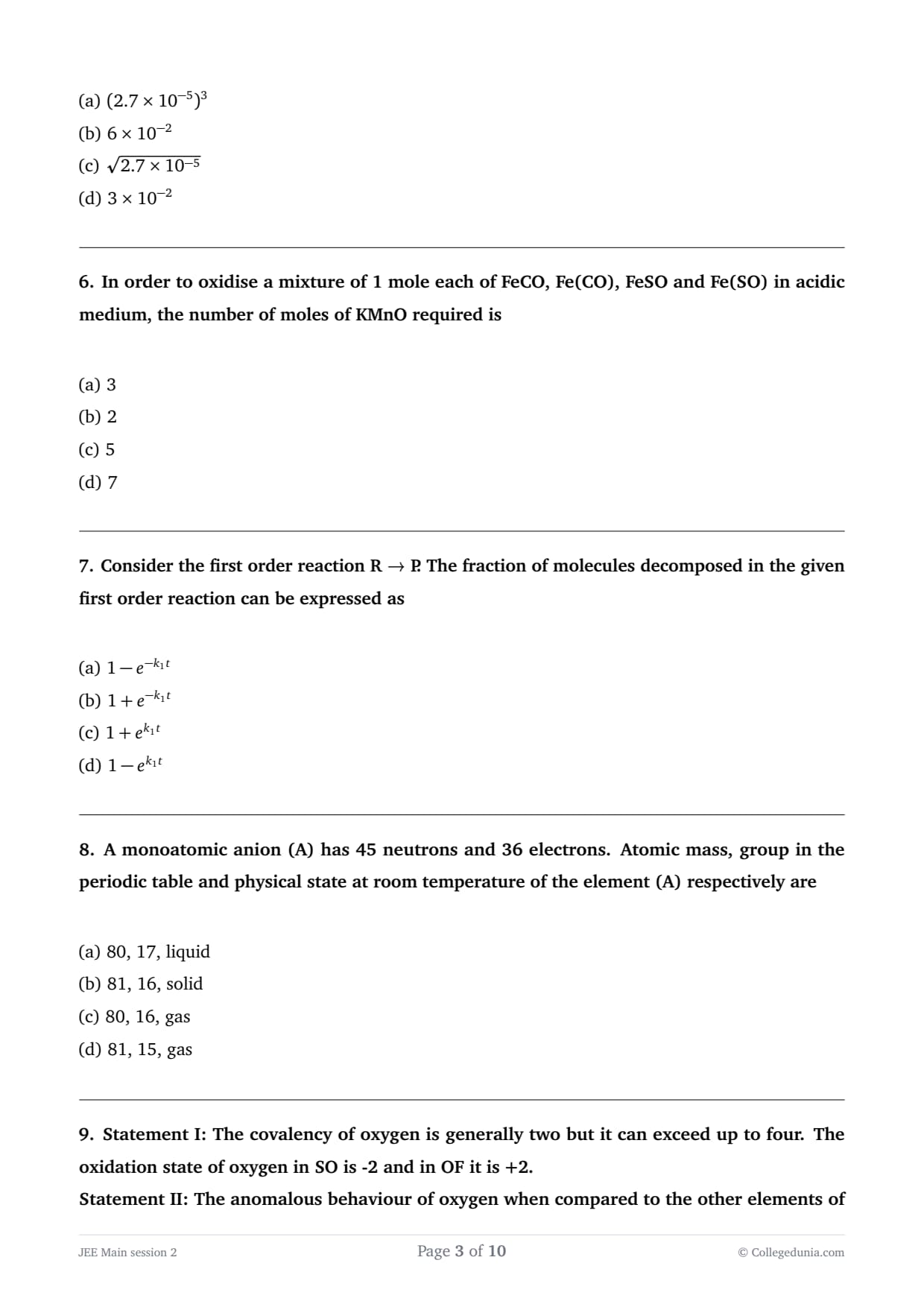
At T(K), the equilibrium constant of \(A_2(g) + B_2(g) \rightleftharpoons C(g)\) is \(2.7 \times 10^{-5}\). What is the equilibrium constant for \(\frac{1}{3} A_2(g) + \frac{1}{3} B_2(g) \rightleftharpoons \frac{1}{3} C(g)\) at the same temperature?
In order to oxidise a mixture of 1 mole each of FeC₂O₄, Fe₂(C₂O₄)₃, FeSO₄ and Fe₂(SO₄)₃ in acidic medium, the number of moles of KMnO₄ required is
Consider the first order reaction R → P. The fraction of molecules decomposed in the given first order reaction can be expressed as
A monoatomic anion (A⁻) has 45 neutrons and 36 electrons. Atomic mass, group in the periodic table and physical state at room temperature of the element (A) respectively are
Statement I: The covalency of oxygen is generally two but it can exceed up to four. The oxidation state of oxygen in SO₂ is -2 and in OF₂ it is +2.
Statement II: The anomalous behaviour of oxygen when compared to the other elements of group 16 is due to its small size and high electronegativity.
In the light of the above statements, choose the correct answer:
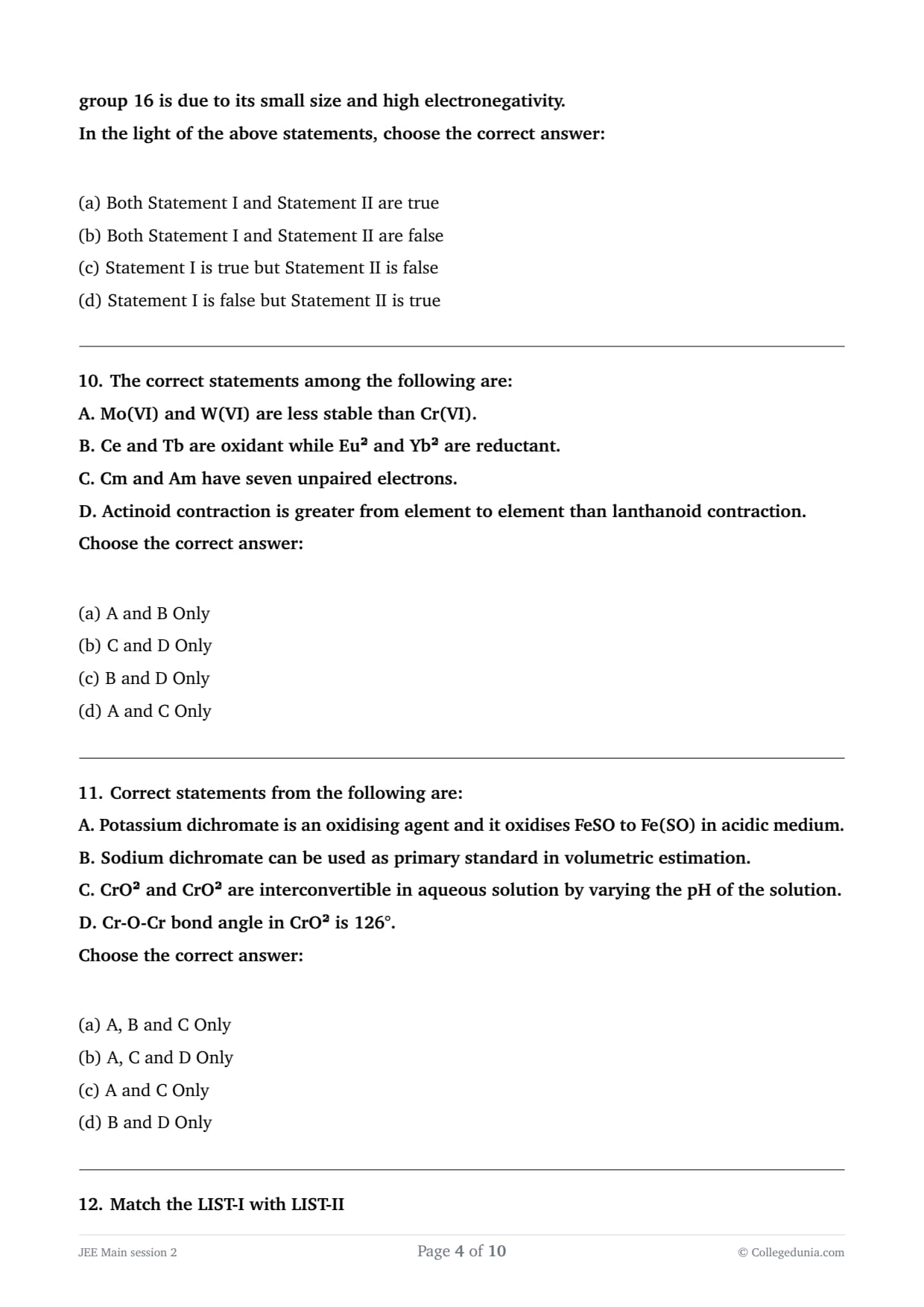
The correct statements among the following are:
A. Mo(VI) and W(VI) are less stable than Cr(VI).
B. Ce⁴⁺ and Tb⁴⁺ are oxidant while Eu²⁺ and Yb²⁺ are reductant.
C. Cm and Am have seven unpaired electrons.
D. Actinoid contraction is greater from element to element than lanthanoid contraction.
Choose the correct answer:
Correct statements from the following are:
A. Potassium dichromate is an oxidising agent and it oxidises FeSO₄ to Fe₂(SO₄)₃ in acidic medium.
B. Sodium dichromate can be used as primary standard in volumetric estimation.
C. CrO₄²⁻ and Cr₂O₇²⁻ are interconvertible in aqueous solution by varying the pH of the solution.
D. Cr-O-Cr bond angle in Cr₂O₇²⁻ is 126°.
Choose the correct answer:
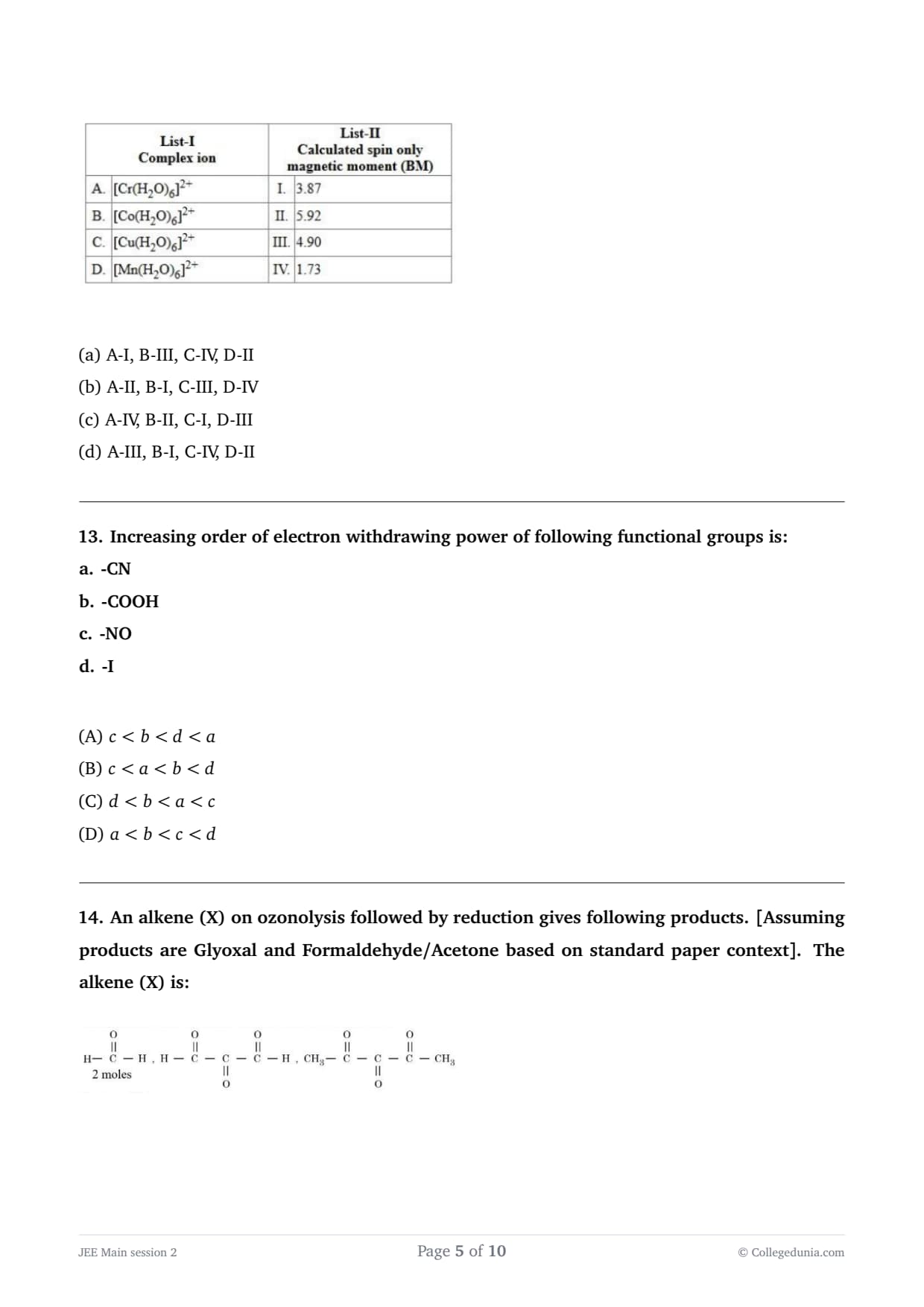
Match the LIST-I with LIST-II

Increasing order of electron withdrawing power of following functional groups is:
a. -CN
b. -COOH
c. -NO₂
d. -I
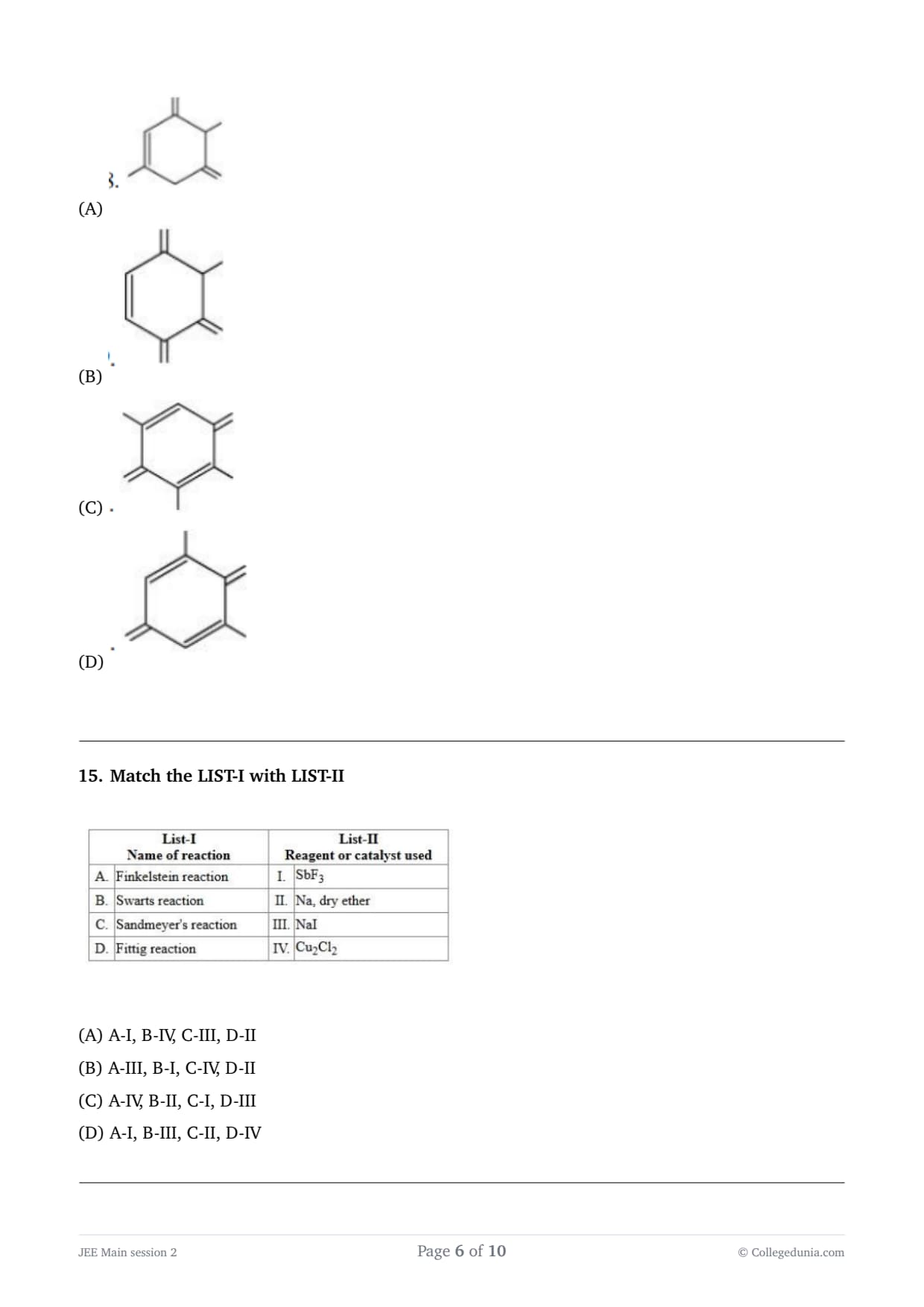
An alkene (X) on ozonolysis followed by reduction gives following products. [Assuming products are Glyoxal and Formaldehyde/Acetone based on standard paper context]. The alkene (X) is:

- (A)
![]()
- (B)
![]()
- (C)
![]()
- (D)
![]()


Match the LIST-I with LIST-II

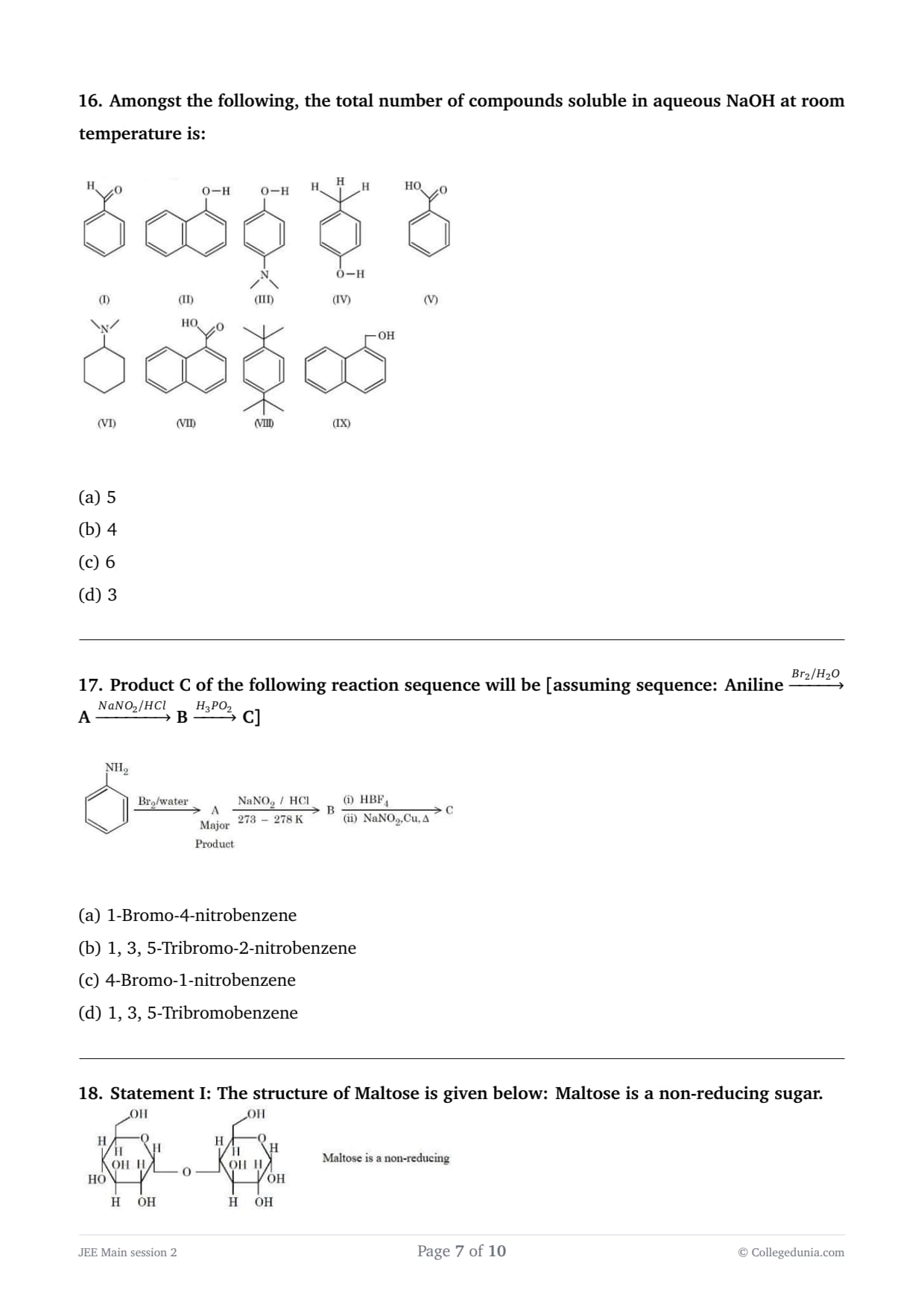
Amongst the following, the total number of compounds soluble in aqueous NaOH at room temperature is:

Product C of the following reaction sequence will be [assuming sequence: Aniline \(\xrightarrow{Br_2/H_2O}\) A \(\xrightarrow{NaNO_2/HCl}\) B \(\xrightarrow{H_3PO_2}\) C]

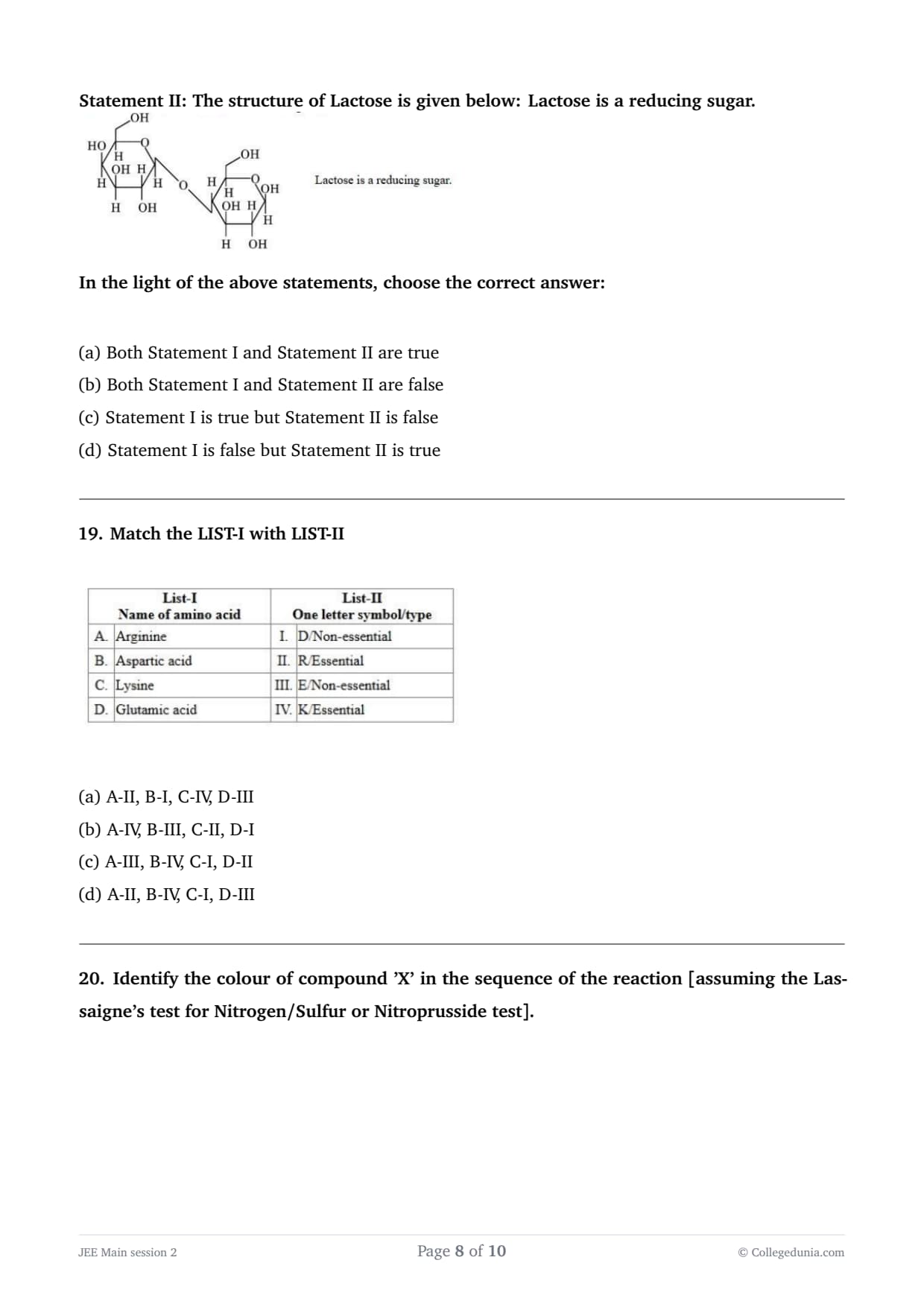
Statement I: The structure of Maltose is given below: Maltose is a non-reducing sugar.

Statement II: The structure of Lactose is given below: Lactose is a reducing sugar.

In the light of the above statements, choose the correct answer:
Match the LIST-I with LIST-II

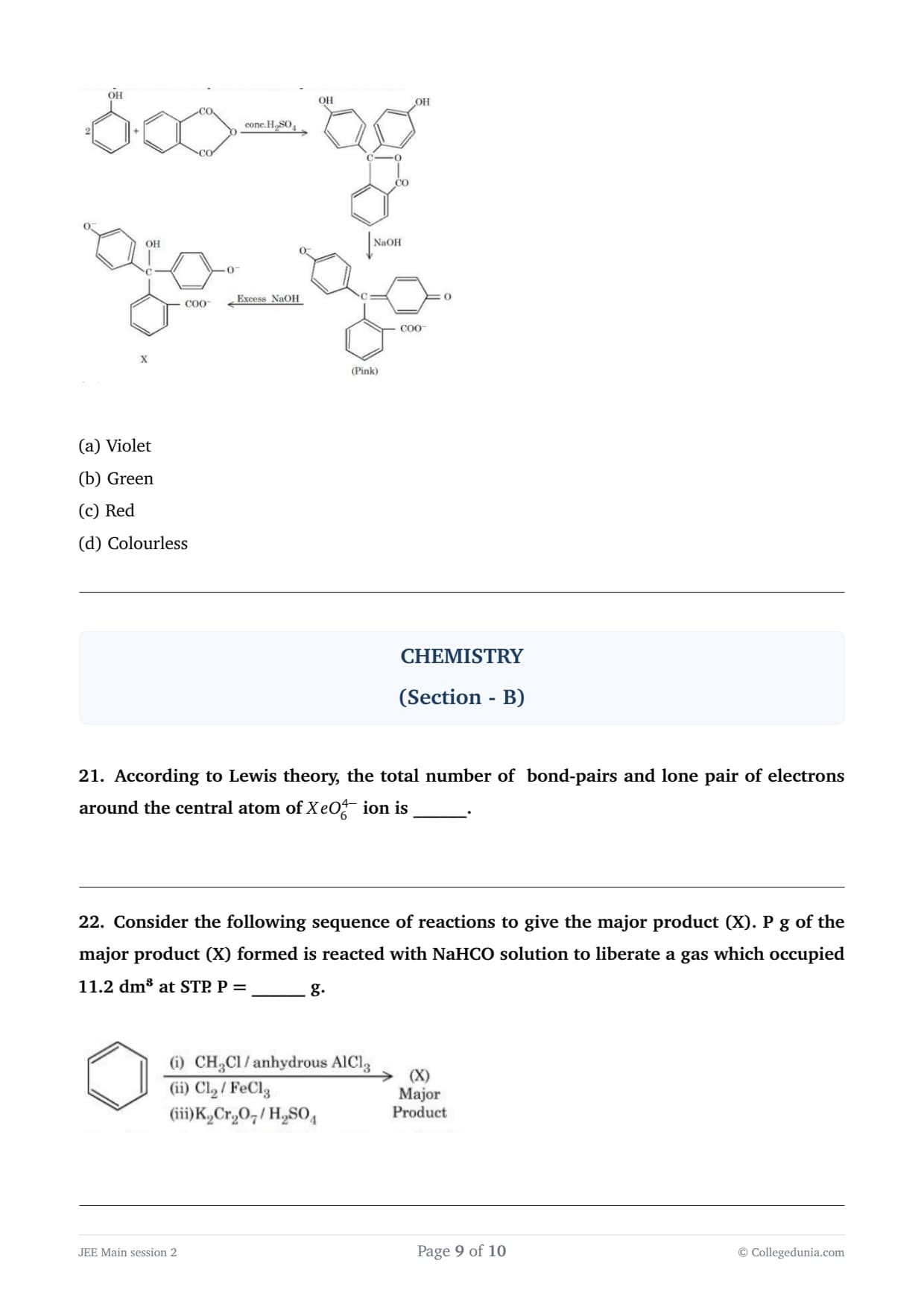
Identify the colour of compound 'X' in the sequence of the reaction [assuming the Lassaigne's test for Nitrogen/Sulfur or Nitroprusside test].

According to Lewis theory, the total number of σ bond-pairs and lone pair of electrons around the central atom of \(XeO_6^{4-}\) ion is ______.
Consider the following sequence of reactions to give the major product (X). P g of the major product (X) formed is reacted with NaHCO₃ solution to liberate a gas which occupied 11.2 dm³ at STP. P = ______ g.

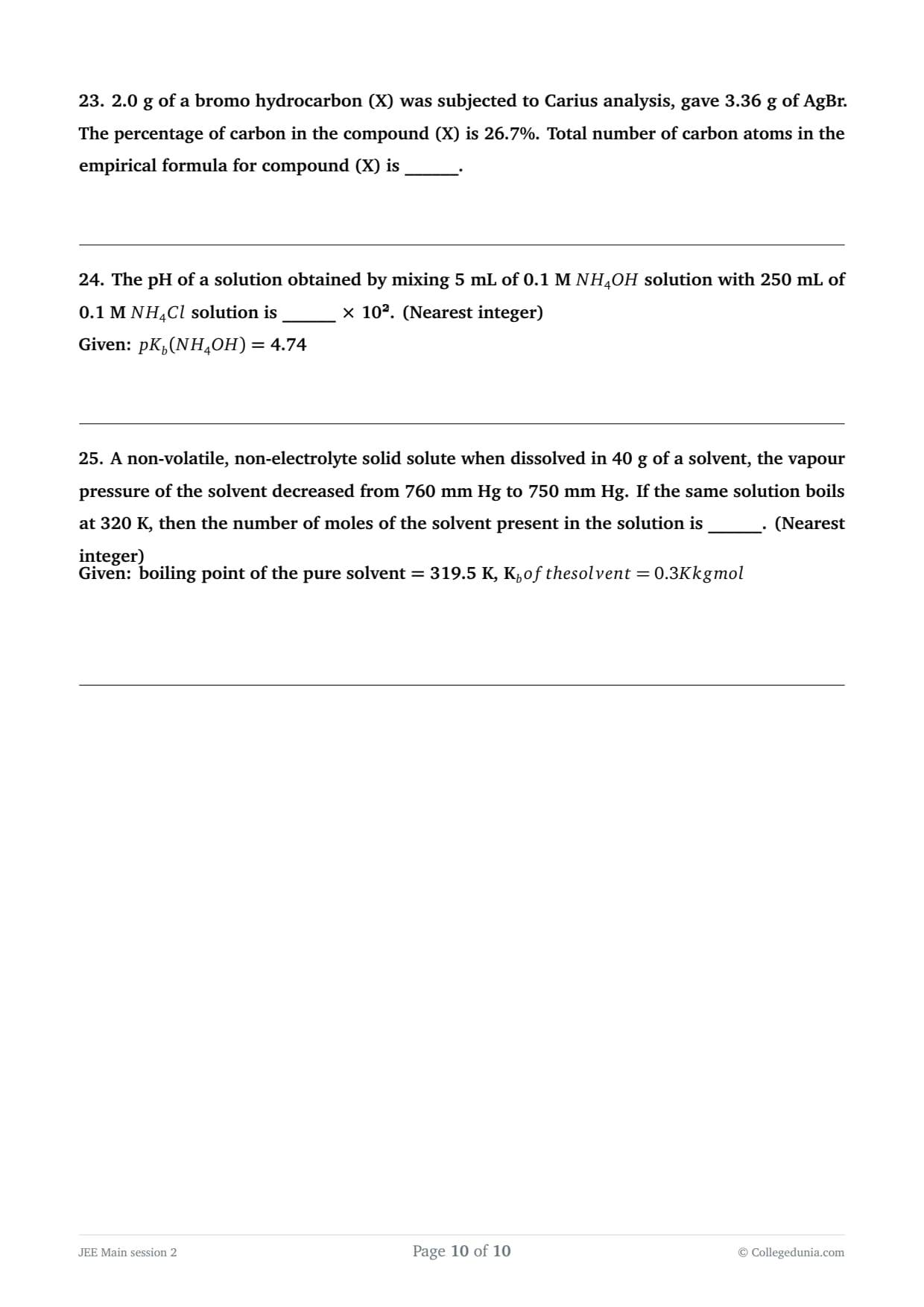
2.0 g of a bromo hydrocarbon (X) was subjected to Carius analysis, gave 3.36 g of AgBr. The percentage of carbon in the compound (X) is 26.7%. Total number of carbon atoms in the empirical formula for compound (X) is ______.
The pH of a solution obtained by mixing 5 mL of 0.1 M \(NH_4OH\) solution with 250 mL of 0.1 M \(NH_4Cl\) solution is ______ × 10⁻². (Nearest integer)
Given: \(pK_b (NH_4OH)\) = 4.74
A non-volatile, non-electrolyte solid solute when dissolved in 40 g of a solvent, the vapour pressure of the solvent decreased from 760 mm Hg to 750 mm Hg. If the same solution boils at 320 K, then the number of moles of the solvent present in the solution is ______. (Nearest integer)
[Given: boiling point of the pure solvent = 319.5 K, K_b of the solvent = 0.3 K kg mol⁻¹]
JEE Main 2026 Chemistry Exam Pattern
| Particulars | Details |
|---|---|
| Exam Mode | Online (Computer-Based Test) |
| Paper | B.E./B.Tech |
| Medium of Exam | 13 languages: English, Hindi, Gujarati, Bengali, Tamil, Telugu, Kannada, Marathi, Malayalam, Odia, Punjabi, Assamese, Urdu |
| Type of Questions | Multiple Choice Questions (MCQs) + Numerical Value Questions |
| Total Marks | 100 marks |
| Marking Scheme | +4 for correct answer & -1 for incorrect MCQ and Numerical Value-based Questions |
| Total Questions | 25 Questions |



Comments