




JEE Main 2026 April 2 Shift 2 mathematics question paper is available here with answer key and solutions. NTA conducted the second shift of the day on April 2, 2026, from 3:00 PM to 6:00 PM.
- The JEE Main Mathematics Question Paper contains a total of 25 questions.
- Each correct answer gets you 4 marks while incorrect answers gets you a negative mark of 1.
Candidates can download the JEE Main 2026 April 2 Shift 2 mathematics question paper along with detailed solutions to analyze their performance and understand the exam pattern better.
Also Check:
- JEE Main 2026 April 4 Shift 1 Question Paper with Solutions
- Download JEE Main 2026 Session 2 Question Paper for all Shifts
JEE Main 2026 April 2 Shift 2 Mathematics Question Paper with Solution PDF



Let \( \alpha, \beta \) be the roots of the equation \( x^2 - 3x + r = 0 \), and \( \frac{\alpha}{2}, 2\beta \) be the roots of the equation \( x^2 + 3x + r = 0 \).
If the roots of the equation \( x^2 + 6x = m \) are \( 2\alpha + \beta + 2r \) and \( \alpha - 2\beta - \frac{r}{2} \), then \( m \) is equal to:
Let the circles \( C_1 : |z| = r \) and \( C_2 : |z - 3 - 4i| = 5, z \in \mathbb{C} \), be such that \( C_2 \) lies within \( C_1 \). If \( z_1 \) moves on \( C_1 \), \( z_2 \) moves on \( C_2 \) and \( \min |z_1 - z_2| = 2 \), then \( \max |z_1 - z_2| \) is equal to:
If the system of equations
\[ x + 5y + 6z = 4 \] \[ 2x + 3y + 4z = 7 \] \[ x + 6y + az = b \]
has infinitely many solutions, then the point \( (a, b) \) lies on the line
Let \( a_1, a_2, a_3, \dots \) be an A.P. and \( g_1 = a_1, g_2 = a_2, g_3 = a_3, \dots \) be an increasing G.P. If \( a_1 = a_2 + g_2 = 1 \) and \( a_3 + g_3 = 4 \), then \( a_{10} + g_5 \) is equal to:
The sum \( \frac{1^3}{1} + \frac{2^3}{1+3} + \frac{3^3}{1+3+5} + \cdots \) up to 8 terms is:
If for \( 3 \leq r \leq 30 \),
\[ \left( 30C_{30-r} \right) + 3 \left( 30C_{31-r} \right) + 3 \left( 30C_{32-r} \right) + 3 \left( 30C_{33-r} \right) = mC_{r},
then m equals: \]
Let \( p_n \) denote the total number of triangles formed by joining the vertices of an \( n \)-side regular polygon. If \( p_{n+1} - p_n = 66 \), then the sum of all distinct prime divisors of \( n \) is:
A man throws a fair coin repeatedly. He gets 10 points for each head he throws and 5 points for each tail he throws. If the probability that he gets exactly 30 points is \( \frac{m}{n} \), gcd \( (m, n) = 1 \), then \( m + n \) is equal to:
The mean and variance of \( n \) observations are 8 and 16, respectively. If the sum of the first \( (n-1) \) observations is 48 and the sum of squares of the first \( (n-1) \) observations is 496, then the value of \( n \) is:
Let a circle pass through the origin and its center be the point of intersection of two mutually perpendicular lines \( x + (k-1)y + 3 = 0 \) and \( 2x + k2y - 4 = 0 \). If the line \( x - y + 2 = 0 \) intersects the circle at the points A and B, then \( (AB)^2 \) is equal to:
Let O be the origin, and P and Q be two points on the rectangular hyperbola \( xy = 12 \) such that the midpoint of the line segment PQ is \( \left( \frac{1}{2}, -\frac{1}{2} \right) \). Then the area of the triangle OPQ equals:
Let the parabola \( y = x^2 + px + q \) passing through the point \( (1, -1) \) be such that the distance between its vertex and the x-axis is minimum. Then the value of \( p^2 + q^2 \) is:
Let \( P = \{ \theta \in [0, 4\pi] : \tan^2\theta \neq 1 \} \) and \( S = \{ a \in \mathbb{Z} : 2(\cos^8\theta - \sin^8\theta) \sec 2\theta = a^2, \theta \in P \} \). Then \( n(S) \) is:
Let the vectors \( \mathbf{a} = -\hat{i} + \hat{j} + 3\hat{k} \) and \( \mathbf{b} = \hat{i} + 3\hat{j} + \hat{k} \). For some \( \lambda, \mu \in \mathbb{R} \), let \( \mathbf{c} = \lambda \mathbf{a} + \mu \mathbf{b} \). If \( \mathbf{c} \cdot (3\hat{i} - 6\hat{j} + 2\hat{k}) = 10 \) and \( \mathbf{c} \cdot (\hat{i} + \hat{j} + \hat{k}) = -2 \), then \( |\mathbf{c}|^2 \) is equal to:
Let the point \( A \) be the foot of perpendicular drawn from the point \( P(a, b, 0) \) on the line
\[ \frac{x - 1}{2} = \frac{y - 2}{1} = \frac{z - \alpha}{3}. \]
If the midpoint of the line segment \( PA \) is \( \left( \frac{3}{4}, \frac{4}{3}, -\frac{1}{4} \right) \), then the value of \( a^2 + b^2 + \alpha^2 \) is:
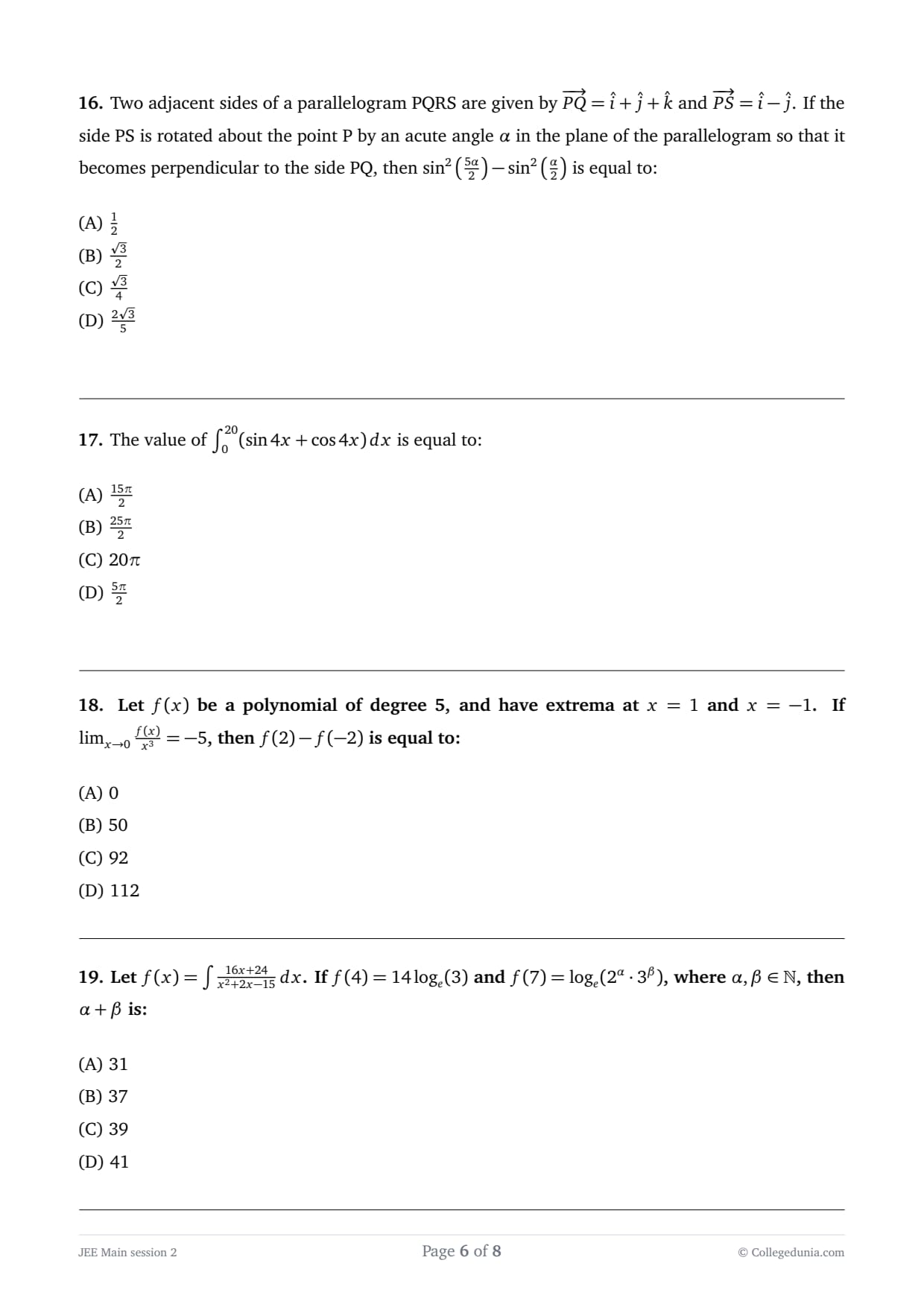
Two adjacent sides of a parallelogram PQRS are given by \( \overrightarrow{PQ} = \hat{i} + \hat{j} + \hat{k} \) and \( \overrightarrow{PS} = \hat{i} - \hat{j} \). If the side PS is rotated about the point P by an acute angle \( \alpha \) in the plane of the parallelogram so that it becomes perpendicular to the side PQ, then \( \sin^2 \left( \frac{5\alpha}{2} \right) - \sin^2 \left( \frac{\alpha}{2} \right) \) is equal to:
The value of \( \int_0^{20} (\sin 4x + \cos 4x) \, dx \) is equal to:
Let \( f(x) \) be a polynomial of degree 5, and have extrema at \( x = 1 \) and \( x = -1 \). If \( \lim_{x \to 0} \frac{f(x)}{x^3} = -5 \), then \( f(2) - f(-2) \) is equal to:
Let \( f(x) = \int_{} \frac{16x + 24}{x^2 + 2x - 15} \, dx \). If \( f(4) = 14 \log_e(3) \) and \( f(7) = \log_e(2^\alpha \cdot 3^\beta) \), where \( \alpha, \beta \in \mathbb{N} \), then \( \alpha + \beta \) is:
Let \( x = x(y) \) be the solution of the differential equation \[ 2y^2 \frac{dx}{dy} - 2xy + x^2 = 0, \quad y > 1, \quad x(e) = e. \]
Then \( x(e^2) \) is equal to:
Let \( A = \{2, 3, 4, 5, 6\} \). Let \( R \) be a relation on the set \( A \times A \) given by \( (x, y) R (z, w) \) if and only if \( x \) divides \( z \) and \( y \leq w \). Then the number of elements in \( R \) is _______.
Consider the matrices \[ A = \begin{bmatrix} 2 & -2 \\
4 & -2 \end{bmatrix}, \quad B = \begin{bmatrix} 3 & 9 \\
1 & 3 \end{bmatrix}. \]
If matrices \( P \) and \( Q \) are such that \( PA = B \) and \( AQ = B \), then the absolute value of the sum of the diagonal elements of \( 2(P + Q) \) is _____ .
Let A be the point \( (3, 0) \) and circles with variable diameter AB touch the circle \( x^2 + y^2 = 36 \) internally. Let the curve \( C \) be the locus of the point B. If the eccentricity of \( C \) is \( e \), then \( 72e^2 \) is equal to _______.
If the area of the region bounded by \(16x^2 - 9y^2 = 144\) and \(8x - 3y = 24\) is \(A\), then \(3(A + 6 \log_e(3))\) is equal to _______.
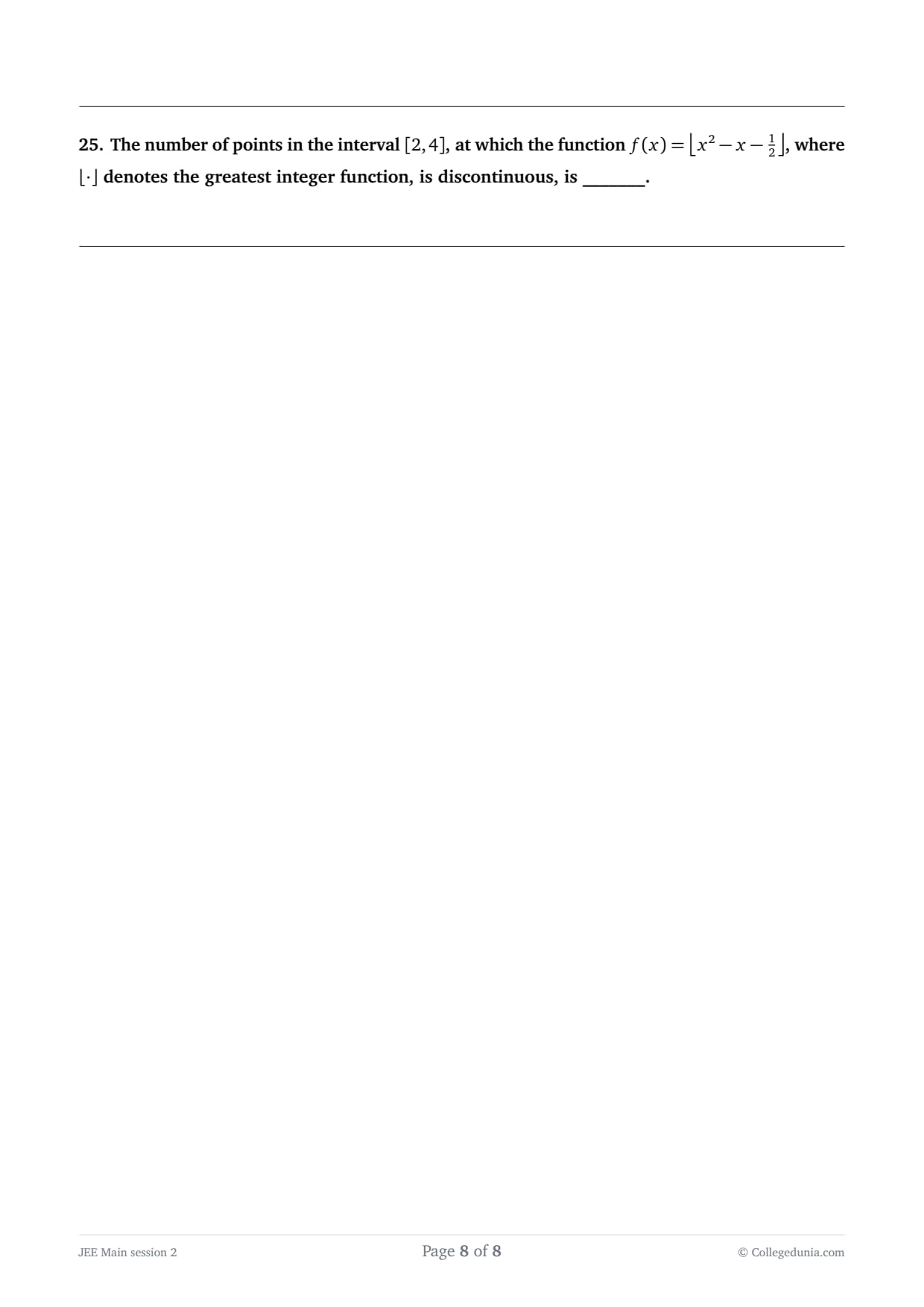
The number of points in the interval \( [2, 4] \), at which the function \( f(x) = \left\lfloor x^2 - x - \frac{1}{2} \right\rfloor \), where \( \left\lfloor \cdot \right\rfloor \) denotes the greatest integer function, is discontinuous, is _______.
Also Check:
JEE Main 2026 Mathematics Exam Pattern
| Particulars | Details |
|---|---|
| Exam Mode | Online (Computer-Based Test) |
| Paper | B.E./B.Tech |
| Medium of Exam | 13 languages: English, Hindi, Gujarati, Bengali, Tamil, Telugu, Kannada, Marathi, Malayalam, Odia, Punjabi, Assamese, Urdu |
| Type of Questions | Multiple Choice Questions (MCQs) + Numerical Value Questions |
| Total Marks | 100 marks |
| Marking Scheme | +4 for correct answer & -1 for incorrect MCQ and Numerical Value-based Questions |
| Total Questions | 25 Questions |



Comments