




JEE Main Circular Motion handwritten notes, free to download as a 20-page PDF. The topic is worth about 4 to 8 marks each year and takes roughly five days to learn, so it is one of the quickest to finish.
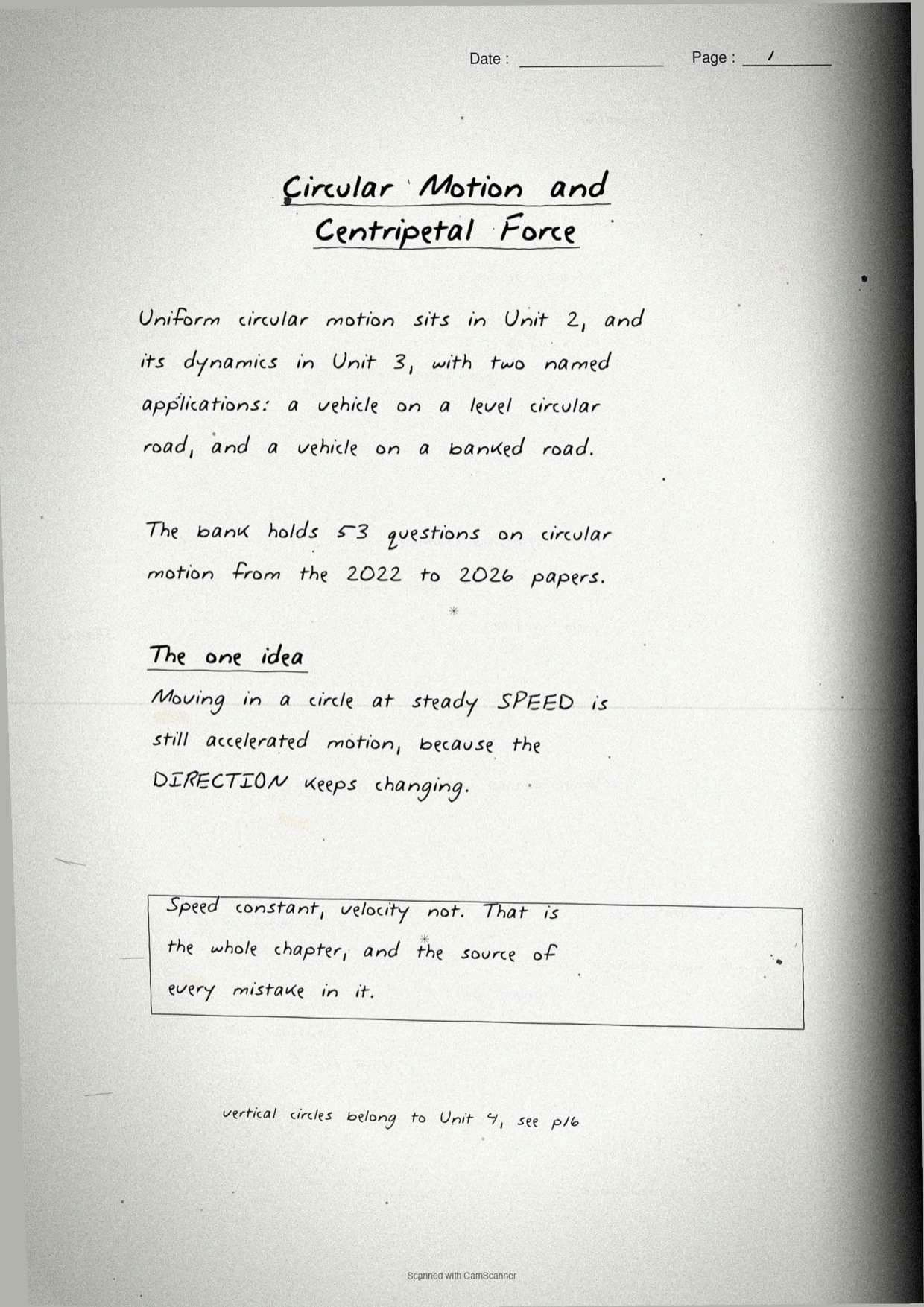
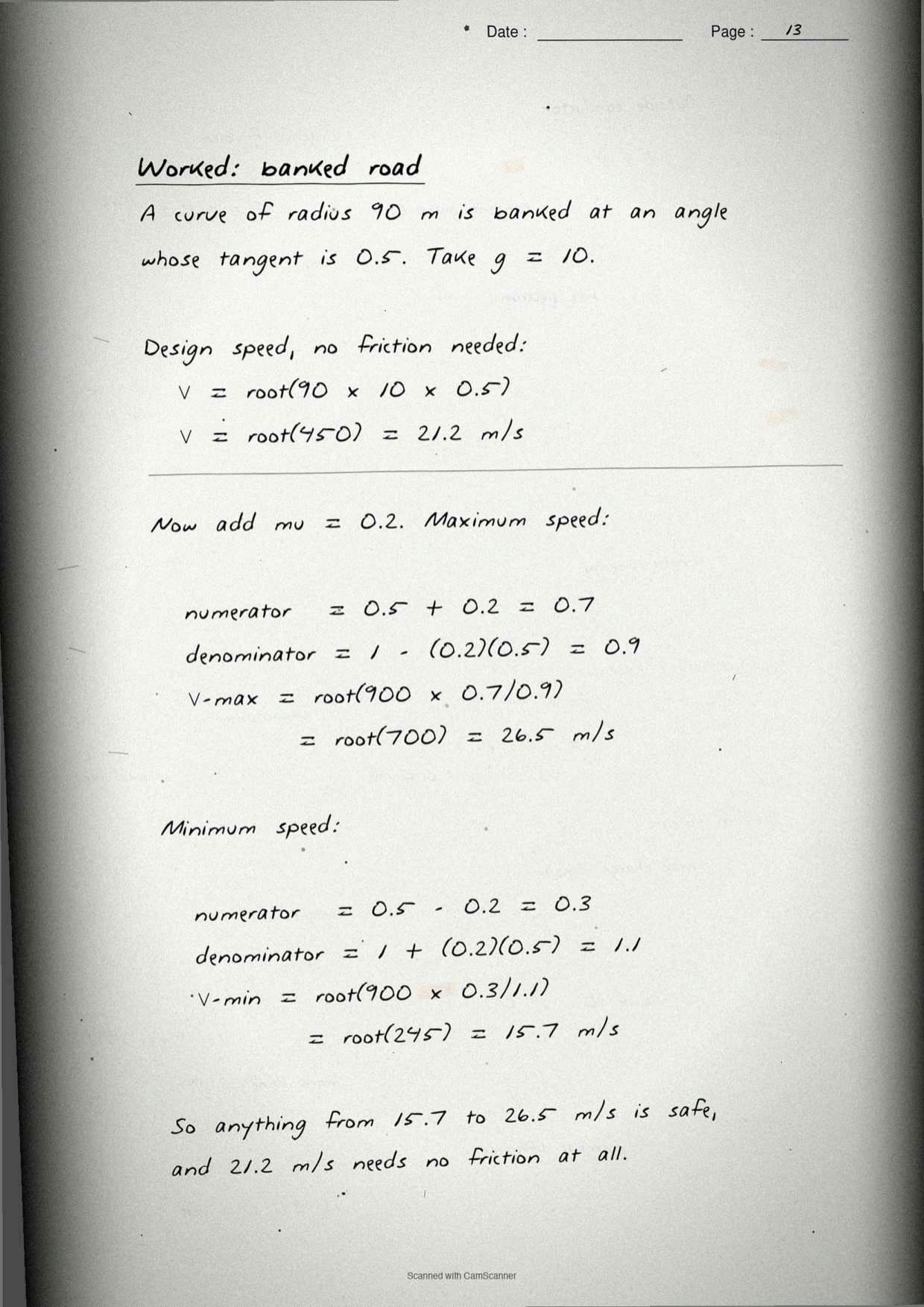
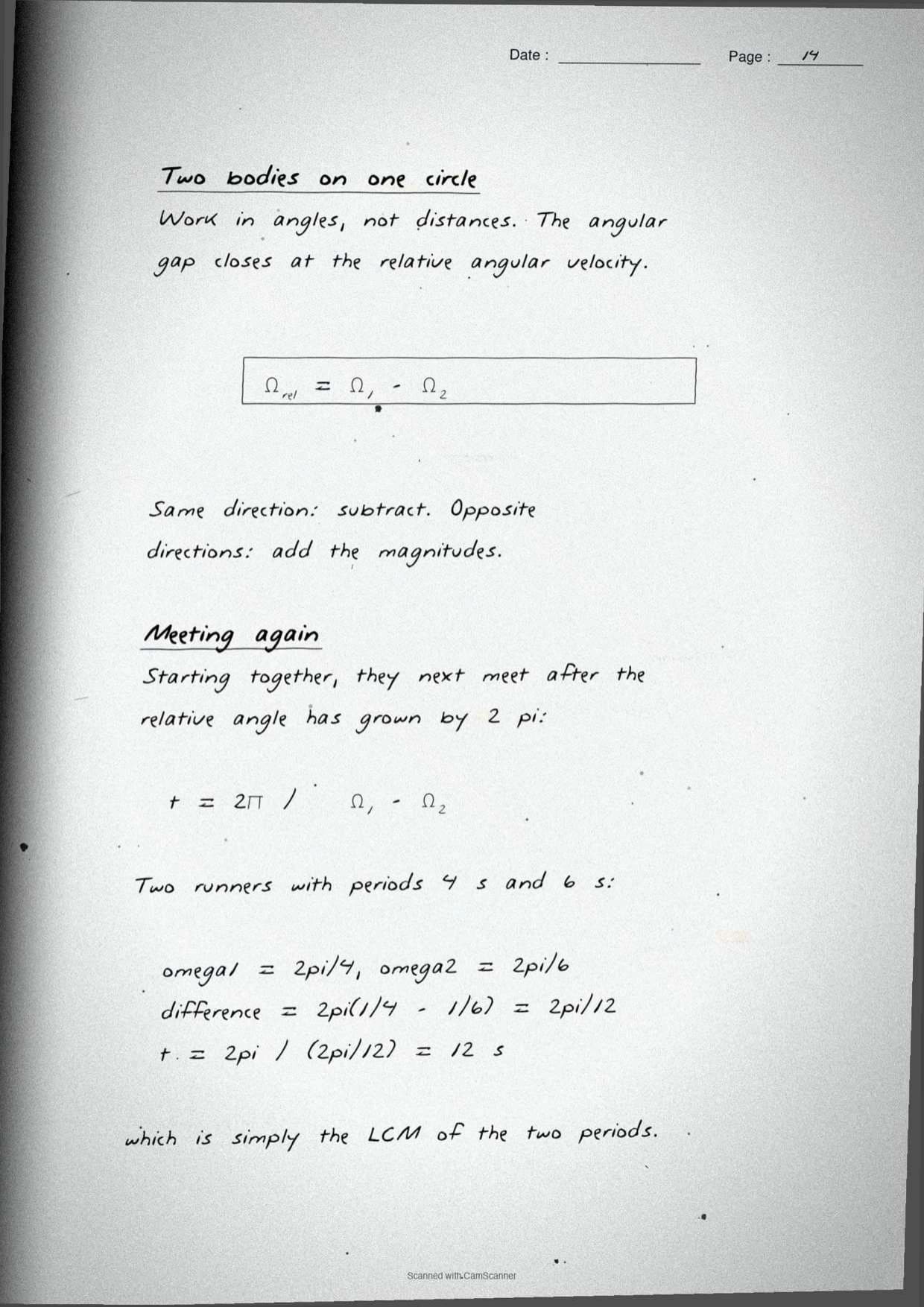
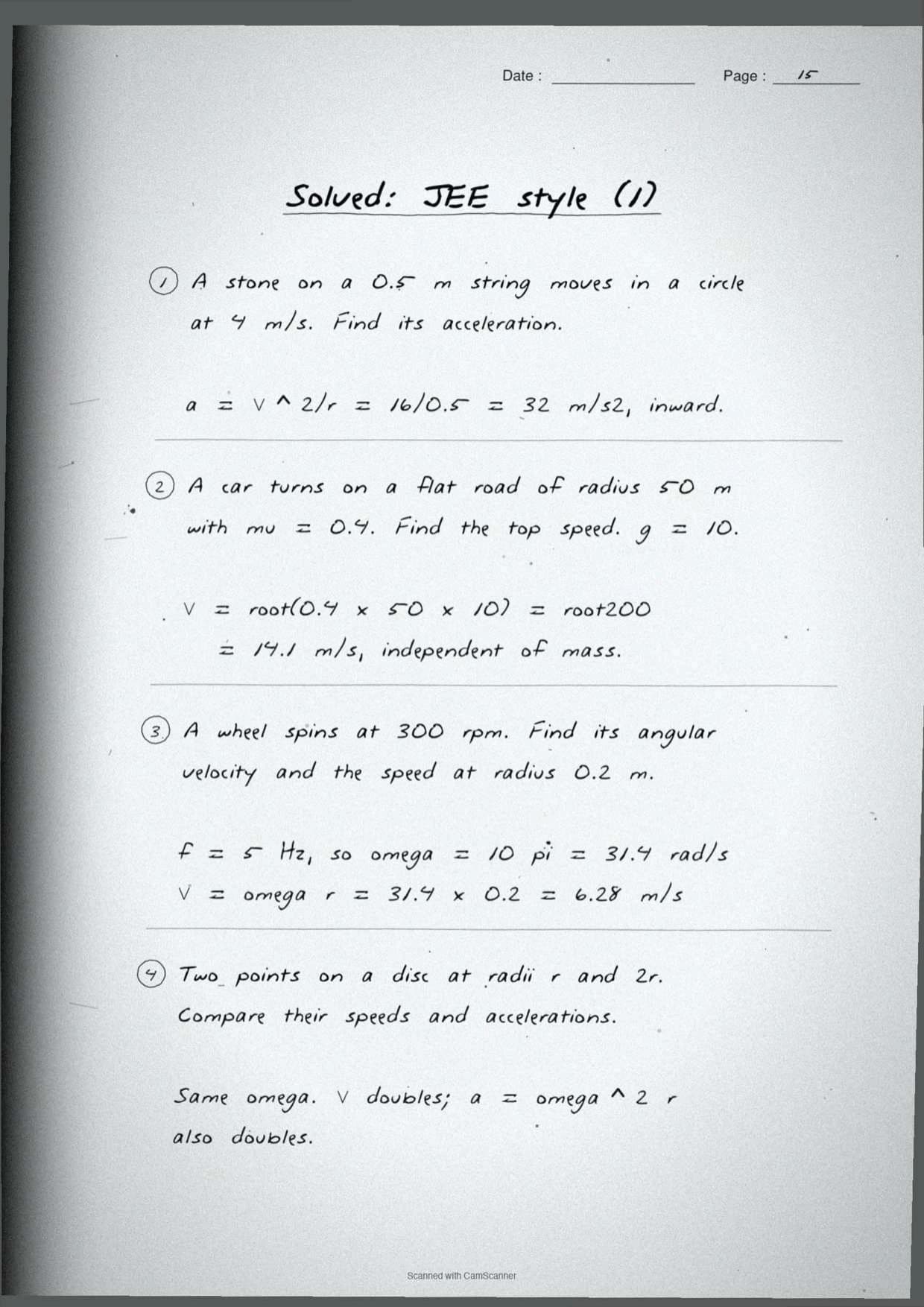
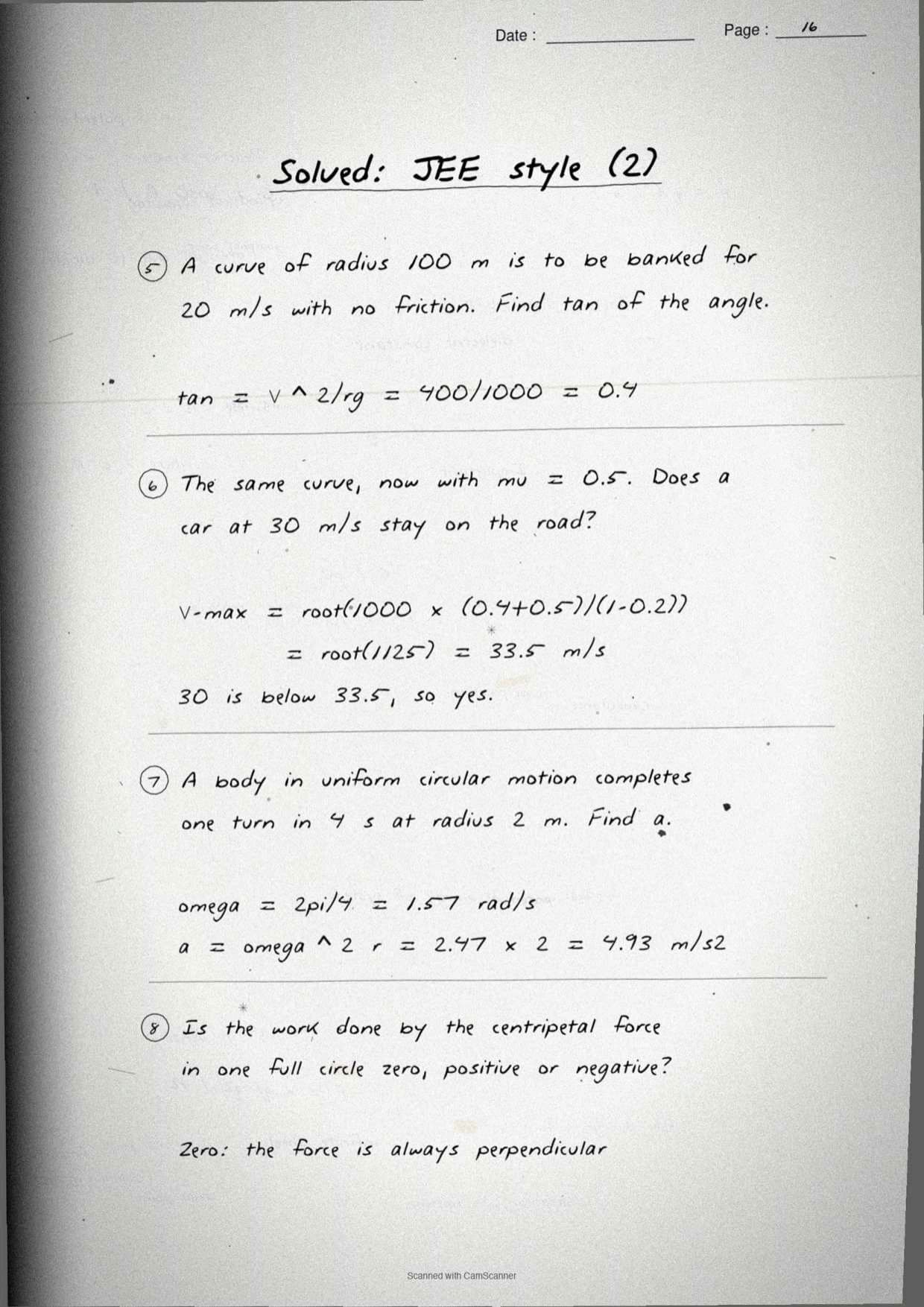
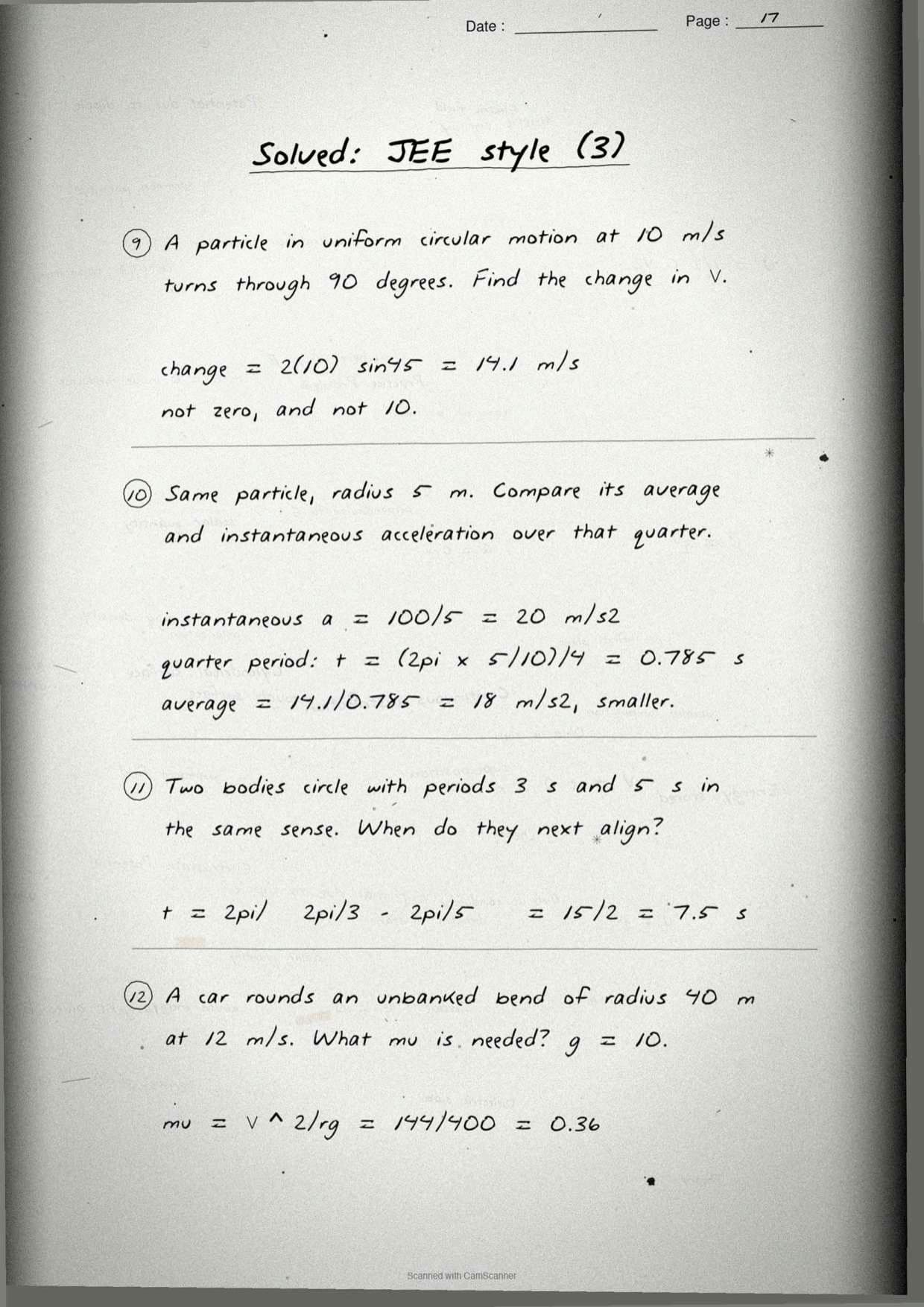
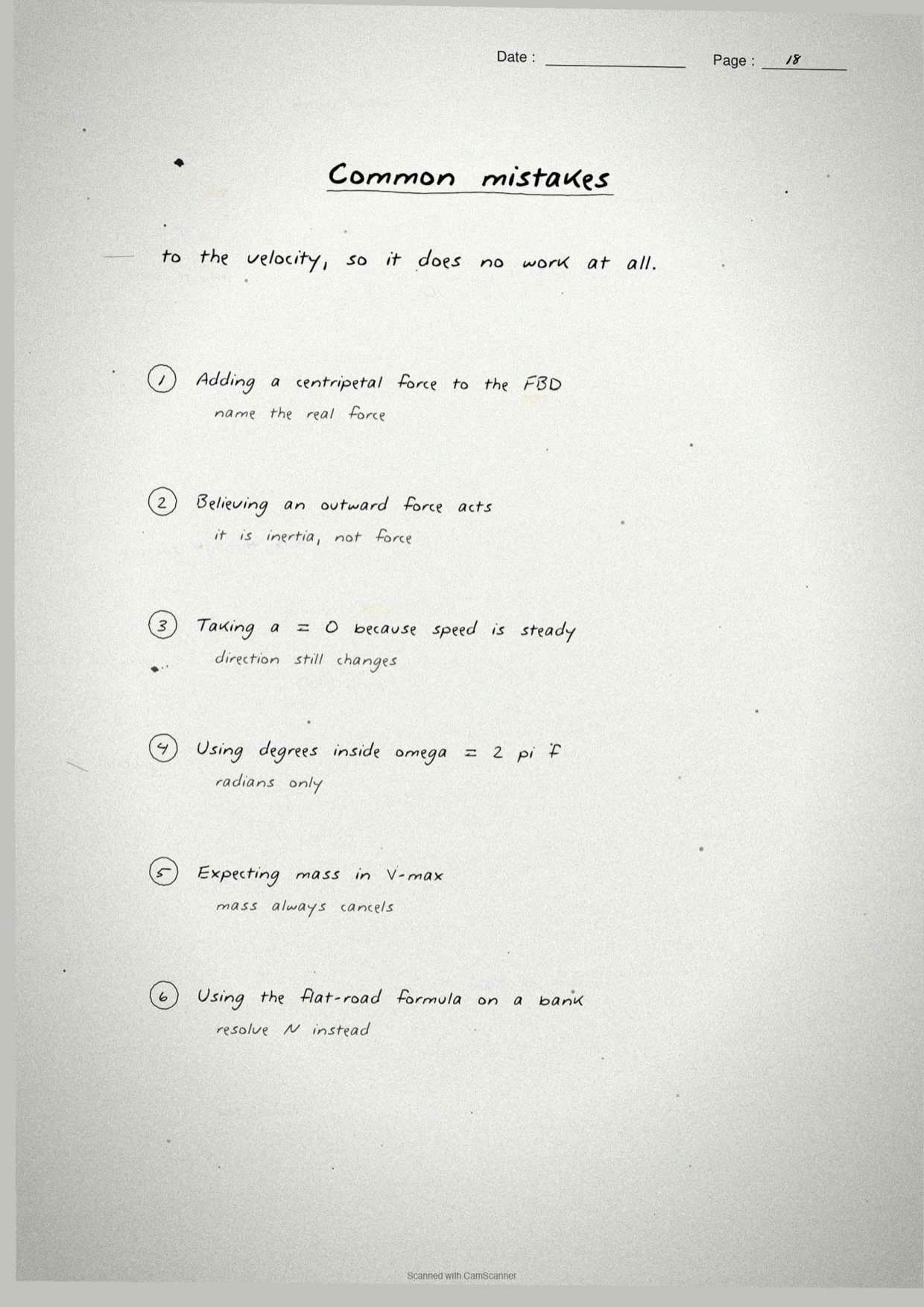
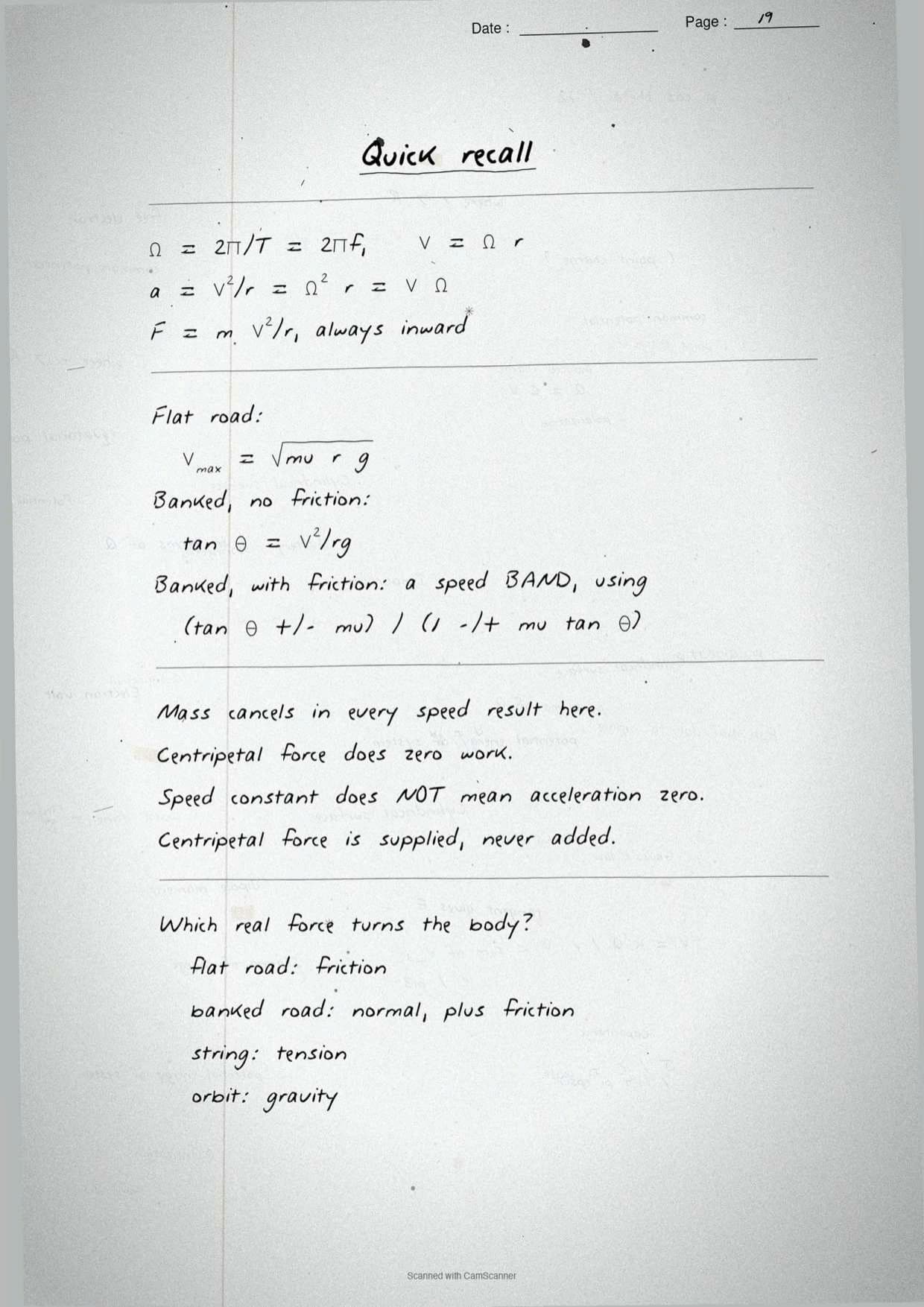
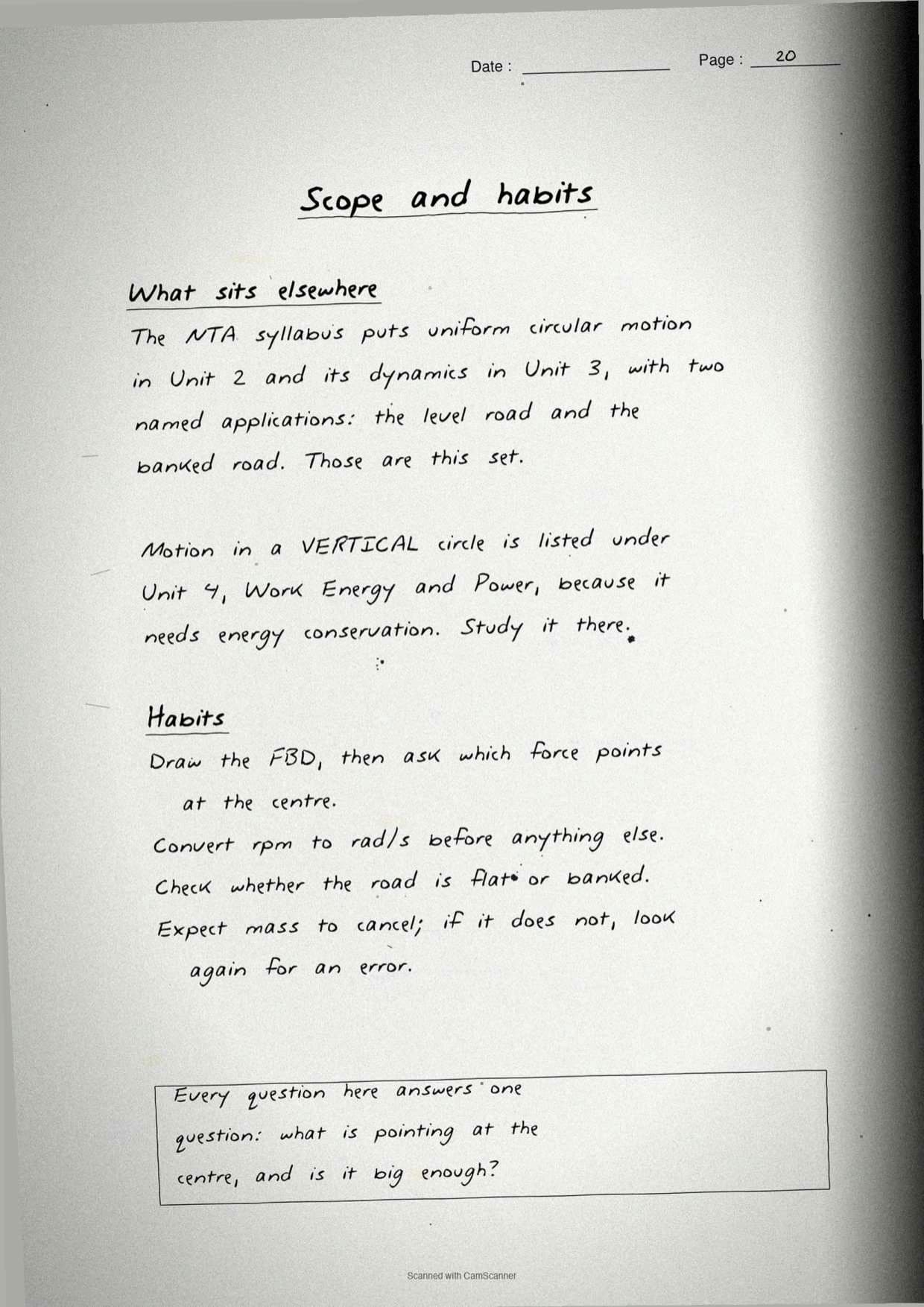
Scoped to the official NTA syllabus: uniform circular motion from Unit 2, and its dynamics from Unit 3 with the two named applications, a vehicle on a level circular road and a vehicle on a banked road.
The One Idea Behind the Whole Topic
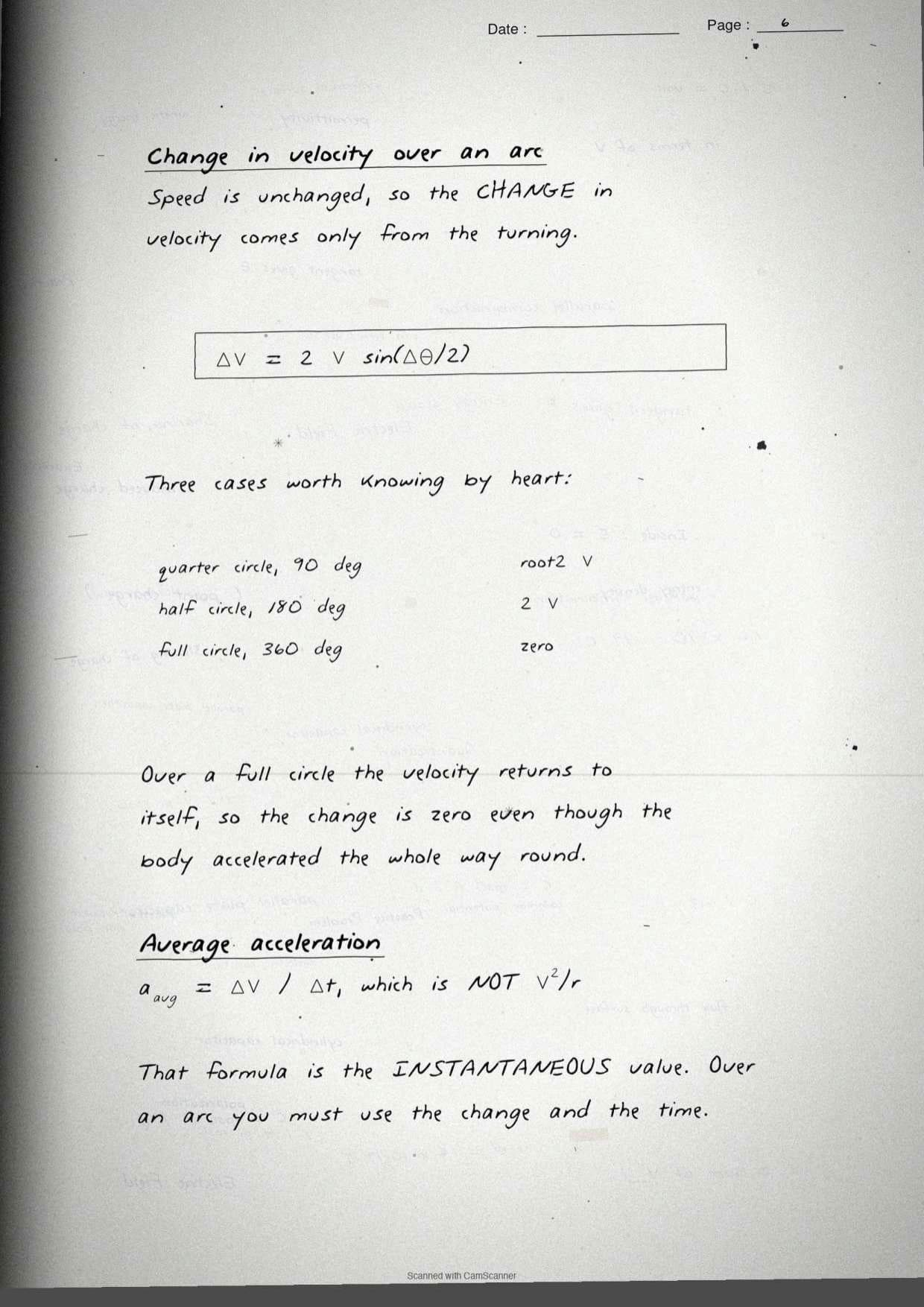
Moving in a circle at steady speed is still accelerated motion, because the direction keeps changing. Speed is constant; velocity is not.
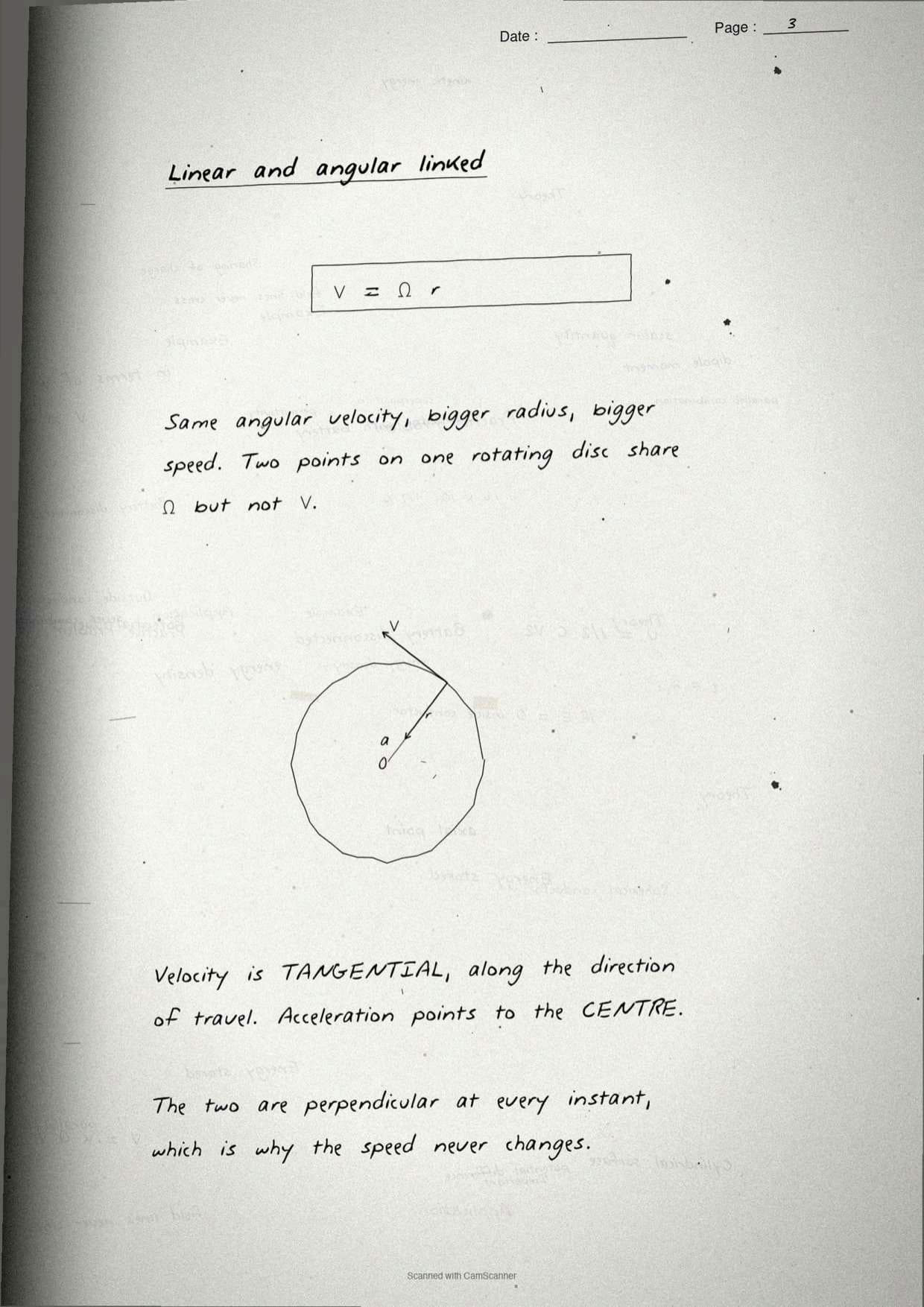
Velocity points along the tangent and acceleration points at the centre, and the two stay perpendicular at every instant. That perpendicularity is exactly why the speed never changes and why the centripetal force does no work.
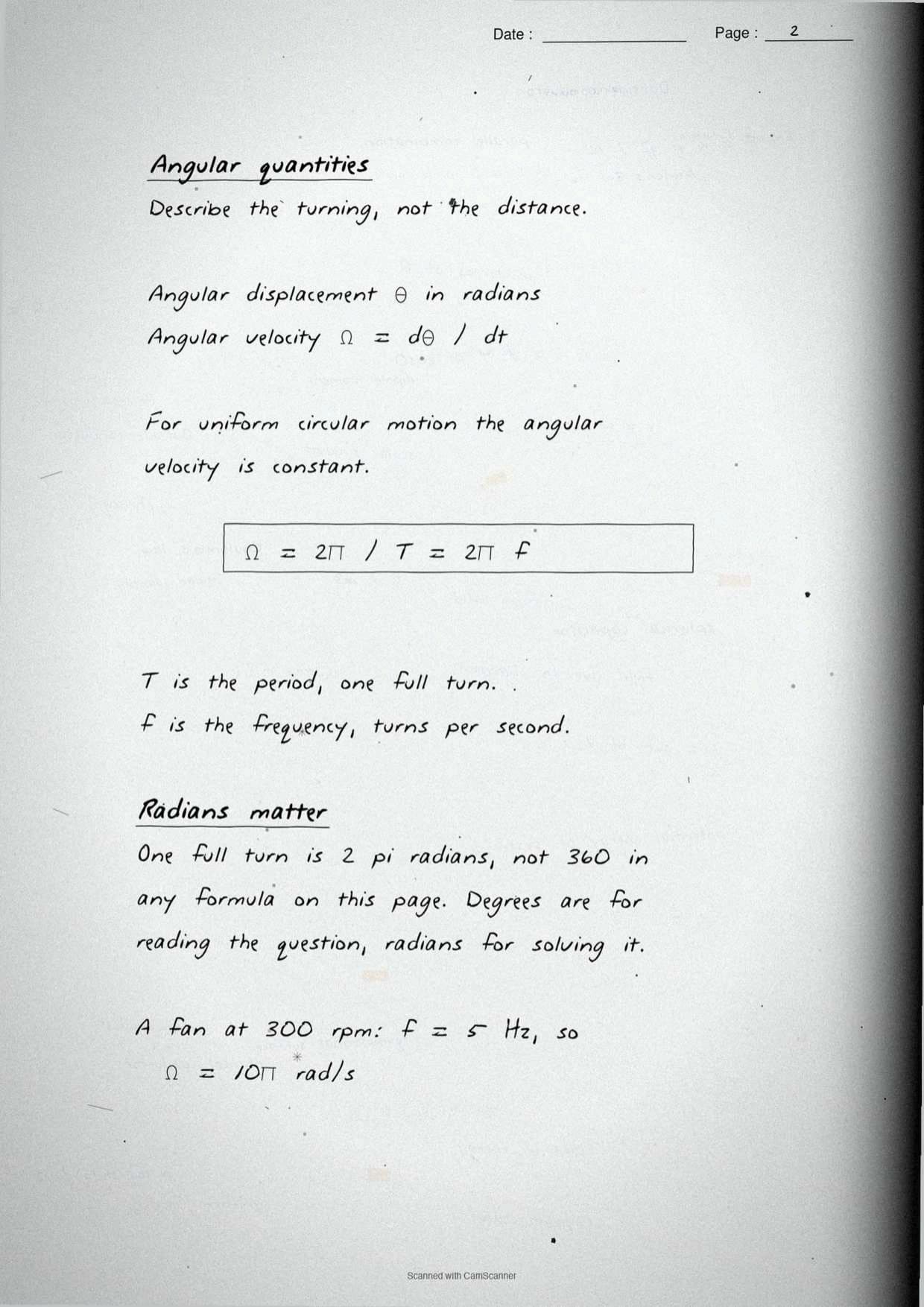
Angular Quantities and the Link to Speed
- Angular velocity is 2 pi over the period, or 2 pi times the frequency
- Speed and angular velocity are linked by v = omega r
- Two points on one rotating disc share omega but not speed
- Radians are for solving; degrees are only for reading the question
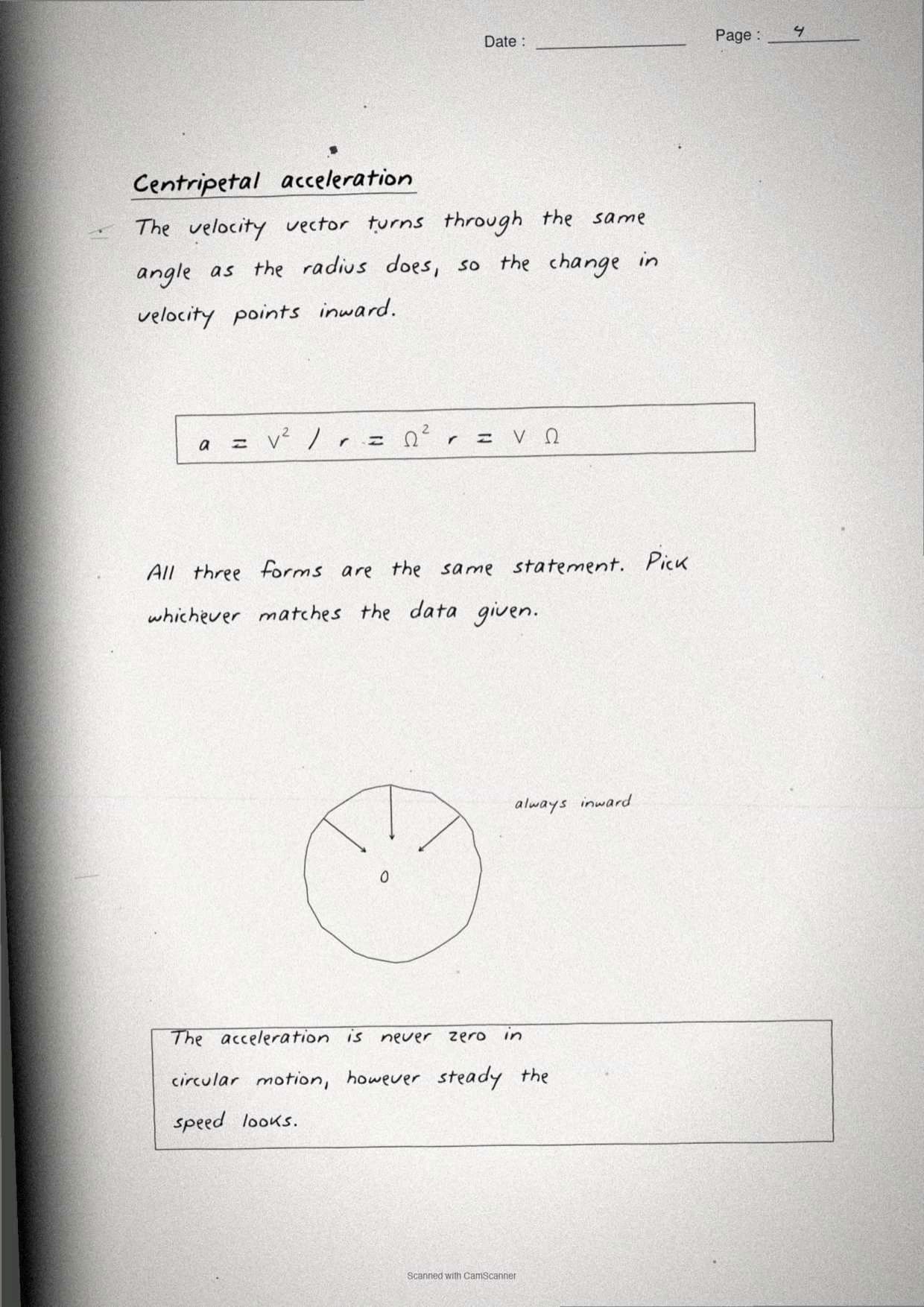
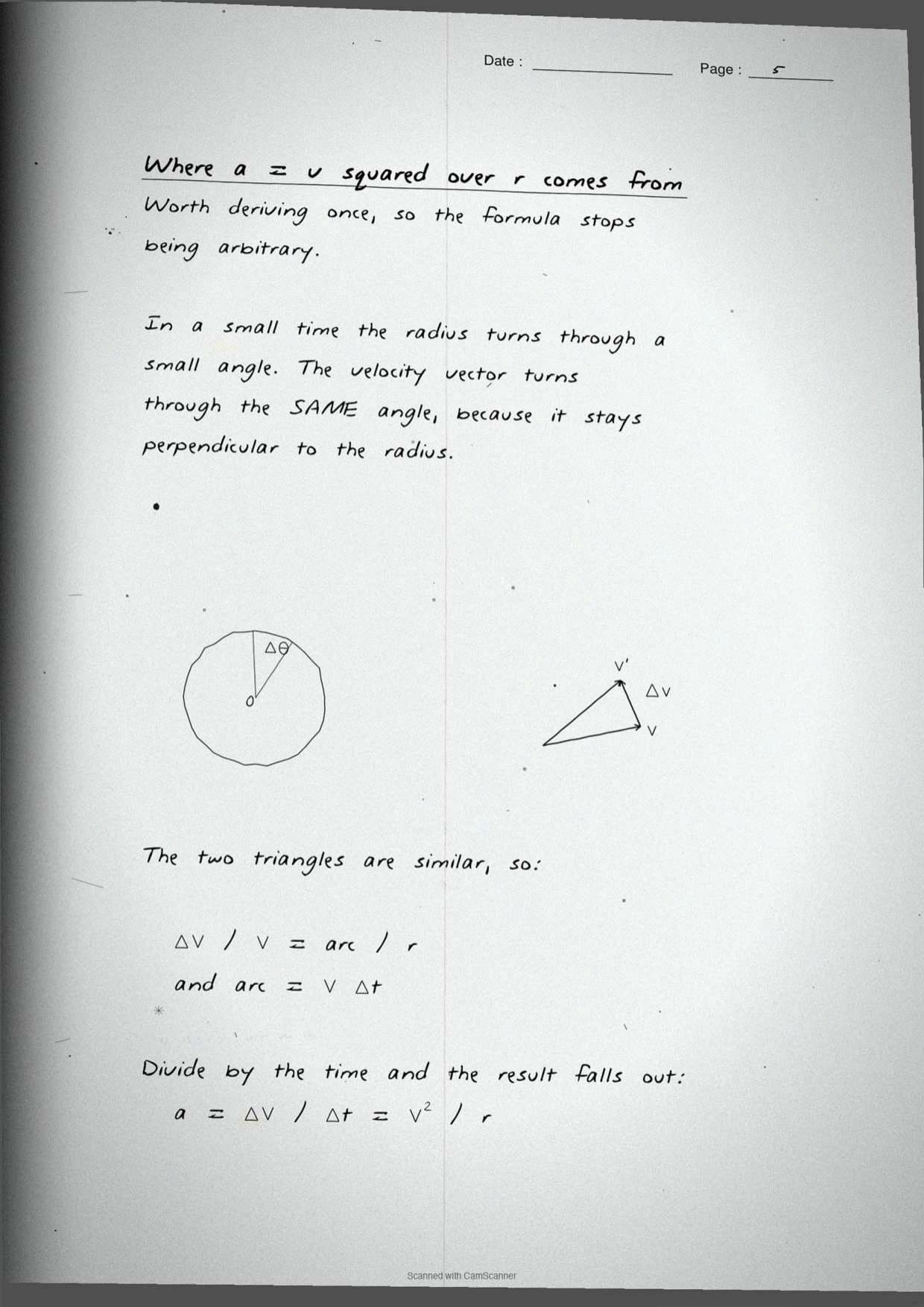
Centripetal acceleration has three equivalent forms, v squared over r, omega squared times r, and v times omega. The notes derive the first geometrically from similar triangles rather than asserting it.
Centripetal Force Is Supplied, Never Added
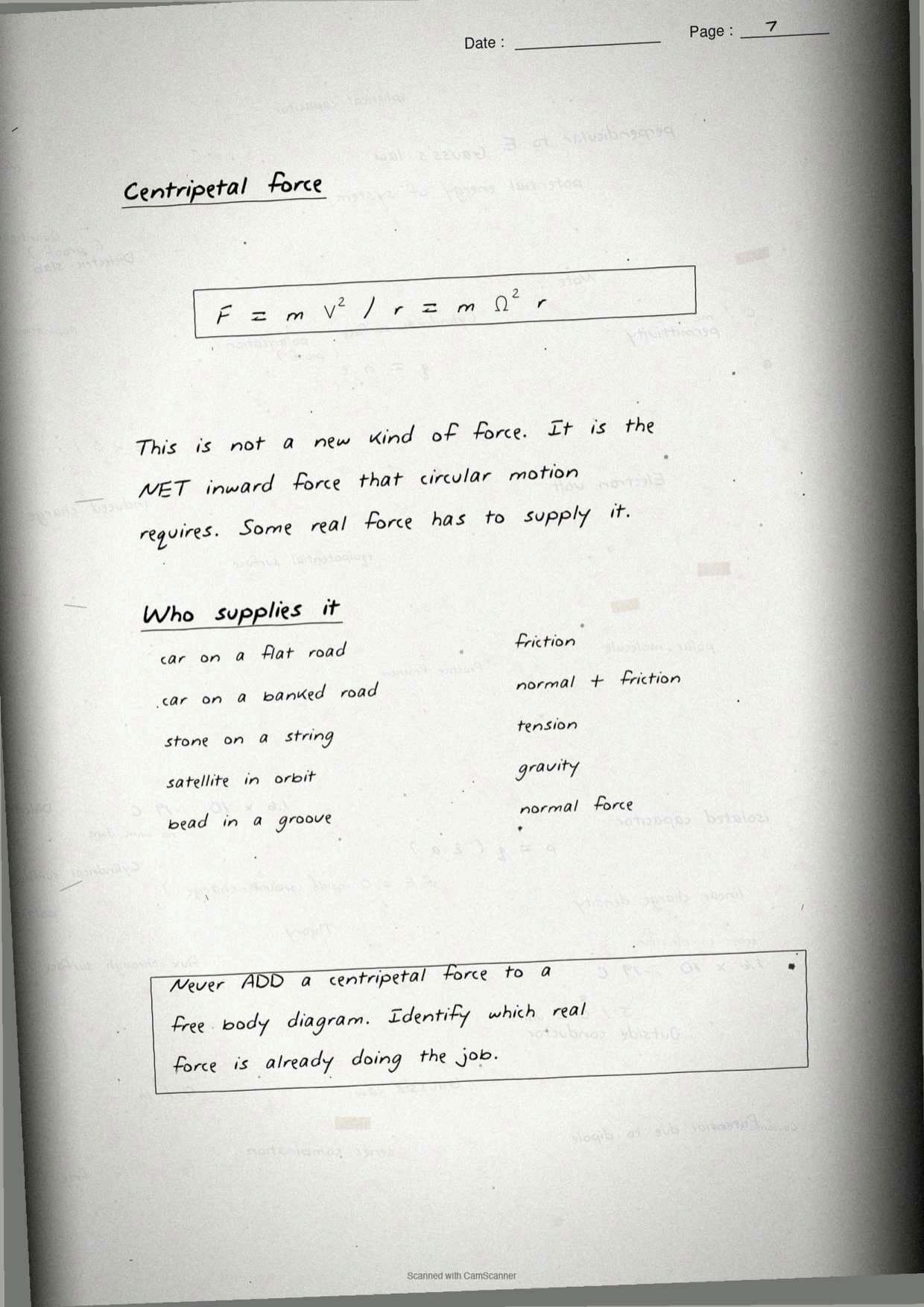
Centripetal force is not a new kind of force. It is the net inward force that circular motion requires, and some real force has to provide it.
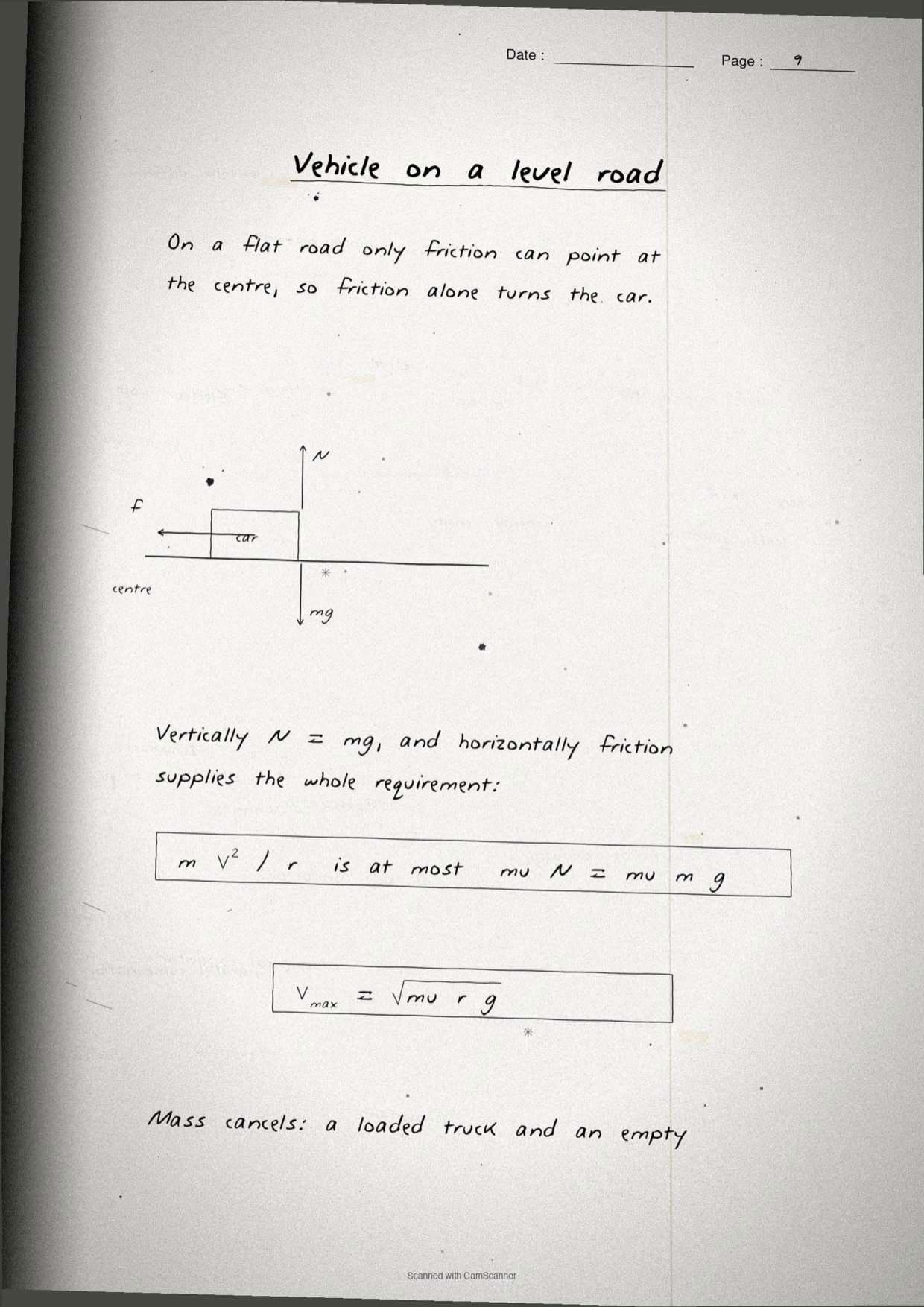
- Car on a flat road: friction
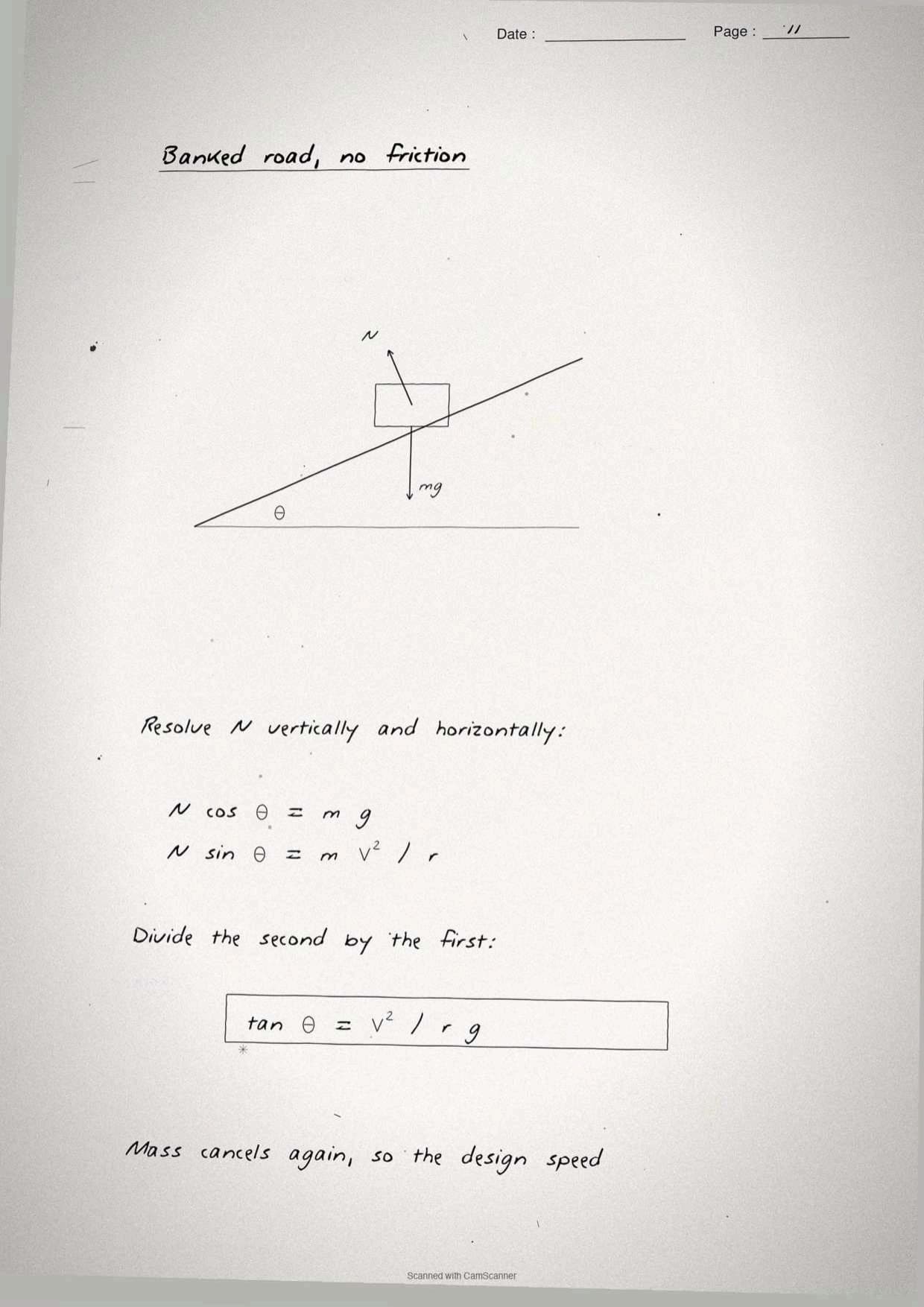
- Car on a banked road: normal force, plus friction
- Stone on a string: tension
- Satellite in orbit: gravity
So it never gets drawn as an extra arrow on a free body diagram. The question to ask is which force already present is pointing at the centre.
The Outward Force That Does Not Exist
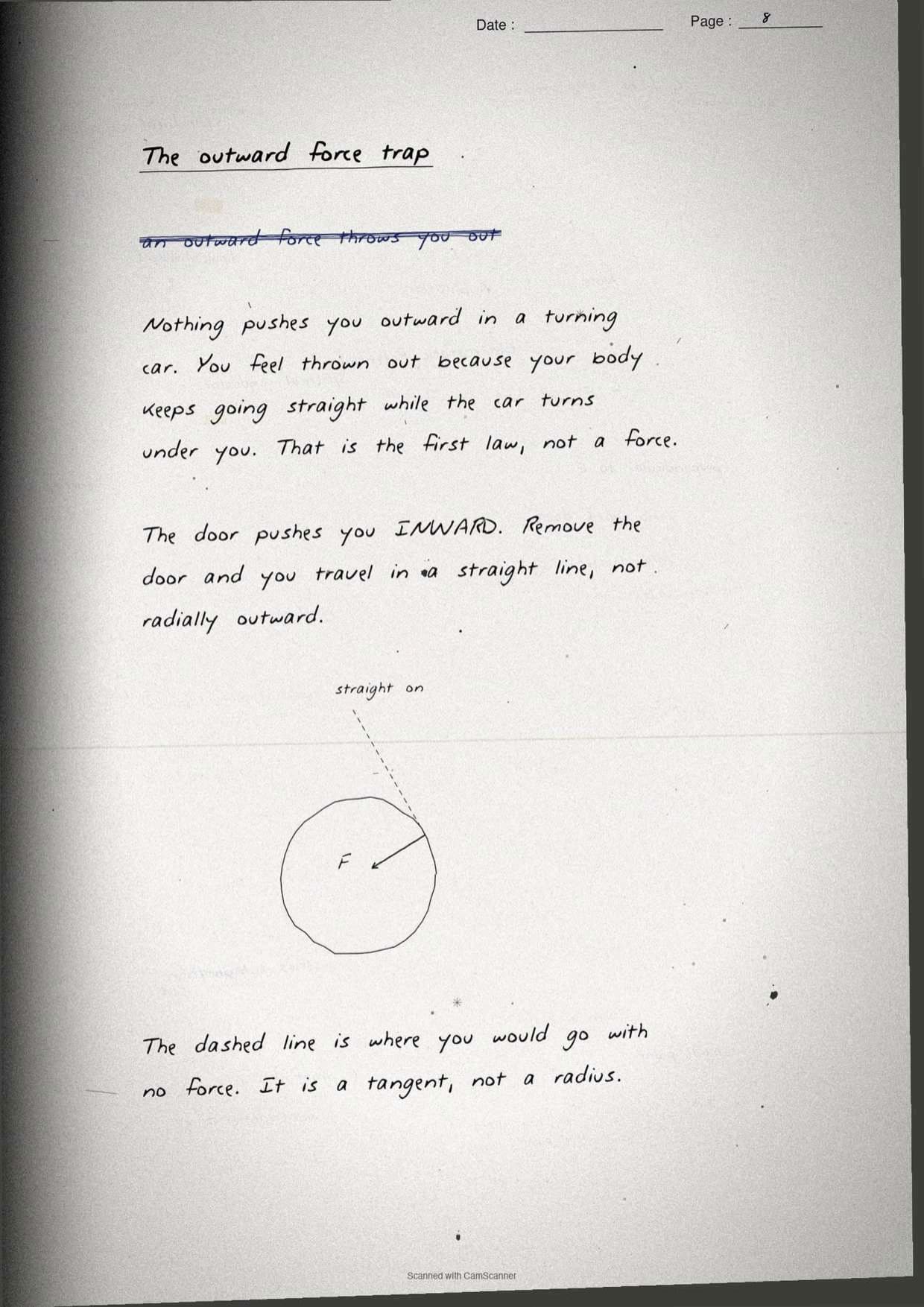
Nothing pushes you outward in a turning car. Your body continues straight while the car turns under you, which is the first law rather than a force. Remove the door and you travel along the tangent, not radially outward.
Level Road and Banked Road
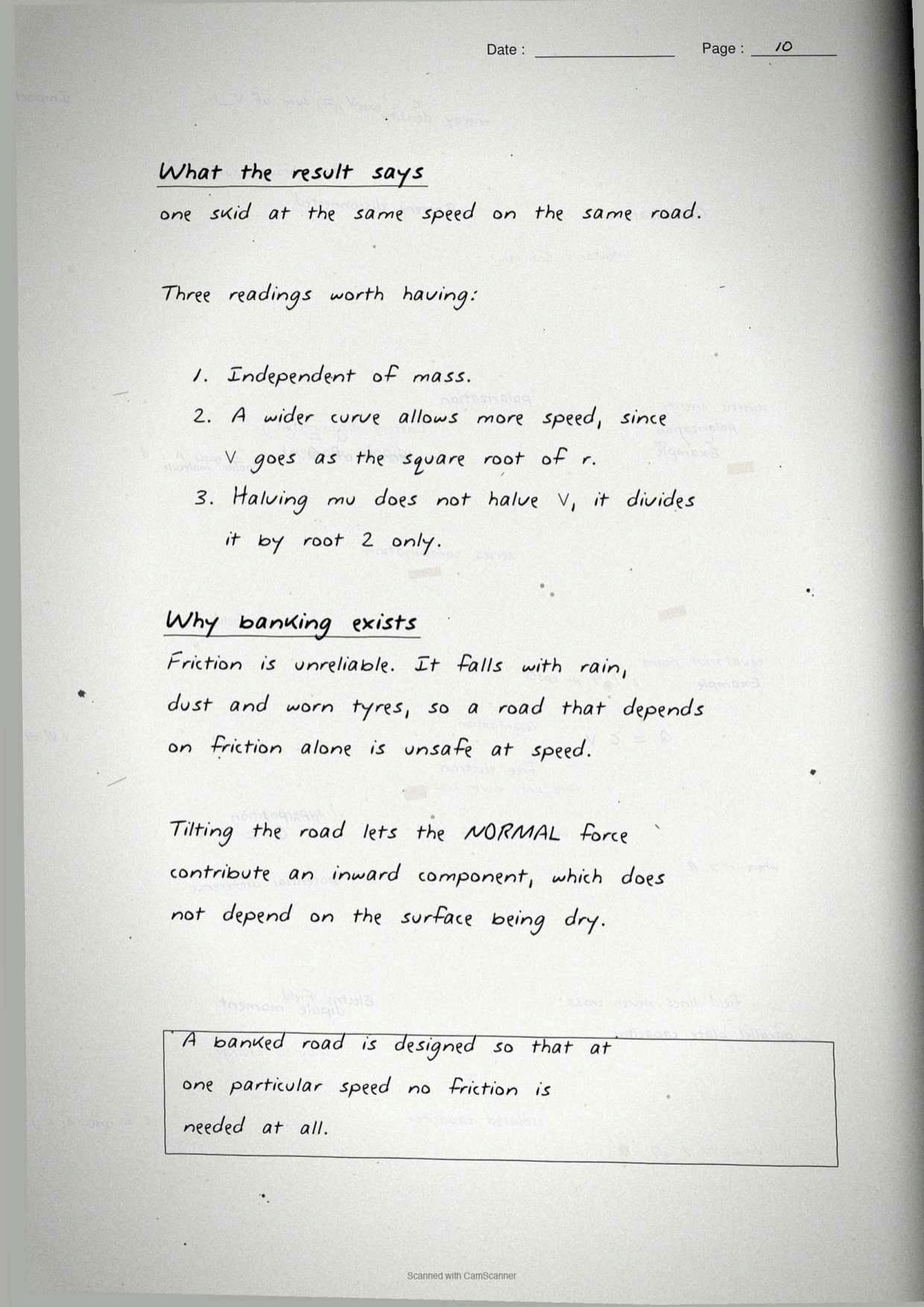
On a flat road only friction can point at the centre, which gives a maximum speed of the square root of mu times r times g. Mass cancels, so a loaded truck and an empty one skid at the same speed on the same road.
Friction is unreliable though: it drops with rain, dust and worn tyres. Banking lets the normal force contribute an inward component that does not depend on the surface being dry.
- Frictionless bank: tan of the angle equals v squared over r g
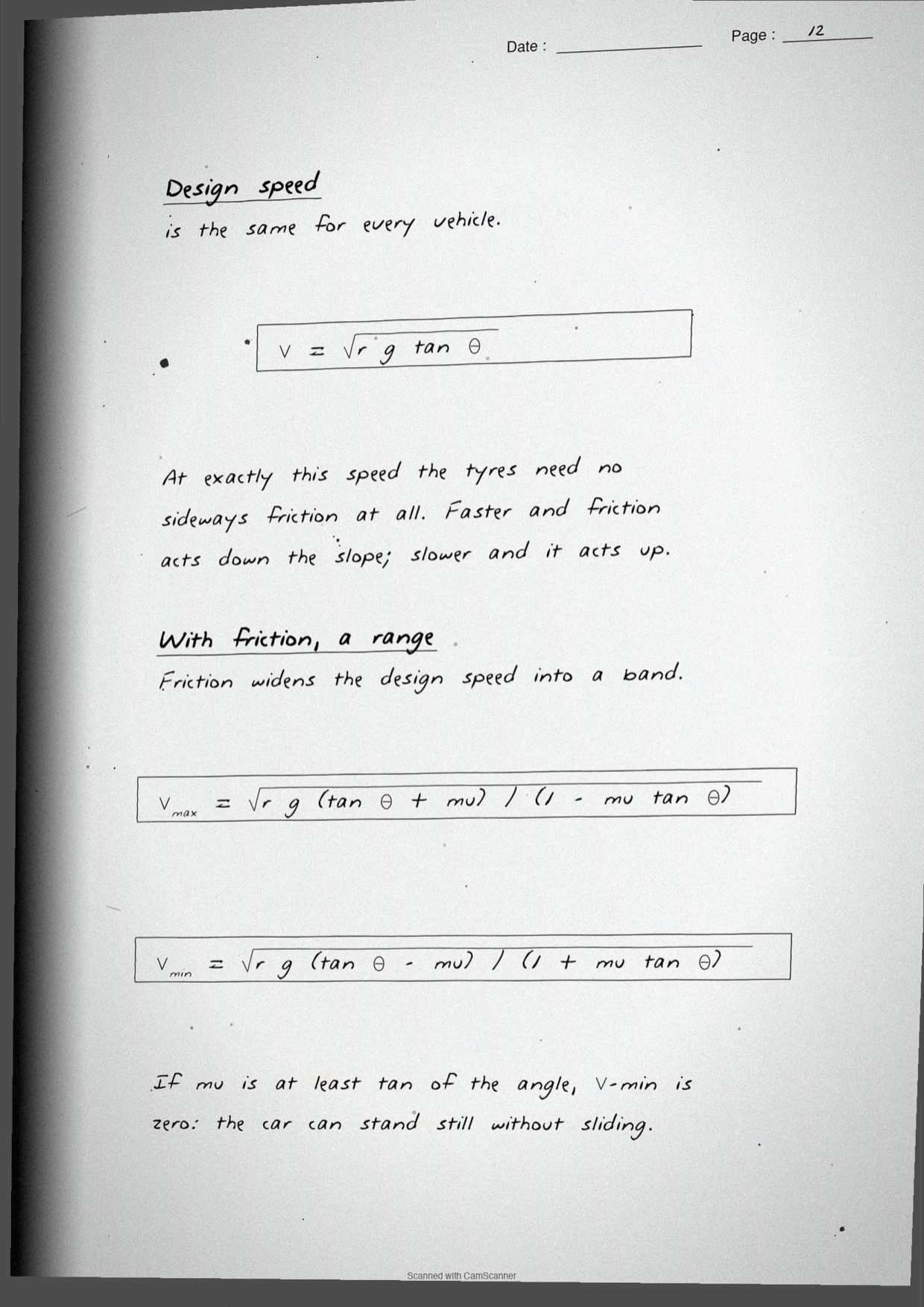
- That gives a single design speed at which no sideways friction is needed
- Adding friction widens the design speed into a band, with a maximum and a minimum
- If mu is at least the tangent of the angle, the minimum is zero and the car can simply stand still
Watch Circular Motion Worked on a Board
Source: Physics Wallah
Where Students Lose Marks Here
- Adding a centripetal force to the free body diagram instead of naming the real one
- Believing an outward force acts on the body
- Taking the acceleration as zero because the speed is steady
- Using degrees inside the omega formula instead of radians
- Expecting mass to appear in a maximum-speed result, where it always cancels
- Applying the flat-road formula to a banked road instead of resolving the normal force
What Sits Elsewhere in the Syllabus
Motion in a vertical circle is listed under Unit 4, Work Energy and Power, because it needs energy conservation rather than force balance alone. These notes cross-reference it and deliberately stop at the boundary rather than padding the topic out.
Every question here answers one question: what is pointing at the centre, and is it big enough?
JEE Main Circular Motion Handwritten Notes FAQs
Ques. Why is a body in uniform circular motion accelerating if its speed is constant?
Ans. Because acceleration is the rate of change of velocity, and velocity includes direction. The direction changes continuously, so there is an acceleration of v squared over r pointing at the centre even though the speed never changes.
Ques. Is centrifugal force a real force?
Ans. Not in a ground frame. The feeling of being thrown outward is inertia: your body continues in a straight line while the vehicle turns. If the force were real and outward, releasing the body would send it radially outward, whereas it actually moves along the tangent.
Ques. Does the maximum safe speed on a curve depend on the mass of the vehicle?
Ans. No. Mass cancels on both sides, on a flat road and on a banked one. That is why the same speed limit is posted for cars and for loaded trucks on the same bend.
Ques. Why are roads banked at all if friction can turn the car?
Ans. Because friction is unreliable, falling with rain, dust and tyre wear. Banking makes a component of the normal force point inward, which does not depend on the surface being dry, so the curve stays safe in bad conditions.
Ques. Can the notes be downloaded for free?
Ans. Yes. The full 20 page PDF can be read on this page and downloaded at no cost, so it can be printed or kept on a phone for revision.



Comments