




JEE Main 2024 April 6 Shift 2 Question Paper is available here with answer key and solution pdf. NTA conducted the second shift on April 6, 2024, from 3:00 PM to 6:00 PM. The JEE Main 2024 Paper 1 (B.E./B.Tech) question paper includes the following:
- 90 questions in a 3-hour CBT Mode: 30 each from Mathematics, Physics and Chemistry (75 to be attempted)
- Section A: 20 multiple choice questions (MCQs) per subject, 4 marks each
- Section B: 10 numerical value questions per subject, attempt any 5, 4 marks each (integer answer)
- Marking: +4 for a correct answer, -1 for an incorrect answer, 0 for an unattempted question
JEE Main 2024 April 6 Shift 2 Question Paper with Solution PDF
| NTA Official PDF | CD PDF | CD PDF with Solutions |
|---|---|---|
| Download official PDF 4.93 MB | Download Collegedunia PDF 1.21 MB | Download solutions PDF 1.02 MB |
Also Check:
JEE Main 2024 April 6 Shift 2 Questions with Solutions
Mathematics - Section A (Q1 - Q20)
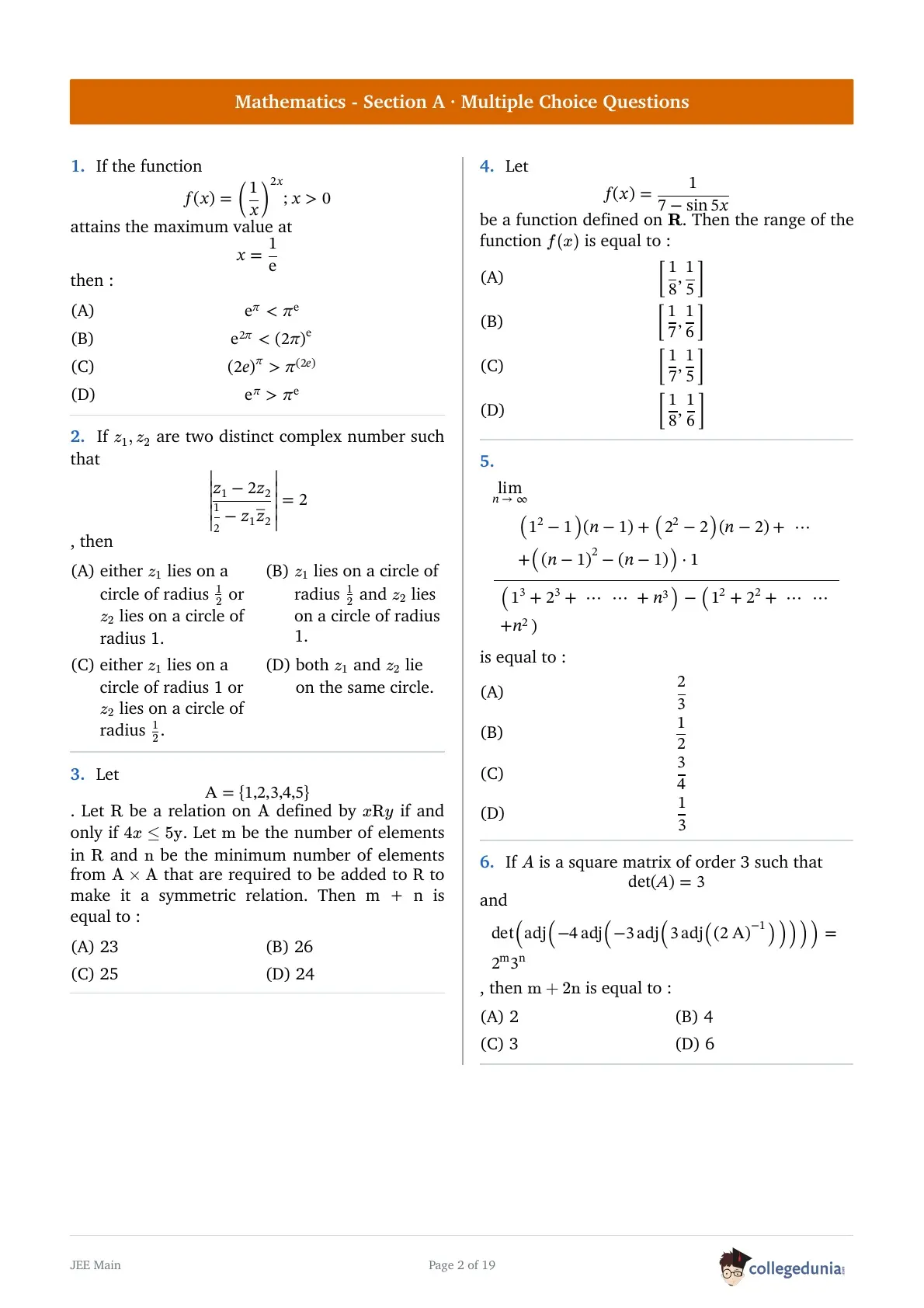
If the function \(f(x) = \left(\frac{1}{x}\right)^{2x}; \, x>0\) attains the maximum value at \(x = \frac{1}{c}\), then:
If \(z_1, z_2\) are two distinct complex numbers such that \[ \frac{|z_1 - 2z_2|}{\left| \frac{1}{2} - z_1 \overline{z_2} \right|} = 2, \] then
Let \(A = \{1, 2, 3, 4, 5\}\). Let \(R\) be a relation on \(A\) defined by \(xRy\) if and only if \(4x \leq 5y\). Let \(m\) be the number of elements in \(R\) and \(n\) be the minimum number of elements from \(A \times A\) that are required to be added to \(R\) to make it a symmetric relation. Then \(m + n\) is equal to:
Let \(f(x) = \frac{1}{7 - \sin 5x}\) be a function defined on \(\mathbb{R}\). Then the range of the function \(f(x)\) is equal to:
\[ \lim_{n \to \infty} \frac{(1^2 - 1)(n-1) + (2^2 - 2)(n-2) + \ldots + ((n-1)^2 - (n-1))}{(1^3 + 2^3 + \ldots + n^3) - (1^2 + 2^2 + \ldots + n^2)} \] is equal to:
If \(A\) is a square matrix of order 3 such that \[ \det(A) = 3 \] and \[ \det(\text{adj}(-4 \, \text{adj}(-3 \, \text{adj}(3 \, \text{adj}((2A)^{-1}))))) = 2^{m^3 n}, \] then \(m + 2n\) is equal to:
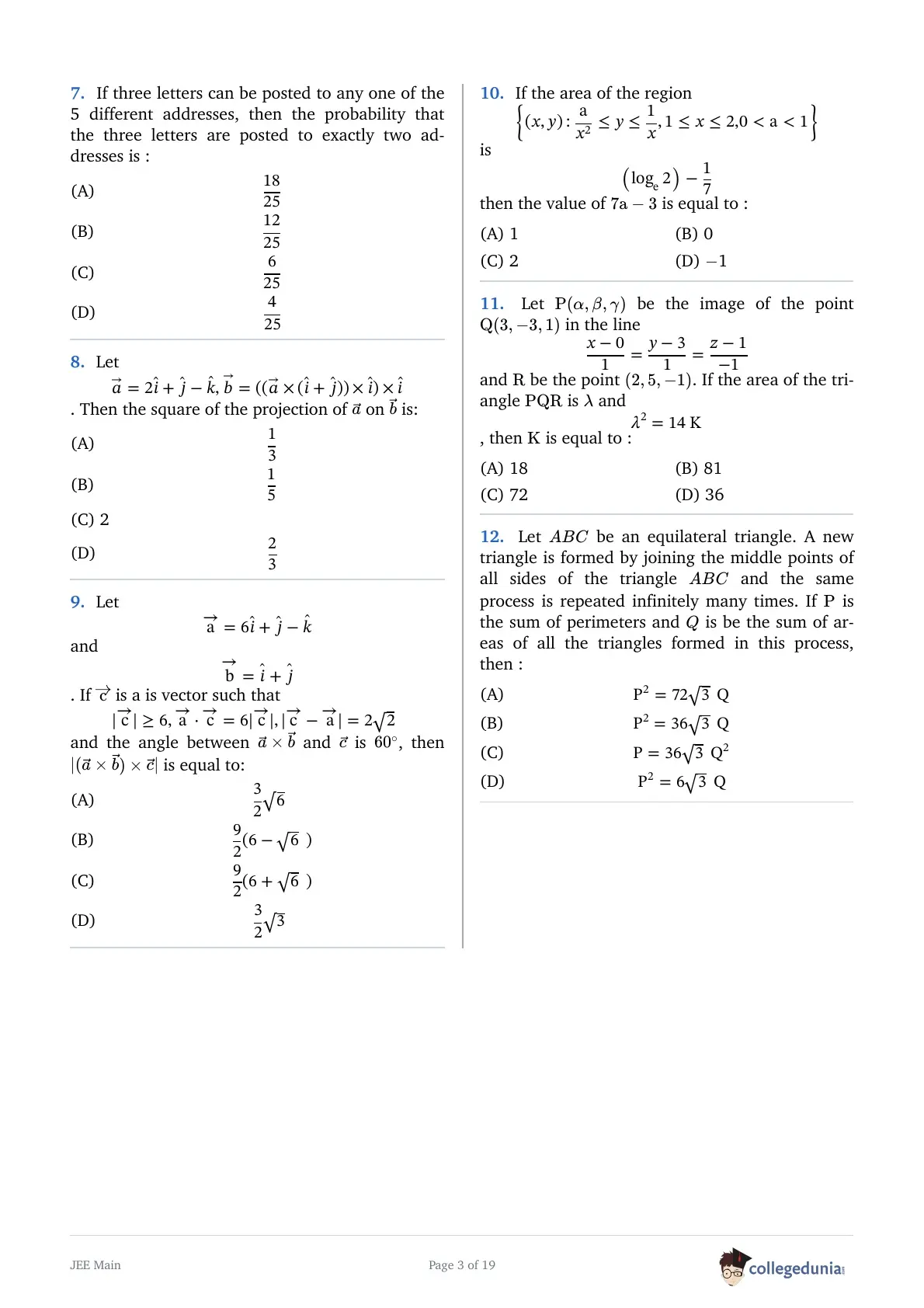
If three letters can be posted to any one of the 5 different addresses, then the probability that the three letters are posted to exactly two addresses is:
Let \(\vec{a} = 2\hat{i} + \hat{j} - \hat{k}\), \(\vec{b} = \left((\vec{a} \times (\hat{i} + \hat{j})) \times \hat{i}\right) \times \hat{i}\). Then the square of the projection of \(\vec{a}\) on \(\vec{b}\) is:
Let \(\vec{a} = 6\hat{i} + \hat{j} - \hat{k}\) and \(\vec{b} = \hat{i} + \hat{j}\). If \(\vec{c}\) is a vector such that \[ |\vec{c}| \geq 6, \quad \vec{a} \cdot \vec{c} = 6 |\vec{c}|, \quad |\vec{c} - \vec{a}| = 2\sqrt{2} \] and the angle between \(\vec{a} \times \vec{b}\) and \(\vec{c}\) is \(60^\circ\), then \(|(\vec{a} \times \vec{b}) \times \vec{c}|\) is equal to:
If the area of the region \[ \left\{(x, y) : \frac{a}{x^2} \leq y \leq \frac{1}{x}, \, 1 \leq x \leq 2, \, 0<a<1 \right\} \] is \[ (\log 2) - \frac{1}{7}, \] then the value of \(7a - 3\) is equal to:
Let \(P(\alpha, \beta, \gamma)\) be the image of the point \(Q(3, -3, 1)\) in the line \[\frac{x - 0}{1} = \frac{y - 3}{1} = \frac{z - 1}{-1}\]and \(R\) be the point \((2, 5, -1)\). If the area of the triangle \(PQR\) is \(\lambda\) and \(\lambda^2 = 14K\), then \(K\) is equal to:
Let ABC be an equilateral triangle. A new triangle is formed by joining the middle points of all sides of the triangle ABC and the same process is repeated infinitely many times. If P is the sum of perimeters and Q is be the sum of areas of all the triangles formed in this process, then:
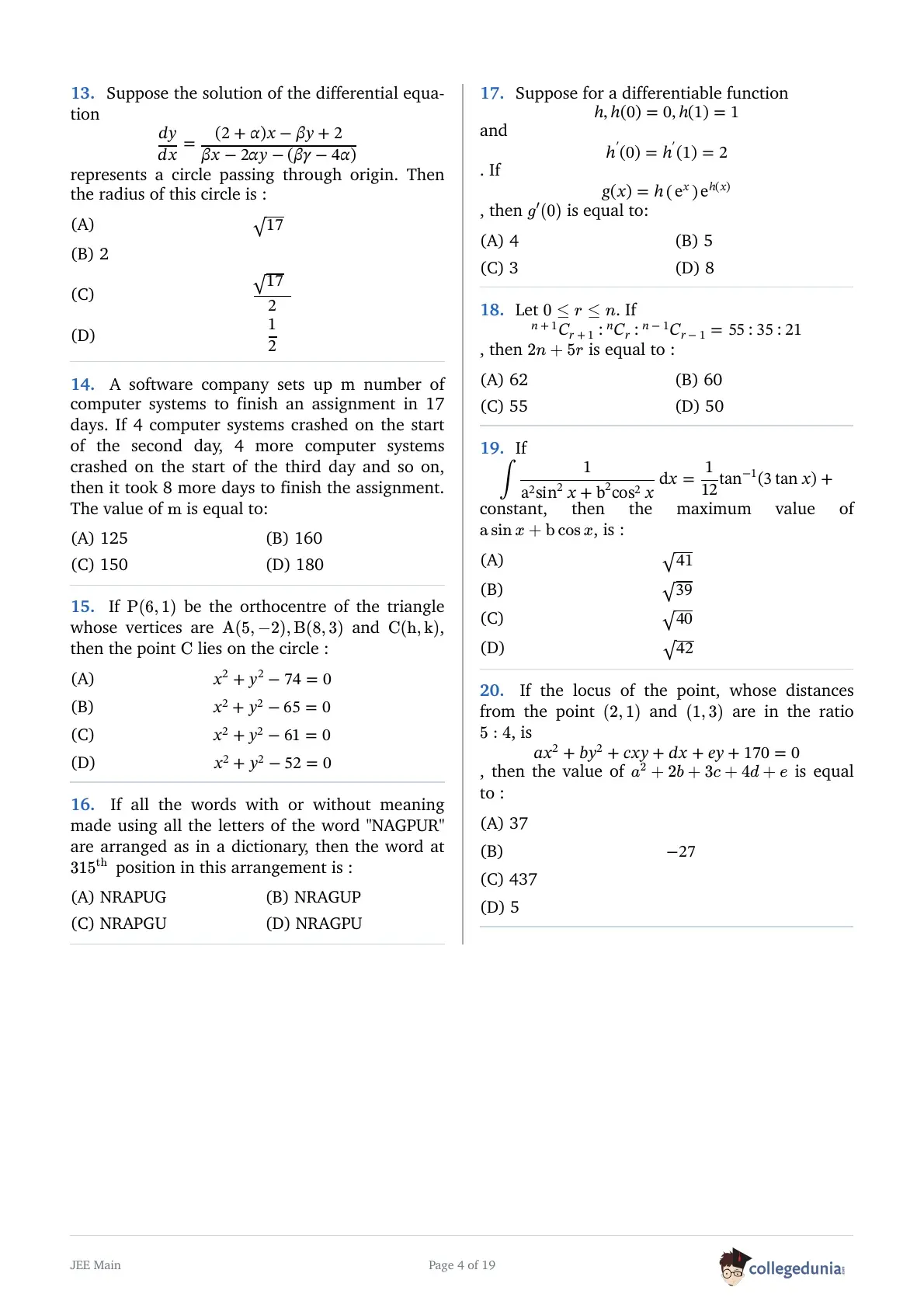
Suppose the solution of the differential equation \[\frac{dy}{dx} = \frac{(2 + \alpha)x - \beta y + 2}{\beta x - 2\alpha y - (\beta \gamma - 4\alpha)}\]represents a circle passing through the origin. Then the radius of this circle is:
A software company sets up m number of computer systems to finish an assignment in 17 days. If 4 computer systems crashed on the start of the second day, 4 more computer systems crashed on the start of the third day and so on, then it took 8 more days to finish the assignment. The value of m is equal to :
If P(6, 1) be the orthocentre of the triangle whose vertices are A(5, –2), B(8, 3) and C(h, k), then the point C lies on the circle.
If all the words with or without meaning made using all the letters of the word "NAGPUR" are arranged as in a dictionary, then the word at 315th position in this arrangement is
Suppose for a differentiable function \(h\), \(h(0) = 0\), \(h(1) = 1\) and \(h'(0) = h'(1) = 2\). If \(g(x) = h(e^x) \, e^{h(x)}\), then \(g'(0)\) is equal to:
Let \( 0 \le r \le n \). If \( ^{n+1}C_{r+1} : ^nC_r : ^{n-1}C_{r-1} = 55 : 35 : 21 \), then \( 2n + 5r \) is equal to:
If \[\int \frac{1}{a^2 \sin^2 x + b^2 \cos^2 x} \, dx = \frac{1}{12} \tan^{-1}(3 \tan x) + \text{constant},\]then the maximum value of \(a \sin x + b \cos x\) is:
If the locus of the point, whose distances from the point \((2, 1)\) and \((1, 3)\) are in the ratio \(5 : 4\), is \[ ax^2 + by^2 + cxy + dx + ey + 170 = 0, \] then the value of \(a^2 + 2b + 3c + 4d + e\) is equal to:
Mathematics - Section B (Q21 - Q30)
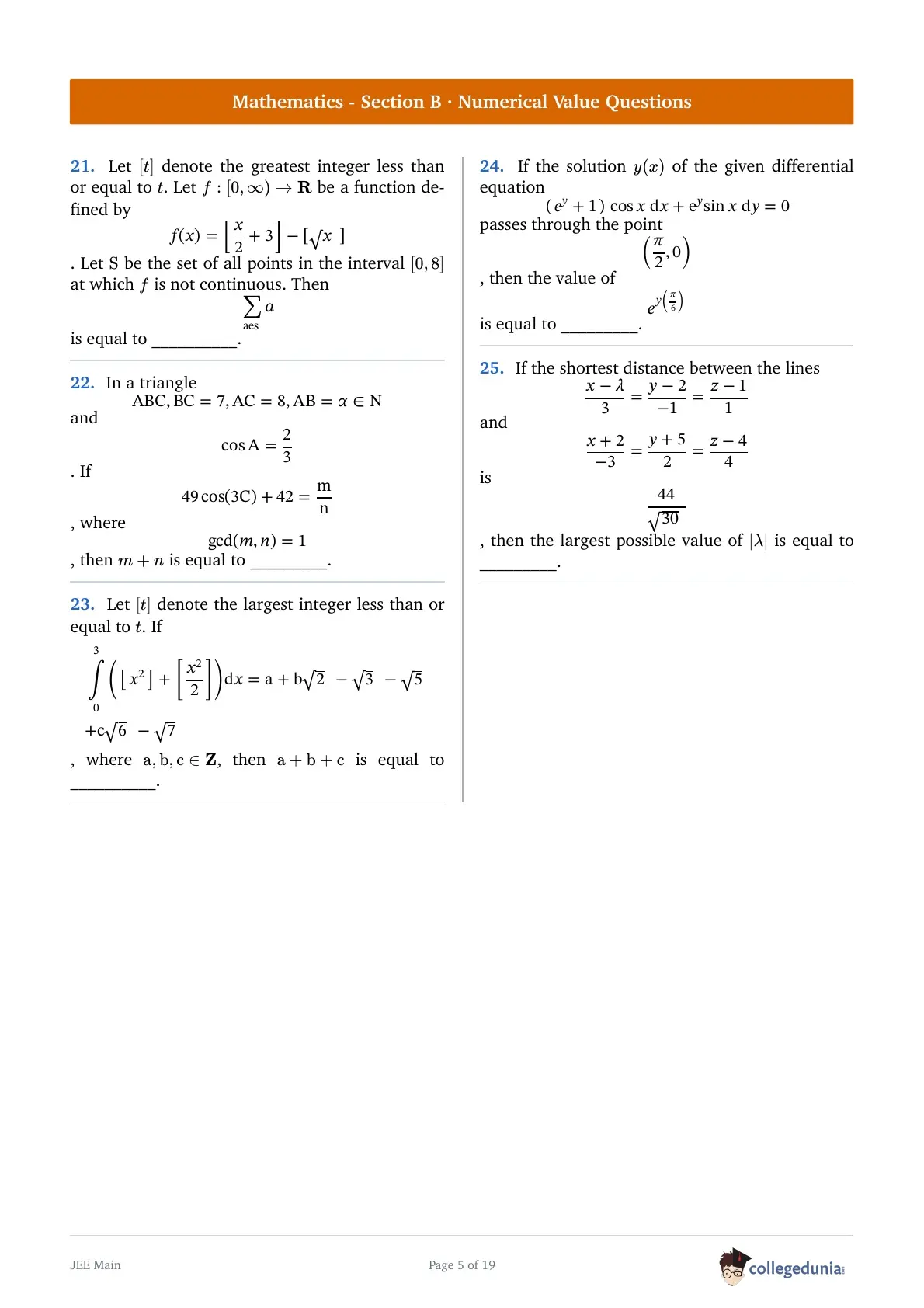
Let \([t]\) denote the greatest integer less than or equal to \(t\). Let \(f: [0, \infty) \to \mathbb{R}\) be a function defined by \[ f(x) = \left[\frac{x}{2} + 3\right] - \left[\sqrt{x}\right]. \] Let \(S\) be the set of all points in the interval \([0, 8]\) at which \(f\) is not continuous. Then \[ \sum_{a \in S} a \] is equal to ________.
In a triangle \(ABC\), \(BC = 7\), \(AC = 8\), \(AB = \alpha \in \mathbb{N}\) and \(\cos A = \frac{2}{3}\). If \[ 49 \cos(3C) + 42 = \frac{m}{n}, \] where \(\gcd(m, n) = 1\), then \(m + n\) is equal to ________.
Let \([t]\) denote the largest integer less than or equal to \(t\). If \[ \int_0^1 \left(\left[x^2\right] + \left\lfloor \frac{x^2}{2} \right\rfloor\right) dx = a + b\sqrt{2} - \sqrt{3} - \sqrt{5} + c\sqrt{6} - \sqrt{7}, \] where \(a, b, c \in \mathbb{Z}\), then \(a + b + c\) is equal to ________.
If the solution \(y(x)\) of the given differential equation \[(e^y + 1) \cos x \, dx + e^y \sin x \, dy = 0\]passes through the point \(\left(\frac{\pi}{2}, 0\right)\), then the value of \(e^{y\left(\frac{\pi}{6}\right)}\) is equal to ________.
If the shortest distance between the lines \[ \frac{x - \lambda}{3} = \frac{y - 2}{-1} = \frac{z - 1}{1} \] and \[ \frac{x + 2}{-3} = \frac{y + 5}{2} = \frac{z - 4}{4} \] is \[ \frac{44}{\sqrt{30}}, \] then the largest possible value of \(|\lambda|\) is equal to ________.
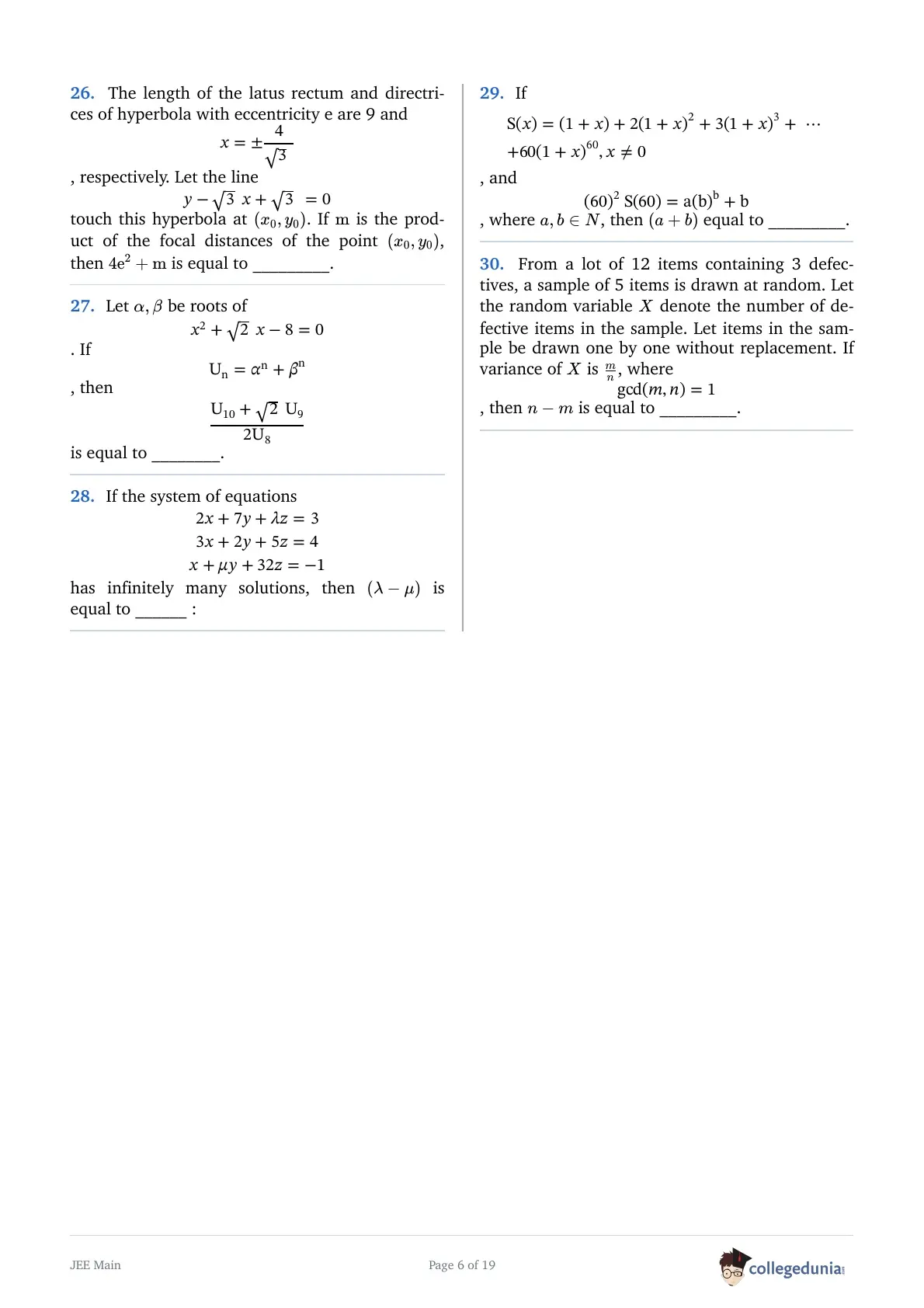
The length of the latus rectum and directrices of a hyperbola with eccentricity \(e\) are 9 and \(x = \pm \frac{4}{\sqrt{3}}\), respectively. Let the line \(y - \sqrt{3}x + \sqrt{3} = 0\) touch this hyperbola at \((x_0, y_0)\). If \(m\) is the product of the focal distances of the point \((x_0, y_0)\), then \(4e^2 + m\) is equal to ________.
Let \(\alpha, \beta\) be roots of \(x^2 + \sqrt{2}x - 8 = 0\). If \(U_n = \alpha^n + \beta^n\), then \[ \frac{U_{10} + \sqrt{12} U_9}{2 U_8} \] is equal to ________.
If the system of equations \[2x + 7y + \lambda z = 3,\]\[3x + 2y + 5z = 4,\]\[x + \mu y + 32z = -1\]has infinitely many solutions, then \((\lambda - \mu)\) is equal to ________.
If \[ S(x) = (1 + x) + 2(1 + x)^2 + 3(1 + x)^3 + \ldots + 60(1 + x)^{60}, \, x \neq 0, \] and \[ (60)^2 S(60) = a(b)^b + b, \] where \(a, b \in \mathbb{N}\), then \((a + b)\) is equal to ________.
From a lot of 12 items containing 3 defectives, a sample of 5 items is drawn at random. Let the random variable \(X\) denote the number of defective items in the sample. Let items in the sample be drawn one by one without replacement. If the variance of \(X\) is \(\frac{m}{n}\), where \(\gcd(m, n) = 1\), then \(n - m\) is equal to ________.
Physics - Section A (Q31 - Q50)
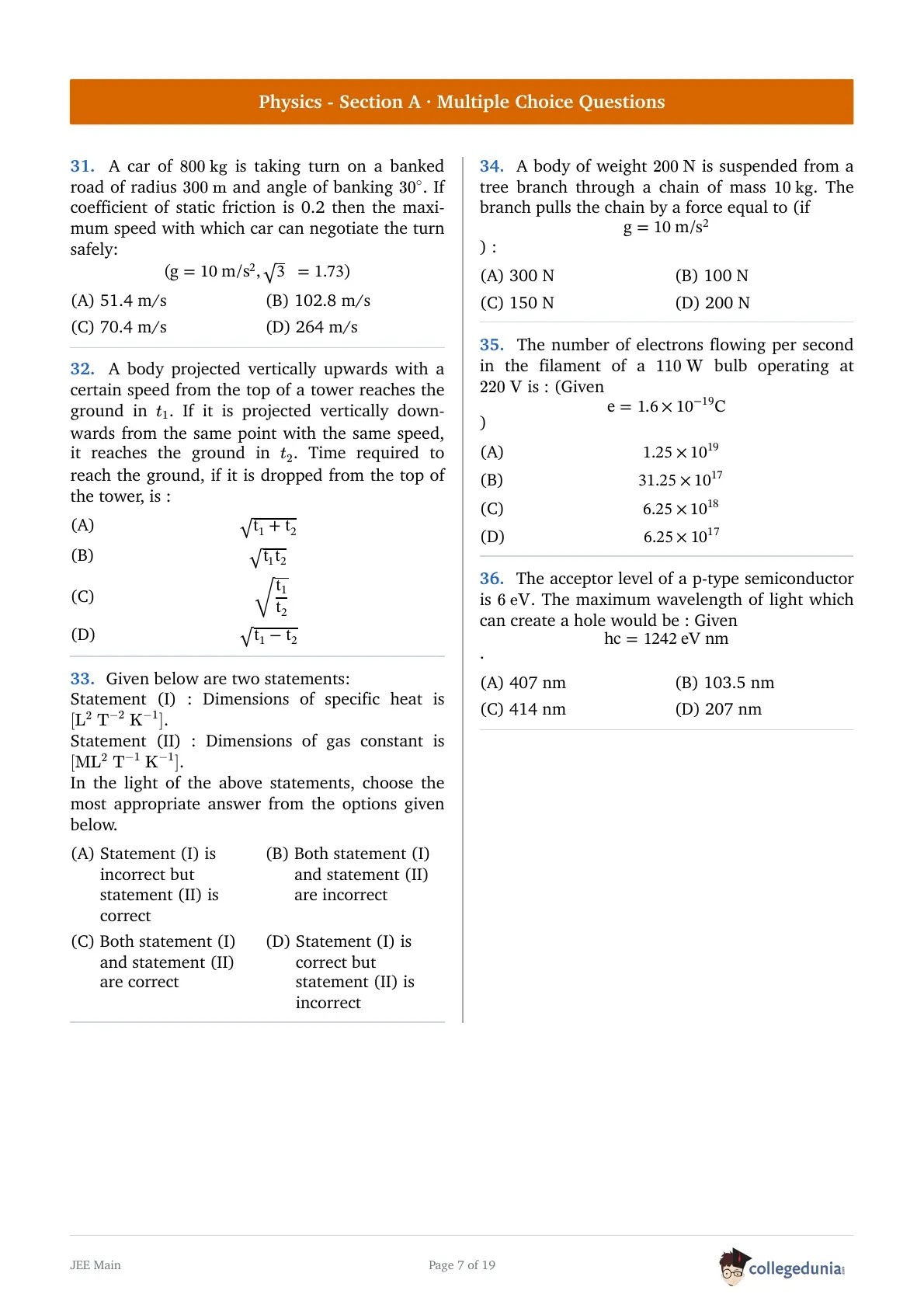
A car of 800 kg is taking a turn on a banked road of radius 300 m and angle of banking 30°. If the coefficient of static friction is 0.2, then the maximum speed with which the car can negotiate the turn safely: (Given \(g = 10 \, \text{m/s}^2\), \(\sqrt{3} = 1.73\)).
A body projected vertically upwards with a certain speed from the top of a tower reaches the ground in t1. If it is projected vertically downwards from the same point with the same speed, it reaches the ground in t2. Time required to reach the ground, if it is dropped from the top of the tower, is :
Given below are two statements:
Statement (I): Dimensions of specific heat is \([L^{2}T^{-2}K^{-1}]\)
Statement (II): Dimensions of gas constant is \([M L^{2}T^{-2}K^{-1}]\)
A body of weight 200 N is suspended from a tree branch through a chain of mass 10 kg. The branch pulls the chain by a force equal to (if \(g = 10 \, \text{m/s}^2\)):
The number of electrons flowing per second in the filament of a 110 W bulb operating at 220 V is: (Given \(e = 1.6 \times 10^{-19}\) C)
The acceptor level of a p-type semiconductor is 6eV. The maximum wavelength of light which can create a hole would be : Given hc = 1242 eV nm.
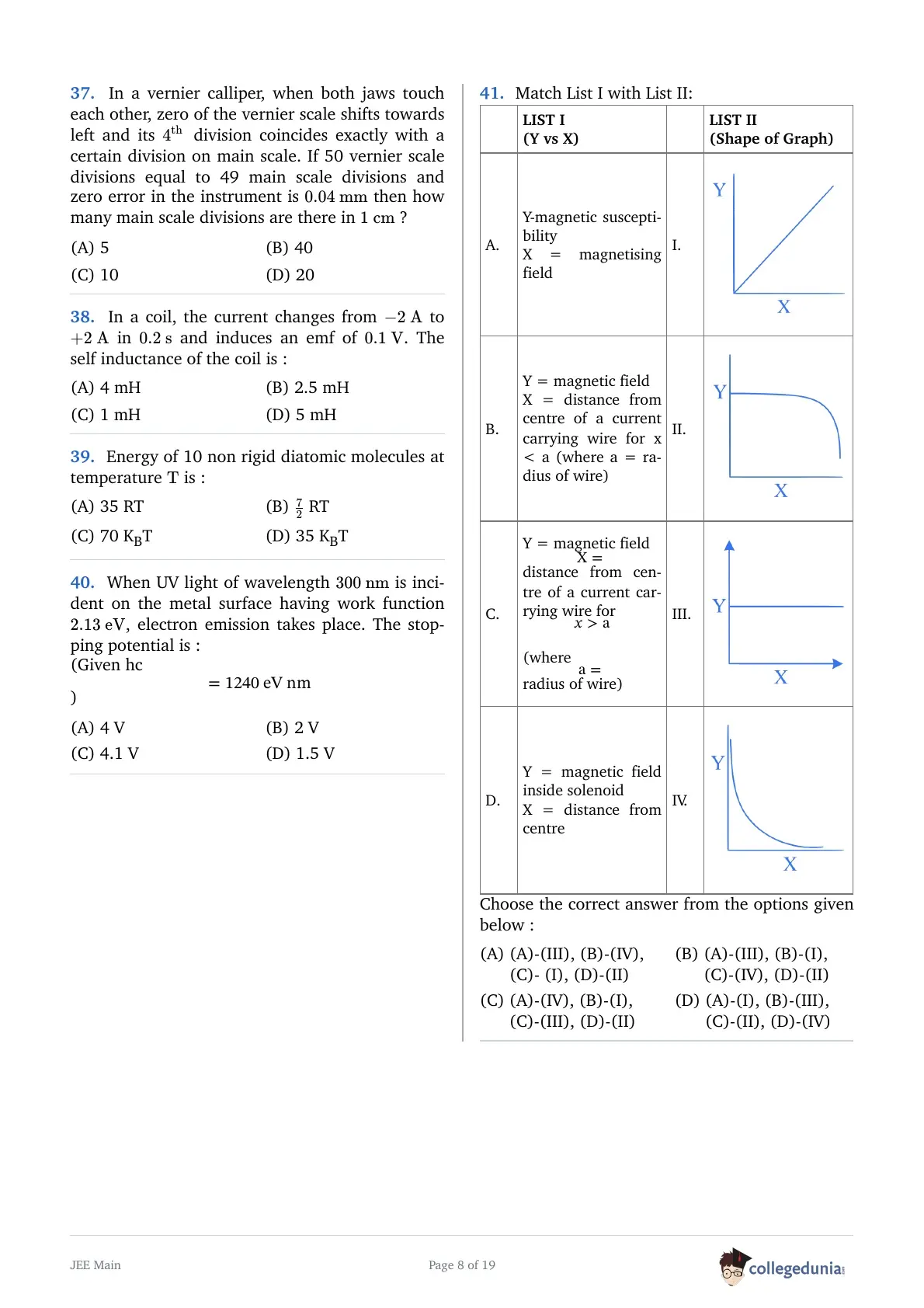
In a vernier calliper, when both jaws touch each other, zero of the vernier scale shifts towards left and its \(4^\text{th}\) division coincides exactly with a certain division on the main scale. If 50 vernier scale divisions equal to 49 main scale divisions and zero error in the instrument is 0.04 mm, then how many main scale divisions are there in 1 cm?
In a coil, the current changes form –2 A to +2A in 0.2 s and induces an emf of 0.1 V. The self-inductance of the coil is :
Energy of 10 non rigid diatomic molecules at temperature T is :
When UV light of wavelength 300 nm is incident on the metal surface having work function 2.13 eV, electron emission takes place. The stopping potential is : (Given hc = 1240 eV nm)
Match List-I with List-II
Choose the correct answer from the options given below :
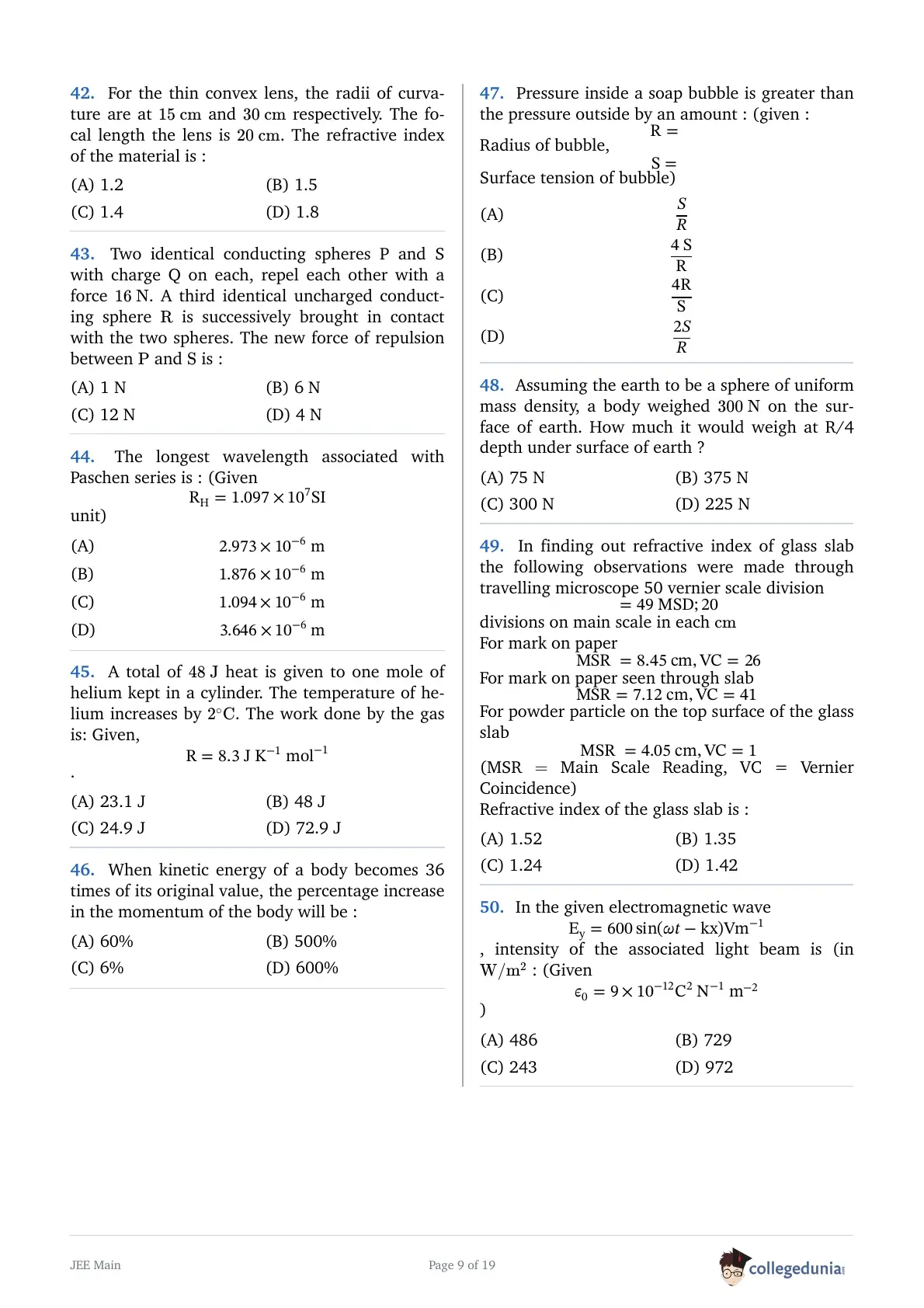
For the thin convex lens, the radii of curvature are at 15 cm and 30 cm respectively. The focal length the lens is 20 cm. The refractive index of the material is :
Two identical conducting spheres P and S with charge Q on each, repel each other with a force 16N. A third identical uncharged conducting sphere R is successively brought in contact with the two spheres. The new force of repulsion between P and S is :
The longest wavelength associated with Paschen series is: (Given \(R_H = 1.097 \times 10^7\) SI unit)
A total of 48 J heat is given to one mole of helium kept in a cylinder. The temperature of helium increases by \(2^\circ C\). The work done by the gas is: (Given, \(R = 8.3 \, \text{J K}^{-1} \, \text{mol}^{-1}\)).
When kinetic energy of a body becomes 36 times of its original value, the percentage increase in the momentum of the body will be
Pressure inside a soap bubble is greater than the pressure outside by an amount;(given : R = Radius of bubble, S = Surface tension of bubble)
Assuming the earth to be a sphere of uniform mass density, a body weighed 300 N on the surface of earth. How much it would weigh at R/4 depth under surface of earth ?
In finding out the refractive index of the glass slab, the following observations were made through a travelling microscope: 50 vernier scale divisions (VSD), 49 MSD, 20 divisions on the main scale in each cm. For the mark on paper: \[ \text{MSR} = 8.45 \, \text{cm}, \quad \text{VC} = 26 \] For the mark on paper seen through the slab: \[ \text{MSR} = 7.12 \, \text{cm}, \quad \text{VC} = 41 \] For the powder particle on the top surface of the glass slab: \[ \text{MSR} = 4.05 \, \text{cm}, \quad \text{VC} = 1 \] (MSR = Main Scale Reading, VC = Vernier Coincidence) Refractive index of the glass slab is:
In the given electromagnetic wave \[ E_y = 600 \sin(\omega t - kx) \, \text{V/m}, \] intensity of the associated light beam is (in W/m\(^2\)); (Given \(\epsilon_0 = 9 \times 10^{-12} \, \text{C}^2 \text{N}^{-1} \text{m}^{-2}\)).
Physics - Section B (Q51 - Q60)
For a given series LCR circuit, it is found that maximum current is drawn when value of variable capacitance is \(2.5 \, \text{nF}\). If resistance of \(2000 \, \Omega\) and \(100 \, \text{mH}\) inductor is being used in the given circuit. The frequency of AC source is ____ \(\times \, 10^3 \, \text{Hz}\). (Given \(\pi^2 = 10\))
Three balls of masses \(2 \, \text{kg}\), \(4 \, \text{kg}\), and \(6 \, \text{kg}\) respectively are arranged at the centre of the edges of an equilateral triangle of side \(2 \, \text{m}\).The moment of inertia of the system about an axis through the centroid and perpendicular to the plane of the triangle, will be ____ \(\text{kg} \, \text{m}^2\)
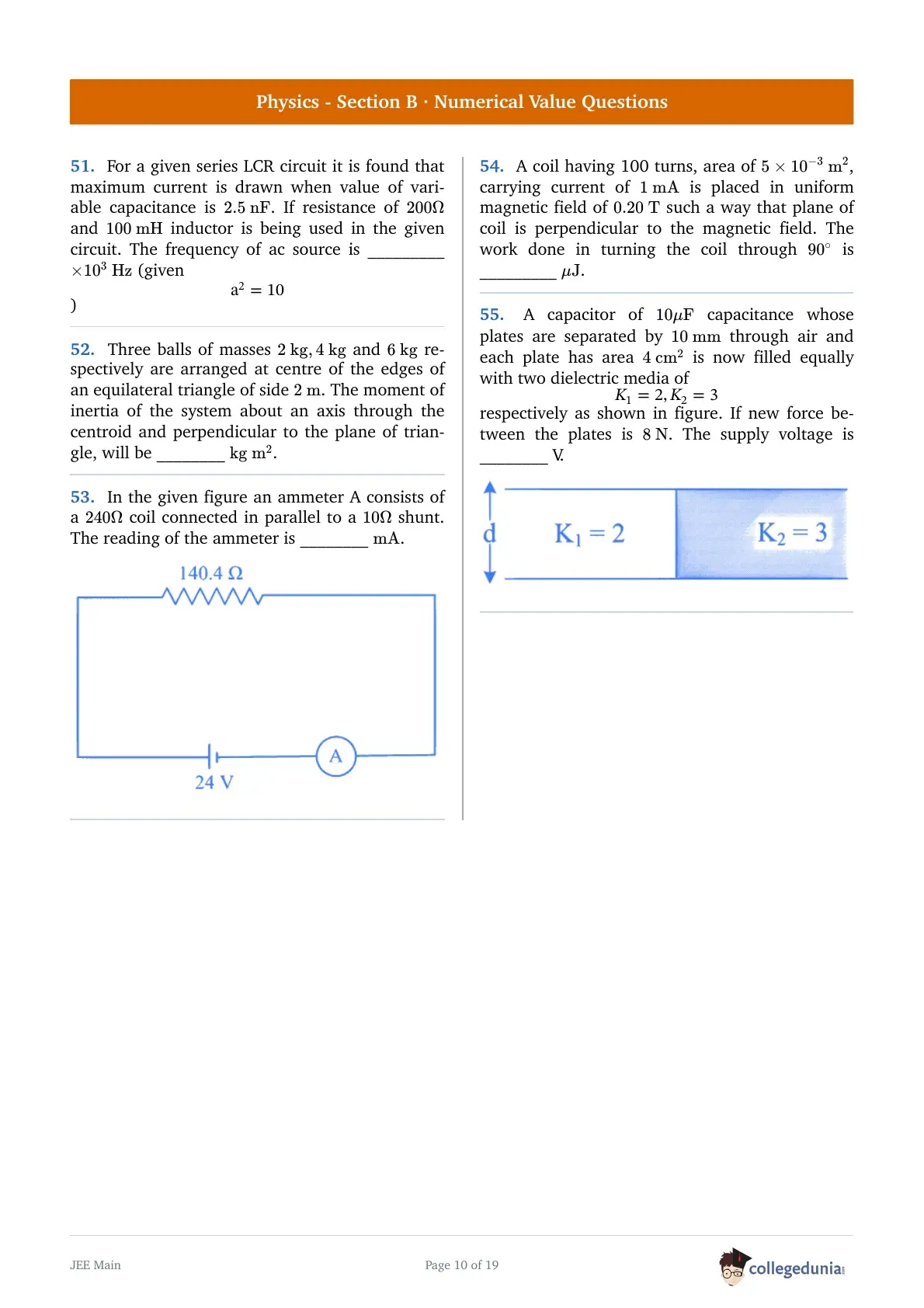
In the given figure, an ammeter \(A\) consists of a \(240 \, \Omega\) coil connected in parallel to a \(10 \, \Omega\) shunt. The reading of the ammeter is ____ \(\text{mA}\).
A coil having 100 turns, area of \(5 \times 10^{-3} \, \text{m}^2\), carrying current of \(1 \, \text{mA}\) is placed in a uniform magnetic field of \(0.20 \, \text{T}\) such a way that the plane of the coil is perpendicular to the magnetic field.
The work done in turning the coil through \(90^\circ\) is ____ \(\mu \text{J}\).
A capacitor of \(10 \, \mu\text{F}\) capacitance whose plates are separated by \(10 \, \text{mm}\) through air and each plate has area \(4 \, \text{cm}^2\) is now filled equally with two dielectric media of \(K_1 = 2\), \(K_2 = 3\) respectively as shown in the figure. If new force between the plates is \(8 \, \text{N}\), the supply voltage is ____ \(\text{V}\).
A particle moves in a straight line so that its displacement \(x\) at any time \(t\) is given by \(x^2 = 1 + t^2\).
Its acceleration at any time \(t\) is \(x^{-n}\) where \(n =\) ____.
Two coherent monochromatic light beams of intensities I and 4I are superimposed. The difference between maximum and minimum possible intensities in the resulting beam is x I. The value of x is______.
Two open organ pipes of length \(60 \, \text{cm}\) and \(90 \, \text{cm}\) resonate at \(6^\text{th}\) and \(5^\text{th}\) harmonics respectively. The difference of frequencies for the given modes is ____ \(\text{Hz}\).
(Velocity of sound in air \(= 333 \, \text{m/s}\))
In Franck-Hertz experiment, the first dip in the current-voltage graph for hydrogen is observed at 10.2 V. The wavelength of light emitted by hydrogen atom when excited to the first excitation level is _____ nm.
(Given \(hc = 1245 \, \text{eV nm}, \, e = 1.6 \times 10^{-19} \, \text{C}\)).
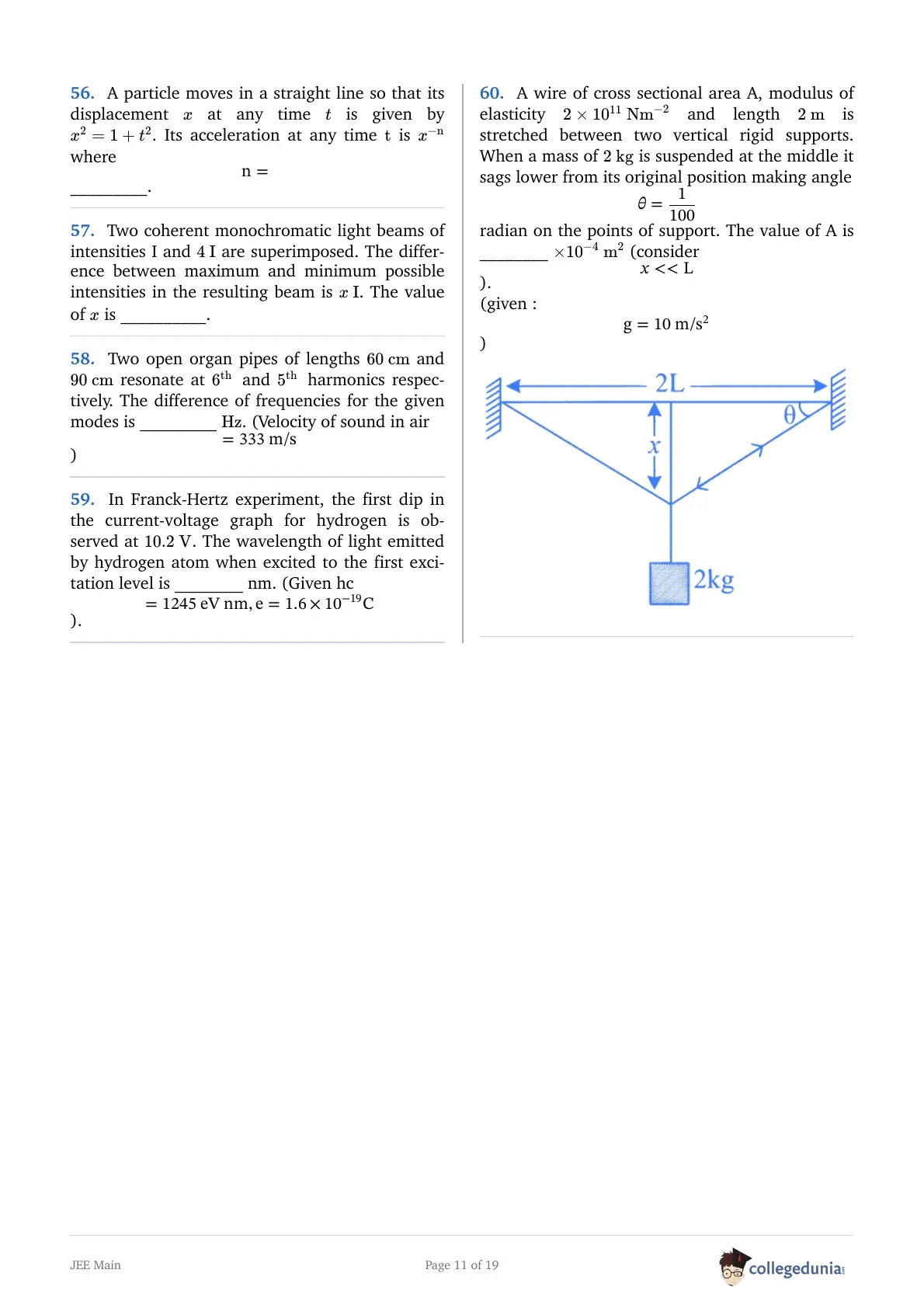
A wire of cross-sectional area \(A\), modulus of elasticity \(2 \times 10^{11} \, \text{Nm}^{-2}\), and length \(2 \, \text{m}\) is stretched between two vertical rigid supports.
When a mass of \(2 \, \text{kg}\) is suspended at the middle, it sags lower from its original position making angle \(\theta = \frac{1}{100}\) radian on the points of support.
The value of \(A\) is ____ \(\times 10^{-4} \, \text{m}^2\) (consider \(x \ll l\)).
(Given: \(g = 10 \, \text{m/s}^2\))
Chemistry - Section A (Q61 - Q80)
The number of ions from the following that are expected to behave as oxidising agent is: \(\text{Sn}^{4+}, \, \text{Sn}^{2+}, \, \text{Pb}^{2+}, \, \text{Tl}^{3+}, \, \text{Pb}^{4+}, \, \text{Tl}^{+}\)

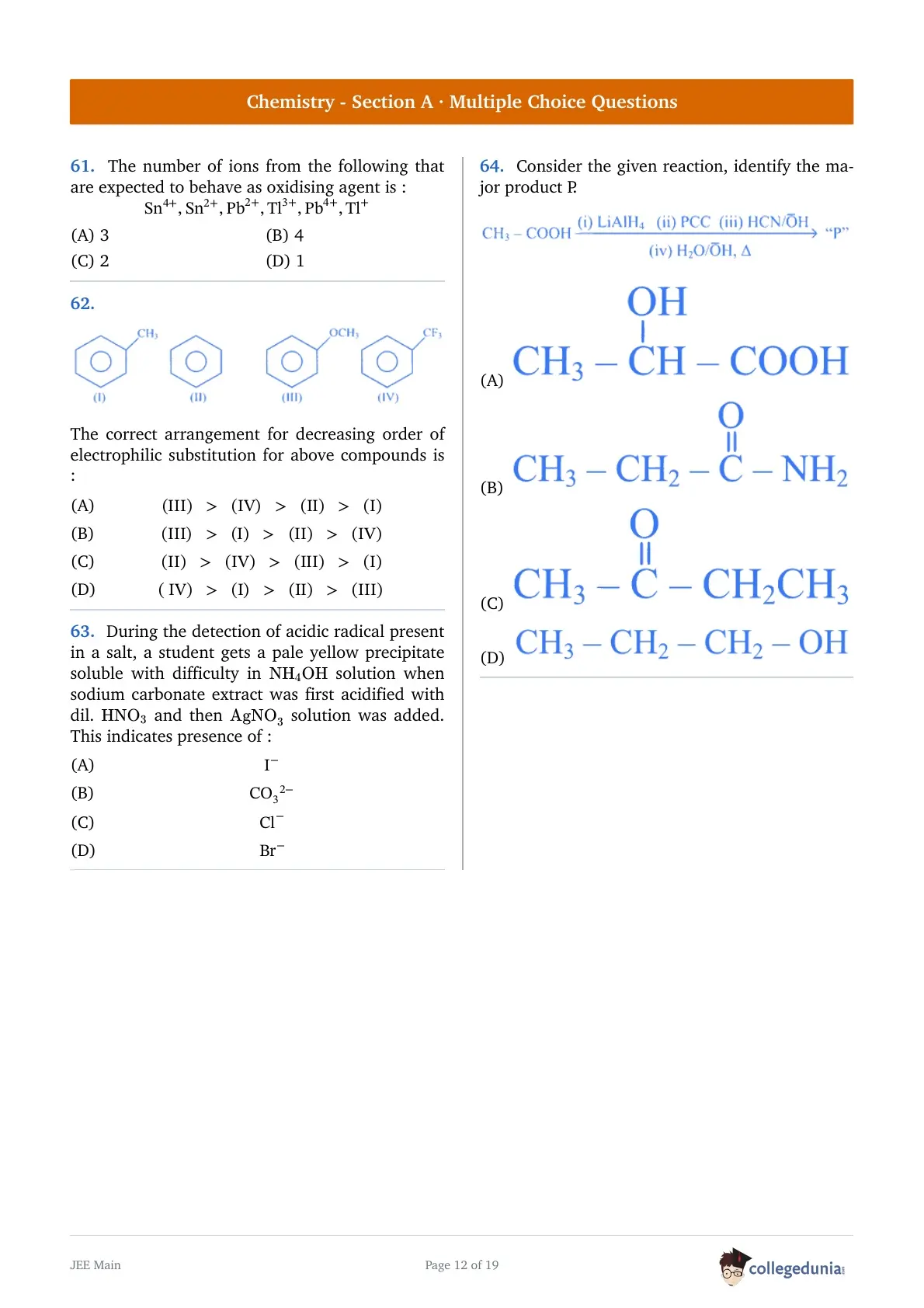
The correct arrangement for decreasing order of electrophilic substitution for above compounds
During the detection of acidic radical present in a salt, a student gets a pale yellow precipitate soluble with difficulty in \(\text{NH}_4\text{OH}\) solution when sodium carbonate extract was first acidified with dil. \(\text{HNO}_3\) and then \(\text{AgNO}_3\) solution was added. This indicates the presence of:
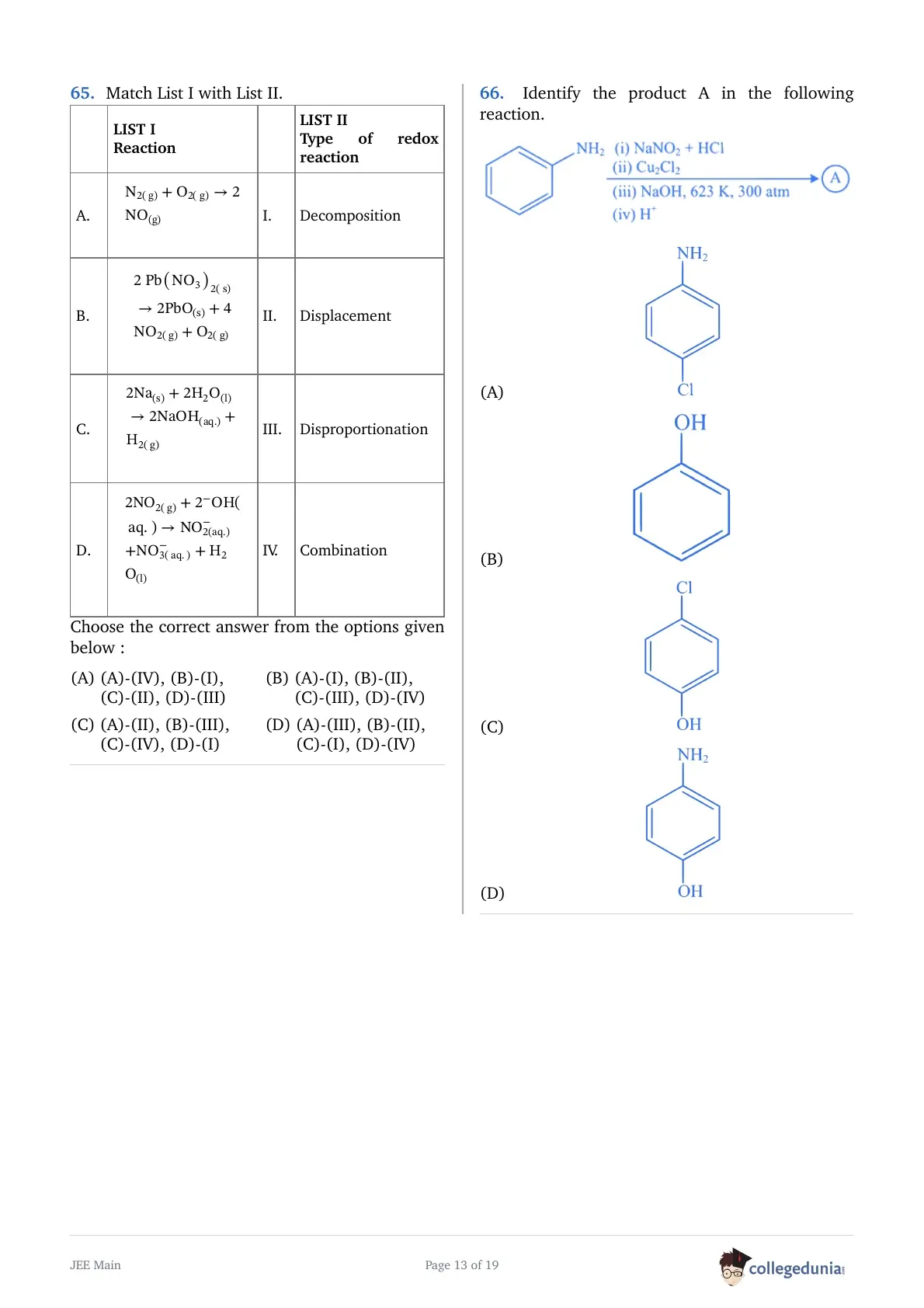
Consider the given reaction, identify the major product P.
- (1) \(\text{CH}_3 - \text{CH}_2 - \text{CH}_2 - \text{OH}\)
- (2)
![Product 2]()
- (3)
![Product 3]()
- (4)
![Product 4]()


| List-I Reaction | List-II Type of redox reaction |
|---|---|
| (A) N2(g) + O2(g) → 2NO(g) | (I) Decomposition |
| (B) 2Pb (NO3)2(s) → 2PbO(s) + 4NO2(g) + O2(g) | (II) Displacement |
| (C) 2Na(s) + 2H2O(l) → 2NaOH(aq) + H2(g) | (III) Disproportionation |
| (D) 2NO2(g) + 2OH-(aq) → NO2-(aq) + NO3-(aq) + H2O(l) | (IV) Combination |


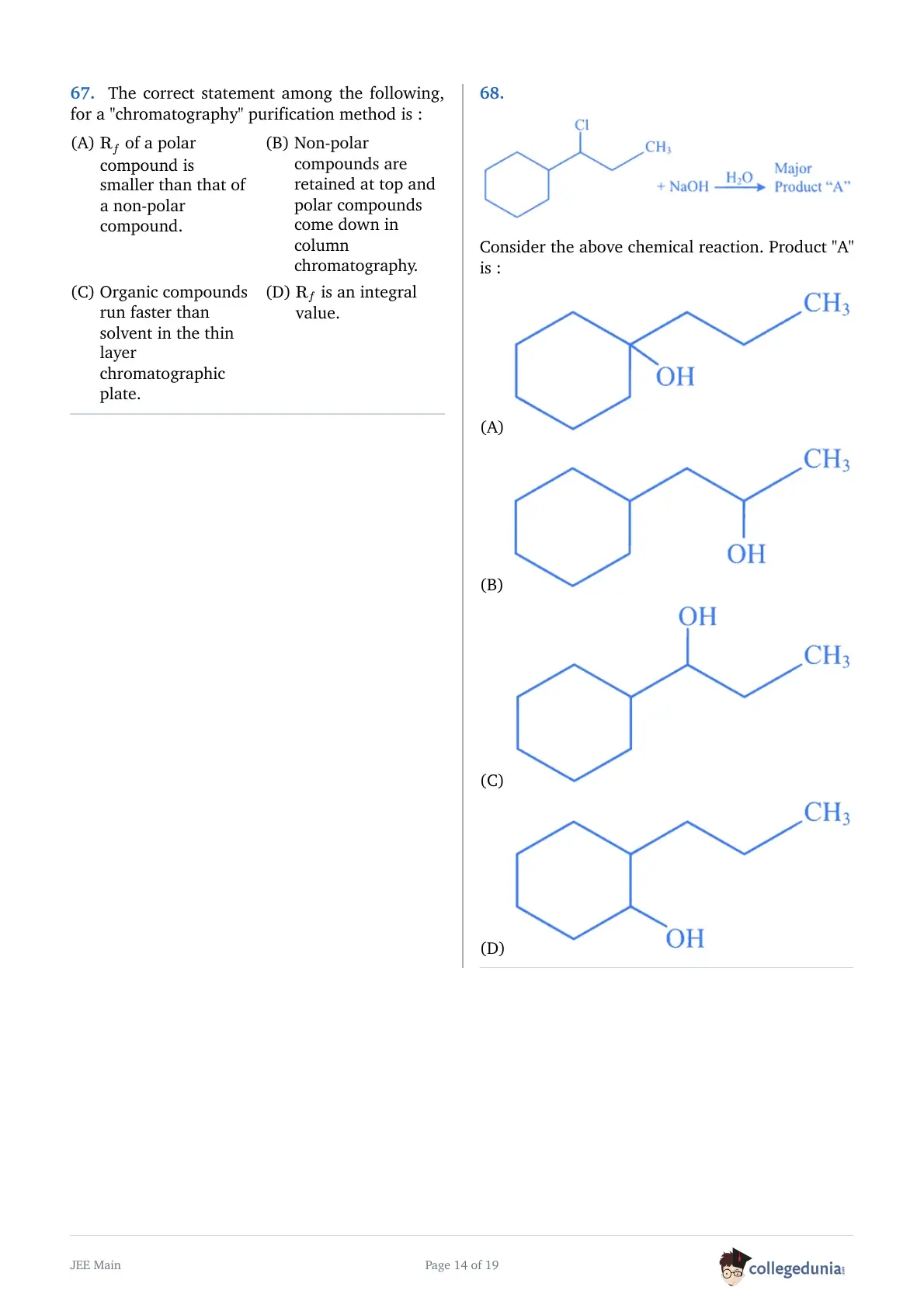
The correct statements among the following, for a "chromatography" purification method is:

Consider the above chemical reaction. Product "A" is:
- (1)
![Product 1]()
- (2)
![Product 2]()
- (3)
![Product 3]()
- (4)
![Product 4]()


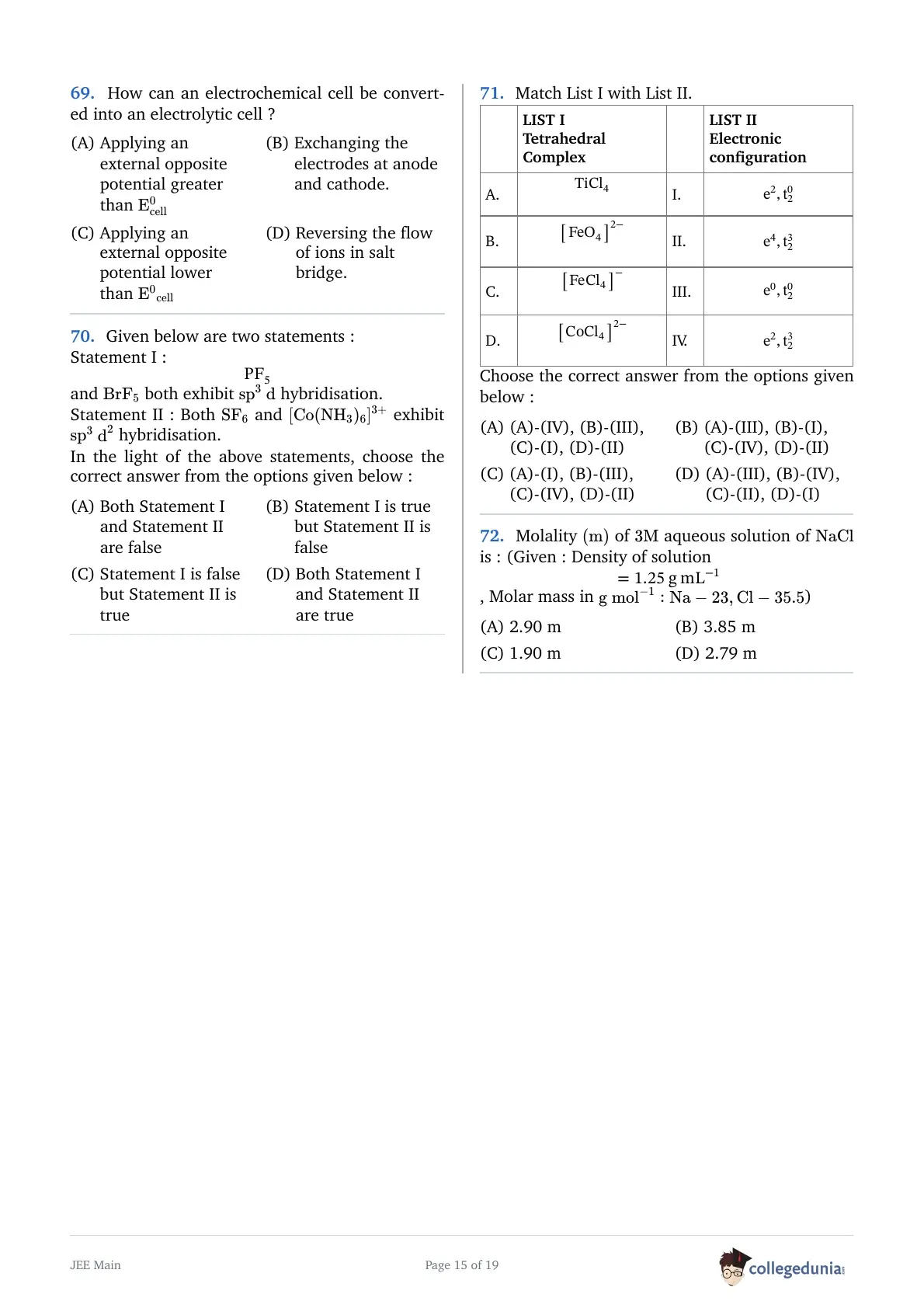
How can an electrochemical cell be converted into an electrolytic cell ?
Given below are two statements: Statement I: \(\text{PF}_5\) and \(\text{BrF}_5\) both exhibit \(\text{sp}^3\text{d}\) hybridisation.Statement II: Both \(\text{SF}_6\) and \([\text{Co}(\text{NH}_3)_6]^{3+}\) exhibit \(\text{sp}^3\text{d}^2\) hybridisation. In the light of the above statements,choose the correct answer from the options given below:
| List-I Tetrahedral Complex | List-II Electronic configuration |
|---|---|
| (A) TiCl4 | (I) e2, t20 |
| (B) [FeO4]2- | (II) e4, t23 |
| (C) [FeCl4]- | (III) e0, t22 |
| (D) [CoCl4]2- | (IV) e2, t23 |
Molality \((m)\) of \(3 \, \text{M}\) aqueous solution of \(\text{NaCl}\) is:
(Given: Density of solution \(= 1.25 \, \text{g mL}^{-1}\), Molar mass in \(\text{g mol}^{-1}\): \(\text{Na} = 23, \, \text{Cl} = 35.5\))
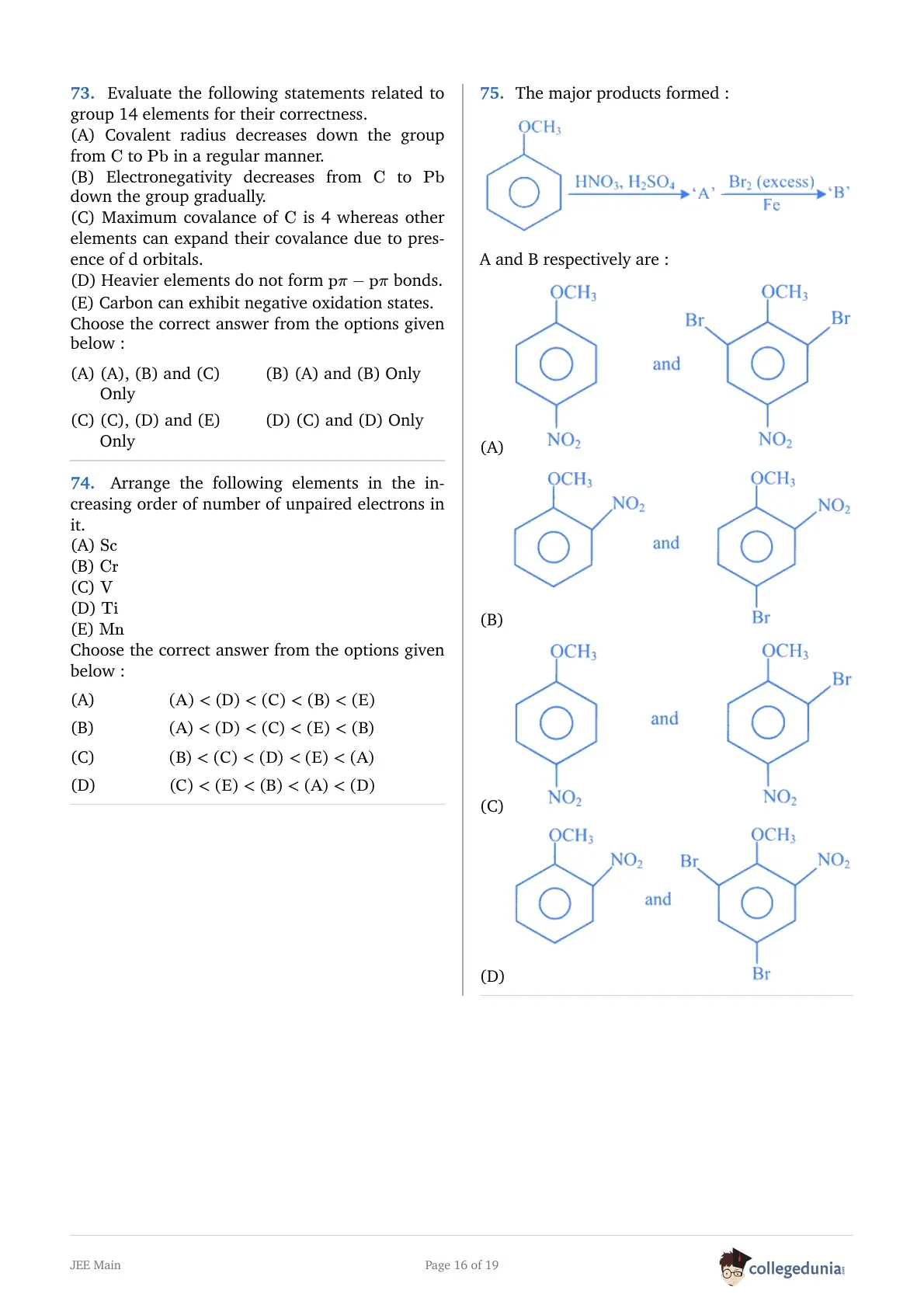
Evaluate the following statements related to group 14 elements for their correctness.
(A) Covalent radius decreases down the group from C to Pb in a regular manner.
(B) Electronegativity decreases from C to Pb down the group gradually.
(C) Maximum covalence of C is 4 whereas other elements can expand their covalence due to presence of d orbitals.
(D) Heavier elements do not form ppi-ppi bonds.
(E) Carbon can exhibit negative oxidation states.
Choose the correct answer from the options given below:
Arrange the following elements in the increasing order of number of unpaired electrons in it.
(A) Sc
(B) Cr
(C) V
(D) Ti
(E) Mn
Choose the correct answer from the options given below:


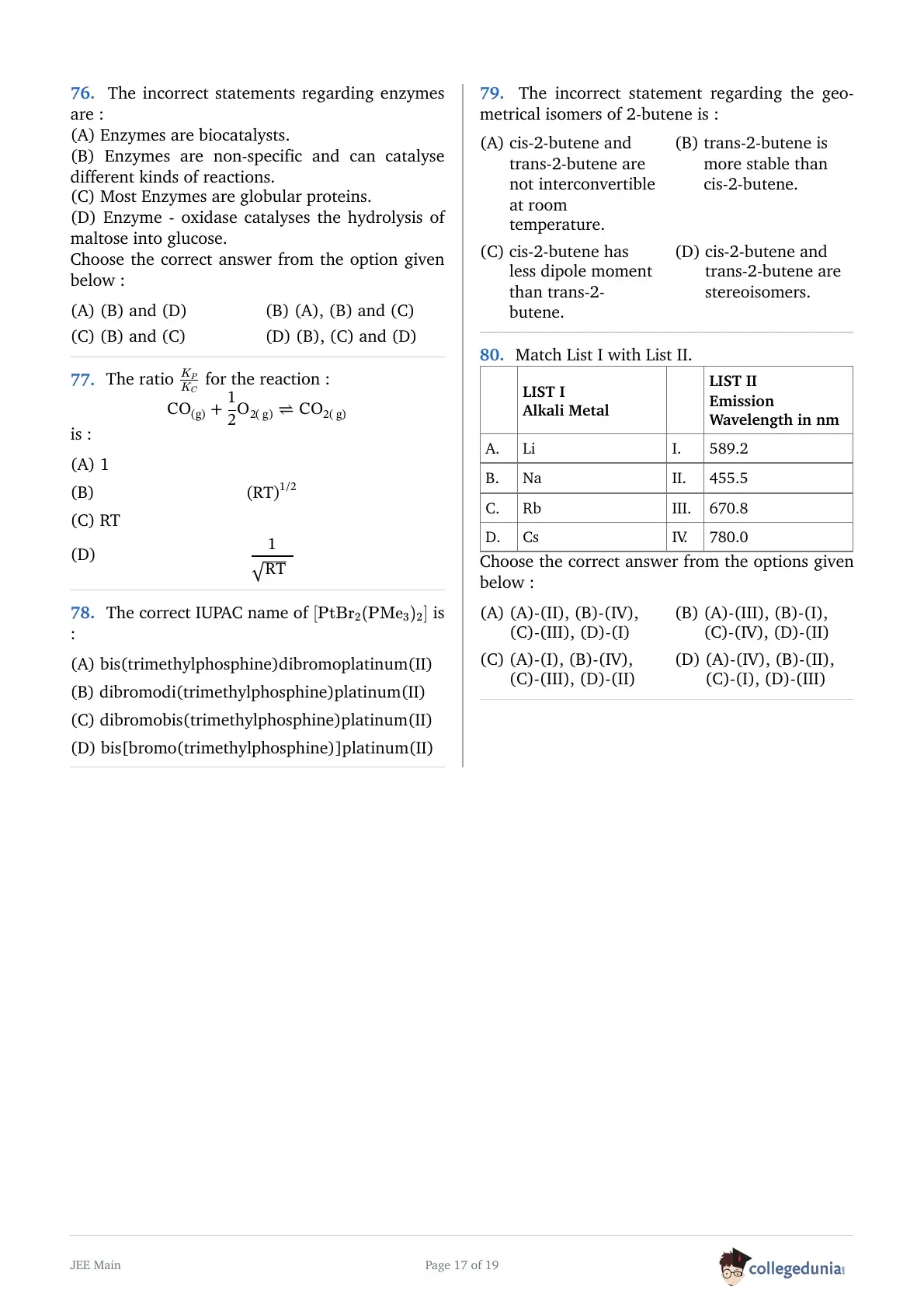
The incorrect statements regarding enzymes are
(A) Enzymes are biocatalysts.
(B) Enzymes are non-specific and can catalyse different kinds of reactions.
(C) Most Enzymes are globular proteins.
(D) Enzyme - oxidase catalyses the hydrolysis of maltose into glucose.
Choose the correct answer from the option given below:
The ratio \(\frac{K_P}{K_C}\) for the reaction: 
The correct IUPAC name of \([\text{PtBr}_2(\text{PMe}_3)_2]\) is:
The incorrect statement regarding the geometrical isomers of 2-butene is:
| List-I Alkali Metal | List-II Emission Wavelength in nm |
|---|---|
| (A) Li | (I) 589.2 |
| (B) Na | (II) 455.5 |
| (C) Rb | (III) 670.8 |
| (D) Cs | (IV) 780.0 |
Chemistry - Section B (Q81 - Q90)
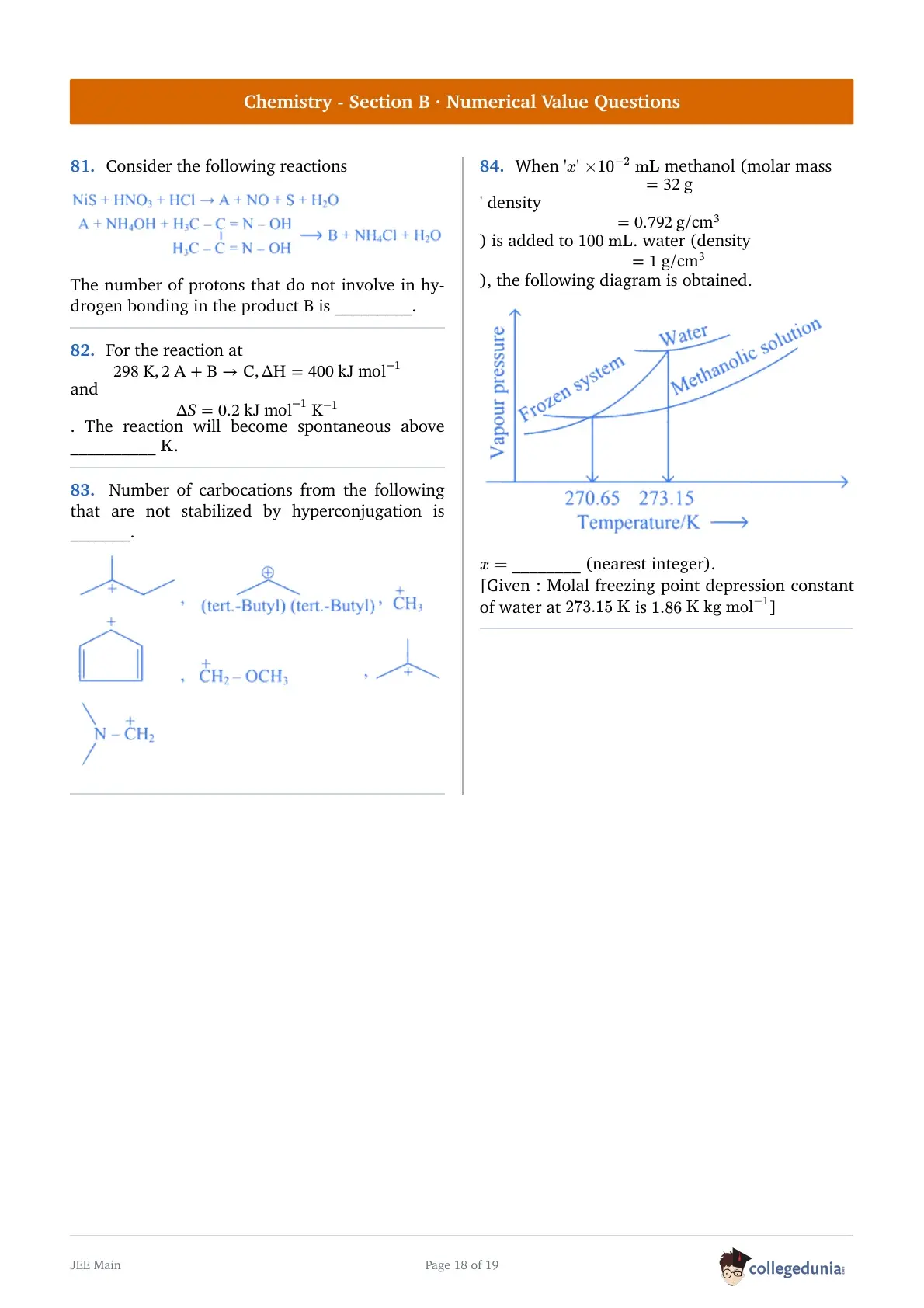
Consider the following reactions
The number of protons that do not involve in hydrogen bonding in the product B is______.
For the reaction at \(298 \, \text{K}\), \(2\text{A} + \text{B} \rightarrow \text{C}\). \(\Delta H = 400 \, \text{kJ mol}^{-1}\) and \(\Delta S = 0.2 \, \text{kJ mol}^{-1} \, \text{K}^{-1}\). The reaction will become spontaneous above ____ \(\text{K}\).
Number of carbocation from the following that are not stabilized by hyperconjugation is _________ .
When '\(x \times 10^{-2} \, \text{mL}\)' methanol (molar mass \(= 32 \, \text{g}\); density \(= 0.792 \, \text{g/cm}^3\)) is added to \(100 \, \text{mL}\) water (density \(= 1 \, \text{g/cm}^3\)), the following diagram is obtained.

x = __________ (nearest integer)
[Given: Molal freezing point depression constant of water at \(273.15 \, \text{K}\) is \(1.86 \, \text{K kg mol}^{-1}\)]
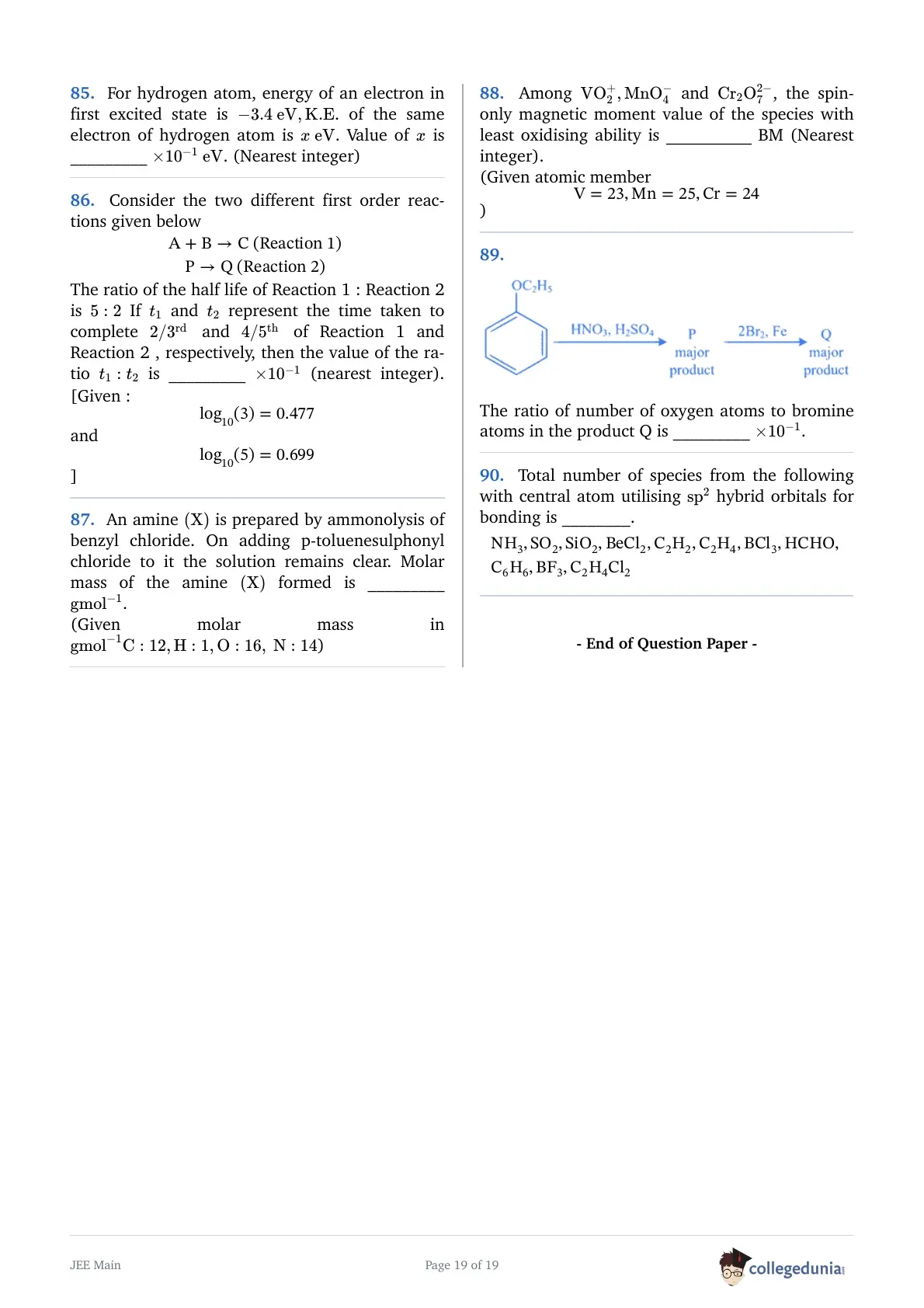
For hydrogen atom, energy of an electron in first excited state is \(-3.4 \, \text{eV}\), K.E. of the same electron of hydrogen atom is \(x \, \text{eV}\).Value of \(x\) is ____ \(\times 10^{-1} \, \text{eV}\). (Nearest integer)
Consider the two different first-order reactions given below: \(\text{A + B} \rightarrow \text{C (Reaction 1)}\)
\(\text{P} \rightarrow \text{Q (Reaction 2)}\)The ratio of the half-life of Reaction 1 : Reaction 2 is \(5 : 2\). If \(t_1\) and \(t_2\) represent the time taken to complete \(\frac{2}{3}^\text{rd}\) and \(\frac{4}{5}^\text{th}\) of Reaction 1 and Reaction 2, respectively, then the value of the ratio \(t_1 : t_2\) is ____ \(\times 10^{-1}\) (nearest integer).[Given: \(\log_{10}(3) = 0.477\) and \(\log_{10}(5) = 0.699\)]
An amine \((\text{X})\) is prepared by ammonolysis of benzyl chloride. On adding \(p\)-toluenesulphonyl chloride to it, the solution remains clear.Molar mass of the amine \((\text{X})\) formed is _____ \(\text{g mol}^{-1}\).(Given molar mass in \(\text{g mol}^{-1}\): \(\text{C} = 12, \, \text{H} = 1, \, \text{O} = 16, \, \text{N} = 14\))
Among \(VO_2^+\), \(MnO_4^-\), and \(Cr_2O_7^{2-}\), the spin-only magnetic moment value of the species with least oxidising ability is _____________ BM (Nearest integer).(Given atomic number \(V = 23\), \(Mn = 25\), \(Cr = 24\))

The ratio of number of oxygen atoms to bromine atoms in the product \(Q\) is ___ \(\times 10^{-1}\).
Total number of species from the following with central atom utilising \(2p^2\) hybrid orbitals for bonding is _______.
\(\text{NH}_3, \, \text{SO}_2, \, \text{SiO}_2, \, \text{BeCl}_2, \, \text{C}_2\text{H}_2, \, \text{C}_2\text{H}_4, \, \text{BCl}_3, \, \text{HCHO}, \, \text{C}_6\text{H}_6, \, \text{BF}_3, \, \text{C}_2\text{H}_4\text{Cl}_2\)
JEE Main 2024 Exam Pattern and Marking Scheme
| Particulars | Details |
|---|---|
| Exam Mode | Online (Computer-Based Test) |
| Paper | B.E./B.Tech |
| Medium of Exam | 13 languages: English, Hindi, Gujarati, Bengali, Tamil, Telugu, Kannada, Marathi, Malayalam, Odia, Punjabi, Assamese, Urdu |
| Duration | 3 hours (180 minutes) |
| Type of Questions | Multiple Choice Questions (MCQs) + Numerical Value Questions (attempt any 5 of 10 per subject) |
| Total Marks | 300 marks |
| Subjects | Mathematics, Physics, Chemistry |
| Marking Scheme | +4 for correct answer & -1 for incorrect MCQ and Numerical Value-based Questions |
| Total Questions | 90 Questions (30 per subject), 75 to be attempted |
| Eligibility | Passed or appearing in Class 12 with Physics, Chemistry, and Mathematics |
JEE Main 2024 Question Paper Session 2 (April)
Check JEE Main 2024 Question Paper Session 2 for other shifts.
JEE Main 2024 Question Paper Session 1 (January)
Those appearing for JEE Main 2024 can use the links below to practice and keep track of their exam preparation level by attempting the shift-wise JEE Main 2024 question paper provided below.
| Exam Date and Shift | Question Paper PDF |
|---|---|
| JEE Main 27 Jan Shift 1 2024 Question Paper | Check Here |
| JEE Main 27 Jan Shift 2 2024 Question Paper | Check Here |
| JEE Main 29 Jan Shift 1 2024 Question Paper | Check Here |
| JEE Main 29 Jan Shift 2 2024 Question Paper | Check Here |
| JEE Main 30 Jan Shift 1 2024 Question Paper | Check Here |
| JEE Main 30 Jan Shift 2 2024 Question Paper | Check Here |
| JEE Main 31 Jan Shift 1 2024 Question Paper | Check Here |
| JEE Main 31 Jan Shift 2 2024 Question Paper | Check Here |
| JEE Main 1 Feb Shift 1 2024 Question Paper | Check Here |
| JEE Main 1 Feb Shift 2 2024 Question Paper | Check Here |
Also Check:
| JEE Main 2024 Paper Analysis | JEE Main 2024 Answer Key |
| JEE Main 2024 Cutoff | JEE Main 2024 Marks vs Rank |
JEE Main 2024 6 April Shift 2 Question Paper by Coaching Institute
| Coaching Institutes | Question Paper with Solutions PDF |
|---|---|
| Aakash BYJUs | Download PDF |
| Vedantu | Download PDF |
| Reliable Institute | To be updated |
| Resonance | To be updated |
| Sri Chaitanya | To be updated |
| FIIT JEE | To be updated |
JEE Main 2024 6 April Shift 2 Paper Analysis
JEE Main 2024 6 April Shift 2 paper analysis for B.E./ B.Tech is updated here with details on the difficulty level of the exam, topics with the highest weightage in the exam, section-wise difficulty level, etc.
JEE Main 2024 Question Paper Pattern
| Feature | Question Paper Pattern |
|---|---|
| Examination Mode | Computer-based Test |
| Exam Language | 13 languages (English, Hindi, Assamese, Bengali, Gujarati, Kannada, Malayalam, Marathi, Odia, Punjabi, Tamil, Telugu, and Urdu) |
| Number of Sections | Three- Physics, Chemistry, Mathematics |
| Exam Duration | 3 hours |
| Sectional Time Limit | None |
| Total Marks | 300 marks |
| Total Number of Questions Asked | 90 Questions |
| Total Number of Questions to be Answered | 75 questions |
| Type of Questions | MCQs and Numerical Answer Type Questions |
| Section-wise Number of Questions | Physics- 20 MCQs and 10 numerical type, Chemistry- 20 MCQs and 10 numerical type, Mathematics- 20 MCQs and 10 numerical type |
| Marking Scheme | +4 for each correct answer |
| Negative Marking | -1 for each incorrect answer |
Read More:
- JEE Main 2024 question paper pattern and marking scheme
- Most important chapters in JEE Mains 2024, Check chapter wise weightage here



Comments