




JEE Main 2024 April 4 Shift 2 Question Paper is available here with answer key and solution pdf. NTA conducted the second shift on April 4, 2024, from 3:00 PM to 6:00 PM. The JEE Main 2024 Paper 1 (B.E./B.Tech) question paper includes the following:
- 90 questions in a 3-hour CBT Mode: 30 each from Mathematics, Physics and Chemistry (75 to be attempted)
- Section A: 20 multiple choice questions (MCQs) per subject, 4 marks each
- Section B: 10 numerical value questions per subject, attempt any 5, 4 marks each (integer answer)
- Marking: +4 for a correct answer, -1 for an incorrect answer, 0 for an unattempted question
JEE Main 2024 April 4 Shift 2 Question Paper with Solution PDF
| NTA Official PDF | CD PDF | CD PDF with Solutions |
|---|---|---|
| Download official PDF 4.42 MB | Download Collegedunia PDF 1.10 MB | Download solutions PDF 1.29 MB |
Also Check:
JEE Main 2024 April 4 Shift 2 Questions with Solutions
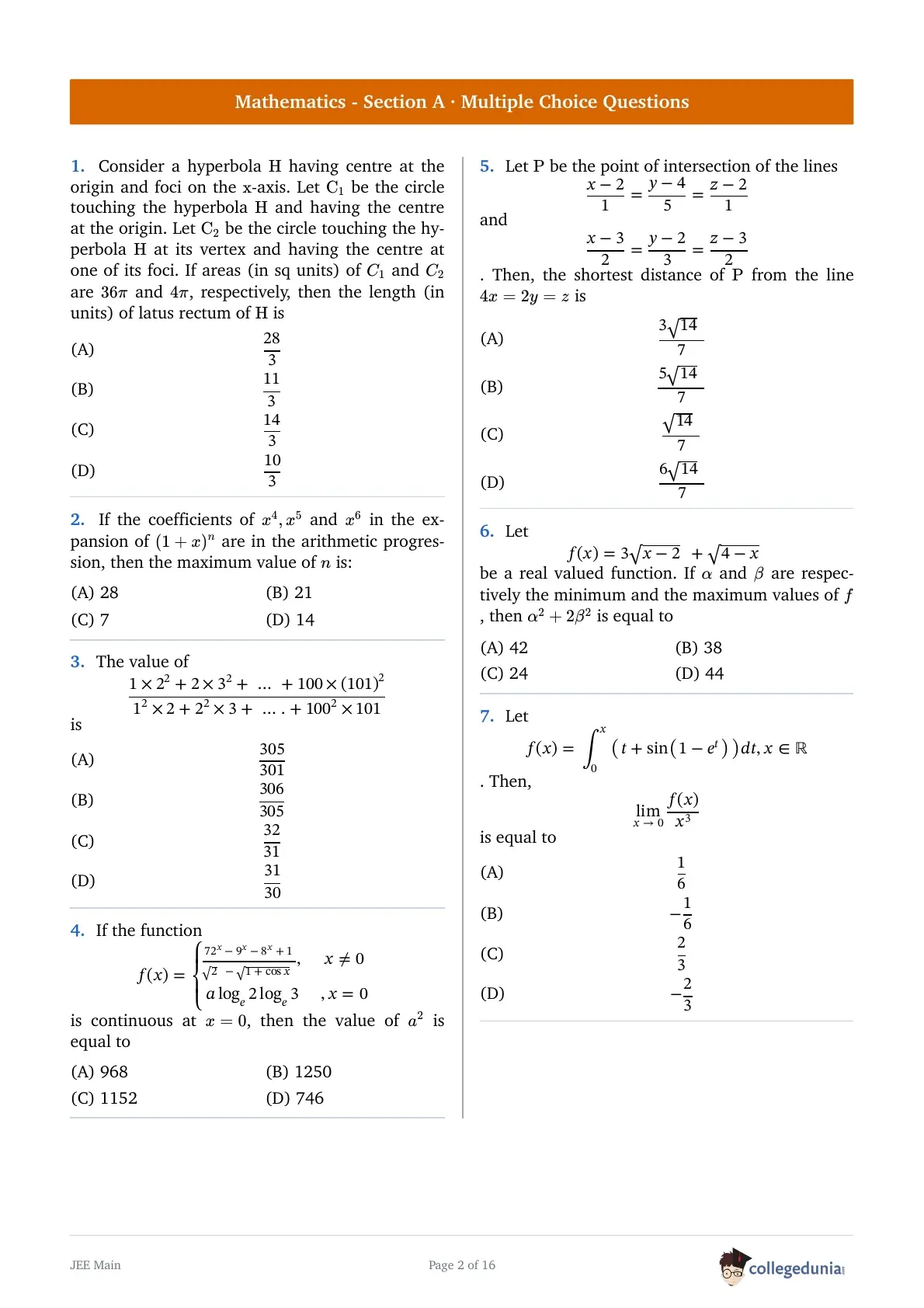
Mathematics - Section A (Q1 - Q20)
Consider a hyperbola \( H \) having its centre at the origin and foci on the \( x \)-axis. Let \( C_1 \) be the circle touching the hyperbola \( H \) and having its centre at the origin. Let \( C_2 \) be the circle touching the hyperbola \( H \) at its vertex and having its centre at one of its foci. If the areas (in square units) of \( C_1 \) and \( C_2 \) are \( 36\pi \) and \( 4\pi \), respectively, then the length (in units) of the latus rectum of \( H \) is:
If the coefficients of \( x^4 \), \( x^5 \), and \( x^6 \) in the expansion of \( (1 + x)^n \) are in arithmetic progression, then the maximum value of \( n \) is:
The value of \(\frac{1 \times 2^2 + 2 \times 3^2 + \dots + 100 \times (101)^2}{1^2 \times 2 + 2^2 \times 3 + \dots + 100^2 \times 101}\) is:
If the function \( f(x) = \begin{cases} \frac{72^x - 9^x - 8^x + 1}{\sqrt{2} - \sqrt{1 + \cos x}}, & x \neq 0 \\ a \log_e 2 \log_e 3, & x = 0 \end{cases} \) is continuous at \( x = 0 \), then the value of \( a^2 \) is equal to
Let \( P \) be the point of intersection of the lines \[ \frac{x - 2}{1} = \frac{y - 4}{5} = \frac{z - 2}{1} \quad \text{and} \quad \frac{x - 3}{2} = \frac{y - 2}{3} = \frac{z - 3}{2}. \] Then, the shortest distance of \( P \) from the line \( 4x = 2y = z \) is:
Let \( f(x) = 3\sqrt{x - 2} + \sqrt{4 - x} \) be a real-valued function. If \( \alpha \) and \( \beta \) are respectively the minimum and the maximum values of \( f \), then \( \alpha^2 + 2\beta^2 \) is equal to:
Let \[ f(x) = \int_{0}^{x} \left( t + \sin\left(1 - e^t\right) \right) \, dt, \, x \in \mathbb{R}. \] Then \[ \lim_{x \to 0} \frac{f(x)}{x^3} \] is equal to:
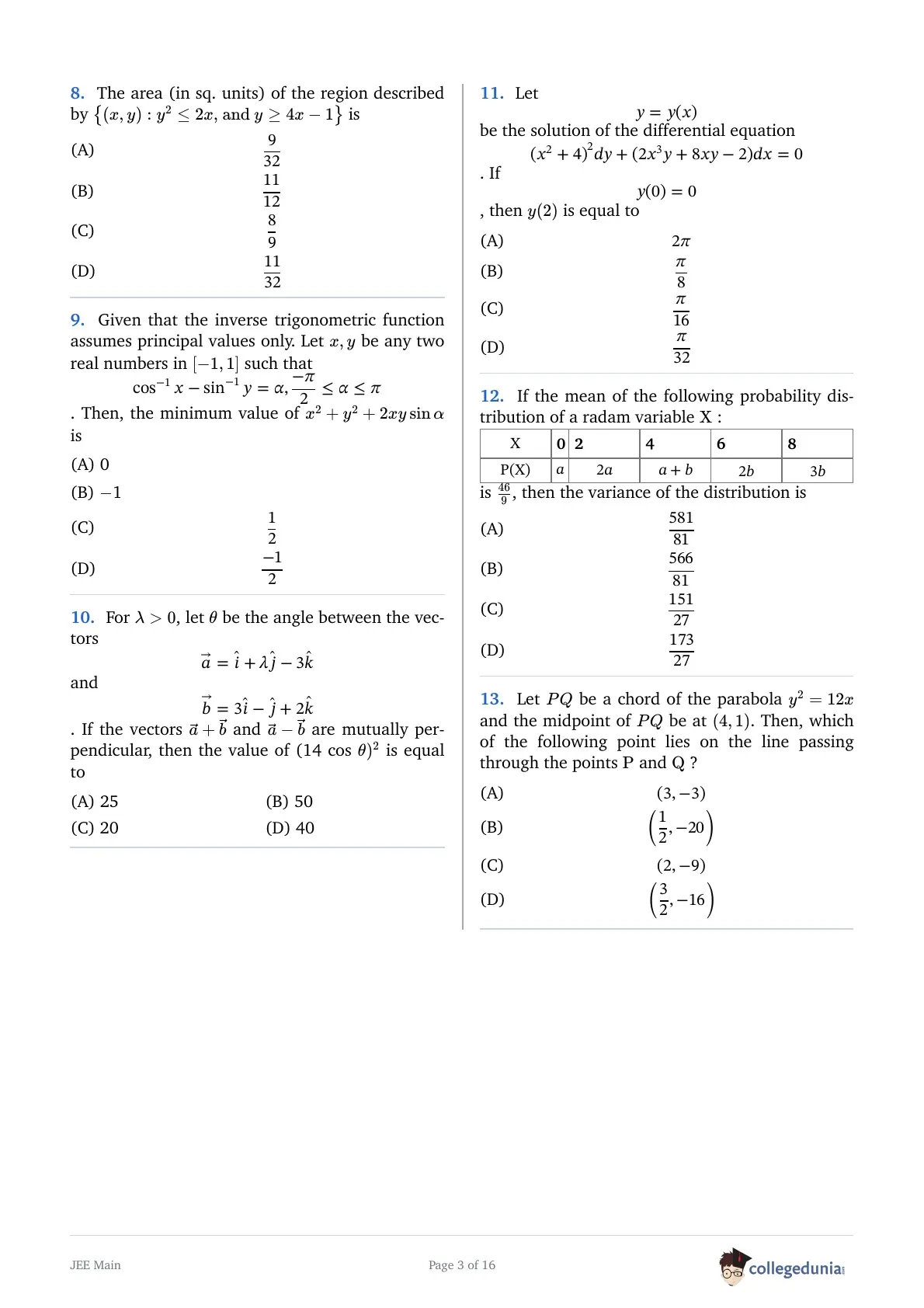
The area (in square units) of the region described by: \[ \{(x, y) : y^2 \leq 2x, \, \text{and} \, y \geq 4x - 1\} \] is:
Given the inverse trigonometric function assumes principal values only. Let \( x, y \) be any two real numbers in \( [-1, 1] \) such that \[ \cos^{-1}x - \sin^{-1}y = \alpha, \, -\frac{\pi}{2} \leq \alpha \leq \pi. \] Then, the minimum value of \( x^2 + y^2 + 2xy \sin \alpha \) is:
\[\text{If } \lambda>0, \text{ let } \theta \text{ be the angle between the vectors }\vec{a} = \hat{i} + \lambda \hat{j} - 3 \hat{k} \text{ and } \vec{b} = 3 \hat{i} - \hat{j} + 2 \hat{k}.\text{ If the vectors } \vec{a} + \vec{b} \text{ and } \vec{a} - \vec{b} \text{ are mutually perpendicular, then the value of } (14 \cos \theta)^2 \text{ is equal to.}\]
Let \( y = y(x) \) be the solution of the differential equation: \[ (x^2 + 4)^2 \, dy + \left( 2x^3 y + 8xy - 2 \right) dx = 0. \] If \( y(0) = 0 \), then \( y(2) \) is equal to:
If the mean of the following probability distribution of a random variable \( X \): \[ \begin{array}{|c|c|c|c|c|c|} \hline X & 0 & 2 & 4 & 6 & 8 \\ \hline P(X) & a & 2a & a+b & 2b & 3b \\ \hline \end{array} \] is \( \frac{46}{9} \), then the variance of the distribution is:
Let \( PQ \) be a chord of the parabola \( y^2 = 12x \) and the midpoint of \( PQ \) be at \( (4, 1) \). Then, which of the following points lies on the line passing through the points \( P \) and \( Q \)?
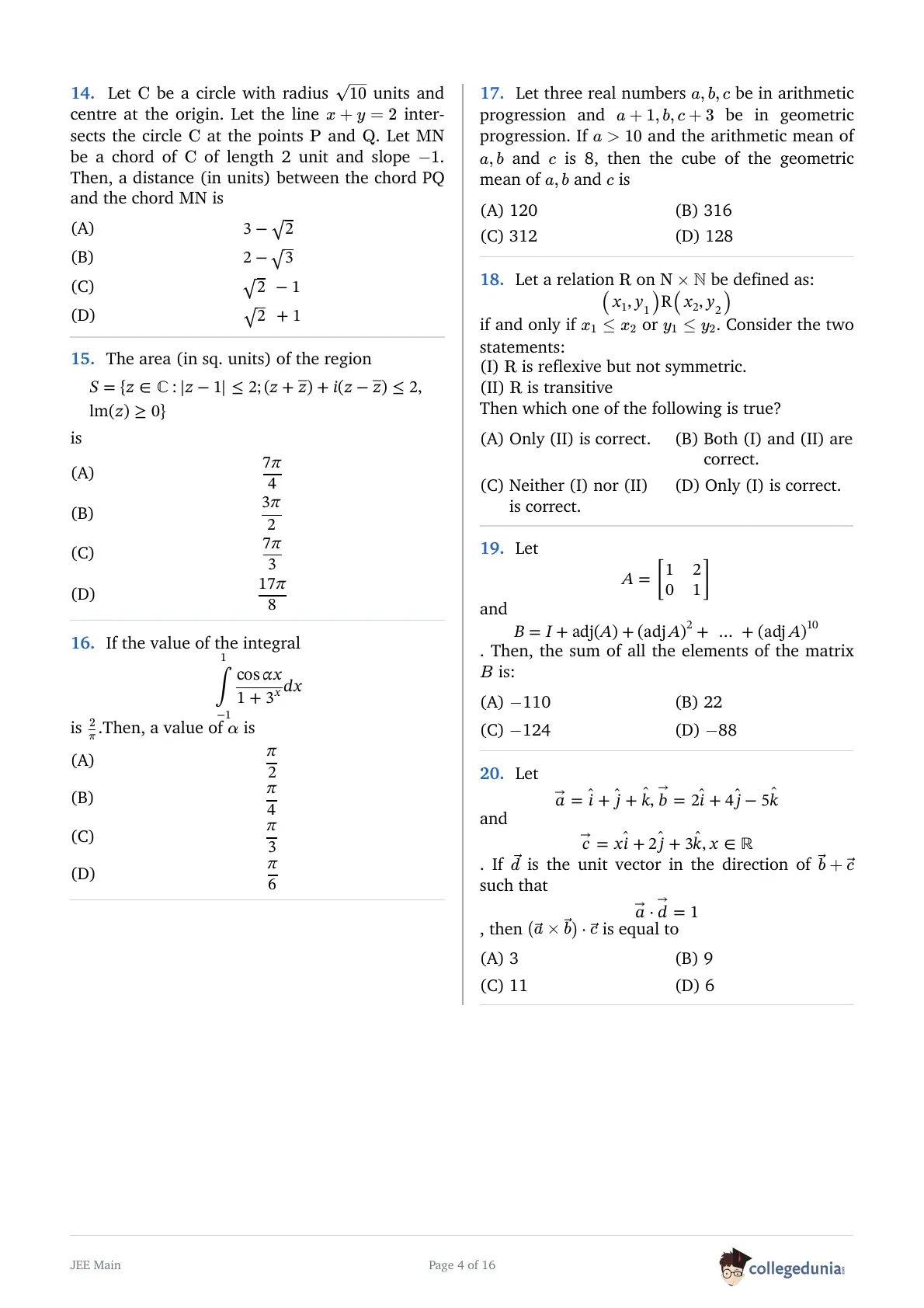
Let C be a circle with radius \( \sqrt{10} \) units and centre at the origin. Let the line \( x + y = 2 \) intersects the circle C at the points P and Q. Let MN be a chord of C of length 2 unit and slope \(-1\). Then, a distance (in units) between the chord PQ and the chord MN is
The area (in square units) of the region \[ S = \{ z \in \mathbb{C} : |z - 1| \leq 2; (z + \bar{z}) + i (z - \bar{z}) \leq 2, \, \operatorname{Im}(z) \geq 0 \} \] is:
If the value of the integral \[ \int_{-1}^{1} \frac{\cos \alpha x}{1 + 3^x} \, dx = \frac{2}{\pi}, \] then a value of \( \alpha \) is:
Let three real numbers a,b,c be in arithmetic progression and a + 1, b, c + 3 be in geometric progression. If a>10 and the arithmetic mean of a,b and c is 8, then the cube of the geometric mean of a,b and c is
Let a relation \( R \) on \( \mathbb{N} \times \mathbb{N} \) be defined as: \[(x_1, y_1) \, R \, (x_2, y_2) \text{ if and only if } x_1 \leq x_2 \text{ or } y_1 \leq y_2.\]
Consider the two statements:
[(I)] \( R \) is reflexive but not symmetric.
[(II)] \( R \) is transitive.
Then which one of the following is true:
Let \( A = \begin{bmatrix} 1 & 2 \\ 0 & 1 \end{bmatrix} \) and \[B = I + \text{adj}(A) + (\text{adj}(A))^2 + \dots + (\text{adj}(A))^{10}.\]Then, the sum of all the elements of the matrix \( B \) is:
Let \[ \vec{a} = \hat{i} + \hat{j} + \hat{k}, \quad \vec{b} = 2\hat{i} + 4\hat{j} - 5\hat{k}, \quad \text{and} \quad \vec{c} = x\hat{i} + 2\hat{j} + 3\hat{k}, \, x \in \mathbb{R}. \] If \( \vec{d} \) is the unit vector in the direction of \( \vec{b} + \vec{c} \) such that \( \vec{a} \cdot \vec{d} = 1 \), then \( (\vec{a} \times \vec{b}) \cdot \vec{c} \) is equal to:
Mathematics - Section B (Q21 - Q30)
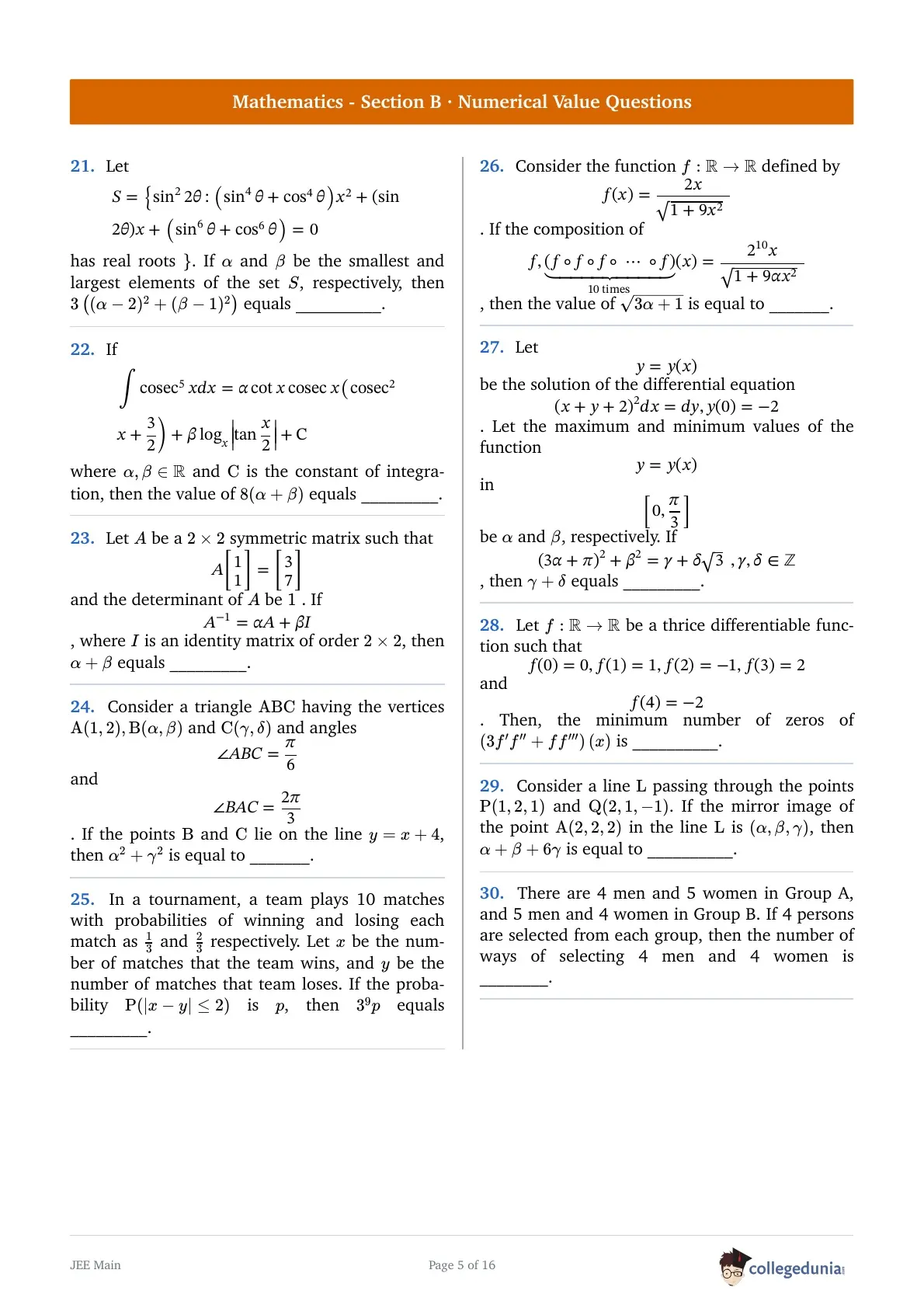
Let \[ S = \{ \sin^2 2\theta : (\sin^4 \theta + \cos^4 \theta)x^2 + (\sin 2\theta)x + (\sin^6 \theta + \cos^6 \theta) = 0 \, \text{has real roots} \}. \] If \( \alpha \) and \( \beta \) are the smallest and largest elements of the set \( S \), respectively, then \[ 3 \big((\alpha - 2)^2 + (\beta - 1)^2 \big) \] equals:
If \[ \int \cosec^5 x \, dx = \alpha \cot x \cosec x \left( \cosec^2 x + \frac{3}{2} \right) + \beta \log_e \left| \tan \frac{x}{2} \right| + C, \] where \( \alpha, \beta \in \mathbb{R} \) and \( C \) is the constant of integration, then the value of \( 8(\alpha + \beta) \) equals:
Let \( A \) be a \( 2 \times 2 \) symmetric matrix such that \[ A \begin{bmatrix} 1 \\ 1 \end{bmatrix} = \begin{bmatrix} 3 \\ 7 \end{bmatrix} \] and the determinant of \( A \) be 1. If \( A^{-1} = \alpha A + \beta I \), where \( I \) is the identity matrix of order \( 2 \times 2 \), then \( \alpha + \beta \) equals \( \dots \).
Consider a triangle \( \triangle ABC \) having the vertices \( A(1, 2) \), \( B(\alpha, \beta) \), and \( C(\gamma, \delta) \) and angles \( \angle ABC = \frac{\pi}{6} \) and \( \angle BAC = \frac{2\pi}{3} \). If the points \( B \) and \( C \) lie on the line \( y = x + 4 \), then \( \alpha^2 + \gamma^2 \) is equal to \( \dots \).
In a tournament, a team plays 10 matches with probabilities of winning and losing each match as \( \frac{1}{3} \) and \( \frac{2}{3} \), respectively. Let \( x \) be the number of matches that the team wins, and \( y \) be the number of matches that the team loses. If the probability \( P(|x - y| \leq 2) \) is \( p \), then \( 3^9 p \) equals .
Consider the function \( f : \mathbb{R} \to \mathbb{R} \) defined by \[ f(x) = \frac{2x}{\sqrt{1 + 9x^2}}. \] If the composition of \( f \), \[ (f \circ f \circ f \circ \dots \circ f)(x) \quad \text{(10 times)} = \frac{2^{10}x}{\sqrt{1 + 9\alpha x^2}}, \] then the value of \( \sqrt{3\alpha + 1} \) is equal to \( \dots \).
Let \( y = y(x) \) be the solution of the differential equation \[ (x + y + 2)^2 \, dx = dy, \quad y(0) = -2. \] Let the maximum and minimum values of the function \( y = y(x) \) in \( \left[ 0, \frac{\pi}{3} \right] \) be \( \alpha \) and \( \beta \), respectively. If \[ (3\alpha + \pi)^2 + \beta^2 = \gamma + \delta\sqrt{3}, \quad \gamma, \delta \in \mathbb{Z}, \] then \( \gamma + \delta \) equals \( \dots \).
Let \( f : \mathbb{R} \to \mathbb{R} \) be a thrice differentiable function such that \[ f(0) = 0, \, f(1) = 1, \, f(2) = -1, \, f(3) = 2, \, \text{and} \, f(4) = -2. \] Then, the minimum number of zeros of \( (3f' f' + f'') (x) \) is:
Consider a line \( L \) passing through the points \( P(1, 2, 1) \) and \( Q(2, 1, -1) \). If the mirror image of the point \( A(2, 2, 2) \) in the line \( L \) is \( (\alpha, \beta, \gamma) \), then \( \alpha + \beta + 6\gamma \) is equal to .
There are 4 men and 5 women in Group A, and 5 men and 4 women in Group B. If 4 persons are selected from each group, then the number of ways of selecting 4 men and 4 women is
Physics - Section A (Q31 - Q50)
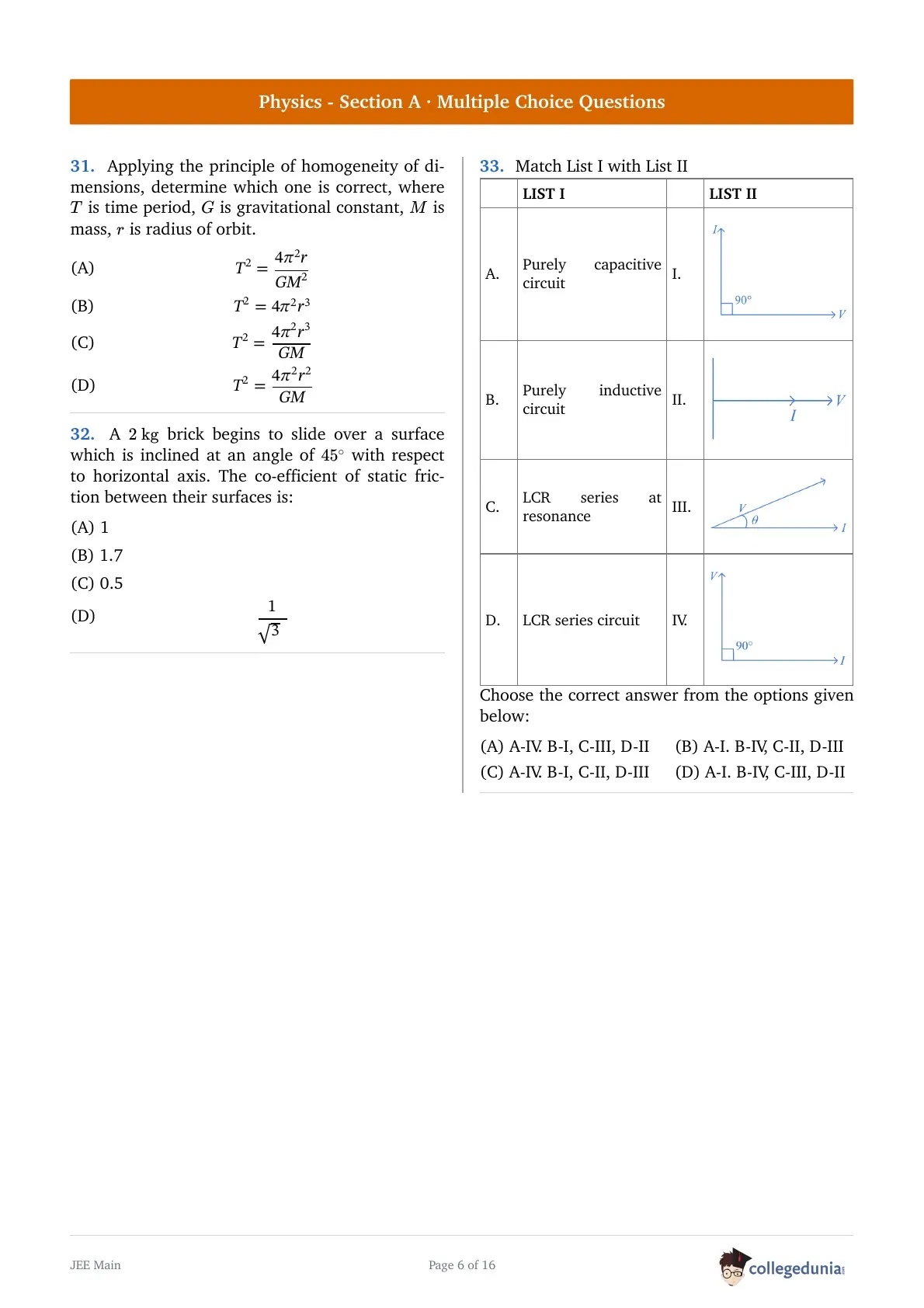
Applying the principle of homogeneity of dimensions, determine which one is correct. Where \( T \) is the time period, \( G \) is the gravitational constant, \( M \) is the mass, and \( r \) is the radius of the orbit.
A 2 kg brick begins to slide over a surface which is inclined at an angle of \( 45^\circ \) with respect to the horizontal axis. The coefficient of static friction between their surfaces is:
Match List I with List II

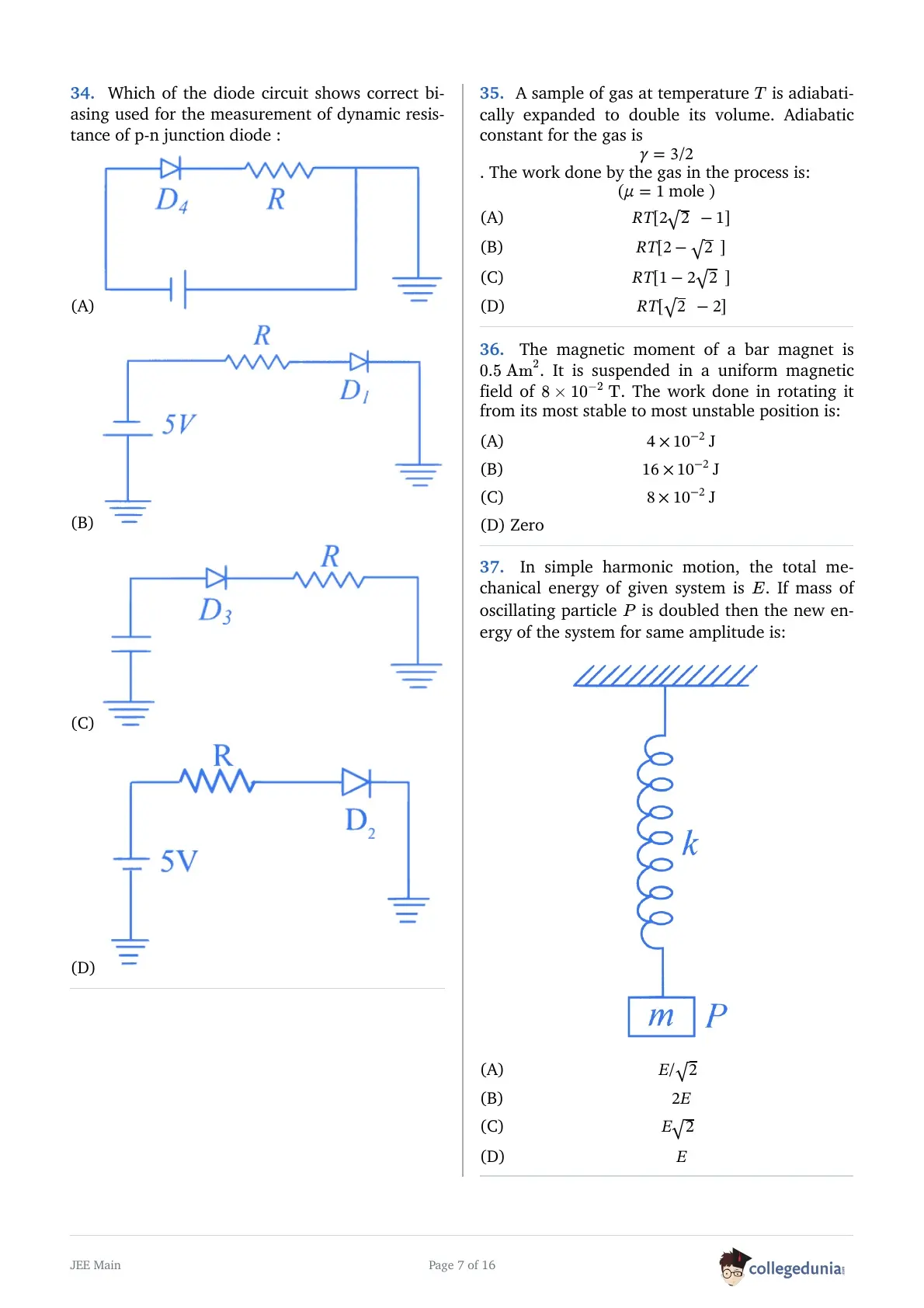
Which of the diode circuit shows correct biasing used for the measurement of dynamic resistance of p-n junction diode :
- (1)
![]()
- (2)
![]()
- (3)
![]()
- (4)
![]()


A sample of gas at temperature \( T \) is adiabatically expanded to double its volume. Adiabatic constant for the gas is \( \gamma = \frac{3}{2} \). The work done by the gas in the process is (\( \mu = 1 \) mole):
The magnetic moment of a bar magnet is \( 0.5 \, \text{Am}^2 \). It is suspended in a uniform magnetic field of \( 8 \times 10^{-2} \, \text{T} \). The work done in rotating it from its most stable to most unstable position is:
In simple harmonic motion, the total mechanical energy of the given system is \( E \). If the mass of the oscillating particle \( P \) is doubled, then the new energy of the system for the same amplitude is:

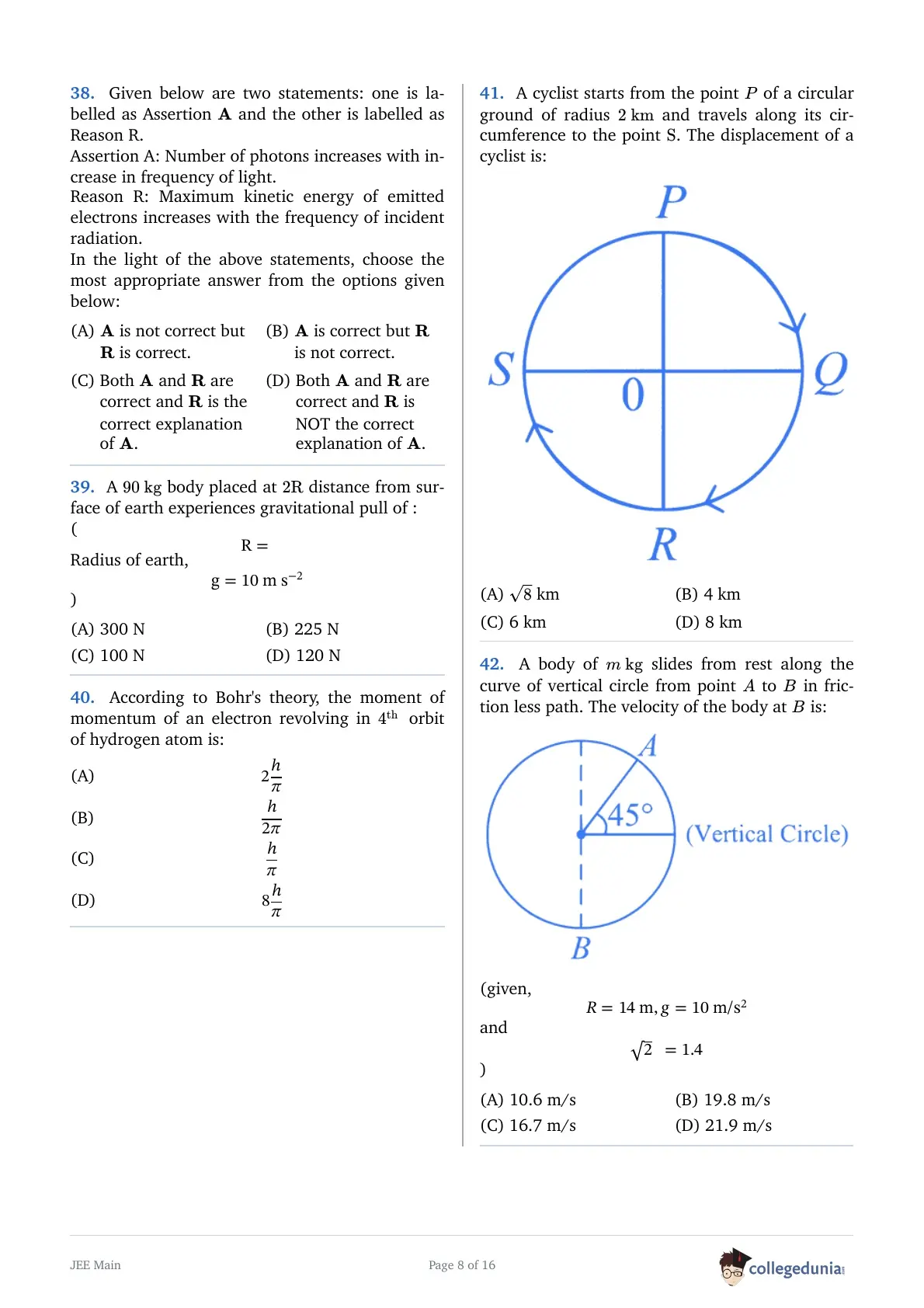
Given below are two statements: one is labelled as Assertion (A) and the other is labelled as Reason (R).
Assertion (A): Number of photons increases with increase in frequency of light.
Reason (R): Maximum kinetic energy of emitted electrons increases with the frequency of incident radiation.
In the light of the above statements, choose the most appropriate answer from the options given below:
A 90 kg body placed at \( 2R \) distance from the surface of the earth experiences gravitational pull of:
(\( R \) = Radius of Earth, \( g = 10 \, \text{ms}^{-2} \)).
According to Bohr's theory, the moment of momentum of an electron revolving in the 4th orbit of a hydrogen atom is:
A cyclist starts from the point P of a circular ground of radius 2 km and travels along its circumference to the point S. The displacement of a cyclist is :

A body of m kg slides from rest along the curve of vertical circle from point A to B in friction less path. The velocity of the body at B is :

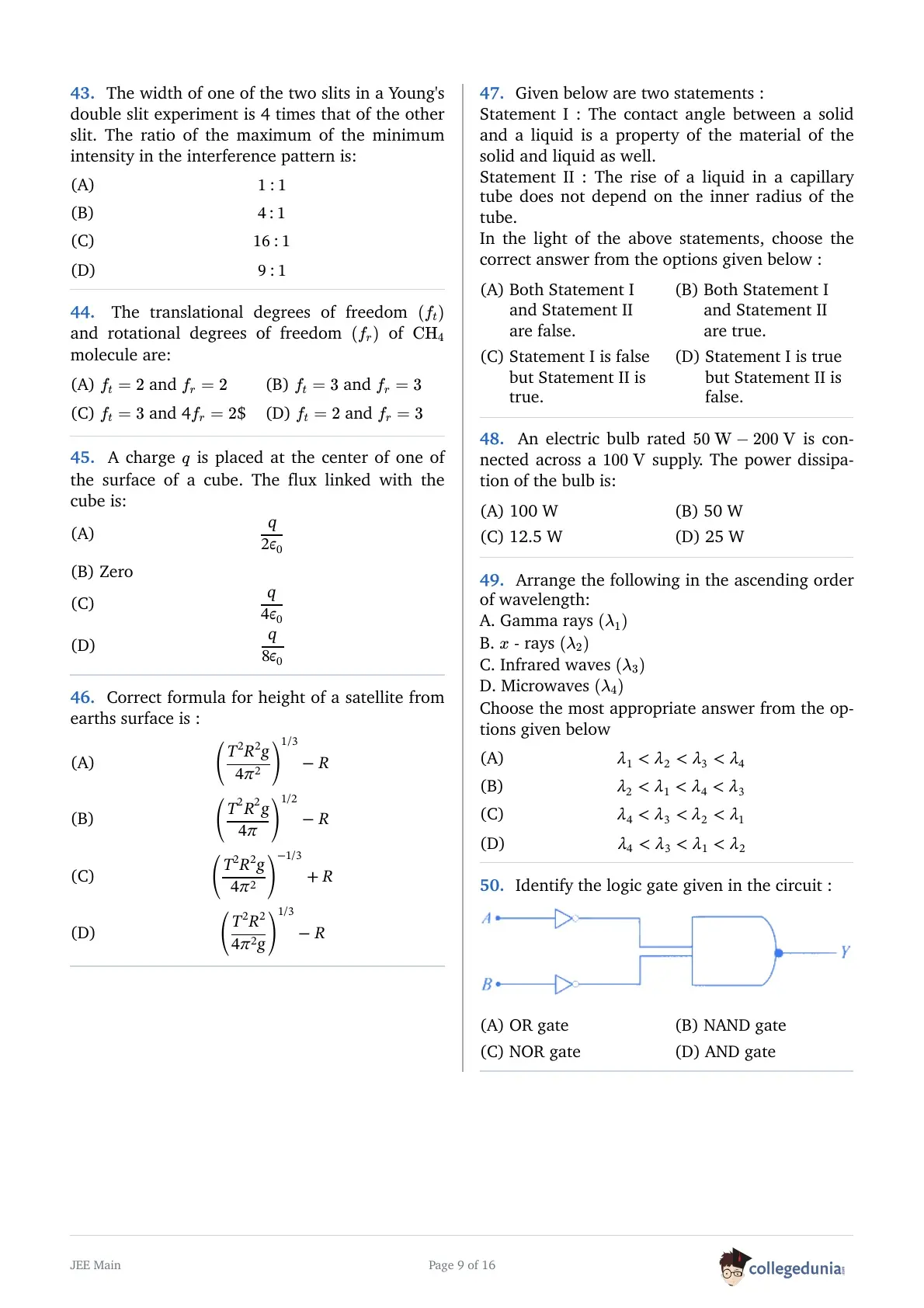
The width of one of the two slits in a Young's double slit experiment is 4 times that of the other slit. The ratio of the maximum of the minimum intensity in the interference pattern is :
The translational degrees of freedom (\(f_t\)) and rotational degrees of freedom (\(f_r\)) of \( \text{CH}_4 \) molecule are:
A charge q is placed at the center of one of the surface of a cube. The flux linked with the cube is :-
Correct formula for height of a satellite from earths surface is :
Given below are two statements :
Statement I : The contact angle between a solid and a liquid is a property of the material of the solid and liquid as well.
Statement II : The rise of a liquid in a capillary tube does not depend on the inner radius of the tube.
In the light of the above statements, choose the correct answer from the options given below :
An electric bulb rated 50 W – 200 V is connected across a 100 V supply. The power dissipation of the bulb is :
Arrange the following in the ascending order of wavelength:
(A) Gamma rays (\( \lambda_1 \))
(B) X-ray (\( \lambda_2 \))
(C) Infrared waves (\( \lambda_3 \))
(D) Microwaves (\( \lambda_4 \))
Choose the most appropriate answer from the options given below:

Physics - Section B (Q51 - Q60)
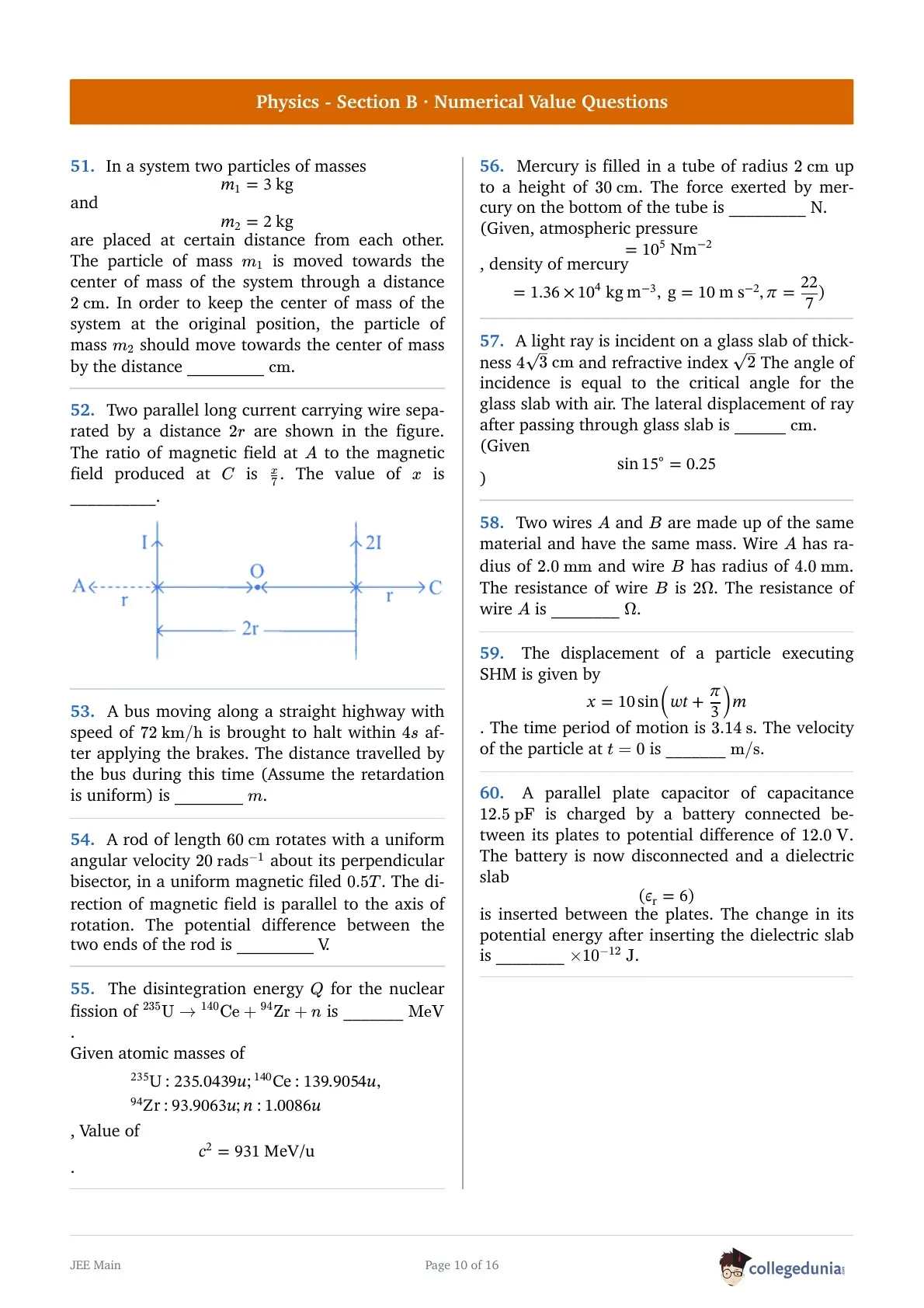
In a system, two particles of masses \( m_1 = 3 \, \text{kg} \) and \( m_2 = 2 \, \text{kg} \) are placed at a certain distance from each other. The particle of mass \( m_1 \) is moved towards the center of mass of the system through a distance \( 2 \, \text{cm} \). In order to keep the center of mass of the system at the original position, the particle of mass \( m_2 \) should move towards the center of mass by the distance ______ \( \, \text{cm} \).
Two parallel long current carrying wire separated by a distance \(2r\) are shown in the figure. The ratio of magnetic field at \(A\) to the magnetic field produced at \(C\) is \(\frac{x}{7}\). The value of \(x\) is ___.

A bus moving along a straight highway with speed of 72 km/h is brought to halt within 4s after applying the brakes. The distance travelled by the bus during this time (Assume the retardation is uniform) is _______m.
A rod of length 60 cm rotates with a uniform angular velocity \(20 \, \text{rad} \, \text{s}^{-1}\) about its perpendicular bisector, in a uniform magnetic field \(0.5 \, \text{T}\). The direction of the magnetic field is parallel to the axis of rotation. The potential difference between the two ends of the rod is _____ V.
The disintegration energy Q for the nuclear fission of ²³⁵U → ¹⁴⁰Ce + ⁹⁴Zr + n is _____ MeV.
Given atomic masses:
²³⁵U = 235.0439 u
¹⁴⁰Ce = 139.9054 u
⁹⁴Zr = 93.9063 u
n = 1.0086 u
Value of c² = 931 MeV/u.
Mercury is filled in a tube of radius \(2 \, \text{cm}\) up to a height of \(30 \, \text{cm}\). The force exerted by mercury on the bottom of the tube is ___N.
(Given, atmospheric pressure = \(10^5 \, \text{N/m}^2\), density of mercury = \(1.36 \times 10^4 \, \text{kg/m}^3\), \(g = 10 \, \text{m/s}^2\), \(\pi = \frac{22}{7}\))
A light ray is incident on a glass slab of thickness \(4\sqrt{3}\) cm and refractive index \(\sqrt{2}\). The angle of incidence is equal to the critical angle for the glass slab with air. The lateral displacement of the ray after passing through the glass slab is _____ cm.
(Given \(\sin 15^\circ = 0.25\))
Two wires A and B are made up of the same material and have the same mass. Wire A has radius \(2.0 \, \text{mm}\) and wire B has radius \(4.0 \, \text{mm}\). The resistance of wire B is \(2 \, \Omega\). The resistance of wire A is _____ \( \Omega \).
The displacement of a particle executing SHM is given by \( x = 10 \sin\left(\omega t + \frac{\pi}{3}\right) \, \text{m} \). The time period of motion is \( 3.14 \, \text{s} \). The velocity of the particle at \( t = 0 \) is ______ m/s.
A parallel plate capacitor of capacitance \( 12.5 \, \text{pF} \) is charged by a battery connected between its plates to a potential difference of \( 12.0 \, \text{V} \). The battery is now disconnected and a dielectric slab (\( \varepsilon_r = 6 \)) is inserted between the plates. The change in its potential energy after inserting the dielectric slab is ______ \( \times 10^{-12} \, \text{J} \).
Chemistry - Section A (Q61 - Q80)
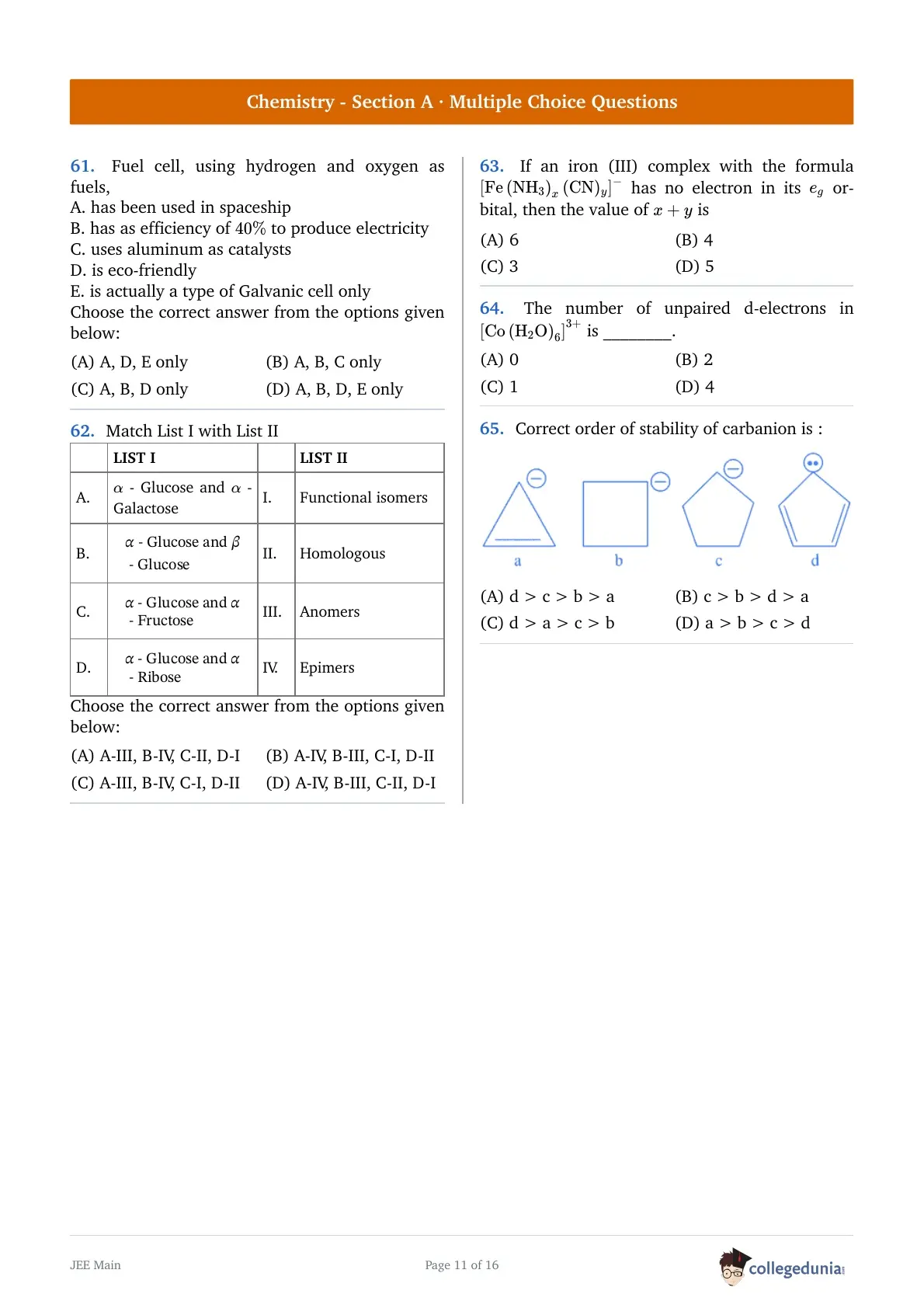
Fuel cell, using hydrogen and oxygen as fuels,
A. has been used in spaceship
B. has as efficiency of 40% to produce electricity
C. uses aluminium as catalysts
D. is eco-friendly
E. is actually a type of Galvanic cell only
Match List I with List II

If an iron (III) complex with the formula \[\left[ \text{Fe}(\text{NH}_3)_x (\text{CN})_y \right]^-\]has no electron in its \( e_g \) orbital, then the value of \( x + y \) is:
The number of unpaired d-electrons in \([ \text{Co}(\text{H}_2\text{O})_6 ]^{3+}\) is ______


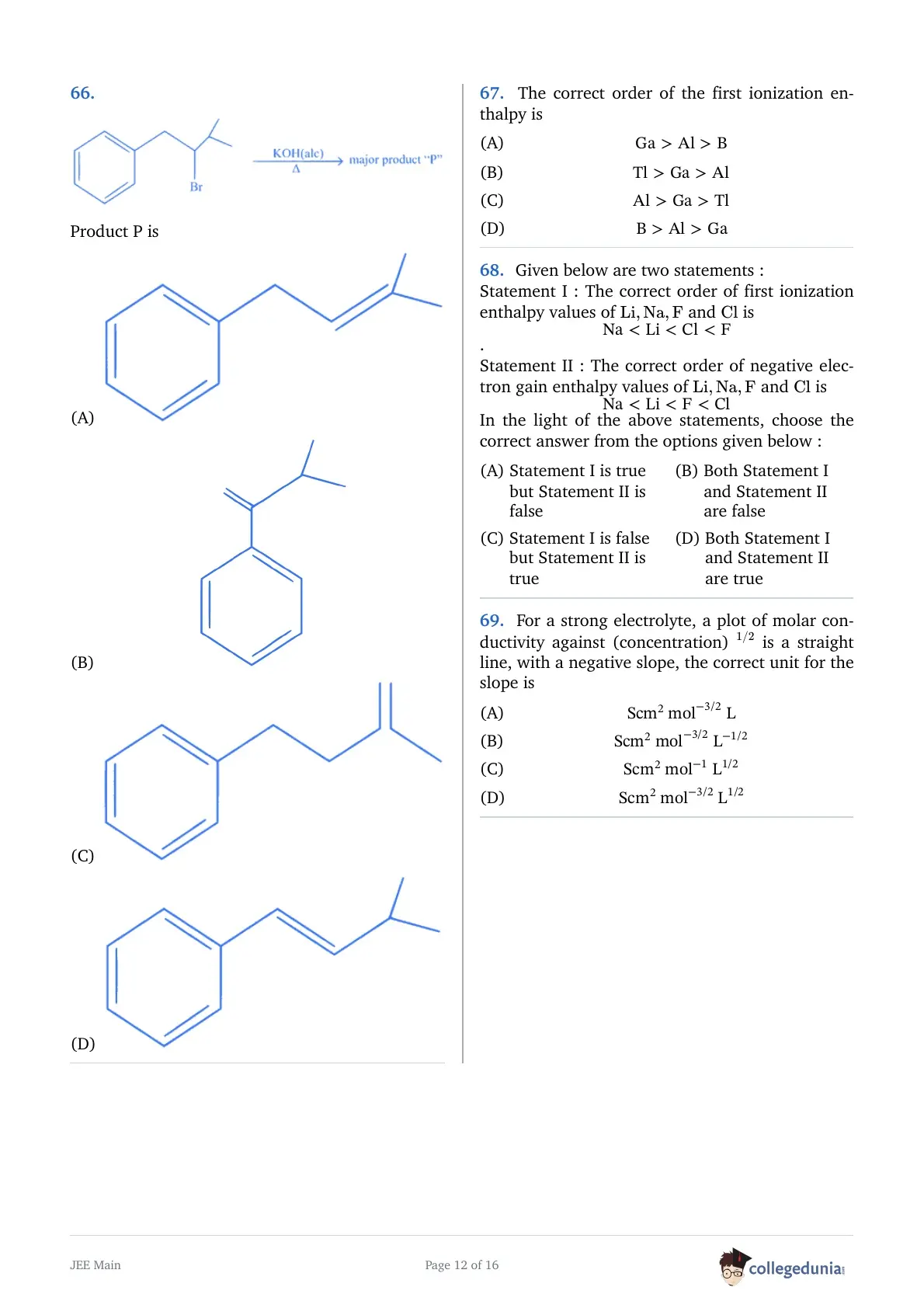
The correct order of the first ionization enthalpy is
Given below are two statements:
Statement I: The correct order of first ionization enthalpy values of Li, Na, F, and Cl is \( \text{Na} < \text{Li} < \text{Cl} < \text{F} \).
Statement II: The correct order of negative electron gain enthalpy values of Li, Na, F, and Cl is \( \text{Na} < \text{Li} < \text{F} < \text{Cl} \).
In the light of the above statements, choose the correct answer from the options given below:
For a strong electrolyte, a plot of molar conductivity against \( (\text{concentration})^{1/2} \) is a straight line, with a negative slope, the correct unit for the slope is:
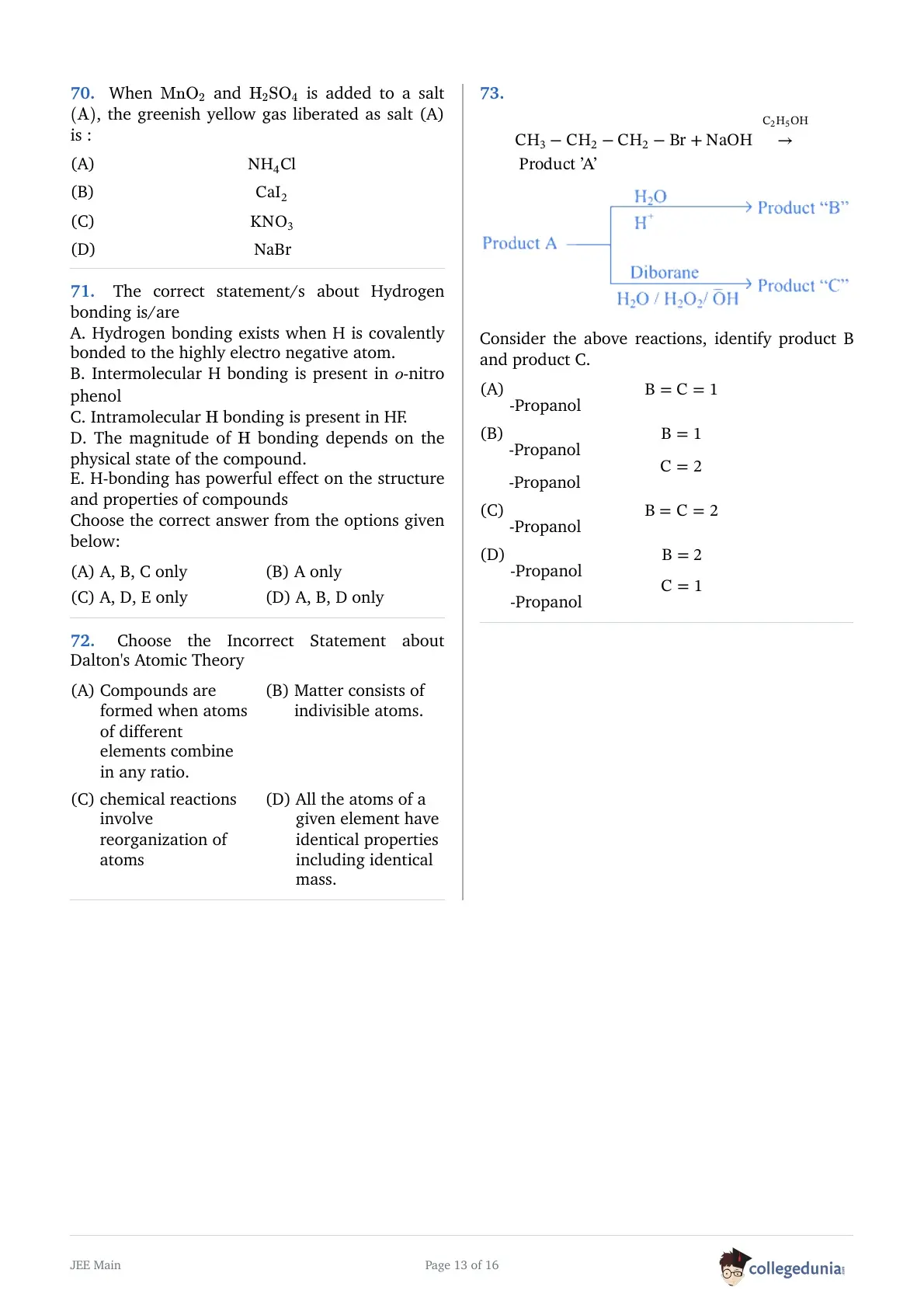
When \( \text{MnO}_2 \) and \( \text{H}_2\text{SO}_4 \) is added to a salt (A), the greenish yellow gas liberated as salt (A) is:
The correct statement/s about Hydrogen bonding is/are :
A. Hydrogen bonding exists when H is covalently bonded to the highly electro negative atom.
B. Intermolecular H bonding is present in o-nitro phenol
C. Intramolecular H bonding is present in HF.
D. The magnitude of H bonding depends on the physical state of the compound.
E. H-bonding has powerful effect on the structure and properties of compounds.
Choose the correct answer from the options given below :
Choose the Incorrect Statement about Dalton's Atomic Theory

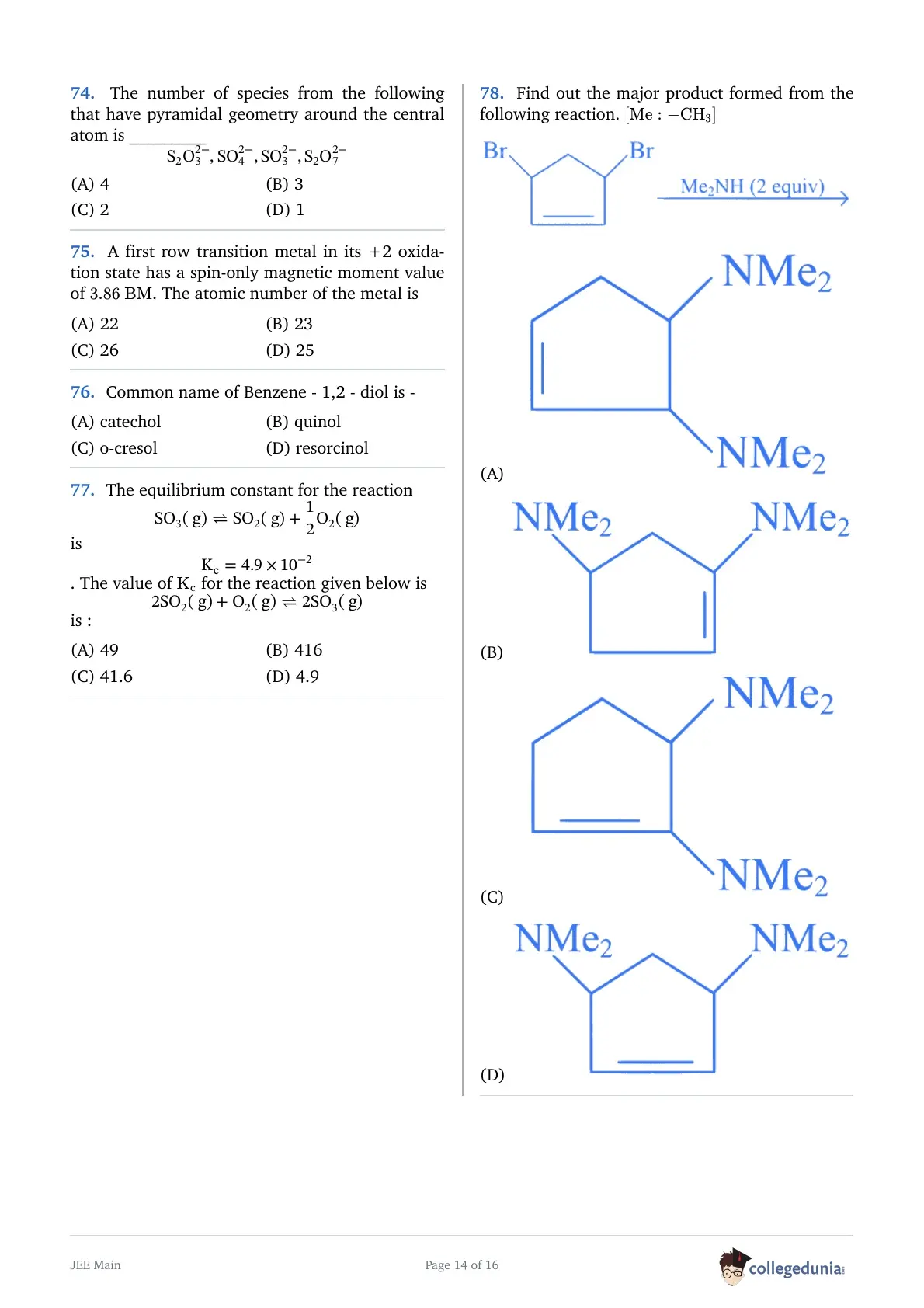
The number of species from the following that have pyramidal geometry around the central atom is ______
\( \text{S}_2\text{O}_3^{2-}, \, \text{SO}_4^{2-}, \, \text{SO}_3^{2-}, \, \text{S}_2\text{O}_7^{2-} \)
A first row transition metal in its +2 oxidation state has a spin-only magnetic moment value of 3.86 BM. The atomic number of the metal is
Common name of Benzene-1, 2-diol is
The equilibrium constant for the reaction
\( \text{SO}_3 \, (g) \rightleftharpoons \text{SO}_2 \, (g) + \frac{1}{2} \text{O}_2 \, (g) \)
is \( K_C = 4.9 \times 10^{-2} \). The value of \( K_C \) for the reaction given below is
\( 2 \text{SO}_2 \, (g) + \text{O}_2 \, (g) \rightleftharpoons 2 \text{SO}_3 \, (g) \) is
Find out the major product formed from the following reaction.\([ \text{Me: } -\text{CH}_3 ]\)

- (1)
![]()
- (2)
![]()
- (3)
![]()
- (4)
![]()


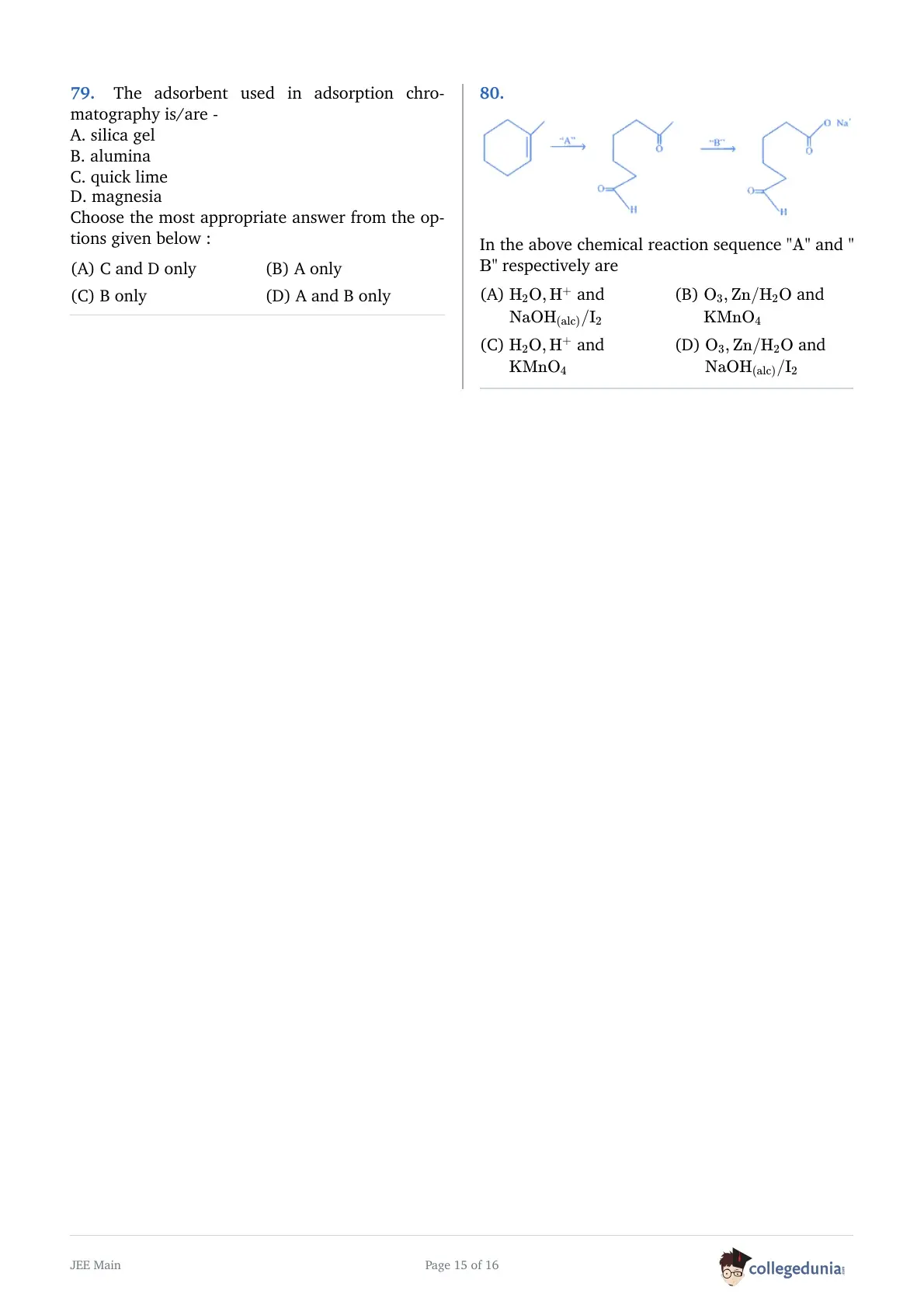
The adsorbent used in adsorption chromatography is/are
A. silica gel
B. alumina
C. quick lime
D. magnesia
Choose the most appropriate answer from the options given below :

Chemistry - Section B (Q81 - Q90)
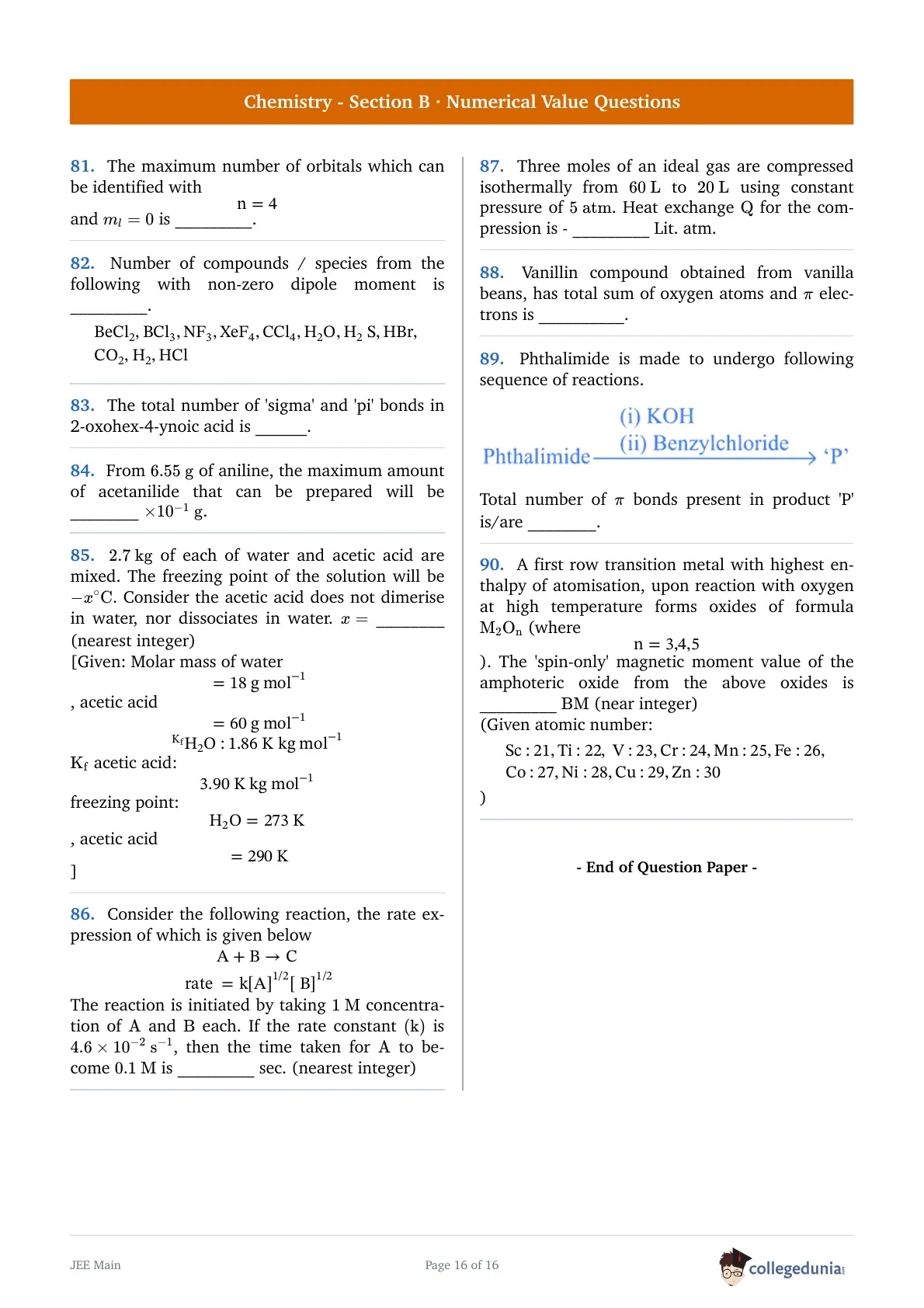
The maximum number of orbitals which can be identified with \( n = 4 \) and \( m_l = 0 \) is ______
Number of compounds/species from the following with non-zero dipole moment is ______
\(\text{BeCl}_2, \, \text{BCl}_3, \, \text{NF}_3, \, \text{XeF}_4, \, \text{CCl}_4, \, \text{H}_2\text{O}, \, \text{H}_2\text{S}, \, \text{HBr}, \, \text{CO}_2, \, \text{H}_2, \, \text{HCl}\)
The total number of 'sigma' and 'Pi' bonds in 2-oxohex-4-ynoic acid is____.
From 6.55 g of aniline, the maximum amount of acetanilide that can be prepared will be ___ × \( 10^{-1} \) g.
2.7 Kg of each of water and acetic acid are mixed. The freezing point of the solution will be –x °C. Consider the acetic acid does not dimerise in water, nor dissociates in water. \( x = \) ______ (nearest integer).
[Given: Molar mass of water = \( 18 \, \text{g mol}^{-1} \), acetic acid = \( 60 \, \text{g mol}^{-1} \) \( K_f \, \text{H}_2\text{O} = 1.86 \, \text{K kg mol}^{-1} \) \( K_f \, \text{acetic acid} = 3.90 \, \text{K kg mol}^{-1} \) Freezing point: \( \text{H}_2\text{O} = 273 \, \text{K}, \, \text{acetic acid} = 290 \, \text{K} \)]
Consider the following reaction, the rate expression of which is given below:
\( \text{A} + \text{B} \to \text{C} \)
\(\text{rate} = k [\text{A}]^{1/2} [\text{B}]^{1/2}\)
The reaction is initiated by taking 1M concentration of A and B each. If the rate constant (\(k\)) is \(4.6 \times 10^{-2} \, \text{s}^{-1}\), then the time taken for A to become 0.1 M is ______ sec. (nearest integer)
Three moles of an ideal gas are compressed isothermally from 60 L to 20 L using constant pressure of 5 atm. Heat exchange Q for the compression is – ____ Lit. atm.
Vanillin compound obtained from vanilla beans, has total sum of oxygen atoms and \( \pi \) electrons is ______
Phthalimide is made to undergo following sequence of reactions.

A first row transition metal with the highest enthalpy of atomisation, upon reaction with oxygen at high temperature, forms oxides of formula \( \text{M}_2\text{O}_n \) (where \( n = 3, 4, 5 \)). The 'spin-only' magnetic moment value of the amphoteric oxide from the above oxides is ___ BM (near integer).
(Given atomic number: \( \text{Sc: 21, Ti: 22, V: 23, Cr: 24, Mn: 25, Fe: 26, Co: 27, Ni: 28, Cu: 29, Zn: 30} \))
JEE Main 2024 Exam Pattern and Marking Scheme
| Particulars | Details |
|---|---|
| Exam Mode | Online (Computer-Based Test) |
| Paper | B.E./B.Tech |
| Medium of Exam | 13 languages: English, Hindi, Gujarati, Bengali, Tamil, Telugu, Kannada, Marathi, Malayalam, Odia, Punjabi, Assamese, Urdu |
| Duration | 3 hours (180 minutes) |
| Type of Questions | Multiple Choice Questions (MCQs) + Numerical Value Questions (attempt any 5 of 10 per subject) |
| Total Marks | 300 marks |
| Subjects | Mathematics, Physics, Chemistry |
| Marking Scheme | +4 for correct answer & -1 for incorrect MCQ and Numerical Value-based Questions |
| Total Questions | 90 Questions (30 per subject), 75 to be attempted |
| Eligibility | Passed or appearing in Class 12 with Physics, Chemistry, and Mathematics |
JEE Main 2024 Question Paper Session 2 (April)
Check JEE Main 2024 Question Paper Session 2 for other shifts.
JEE Main 2024 Question Paper Session 1 (January)
Those appearing for JEE Main 2024 can use the links below to practice and keep track of their exam preparation level by attempting the shift-wise JEE Main 2024 question paper provided below.
| Exam Date and Shift | Question Paper PDF |
|---|---|
| JEE Main 27 Jan Shift 1 2024 Question Paper | Check Here |
| JEE Main 27 Jan Shift 2 2024 Question Paper | Check Here |
| JEE Main 29 Jan Shift 1 2024 Question Paper | Check Here |
| JEE Main 29 Jan Shift 2 2024 Question Paper | Check Here |
| JEE Main 30 Jan Shift 1 2024 Question Paper | Check Here |
| JEE Main 30 Jan Shift 2 2024 Question Paper | Check Here |
| JEE Main 31 Jan Shift 1 2024 Question Paper | Check Here |
| JEE Main 31 Jan Shift 2 2024 Question Paper | Check Here |
| JEE Main 1 Feb Shift 1 2024 Question Paper | Check Here |
| JEE Main 1 Feb Shift 2 2024 Question Paper | Check Here |
Also Check:
| JEE Main 2024 Paper Analysis | JEE Main 2024 Answer Key |
| JEE Main 2024 Cutoff | JEE Main 2024 Marks vs Rank |
JEE Main 2024 4 April Shift 2 Question Paper by Coaching Institute
| Coaching Institutes | Question Paper with Solutions PDF |
|---|---|
| Aakash BYJUs | Download PDF |
| Reliable Institute | To be updated |
| Resonance | To be updated |
| Vedantu | Download PDF |
| Sri Chaitanya | To be updated |
| FIIT JEE | To be updated |
JEE Main 2024 4 April Shift 2 Paper Analysis
JEE Main 2024 4 April Shift 2 paper analysis for B.E./ B.Tech is updated here with details on the difficulty level of the exam, topics with the highest weightage in the exam, section-wise difficulty level, etc.
JEE Main 2024 Question Paper Pattern
| Feature | Question Paper Pattern |
|---|---|
| Examination Mode | Computer-based Test |
| Exam Language | 13 languages (English, Hindi, Assamese, Bengali, Gujarati, Kannada, Malayalam, Marathi, Odia, Punjabi, Tamil, Telugu, and Urdu) |
| Number of Sections | Three- Physics, Chemistry, Mathematics |
| Exam Duration | 3 hours |
| Sectional Time Limit | None |
| Total Marks | 300 marks |
| Total Number of Questions Asked | 90 Questions |
| Total Number of Questions to be Answered | 75 questions |
| Type of Questions | MCQs and Numerical Answer Type Questions |
| Section-wise Number of Questions | Physics- 20 MCQs and 10 numerical type, Chemistry- 20 MCQs and 10 numerical type, Mathematics- 20 MCQs and 10 numerical type |
| Marking Scheme | +4 for each correct answer |
| Negative Marking | -1 for each incorrect answer |
Read More:
- JEE Main 2024 question paper pattern and marking scheme
- Most important chapters in JEE Mains 2024, Check chapter wise weightage here



Comments