




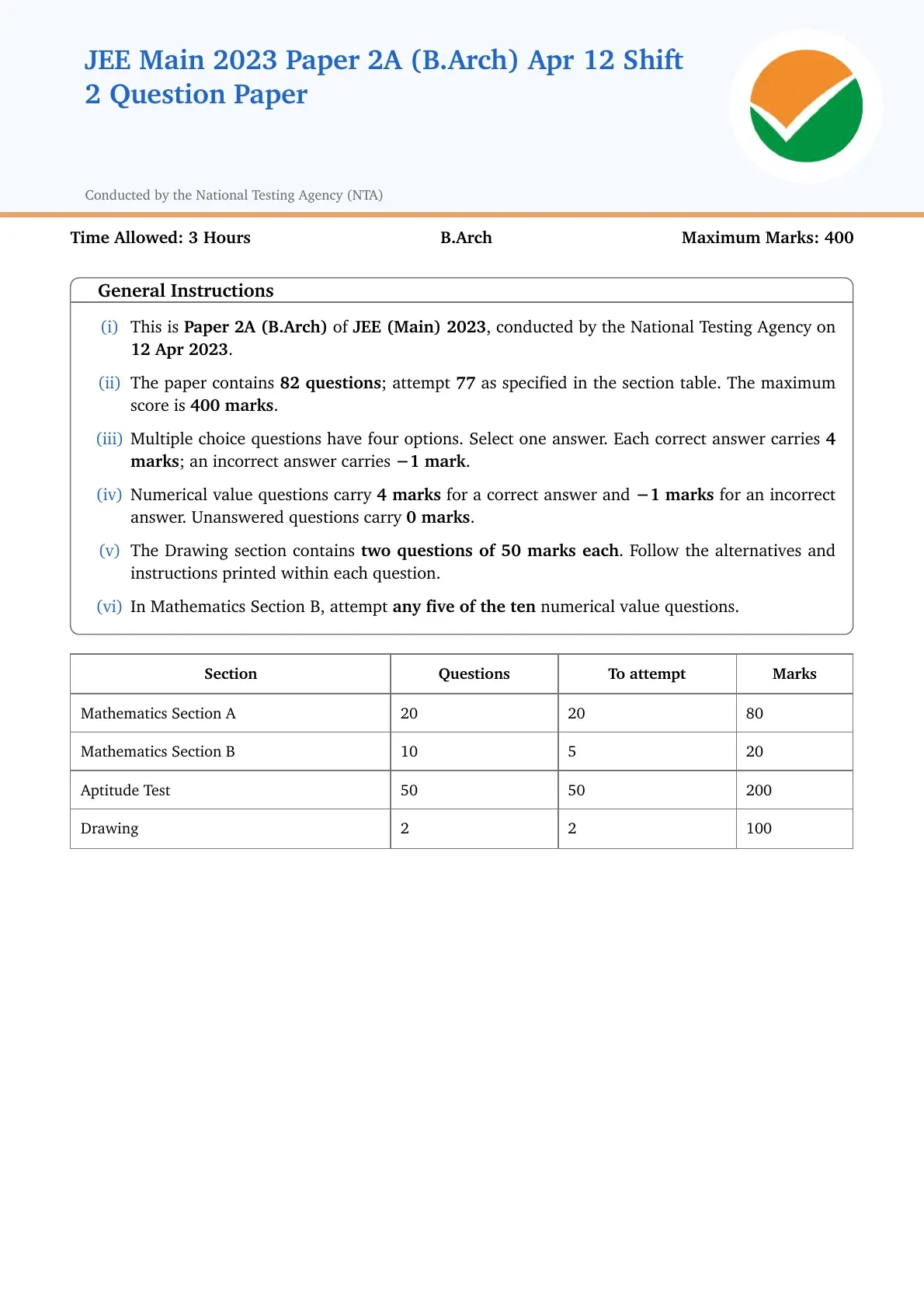
JEE Main 2023 B.Arch April 12 (Paper 2A) Question Paper is available here with solutions PDF and detailed solutions for every question. NTA conducted the JEE Main 2023 B.Arch (Paper 2A) exam on April 12, 2023, from 3:00 PM to 6:00 PM (Session 2). The question paper includes the following:
- 82 questions in a 3-hour paper (77 to be attempted): Part I Mathematics (30), Part II Aptitude Test (50) and Part III Drawing Test (2)
- Mathematics: 20 multiple choice questions (MCQs) and 10 numerical value questions, of which any 5 are to be attempted; 4 marks each (100 marks)
- Aptitude Test: 50 MCQs, 4 marks each (200 marks)
- Drawing Test: 2 drawing questions, 50 marks each (100 marks)
- Marking: +4 for a correct answer, -1 for an incorrect MCQ or numerical answer, 0 for an unattempted question; maximum marks 400
JEE Main 2023 B.Arch April 12 (Paper 2A) Question Paper with Solution PDF
| NTA Official PDF | CD PDF | CD PDF with Solutions |
|---|---|---|
| Download official PDF 4.71 MB | Download Collegedunia PDF 4.88 MB | Download solutions PDF 2.60 MB |
Also Check:
JEE Main 2023 B.Arch April 12 (Paper 2A) Questions with Solutions
Mathematics (Q1 - Q30)
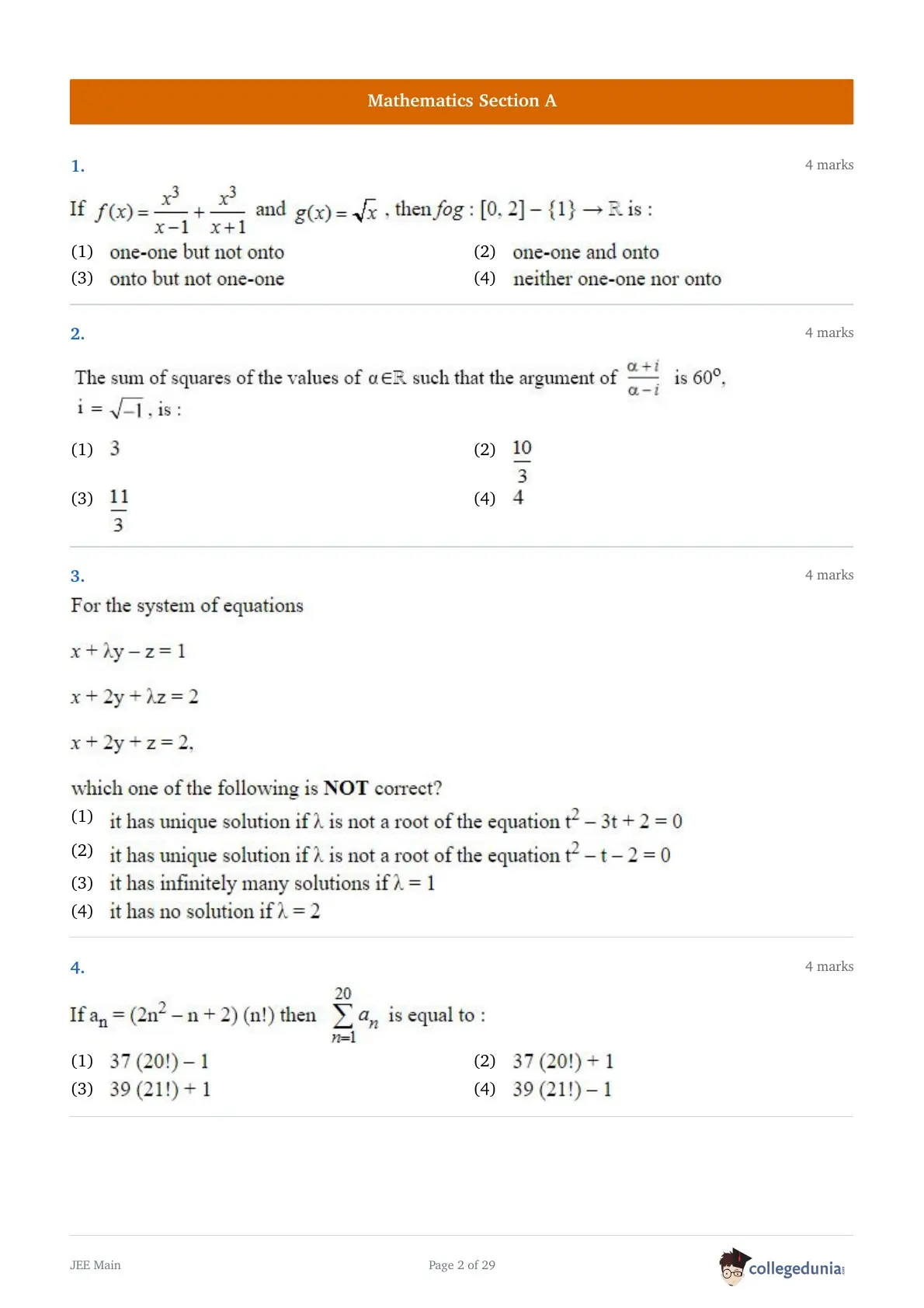
If \( f(x)=\frac{x^{3}}{x-1}+\frac{x^{3}}{x+1} \) and \( g(x)=\sqrt{x} \), then \( f \circ g:[0,2]-\{1\} \rightarrow \mathbb{R} \) is :
The sum of squares of the values of \( \alpha \in \mathbb{R} \) such that the argument of \( \frac{\alpha+i}{\alpha-i} \) is \( 60^{\circ} \), \( i=\sqrt{-1} \), is :
For the system of equations
\( x+\lambda y-z=1 \)
\( x+2y+\lambda z=2 \)
\( x+2y+z=2 \),
which one of the following is NOT correct ?
If \[ a_n=(2n^2-n+2)(n!) , \] then \[ \sum_{n=1}^{20} a_n \] is equal to:
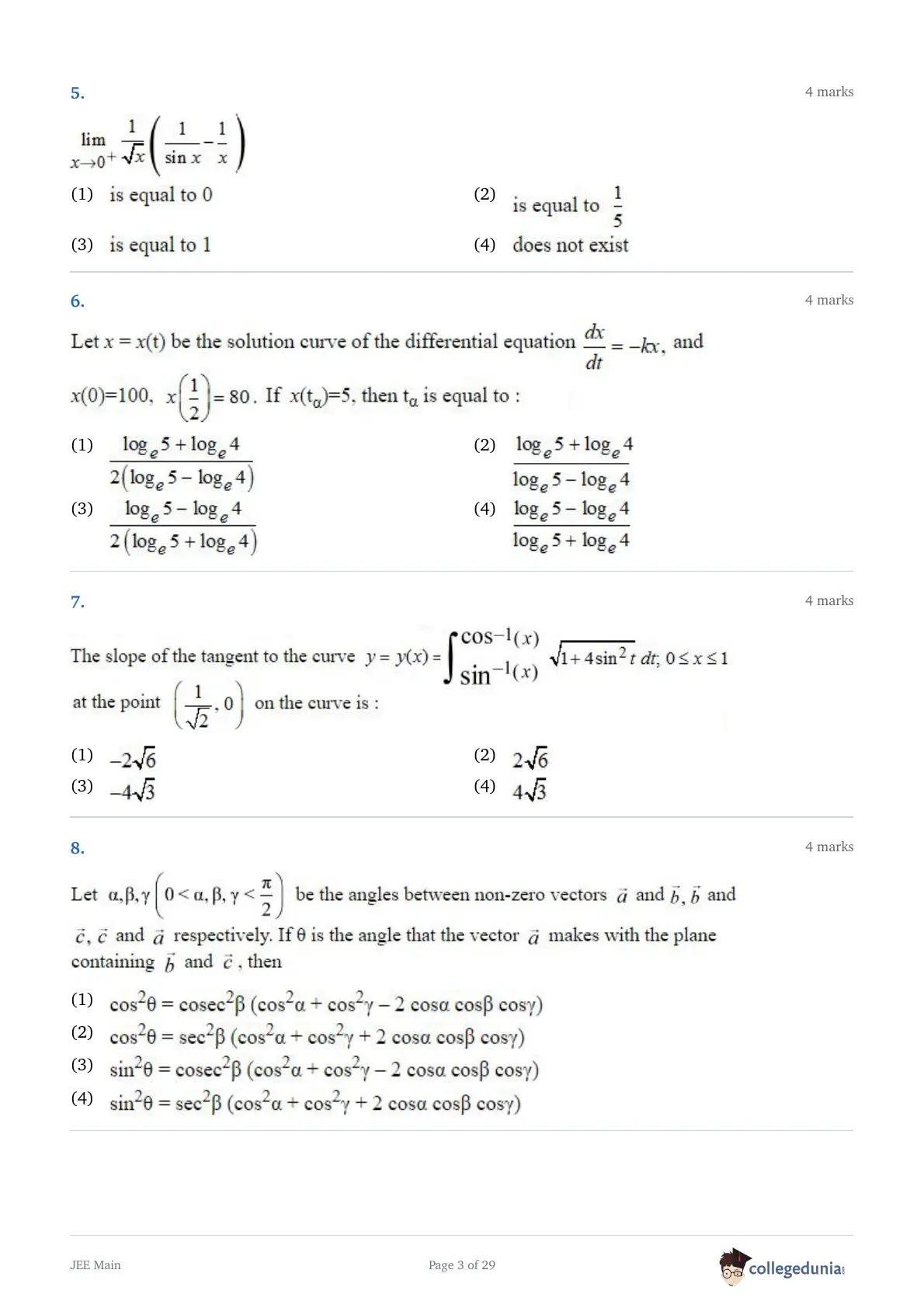
\( \lim_{x\rightarrow0^{+}}\frac{1}{\sqrt{x}}\left(\frac{1}{\sin x}-\frac{1}{x}\right) \)
The slope of the tangent to the curve \( y=y(x)=\int_{\sin^{-1}(x)}^{\cos^{-1}(x)}\sqrt{1+4\sin^{2}t}\,dt\ ;\ 0\le x\le1 \) at the point \( \left(\frac{1}{\sqrt{2}},0\right) \) on the curve is :
Let \( \alpha,\beta,\gamma\left(0<\alpha,\beta,\gamma<\frac{\pi}{2}\right) \) be the angles between non-zero vectors \( \vec{a} \) and \( \vec{b} \), \( \vec{b} \) and \( \vec{c} \), \( \vec{c} \) and \( \vec{a} \) respectively. If \( \theta \) is the angle that the vector \( \vec{a} \) makes with the plane containing \( \vec{b} \) and \( \vec{c} \), then
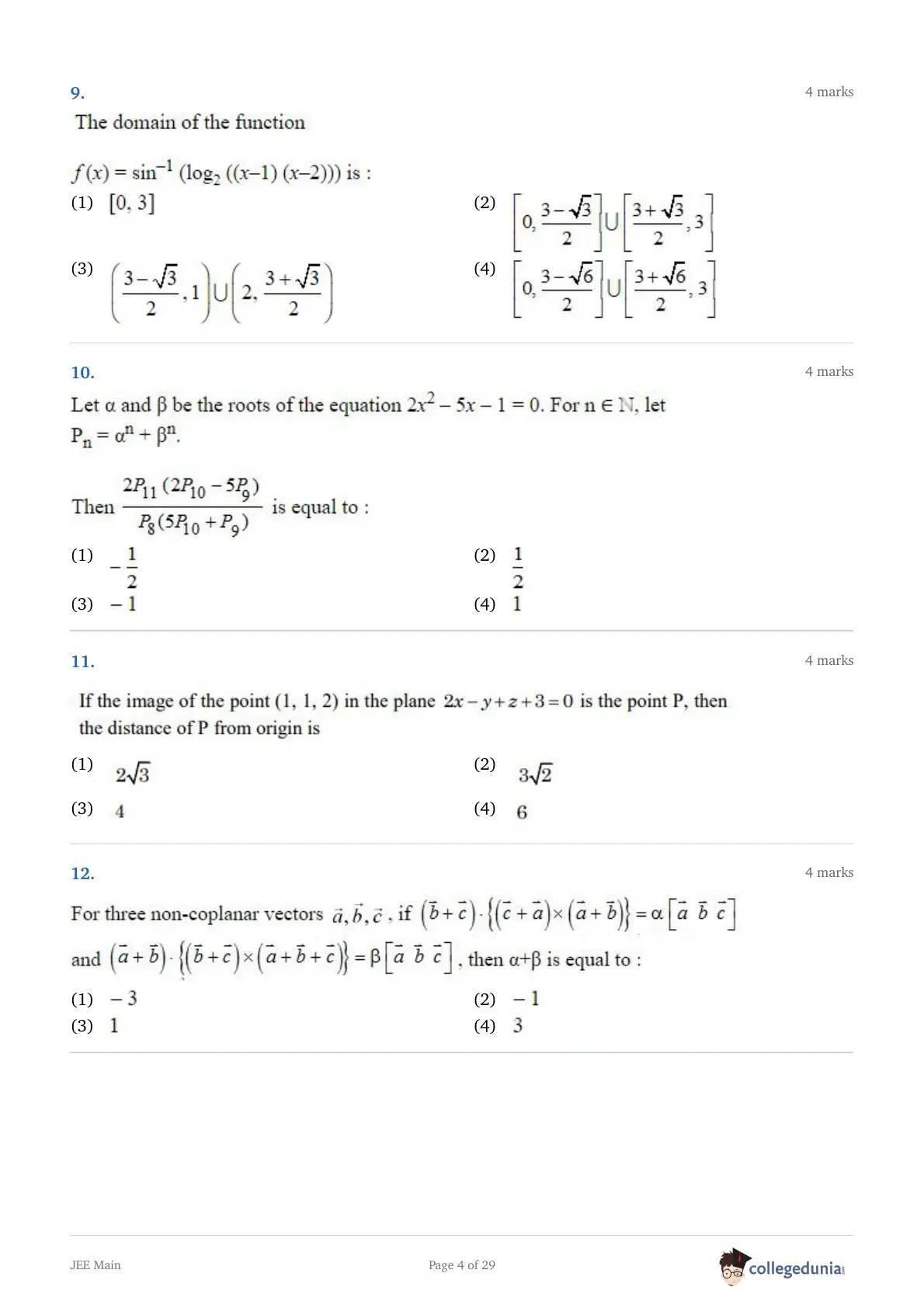
The domain of the function \(f(x)=\sin ^{-1}\left(\log _{2}((x-1)(x-2))\right)\) is :
Let \(\alpha\) and \(\beta\) be the roots of the equation \[ 2x^2-5x-1=0. \] For \(n\in\mathbb{N}\), let \[ P_n=\alpha^n+\beta^n. \] Then the value of \[ \frac{2P_{11}\,(2P_{10}-5P_9)}{P_8\,(5P_{10}+P_9)} \] is equal to:
If the image of the point \((1,1,2)\) in the plane \(2 x-y+z+3=0\) is the point P, then the distance of P from origin is
For three non–coplanar vectors \(\vec a,\vec b,\vec c\), if \[ (\vec b+\vec c)\cdot\big((\vec c+\vec a)\times(\vec a+\vec b)\big) = \alpha \,[\vec a\,\vec b\,\vec c] \] and \[ (\vec a+\vec b)\cdot\big((\vec b+\vec c)\times(\vec a+\vec b+\vec c)\big) = \beta \,[\vec a\,\vec b\,\vec c], \] then \(\alpha+\beta\) is equal to:
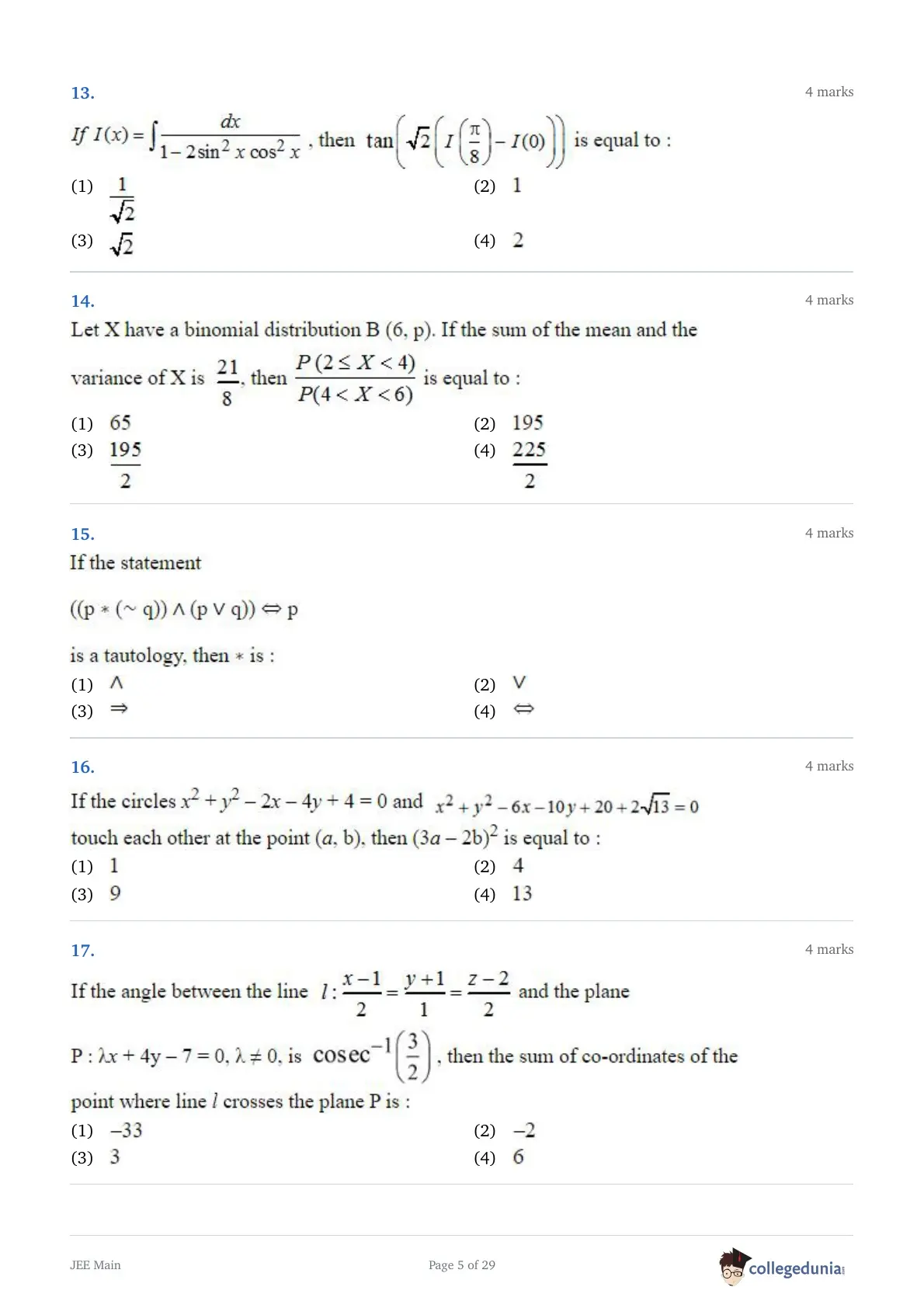
If \(I(x)=\int \frac{d x}{1-2 \sin ^{2} x \cos ^{2} x}\), then \(\tan \left(\sqrt{2}\left(I\left(\frac{\pi}{8}\right)-I(0)\right)\right)\) is equal to :
Let \(X\) have a binomial distribution \(B(6,p)\). If the sum of the mean and the variance of \(X\) is \(\dfrac{21}{8}\), then \[ \frac{P(2\le X<4)}{P(4<X<6)} \] is equal to:
If the statement
\(((\mathrm{p} * (\sim \mathrm{q})) \wedge(\mathrm{p} \vee \mathrm{q})) \Leftrightarrow \mathrm{p}\)
is a tautology, then \(*\) is :
If the circles \(x^{2}+y^{2}-2 x-4 y+4=0\) and \(x^{2}+y^{2}-6 x-10 y+20+2 \sqrt{13}=0\) touch each other at the point \((a, \mathrm{b})\), then \((3 a-2 \mathrm{b})^{2}\) is equal to :
If the angle between the line \(l: \frac{x-1}{2}=\frac{y+1}{1}=\frac{z-2}{2}\) and the plane \(\mathrm{P}: \lambda x+4y-7=0,\ \lambda \neq 0\), is \(\operatorname{cosec}^{-1}\left(\frac{3}{2}\right)\), then the sum of co-ordinates of the point where line \(l\) crosses the plane P is :
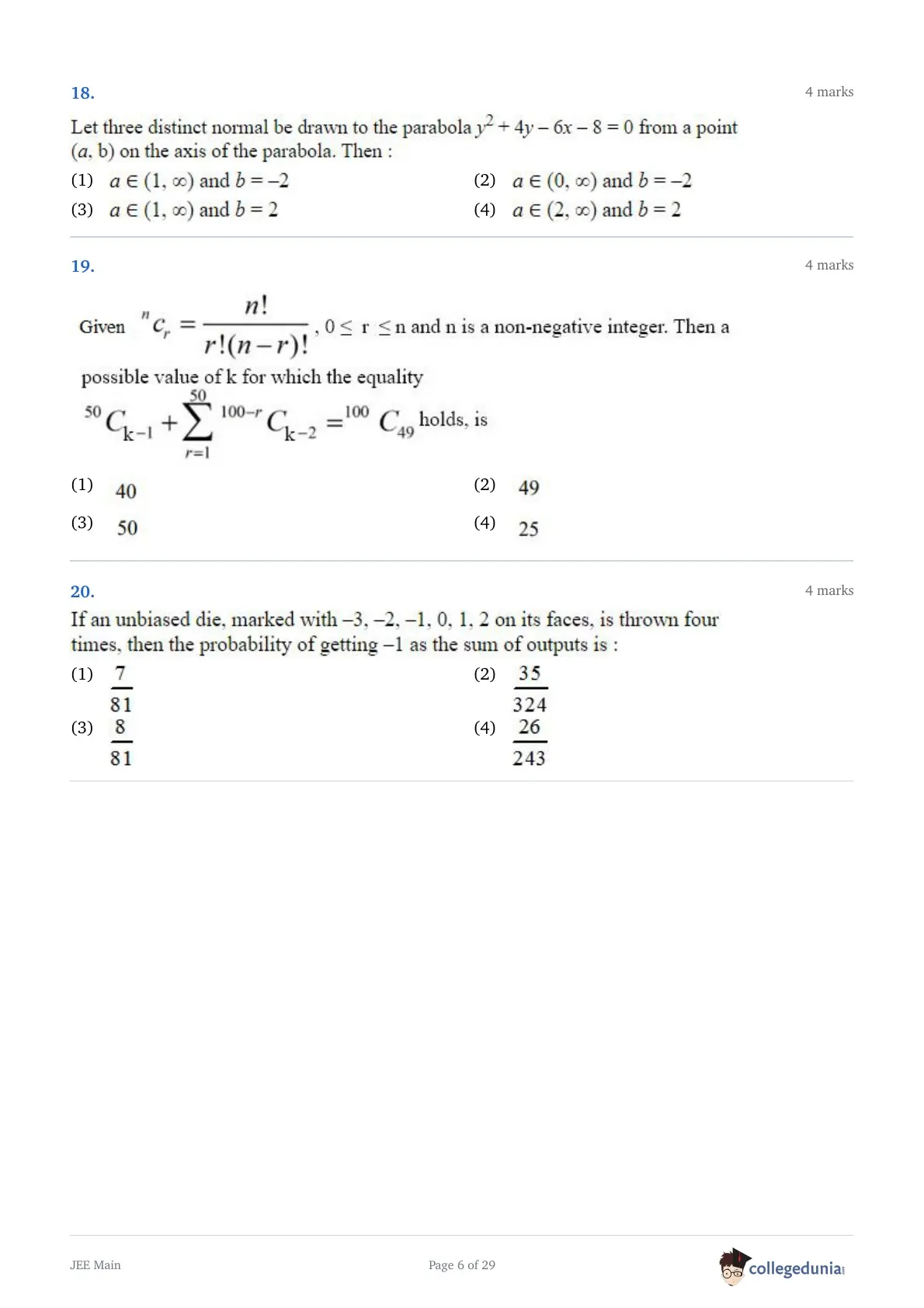
Let three distinct normal be drawn to the parabola \(y^{2}+4y-6x-8=0\) from a point \((a, \mathrm{b})\) on the axis of the parabola. Then :
Given \({}^{n}C_{r}=\frac{n!}{r!(n-r)!}\), \(0 \leq r \leq n\) and n is a non-negative integer. Then a possible value of k for which the equality
\({}^{50}C_{k-1}+\sum_{r=1}^{50}{}^{100-r}C_{k-2}={}^{100}C_{49}\) holds, is
If an unbiased die, marked with \(-3,-2,-1,0,1,2\) on its faces, is thrown four times, then the probability of getting \(-1\) as the sum of outputs is :
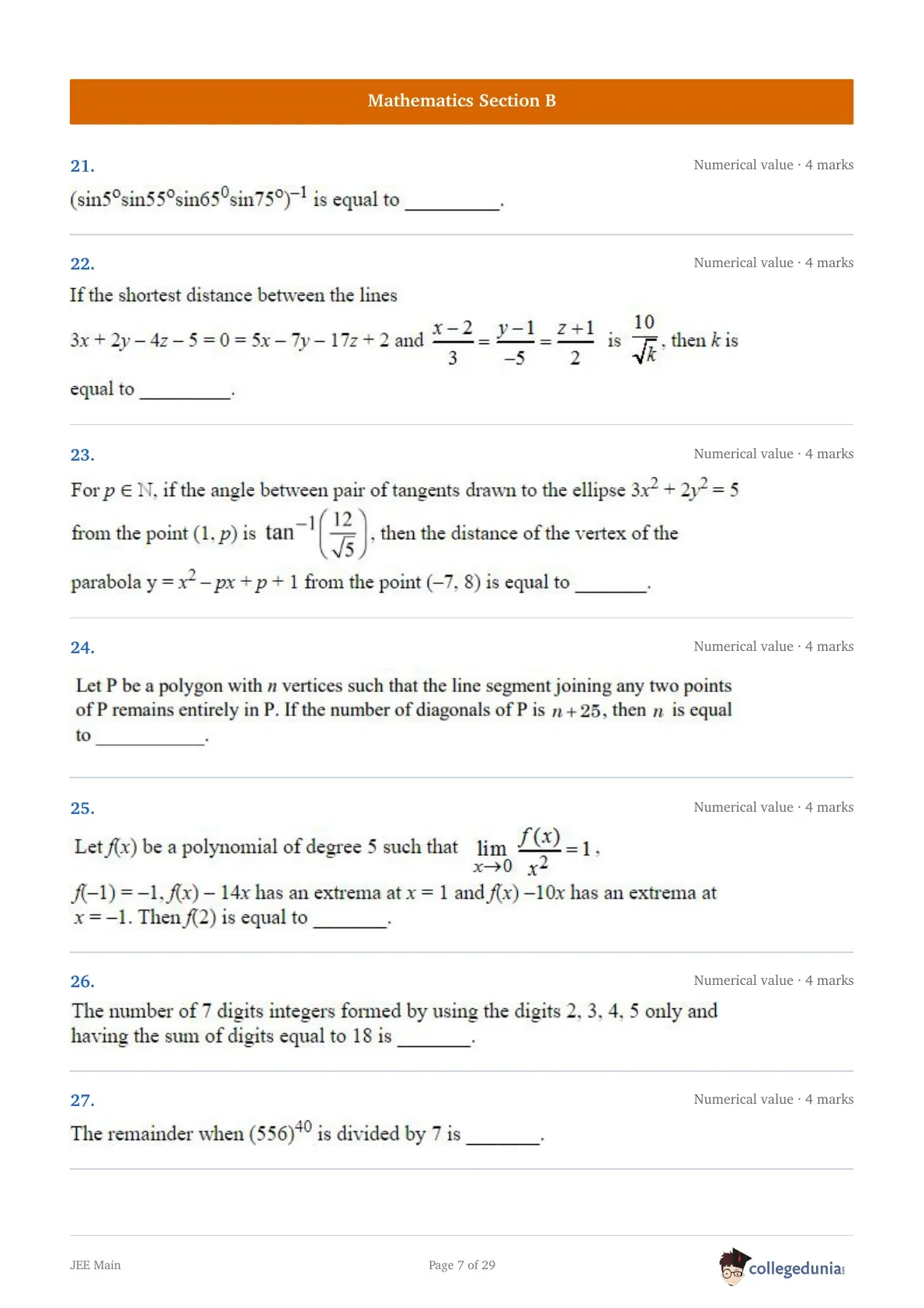
\(\left(\sin 5^{\circ} \sin 55^{\circ} \sin 65^{\circ} \sin 75^{\circ}\right)^{-1}\) is equal to ________.
If the shortest distance between the lines \(3x+2y-4z-5=0=5x-7y-17z+2\) and \(\frac{x-2}{3}=\frac{y-1}{-5}=\frac{z+1}{2}\) is \(\frac{10}{\sqrt{k}}\), then \(k\) is equal to ________.
For \(p \in \mathbb{N}\), if the angle between pair of tangents drawn to the ellipse \(3x^{2}+2y^{2}=5\) from the point \((1, p)\) is \(\tan^{-1}\left(\frac{12}{\sqrt{5}}\right)\), then the distance of the vertex of the parabola \(y=x^{2}-px+p+1\) from the point \((-7,8)\) is equal to ________.
Let P be a polygon with \(n\) vertices such that the line segment joining any two points of P remains entirely in P. If the number of diagonals of P is \(n+25\), then \(n\) is equal to ________.
Let \(f(x)\) be a polynomial of degree 5 such that \(\lim_{x \to 0} \frac{f(x)}{x^{2}}=1\), \(f(-1)=-1\), \(f(x)-14x\) has an extrema at \(x=1\) and \(f(x)-10x\) has an extrema at \(x=-1\). Then \(f(2)\) is equal to ________.
The number of 7 digits integers formed by using the digits 2, 3, 4, 5 only and having the sum of digits equal to 18 is ________.
The remainder when \((556)^{40}\) is divided by 7 is ________.
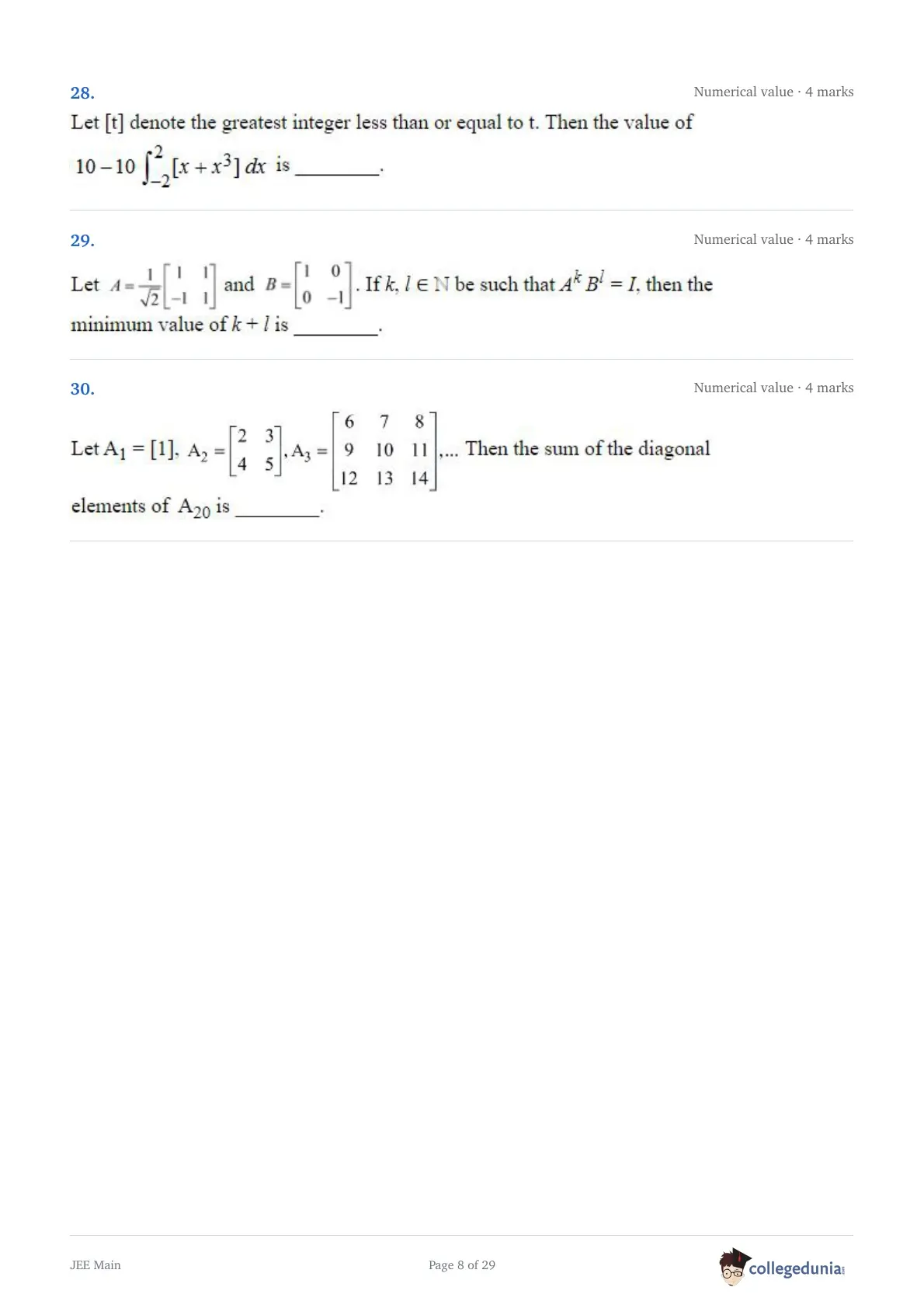
Let \([\mathrm{t}]\) denote the greatest integer less than or equal to t. Then the value of \(10-10 \int_{-2}^{2}\left[x+x^{3}\right] dx\) is ________.
Let \(A=\frac{1}{\sqrt{2}}\left[\begin{array}{cc}1 & 1 \\ -1 & 1\end{array}\right]\) and \(B=\left[\begin{array}{cc}1 & 0 \\ 0 & -1\end{array}\right]\). If \(k, l \in \mathbb{N}\) be such that \(A^{k} B^{l}=I\), then the minimum value of \(k+l\) is ________.
Let \(\mathrm{A}_{1}=[1]\), \(\mathrm{A}_{2}=\left[\begin{array}{ll}2 & 3 \\ 4 & 5\end{array}\right]\), \(\mathrm{A}_{3}=\left[\begin{array}{ccc}6 & 7 & 8 \\ 9 & 10 & 11 \\ 12 & 13 & 14\end{array}\right], \ldots\) Then the sum of the diagonal elements of \(\mathrm{A}_{20}\) is ________.
Aptitude Test (Q31 - Q80)
Which of the following is not a sustainable development goal targeted to be achieved by 2030?
KANDARIYA MAHADEV TEMPLE is situated in which state of India?
Vertical elements in a building are:-
Cavity Walls are used for
Lintel is related to:

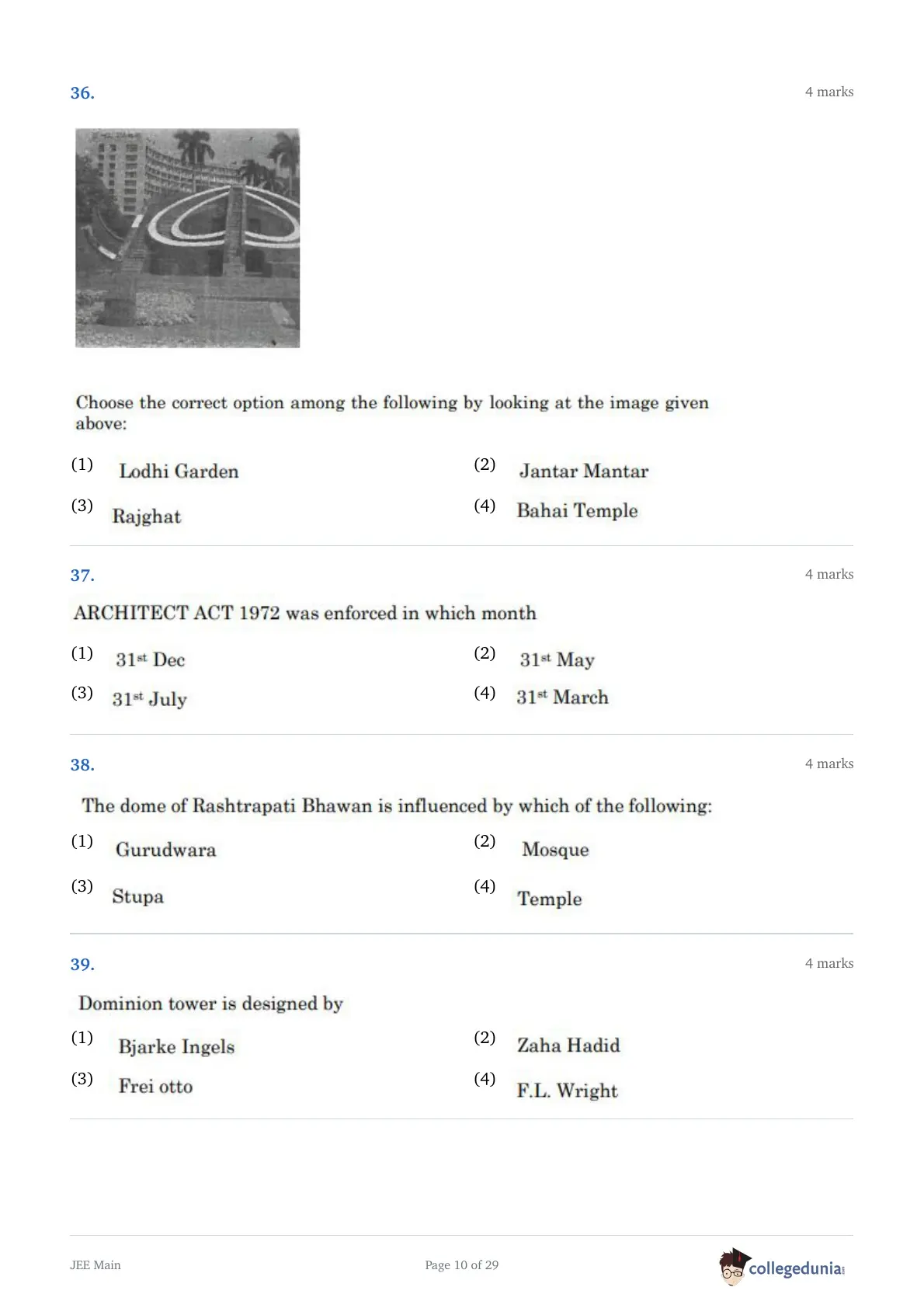
Choose the correct option among the following by looking at the image given above:
ARCHITECT ACT 1972 was enforced in which month
The dome of Rashtrapati Bhawan is influenced by which of the following:
Dominion tower is designed by
The largest river island of the world is present in which state of India?
Who prepared the first layout of the town of Jamshedpur?

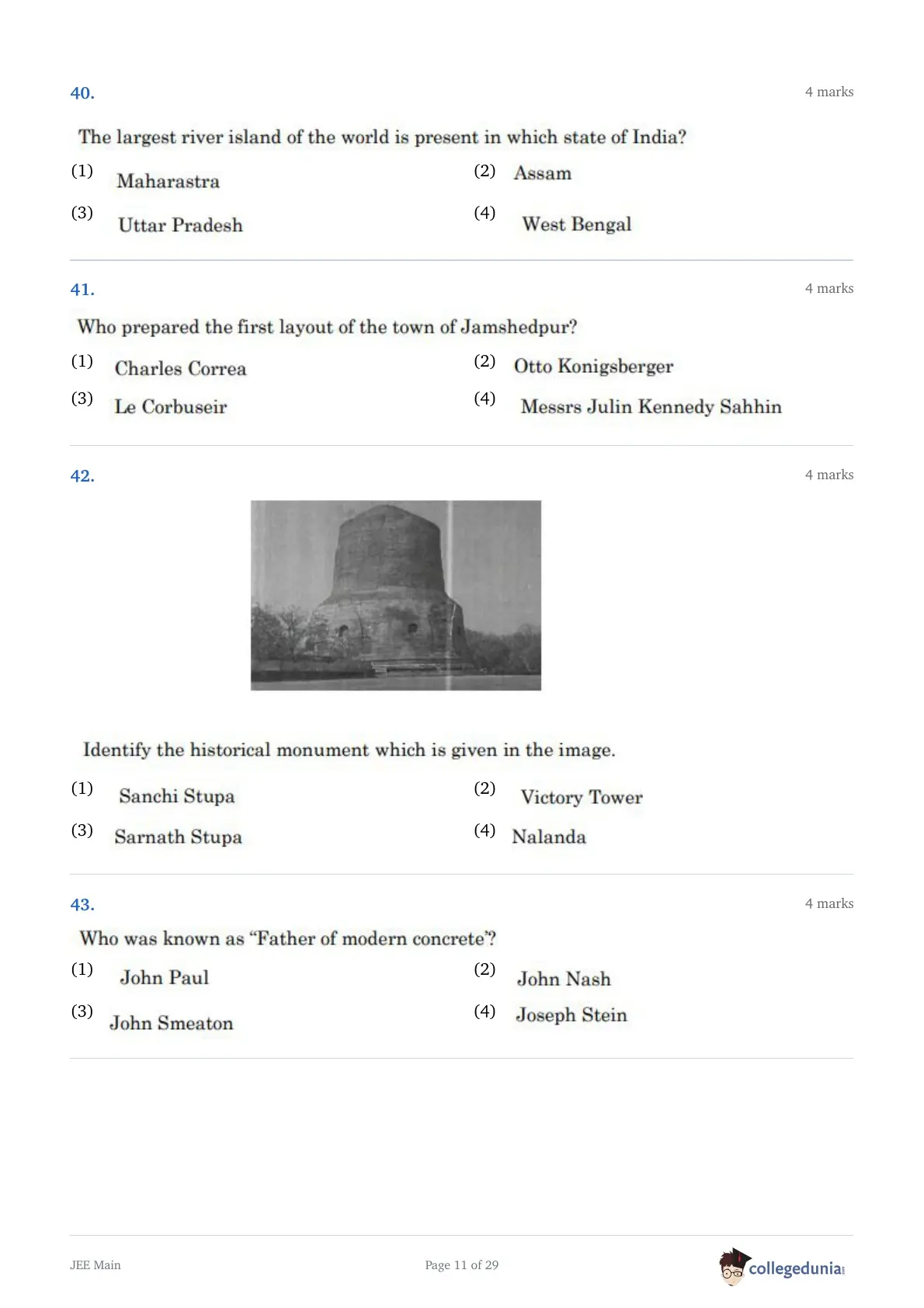
Identify the historical monument which is given in the image.
Who was known as “Father of modern concrete”?
Who is the architect of TWA Airport, New York?
Starting from a point, Maria walked 12 meters towards North, she turned right and walked 10 meters. She again turned right and walked 12 meters, then she turned left and walked 5 meters. How far is she now and in which direction from the starting point? Consider the starting point is in south direction.
Who among the following is not Pritzker prize winner?
Which of the following is not Antonio Gaudi’s project?
Which one of the following is most earthquake resistant structure?
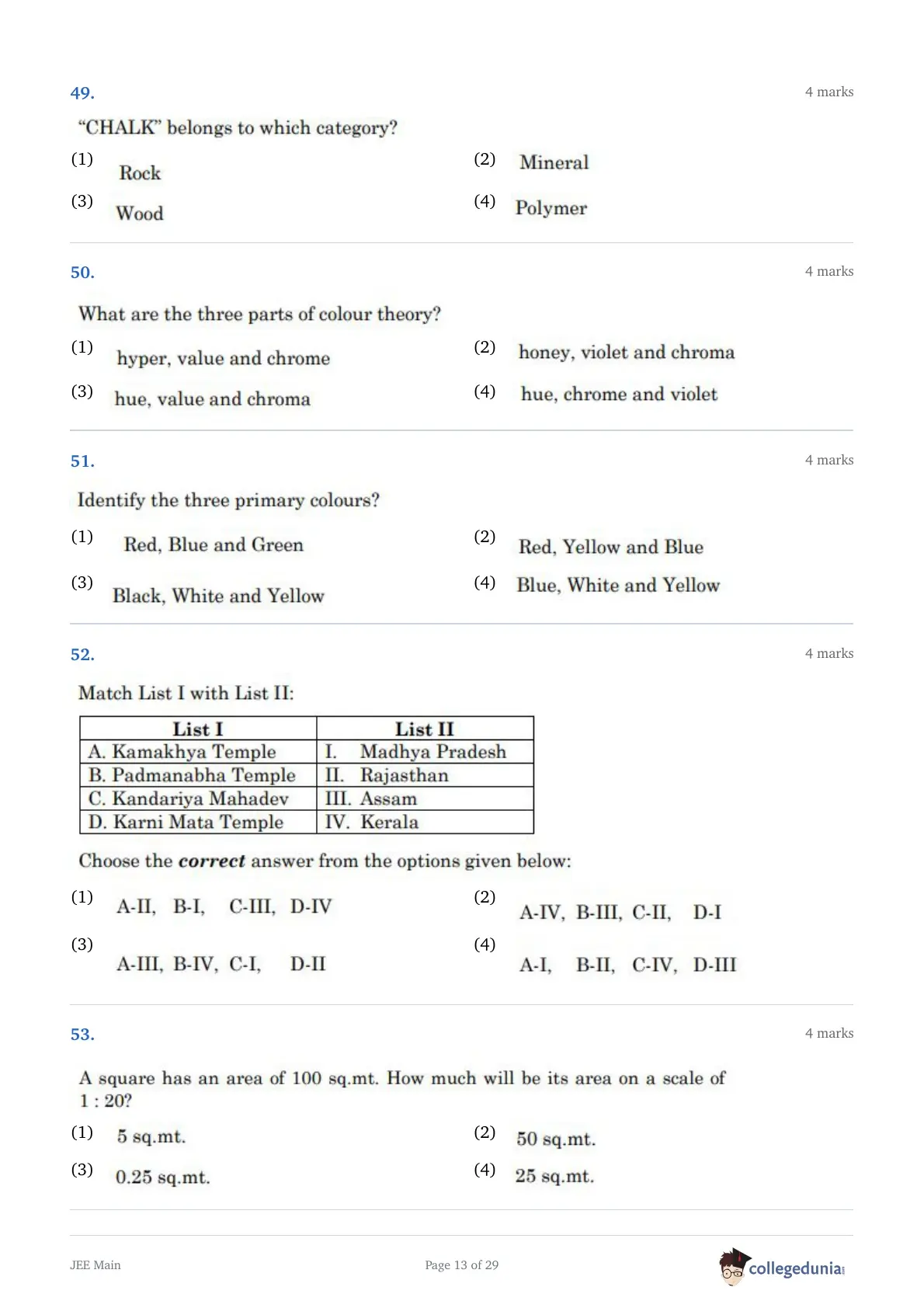
"CHALK" belongs to which category?
What are the three parts of colour theory?
Identify the three primary colours?
| List I | List II |
| A. Kamakhya Temple | I. Madhya Pradesh |
| B. Padmanabha Temple | II. Rajasthan |
| C. Kandariya Mahadev | III. Assam |
| D. Karni Mata Temple | IV. Kerala |
A square has an area of 100 sq.mt. How much will be its area on a scale of 1 : 20?
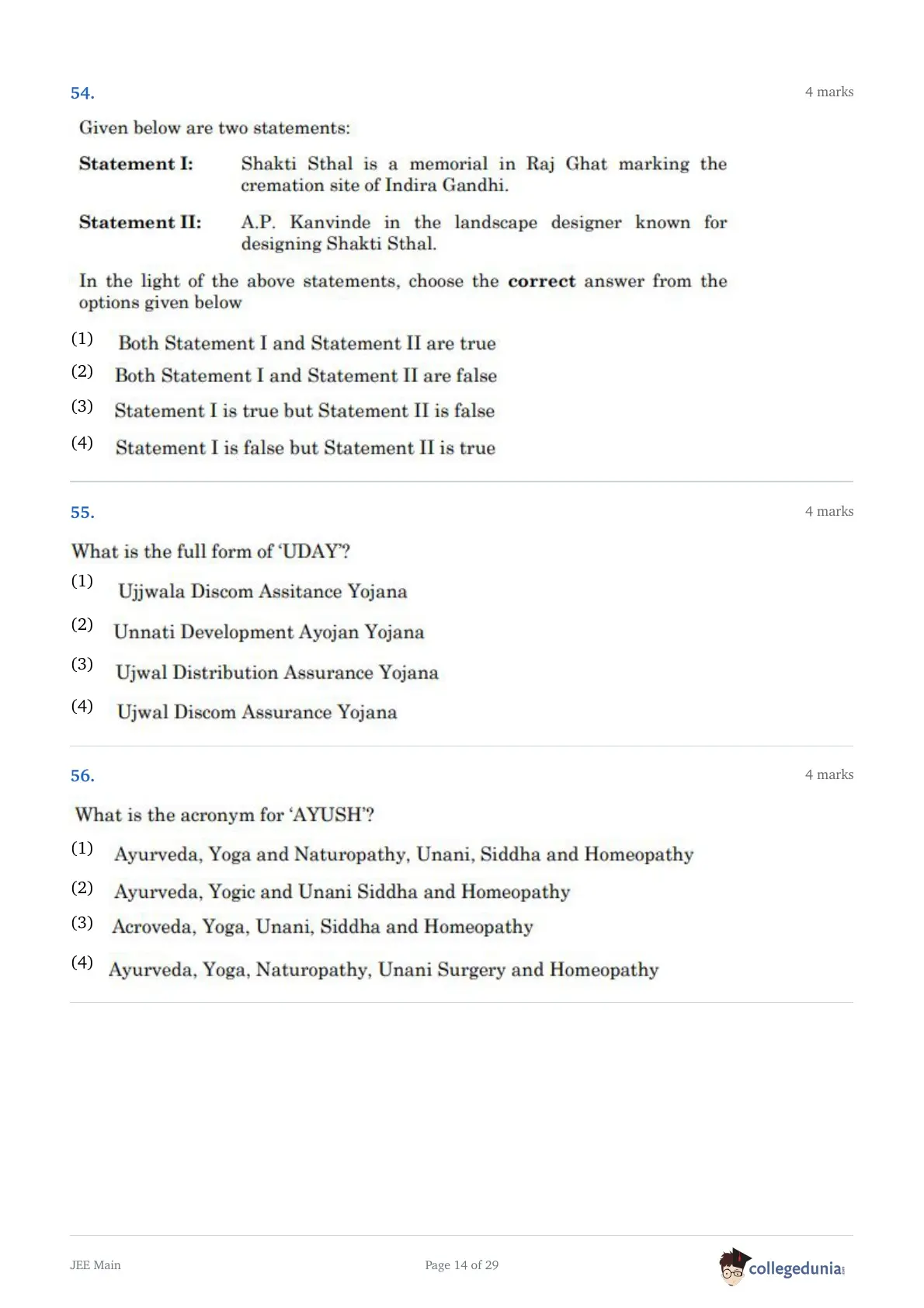
Given below are two statements:
Statement I: Shakti Sthal is a memorial in Raj Ghat marking the cremation site of Indira Gandhi.
Statement II: A.P. Kanvinde in the landscape designer known for designing Shakti Sthal.
In the light of the above statements, choose the correct answer from the options given below
What is the full form of "UDAY"?
What is the acronym for "AYUSH"?
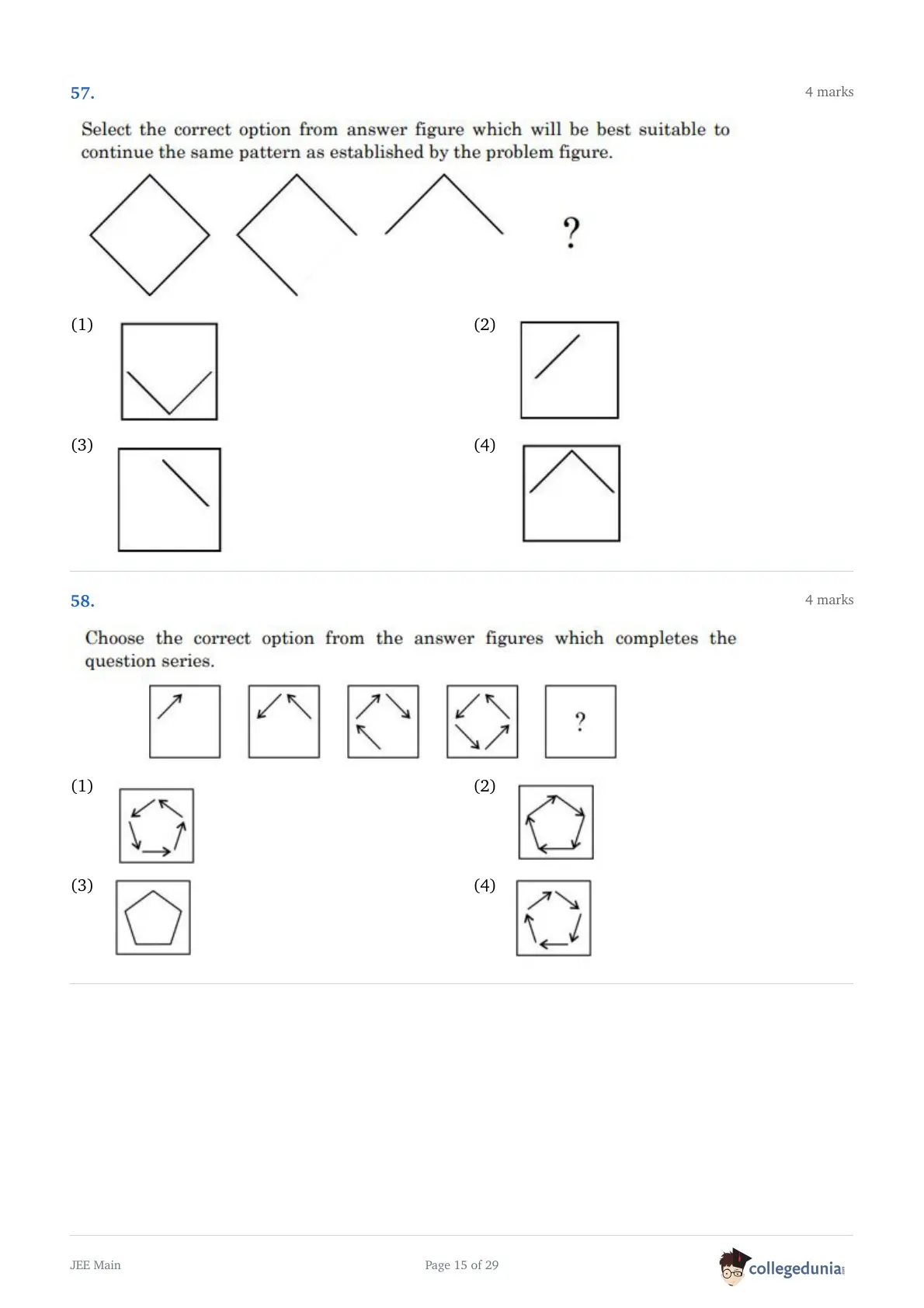
Select the correct option from answer figure which will be best suitable to continue the same pattern as established by the problem figure.
- (1)
![]()
- (2)
![]()
- (3)
![]()
- (4)
![]()


Choose the correct option from the answer figures which completes the question series.
- (1)
![]()
- (2)
![]()
- (3)
![]()
- (4)
![]()


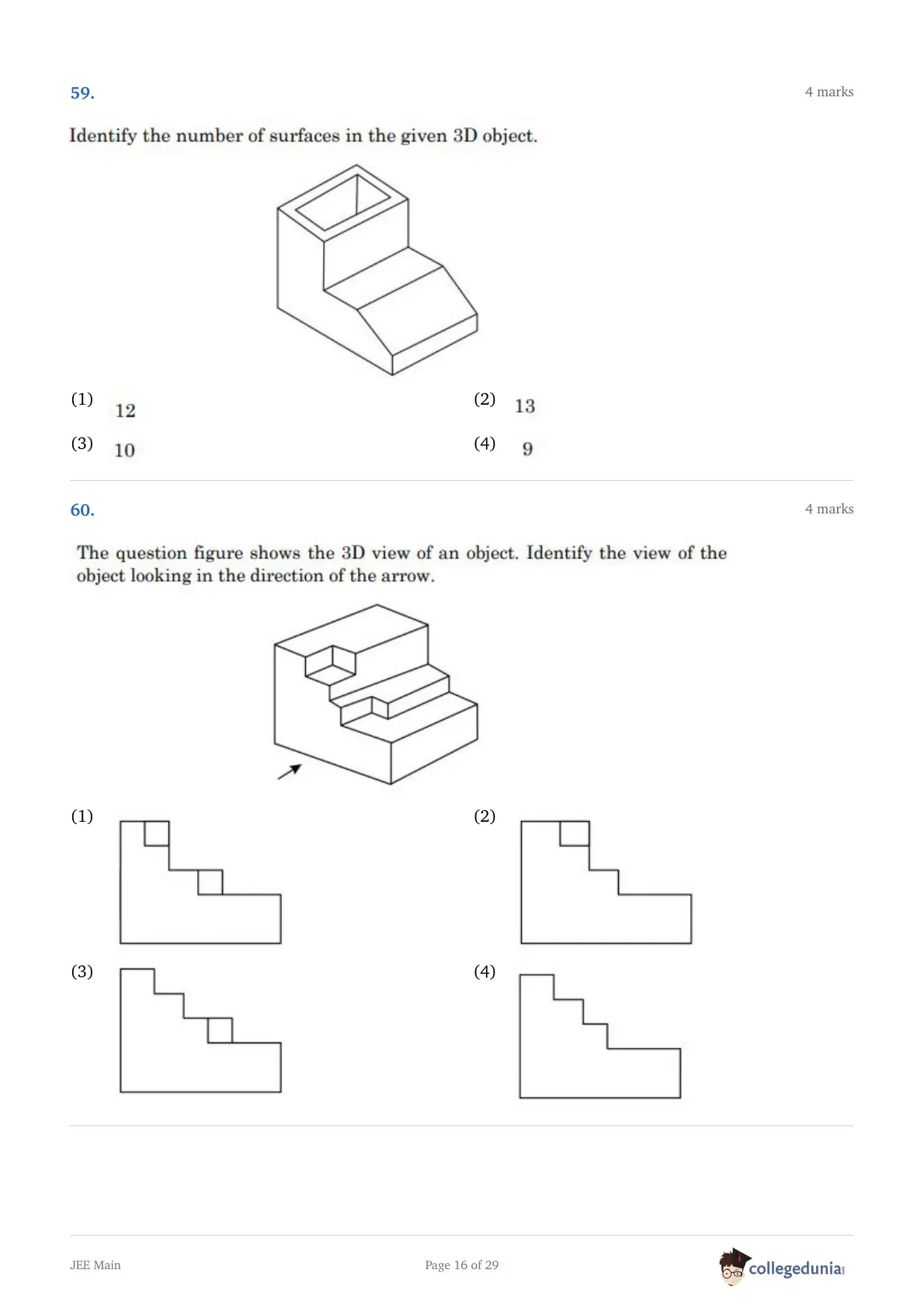
Identify the number of surfaces in the given 3D object.
The question figure shows the 3D view of an object. Identify the view of the object looking in the direction of the arrow.
- (1)
![]()
- (2)
![]()
- (3)
![]()
- (4)
![]()


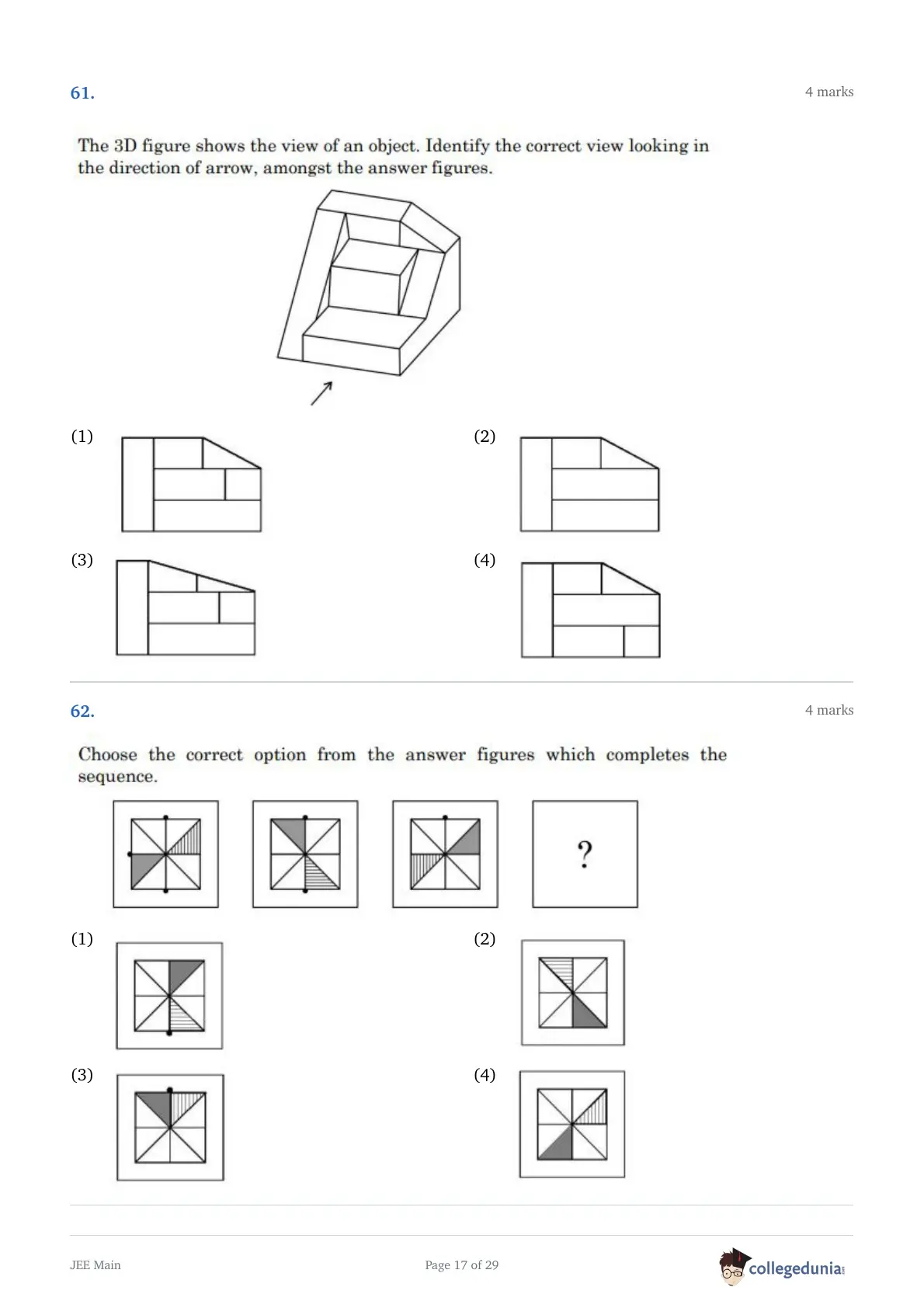
The 3D figure shows the view of an object. Identify the correct view looking in the direction of arrow, amongst the answer figures.
- (1)
![]()
- (2)
![]()
- (3)
![]()
- (4)
![]()


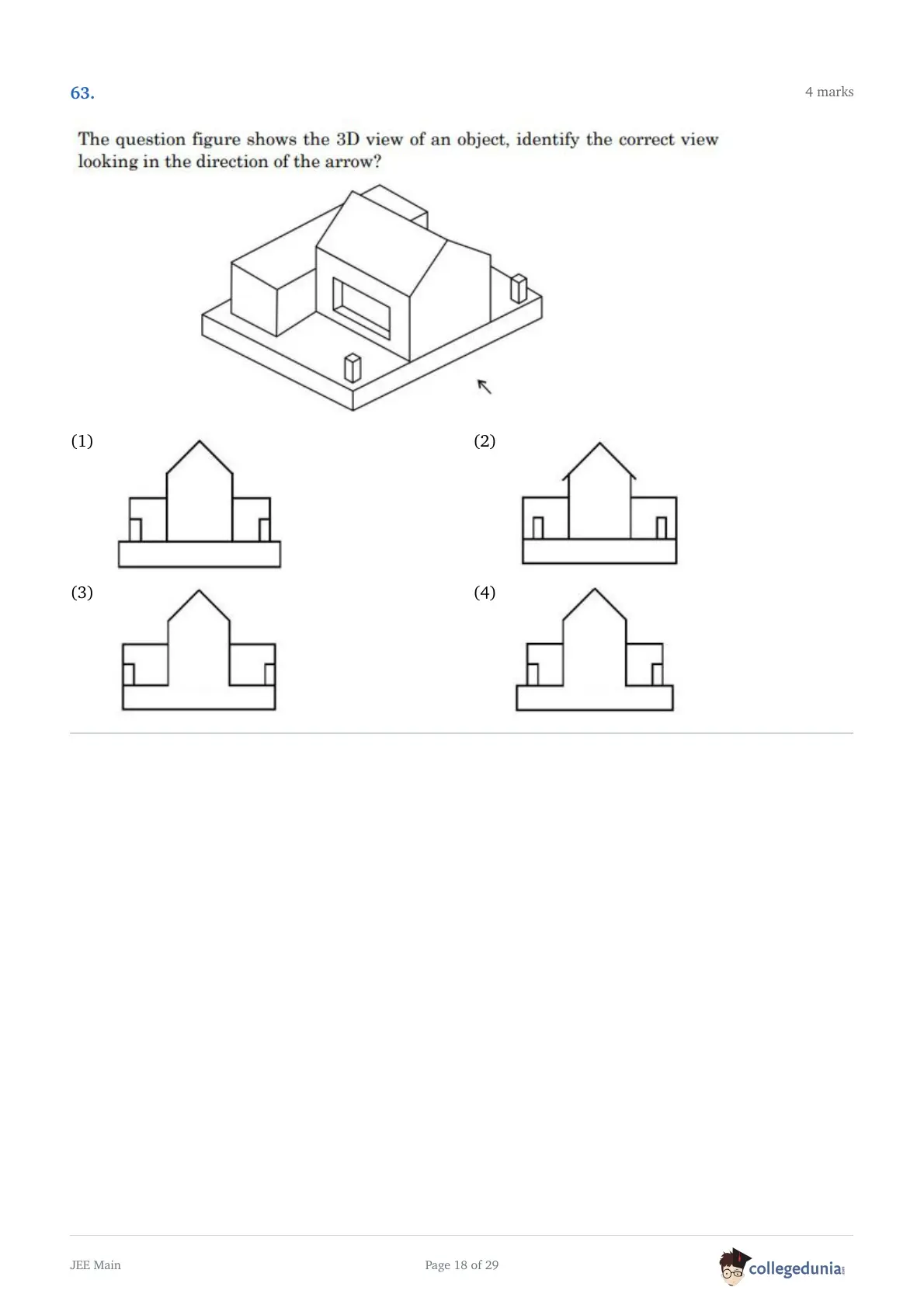
Choose the correct option from the answer figures which completes the sequence.
- (1)
![]()
- (2)
![]()
- (3)
![]()
- (4)
![]()


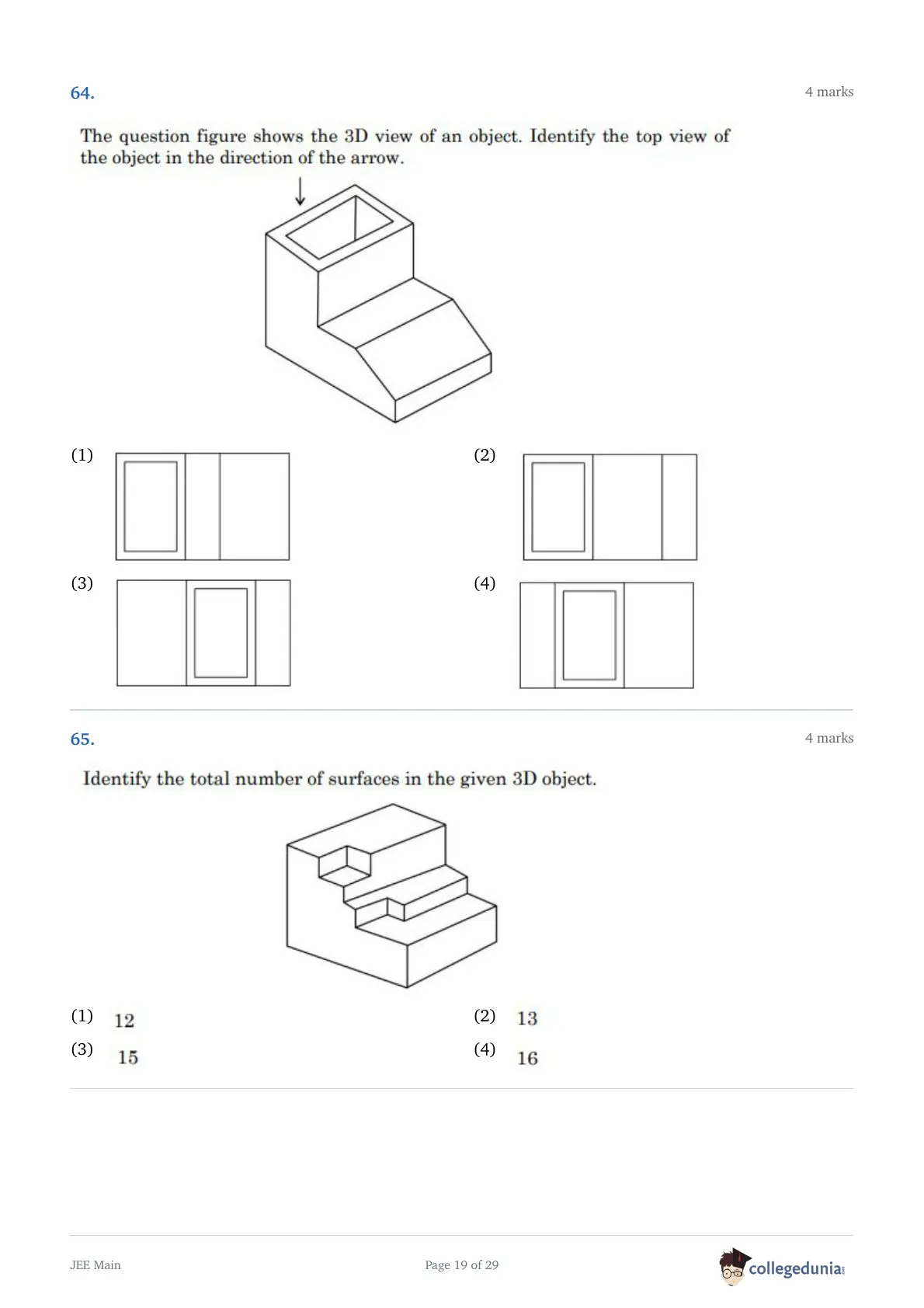
The question figure shows the 3D view of an object, identify the correct view looking in the direction of the arrow?
- (1)
![]()
- (2)
![]()
- (3)
![]()
- (4)
![]()


The question figure shows the 3D view of an object. Identify the top view of the object in the direction of the arrow.
- (1)
![]()
- (2)
![]()
- (3)
![]()
- (4)
![]()


Identify the total number of surfaces in the given 3D object.
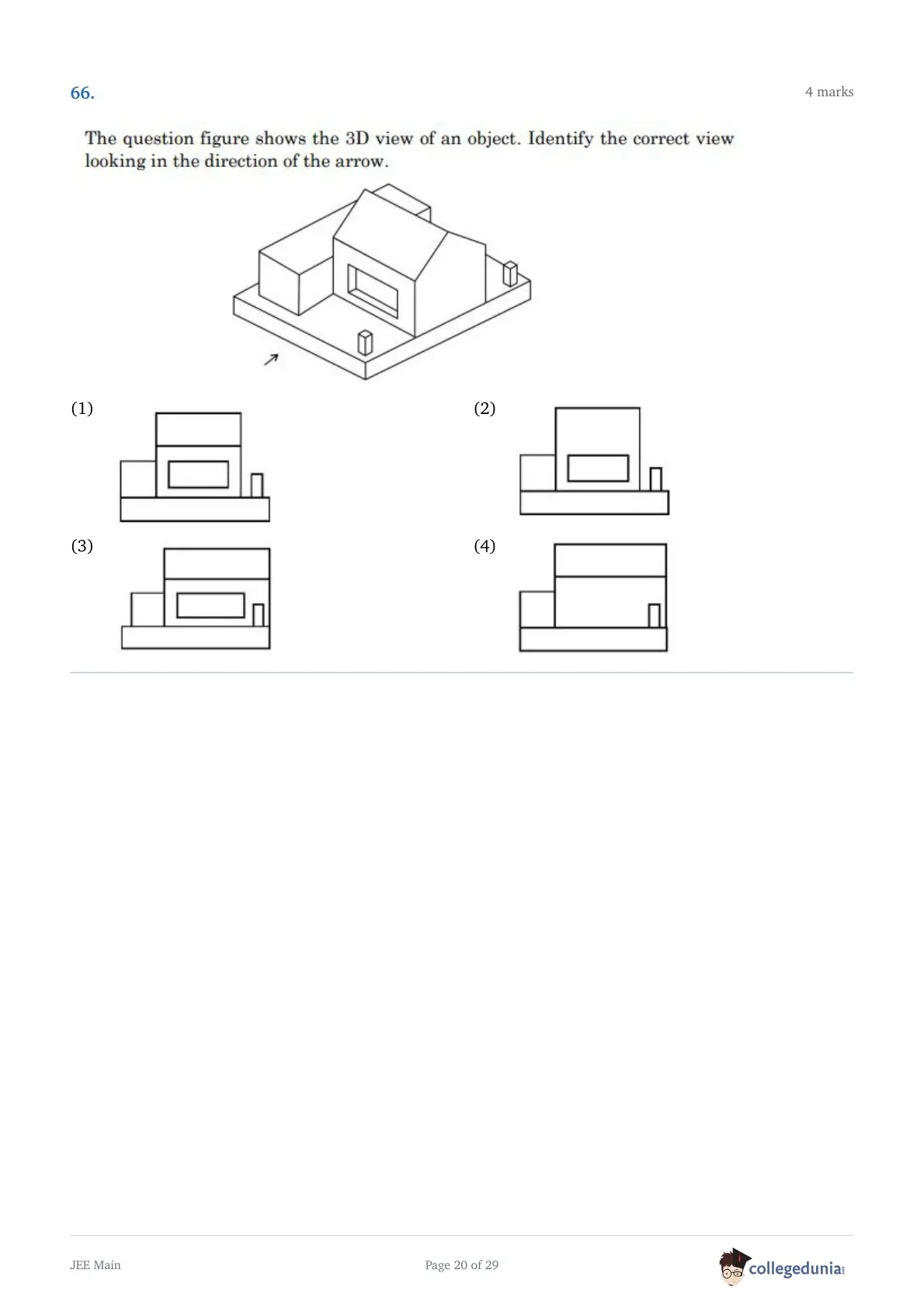
The question figure shows the 3D view of an object. Identify the correct view looking in the direction of the arrow.
- (1)
![]()
- (2)
![]()
- (3)
![]()
- (4)
![]()


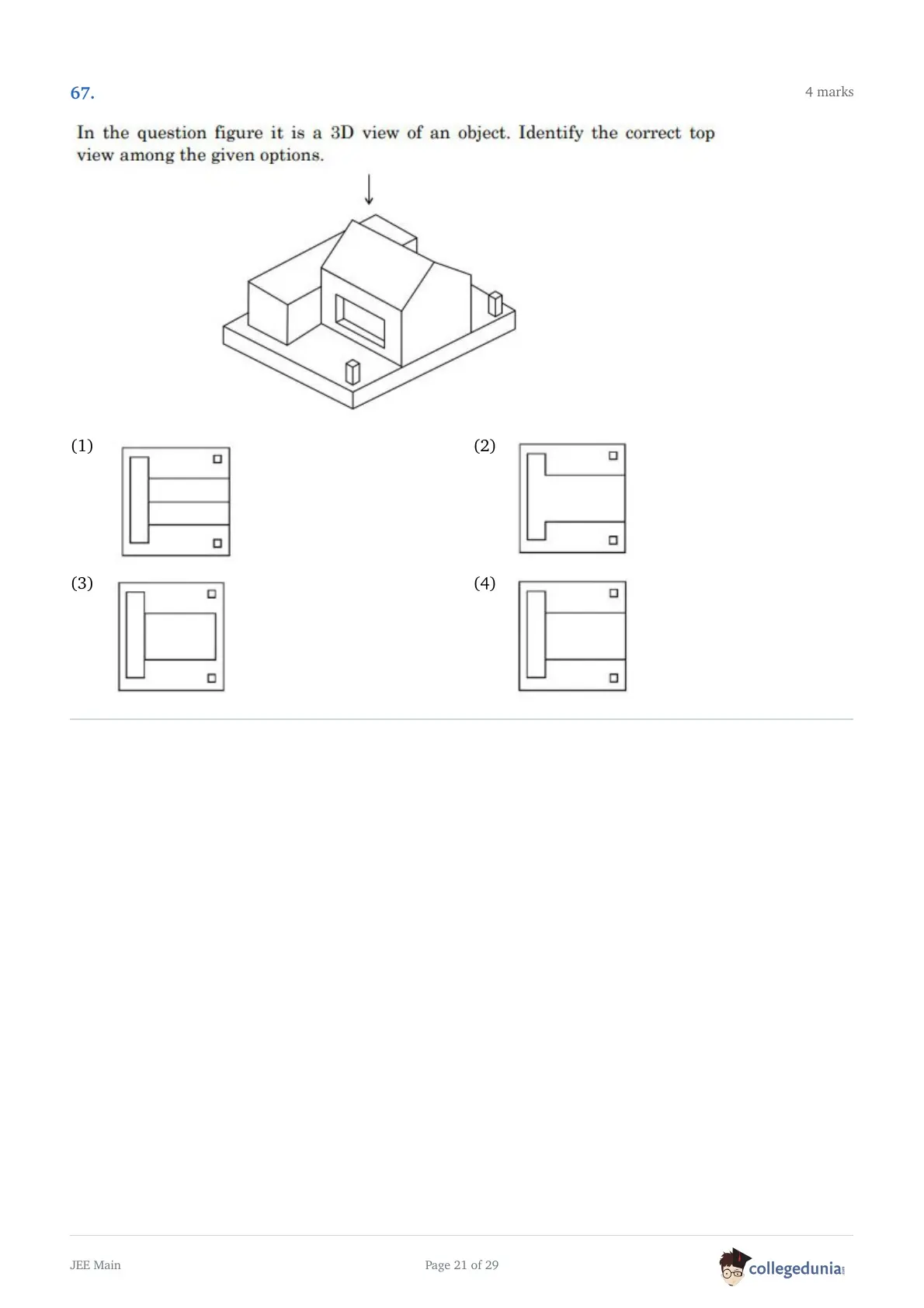
In the question figure it is a 3D view of an object. Identify the correct top view among the given options.
- (1)
![]()
- (2)
![]()
- (3)
![]()
- (4)
![]()


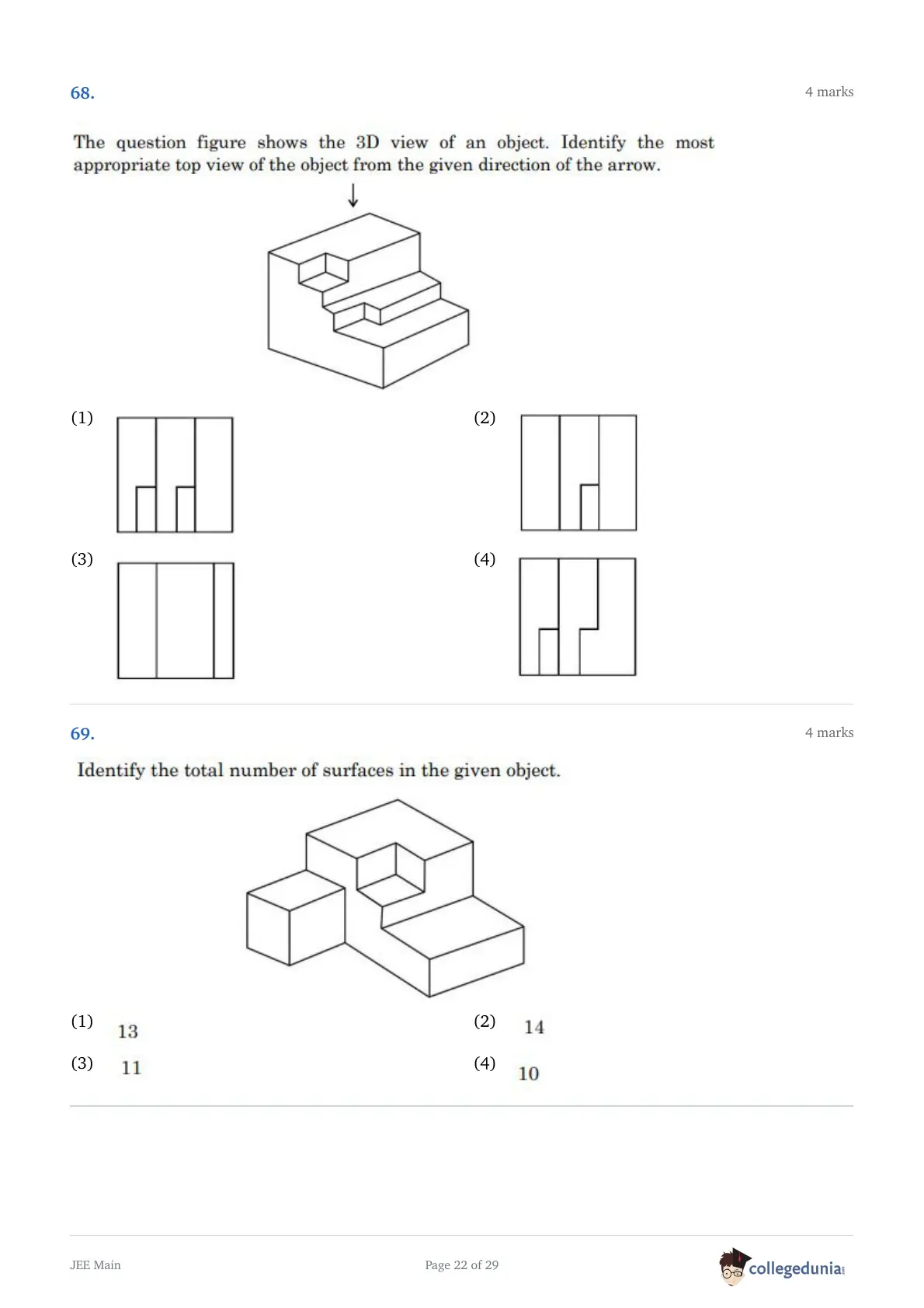
The question figure shows the 3D view of an object. Identify the most appropriate top view of the object from the given direction of the arrow.
- (1)
![]()
- (2)
![]()
- (3)
![]()
- (4)
![]()


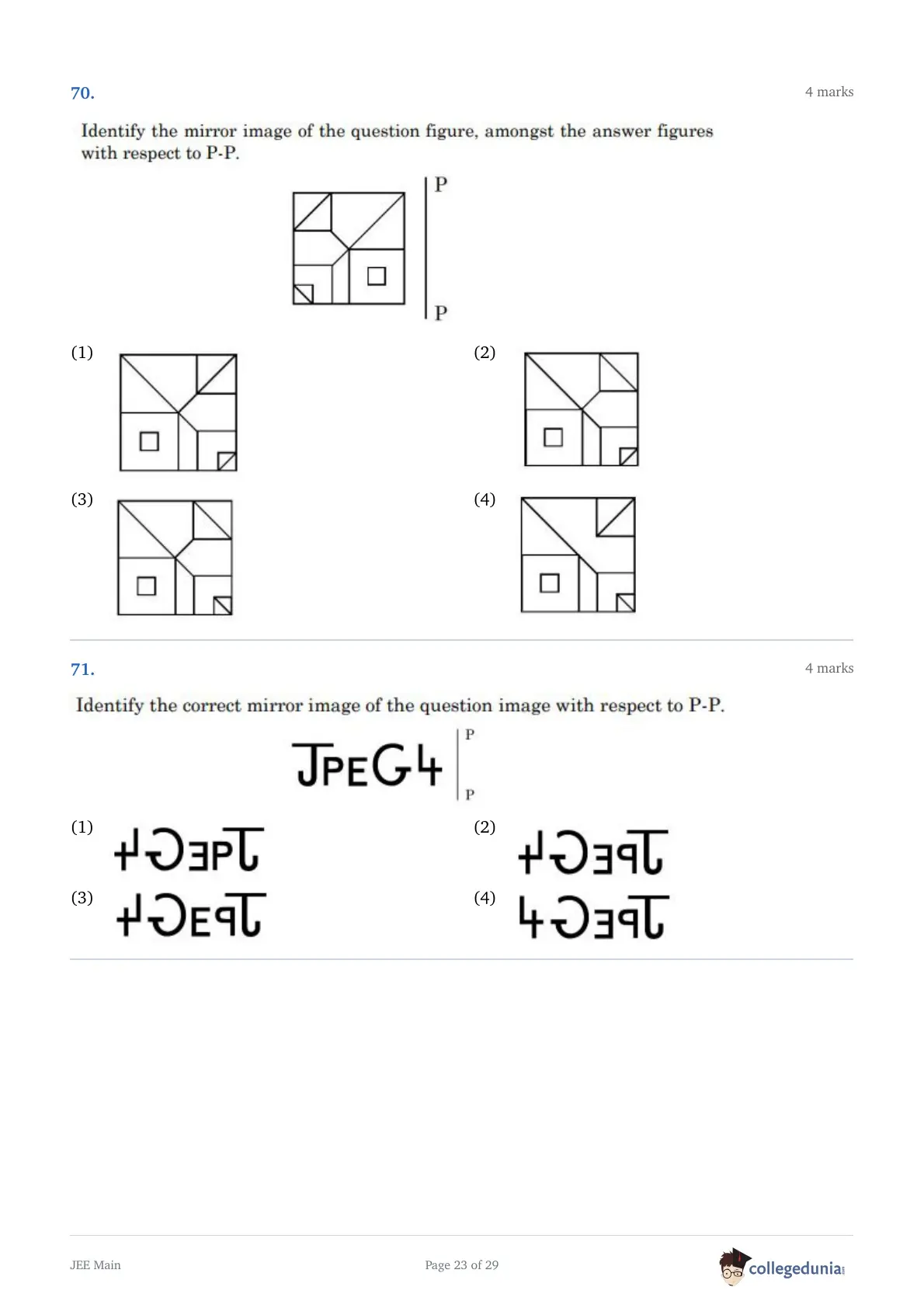
Identify the total number of surfaces in the given object.
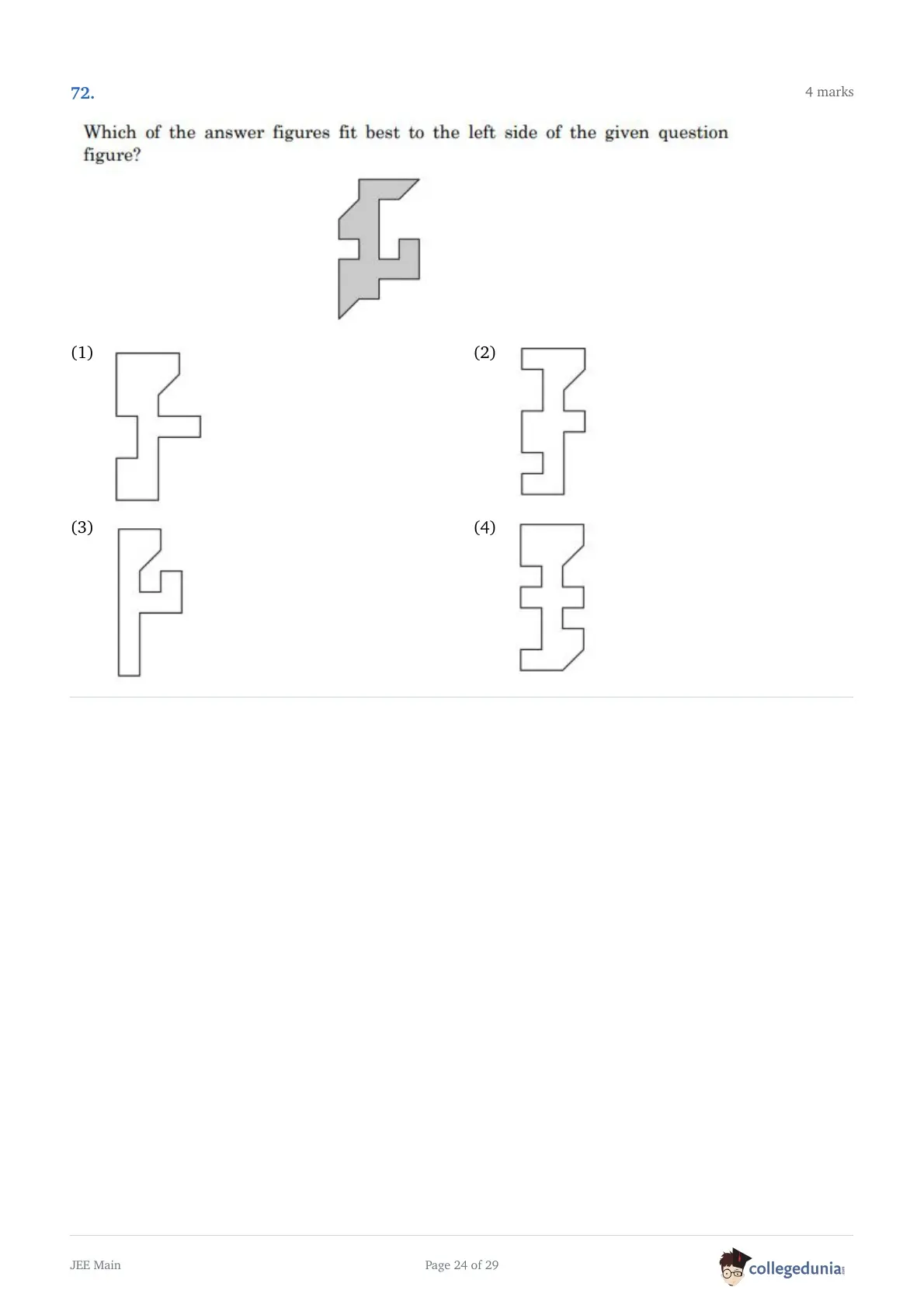
Identify the mirror image of the question figure, amongst the answer figures with respect to P-P.
- (1)
![]()
- (2)
![]()
- (3)
![]()
- (4)
![]()


Identify the correct mirror image of the question image with respect to P-P.
- (1)
![]()
- (2)
![]()
- (3)
![]()
- (4)
![]()


Which of the answer figures fit best to the left side of the given question figure?
- (1)
![]()
- (2)
![]()
- (3)
![]()
- (4)
![]()


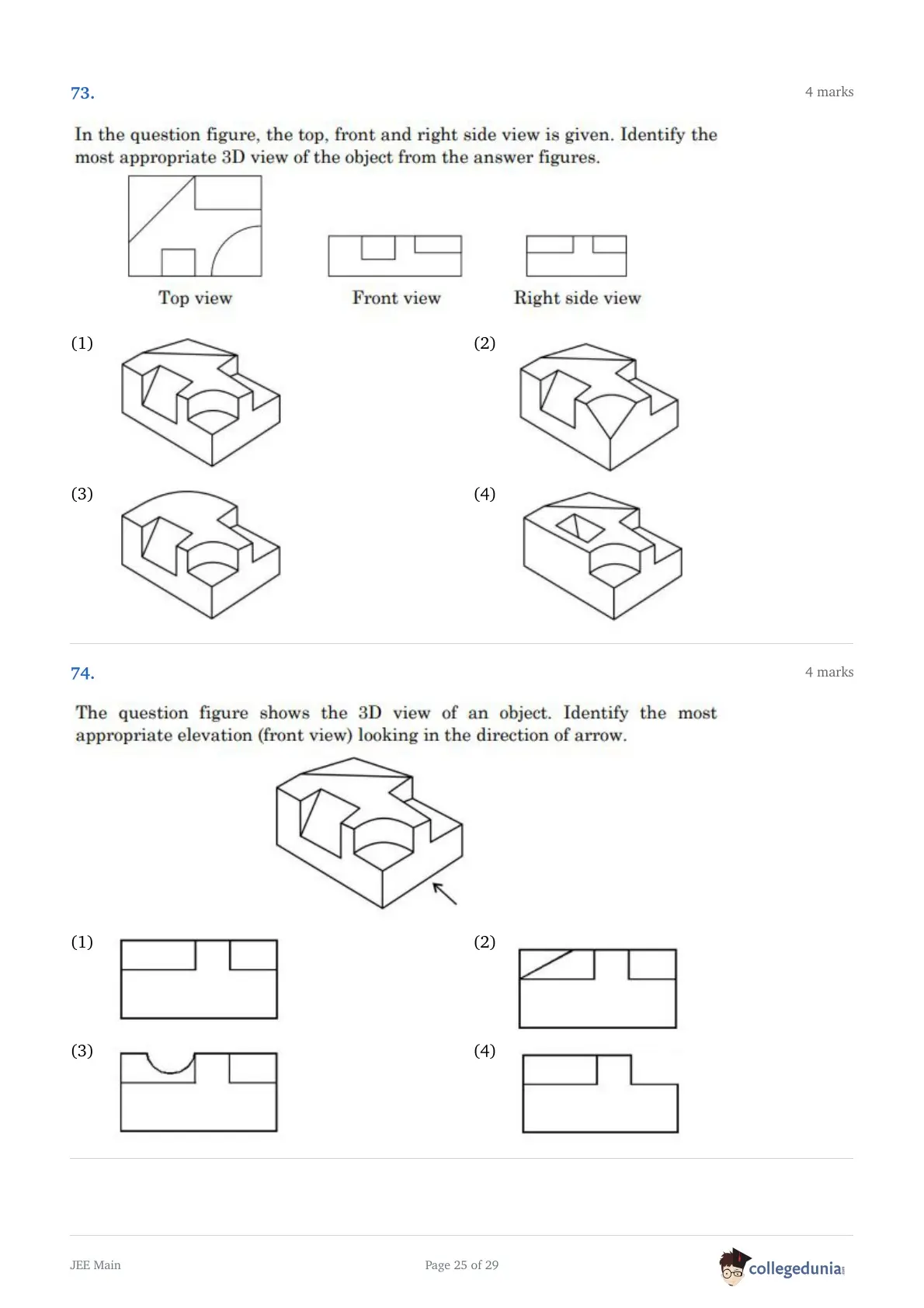
In the question figure, the top, front and right side view is given. Identify the most appropriate 3D view of the object from the answer figures.
- (1)
![]()
- (2)
![]()
- (3)
![]()
- (4)
![]()


The question figure shows the 3D view of an object. Identify the most appropriate elevation (front view) looking in the direction of arrow.
- (1)
![]()
- (2)
![]()
- (3)
![]()
- (4)
![]()


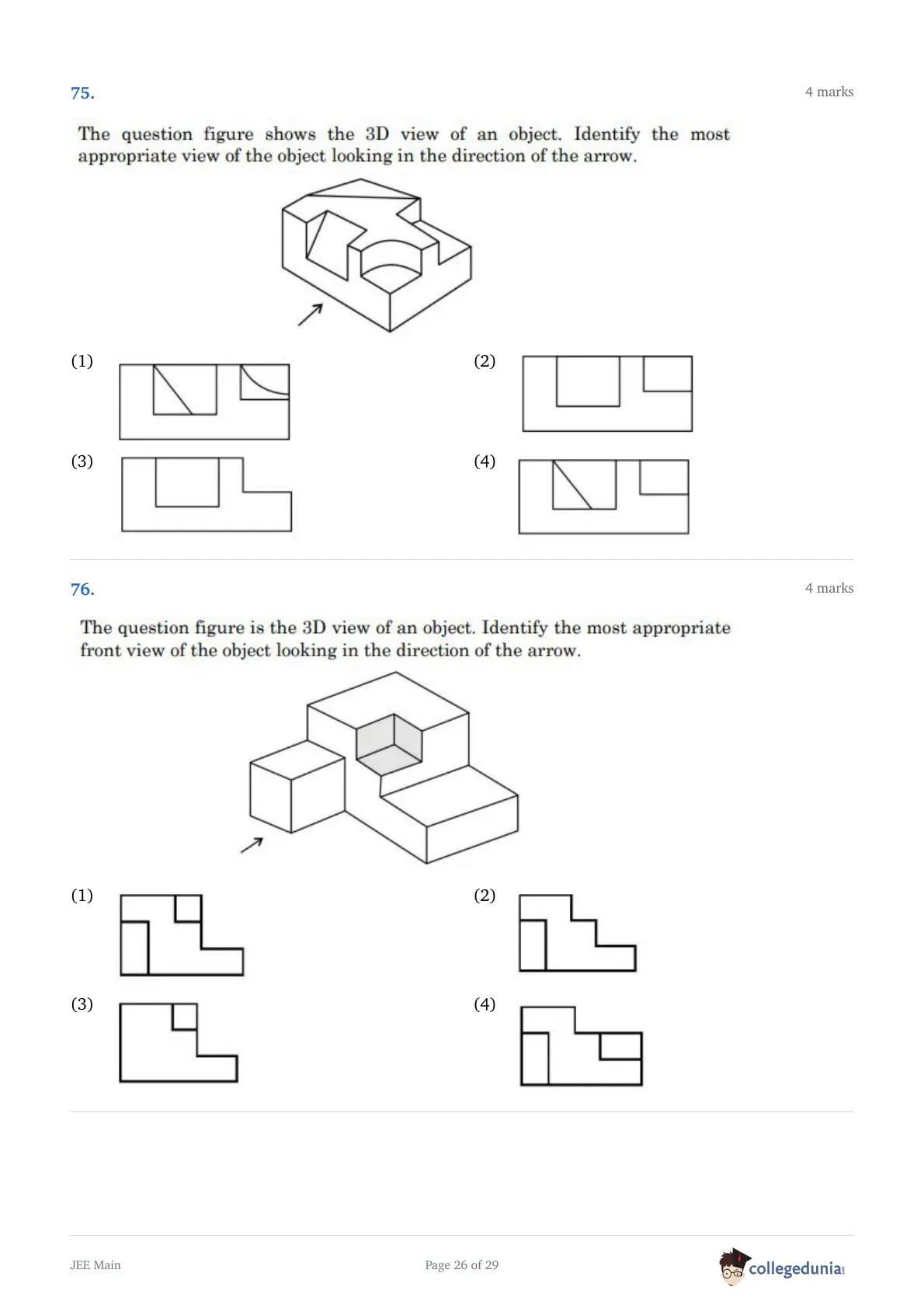
The question figure shows the 3D view of an object. Identify the most appropriate view of the object looking in the direction of the arrow.
- (1)
![]()
- (2)
![]()
- (3)
![]()
- (4)
![]()


The question figure is the 3D view of an object. Identify the most appropriate front view of the object looking in the direction of the arrow.
- (1)
![]()
- (2)
![]()
- (3)
![]()
- (4)
![]()


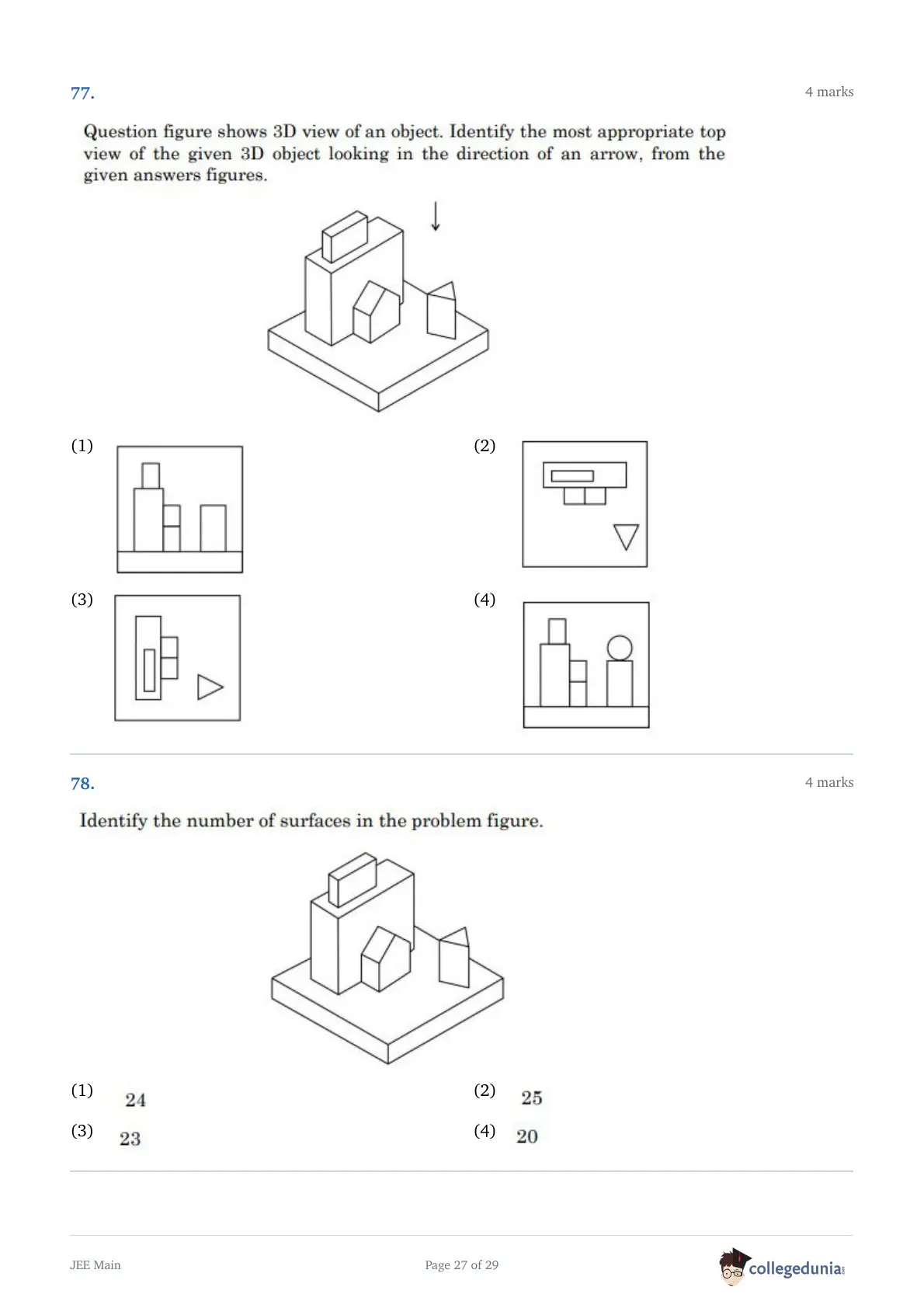
Question figure shows 3D view of an object. Identify the most appropriate top view of the given 3D object looking in the direction of an arrow, from the given answers figures.
- (1)
![]()
- (2)
![]()
- (3)
![]()
- (4)
![]()


Identify the number of surfaces in the problem figure.
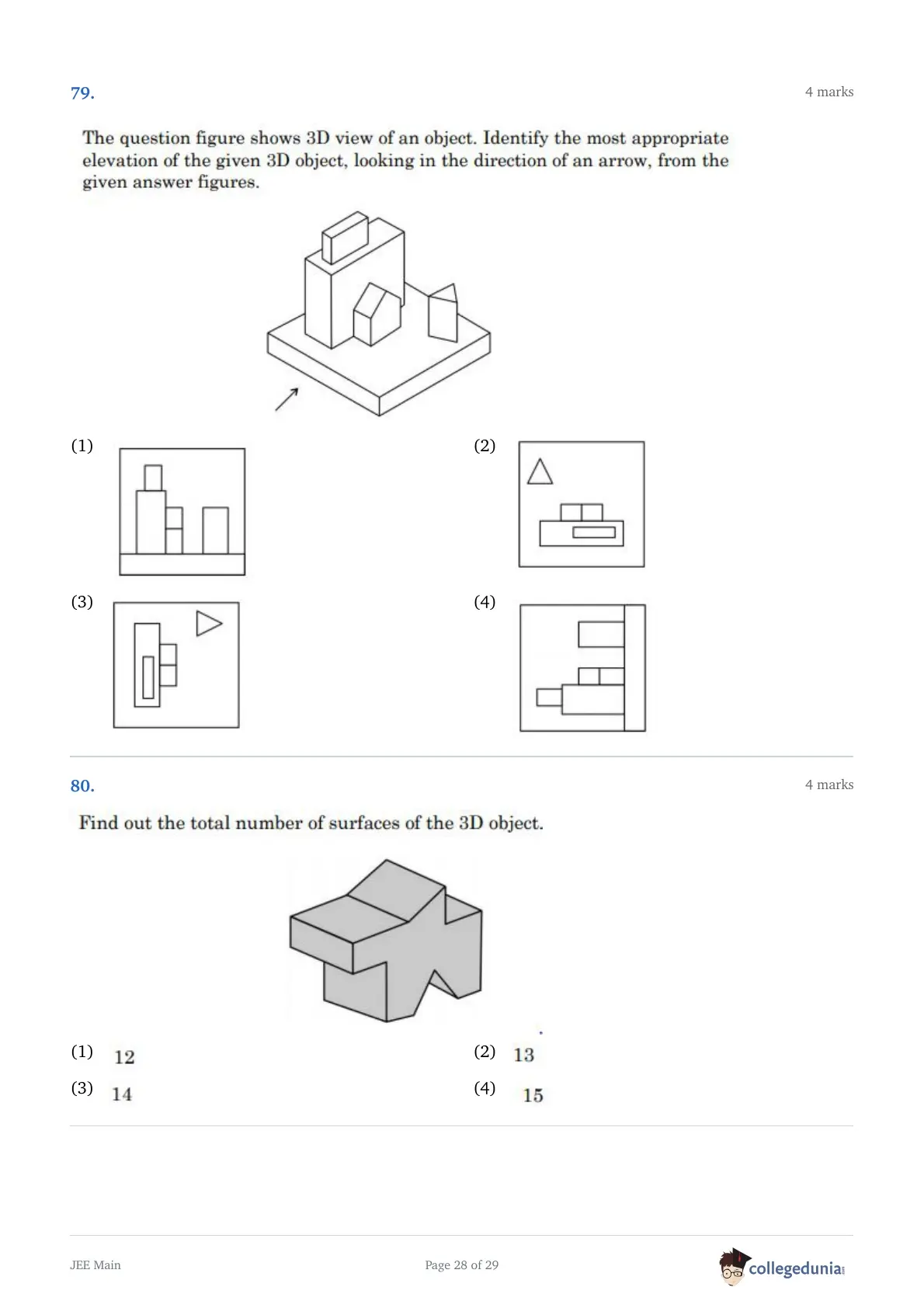
The question figure shows 3D view of an object. Identify the most appropriate elevation of the given 3D object, looking in the direction of an arrow, from the given answer figures.
- (1)
![]()
- (2)
![]()
- (3)
![]()
- (4)
![]()


Find out the total number of surfaces of the 3D object.
Drawing Test (Q81 - Q82)

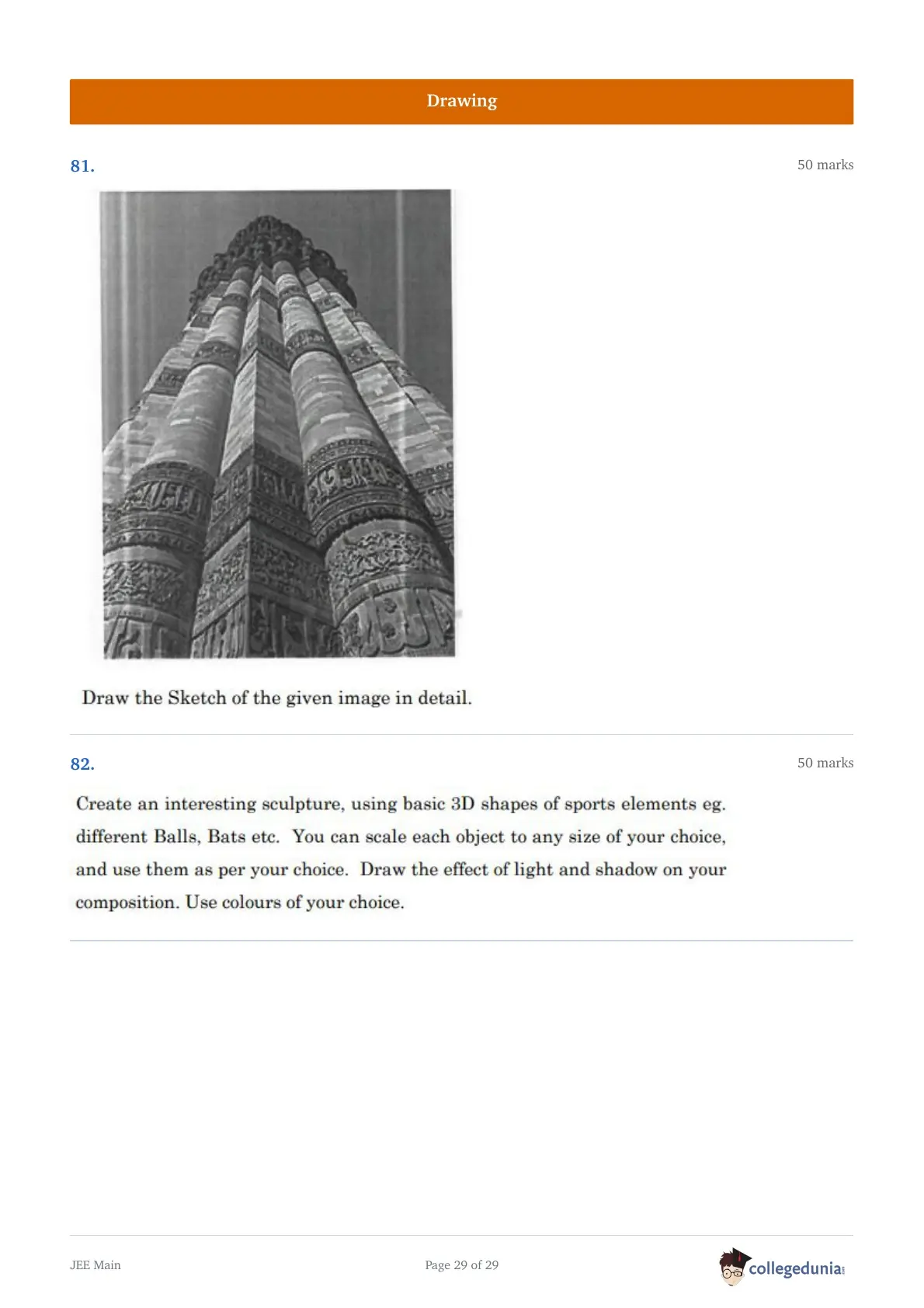
Draw the Sketch of the given image in detail.
Create an interesting sculpture, using basic 3D shapes of sports elements eg. different Balls, Bats etc. You can scale each object to any size of your choice, and use them as per your choice. Draw the effect of light and shadow on your composition. Use colours of your choice.
JEE Main 2023 B.Arch (Paper 2A) Exam Pattern and Marking Scheme
| Particulars | Details |
|---|---|
| Exam Mode | Online (Computer-Based Test) for Mathematics and Aptitude; Drawing Test on paper |
| Paper | B.Arch (Paper 2A) |
| Duration | 3 hours (180 minutes) |
| Type of Questions | Multiple Choice Questions (MCQs), numerical value questions and drawing questions |
| Subjects | Mathematics, Aptitude Test, Drawing Test |
| Total Questions | 82 questions (77 to be attempted) |
| Total Marks | 400 marks |
| Marking Scheme | +4 for correct answer & -1 for incorrect answer; 0 for unattempted |
JEE Main 2023 Paper Analysis April 12 Shift 2
JEE Main 2023 Paper Analysis for the exam scheduled on April 12 Shift 2 is available here. Candidates can check subject-wise paper analysis for the exam scheduled on April 12 Shift 2 here along with the topics with the highest weightage.
JEE Main 2023 B.Arch Question Paper Pattern
| Feature | Question Paper Pattern |
|---|---|
| Examination Mode | Computer-based Test (Pen-paper for Drawing Test) |
| Exam Language | 13 languages (English, Hindi, Assamese, Bengali, Gujarati, Kannada, Malayalam, Marathi, Odia, Punjabi, Tamil, Telugu, and Urdu) |
| Number of Sections | Three- Mathematics, Aptitude, Drawing |
| Exam Duration | 3 hours |
| Sectional Time Limit | None |
| Total Marks | 400 marks |
| Total Number of Questions Asked | 82 Questions |
| Total Number of Questions to be Answered | 77 questions |
| Type of Questions | MCQs and Numerical Answer Type Questions; Drawing Test |
| Section-wise Number of Questions | Mathematics- 20 MCQs and 10 numerical type Aptitude- 50 MCQs Drawing- 2 drawing questions |
| Marking Scheme | +4 for each correct answer (50 marks for each drawing question) |
| Negative Marking | -1 for each incorrect answer (no negative marking in drawing test) |
Also Check:



Comments