




JEE Main 2023 Chemistry April 15 Shift 1 Question Paper is available here for download. Candidates can download official JEE Main 2023 Chemistry Question Paper PDF with Solution and Answer Key for April 15 Shift 1 using the link below. JEE Main Chemistry Question Paper is divided into two sections, Section A with 20 MCQs and Section B with 10 numerical type questions. Candidates are required to answer all questions from Section A and any 5 questions from section B.
JEE Main 2023 Chemistry Question Paper April 15 Shift 1 PDF
Related Links:
- Download JEE Main Previous Year Question Papers PDF with Solutions
- Download JEE Main 2025 Question Paper for all Shifts
JEE Main 2023 Chemistry Question Paper Apr 15 Shift 1- Download PDF
| JEE Main 2023 April 15 Shift 1 Chemistry Question Paper with Solution PDF |  Download Download |
Check Solution |
Which one of the following is not an example of calcination?
View Solution
Calcination is a process in which an ore is heated to high temperature in the absence or limited supply of air. This leads to the decomposition of the ore, typically releasing volatile components such as water or carbon dioxide.
- In the reaction \( CaCO_3 \xrightarrow{\Delta} CaO + CO_2 \), calcium carbonate is heated to produce calcium oxide and carbon dioxide, which is a classic example of calcination.
- In the reaction \( 2PbS + 3O_2 \xrightarrow{\Delta} 2PbO + 2SO_2 \), lead sulfide is oxidized, which is an oxidation reaction, not calcination.
- The reaction \( CaCO_3 \cdot MgCO_3 \xrightarrow{\Delta} CaO + MgO + 2CO_2 \) is a calcination reaction, as it involves heating the carbonate to produce oxides and release carbon dioxide.
- In the reaction \( Fe_2O_3 \cdot xH_2O \xrightarrow{\Delta} Fe_3O_4 + xH_2O \), water is driven off from iron ore, which is another example of calcination.
Thus, option (2) is not an example of calcination. Quick Tip: Calcination specifically refers to the thermal decomposition of an ore, often to remove water or carbon dioxide. Oxidation reactions like the one in option (2) are not classified as calcination.
During water-gas shift reaction
View Solution
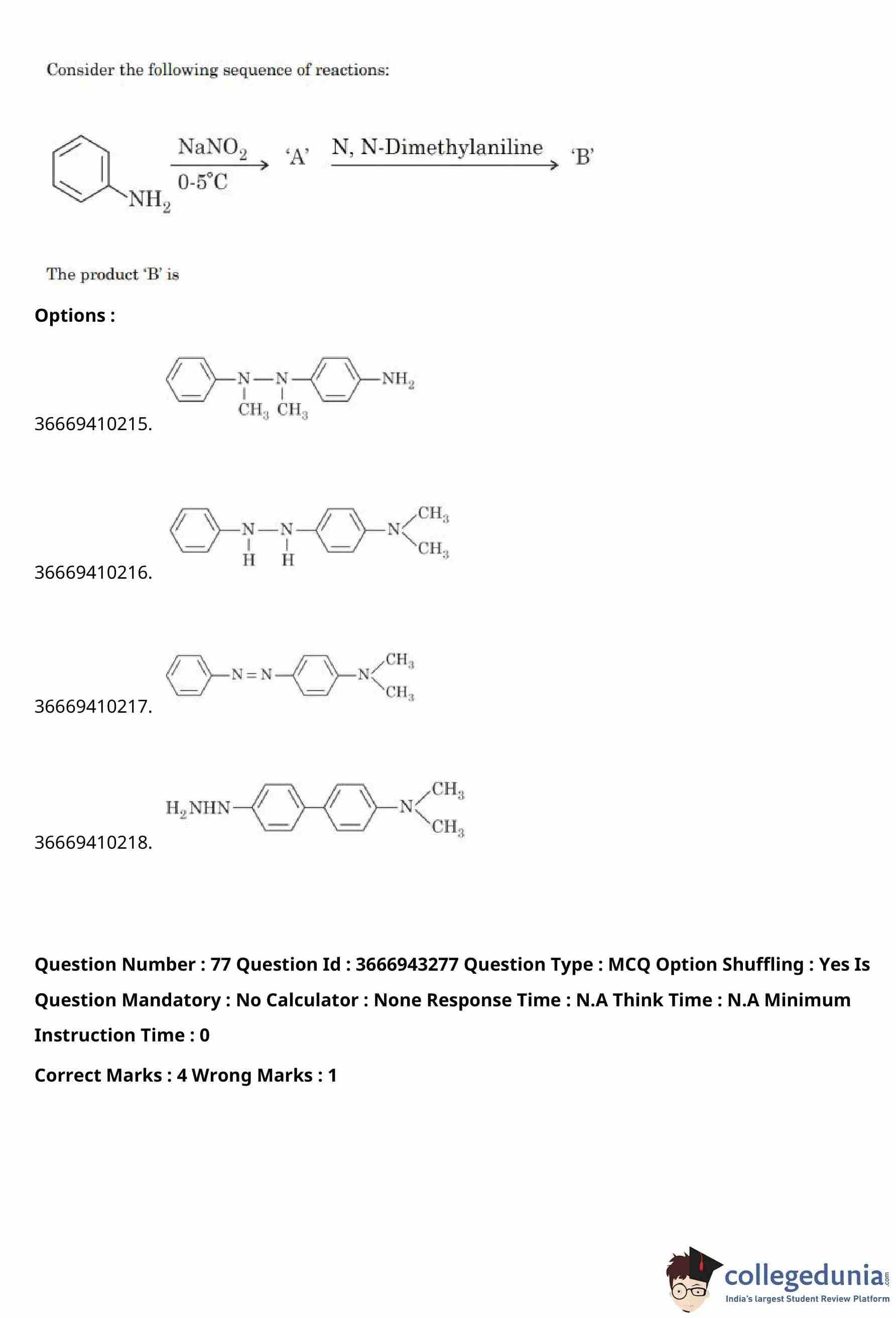
Consider the following sequence of reaction:

The product \( B \) is:
- (1)
![]()
- (2)
![]()
- (3)
![]()
- (4)
![]()


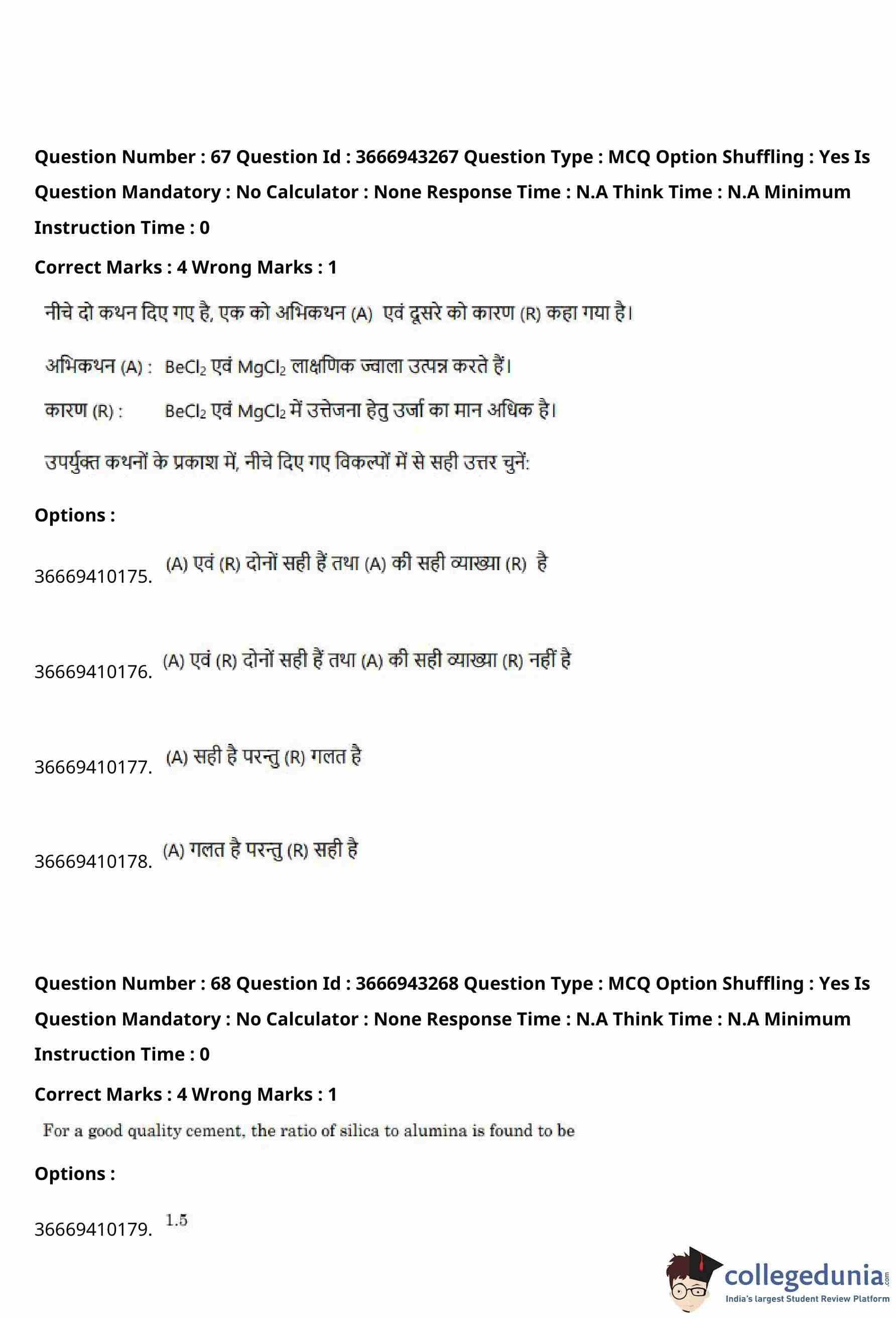
Given below are two statements: One is labeled as Assertion A and the other is labeled as Reason R:
Assertion (A): \( BeCl_2 \) and \( MgCl_2 \) Produce characteristic flame
Reason (R): The excitation energy is high in \( BeCl_2 \) and \( MgCl_2 \)
In the light of the above statement, choose the correct answer from the options given below:
View Solution


For a good quality cement, the ratio of silica to alumina is found to be
View Solution
Which of the following expressions is correct in case of a CaCl unit cell (edge length 'a')?
View Solution
Given below are two statements:
Statement I: According to Bohr's model of hydrogen atom, the angular momentum of an electron in a given stationary state is quantised.
Statement II: The concept of electron in Bohr's orbit violates the Heisenberg uncertainty principle.
In the light of the above statements, choose the most appropriate answer from the options given below:
View Solution
In the above conversion the correct sequence of reagents to be added is:
View Solution
The product formed in the following multistep reaction is:

- (1)
![]()
- (2)
![]()
- (3)
![]()
- (4)
![]()


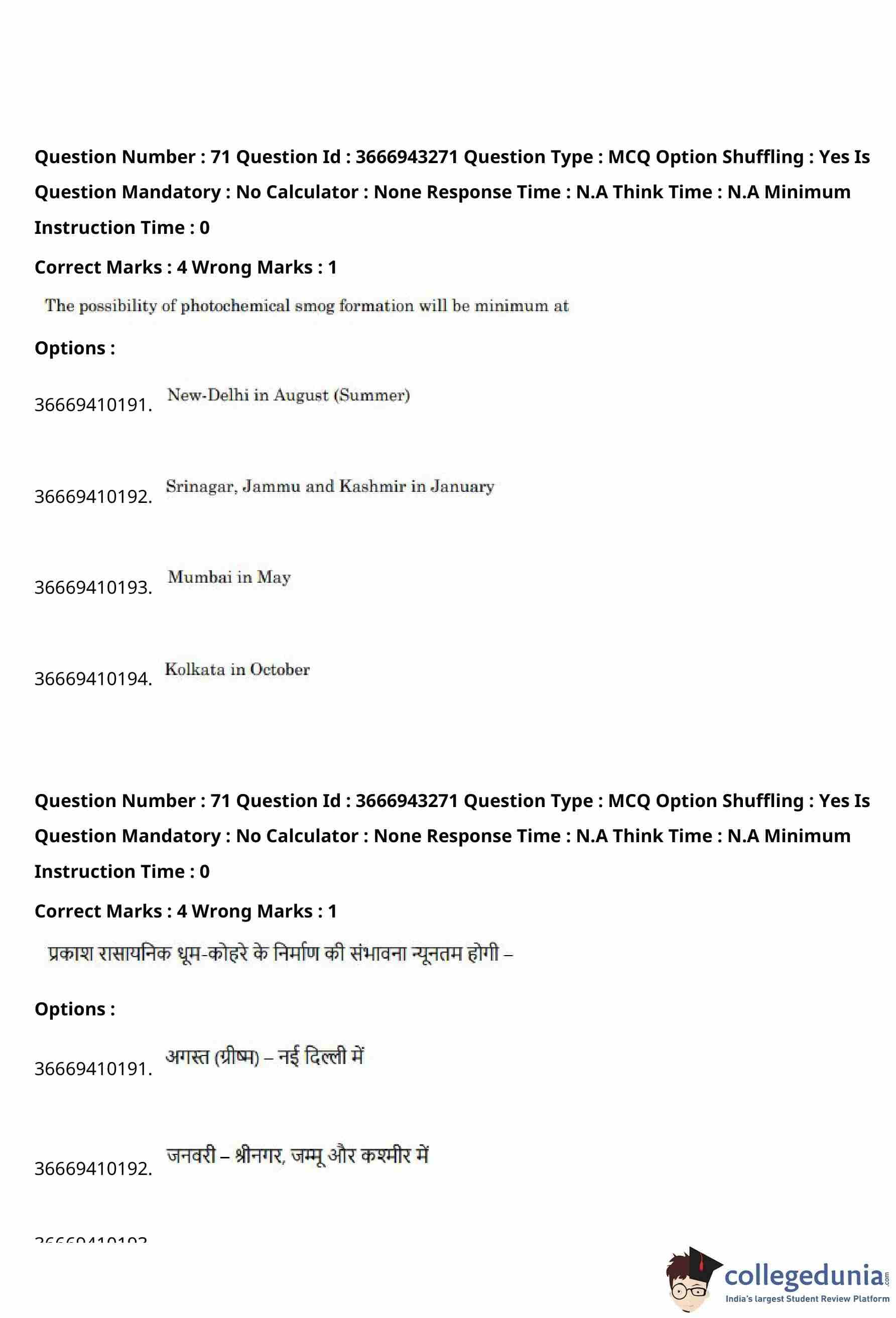
The possibility of photochemical smog formation will be minimum at:
View Solution
Consider the following statements:
(A) NF\(_3\) molecule has a trigonal planar structure.
(B) Bond length of N\(_2\) is shorter than O\(_2\).
(C) Isoelectronic molecules or ions have identical bond order.
(D) Dipole moment of HS is higher than that of water molecule.
Choose the correct answer from the options given below:
View Solution
The number of P–O–P bonds in H\(_4\)P\(_2\)O\(_7\), (HPO\(_3\))\(_3\), and P\(_4\)O\(_{10}\) are respectively:
View Solution
Which is not true for arginine?
View Solution
The complex with highest magnitude of crystal field splitting energy (\(\Delta_o\)) is
View Solution
Which of the following statement is correct for paper chromatography?
View Solution
Which of the following statement(s) is/are correct?
(A) The pH of 1 x 10\(^-8\) M HCl solution is 8
(B) The conjugate base of H\(_2\)PH\(_4^+\) is HPO\(_4^{2-}\)
(C) K\(_w\) increases with increase in temperature.
(D) When a solution of a weak monoprotic acid is titrated against a strong base at half neutralisation point, pH = \(\frac{1}{2}\) pK\(_a\).
View Solution
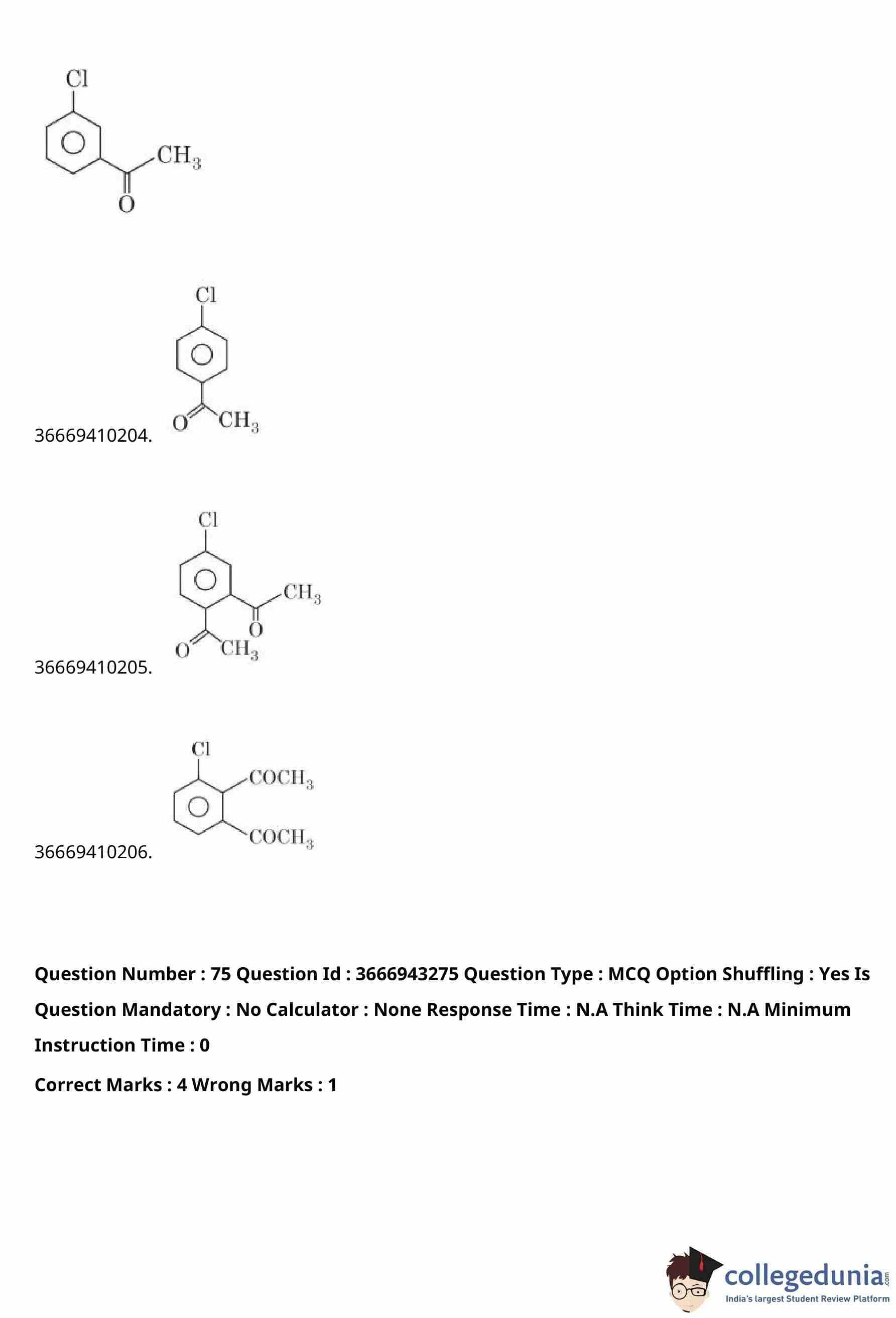
The major product in the Friedel-Craft acylation of chlorobenzene is:
- (1)
![]()
- (2)
![]()
- (3)
![]()
- (4)
![]()


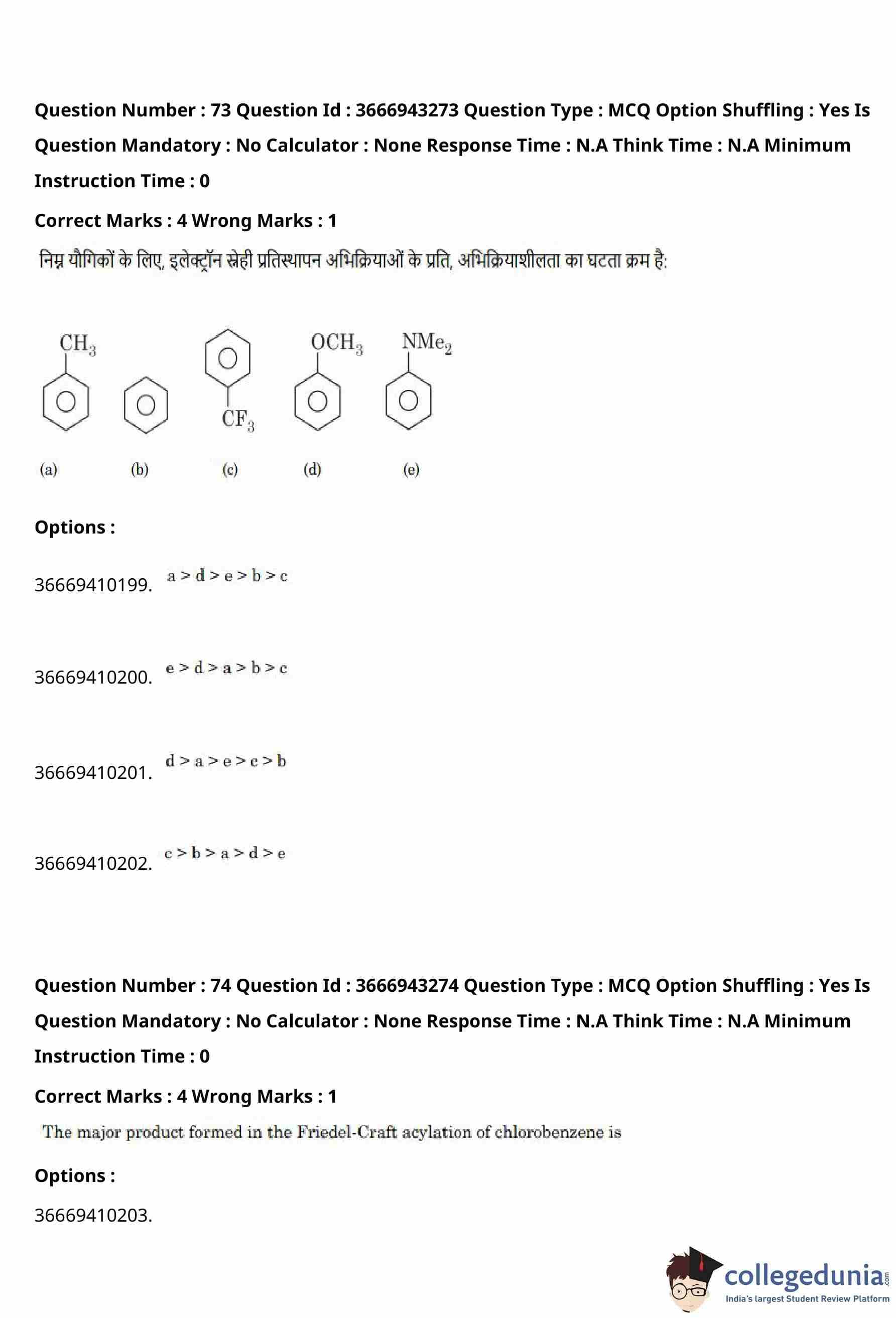
Decreasing order of reactivity towards electrophilic substitution for the following compounds is:

View Solution
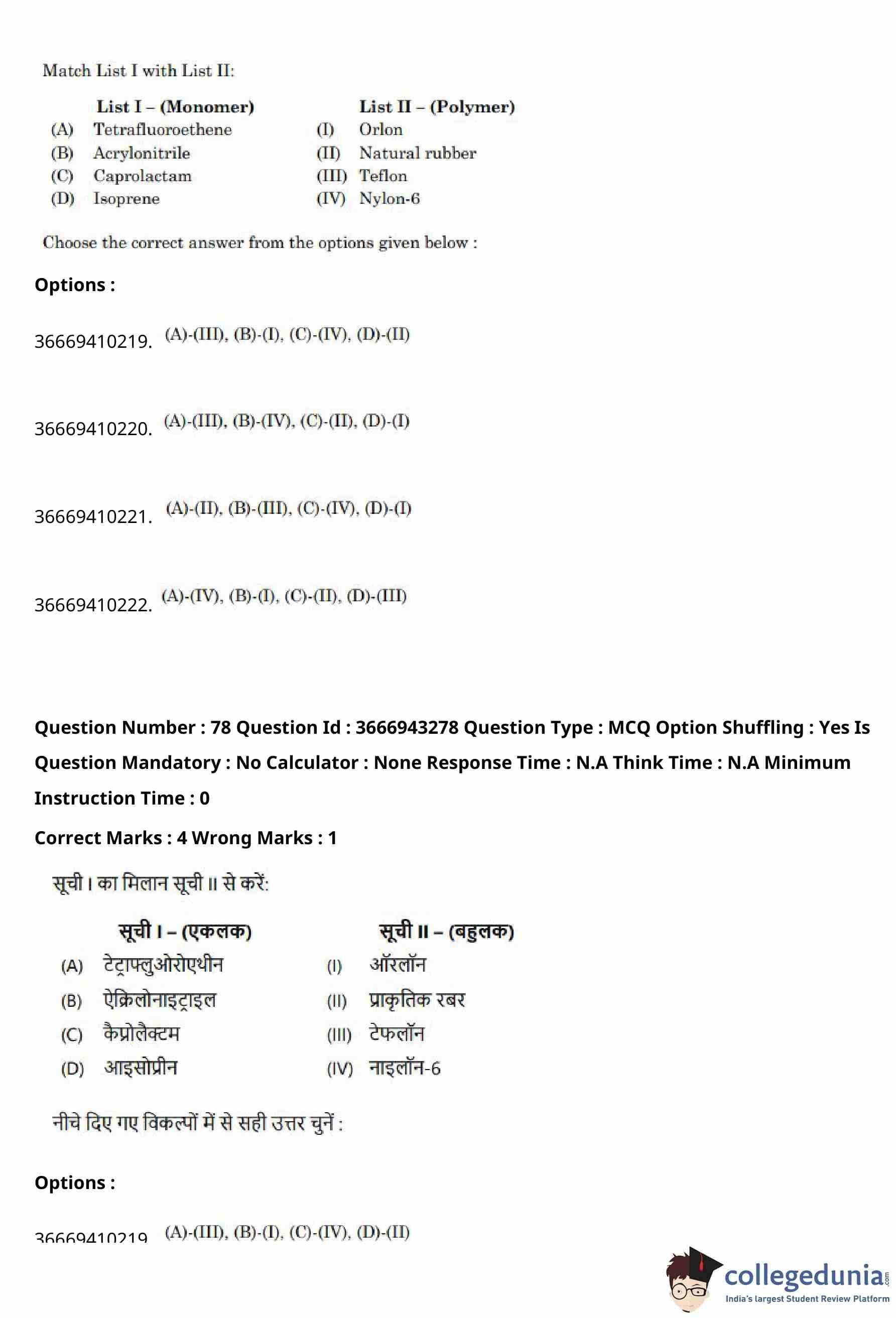
Match List-I with List-II :

Choose the correct answer from the options given below:
View Solution
The homoleptic and octahedral complex of \( Co^{2+} \) and \( H_2O \) has ____ unpaired electron(s) in the \( t_{2g} \) set of orbitals.
View Solution
30.4 kJ of heat is required to melt one mole of sodium chloride and the entropy change at the melting point is 28.4 \( J K^{-1} mol^{-1} \) at 1 atm. The melting point of sodium chloride is ____ K. (Nearest Integer)
View Solution
The total number of isoelectronic species from the given set is ___.
View Solution
The given species are: \[ O^{2-}, \, F^-, \, Al^{3+}, \, Na^+, \, O^+, \, Mg, \, Al^{3+}, \, F. \]
The number of electrons in each species is as follows:
- \( O^{2-} \) has 10 electrons
- \( F^- \) has 10 electrons
- \( Al^{3+} \) has 10 electrons
- \( Na^+ \) has 10 electrons
- \( O^+ \) has 9 electrons
- \( Mg \) has 10 electrons
- \( Al^{3+} \) has 10 electrons
- \( F \) has 9 electrons
The isoelectronic species are those with the same number of electrons. The isoelectronic species in the set are:
- \( O^{2-} \), \( F^- \), \( Al^{3+} \), \( Na^+ \), \( Mg \), \( F \)
Therefore, the total number of isoelectronic species is 5. Quick Tip: Isoelectronic species have the same number of electrons, but may differ in the number of protons.
For a reversible reaction \( A \rightleftharpoons B \), the \( \Delta H_{forward} = 20 \, kJ/mol \). The activation energy of the uncatalysed forward reaction is 300 kJ/mol. When the reaction is catalysed keeping the reactant concentration same, the rate of the catalysed forward reaction at 27°C is found to be same as that of the uncatalysed reaction at 327°C. The activation energy of the catalysed backward reaction is ____ kJ/mol.
View Solution
The vapour pressure of 30% (w/v) aqueous solution of glucose is _____ mm Hg at 25°C.
[Given: The density of 30% (w/v), aqueous solutions of glucose is 1.2 g cm and vapour pressure of pure water is 24 mm Hg. ]
View Solution
In Chromyl chloride, the oxidation state of chromium is (+) ____.
View Solution
The volume (in mL) of 0.1 M AgNO\textsubscript{3} required for complete precipitation of chloride ions present in 20 mL of 0.01 M solution of as silver chloride is ____.
View Solution
20 mL of 0.5 M NaCl is required to coagulate 200 mL of As\textsubscript{2}S\textsubscript{3} solution in 2 hours. The coagulating value of NaCl is ___.
View Solution
The total change in the oxidation state of manganese involved in the reaction of KMnO\textsubscript{4} and potassium iodide in the acidic medium is _____.
View Solution
The number of correct statements from the following is \
_____.
(A) Conductivity always decreases with decrease in concentration for both strong and weak electrolysis.
(B) The number of ions per unit volume that carry current in a solution increases on dilution.
(C) Molar conductivity increases with decrease in concentration.
(D) The variation in molar conductivity is different for strong and weak electrolysis.
(E) For weak electrolysis, the change in molar conductivity with dilution is due to the decrease in degree of dissociation.
View Solution












JEE Main 2023 Chemistry Paper Analysis April 15 Shift 1
JEE Main 2023 Chemistry Paper Analysis for the exam scheduled on April 15 Shift 1 is available here. Candidates can check subject-wise paper analysis for the exam scheduled on April 15 Shift 1 here along with the topics with the highest weightage.
JEE Main 2023 Chemistry Question Paper Pattern
| Feature | Question Paper Pattern |
|---|---|
| Examination Mode | Computer-based Test |
| Exam Language | 13 languages (English, Hindi, Assamese, Bengali, Gujarati, Kannada, Malayalam, Marathi, Odia, Punjabi, Tamil, Telugu, and Urdu) |
| Exam Duration | 3 hours |
| Sectional Time Limit | None |
| Chemistry Marks | 100 marks |
| Total Number of Questions Asked | 20 MCQs + 10 Numerical Type Questions |
| Total Number of Questions to be Answered | 20 MCQs + 5 Numerical Type Questions |
| Marking Scheme | +4 for each correct answer |
| Negative Marking | -1 for each incorrect answer |
Also Check:





Comments