




JEE Main 2022 June 24 Shift 2 Question Paper is available here with solutions PDF and detailed solutions for every question. NTA conducted the second shift on June 24, 2022, from 3:00 PM to 6:00 PM. The JEE Main 2022 Paper 1 (B.E./B.Tech) question paper includes the following:
- 90 questions in a 3-hour CBT Mode: 30 each from Mathematics, Physics and Chemistry (75 to be attempted)
- Section A: 20 multiple choice questions (MCQs) per subject, all compulsory, 4 marks each
- Section B: 10 numerical value questions per subject, any 5 to be attempted, 4 marks each
- Marking: +4 for a correct answer, -1 for an incorrect answer, 0 for an unattempted question
- Maximum marks: 300 (100 per subject)
JEE Main 2022 June 24 Shift 2 Question Paper with Solution PDF
| NTA Official PDF | CD PDF | CD PDF with Solutions |
|---|---|---|
| Download official PDF 4.01 MB | Download Collegedunia PDF 0.74 MB | Download solutions PDF 0.78 MB |
Also Check:
JEE Main 2022 June 24 Shift 2 Questions with Solutions
Mathematics - Section A (Q1 - Q20)
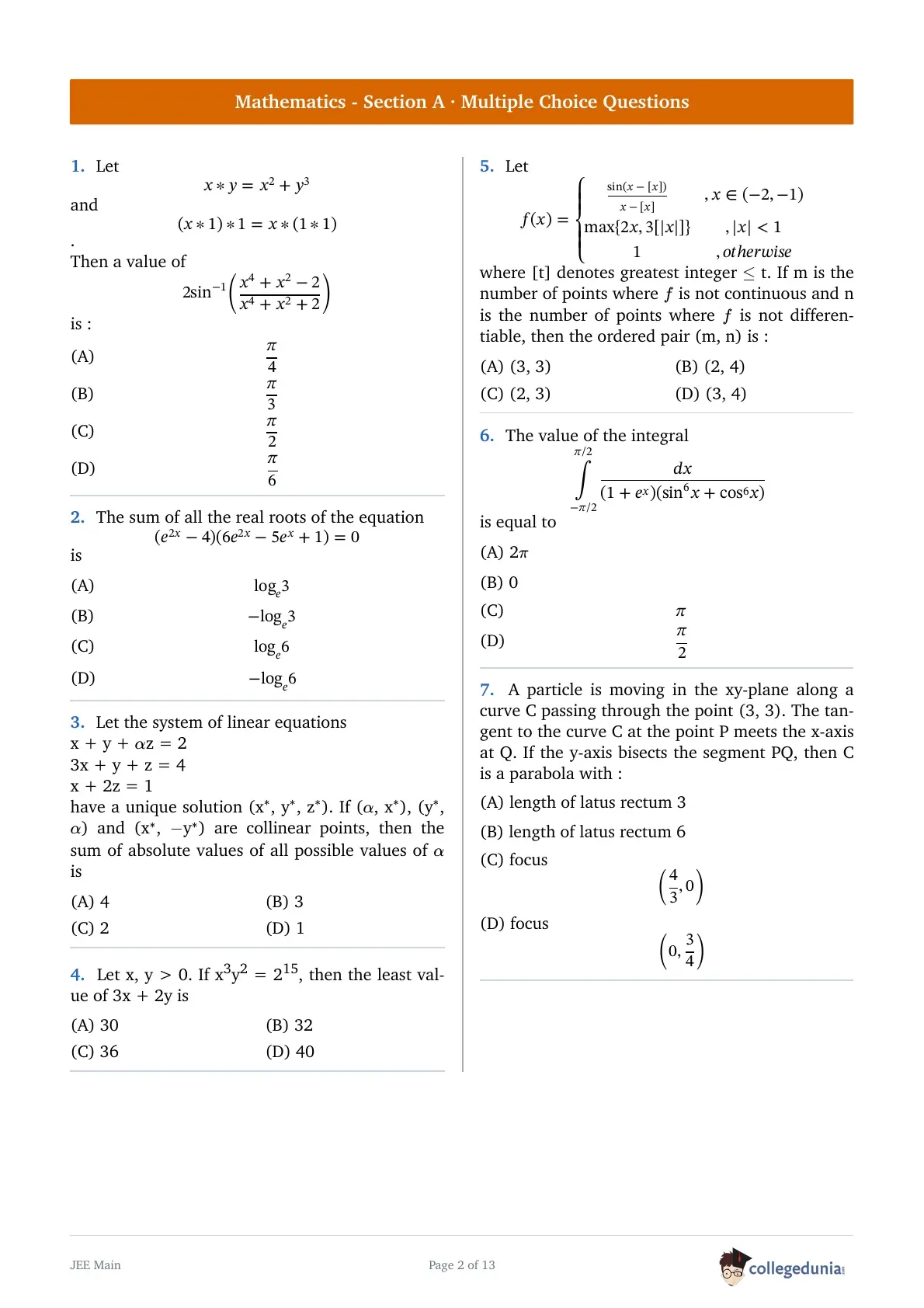
Let \(x * y\) = \(x^2 + y^3\) and \((x * 1) * 1\) = \(x * (1 * 1)\). Then a value of \(2 sin^{-1}\bigg(\frac{x^4+x^2-2}{x^4+x^2+2}\bigg)\) is
The sum of all the real roots of the equation \((e^{2x} – 4)(6e^{2x} – 5e^x + 1) = 0\) is
Let the system of linear equations
x + y + az = 2
3x + y + z = 4
x + 2z = 1
have a unique solution (x*, y*, z*). If (α, x*), (y*, α) and (x*, –y*) are collinear points, then the sum of absolute values of all possible values of α is
Let \(x, y > 0\). If \(x^3y^2 = 2^{15}\), then the least value of \(3x + 2y\) is
\(f(x) = \begin{cases} \frac{sin(x-|x|)}{x-|x|} & \quad {x \in(-2,-1) } \\ max{2x,3[|x|]}, & \quad \text{|x|<1}\\1 & \quad \text{,otherwise} \end{cases}\) Where [t] denotes greatest integer t. If m is the number of points where f is not continuous and n is the number of points where f is not differentiable, then the ordered pair (m, n) is
The value of the integral \(∫^{ \frac{π}{2}}_{ \frac{-π}{2}} \frac{dx}{(1+e^x)(sin^6x+cos^6x)}\) is equal to
A particle is moving in the xy-plane along a curve C passing through the point (3, 3). The tangent to the curve C at the point P meets the x-axis at Q. If the y-axis bisects the segment PQ, then C is a parabola with
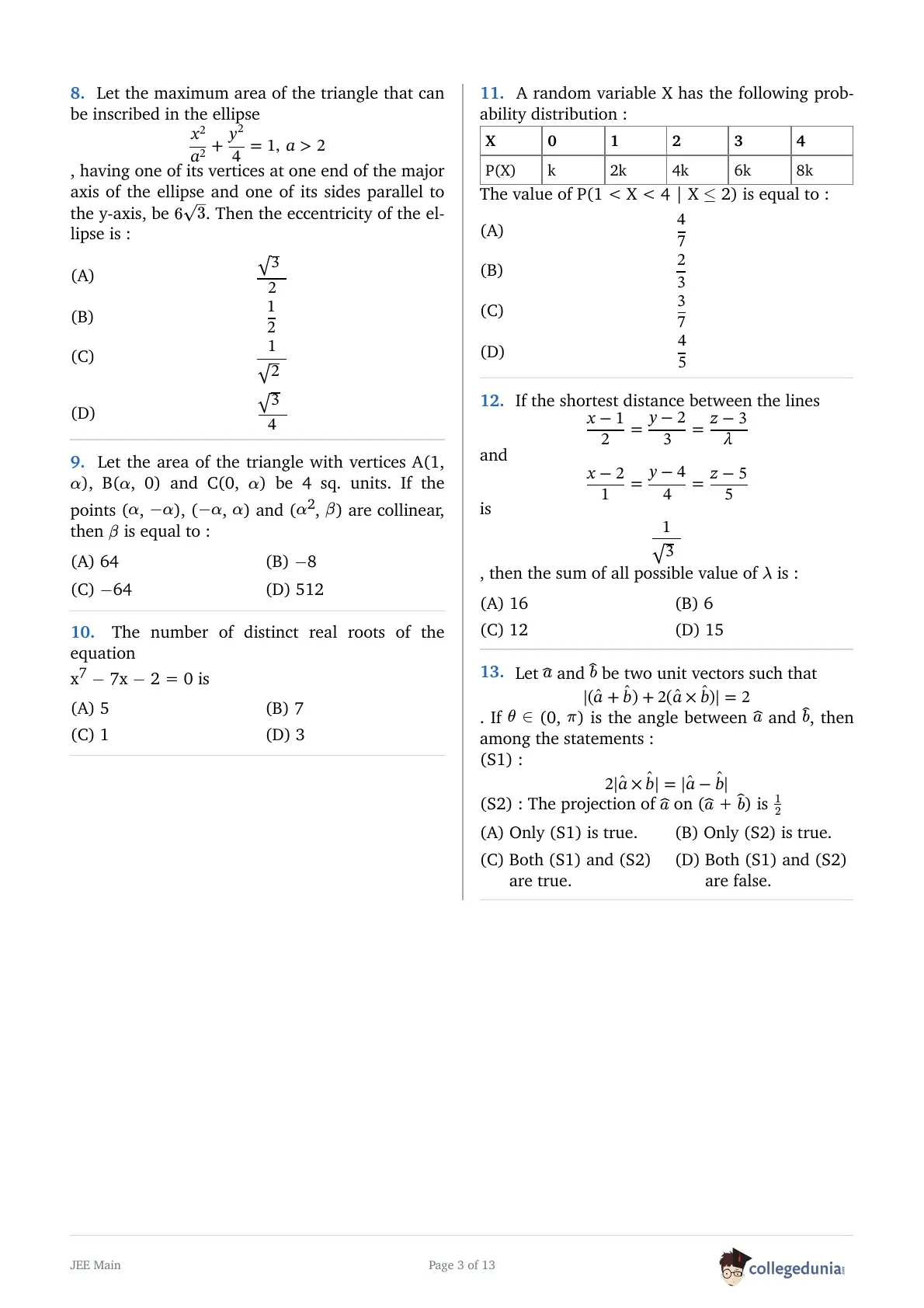
Let the maximum area of the triangle that can be inscribed in the ellipse \(\frac{x^2}{a^2}+\frac{y^2}{4} = 1, a>2\), having one of its vertices at one end of the major axis of the ellipse and one of its sides parallel to the \(y\)-axis, be \(6\sqrt3\). Then the eccentricity of the ellipse is
Let the area of the triangle with vertices \(A(1, α), B(α, 0)\) and \(C(0, α)\) be \(4\) sq. units. If the points \((α, –α), (–α, α)\) and \((α^2, β)\) are collinear, then \(β\) is equal to
The number of distinct real roots of the equation \(x^7 – 7x – 2 = 0\) is
| x | 0 | 1 | 2 | 3 | 4 |
| P(x) | k | 2k | 4k | 6k | 8k |
The value of \(P(1 < X < 4 | x ≤ 2)\) is equal to
If the shortest distance between the lines \(\frac{x-1}{2} = \frac{y-2}{3} = \frac{z-3}{λ}\; and\; \frac{x-2}{1 }= \frac{y-4}{4 }= \frac{z-5}{5 }\;is\; \frac{1}{\sqrt3}\), then the sum of all possible values of \(λ\) is :
Let \(\hat a\) and \(\hat b\) be two unit vectors such that \(| (a+b)+2(a × b)|\) =\( 2\). If \(θ ∈ (0, π)\) is the angle between a and b, then among the statements: \((S1)\): \(2|a×b|=|a-b|\) \((S2)\): The projection of a on \((\hat a+\hat b)\) is \(\frac{1}{2}\)
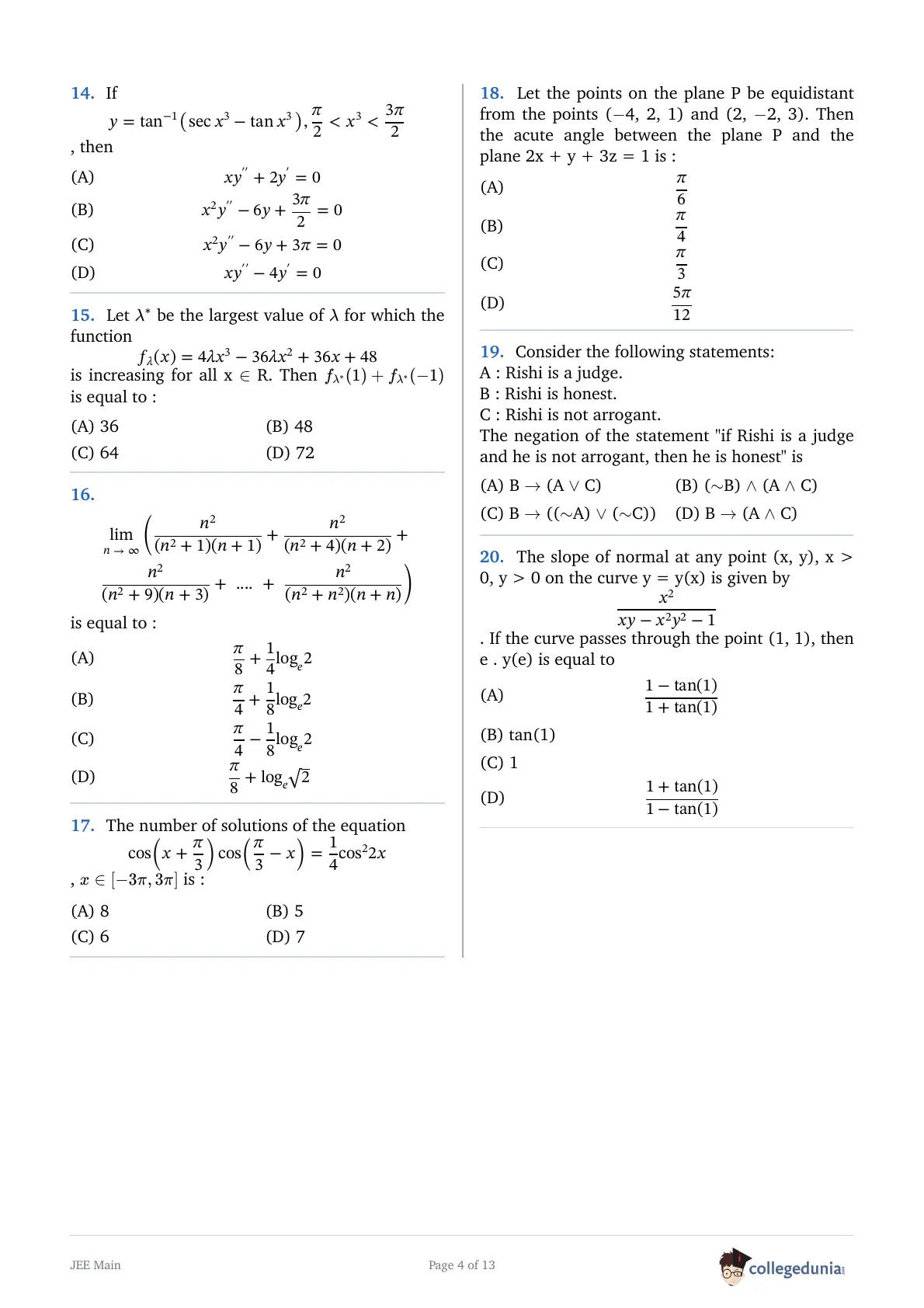
\(y=tan^{-1}(sec \;x^3 - tan\; x^3), \frac{π}{2} < x^3< \frac{3π}{2},\) then
Let \(λ^*\) be the largest value of \(λ\) for which the function \(f_λ(x) = 4λx^3 – 36λx^2 + 36x + 48\) is increasing for all \(x ∈ ℝ\). Then \(f_λ^* (1) + f_λ^* (– 1)\) is equal to :
\(lim _{ n → ∞}\bigg (\frac{n^2}{(n^2+1)(n+1)}+\frac{n^2}{(n^2+4)(n+2)}+\frac{n^2}{(n2+9)(n+3)}.....+ \frac{n^2}{(n^2+n^2)(n+n)}\bigg)\)is equal to
The number of solutions of the equation \(cos \bigg(x+\frac{π}{3}\bigg)cos\bigg(\frac{π}{3-x}\bigg)=\frac{1}{4}cos^22x,x ∈ [-3π, 3π]\) is:
Let the points on the plane P be equidistant from the points (–4, 2, 1) and (2, –2, 3). Then the acute angle between the plane P and the plane 2x + y + 3z = 1 is
Consider the following statements:
A : Rishi is a judge.
B : Rishi is honest.
C : Rishi is not arrogant.
The negation of the statement “if Rishi is a judge and he is not arrogant, then he is honest” is
The slope of normal at any point \((x, y), x > 0, y > 0\) on the curve \(y = y(x)\) is given by \(\frac{x^2}{xy-x^2y2^-1}\) If the curve passes through the point (1, 1), then \(e · y(e)\) is equal to
Mathematics - Section B (Q21 - Q30)
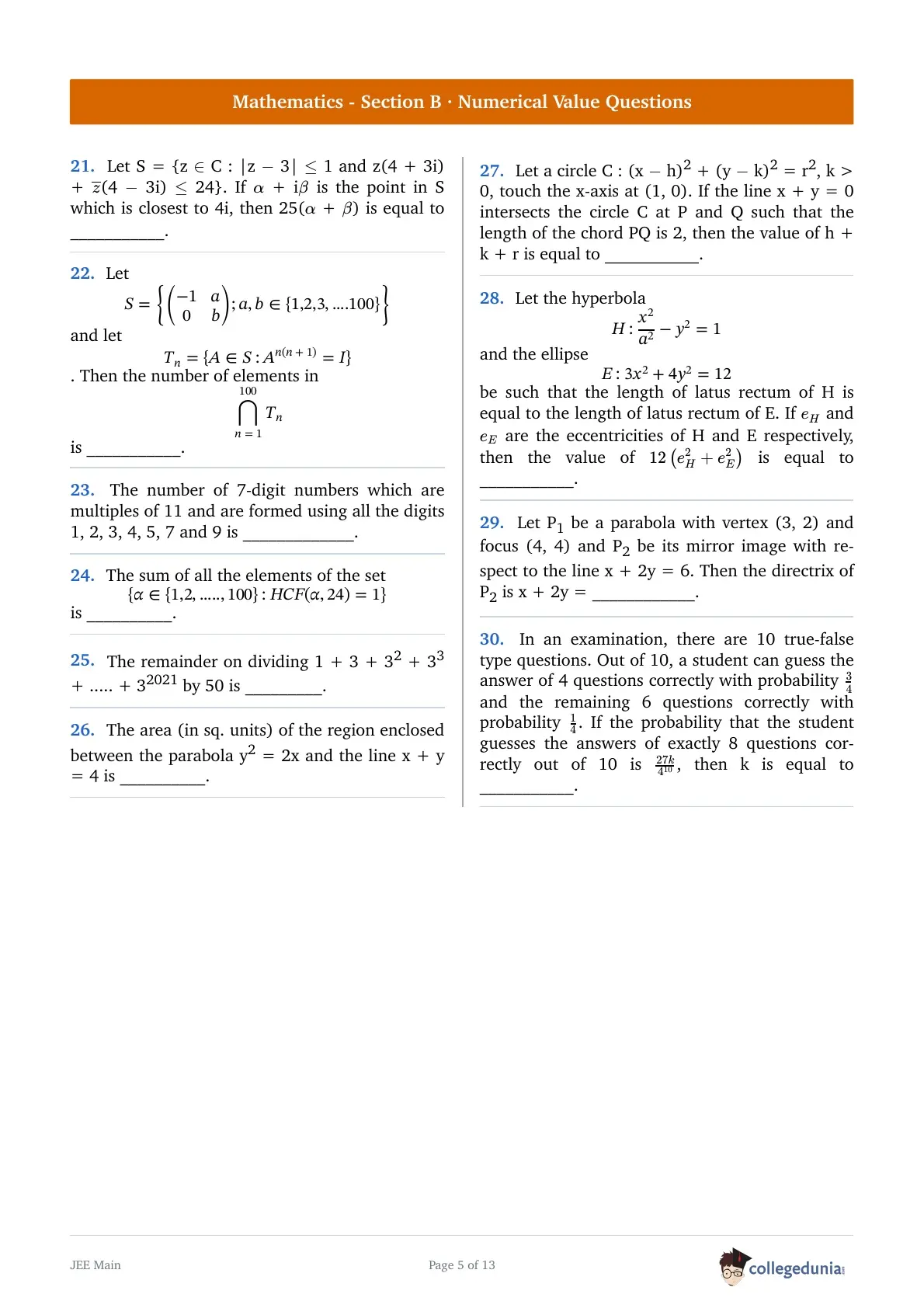
Let \(S = z ∈ C: |z-3| <= 1\) and \(z (4+3i)+z(4-3)≤24.\)
If α + iβ is the point in S which is closest to 4i, then 25(α + β) is equal to ______.
Let \(S ={ (\begin{matrix} -1 & 0 \\ a & b \end{matrix}), a,b, ∈(1,2,3,.....100)}\) and
let \(T_n = {A ∈ S : A^{n(n + 1)} = I}. \)
Then the number of elements in \(\bigcap_{n=1}^{100}\) \(T_n \) is
The number of 7-digit numbers which are multiples of 11 and are formed using all the digits 1, 2, 3, 4, 5, 7 and 9 is _____.
The sum of all the elements of the set {α ∈ {1, 2, …, 100} : HCF(α, 24) = 1} is
The remainder on dividing 1 + 3 + 32 + 33 + … + 32021 by 50 ____ is
The area (in sq. units) of the region enclosed between the parabola y2 = 2x and the line x + y = 4 is _______.
Let a circle C : (x – h)2 + (y – k)2 = r2, k > 0, touch the x-axis at (1, 0). If the line x + y = 0 intersects the circle C at P and Q such that the length of the chord PQ is 2, then the value of h + k + r is equal to ____.
Let the hyperbola
\(H:\frac{x^2}{a^2}−y^2=1\)
and the ellipse
\(E:3x^2+4y^2=12\)
be such that the length of latus rectum of H is equal to the length of latus rectum of E. If eH and eE are the eccentricities of H and E respectively, then the value of
\(12 (e^{2}_H+e^{2}_E)\) is equal to _____ .
Let P1 be a parabola with vertex (3, 2) and focus (4, 4) and P2 be its mirror image with respect to the line x + 2y = 6. Then the directrix of P2 is x + 2y = _______.
In an examination, there are 10 true-false type questions. Out of 10, a student can guess the answer of 4 questions correctly with probability 3/4 and the remaining 6 questions correctly with probability ¼. If the probability that the student guesses the answers of exactly 8 questions correctly out of 10 is \(\frac{27k}{4^{10}}\),then k is equal to
Physics - Section A (Q31 - Q50)
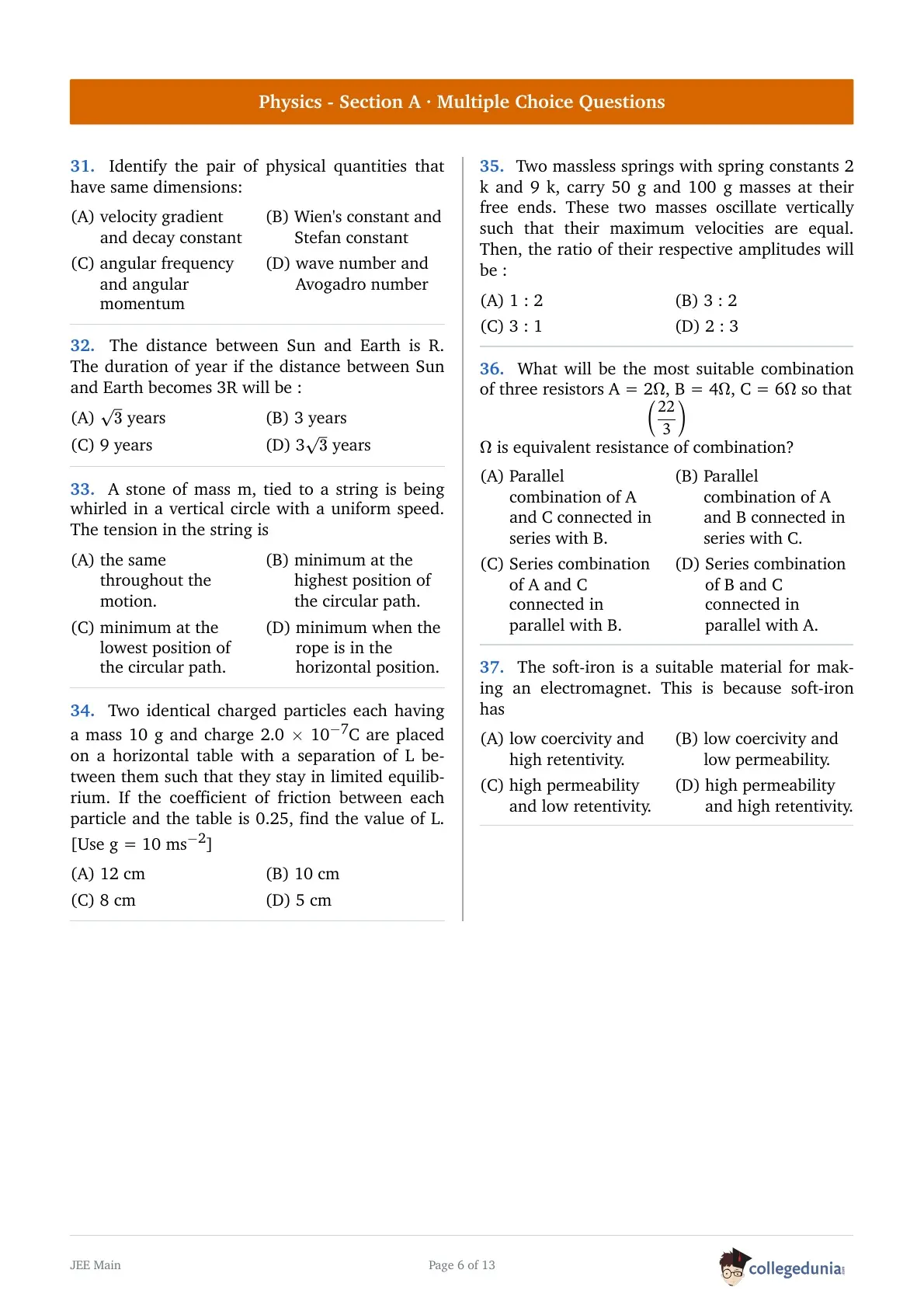
Identify the pair of physical quantities that have same dimensions :
The distance between Sun and Earth is R. The duration of year if the distance between Sun and Earth becomes 3R will be :
A stone of mass m tied to a string is being whirled in a vertical circle with a uniform speed. The tension in the string is
Two identical charged particles each having a mass 10 g and charge \(2.0 × 10^{–7}\) C are placed on a horizontal table with a separation of L between them such that they stay in limited equilibrium. If the coefficient of friction between each particle and the table is \(0.25\), find the value of L. [Use g = \(10\) \(ms^{–2}\)]
Two massless springs with spring constant 2 k and 9 k, carry 50 g and 100 g masses at their free ends. These two masses oscillate vertically such that their maximum velocities are equal. Then, the ratio of their respective amplitude will be
What will be the most suitable combination of three resistors A = 2 Ω, B = 4 Ω, C = 6 Ω so that \((22/3)\) Ω is equivalent resistance of combination?
The soft-iron is a suitable material for making an electromagnet. This is because soft-iron has
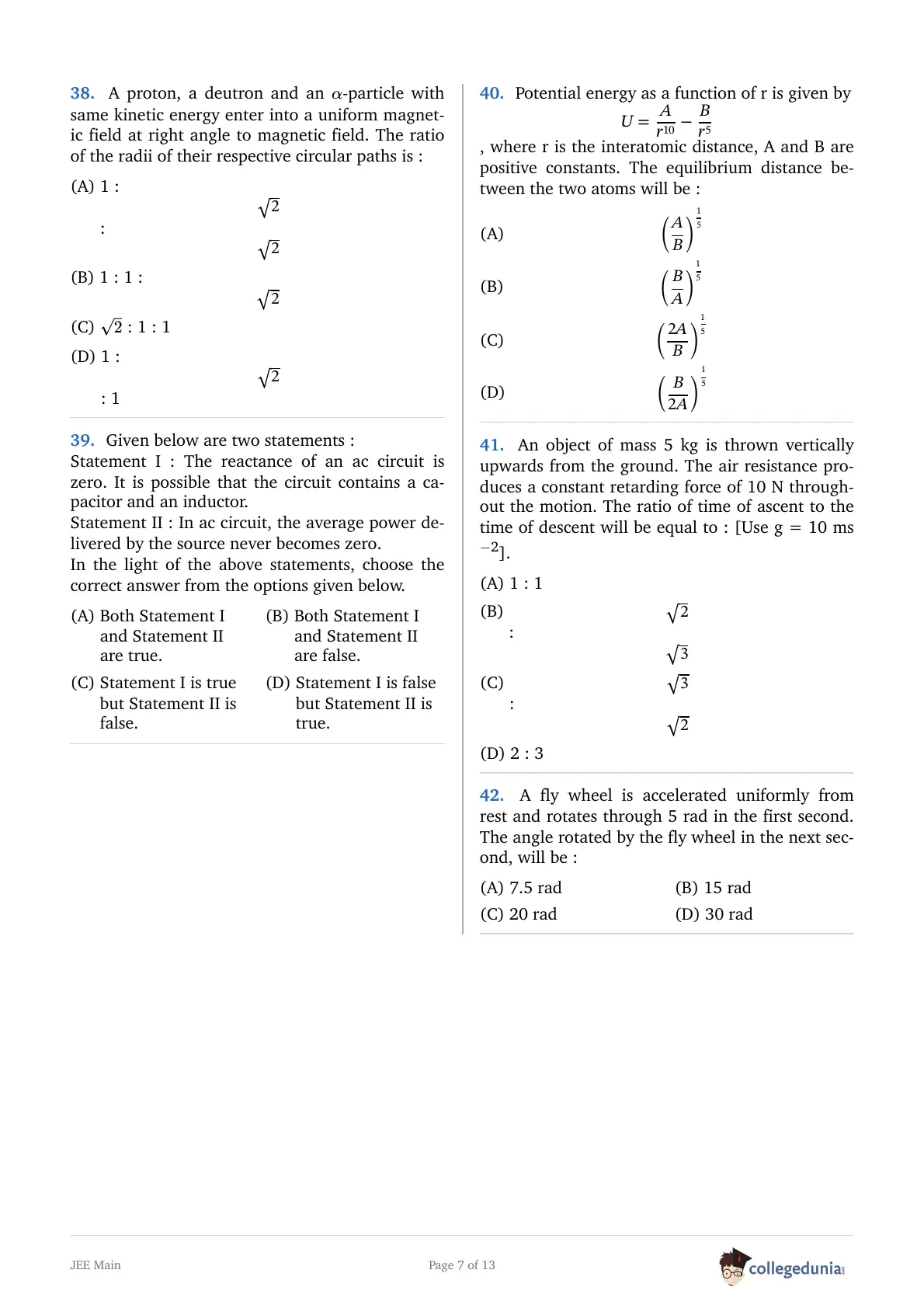
A proton, a deuteron and an α-particle with same kinetic energy enter into a uniform magnetic field at right angle to magnetic field. The ratio of the radii of their respective circular paths is :
Given below are two statements:
Statement-I : The reactance of an ac circuit is zero. It is possible that the circuit contains a capacitor and an inductor.
Statement-II : In ac circuit, the average power delivered by the source never becomes zero.
In the light of the above statements, choose the correct answer from the options given below.
Potential energy as a function of r is given by \(U = \frac{A}{r^{10}}-\frac{B}{r^5}\), where \(r\) is the interatomic distance, A and B are positive constants. The equilibrium distance between the two atoms will be:
An object of mass 5 kg is thrown vertically upwards from the ground. The air resistance produces a constant retarding force of 10 N throughout the motion. The ratio of time of ascent to the time of descent will be equal to [Use \(g\) = \(10 \;ms^{–2}\)].
A fly wheel is accelerated uniformly from rest and rotates through 5 rad in the first second. The angle rotated by the fly wheel in the next second, will be:
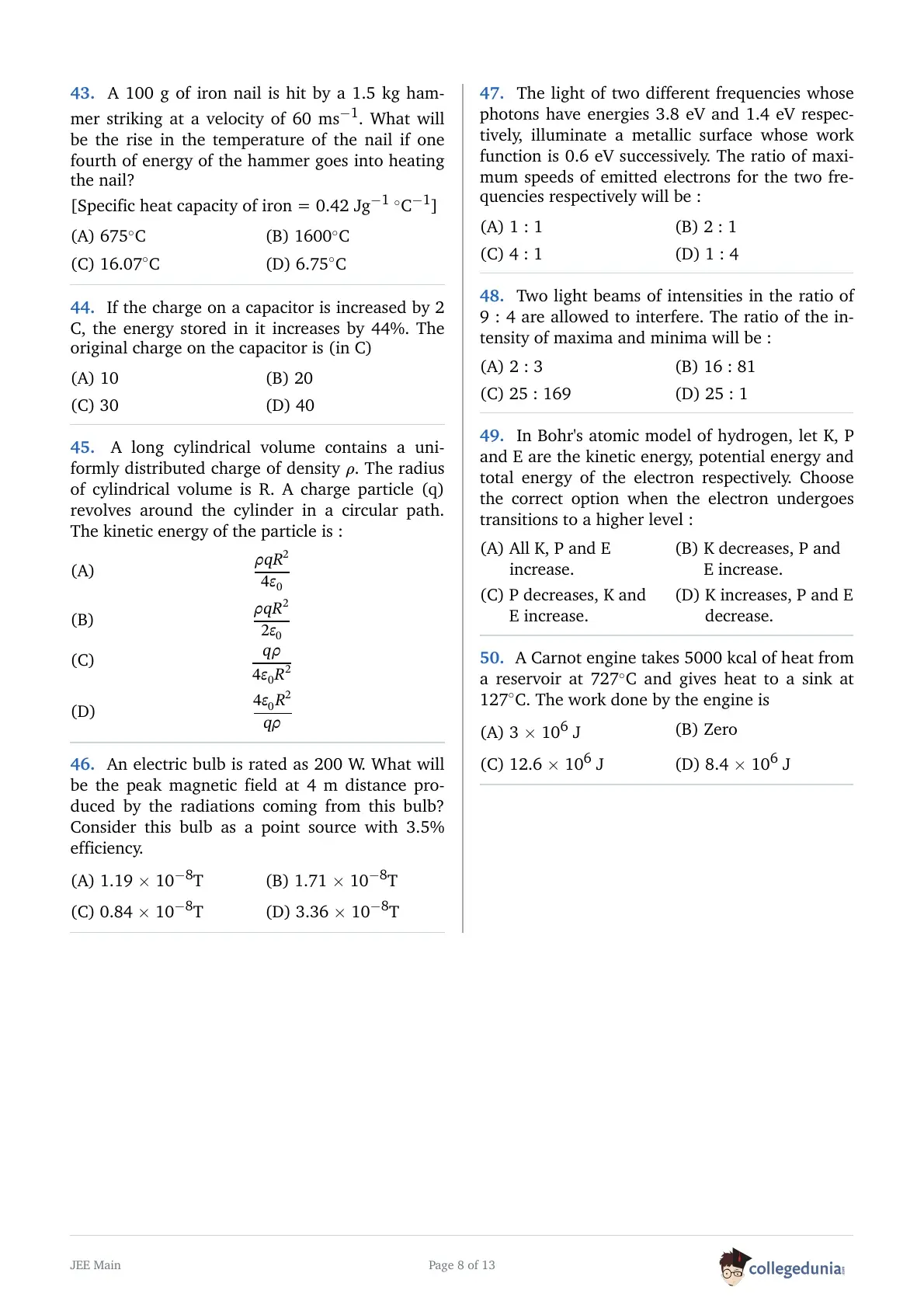
A 100 g of iron nail is hit by a \(1.5\) \(kg\) hammer striking at a velocity of \(60 \;ms^{–1}\). What will be the rise in the temperature of the nail if one fourth of energy of the hammer goes into heating the nail?
[Specific heat capacity of iron = \(0.42\; Jg^{–1} °C^{–1}\)]
If the charge on a capacitor is increased by 2 C, the energy stored in it increases by 44%. The original charge on the capacitor is (in C)
A long cylindrical volume contains a uniformly distributed charge of density ρ. The radius of cylindrical volume is R. A charge particle (q) revolves around the cylinder in a circular path. The kinetic energy of the particle is:
An electric bulb is rated as 200 W. What will be the peak magnetic field at 4 m distance produced by the radiations coming from this bulb? Consider this bulb as a point source with 3.5% efficiency.
The light of two different frequencies whose photons have energies 3.8 eV and 1.4 eV respectively, illuminate a metallic surface whose work function is 0.6 eV successively. The ratio of maximum speeds of emitted electrons for the two frequencies respectively will be
Two light beams of intensities in the ratio of 9 : 4 are allowed to interfere. The ratio of the intensity of maxima and minima will be:
In Bohr’s atomic model of hydrogen, let K, P and E are the kinetic energy, potential energy and total energy of the electron respectively. Choose the correct option when the electron undergoes transitions to a higher level:
A Carnot engine takes 5000 kcal of heat from a reservoir at 727°C and gives heat to a sink at 127°C. The work done by the engine is
Physics - Section B (Q51 - Q60)
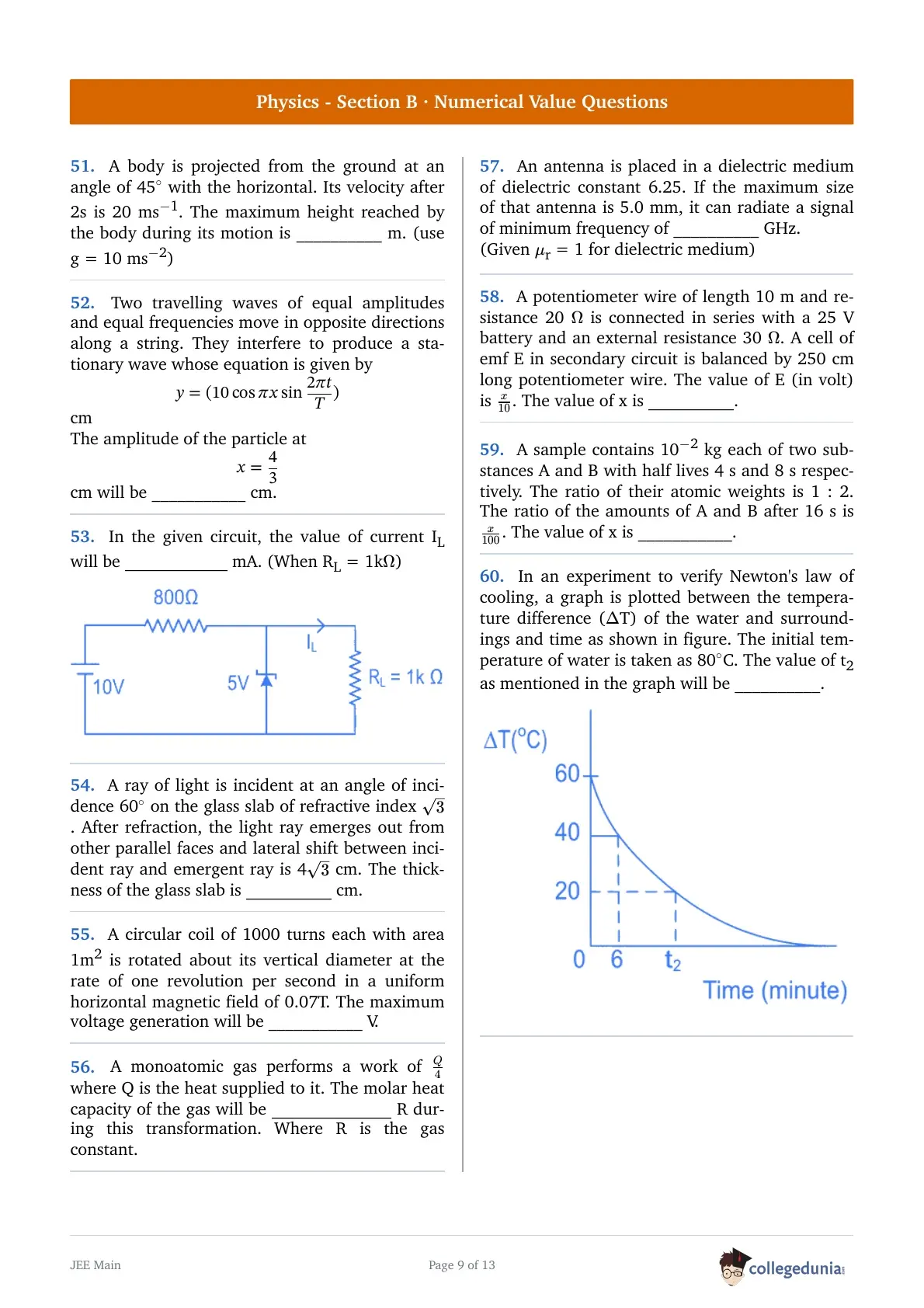
A body is projected from the ground at an angle of 45° with the horizontal. Its velocity after \(2\) \(s\) is \(20\) \(ms^{–1}\). The maximum height reached by the body during its motion is ________ m. (use \(g\) = \(10\) \(ms^{–2}\))
Two travelling waves of equal amplitudes and equal frequencies move in opposite directions along a string. They interfere to produce a stationary wave whose equation is given by \(y = (10 cos \ \pi x\ sin \frac {2\pi t}{T})\) cm. The amplitude of the particle at \(x = \frac 43\) cm will be _______ cm.
In the given circuit, the value of current \(I_L\) will be __________ mA. (When \(R_L = 1\ kΩ\))
A ray of light is incident at an angle of incidence \(60º\) on the glass slab of refractive index \(\sqrt 3.\) After refraction, the light ray emerges out from other parallel faces and lateral shift between incident ray and emergent ray is \(4\sqrt 3.\) cm. The thickness of the glass slab is ______ cm.
A circular coil of \(1000\) turns each with area \(1\ m^2\) is rotated about its vertical diameter at the rate of one revolution per second in a uniform horizontal magnetic field of \(0.07\ T\). The maximum voltage generation will be _____ V.
A monoatomic gas performs a work of \(\frac Q4\) where \(Q\) is the heat supplied to it. The molar heat capacity of the gas will be ____ \(R\) during this transformation. Where \(R\) is the gas constant.
An antenna is placed in a dielectric medium of dielectric constant \(6.25\). If the maximum size of that antenna is \(5.0\) \(mm\), it can radiate a signal of minimum frequency of __________GHz. (Given \(μr\) = \(1\) for dielectric medium)
A potentiometer wire of length 10 m and resistance 20 Ω is connected in series with a 25 V battery and an external resistance 30 Ω. A cell of emf E in secondary circuit is balanced by 250 cm long potentiometer wire. The value of E (in volt) is \(\frac {x}{10}\). The value of \(x\) is ______.
A sample contains \(10^{–2}\) kg each of two substances A and B with half lives 4 s and 8 s respectively. The ratio of their atomic weights is 1 : 2. The ratio of the amounts of A and B after 16 s is \(\frac {x}{100}\). The value of \(x\) is ______.
In an experiment to verify Newton’s law of cooling, a graph is plotted between, the temperature difference (ΔT) of the water and surroundings and time as shown in figure. The initial temperature of water is taken as 80ºC. The value of \(t_2\) as mentioned in the graph will be ______.
Chemistry - Section A (Q61 - Q80)
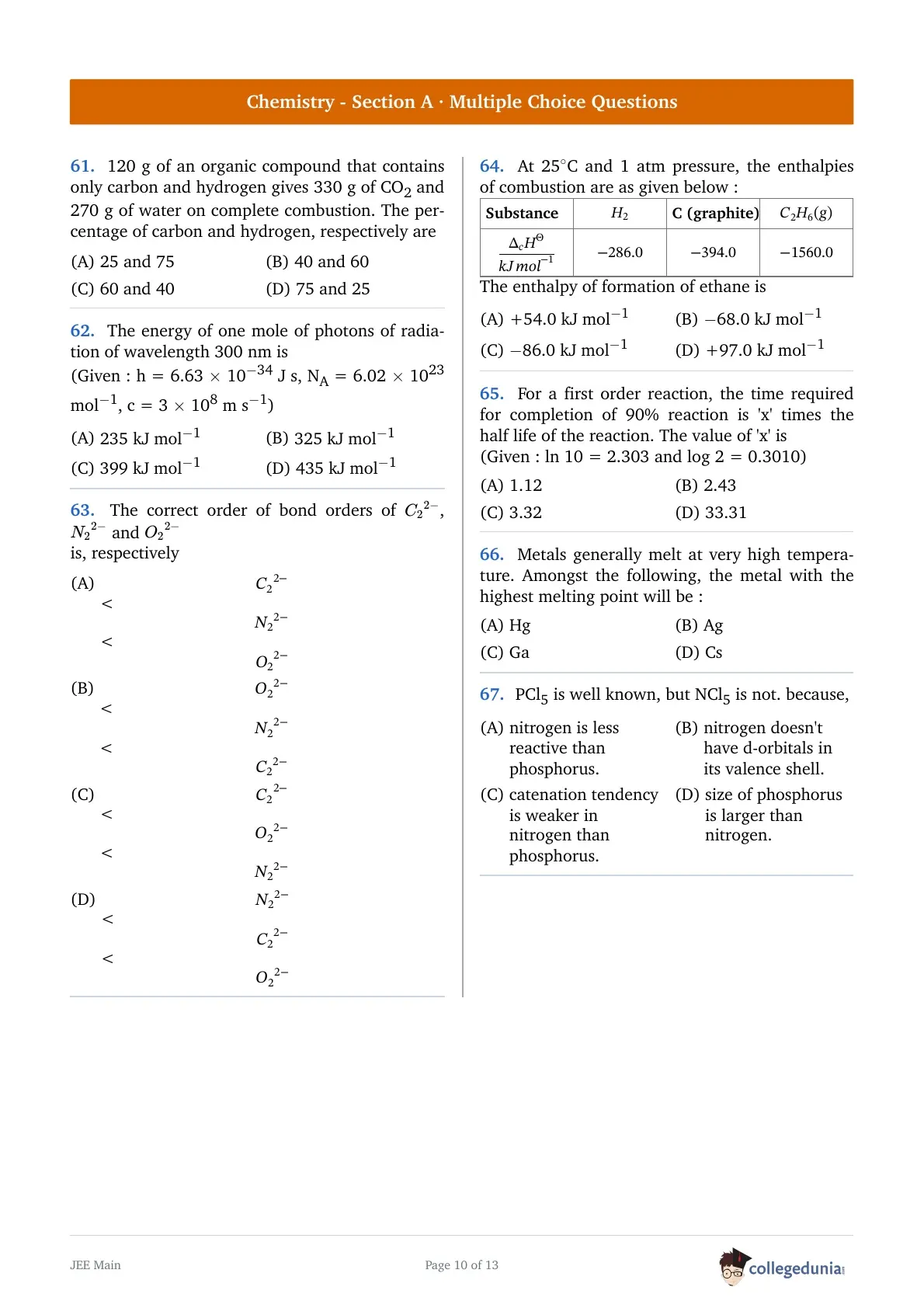
\(120 \;g\) of an organic compound that contains only carbon and hydrogen gives \(330\) \(g\) of \(CO_2\) and \(270\) \(g\) of water on complete combustion. The percentage of carbon and hydrogen, respectively are
The energy of one mole of photons of radiation of wavelength \(300\) \(nm\) is (Given \(h\) = \(6.63 × 10^{–34}\)Js, \(N_A\) = \(6.02 × 10^{23}\) \(mol^{–1}\), \(c = 3 × 10^8\) \(ms^{–1}\))
The correct order of bond orders of \(C_2^{2-}, N_2^{2-}, O_2^{2-}\) is, respectively
| \(Substance\) | \(H_2\) | \(C(graphite)\) | \(C_2H_6(g)\) |
|---|---|---|---|
| \(\frac{D_cH^{\theta}}{kJmol^{-1}}\) | \(-286.0\) | \(-394.0\) | -1560.0 |
The enthalpy of formation of ethane is
For a first order reaction, the time required for completion of 90% reaction is ‘x’ times the half life of the reaction. The value of ‘x’ is (Given: In 10 = 2.303 and log 2 = 0.3010)
Metals generally melt at very high temperature. Amongst the following, the metal with the highest melting point will be
\(PCl_5\) is well known, but \(NCl_5\) is not. Because,
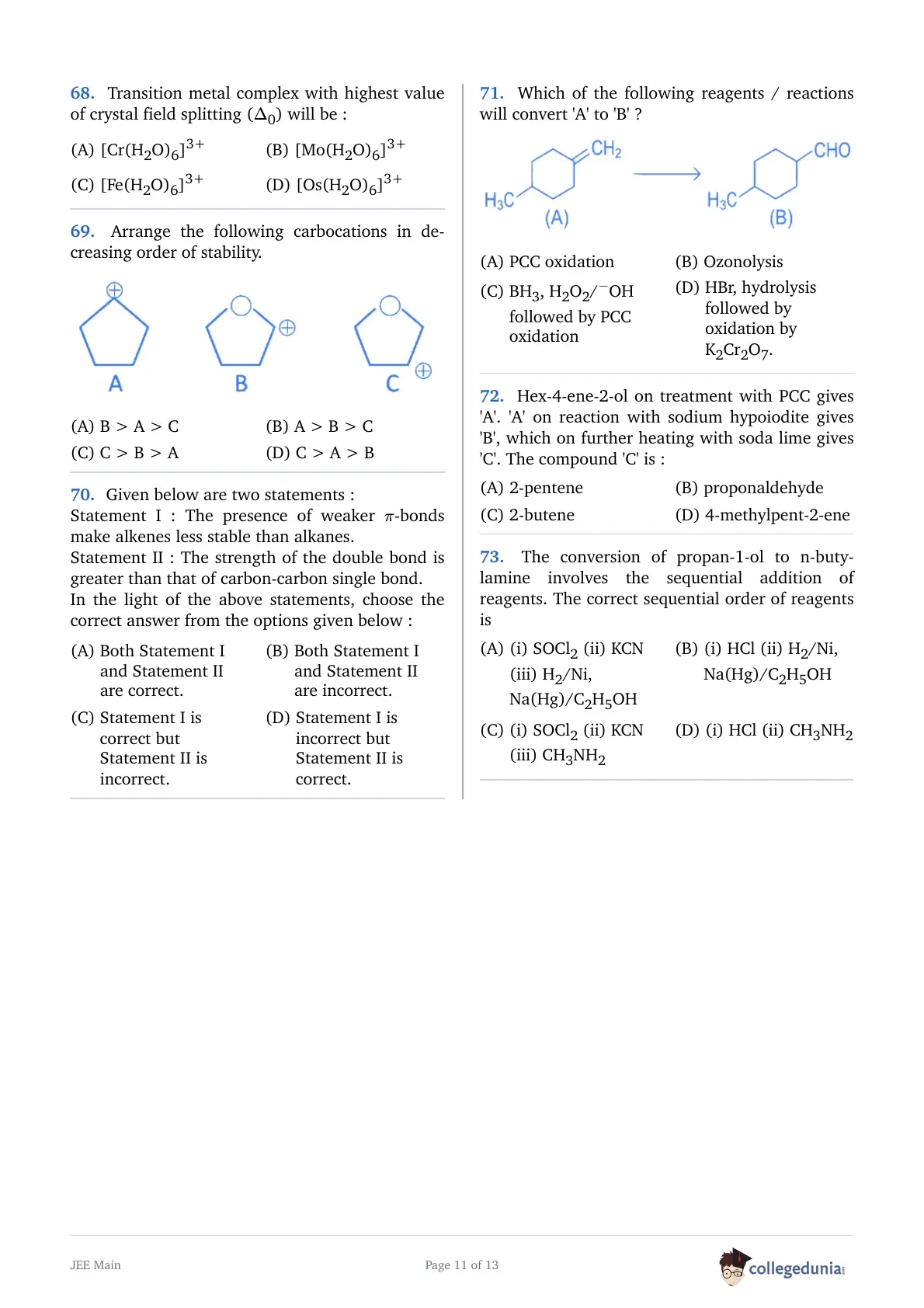
Transition metal complex with highest value of crystal field splitting \((Δ_0)\) will be
Arrange the following carbocations in decreasing order of stability.
Given below are two statements.
Statement I: The presence of weaker π-bonds make alkenes less stable than alkanes.
Statement II: The strength of the double bond is greater than that of carbon-carbon single bond.
In the light of the above statements, choose the correct answer from the options given below.
Which of the following reagents/reactions will convert ‘A’ to ‘B’?
Hex-4-ene-2-ol on treatment with PCC gives ‘A’ on reaction with sodium hypoiodite gives ‘B’, which on further heating with soda lime gives ‘C’. The compound ‘C’ is
The conversion of \(propan-1-ol\) to \(n-butylamine\) involves the sequential addition of reagents. The correct sequential order of reagents is
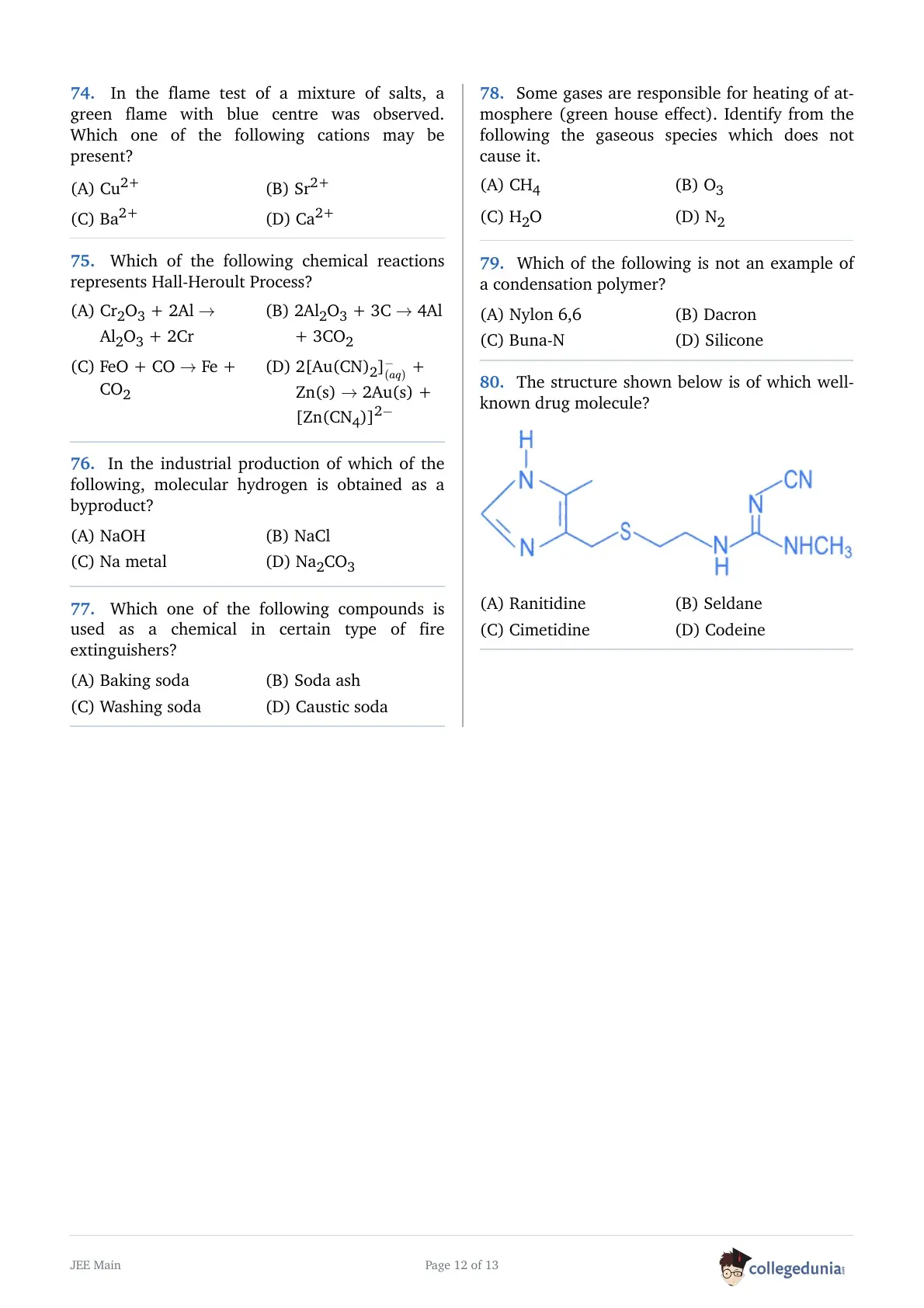
In the flame test of a mixture of salts, a green flame with blue centre was observed. Which one of the following cations may be present?
Which of the following chemical reactions represents Hall-Heroult Process?
In the industrial production of which of the following, molecular hydrogen is obtained as a byproduct?
Which one of the following compounds is used as a chemical in certain type of fire extinguishers?
Some gases are responsible for heating of atmosphere (green house effect). Identify from the following the gaseous species which does not cause it.
Which of the following is not an example of a condensation polymer?
The structure shown below is of which well-known drug molecule?
Chemistry - Section B (Q81 - Q90)
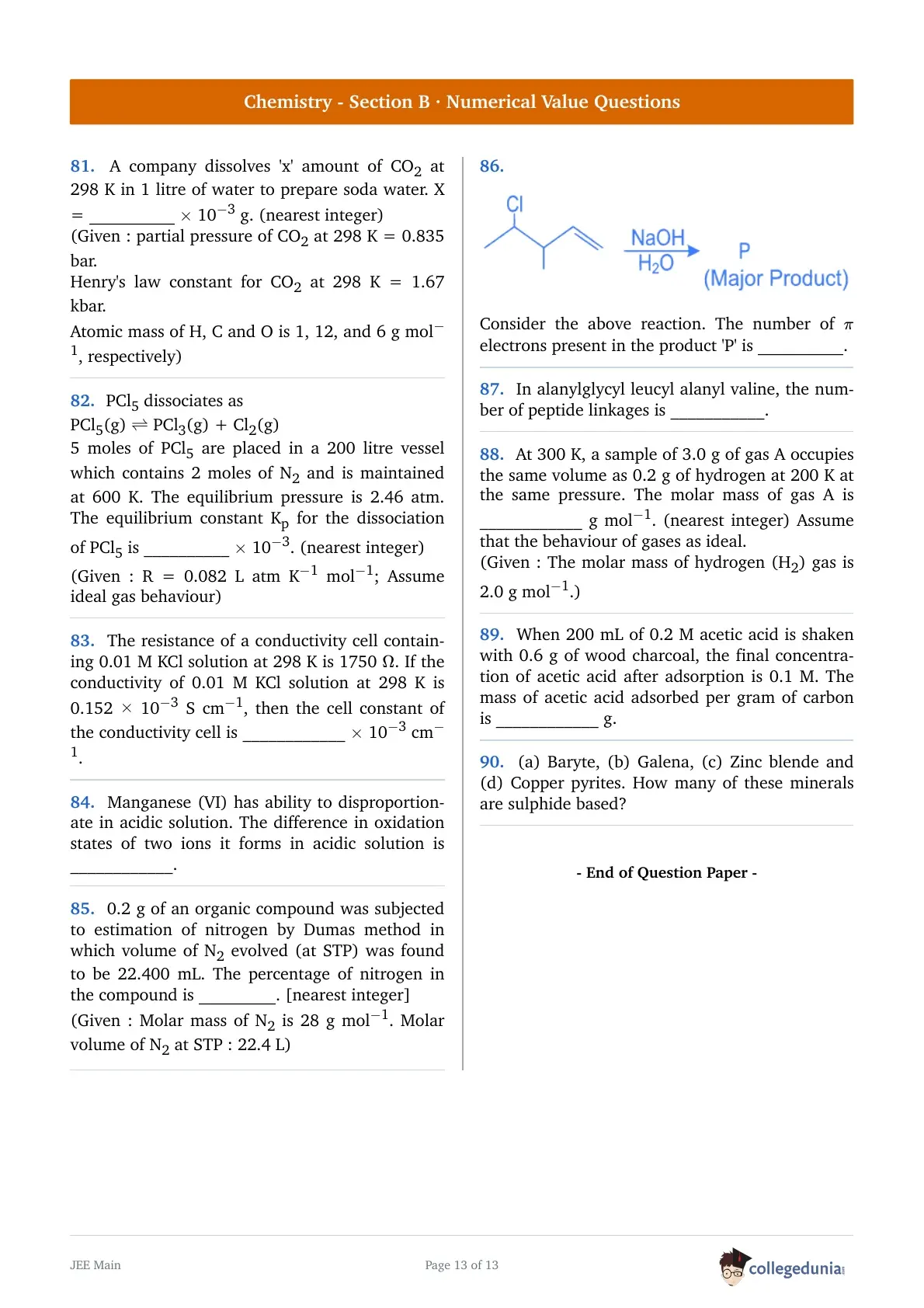
A company dissolves \(‘X’\) amount of \(CO_2\) at \(298\ K\) in \(1\) litre of water to prepare soda water. \(X\) = _____ \(× 10^{–3}\) g. (nearest integer)
(Given: partial pressure of \(CO_2\) at \(298\ K = 0.835\) bar. Henry’s law constant for \(CO_2\) at \(298\ K = 1.67\) Kbar. Atomic mass of \(H\), \(C\) and \(O\) is \(1\), \(12\), and \(6\) g mol–1, respectively)
\(PCl_5\) dissociates as
\(PCl_5(g) ⇌ PCl_3(g)+ Cl_2(g)\)
\(5\) moles of \(PCl_5\) are placed in a \(200\) litre vessel which contains \(2\) moles of \(N_2\) and is maintained at \(600\ K\). The equilibrium pressure is \(2.46\) atm. The equilibrium constant Kp for the dissociation of \(PCl_5\) is ______ \(× 10^{–3}\). (nearest integer)
(Given: \(R = 0.082\) L atm K–1 mol–1; Assume ideal gas behaviour)
The resistance of a conductivity cell containing \(0.01\) M KCl solution at \(298\ K\) is \(1750\ Ω\). If the conductivity of \(0.01\) M KCl solution at \(298\ K\) is \(0.152×10^{–3}\) S cm–1, then the cell constant of the conductivity cell is ______ \(×10^{–3}\) cm–1.
Manganese (VI) has ability to disproportionate in acidic solution. The difference in oxidation states of two ions it forms in acidic solution is _____.
0.2 g of an organic compound was subjected to estimation of nitrogen by Duma’s method in which volume of N2 evolved (at STP) was found to be 22.400 mL. The percentage of nitrogen in the compound is _____. [nearest integer]
(Given : Molar mass of N2 is 28 g mol–1, Molar volume of N2 at STP : 22.4L)

Consider the above reaction. The number of π electrons present in the product ‘P’ is _____ .
In alanylglycylleucylalanyvaline, the number of peptide linkages is__,
At 300 K, a sample of 3.0 g of gas A occupies the same volume as 0.2 g of hydrogen at 200 K at the same pressure. The molar mass of gas A is _____ g mol–1. (nearest integer)
Assume that the behaviour of gases as ideal.
(Given: The molar mass of hydrogen (H2) gas is 2.0 g mol–1).
When 200 mL of 0.2 M acetic acid is shaken with 0.6 g of wood charcoal, the final concentration of acetic acid after adsorption is 0.1 M. The mass of acetic acid adsorbed per gram of carbon is _____ g.
(a) Baryte,
(b) Galena,
(c) Zinc blende and
(d) Copper pyrites.
How many of these minerals are sulphide based?
JEE Main 2022 Exam Pattern and Marking Scheme
| Particulars | Details |
|---|---|
| Exam Mode | Online (Computer-Based Test) |
| Paper | B.E./B.Tech (Paper 1) |
| Duration | 3 hours (180 minutes) |
| Type of Questions | Multiple Choice Questions (MCQs) + Numerical Value Questions |
| Subjects | Mathematics, Physics, Chemistry |
| Total Questions | 90 questions (75 to be attempted) |
| Total Marks | 300 marks |
| Marking Scheme | +4 for correct answer & -1 for incorrect MCQ and Numerical Value-based Questions |
JEE Main 2022 June 24 Shift 2 Difficulty Level
As per the students’ initial reaction, JEE Main 2022 Question Paper for June 24- Shift 2 was reported as moderate. The Mathematics section in JEE Main 2022 June 24- Shift 2 Question Paper was reported as difficult and lengthy, Physics as easy to moderate and Chemistry as easy.
JEE Main 2022 June 24 Shift 2 Subject-wise Memory-Based Solutions PDF
| Subject | Memory-Based Solutions PDF |
|---|---|
| Physics | Download PDF |
| Chemistry | Download PDF |
| Mathematics | Download PDF |
JEE Main 2022 B.E/ B. Tech Other Question Paper with Answer Key PDFs
JEE Main 2022 aspirants can practice and check their exam prep level by attempting the other session question papers as well. The table below shows JEE Main 2022 Question Paper with Answer Key and Solution PDFs for other sessions for Phase 1.
Also Check:



Comments