




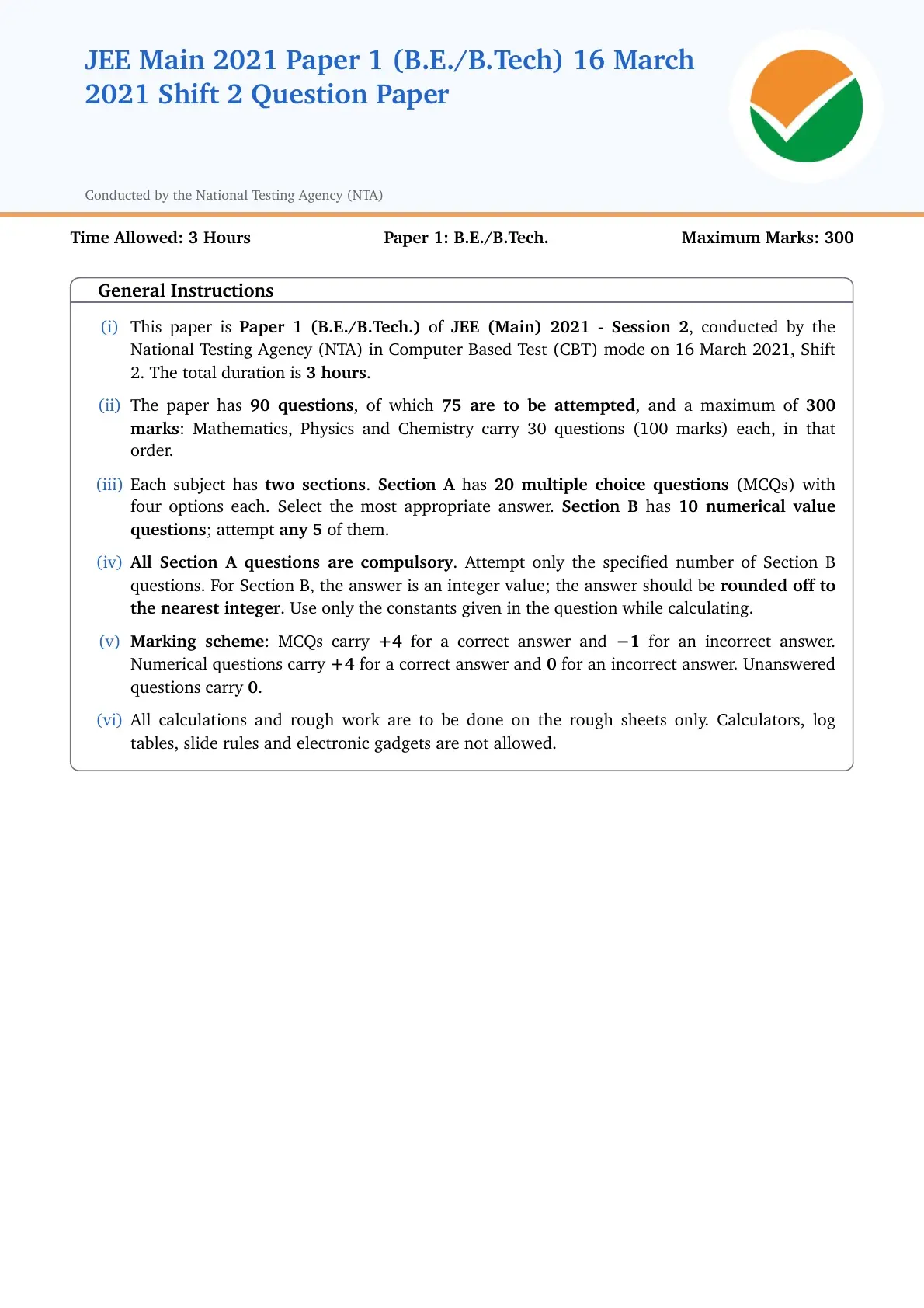
JEE Main 2021 March 16 Shift 2 Question Paper is available here with solutions PDF and detailed solutions for every question. NTA conducted the second shift on March 16, 2021, from 3:00 PM to 6:00 PM. The JEE Main 2021 Paper 1 (B.E./B.Tech) question paper includes the following:
- 90 questions in a 3-hour CBT Mode: 30 each from Mathematics, Physics and Chemistry (75 to be attempted)
- Section A: 20 multiple choice questions (MCQs) per subject, all compulsory, 4 marks each
- Section B: 10 numerical value questions per subject, any 5 to be attempted, 4 marks each
- Marking: +4 for a correct answer, -1 for an incorrect MCQ, 0 for an unattempted question; no negative marking for numerical value questions
- Maximum marks: 300 (100 per subject)
JEE Main 2021 March 16 Shift 2 Question Paper with Solution PDF
| NTA Official PDF | CD PDF | CD PDF with Solutions |
|---|---|---|
| Download official PDF 4.94 MB | Download Collegedunia PDF 0.86 MB | Download solutions PDF 0.87 MB |
Also Check:
JEE Main 2021 March 16 Shift 2 Questions with Solutions
Mathematics - Section A (Q1 - Q20)
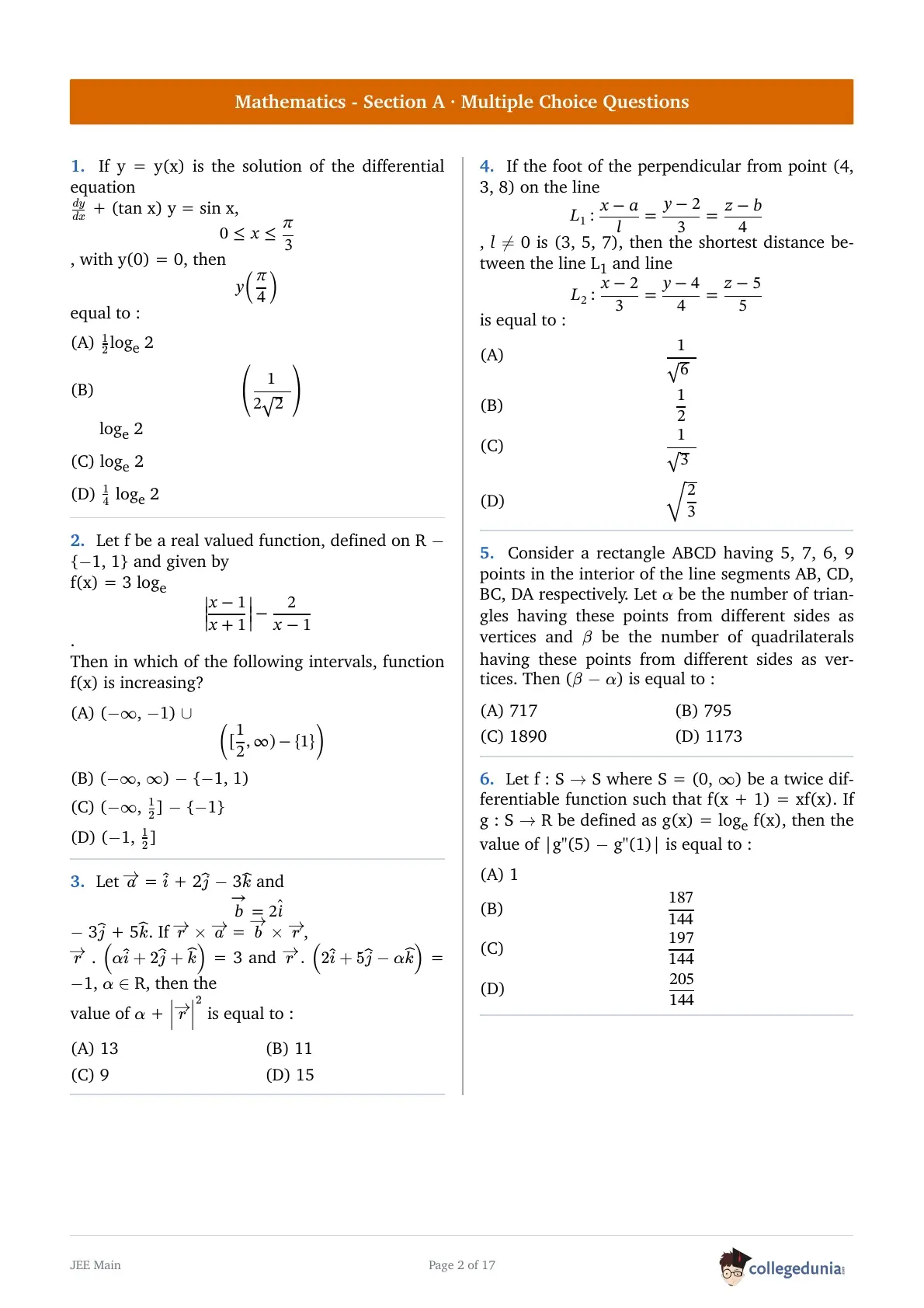
If \(y = y(x)\) is the solution of the differential equation
\(\frac{dy}{dx} + (\tan x)\,y = \sin x,\ 0 \le x \le \frac{\pi}{3}\), with \(y(0) = 0\), then \(y\left(\frac{\pi}{4}\right)\) is equal to :
Let \(f\) be a real valued function, defined on \(\mathbb{R} - \{-1, 1\}\) and given by
\(f(x) = 3\log_e\left|\frac{x-1}{x+1}\right| - \frac{2}{x-1}\).
Then in which of the following intervals, function \(f(x)\) is increasing?
Let \(\vec{a} = \hat{i} + 2\hat{j} - 3\hat{k}\) and \(\vec{b} = 2\hat{i} - 3\hat{j} + 5\hat{k}\). If \(\vec{r}\times\vec{a} = \vec{b}\times\vec{r}\),
\(\vec{r}\cdot\left(\alpha\hat{i} + 2\hat{j} + \hat{k}\right) = 3\) and \(\vec{r}\cdot\left(2\hat{i} + 5\hat{j} - \alpha\hat{k}\right) = -1\), \(\alpha\in\mathbb{R}\), then the value of \(\alpha + |\vec{r}|^2\) is equal to :
If the foot of the perpendicular from point \((4, 3, 8)\) on the line \(L_1: \frac{x-a}{l} = \frac{y-2}{3} = \frac{z-b}{4}\), \(l \ne 0\) is \((3, 5, 7)\), then the shortest distance between the line \(L_1\) and line \(L_2: \frac{x-2}{3} = \frac{y-4}{4} = \frac{z-5}{5}\) is equal to :
Consider a rectangle ABCD having 5, 7, 6, 9 points in the interior of the line segments AB, CD, BC, DA respectively. Let \(\alpha\) be the number of triangles having these points from different sides as vertices and \(\beta\) be the number of quadrilaterals having these points from different sides as vertices. Then \((\beta - \alpha)\) is equal to :
Let \(f: S \to S\) where \(S = (0, \infty)\) be a twice differentiable function such that \(f(x+1) = xf(x)\). If \(g: S \to \mathbb{R}\) be defined as \(g(x) = \log_e f(x)\), then the value of \(|g''(5) - g''(1)|\) is equal to :
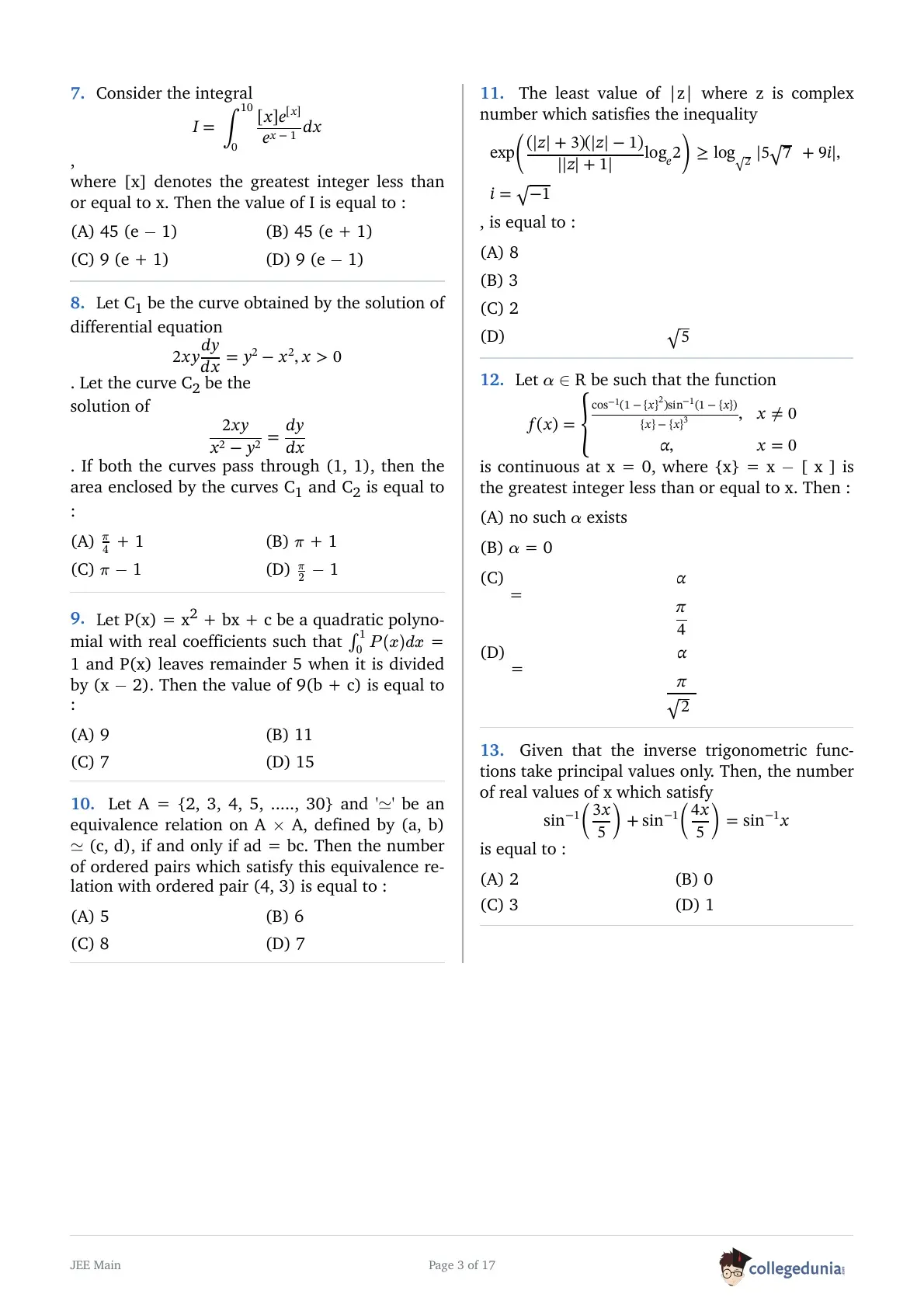
Consider the integral
\(I = \int_0^{10}\frac{[x]e^{[x]}}{e^{x-1}}\,dx\),
where \([x]\) denotes the greatest integer less than or equal to \(x\). Then the value of \(I\) is equal to :
Let \(C_1\) be the curve obtained by the solution of differential equation
\(2xy\frac{dy}{dx} = y^2 - x^2,\ x > 0\). Let the curve \(C_2\) be the solution of
\(\frac{2xy}{x^2 - y^2} = \frac{dy}{dx}\). If both the curves pass through \((1, 1)\), then the area enclosed by the curves \(C_1\) and \(C_2\) is equal to :
Let \(P(x) = x^2 + bx + c\) be a quadratic polynomial with real coefficients such that \(\int_0^1 P(x)\,dx = 1\) and \(P(x)\) leaves remainder 5 when it is divided by \((x - 2)\). Then the value of \(9(b + c)\) is equal to :
Let \( M = \{1,2,3,\ldots,16\} \) and \( R \) be a relation on \( M \) defined by \( xRy \) if and only if \( 4y = 5x - 3 \). Then, the number of ordered pairs required to be added to \( R \) to make it symmetric is
The least value of \(|z|\) where \(z\) is complex number which satisfies the inequality
\(\exp\left(\frac{(|z|+3)(|z|-1)}{||z|+1|}\log_e 2\right)\ge\log_{\sqrt{2}}\left|5\sqrt{7} + 9i\right|,\ i = \sqrt{-1}\), is equal to :
Let \(\alpha\in\mathbb{R}\) be such that the function
\(f(x) = \begin{cases}\dfrac{\cos^{-1}(1 - \{x\}^2)\,\sin^{-1}(1 - \{x\})}{\{x\} - \{x\}^3}, & x \ne 0\\[2mm] \alpha, & x = 0\end{cases}\)
is continuous at \(x = 0\), where \(\{x\} = x - [\,x\,]\) and \([\,x\,]\) is the greatest integer less than or equal to \(x\). Then :
Given that the inverse trigonometric functions take principal values only. Then, the number of real values of \(x\) which satisfy
\(\sin^{-1}\left(\frac{3x}{5}\right) + \sin^{-1}\left(\frac{4x}{5}\right) = \sin^{-1}x\)
is equal to :
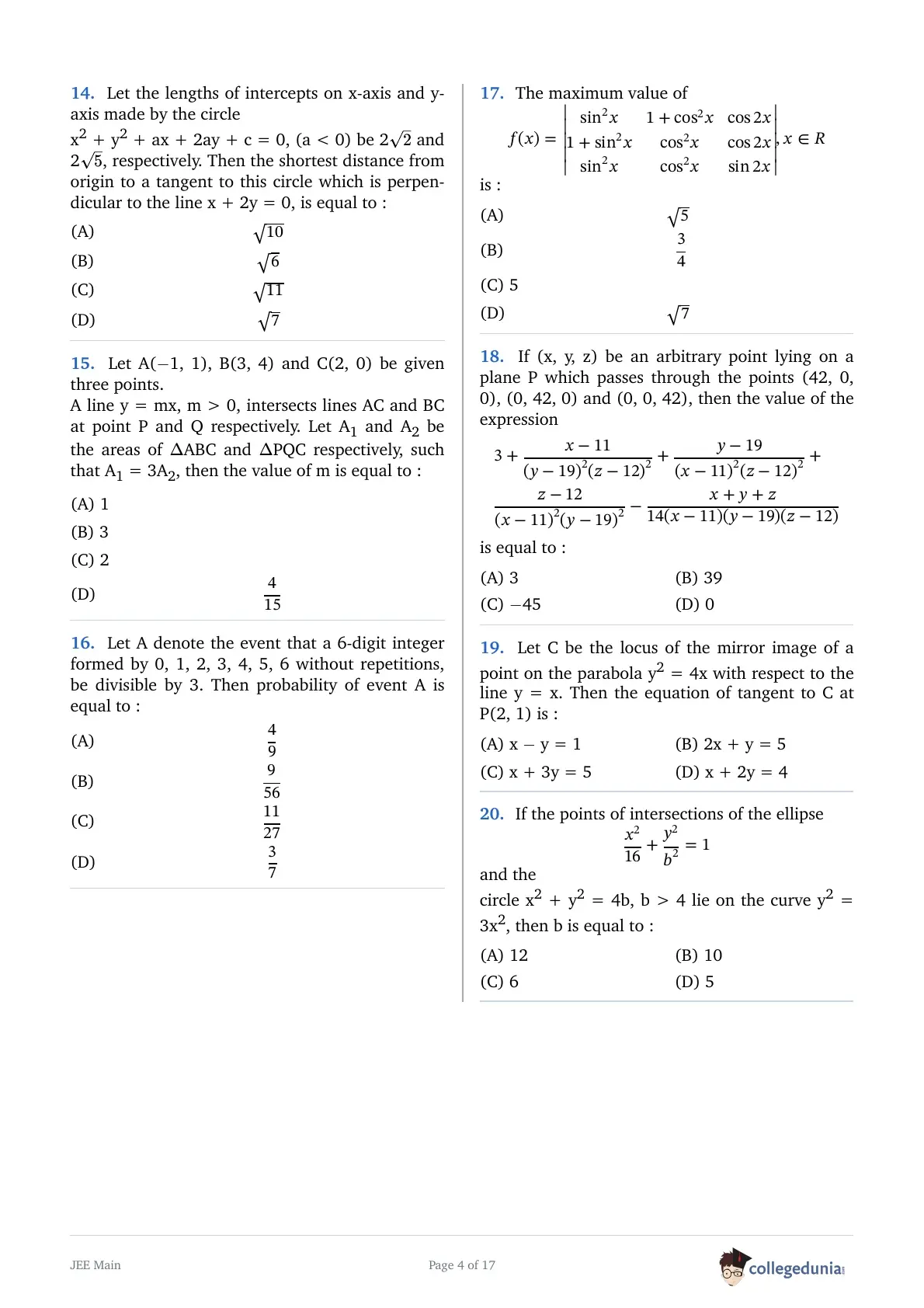
Let the lengths of intercepts on x-axis and y-axis made by the circle
\(x^2 + y^2 + ax + 2ay + c = 0\), \((a < 0)\) be \(2\sqrt{2}\) and \(2\sqrt{5}\), respectively. Then the shortest distance from origin to a tangent to this circle which is perpendicular to the line \(x + 2y = 0\), is equal to :
Let \(A(-1, 1)\), \(B(3, 4)\) and \(C(2, 0)\) be given three points.
A line \(y = mx\), \(m > 0\), intersects lines AC and BC at point P and Q respectively. Let \(A_1\) and \(A_2\) be the areas of \(\Delta ABC\) and \(\Delta PQC\) respectively, such that \(A_1 = 3A_2\), then the value of \(m\) is equal to :
Let A denote the event that a 6-digit integer formed by 0, 1, 2, 3, 4, 5, 6 without repetitions, be divisible by 3. Then probability of event A is equal to :
The maximum value of
\(f(x)=\left|\begin{matrix}\sin^2 x & 1+\cos^2 x & \cos 2x\\ 1+\sin^2 x & \cos^2 x & \cos 2x\\ \sin^2 x & \cos^2 x & \sin 2x\end{matrix}\right|,\ x\in R\)
is :
If \((x, y, z)\) be an arbitrary point lying on a plane P which passes through the points \((42, 0, 0)\), \((0, 42, 0)\) and \((0, 0, 42)\), then the value of the expression
\(3+\frac{x-11}{(y-19)^2(z-12)^2}+\frac{y-19}{(x-11)^2(z-12)^2}+\frac{z-12}{(x-11)^2(y-19)^2}-\frac{x+y+z}{14(x-11)(y-19)(z-12)}\)
is equal to :
Let C be the locus of the mirror image of a point on the parabola \(y^2=4x\) with respect to the line \(y=x\). Then the equation of tangent to C at \(P(2, 1)\) is :
If the points of intersections of the ellipse \(\frac{x^2}{16}+\frac{y^2}{b^2}=1\) and the circle \(x^2+y^2=4b,\ b>4\) lie on the curve \(y^2=3x^2\), then b is equal to :
Mathematics - Section B (Q21 - Q30)
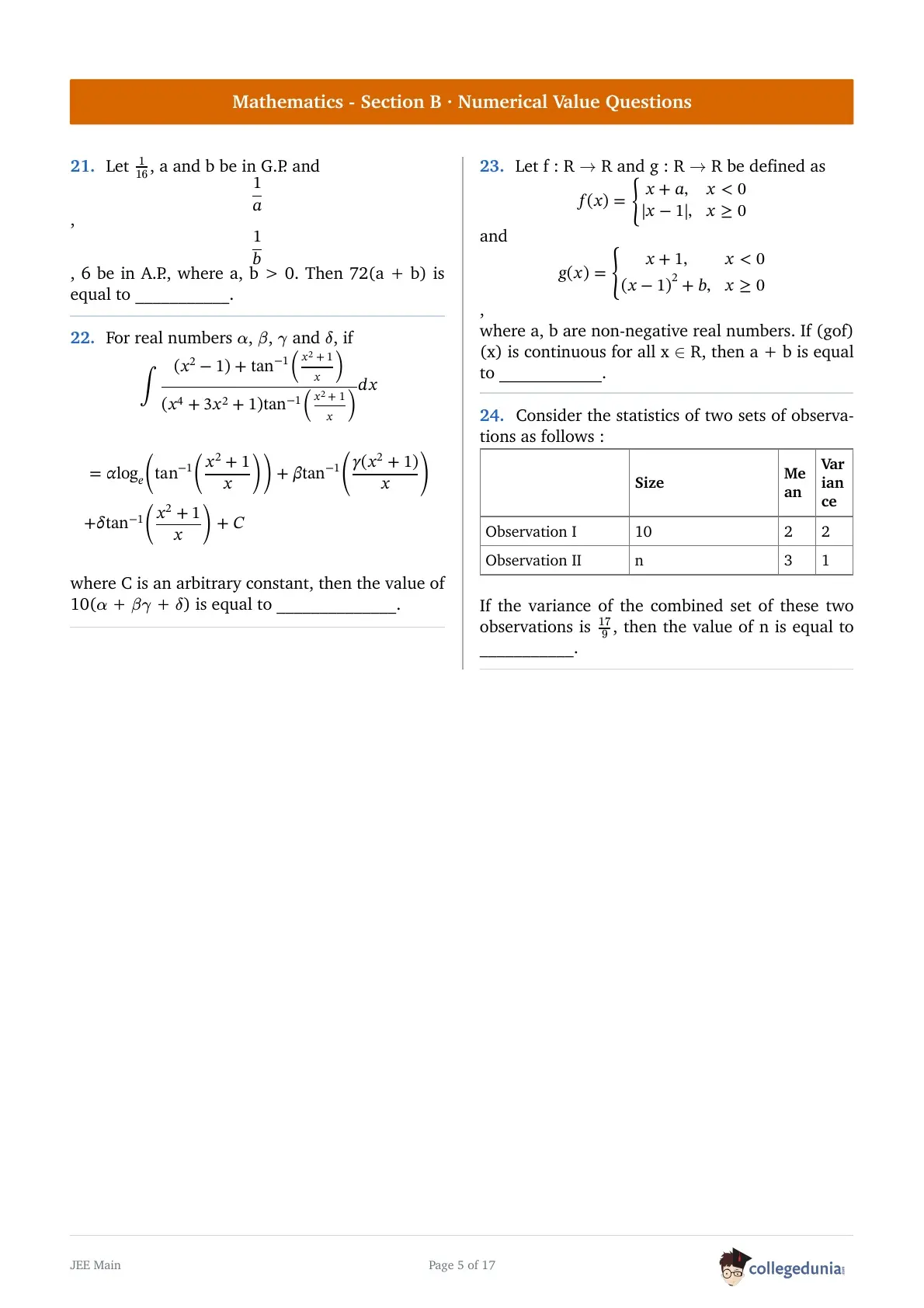
Let \(\frac{1}{16}\), a and b be in G.P. and \(\frac{1}{a}\), \(\frac{1}{b}\), 6 be in A.P., where \(a, b>0\). Then \(72(a+b)\) is equal to ___________.
For real numbers \(\alpha, \beta, \gamma\) and \(\delta\), if
\(\int \frac{(x^2-1)+\tan^{-1}\left(\frac{x^2+1}{x}\right)}{(x^4+3x^2+1)\tan^{-1}\left(\frac{x^2+1}{x}\right)}dx\)
\(=\alpha\log_e\left(\tan^{-1}\left(\frac{x^2+1}{x}\right)\right)+\beta\tan^{-1}\left(\frac{\gamma(x^2+1)}{x}\right)+\delta\tan^{-1}\left(\frac{x^2+1}{x}\right)+C\)
where C is an arbitrary constant, then the value of \(10(\alpha+\beta\gamma+\delta)\) is equal to ______________.
Let \(f:R\to R\) and \(g:R\to R\) be defined as
\(f(x)=\begin{cases}x+a, & x<0\\ |x-1|, & x\ge 0\end{cases}\) and \(g(x)=\begin{cases}x+1, & x<0\\ (x-1)^2+b, & x\ge 0\end{cases}\),
where a, b are non-negative real numbers. If \((g\circ f)(x)\) is continuous for all \(x\in R\), then \(a+b\) is equal to ____________.
| Size | Mean | Variance | |
| Observation I | 10 | 2 | 2 |
| Observation II | n | 3 | 1 |
If the variance of the combined set of these two observations is \(\frac{17}{9}\), then the value of n is equal to ___________.
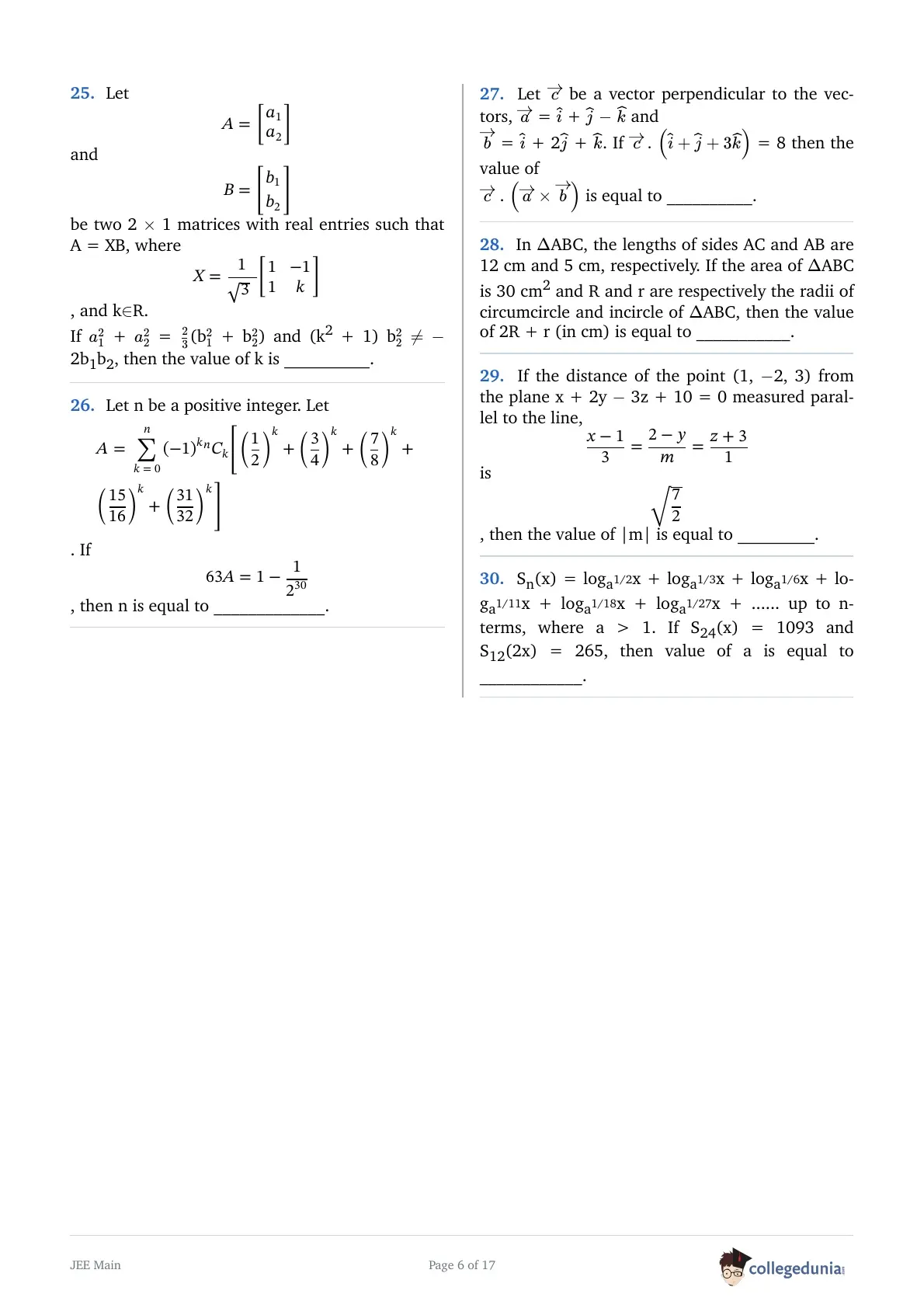
Let \(A=\begin{bmatrix}a_1\\a_2\end{bmatrix}\) and \(B=\begin{bmatrix}b_1\\b_2\end{bmatrix}\) be two \(2\times1\) matrices with real entries such that \(A=XB\), where
\(X=\frac{1}{\sqrt3}\begin{bmatrix}1&-1\\1&k\end{bmatrix}\), and \(k\in R\).
If \(a_1^2+a_2^2=\frac23(b_1^2+b_2^2)\) and \((k^2+1)b_2^2\ne-2b_1b_2\), then the value of k is __________.
Let n be a positive integer. Let
\(A=\sum_{k=0}^{n}(-1)^k\,{}^nC_k\left[\left(\frac12\right)^k+\left(\frac34\right)^k+\left(\frac78\right)^k+\left(\frac{15}{16}\right)^k+\left(\frac{31}{32}\right)^k\right]\).
If \(63A=1-\frac{1}{2^{30}}\), then n is equal to _____________.
Let \(\vec c\) be a vector perpendicular to the vectors, \(\vec a=\hat i+\hat j-\hat k\) and \(\vec b=\hat i+2\hat j+\hat k\). If \(\vec c\cdot(\hat i+\hat j+3\hat k)=8\) then the value of \(\vec c\cdot(\vec a\times\vec b)\) is equal to __________.
In \(\Delta ABC\), the lengths of sides AC and AB are 12 cm and 5 cm, respectively. If the area of \(\Delta ABC\) is 30 cm2 and R and r are respectively the radii of circumcircle and incircle of \(\Delta ABC\), then the value of 2R + r (in cm) is equal to ___________.
The distance of the point (3, 2, \( - \)1) from the plane \( 3x - y + 4z + 1 = 0 \) along the line \( {{2 - x} \over 2} = {{y - 3} \over 2} = {{z + 1} \over 1} \) is equal to :
\(S_n(x)=\log_{a^{1/2}}x+\log_{a^{1/3}}x+\log_{a^{1/6}}x+\log_{a^{1/11}}x+\log_{a^{1/18}}x+\log_{a^{1/27}}x+\ldots\) up to n-terms, where \(a>1\). If \(S_{24}(x)=1093\) and \(S_{12}(2x)=265\), then value of a is equal to ____________.
Physics - Section A (Q31 - Q50)
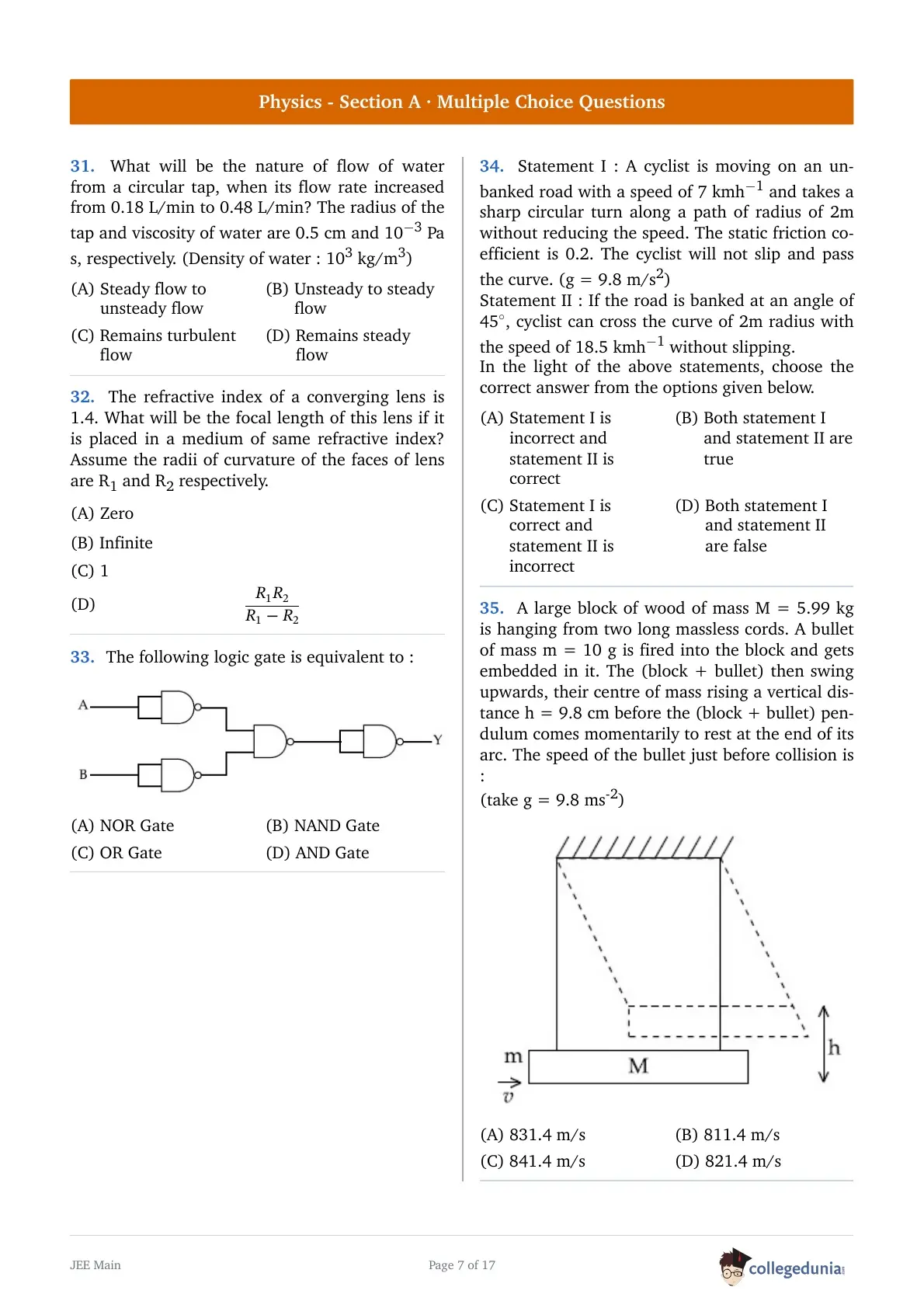
What will be the nature of flow of water from a circular tap, when its flow rate increased from 0.18 L/min to 0.48 L/min? The radius of the tap and viscosity of water are 0.5 cm and \(10^{-3}\) Pa s, respectively. (Density of water : \(10^3\) kg/m3)
The refractive index of a converging lens is 1.4. What will be the focal length of this lens if it is placed in a medium of same refractive index? Assume the radii of curvature of the faces of lens are R1 and R2 respectively.
For given logic gate circuit, an equivalent gate will be

Statement I : A cyclist is moving on an unbanked road with a speed of 7 km h-1 and takes a sharp circular turn along a path of radius of 2 m without reducing the speed. The static friction coefficient is 0.2. The cyclist will not slip and pass the curve. (\(g = 9.8\ \mathrm{m/s^2}\))
Statement II : If the road is banked at an angle of \(45^\circ\), cyclist can cross the curve of 2 m radius with the speed of 18.5 km h-1 without slipping.
In the light of the above statements, choose the correct answer from the options given below.
A large block of wood of mass \(M = 5.99\ \mathrm{kg}\) is hanging from two long massless cords. A bullet of mass \(m = 10\ \mathrm{g}\) is fired into the block and gets embedded in it. The (block + bullet) then swing upwards, their centre of mass rising a vertical distance \(h = 9.8\ \mathrm{cm}\) before the (block + bullet) pendulum comes momentarily to rest at the end of its arc. The speed of the bullet just before collision is :
(take \(g = 9.8\ \mathrm{ms^{-2}}\))
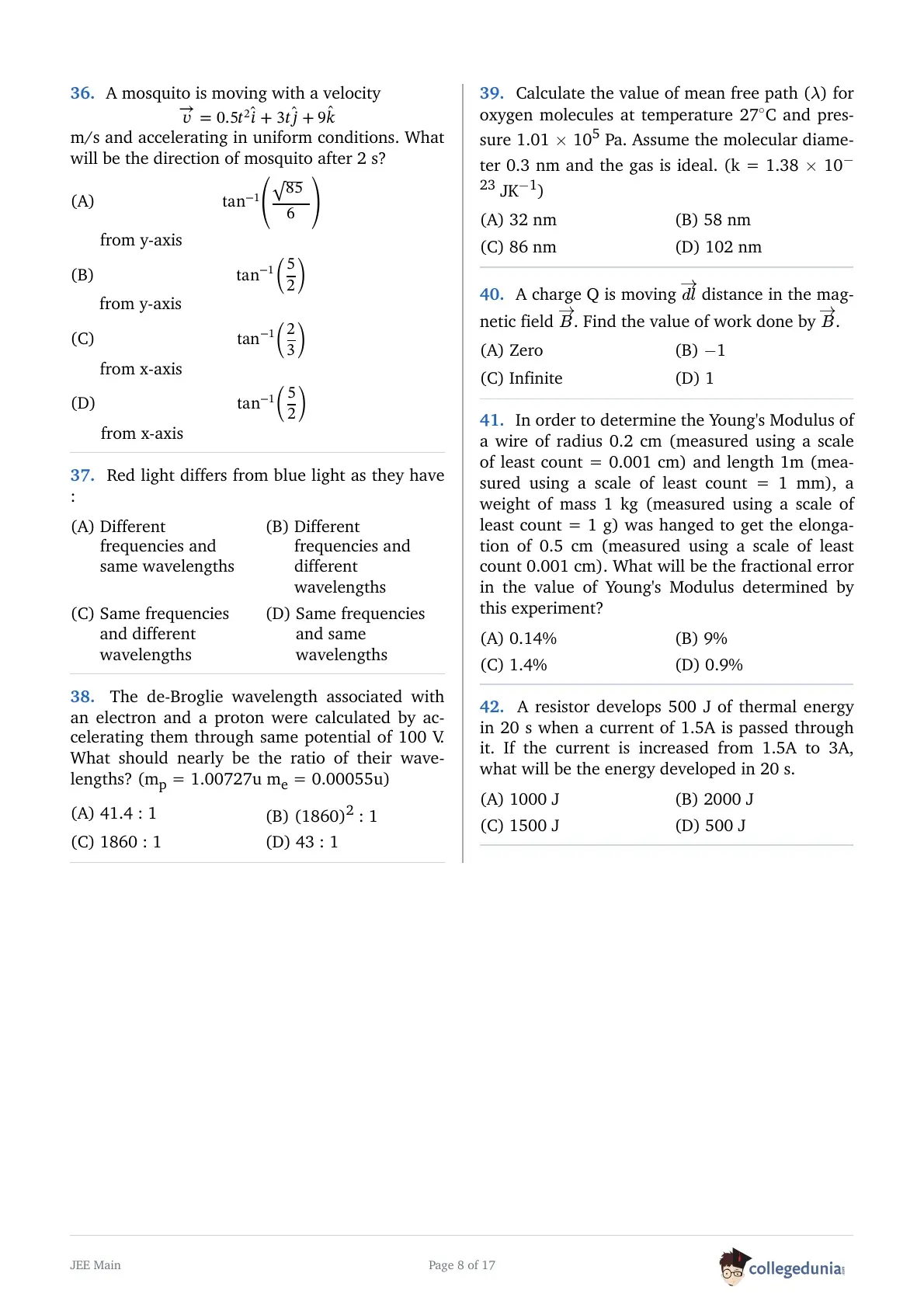
A mosquito is moving with a velocity \(\vec{v} = 0.5t^2\hat{i} + 3t\hat{j} + 9\hat{k}\) m/s and accelerating in uniform conditions. What will be the direction of mosquito after 2 s?
Red light differs from blue light as they have :
The de-Broglie wavelength associated with an electron and a proton were calculated by accelerating them through same potential of 100 V. What should nearly be the ratio of their wavelengths? (\(m_p = 1.00727\ \mathrm{u}\), \(m_e = 0.00055\ \mathrm{u}\))
Calculate the value of mean free path (\(\lambda\)) for oxygen molecules at temperature \(27^\circ\mathrm{C}\) and pressure \(1.01\times 10^5\) Pa. Assume the molecular diameter 0.3 nm and the gas is ideal. (\(k = 1.38\times 10^{-23}\ \mathrm{JK^{-1}}\))
A charge Q is moving \(\overrightarrow{dl}\) distance in the magnetic field \(\overrightarrow{B}\). Find the value of work done by \(\overrightarrow{B}\).
In order to determine the Young's Modulus of a wire of radius 0.2 cm (measured using a scale of least count = 0.001 cm) and length 1 m (measured using a scale of least count = 1 mm), a weight of mass 1 kg (measured using a scale of least count = 1 g) was hanged to get the elongation of 0.5 cm (measured using a scale of least count 0.001 cm). What will be the fractional error in the value of Young's Modulus determined by this experiment?
A resistor develops 300 J of thermal energy in 15 s, when a current of 2 A is passed through it. If the current increases to 3 A, the energy developed in 10 s is ______ J.
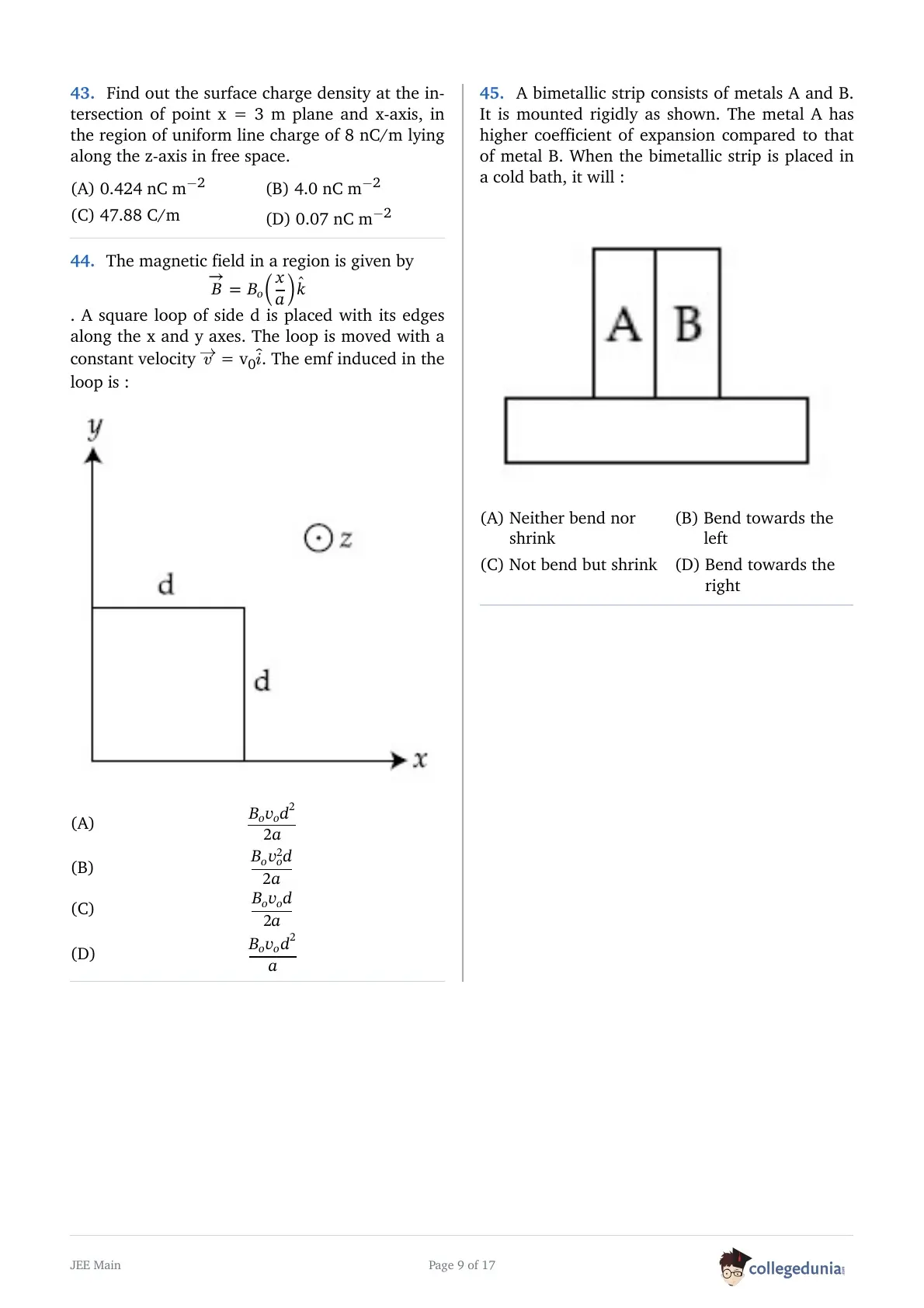
Find out the surface charge density at the intersection of point \(x = 3\ \mathrm{m}\) plane and x-axis, in the region of uniform line charge of 8 nC/m lying along the z-axis in free space.
The magnetic field in a region is given by \(\vec{B} = B_o\left(\frac{x}{a}\right)\hat{k}\). A square loop of side d is placed with its edges along the x and y axes. The loop is moved with a constant velocity \(\vec{v} = v_0\hat{i}\). The emf induced in the loop is :
A bimetallic strip consists of metals A and B. It is mounted rigidly as shown. The metal A has higher coefficient of expansion compared to that of metal B. When the bimetallic strip is placed in a cold bath, it will :
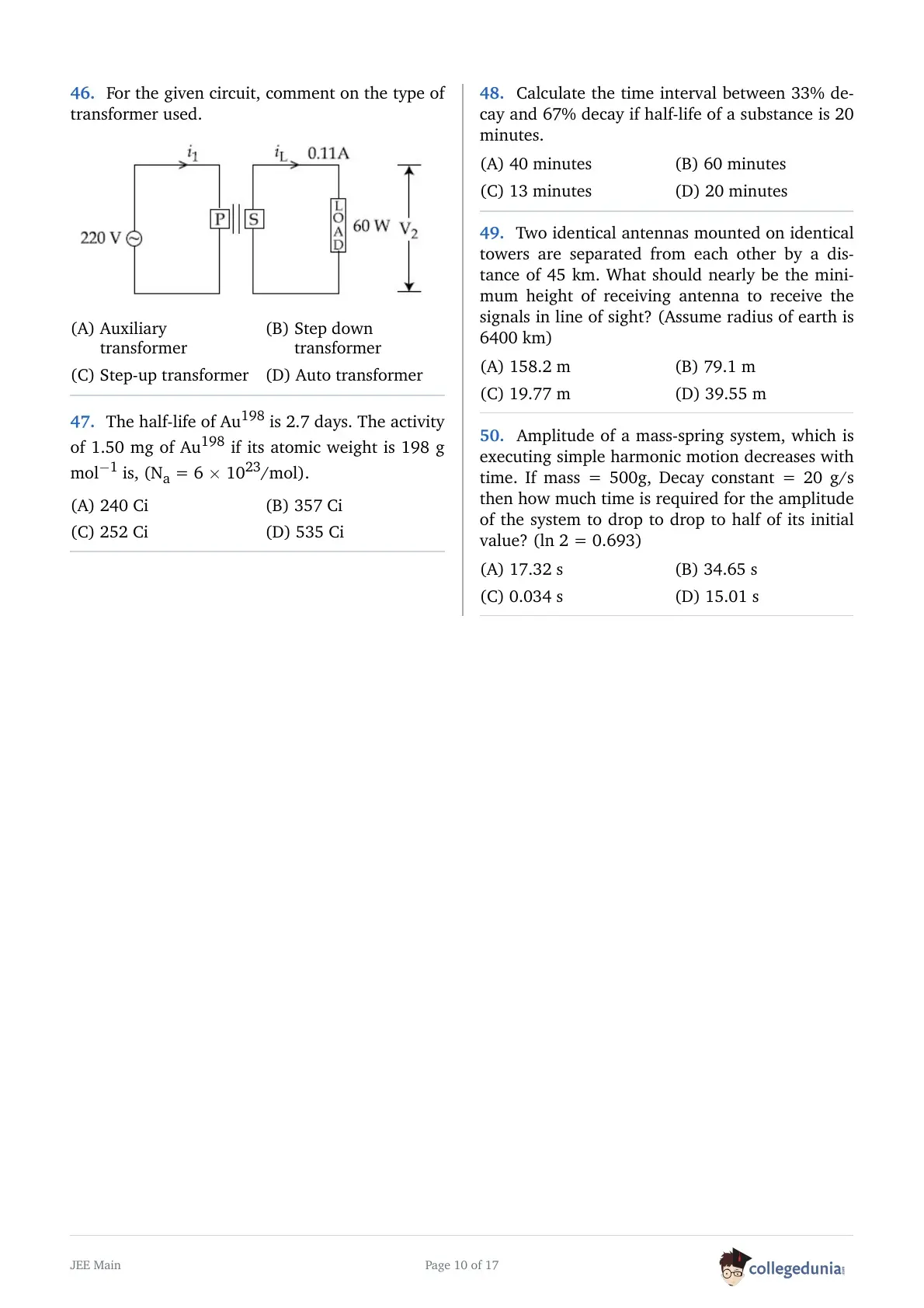
For the given circuit, comment on the type of transformer used.
The half-life of \(\mathrm{Au^{198}}\) is 2.7 days. The activity of 1.50 mg of \(\mathrm{Au^{198}}\) if its atomic weight is \(198\ \mathrm{g\,mol^{-1}}\) is, (\(N_a = 6\times 10^{23}\)/mol).
Calculate the time interval between 33% decay and 67% decay if half-life of a substance is 20 minutes.
Two identical antennas mounted on identical towers are separated from each other by a distance of 45 km. What should nearly be the minimum height of receiving antenna to receive the signals in line of sight? (Assume radius of earth is 6400 km)
Amplitude of a mass-spring system, which is executing simple harmonic motion decreases with time. If mass = 500 g, Decay constant = 20 g/s then how much time is required for the amplitude of the system to drop to drop to half of its initial value? (ln 2 = 0.693)
Physics - Section B (Q51 - Q60)
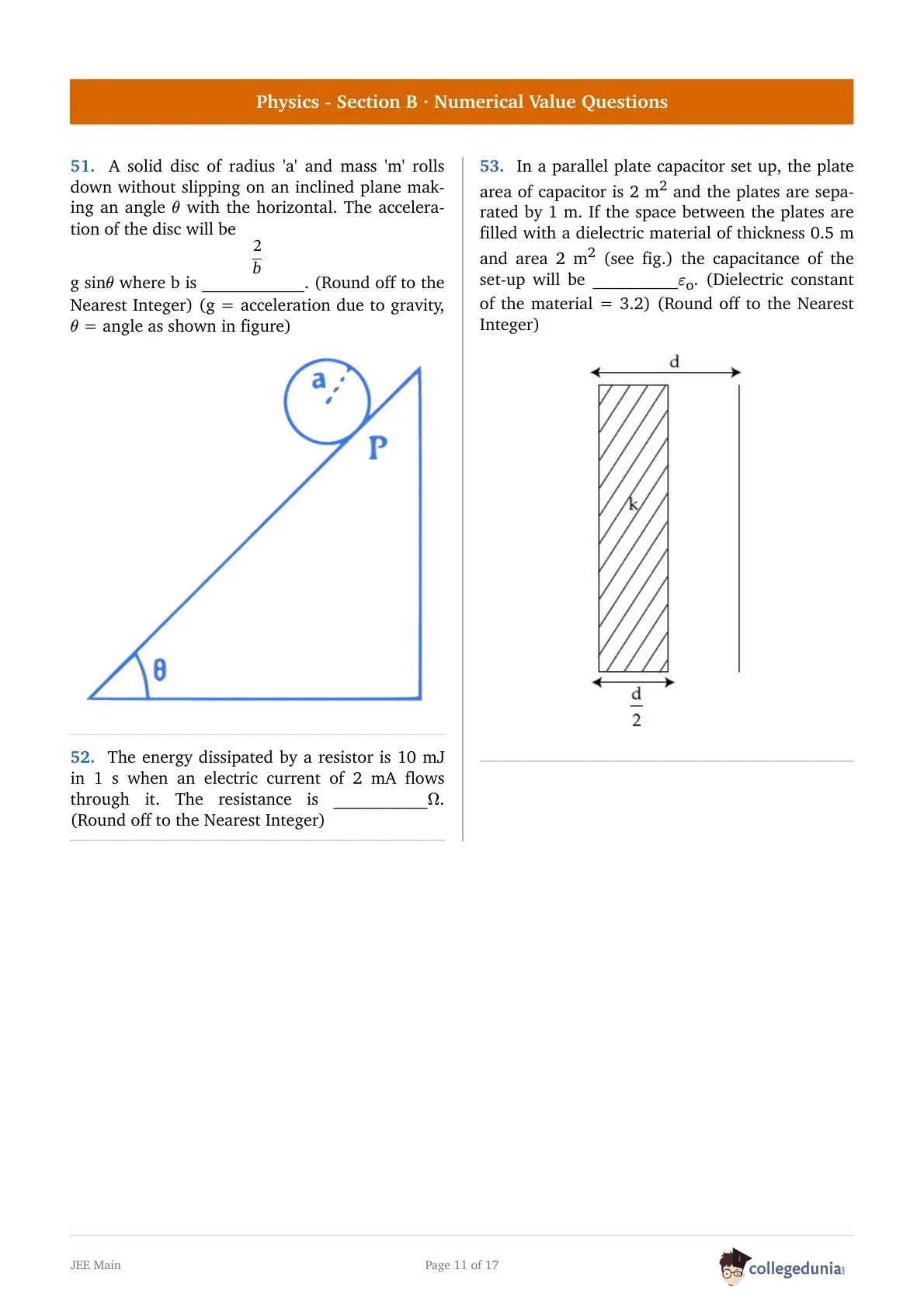
A solid disc of radius 'a' and mass 'm' rolls down without slipping on an inclined plane making an angle \(\theta\) with the horizontal. The acceleration of the disc will be \(\frac{2}{b}\) g sin\(\theta\) where b is ____________. (Round off to the Nearest Integer) (g = acceleration due to gravity, \(\theta\) = angle as shown in figure)
The energy dissipated by a resistor is 10 mJ in 1 s when an electric current of 2 mA flows through it. The resistance is ___________ \(\Omega\). (Round off to the Nearest Integer)
A parallel plate capacitor has plate area \(40\, cm ^2\) and plates separation \(2\, mm\) The space between the plates is filled with a dielectric medium of a thickness \(1 \,mm\) and dielectric constant \(5\) The capacitance of the system is :
An object is kept at rest at a distance of 3R above the earth’s surface where \( R \) is earth’s radius. The minimum speed with which it must be projected so that it does not return to earth is: (Assume \( M \) = mass of earth, \( G \) = Universal gravitational constant)
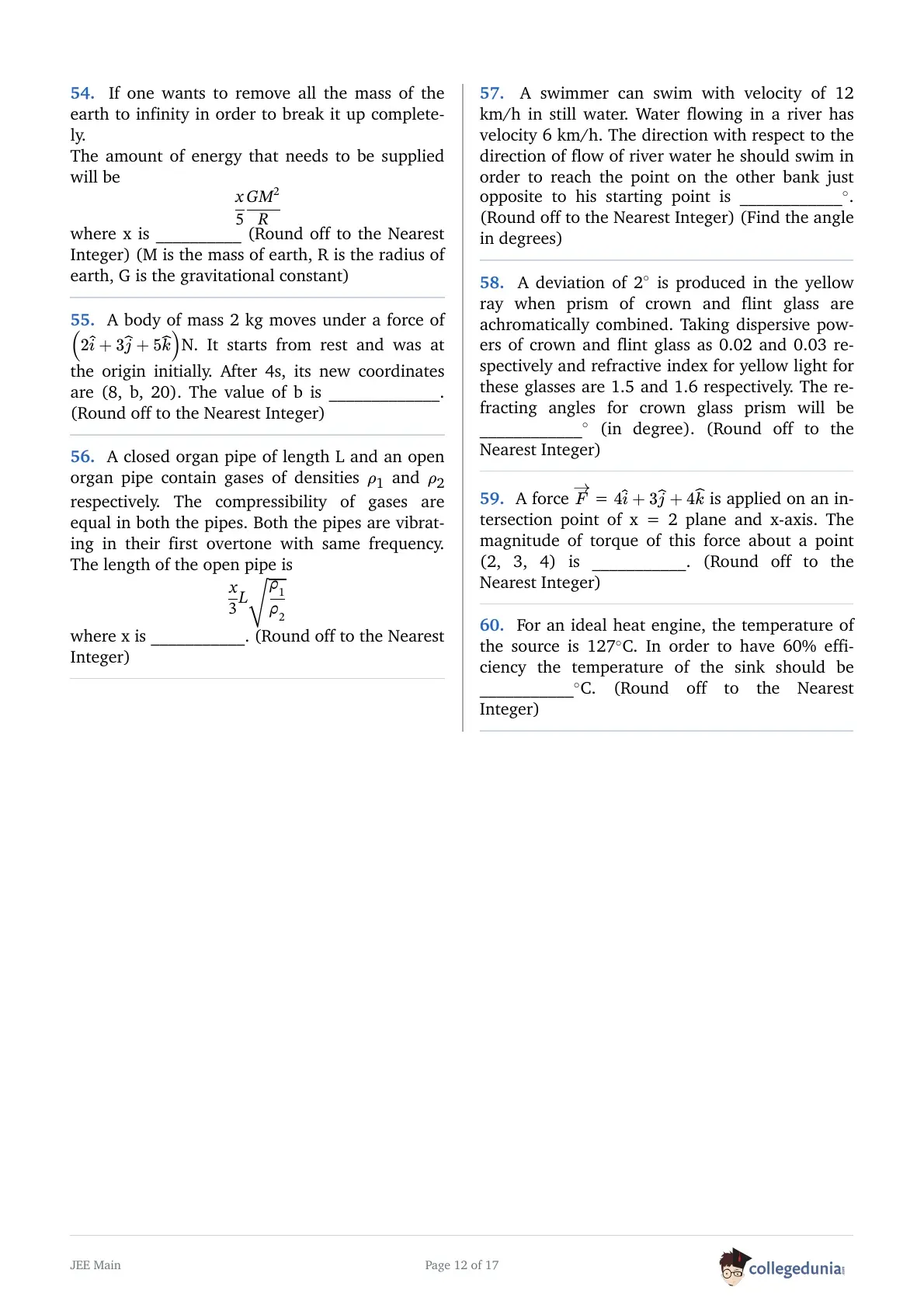
A body of mass 2 kg moves under a force of \(\left(2\hat{i} + 3\hat{j} + 5\hat{k}\right)\) N. It starts from rest and was at the origin initially. After 4 s, its new coordinates are (8, b, 20). The value of b is _____________. (Round off to the Nearest Integer)
A closed organ pipe of length L and an open organ pipe contain gases of densities \(\rho_1\) and \(\rho_2\) respectively. The compressibility of gases are equal in both the pipes. Both the pipes are vibrating in their first overtone with same frequency. The length of the open pipe is \(\frac{x}{3}L\sqrt{\frac{\rho_1}{\rho_2}}\) where x is ___________. (Round off to the Nearest Integer)
A swimmer can swim with velocity of 12 km/h in still water. Water flowing in a river has velocity 6 km/h. The direction with respect to the direction of flow of river water he should swim in order to reach the point on the other bank just opposite to his starting point is ____________\(^\circ\). (Round off to the Nearest Integer) (Find the angle in degrees)
A deviation of \(2^\circ\) is produced in the yellow ray when prism of crown and flint glass are achromatically combined. Taking dispersive powers of crown and flint glass as 0.02 and 0.03 respectively and refractive index for yellow light for these glasses are 1.5 and 1.6 respectively. The refracting angles for crown glass prism will be ____________\(^\circ\) (in degree). (Round off to the Nearest Integer)
A force \( \vec{f} = x^2 \hat{i} + y \hat{j} + y^2 \hat{k} \) acts on a particle in a plane \( x + y = 10 \). The work done by this force during a displacement from \( (0,0) \) to \( (4m, 2m) \) is Joules (round off to the nearest integer).
For an ideal heat engine, the temperature of the source is \(127^\circ\)C. In order to have 60% efficiency the temperature of the sink should be ___________\(^\circ\)C. (Round off to the Nearest Integer)
Chemistry - Section A (Q61 - Q80)
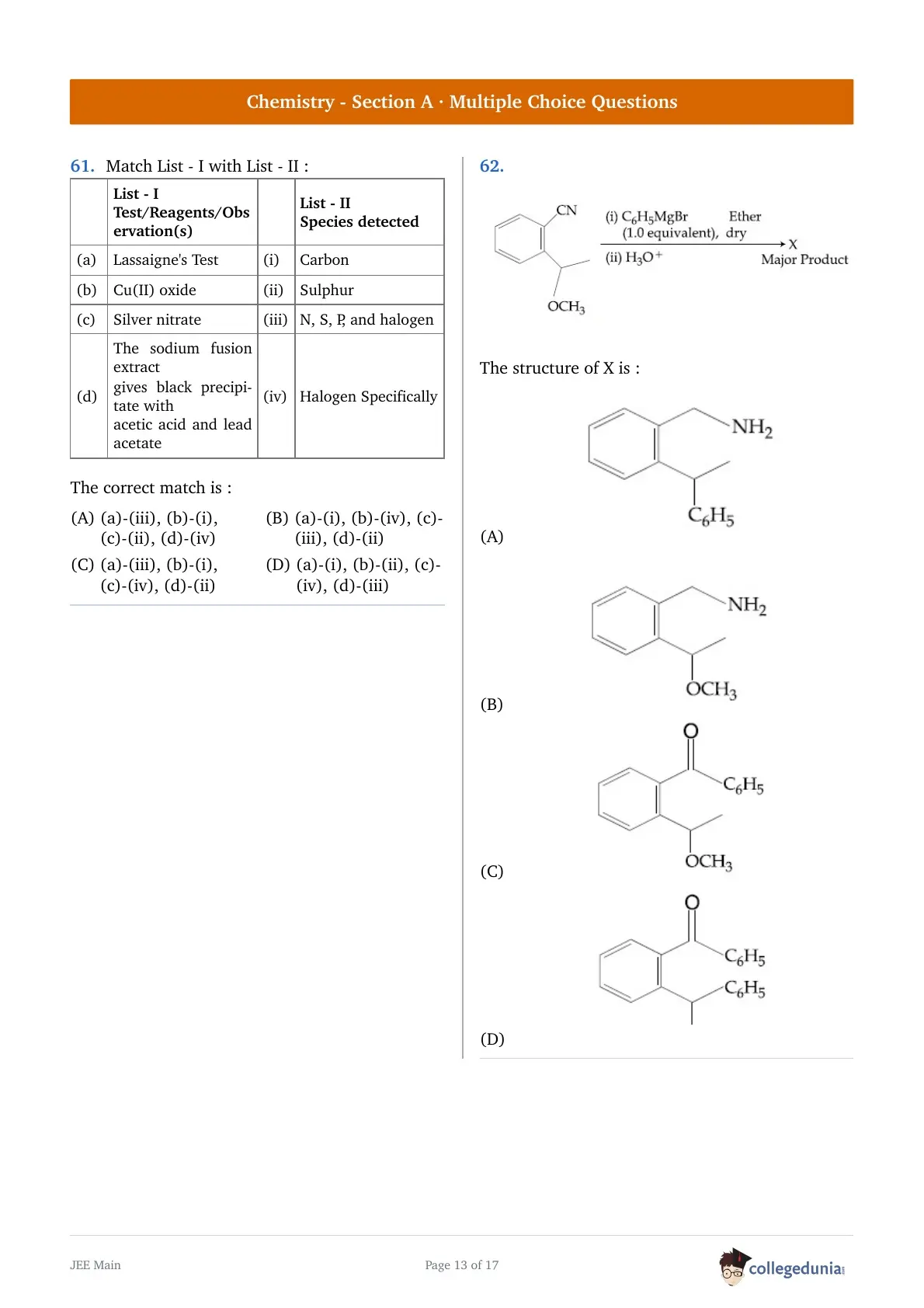
| List - I Test/Reagents/Observation(s) | List - II Species detected | ||
| (a) | Lassaigne's Test | (i) | Carbon |
| (b) | Cu(II) oxide | (ii) | Sulphur |
| (c) | Silver nitrate | (iii) | N, S, P, and halogen |
| (d) | The sodium fusion extract gives black precipitate with acetic acid and lead acetate | (iv) | Halogen Specifically |
The correct match is :


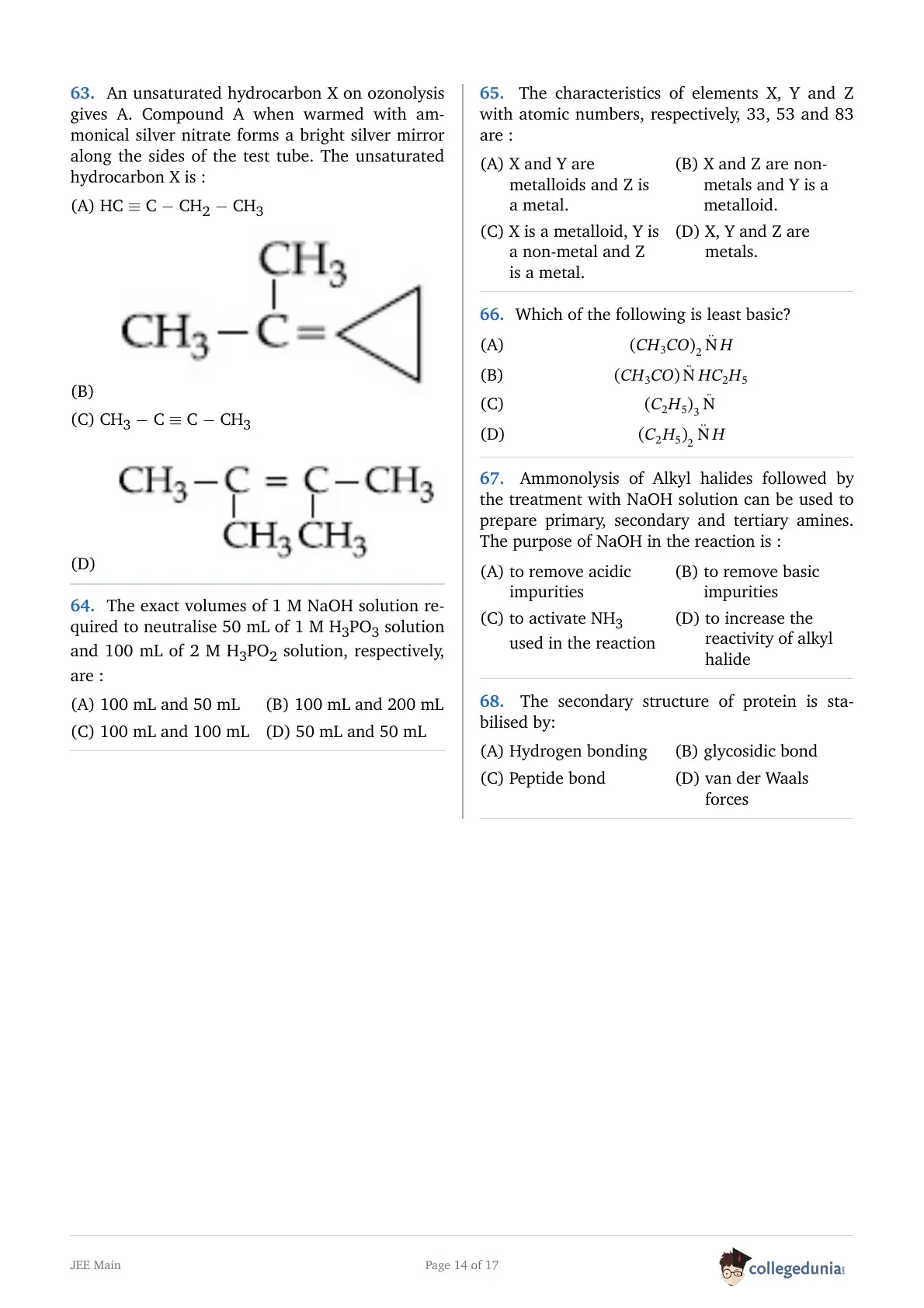
An unsaturated hydrocarbon X on ozonolysis gives A. Compound A when warmed with ammonical silver nitrate forms a bright silver mirror along the sides of the test tube. The unsaturated hydrocarbon X is :
- (1) \(\mathrm{HC \equiv C - CH_2 - CH_3}\)
- (2)
![]()
- (3) \(\mathrm{CH_3 - C \equiv C - CH_3}\)
- (4)
![]()


The exact volumes of 1 M NaOH solution required to neutralise 50 mL of 1 M \(\mathrm{H_3PO_3}\) solution and 100 mL of 2 M \(\mathrm{H_3PO_2}\) solution, respectively, are :
The characteristics of elements X, Y and Z with atomic numbers, respectively, 33, 53 and 83 are :
Which of the following is least basic?
Ammonolysis of Alkyl halides followed by the treatment with NaOH solution can be used to prepare primary, secondary and tertiary amines. The purpose of NaOH in the reaction is :
The secondary structure of protein is stabilised by:
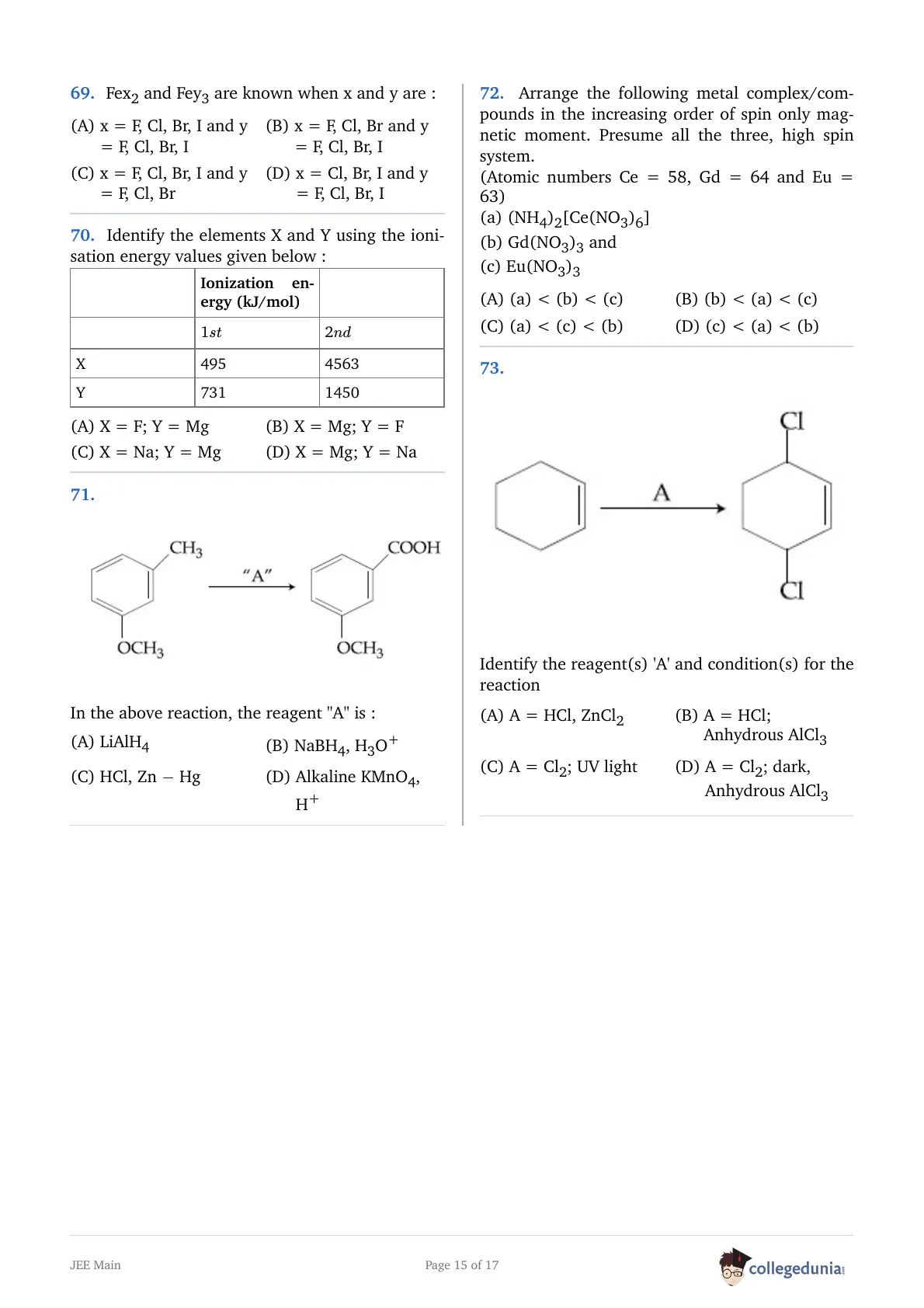
\(\mathrm{FeX_2}\) and \(\mathrm{FeY_3}\) are known when x and y are :
| 1st ionization energy (kJ/mol) | 2nd ionization energy (kJ/mol) | |
| X | 495 | 4563 |
| Y | 731 | 1450 |

In the above reaction, the reagent "A" is :
Arrange the following metal complex/compounds in the increasing order of spin only magnetic moment. Presume all the three, high spin system.
(Atomic numbers Ce = 58, Gd = 64 and Eu = 63)
(a) \(\mathrm{(NH_4)_2[Ce(NO_3)_6]}\)
(b) \(\mathrm{Gd(NO_3)_3}\) and
(c) \(\mathrm{Eu(NO_3)_3}\)

Identify the reagent(s) 'A' and condition(s) for the reaction
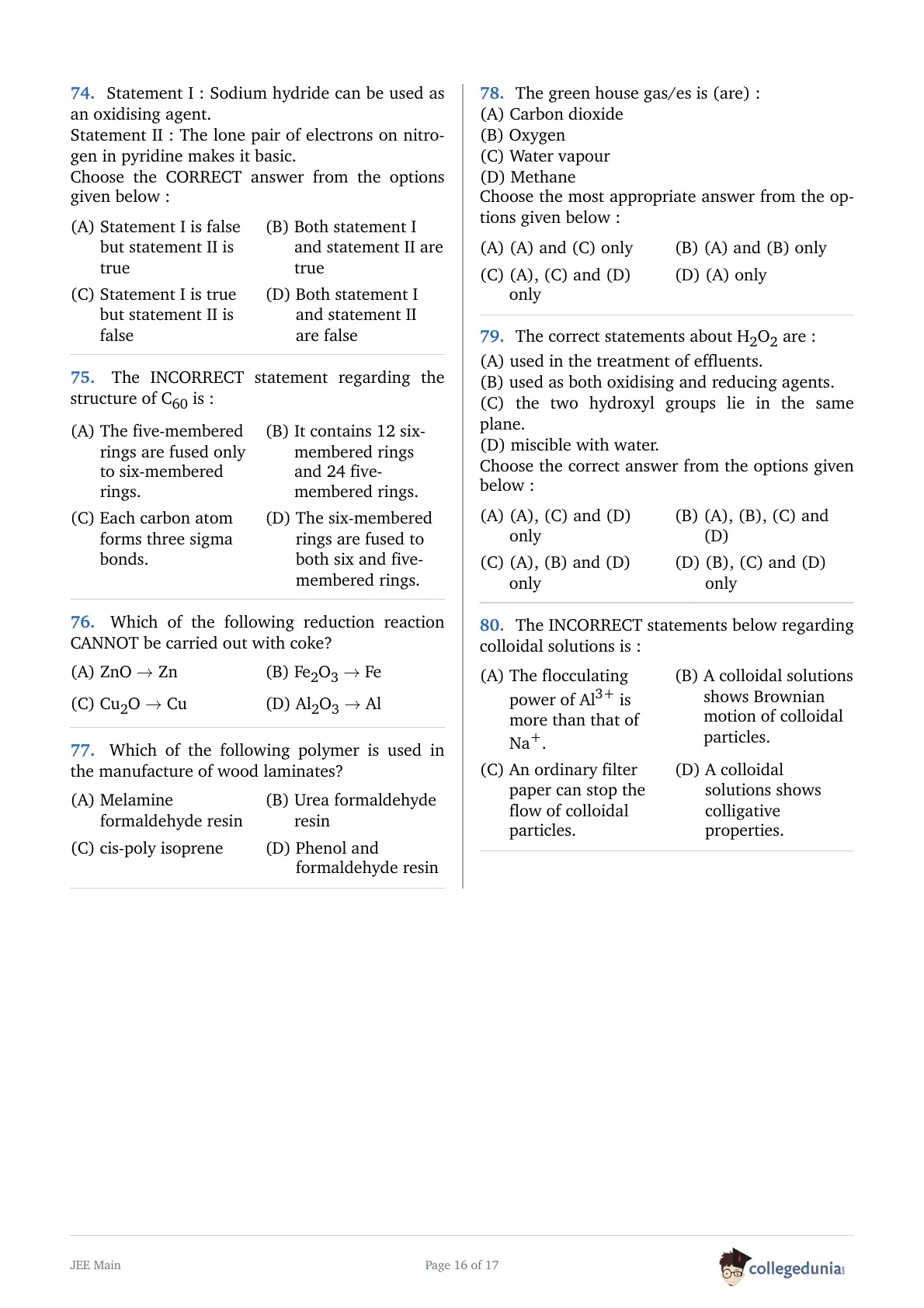
Statement I : Sodium hydride can be used as an oxidising agent.
Statement II : The lone pair of electrons on nitrogen in pyridine makes it basic.
Choose the CORRECT answer from the options given below :
The INCORRECT statement regarding the structure of \(\mathrm{C_{60}}\) is :
Which of the following reduction reaction CANNOT be carried out with coke?
Which of the following polymer is used in the manufacture of wood laminates?
The green house gas/es is (are) :
(A) Carbon dioxide
(B) Oxygen
(C) Water vapour
(D) Methane
Choose the most appropriate answer from the options given below :
The correct statements about \(\mathrm{H_2O_2}\) are :
(A) used in the treatment of effluents.
(B) used as both oxidising and reducing agents.
(C) the two hydroxyl groups lie in the same plane.
(D) miscible with water.
Choose the correct answer from the options given below :
The INCORRECT statements below regarding colloidal solutions is :
Chemistry - Section B (Q81 - Q90)
If \([Cu(H_2O)_4]^{2+}\) absorbs a light of wavelength 600 nm for d-d transition, then the value of octahedral crystal field splitting energy for [\(Cu(H_2O)_6]^{2+}\) will be _______ \(×10^{–21} J\). [Nearest integer]
(Given : h = \(6.63 × 10^{–34} Js\) and \(c = 3.08×10^8 ms^{–1}\))
At 298 K, the molar conductivity of \(x% \ (w/w)\) MX solution (aqueous) is 123.5 S cm\(^2\) mol\(^{-1}\). The conductance of same solution is \(1.9 \times 10^{-3}\) S. The value of \(x\) is ______ \(\times 10^{-2}\).
(Given : cell constant \(= 1.3 \text{ cm}^{-1}\); molar mass of MX is 75 g mol\(^{-1}\), density of aqueous solution of MX at 298 K is 1.0 g mL\(^{-1}\))}
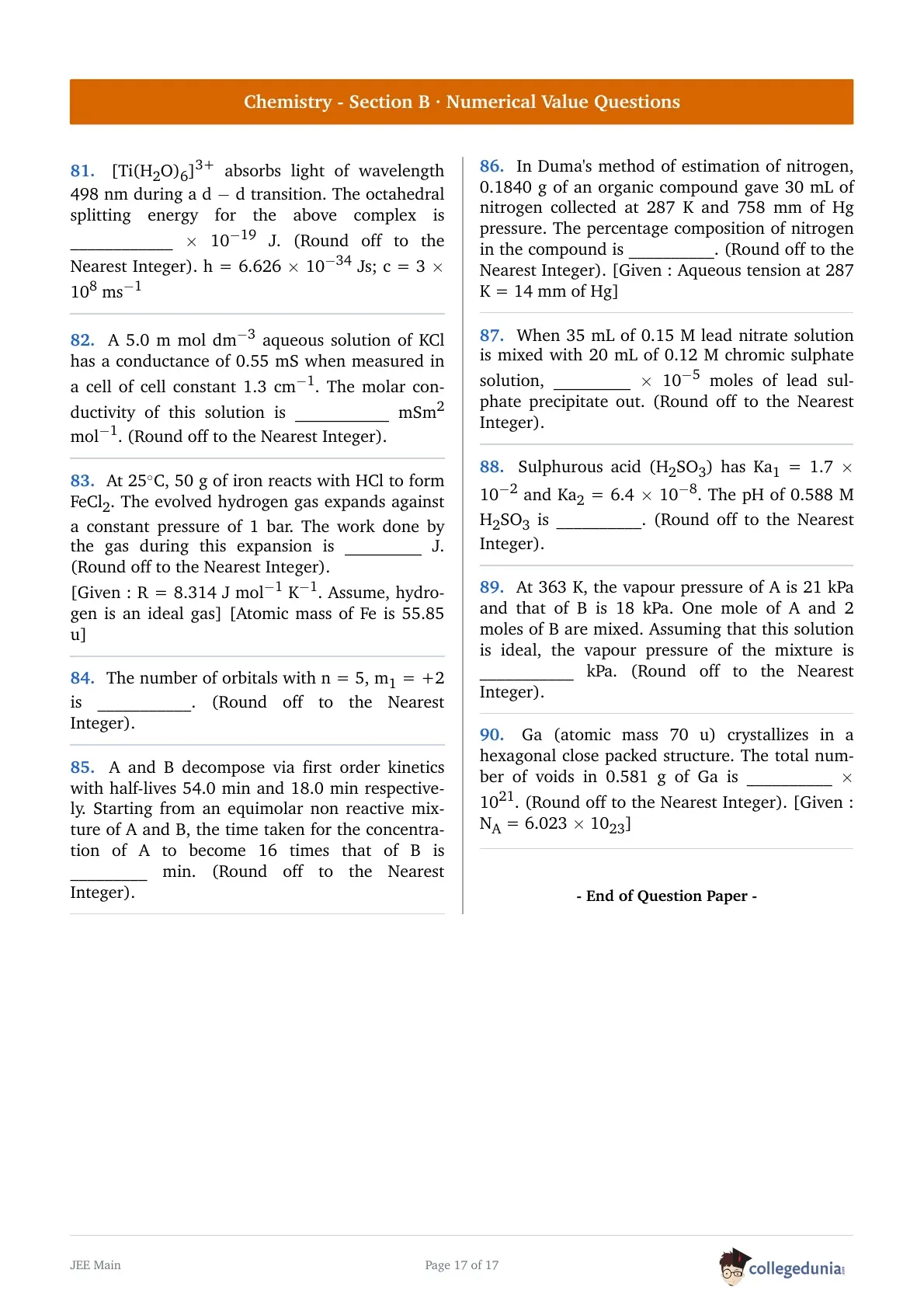
At 25\(^\circ\)C, 50 g of iron reacts with HCl to form \(\mathrm{FeCl_2}\). The evolved hydrogen gas expands against a constant pressure of 1 bar. The work done by the gas during this expansion is _________ J. (Round off to the Nearest Integer).
[Given : R = 8.314 J mol\(^{-1}\) K\(^{-1}\). Assume, hydrogen is an ideal gas] [Atomic mass of Fe is 55.85 u]
The overall order of the reaction is _________. (Round off to the Nearest Integer) based on the NO and Cl\(_2\) data.
A and B decompose via first order kinetics with half-lives 54.0 min and 18.0 min respectively. Starting from an equimolar non reactive mixture of A and B, the time taken for the concentration of A to become 16 times that of B is _________ min. (Round off to the Nearest Integer).
In Duma's method of estimation of nitrogen, 0.1840 g of an organic compound gave 30 mL of nitrogen collected at 287 K and 758 mm of Hg pressure. The percentage composition of nitrogen in the compound is __________. (Round off to the Nearest Integer). [Given : Aqueous tension at 287 K = 14 mm of Hg]
When 35 mL of 0.15 M lead nitrate solution is mixed with 20 mL of 0.12 M chromic sulphate solution, _________ \(\times\) \(10^{-5}\) moles of lead sulphate precipitate out. (Round off to the Nearest Integer).
Sulphurous acid (\(\mathrm{H_2SO_3}\)) has \(\mathrm{Ka_1}\) = 1.7 \(\times\) \(10^{-2}\) and \(\mathrm{Ka_2}\) = 6.4 \(\times\) \(10^{-8}\). The pH of 0.588 M \(\mathrm{H_2SO_3}\) is __________. (Round off to the Nearest Integer).
At 363 K, the vapour pressure of A is 21 kPa and that of B is 18 kPa. One mole of A and 2 moles of B are mixed. Assuming that this solution is ideal, the vapour pressure of the mixture is ___________ kPa. (Round off to the Nearest Integer).
Ga (atomic mass 70 u) crystallizes in a hexagonal close packed structure. The total number of voids in 0.581 g of Ga is __________ \(\times\) \(10^{21}\). (Round off to the Nearest Integer). [Given : \(\mathrm{N_A}\) = 6.023 \(\times\) \(10^{23}\)]
JEE Main 2021 Exam Pattern and Marking Scheme
| Particulars | Details |
|---|---|
| Exam Mode | Online (Computer-Based Test) |
| Paper | B.E./B.Tech (Paper 1) |
| Duration | 3 hours (180 minutes) |
| Type of Questions | Multiple Choice Questions (MCQs) + Numerical Value Questions |
| Subjects | Mathematics, Physics, Chemistry |
| Total Questions | 90 questions (75 to be attempted) |
| Total Marks | 300 marks |
| Marking Scheme | +4 for correct answer & -1 for incorrect MCQ; no negative marking for Numerical Value Questions |
JEE Main 2021 March 16 Shift 2 Difficulty Level
JEE Main 2021 B.E./B.Tech Question Paper - March 16, 2021- Afternoon Session was considered to be average on the difficulty level. The Mathematics section was of moderate difficulty but featured few questions that required lengthy calculation, especially from Coordinate Geometry. The Physics section too was of average difficulty, with few NAT Questions being too difficult. Students had the choice of attempting any 5 Questions from the 10 listed NAT questions in the Physics, Chemistry, and Mathematics section. The Chemistry section featured more questions from Inorganic and Physical chemistry than Organic Chemistry; the questions were mostly direct equation or formula based.
JEE Main 2021 B.E./B.Tech Question Paper March 16 (AN): Weightage of Topics
JEE Main 2021 B.E./B.Tech March 16 Afternoon Session was conducted from 3.00 PM to 6.00 PM. The weightage of topics in JEE Main Syllabus was as follows:
Physics
| Chapter Name | Weightage |
|---|---|
| Electrodynamics | 17% |
| Heat and Thermodynamics | 10% |
| Mechanics | 30% |
| Modern Physics | 20% |
| Optics | 7% |
| SHM and Waves | 7% |
Chemistry
| Chapter Name | Weightage |
|---|---|
| Inorganic Chemistry | 30% |
| Organic Chemistry | 33% |
| Physical Chemistry | 37% |
Mathematics
| Chapter Name | Weightage |
|---|---|
| Binomial Theorem | 5% |
| Complex Numbers | 5% |
| Coordinate Geometry | 30% |
| Differential Calculus | 14% |
| Integral Calculus | 11% |
| Vector and 3D | 14% |
| Trigonometry | 13% |
| Matrix and Determinants | 8% |



Comments