




JEE Main 2021 March 17 Shift 1 Question Paper is available here with solutions PDF and detailed solutions for every question. NTA conducted the first shift on March 17, 2021, from 9:00 AM to 12:00 PM. The JEE Main 2021 Paper 1 (B.E./B.Tech) question paper includes the following:
- 90 questions in a 3-hour CBT Mode: 30 each from Mathematics, Physics and Chemistry (75 to be attempted)
- Section A: 20 multiple choice questions (MCQs) per subject, all compulsory, 4 marks each
- Section B: 10 numerical value questions per subject, any 5 to be attempted, 4 marks each
- Marking: +4 for a correct answer, -1 for an incorrect MCQ, 0 for an unattempted question; no negative marking for numerical value questions
- Maximum marks: 300 (100 per subject)
JEE Main 2021 March 17 Shift 1 Question Paper with Solution PDF
| NTA Official PDF | CD PDF | CD PDF with Solutions |
|---|---|---|
| Download official PDF 5.19 MB | Download Collegedunia PDF 0.96 MB | Download solutions PDF 1.25 MB |
Also Check:
JEE Main 2021 March 17 Shift 1 Questions with Solutions
Mathematics - Section A (Q1 - Q20)
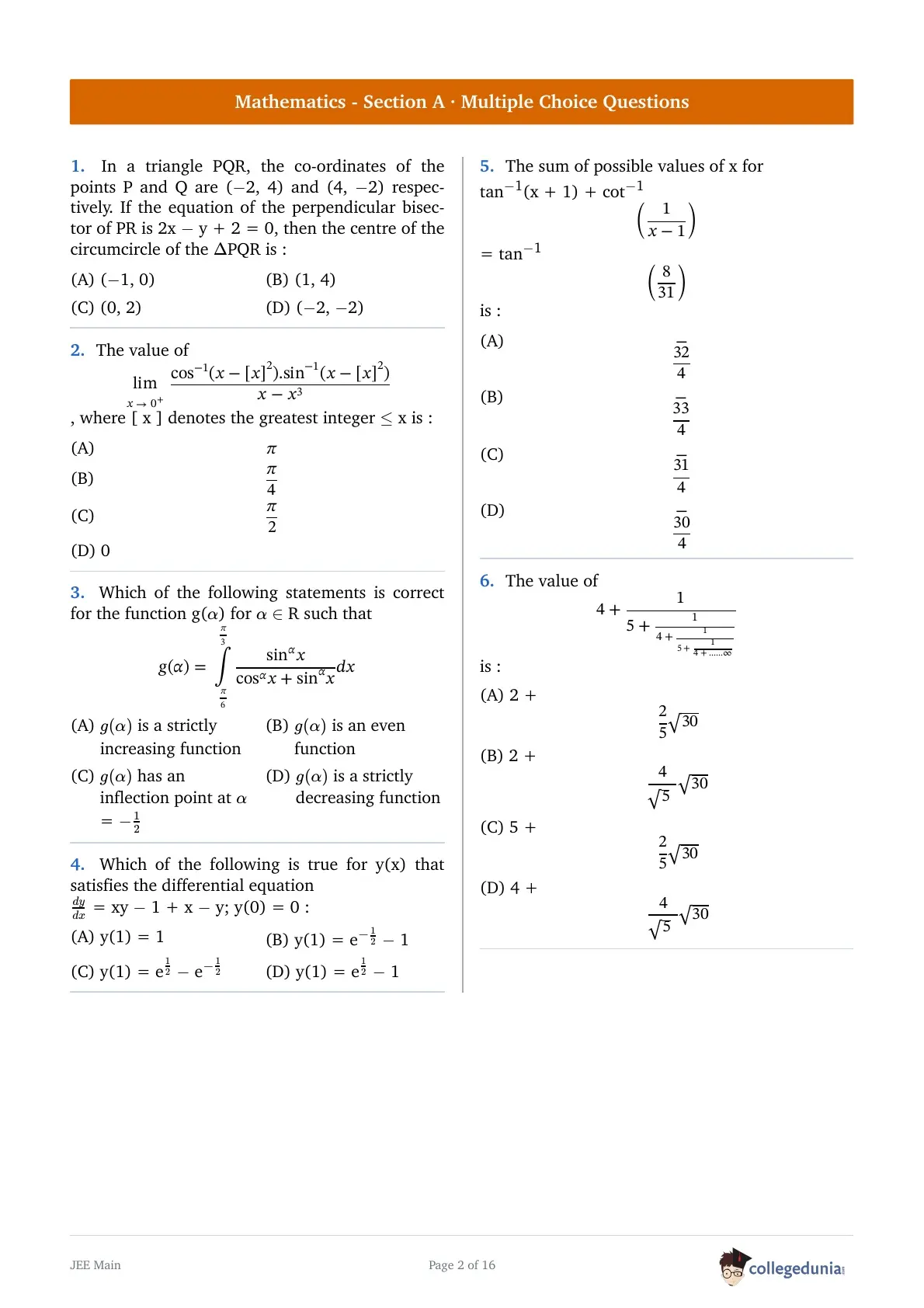
In a triangle PQR, the co-ordinates of the points P and Q are \((-2, 4)\) and \((4, -2)\) respectively. If the equation of the perpendicular bisector of PR is \(2x - y + 2 = 0\), then the centre of the circumcircle of the \(\Delta\)PQR is :
The value of
\(\lim_{x \to 0^+} \dfrac{\cos^{-1}(x - [x]^2) \cdot \sin^{-1}(x - [x]^2)}{x - x^3}\), where \([x]\) denotes the greatest integer \(\le x\) is :
Which of the following statements is correct for the function \(g(\alpha)\) for \(\alpha \in R\) such that
\(g(\alpha) = \int_{\pi/6}^{\pi/3} \dfrac{\sin^{\alpha}x}{\cos^{\alpha}x + \sin^{\alpha}x}\,dx\)
Which of the following is true for \(y(x)\) that satisfies the differential equation
\(\dfrac{dy}{dx} = xy - 1 + x - y\); \(y(0) = 0\) :
The sum of possible values of \(x\) for
\(\tan^{-1}(x + 1) + \cot^{-1}\left(\dfrac{1}{x - 1}\right) = \tan^{-1}\left(\dfrac{8}{31}\right)\) is :
The value of
\(4 + \dfrac{1}{5 + \dfrac{1}{4 + \dfrac{1}{5 + \dfrac{1}{4 + \cdots \infty}}}}\) is :
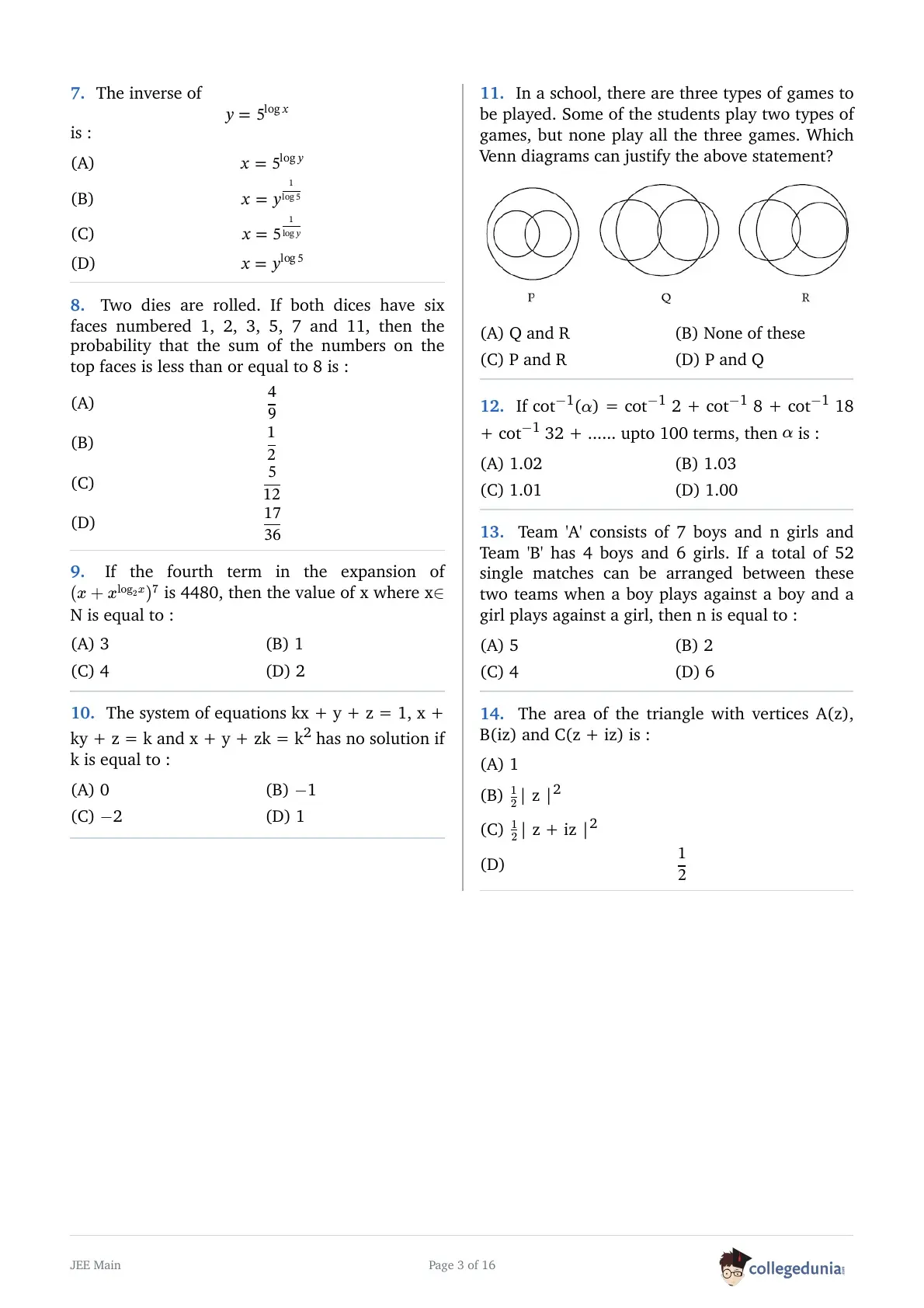
The inverse function of \(f\left(x\right) = \frac{8^{2x}-8^{-2x}}{8^{2x} + 8^{-2x}}, x\epsilon \left(-1, 1\right),\) is __________.
Two dies are rolled. If both dices have six faces numbered 1, 2, 3, 5, 7 and 11, then the probability that the sum of the numbers on the top faces is less than or equal to 8 is :
If the fourth term in the expansion of \((x + x^{\log_2 x})^7\) is 4480, then the value of \(x\) where \(x \in N\) is equal to :
The system of equations \(kx + y + z = 1\), \(x + ky + z = k\) and \(x + y + zk = k^2\) has no solution if \(k\) is equal to :
In a school, there are three types of games to be played. Some of the students play two types of games, but none play all the three games. Which Venn diagrams can justify the above statement?
If \(\cot^{-1}(\alpha) = \cot^{-1}2 + \cot^{-1}8 + \cot^{-1}18 + \cot^{-1}32 + \cdots\) upto 100 terms, then \(\alpha\) is :
Team 'A' consists of 7 boys and \(n\) girls and Team 'B' has 4 boys and 6 girls. If a total of 52 single matches can be arranged between these two teams when a boy plays against a boy and a girl plays against a girl, then \(n\) is equal to :
The area of the triangle with vertices \(A(z)\), \(B(iz)\) and \(C(z + iz)\) is :
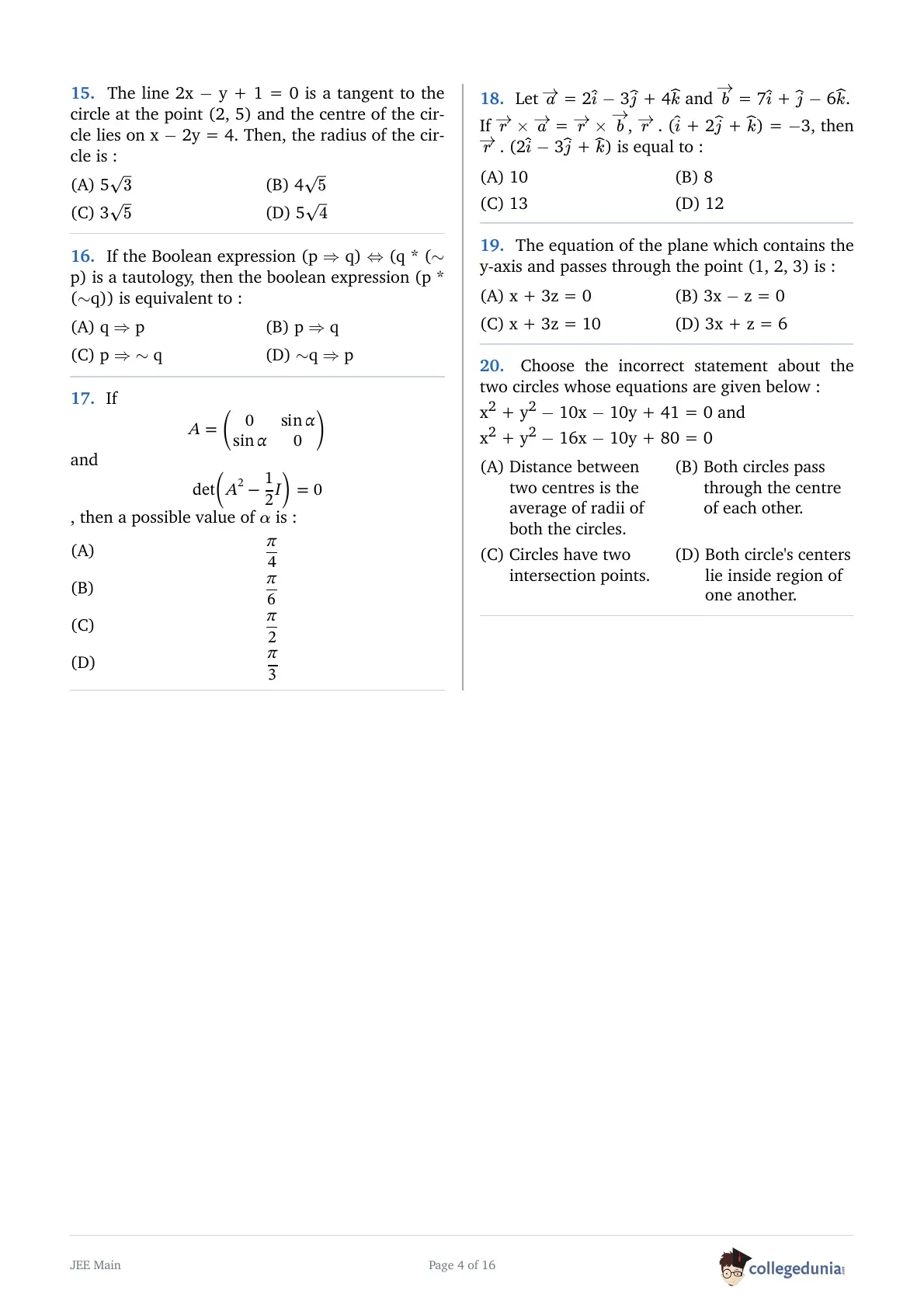
The line \(2x - y + 1 = 0\) is a tangent to the circle at the point \((2, 5)\) and the centre of the circle lies on \(x - 2y = 4\). Then, the radius of the circle is :
If the Boolean expression \((p \Rightarrow q) \Leftrightarrow (q * (\sim p))\) is a tautology, then the boolean expression \((p * (\sim q))\) is equivalent to :
If \(A = \begin{pmatrix} 0 & \sin\alpha \\ \sin\alpha & 0 \end{pmatrix}\) and \(\det\left(A^2 - \frac{1}{2}I\right) = 0\), then a possible value of \(\alpha\) is :
Let \(\vec{a} = 2\hat{i} - 3\hat{j} + 4\hat{k}\) and \(\vec{b} = 7\hat{i} + \hat{j} - 6\hat{k}\).
If \(\vec{r}\times\vec{a} = \vec{r}\times\vec{b}\), \(\vec{r}\cdot(\hat{i} + 2\hat{j} + \hat{k}) = -3\), then \(\vec{r}\cdot(2\hat{i} - 3\hat{j} + \hat{k})\) is equal to :
The equation of the plane which contains the y-axis and passes through the point \((1, 2, 3)\) is :
Choose the incorrect statement about the two circles whose equations are given below :
\(x^2 + y^2 - 10x - 10y + 41 = 0\) and
\(x^2 + y^2 - 16x - 10y + 80 = 0\)
Mathematics - Section B (Q21 - Q30)
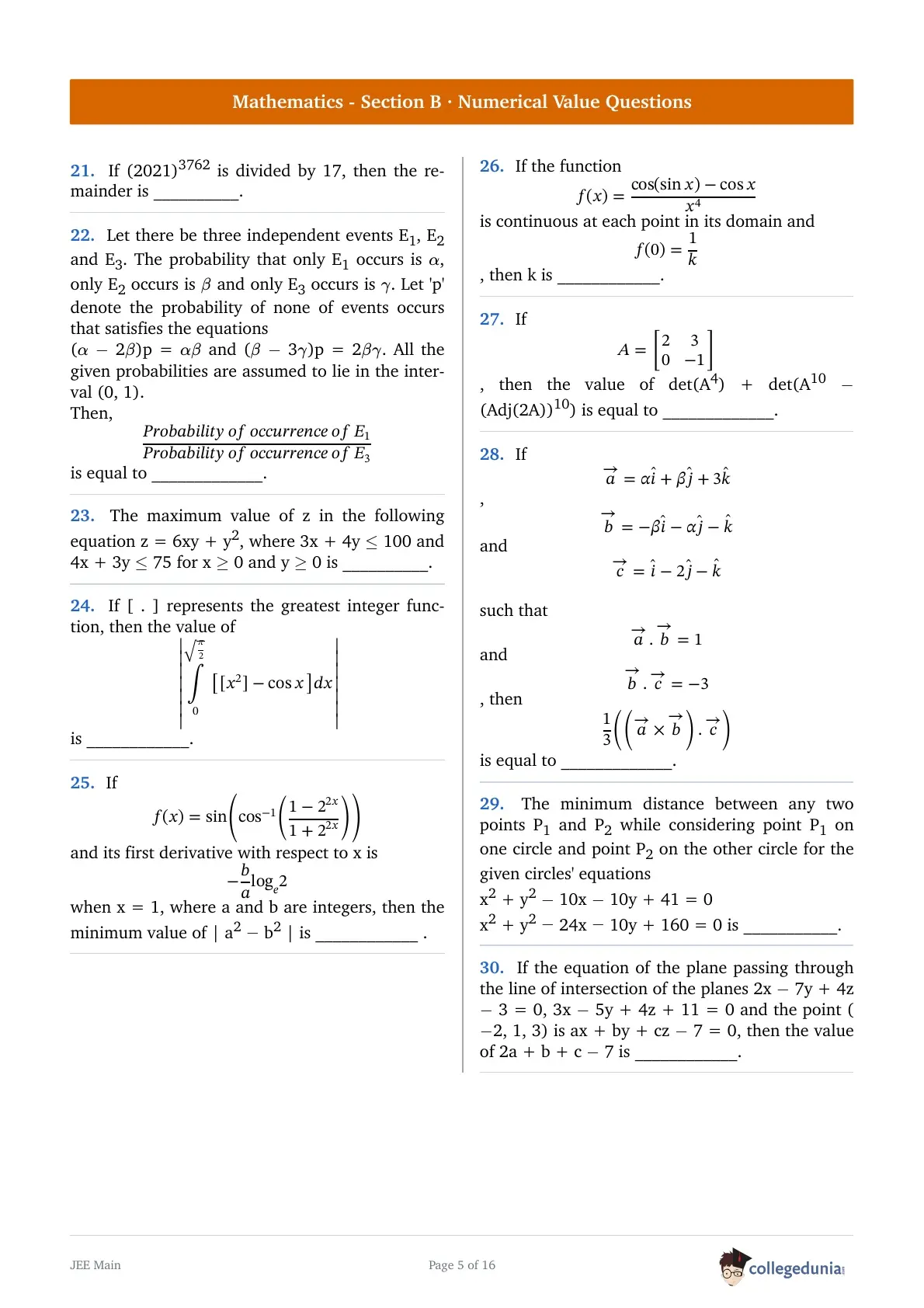
If \((2021)^{3762}\) is divided by 17, then the remainder is __________.
Let there be three independent events \(E_1\), \(E_2\) and \(E_3\). The probability that only \(E_1\) occurs is \(\alpha\), only \(E_2\) occurs is \(\beta\) and only \(E_3\) occurs is \(\gamma\). Let 'p' denote the probability of none of events occurs that satisfies the equations \((\alpha - 2\beta)p = \alpha\beta\) and \((\beta - 3\gamma)p = 2\beta\gamma\). All the given probabilities are assumed to lie in the interval \((0, 1)\).
Then, \(\dfrac{\text{Probability of occurrence of } E_1}{\text{Probability of occurrence of } E_3}\) is equal to _____________.
The maximum value of z in the following equation \(z = 6xy + y^2\), where \(3x + 4y \le 100\) and \(4x + 3y \le 75\) for \(x \ge 0\) and \(y \ge 0\) is __________.
If \[ 24 \left( \int_0^\frac{\pi}{4} \left[ \sin \left( 4x - \frac{\pi}{12} \right) + [2 \sin x] \right] dx \right) = 2n + \alpha, \] where [.] denotes the greatest integer function, then \( \alpha \) is equal to:
If \(f(x) = \sin\left(\cos^{-1}\left(\dfrac{1 - 2^{2x}}{1 + 2^{2x}}\right)\right)\) and its first derivative with respect to x is \(-\dfrac{b}{a}\log_e 2\) when \(x = 1\), where a and b are integers, then the minimum value of \(|a^2 - b^2|\) is ____________ .
If the function \(f(x) = \dfrac{\cos(\sin x) - \cos x}{x^4}\) is continuous at each point in its domain and \(f(0) = \dfrac{1}{k}\), then k is ____________.
If \(A = \begin{bmatrix} 2 & 3 \\ 0 & -1 \end{bmatrix}\), then the value of \(\det(A^4) + \det\left(A^{10} - (\mathrm{Adj}(2A))^{10}\right)\) is equal to _____________.
If \(\vec{a} = \alpha\hat{i} + \beta\hat{j} + 3\hat{k}\), \(\vec{b} = -\beta\hat{i} - \alpha\hat{j} - \hat{k}\) and \(\vec{c} = \hat{i} - 2\hat{j} - \hat{k}\) such that \(\vec{a}\cdot\vec{b} = 1\) and \(\vec{b}\cdot\vec{c} = -3\), then \(\dfrac{1}{3}\left((\vec{a}\times\vec{b})\cdot\vec{c}\right)\) is equal to _____________.
The minimum distance between any two points \(P_1\) and \(P_2\) while considering point \(P_1\) on one circle and point \(P_2\) on the other circle for the given circles' equations
\(x^2 + y^2 - 10x - 10y + 41 = 0\)
\(x^2 + y^2 - 24x - 10y + 160 = 0\) is ___________.
If the equation of the plane passing through the line of intersection of the planes \(2x - 7y + 4z - 3 = 0\), \(3x - 5y + 4z + 11 = 0\) and the point \((-2, 1, 3)\) is \(ax + by + cz - 7 = 0\), then the value of \(2a + b + c - 7\) is ____________.
Physics - Section A (Q31 - Q50)
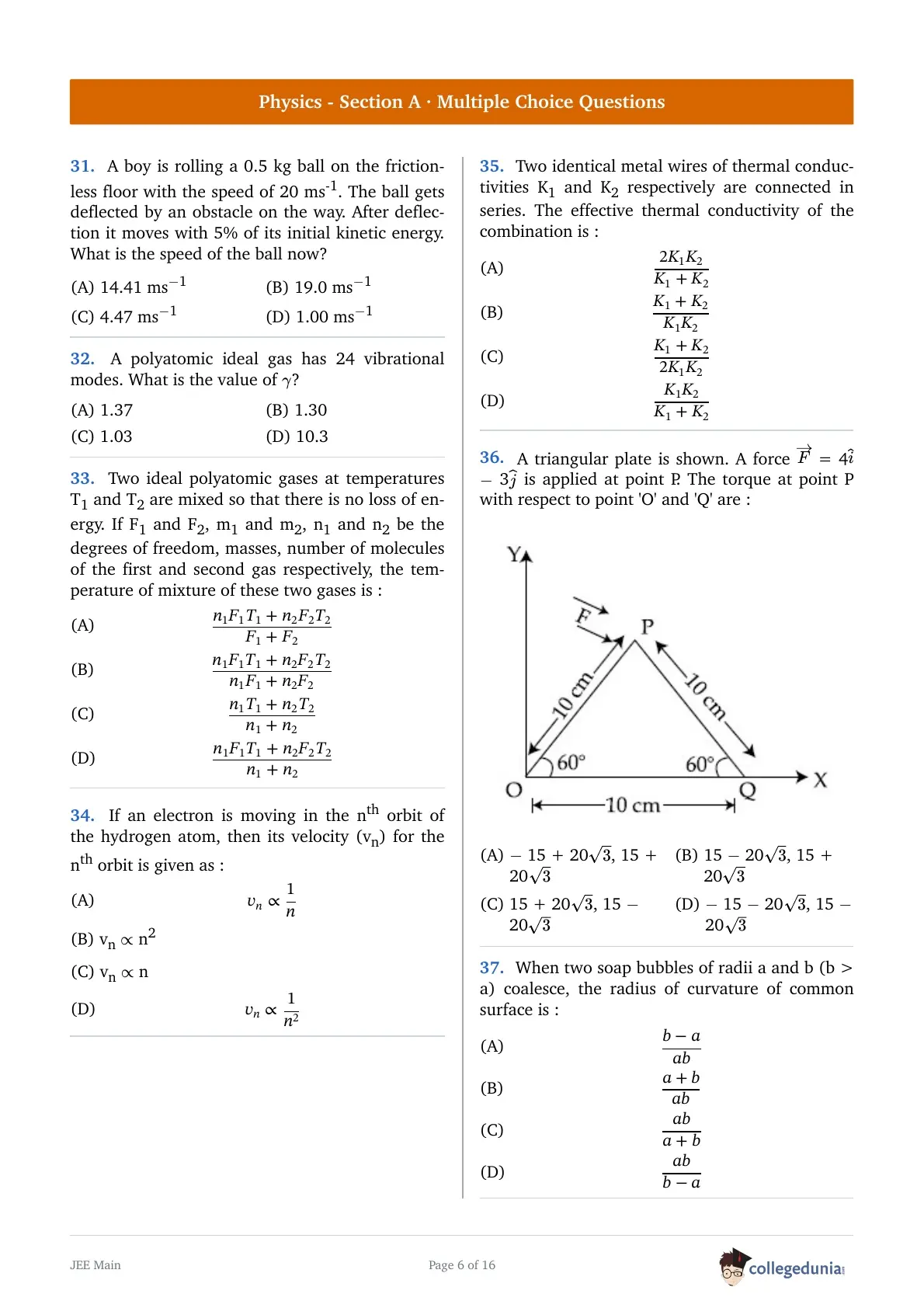
A boy is rolling a 0.5 kg ball on the frictionless floor with the speed of 20 ms-1. The ball gets deflected by an obstacle on the way. After deflection it moves with 5% of its initial kinetic energy. What is the speed of the ball now?
A polyatomic ideal gas has 24 vibrational modes. What is the value of \(\gamma\)?
Two ideal polyatomic gases at temperatures T1 and T2 are mixed so that there is no loss of energy. If F1 and F2, m1 and m2, n1 and n2 be the degrees of freedom, masses, number of molecules of the first and second gas respectively, the temperature of mixture of these two gases is :
If an electron is moving in the nth orbit of the hydrogen atom, then its velocity (vn) for the nth orbit is given as :
Two identical metal wires of thermal conductivities K1 and K2 respectively are connected in series. The effective thermal conductivity of the combination is :
A triangular plate is shown. A force \(\vec{F}=4\hat{i}-3\hat{j}\) is applied at point P. The torque at point P with respect to point 'O' and 'Q' are :
Two soap bubbles of radius 2 cm and 4 cm, respectively, are in contact with each other. The radius of curvature of the common surface, in cm, is _______________.
Body accelerates from rest to 4 m/s, energy is E. If it accelerates from rest to 24, then energy is nE. Find n.
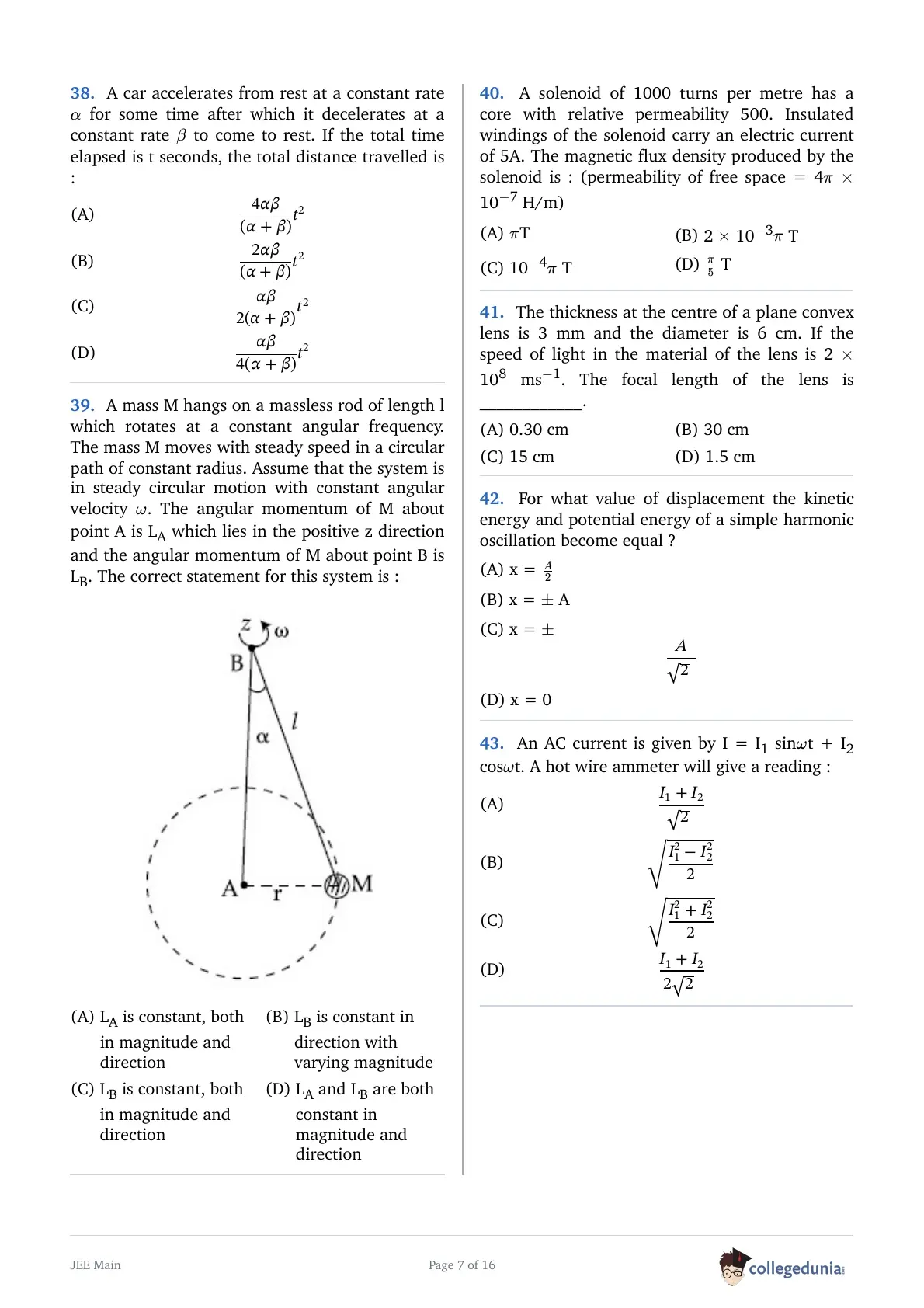
A mass M hangs on a massless rod of length l which rotates at a constant angular frequency. The mass M moves with steady speed in a circular path of constant radius. Assume that the system is in steady circular motion with constant angular velocity \(\omega\). The angular momentum of M about point A is LA which lies in the positive z direction and the angular momentum of M about point B is LB. The correct statement for this system is :
A solenoid of 1000 turns per metre has a core with relative permeability 500. Insulated windings of the solenoid carry an electric current of 5A. The magnetic flux density produced by the solenoid is : (permeability of free space = \(4\pi\times10^{-7}\) H/m)
Diameter of a plano-convex lens is \(6 \,cm\) and thickness at the centre is 3 mm. If speed of light in material of lens is \(2 \times 10^8\) m/s, the focal length of the lens is
For what value of displacement the kinetic energy and potential energy of a simple harmonic oscillation become equal ?
An AC current is given by \(I=I_1\sin\omega t+I_2\cos\omega t\). A hot wire ammeter will give a reading :
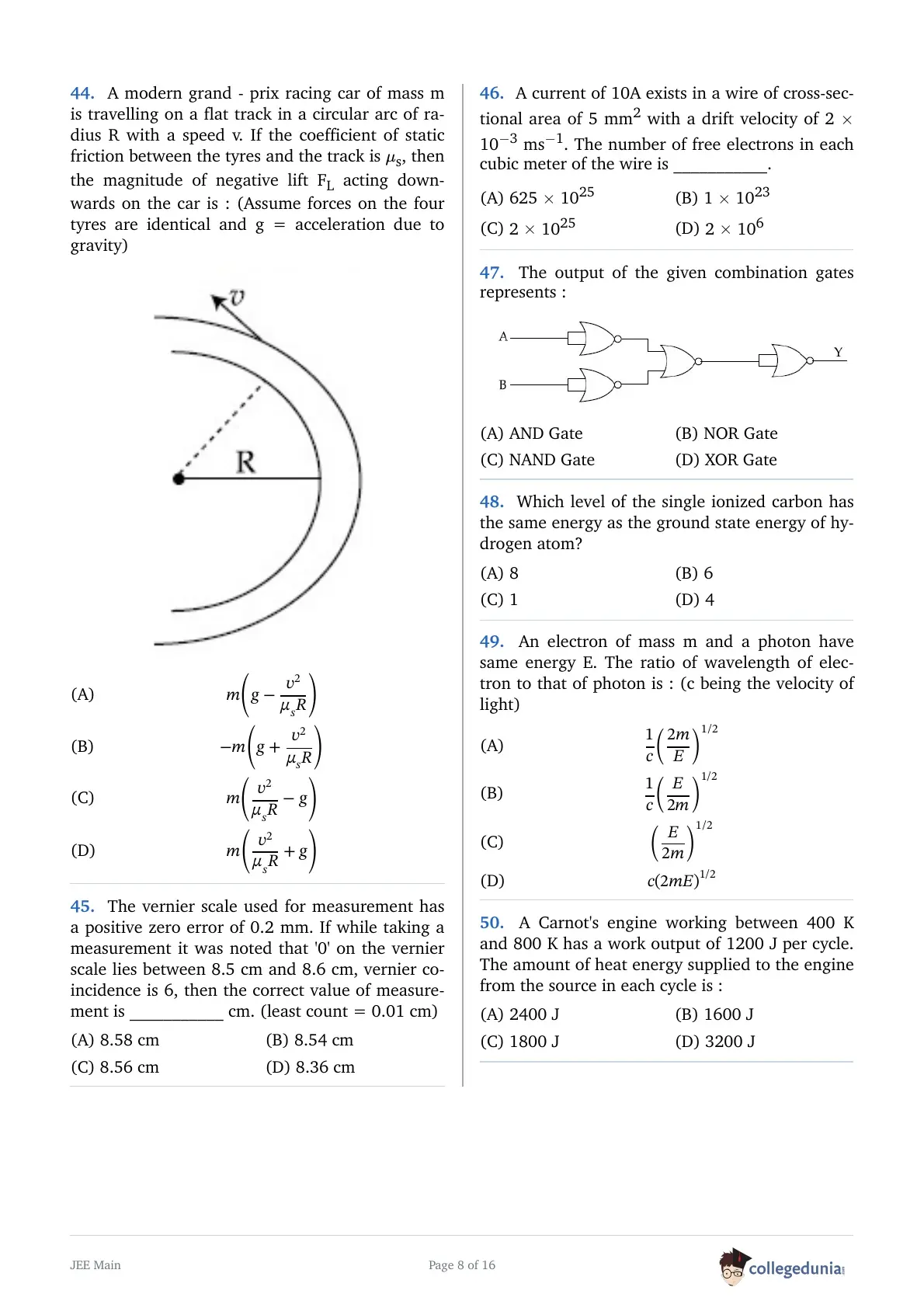
A modern grand - prix racing car of mass m is travelling on a flat track in a circular arc of radius R with a speed v. If the coefficient of static friction between the tyres and the track is \(\mu_s\), then the magnitude of negative lift FL acting downwards on the car is : (Assume forces on the four tyres are identical and g = acceleration due to gravity)
The vernier scale used for measurement has a positive zero error of 0.2 mm. If while taking a measurement it was noted that '0' on the vernier scale lies between 8.5 cm and 8.6 cm, vernier coincidence is 6, then the correct value of measurement is ___________ cm. (least count = 0.01 cm)
A current of 2 A flows through a wire of crosssectional area 25.0 mm2 . The number of free electrons in a cubic meter are 2.0 x 1028 . The drift velocity of the electrons is _____ x 10-6 ms-1 (Given, charge on electron = 1.6 x 10⁻¹⁹C)
The output of the given combination gates represents :
Which level of the single ionized carbon has the same energy as the ground state energy of hydrogen atom?
An electron of mass m and a photon have same energy E. The ratio of wavelength of electron to that of photon is : (c being the velocity of light)
A Carnot engine operates between two reservoirs of temperatures 900 K and 300 K. The engine performs 1200 J of work per cycle. The heat energy (in J) delivered by the engine to the low temperature reservoir, in a cycle, is _______.
Physics - Section B (Q51 - Q60)
The radius in kilometer to which the present radius of earth (R = 6400 km) to be compressed so that the escape velocity is increased 10 times is ___________.
The angular speed of truck wheel is increased from 900 rpm to 2460 rpm in 26 seconds. The number of revolutions by the truck engine during this time is _____________. (Assuming the acceleration to be uniform).
A parallel plate capacitor whose capacitance C is 14 pF is charged by a battery to a potential difference V = 12 V between its plates. The charging battery is now disconnected and a porcelin plate with k = 7 is inserted between the plates, then the plate would oscillate back and forth between the plates with a constant mechanical energy of _____________ pJ. (Assume no friction)
The following bodies,
(1) a ring
(2) a disc
(3) a solid cylinder
(4) a solid sphere,
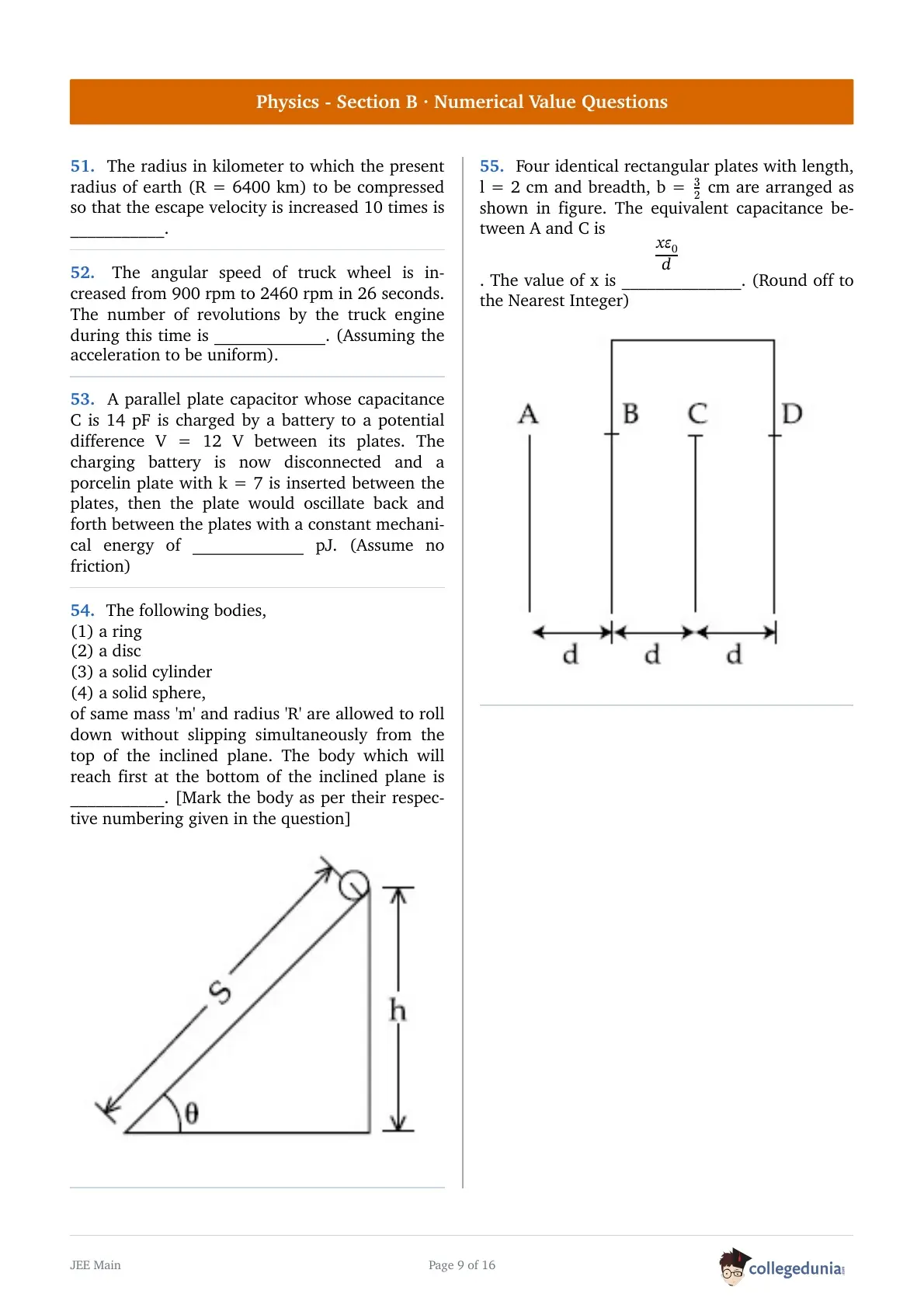
of same mass 'm' and radius 'R' are allowed to roll down without slipping simultaneously from the top of the inclined plane. The body which will reach first at the bottom of the inclined plane is ___________. [Mark the body as per their respective numbering given in the question]
Four identical rectangular plates with length, l = 2 cm and breadth, b = \(\frac{3}{2}\) cm are arranged as shown in figure. The equivalent capacitance between A and C is \(\frac{x\varepsilon_0}{d}\). The value of x is ______________. (Round off to the Nearest Integer)
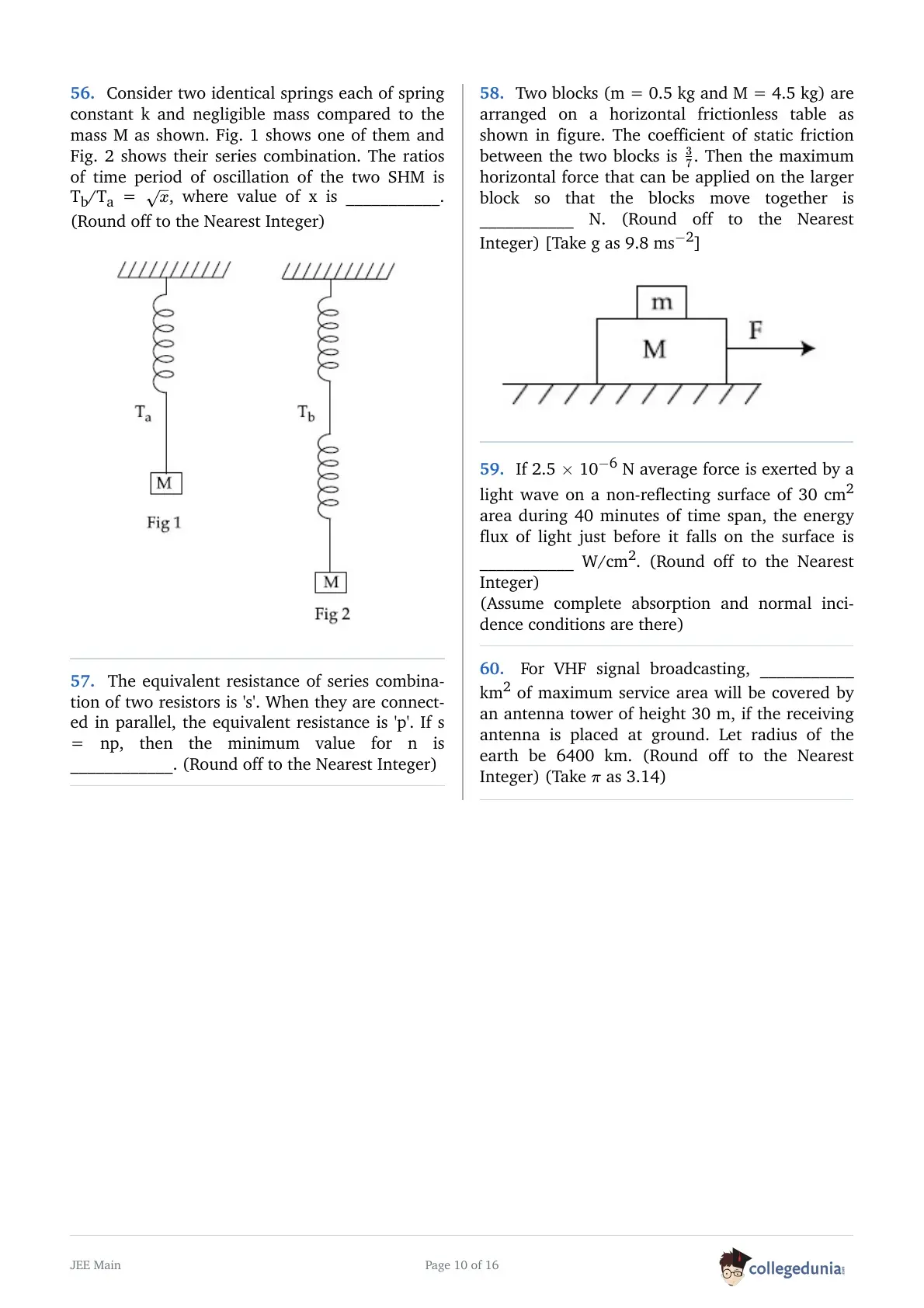
As per given figures, two springs of spring constants k and 2k are connected to mass m. If the period of oscillation in figure (a)is 3s, then the period of oscillation in figure (b) will be \(\sqrt x\) s. The value of \(x\) is _______
The equivalent resistance of series combination of two resistors is 's'. When they are connected in parallel, the equivalent resistance is 'p'. If s = np, then the minimum value for n is ____________. (Round off to the Nearest Integer)
Two blocks (m = 0.5 kg and M = 4.5 kg) are arranged on a horizontal frictionless table as shown in figure. The coefficient of static friction between the two blocks is \(\frac{3}{7}\). Then the maximum horizontal force that can be applied on the larger block so that the blocks move together is ___________ N. (Round off to the Nearest Integer) [Take g as 9.8 ms\(^{-2}\)]
If 2.5 \(\times\) 10\(^{-6}\) N average force is exerted by a light wave on a non-reflecting surface of 30 cm\(^2\) area during 40 minutes of time span, the energy flux of light just before it falls on the surface is ___________ W/cm\(^2\). (Round off to the Nearest Integer)
(Assume complete absorption and normal incidence conditions are there)
For VHF signal broadcasting, ___________ km\(^2\) of maximum service area will be covered by an antenna tower of height 30 m, if the receiving antenna is placed at ground. Let radius of the earth be 6400 km. (Round off to the Nearest Integer) (Take \(\pi\) as 3.14)
Chemistry - Section A (Q61 - Q80)
The absolute value of the electron gain enthalpy of halogens satisfies :
What is the spin-only magnetic moment value (BM) of a divalent metal ion with atomic number 25, in it's aqueous solution?
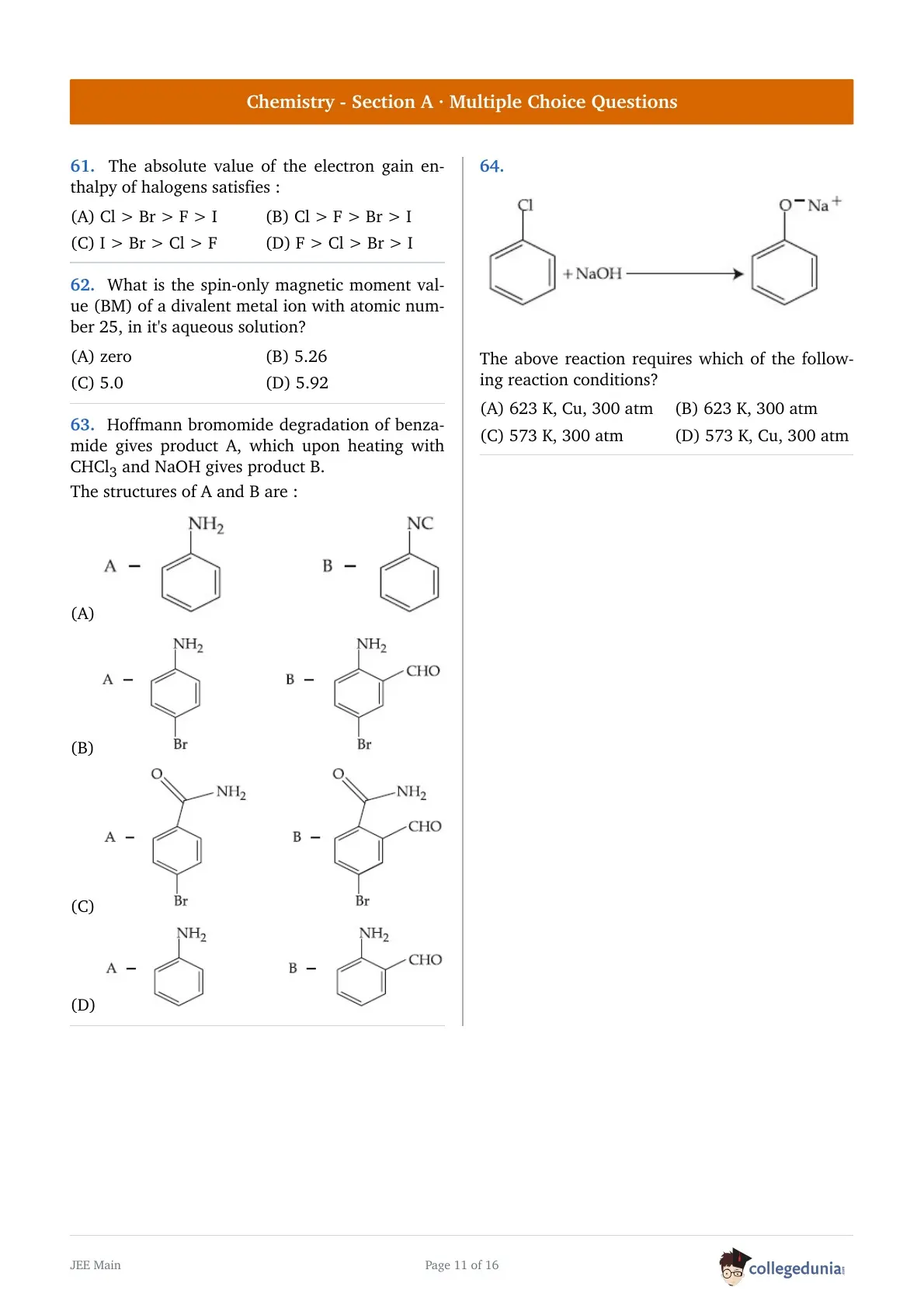
Hoffmann bromomide degradation of benzamide gives product A, which upon heating with \(\mathrm{CHCl_3}\) and NaOH gives product B.
The structures of A and B are :
- (1)
![]()
- (2)
![]()
- (3)
![]()
- (4)
![]()


The above reaction requires which of the following reaction conditions?


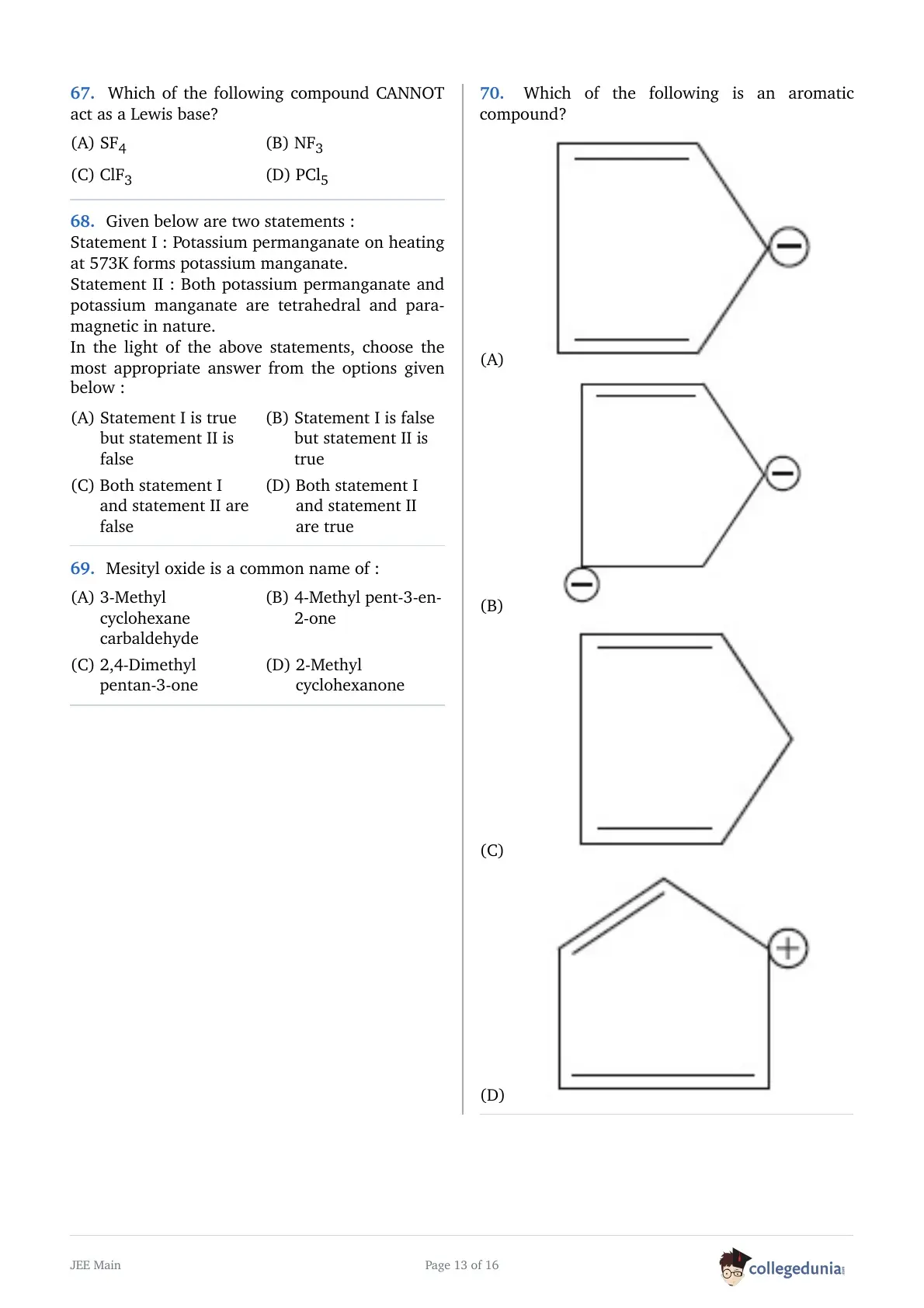
Which of the following compound CANNOT act as a Lewis base?
Given below are two statements :
Statement I : Potassium permanganate on heating at 573K forms potassium manganate.
Statement II : Both potassium permanganate and potassium manganate are tetrahedral and paramagnetic in nature.
In the light of the above statements, choose the most appropriate answer from the options given below :
Mesityl oxide is a common name of :


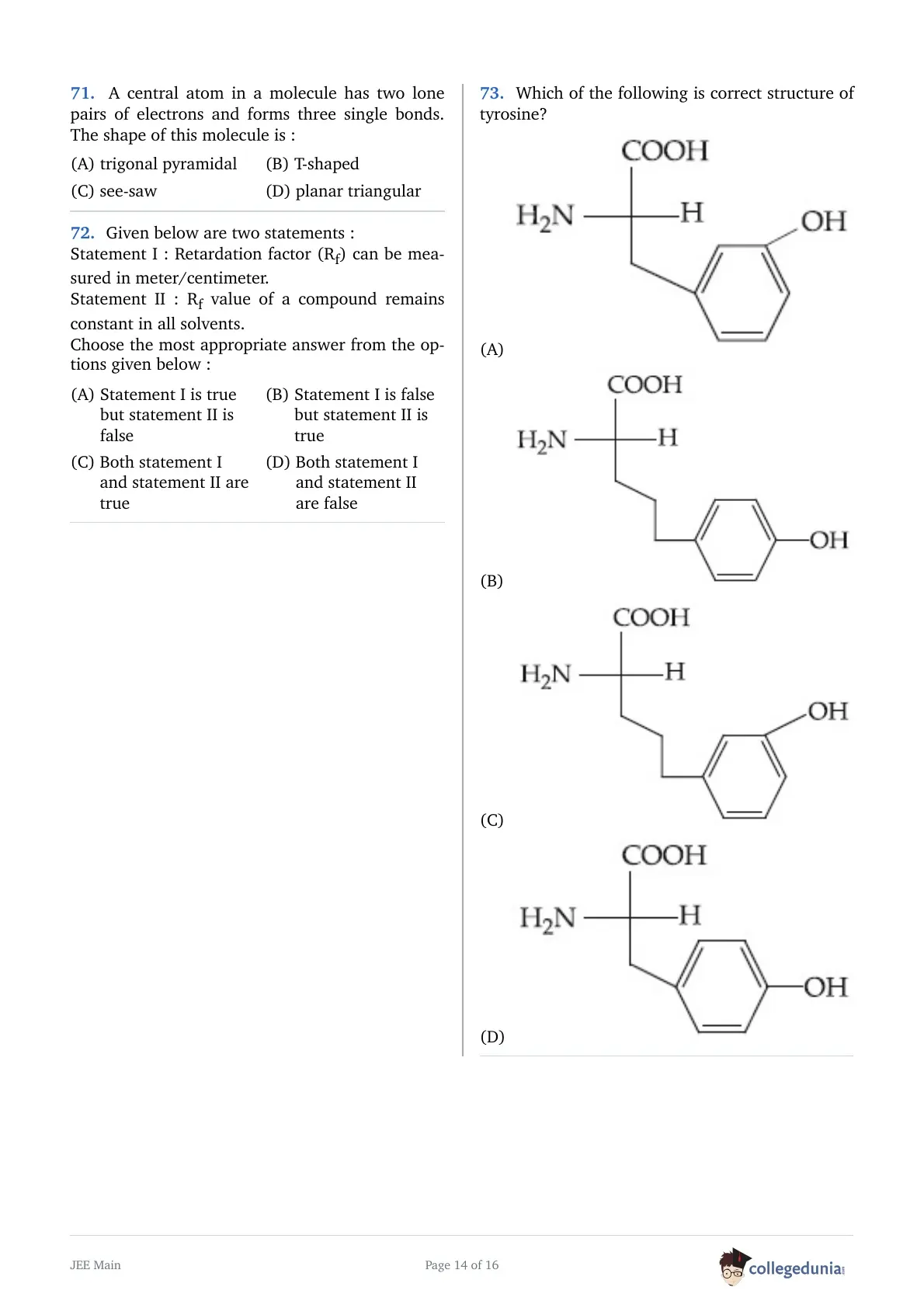
A central atom in a molecule has two lone pairs of electrons and forms three single bonds. The shape of this molecule is :
Given below are two statements :
Statement I : Retardation factor (Rf) can be measured in meter/centimeter.
Statement II : Rf value of a compound remains constant in all solvents.
Choose the most appropriate answer from the options given below :
Which of the following is correct structure of tyrosine?
- (1)
![]()
- (2)
![]()
- (3)
![]()
- (4)
![]()


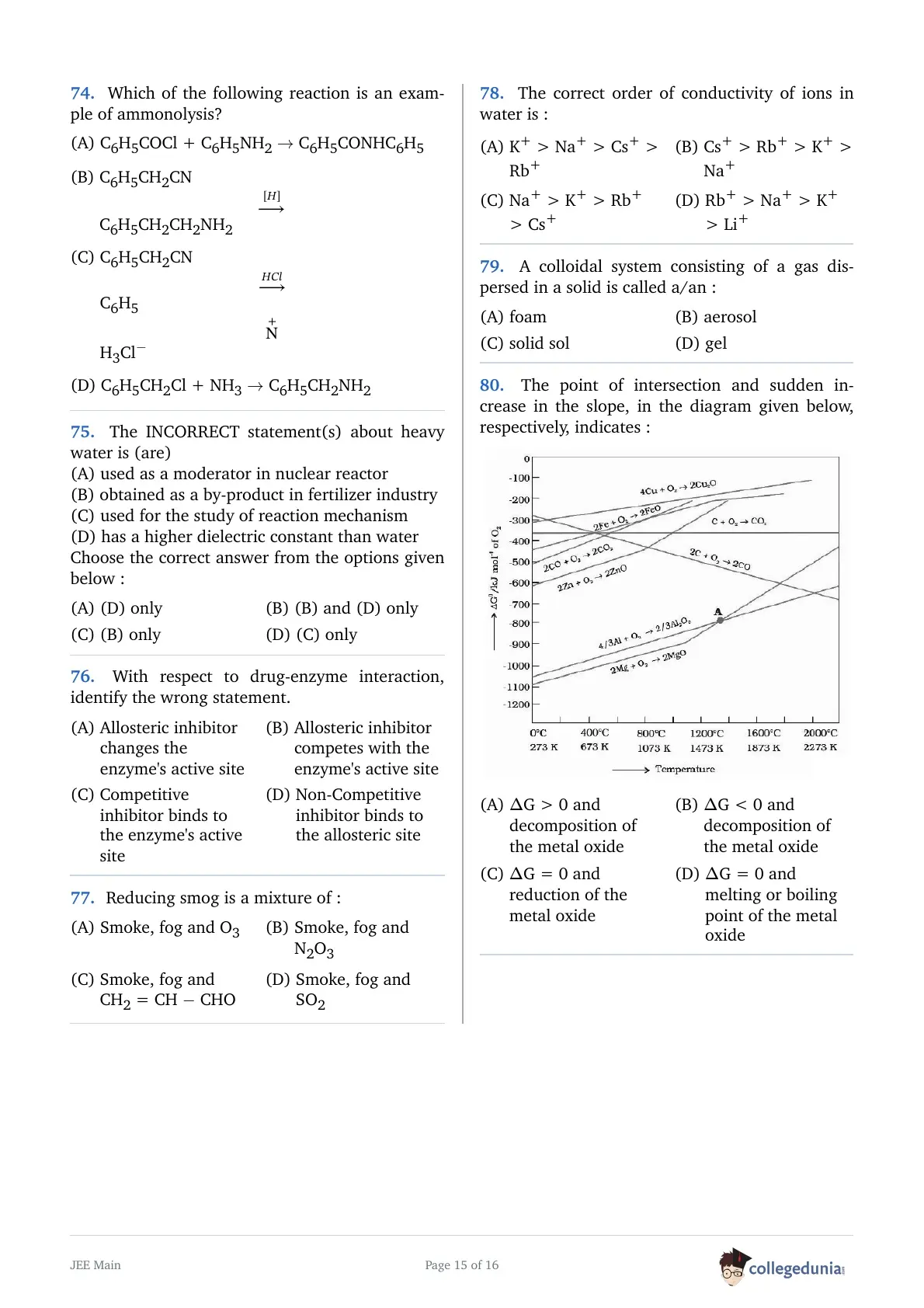
Which of the following reaction is an example of ammonolysis?
The INCORRECT statement(s) about heavy water is (are)
(A) used as a moderator in nuclear reactor
(B) obtained as a by-product in fertilizer industry
(C) used for the study of reaction mechanism
(D) has a higher dielectric constant than water
Choose the correct answer from the options given below :
With respect to drug-enzyme interaction, identify the wrong statement.
Reducing smog is a mixture of :
The correct order of conductivity of ions in water is :
A colloidal system consisting of a gas dispersed in a solid is called a/an :
The point of intersection and sudden increase in the slope, in the diagram given below, respectively, indicates :
Chemistry - Section B (Q81 - Q90)
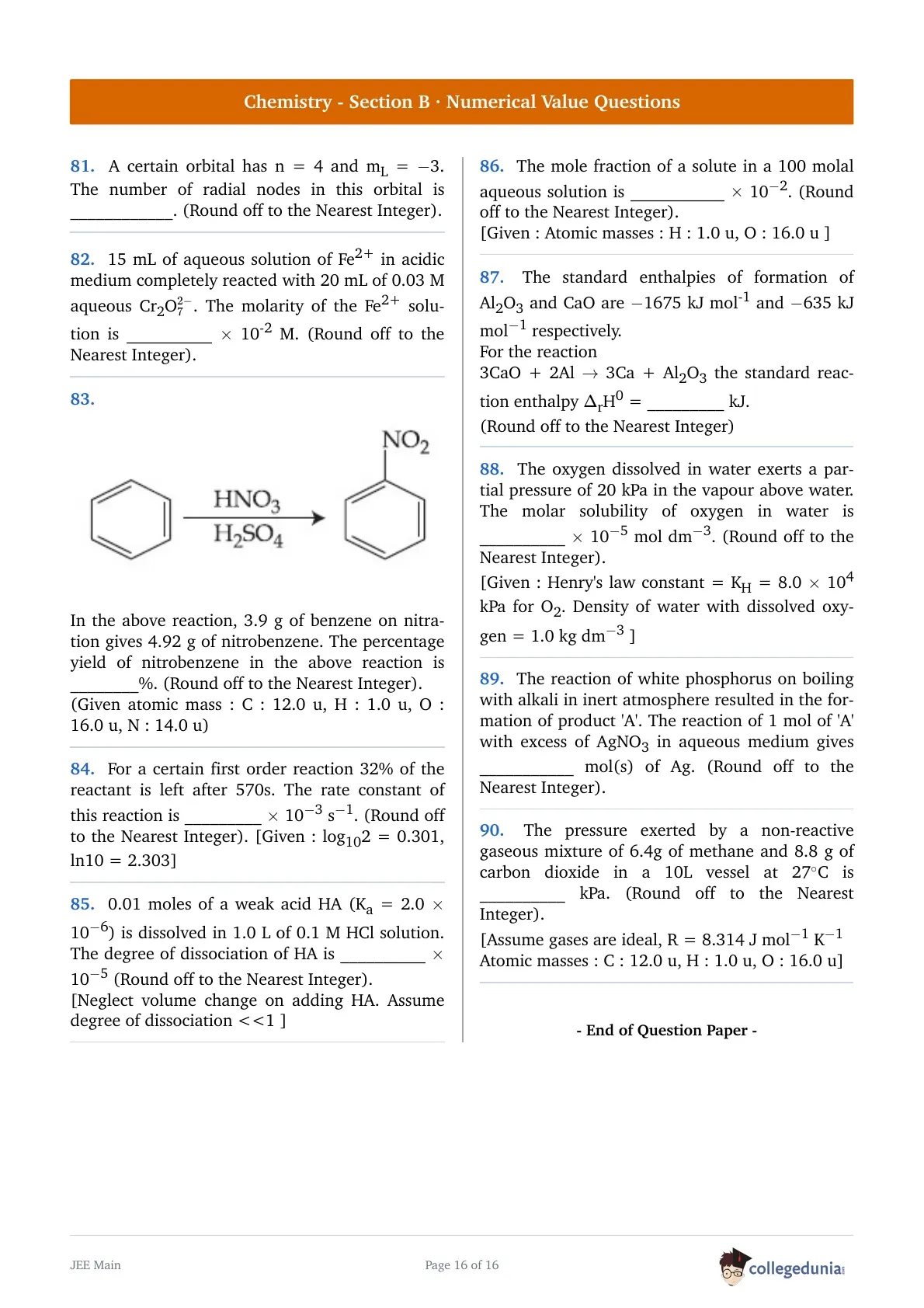
A certain orbital has \(n = 4\) and \(m_L = -3\). The number of radial nodes in this orbital is ____________. (Round off to the Nearest Integer).
20 mL of 0.02 M K2Cr2O7 solution is used for the titration of 10 mL of Fe2+ solution in the acidic medium. The molarity of Fe2+ solution is ______×10–2 M. (Nearest integer)

In the above reaction, 3.9 g of benzene on nitration gives 4.92 g of nitrobenzene. The percentage yield of nitrobenzene in the above reaction is ________\(\%\). (Round off to the Nearest Integer).
(Given atomic mass : C : 12.0 u, H : 1.0 u, O : 16.0 u, N : 14.0 u)
For a certain first order reaction 32% of the reactant is left after 570s. The rate constant of this reaction is _________ \(\times 10^{-3}\ \mathrm{s^{-1}}\). (Round off to the Nearest Integer). [Given : \(\log_{10}2 = 0.301\), \(\ln 10 = 2.303\)]
Consider the dissociation equilibrium of the following weak acid: \[ \mathrm{HA \rightleftharpoons H^+(aq) + A^-(aq)} \] If the \(pK_a\) of the acid is \(4\), then the pH of a \(10\ \text{mM}\) HA solution is ________ (Nearest integer). (Given: The degree of dissociation can be neglected with respect to unity)
The mole fraction of a solute in a 100 molal aqueous solution is ___________ \(\times\) \(10^{-2}\). (Round off to the Nearest Integer).
[Given : Atomic masses : H : 1.0 u, O : 16.0 u ]
The standard enthalpies of formation of \(\mathrm{Al_2O_3}\) and \(\mathrm{CaO}\) are \(-1675\) kJ \(\mathrm{mol^{-1}}\) and \(-635\) kJ \(\mathrm{mol^{-1}}\) respectively.
For the reaction
\(\mathrm{3CaO + 2Al \to 3Ca + Al_2O_3}\) the standard reaction enthalpy \(\Delta_rH^0\) = _________ kJ.
(Round off to the Nearest Integer)
The oxygen dissolved in water exerts a partial pressure of 20 kPa in the vapour above water. The molar solubility of oxygen in water is __________ \(\times\) \(10^{-5}\) \(\mathrm{mol\ dm^{-3}}\). (Round off to the Nearest Integer).
[Given : Henry's law constant = \(K_H\) = 8.0 \(\times\) \(10^4\) kPa for \(\mathrm{O_2}\). Density of water with dissolved oxygen = 1.0 kg \(\mathrm{dm^{-3}}\) ]
The reaction of white phosphorus on boiling with alkali in inert atmosphere resulted in the formation of product 'A'. The reaction of 1 mol of 'A' with excess of \(\mathrm{AgNO_3}\) in aqueous medium gives ___________ mol(s) of Ag. (Round off to the Nearest Integer).
The pressure exerted by a non-reactive gaseous mixture of 6.4g of methane and 8.8 g of carbon dioxide in a 10L vessel at 27\(^\circ\)C is __________ kPa. (Round off to the Nearest Integer).
[Assume gases are ideal, R = 8.314 J \(\mathrm{mol^{-1}\ K^{-1}}\)
Atomic masses : C : 12.0 u, H : 1.0 u, O : 16.0 u]
JEE Main 2021 Exam Pattern and Marking Scheme
| Particulars | Details |
|---|---|
| Exam Mode | Online (Computer-Based Test) |
| Paper | B.E./B.Tech (Paper 1) |
| Duration | 3 hours (180 minutes) |
| Type of Questions | Multiple Choice Questions (MCQs) + Numerical Value Questions |
| Subjects | Mathematics, Physics, Chemistry |
| Total Questions | 90 questions (75 to be attempted) |
| Total Marks | 300 marks |
| Marking Scheme | +4 for correct answer & -1 for incorrect MCQ; no negative marking for Numerical Value Questions |
JEE Main 2021 March 17 Shift 1 Difficulty Level
JEE Main 2021 B.E./B.Tech Question Paper - March 17, 2021- Forenoon Session was rated to be of moderate difficulty by the test takers.50 Questions (56% of the total weightage) were asked from the class XI syllabus and 40 questions (of 44% weightage) were asked from the class XII JEE Main syllabus. The difficulty level of the Chemistry Section was easy, and that of the Physics and Mathematics sections was moderate.
JEE Main 2021 B.E./B.Tech Question Paper March 17 (FN): Weightage of Topics
JEE Main 2021 B.E./B.Tech March 17 Forenoon Session was conducted between 9.00 AM to 12.00 Noon, the topics with the highest weightage across the three sections were:
| Subjects | Topics with the Highest Weightage | Related Links |
|---|---|---|
| Mathematics |
|
JEE Main Mathematics Syllabus |
| Physics |
|
JEE Main Physics Syllabus |
| Chemistry |
|
JEE Main Chemistry Syllabus |



Comments