




JEE Main 2020 September 4 Shift 2 Question Paper is available here with solutions PDF and detailed solutions for every question. NTA conducted the second shift on September 4, 2020, from 3:00 PM to 6:00 PM. The JEE Main 2020 Paper 1 (B.E./B.Tech) question paper includes the following:
- 75 questions in a 3-hour CBT Mode: 25 each from Mathematics, Physics and Chemistry
- Section A: 20 multiple choice questions (MCQs) per subject, 4 marks each
- Section B: 5 numerical value questions per subject, all compulsory, 4 marks each
- Marking: +4 for a correct answer, -1 for an incorrect MCQ, 0 for an unattempted question; no negative marking for numerical value questions
- Maximum marks: 300 (100 per subject)
JEE Main 2020 September 4 Shift 2 Question Paper with Solution PDF
| NTA Official PDF | CD PDF | CD PDF with Solutions |
|---|---|---|
| Download official PDF 4.81 MB | Download Collegedunia PDF 0.96 MB | Download solutions PDF 1.06 MB |
Also Check:
JEE Main 2020 September 4 Shift 2 Questions with Solutions
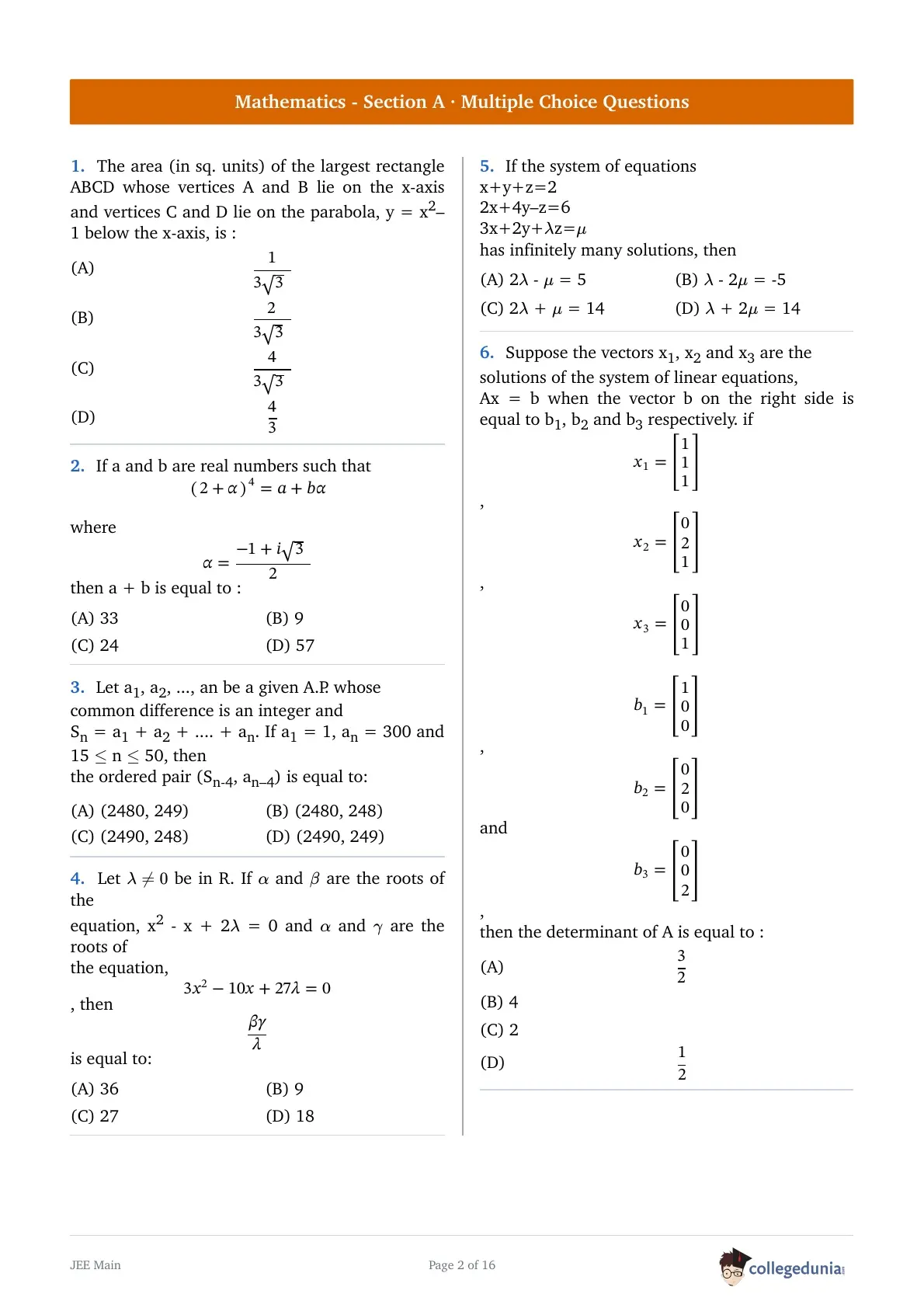
Mathematics - Section A (Q1 - Q20)
The area (in sq. units) of the largest rectangle ABCD whose vertices A and B lie on the x-axis and vertices C and D lie on the parabola, \(y = x^2 - 1\) below the x-axis, is :
If a and b are real numbers such that
\((2+\alpha)^4 = a + b\alpha\)
where \(\alpha = \frac{-1+i\sqrt{3}}{2}\)
then a + b is equal to :
Let \(a_1, a_2, \ldots, a_n\) be a given A.P. whose common difference is an integer and \(S_n = a_1 + a_2 + \ldots + a_n\). If \(a_1 = 1\), \(a_n = 300\) and \(15 \le n \le 50\), then the ordered pair \((S_{n-4},\ a_{n-4})\) is equal to:
let \(\lambda\neq 0\) be in r.If \(\alpha\) and \(\beta\) are the roots of the equation, then x2-x+2\(\lambda\)=0 and \(\alpha\) and \(\gamma\) are the roots of the equation, 3x2-10x+27\(\lambda\)=0,then \(\frac{\beta\gamma}{\lambda}=?\)
If the system of equations
\(x + y + z = 2\)
\(2x + 4y - z = 6\)
\(3x + 2y + \lambda z = \mu\)
has infinitely many solutions, then
Suppose the vectors \(x_1, x_2\) and \(x_3\) are the solutions of the system of linear equations, \(Ax = b\) when the vector b on the right side is equal to \(b_1, b_2\) and \(b_3\) respectively. if
\(x_1 = \begin{bmatrix}1\\1\\1\end{bmatrix},\ x_2 = \begin{bmatrix}0\\2\\1\end{bmatrix},\ x_3 = \begin{bmatrix}0\\0\\1\end{bmatrix}\),
\(b_1 = \begin{bmatrix}1\\0\\0\end{bmatrix},\ b_2 = \begin{bmatrix}0\\2\\0\end{bmatrix}\) and \(b_3 = \begin{bmatrix}0\\0\\2\end{bmatrix}\),
then the determinant of A is equal to :
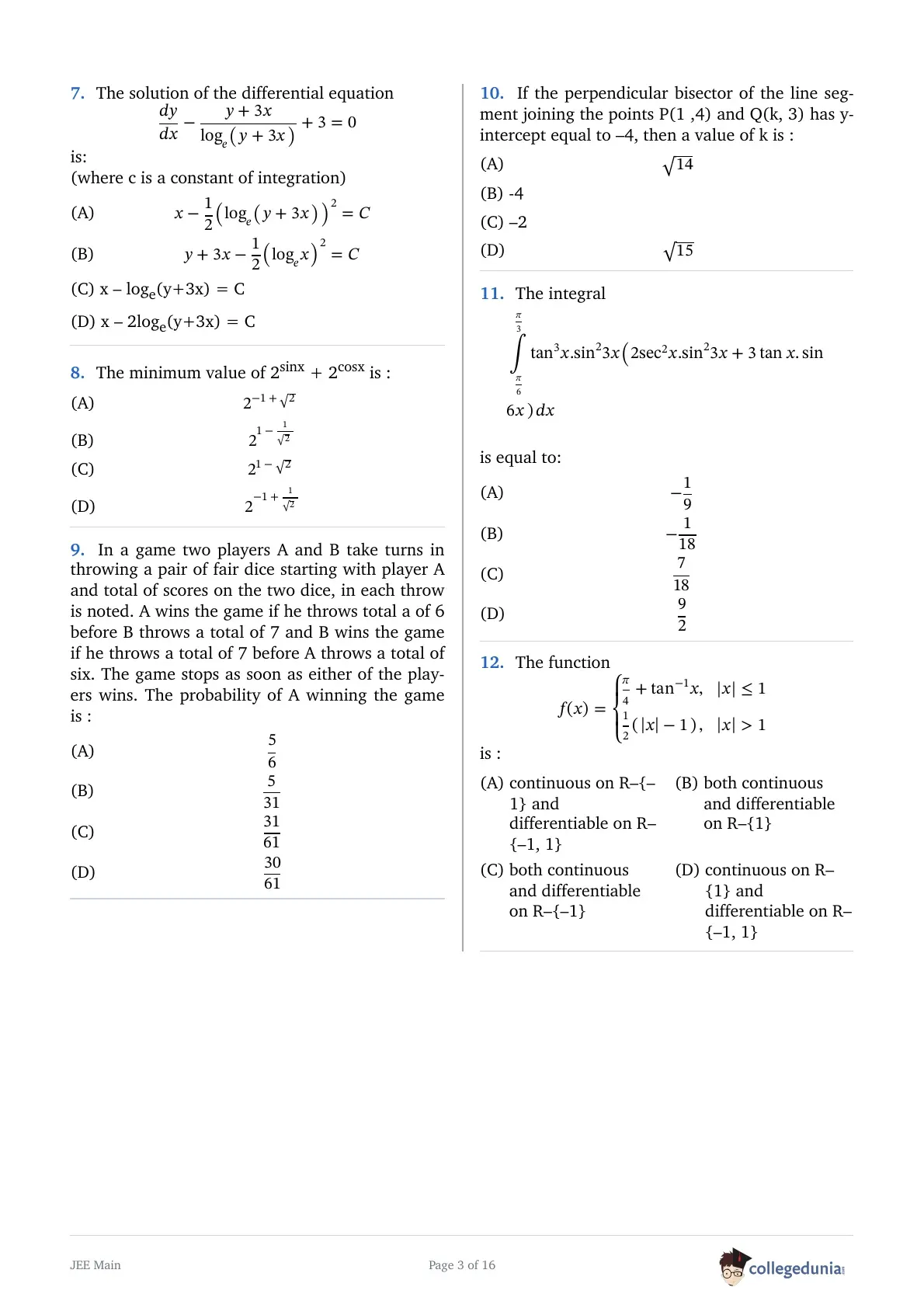
The solution of the differential equation
\(\frac{dy}{dx} - \frac{y+3x}{\log_e (y+3x)} + 3 = 0\)
is:
(where c is a constant of integration)
The minimum value of \(2^{\sin x} + 2^{\cos x}\) is :
In a game two players \(A\) and \(B\) take turns in throwing a pair of fair dice starting with player \(A\) and total of scores on the two dice, in each throw is noted. \(A \) wins the game if he throws a total of \(6\) before \(B\) throws a total of \(7\) and \(B\) wins the game if he throws a total of \(7 \)before \(A\) throws a total of six The game stops as soon as either of the players wins. The probability of \(A\) winning the game is :
If the perpendicular bisector of the line segment joining the points P(1, 4) and Q(k, 3) has y-intercept equal to -4, then a value of k is :
The integral
\(\int_{\pi/6}^{\pi/3} \tan^3 x \cdot \sin^2 3x\left(2\sec^2 x \cdot \sin^2 3x + 3\tan x \cdot \sin 6x\right)dx\)
is equal to:
The function
\(f(x) = \begin{cases} \frac{\pi}{4} + \tan^{-1}x, & |x| \le 1 \\ \frac12(|x| - 1), & |x| \gt 1 \end{cases}\)
is :
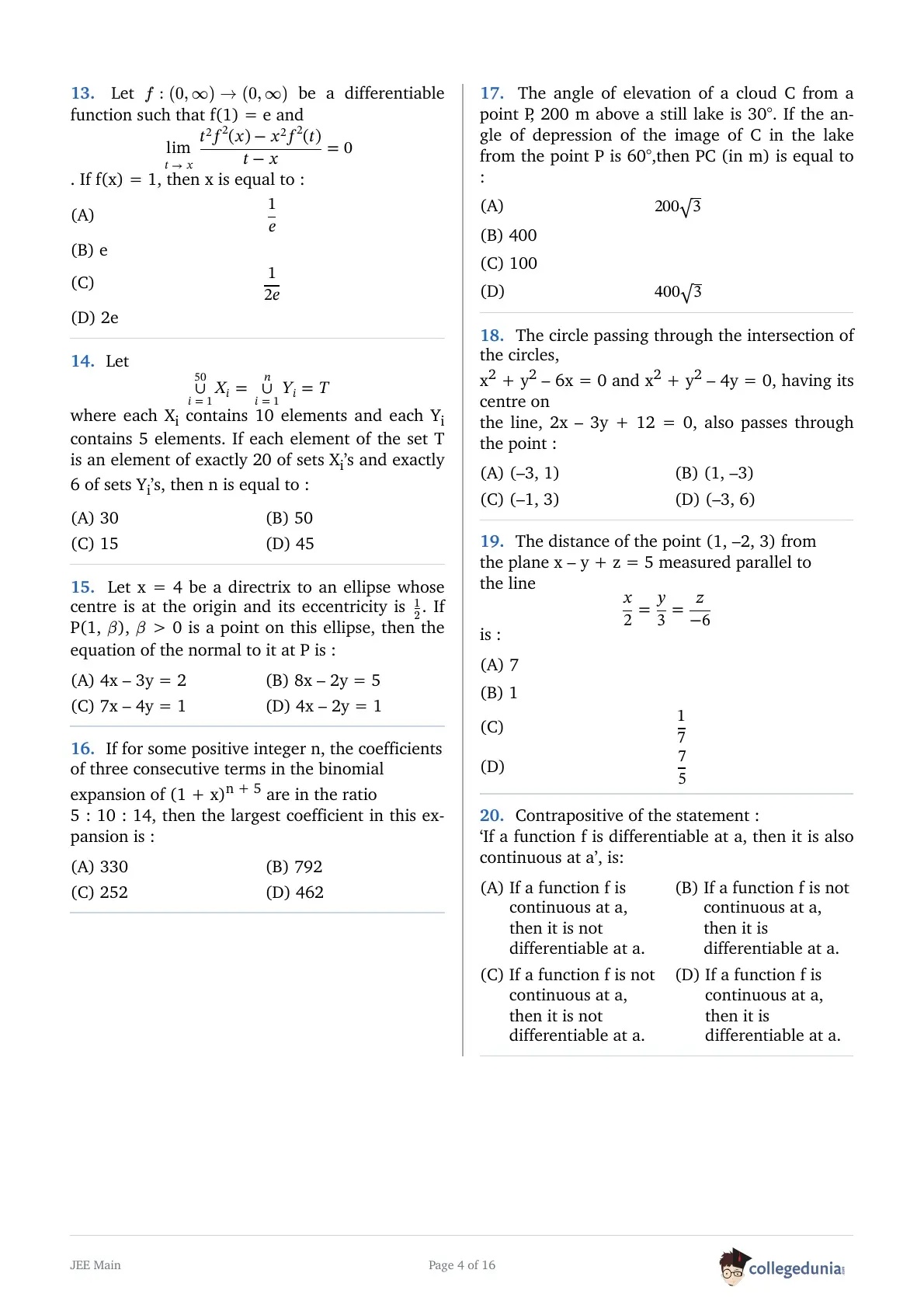
Let \(f:(0,\infty) \to (0,\infty)\) be a differentiable function such that \(f(1) = e\) and
\(\lim_{t \to x} \frac{t^2 f^2(x) - x^2 f^2(t)}{t - x} = 0\).
If \(f(x) = 1\), then x is equal to :
Let \(\bigcup_{i=1}^{50} X_i = \bigcup_{i=1}^{n} Y_i = T\) where each \(X_i\) contains 10 elements and each \(Y_i\) contains 5 elements. If each element of the set T is an element of exactly 20 of sets \(X_i\)'s and exactly 6 of sets \(Y_i\)'s, then n is equal to :
Let x = 4 be a directrix to an ellipse whose centre is at the origin and its eccentricity is \(\frac{1}{2}\). If P(1, \(\beta\)), \(\beta \gt 0\) is a point on this ellipse, then the equation of the normal to it at P is :
For some \( n \neq 10 \), let the coefficients of the 5th, 6th, and 7th terms in the binomial expansion of \( (1 + x)^{n+4} \) be in A.P. Then the largest coefficient in the expansion of \( (1 + x)^{n+4} \) is:
The angle of elevation of a cloud \(C\) from a point \(P , 200 m\) above a still lake is \(30^{\circ} .\) If the angle of depression of the image of \(C\) in the lake from the point \(P\) is \(60^{\circ}\), then \(P C\) (in \(m\) ) is equal to :
The circle passing through the intersection of the circles,
\(x^2 + y^2 - 6x = 0\) and \(x^2 + y^2 - 4y = 0\), having its centre on
the line, \(2x - 3y + 12 = 0\), also passes through the point :
The distance of the point \((1, -2, 3)\) from
the plane \(x - y + z = 5\) measured parallel to
the line \(\frac{x}{2} = \frac{y}{3} = \frac{z}{-6}\) is :
Contrapositive of the statement :
'If a function f is differentiable at a, then it is also continuous at a', is:
Mathematics - Section B (Q21 - Q25)
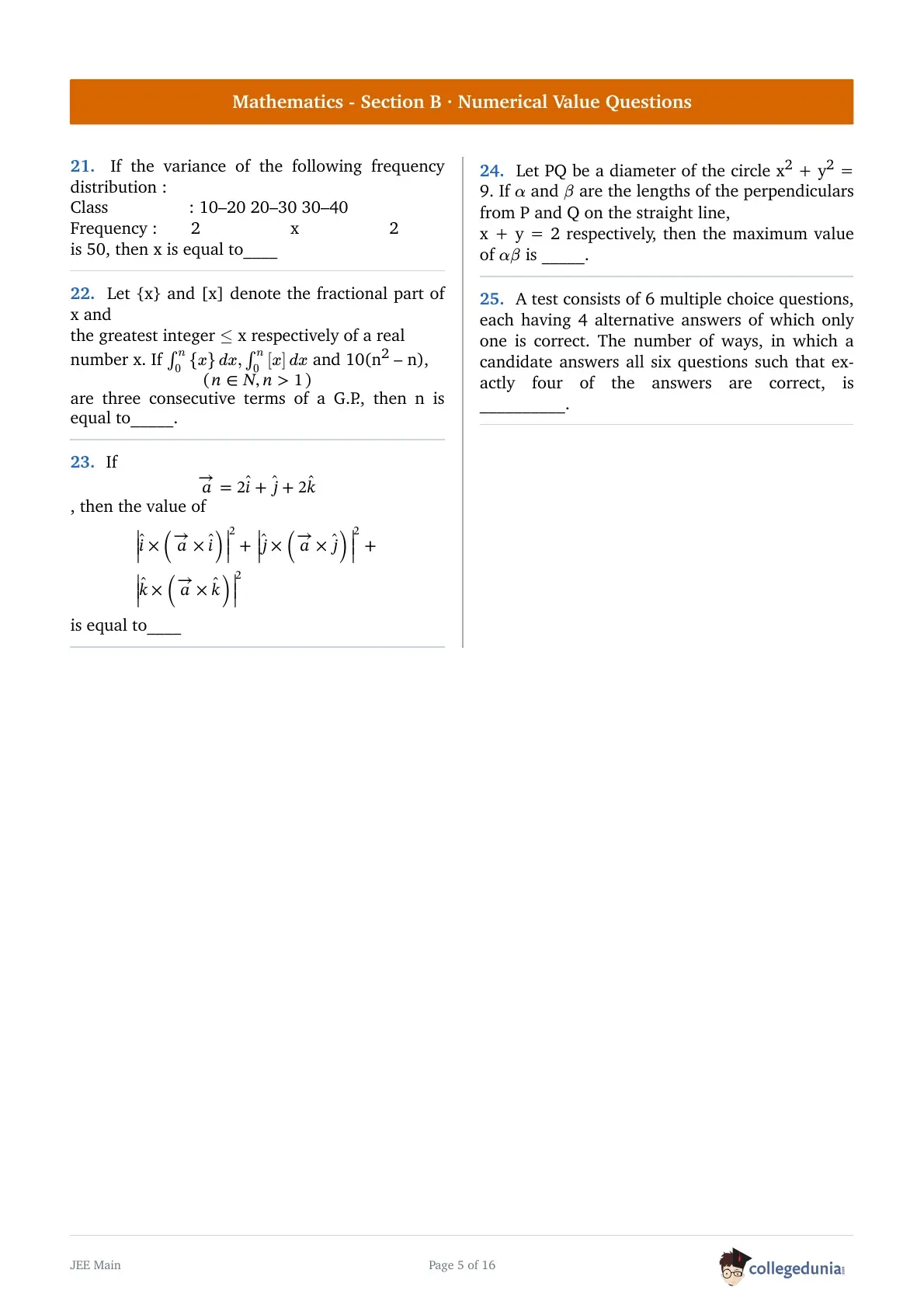
If the variance of the frequency distribution
| xi | Frequency ft |
| 2 | 3 |
| 3 | 6 |
| 4 | 16 |
| 5 | \(\alpha\) |
| 6 | 9 |
| 7 | 5 |
| 8 | 6 |
is 3 , then \(\alpha\) is equal to
Let \(\{x\}\) and \([x]\) denote the fractional part of x and
the greatest integer \(\le x\) respectively of a real number x. If \(\int_0^n \{x\}\,dx\), \(\int_0^n [x]\,dx\) and \(10(n^2 - n)\), \((n \in N, n \gt 1)\) are three consecutive terms of a G.P., then n is equal to ______.
If \(\vec{a} = 2\hat{i} + \hat{j} + 2\hat{k}\), then the value of
\(\left|\hat{i} \times (\vec{a} \times \hat{i})\right|^2 + \left|\hat{j} \times (\vec{a} \times \hat{j})\right|^2 + \left|\hat{k} \times (\vec{a} \times \hat{k})\right|^2\) is equal to ____
If \(p\) and \(q\) are the lengths of the perpendiculars from the origin on the lines, \(x \csc \alpha - y \sec \alpha = k \cot 2\alpha\) and \(x \sin \alpha + y \cos \alpha = k \sin 2\alpha\) respectively, then \(k^2\) is equal to :
A test consists of 6 multiple choice questions, each having 4 alternative answers of which only one is correct. The number of ways, in which a candidate answers all six questions such that exactly four of the answers are correct, is __________.
Physics - Section A (Q26 - Q45)
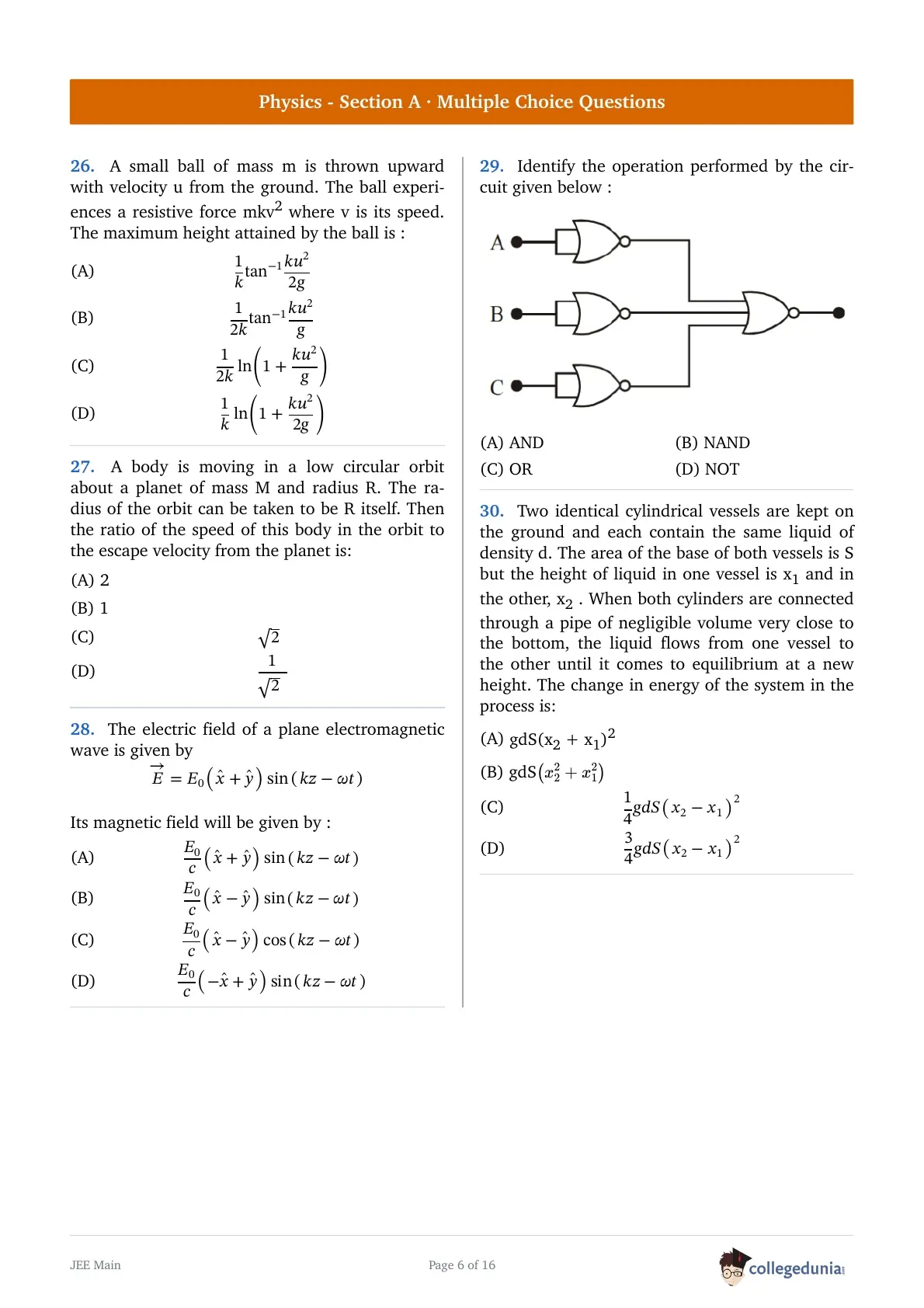
A small ball of mass m is thrown upward with velocity u from the ground. The ball experiences a resistive force \(mkv^2\) where v is its speed. The maximum height attained by the ball is :
A body is moving in a low circular orbit about a planet of mass M and radius R. The radius of the orbit can be taken to be R itself. Then the ratio of the speed of this body in the orbit to the escape velocity from the planet is:
The electric field of a plane electromagnetic wave is given by
\(\vec{E} = E_0(\hat{x} + \hat{y})\sin(kz - \omega t)\)
Its magnetic field will be given by :
Identify the operation performed by the circuit given below : 
Two cylindrical vessels of equal cross-sectional area of \( 2 \, \text{m}^2 \) contain water up to heights 10 m and 6 m, respectively. If the vessels are connected at their bottom, then the work done by the force of gravity is: (Density of water is \( 10^3 \, \text{kg/m}^3 \) and \( g = 10 \, \text{m/s}^2 \))
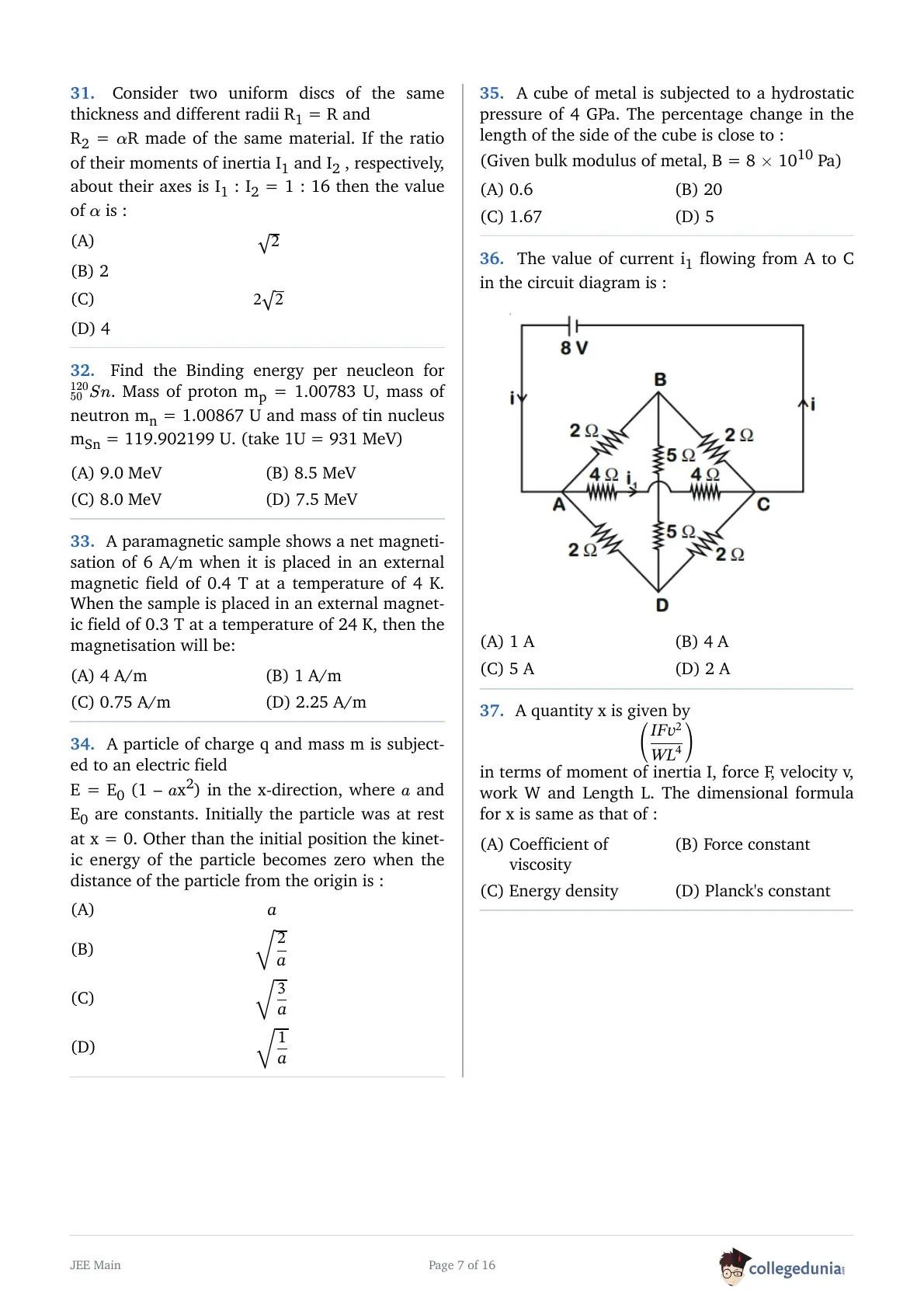
Consider two uniform discs of the same thickness and different radii \(R_1 = R\) and \(R_2 = \alpha R\) made of the same material. If the ratio of their moments of inertia \(I_1\) and \(I_2\), respectively, about their axes is \(I_1 : I_2 = 1 : 16\) then the value of \(\alpha\) is :
Find the binding energy per nucleon for \({ }_{50}^{120} Sn\). Mass of proton \(m _{ p }=1.00783\, U ,\) mass of neutron \(m_{n}=1.00867 \,U\) and mass of tin nucleus \(m _{ Sn }=119.902199 \,U \) (take \(1U = 931 \,MeV)\)
A paramagnetic sample shows a net magnetisation of 6 A/m when it is placed in an external magnetic field of 0.4 T at a temperature of 4 K. When the sample is placed in an external magnetic field of 0.3 T at a temperature of 24 K, then the magnetisation will be:
A particle of charge \(q\) and mass \(m\) is subjected to an electric field \(E = E _{0}\left(1- ax ^{2}\right)\) in the \(x\) -direction, where a and \(E_{0}\) are constants. Initially the particle was at rest at \(x=0\). Other than the initial position the kinetic energy of the particle becomes zero when the distance of the particle from the origin is :
A cube of metal is subjected to a hydrostatic pressure of \(4 \,GPa\). The percentage change in the length of the side of the cube is close to (Given bulk modulus of metal, \(\left. B =8 \times 10^{10} Pa \right)\)
The value of current \(i_1\) flowing from A to C in the circuit diagram is :
A quantity \(x\) is given by \((IFv^2 / WL^{4})\) in terms of moment of inertia \(I, \) force \( F\), velocity \(v ,\) work \(W\) and Length \(L\). The dimensional formula for \(x\) is same as that of :
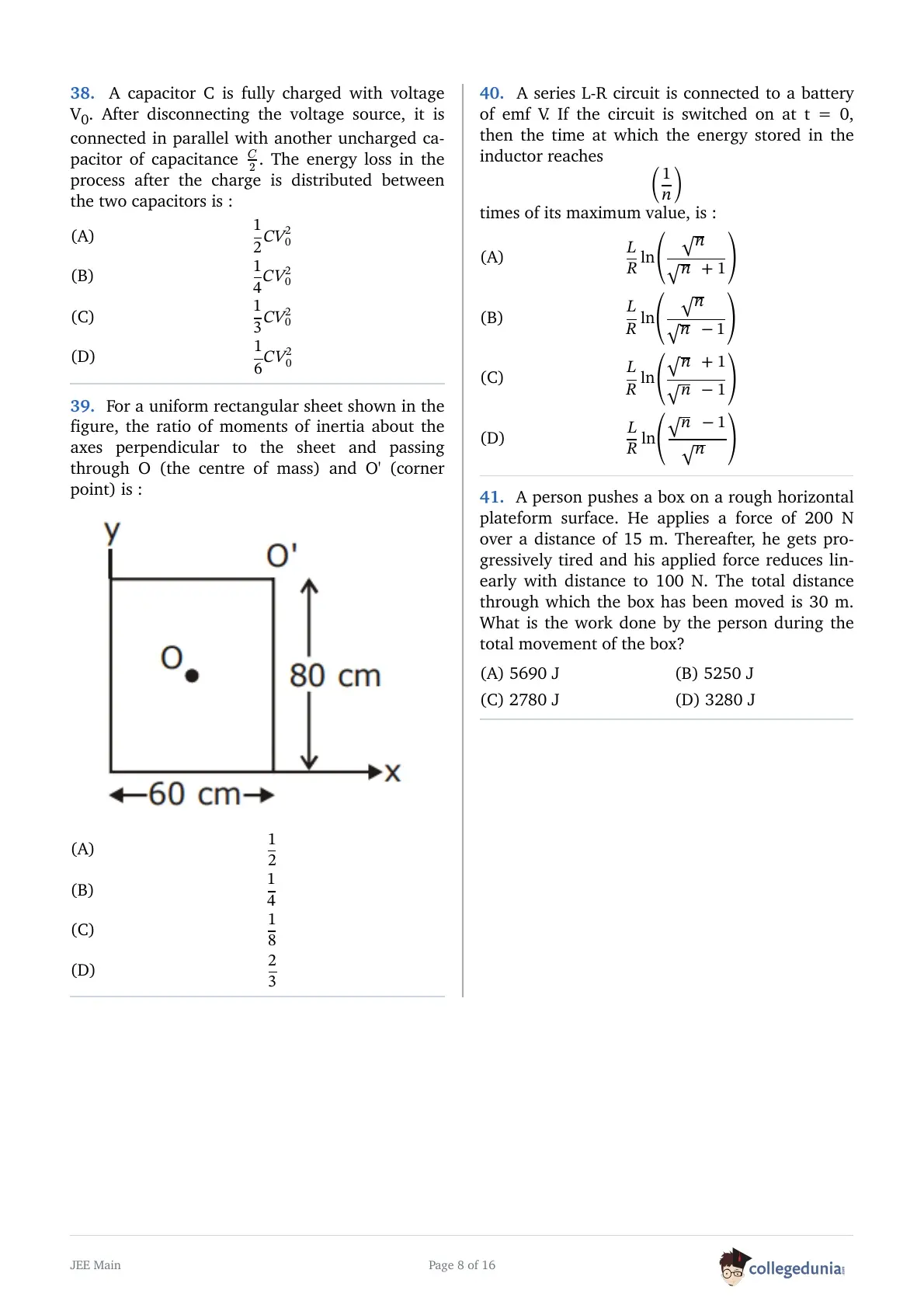
A capacitor \(C\) is fully charged with voltage \(V _{0}\). After disconnecting the voltage source, it is connected in parallel with another uncharged capacitor of capacitance \(\frac{ C }{2} .\) The energy loss in the process after the charge is distributed between the two capacitors is :
For a uniform rectangular sheet shown in the figure, the ratio of moments of inertia about the axes perpendicular to the sheet and passing through O (the centre of mass) and O' (corner point) is :
A series L-R circuit is connected to a battery of emf V. If the circuit is switched on at t = 0, then the time at which the energy stored in the inductor reaches \(\left(\dfrac{1}{n}\right)\) times of its maximum value, is :
A person pushes a box on a rough horizontal plateform surface. He applies a force of 200 N over a distance of 15 m. Thereafter, he gets progressively tired and his applied force reduces linearly with distance to 100 N. The total distance through which the box has been moved is 30 m. What is the work done by the person during the total movement of the box?
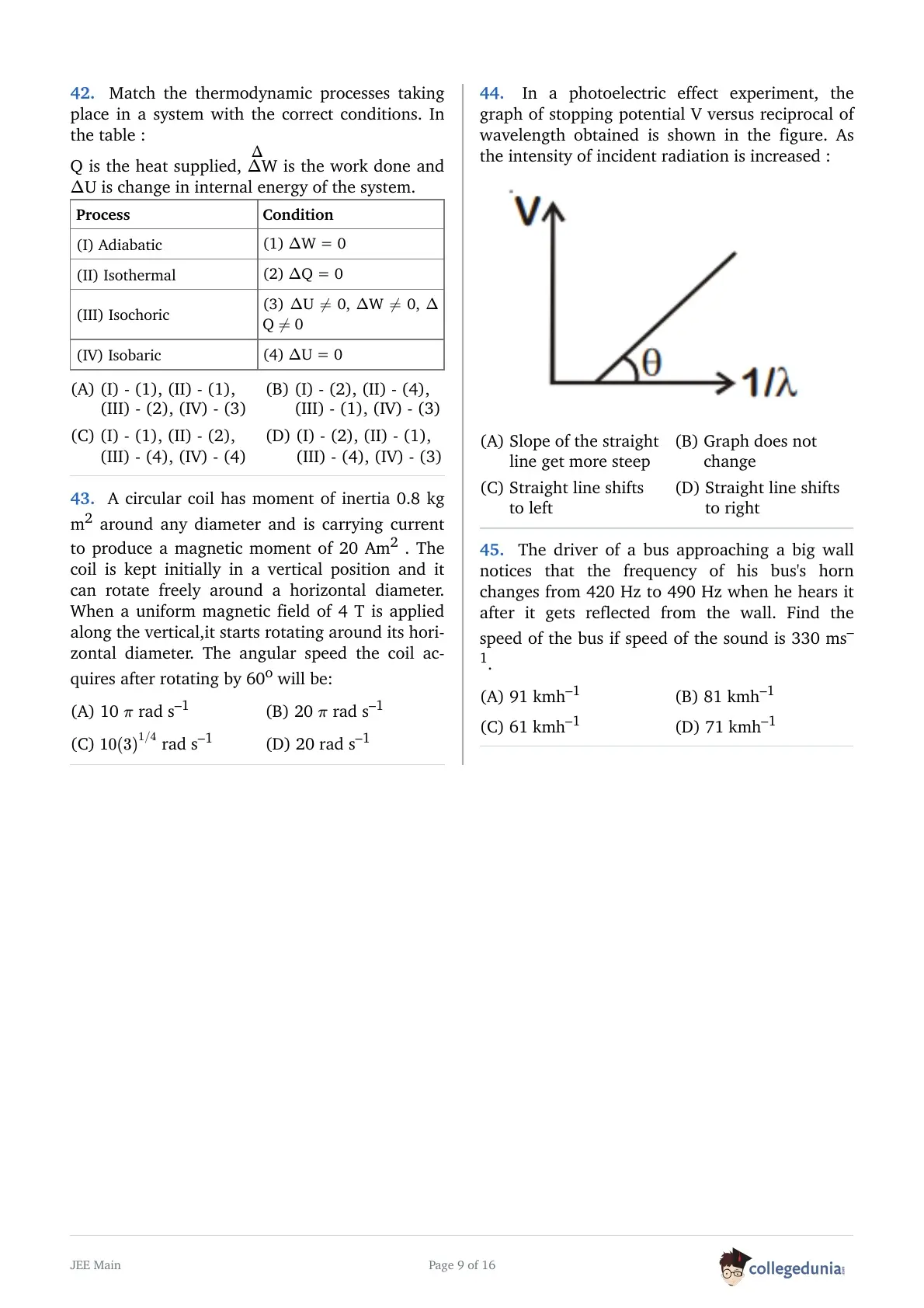
| Process | Condition |
| (I) Adiabatic | (1) \(\Delta W = 0\) |
| (II) Isothermal | (2) \(\Delta Q = 0\) |
| (III) Isochoric | (3) \(\Delta U \neq 0,\ \Delta W \neq 0,\ \Delta Q \neq 0\) |
| (IV) Isobaric | (4) \(\Delta U = 0\) |
A circular coil has moment of inertia 0.8 kg m2 around any diameter and is carrying current to produce a magnetic moment of 20 Am2. The coil is kept initially in a vertical position and it can rotate freely around a horizontal diameter. When a uniform magnetic field of 4 T is applied along the vertical, it starts rotating around its horizontal diameter. The angular speed the coil acquires after rotating by \(60^\circ\) will be:
In a photoelectric effect experiment, the graph of stopping potential V versus reciprocal of wavelength obtained is shown in the figure. As the intensity of incident radiation is increased :
The driver of a bus approaching a big wall notices that the frequency of his bus's horn changes from 420 Hz to 490 Hz when he hears it after it gets reflected from the wall. Find the speed of the bus if speed of the sound is 330 ms-1.
Physics - Section B (Q46 - Q50)
Orange light of wavelength \(6000\times10^{-10}\) m illuminates a single slit of width \(0.6\times10^{-4}\) m. The maximum possible number of diffraction minima produced on both sides of the central maximum is ___________.
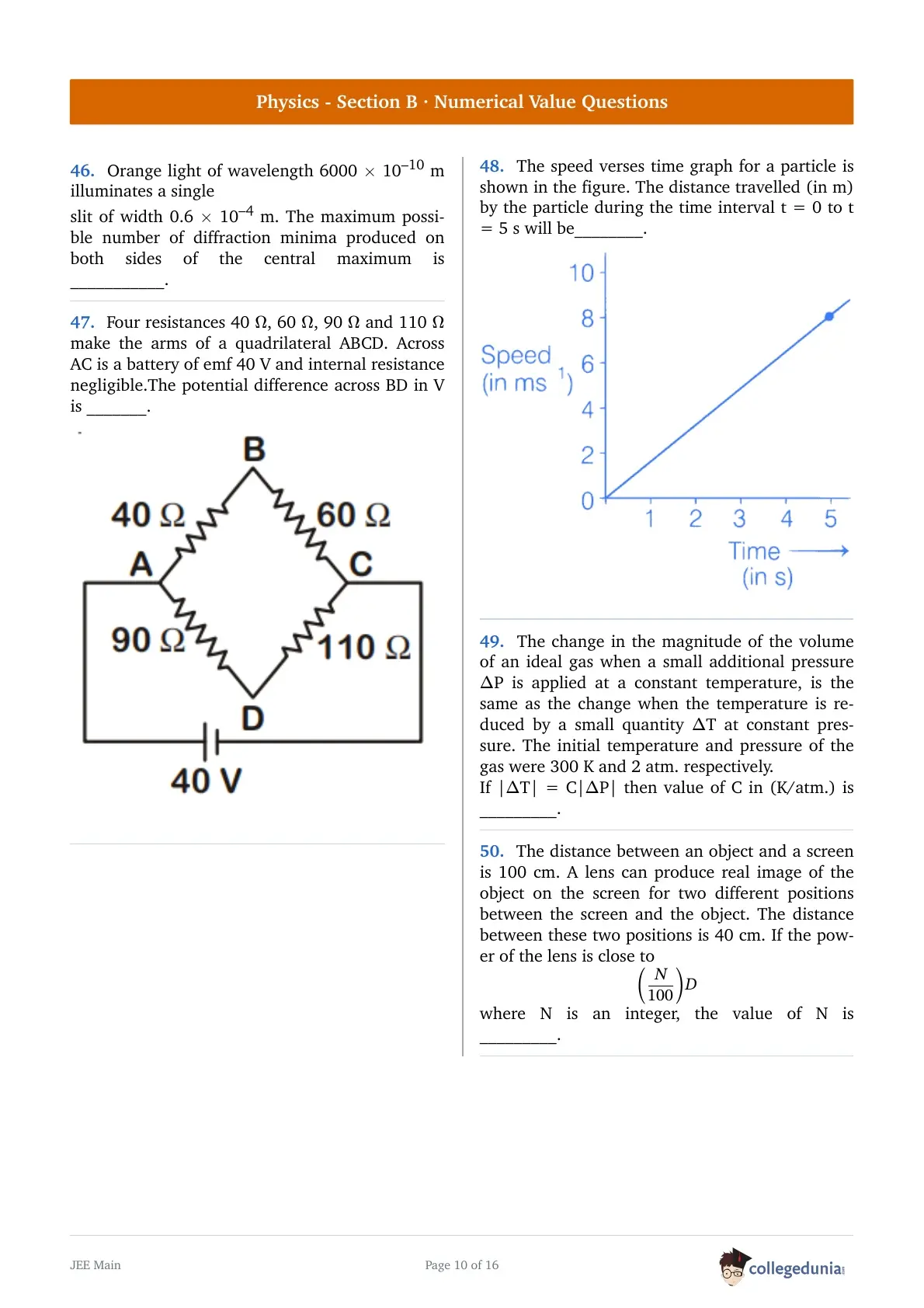
Four resistances 40 \(\Omega\), 60 \(\Omega\), 90 \(\Omega\) and 110 \(\Omega\) make the arms of a quadrilateral ABCD. Across AC is a battery of emf 40 V and internal resistance negligible. The potential difference across BD in V is _______.
The speed verses time graph for a particle is shown in the figure. The distance travelled (in m) by the particle during the time interval t = 0 to t = 5 s will be________.
The change in the magnitude of the volume of an ideal gas when a small additional pressure \(\Delta P\) is applied at a constant temperature, is the same as the change when the temperature is reduced by a small quantity \(\Delta T\) at constant pressure. The initial temperature and pressure of the gas were 300 K and 2 atm. respectively.
If \(|\Delta T| = C|\Delta P|\) then value of C in (K/atm.) is _________.
A concave mirror of focal length \(10\,\text{cm}\) forms an image which is double the size of object when the object is placed at two different positions. The distance between the two positions of the object is _____ cm.
Chemistry - Section A (Q51 - Q70)
The process that is \(NOT\) endothermic in nature is :-
The incorrect statement(s) among (a) - (c) is (are)
(a) W(VI) is more stable than Cr(VI).
(b) In the presence of HCl, permanganate titrations provide satisfactory results.
(c) Some lanthanoid oxides can be used as phosphors.
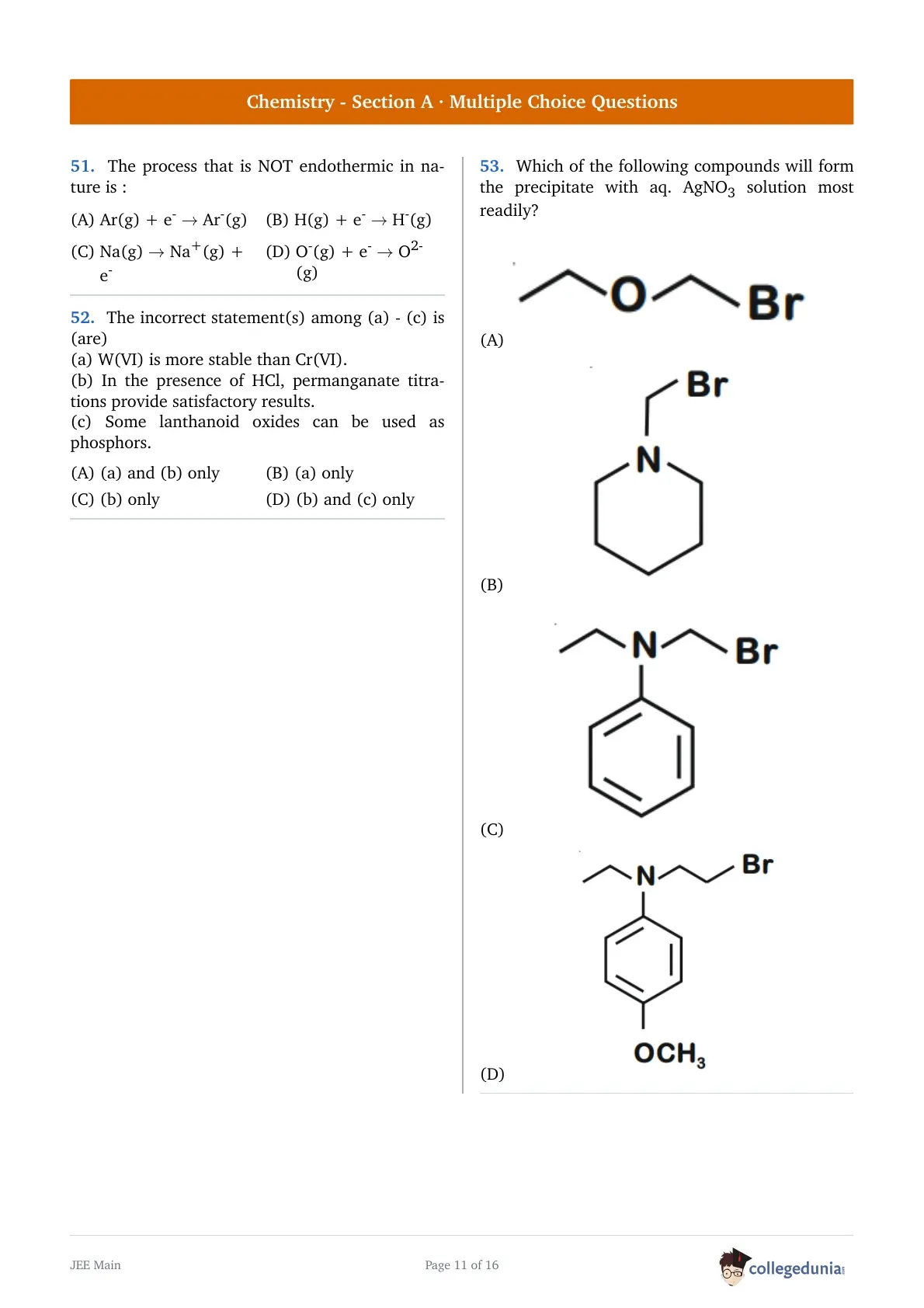
Which of the following compounds will form the precipitate with aq. AgNO3 solution most readily?
- (1)
![]()
- (2)
![]()
- (3)
![]()
- (4)
![]()


If the equilibrium constant for \(\mathrm{A \rightleftharpoons B + C}\) is \(K_{eq}^{(1)}\) and that of \(\mathrm{B + C \rightleftharpoons P}\) is \(K_{eq}^{(2)}\), the equilibrium constant for \(\mathrm{A \rightleftharpoons P}\) is :
The shortest wavelength of hydrogen atom in Lyman series is λ. The longest wavelength in Balmer series of He+ is
Five moles of an ideal gas at 1 bar and 298 K is expanded into vacuum to double the volume. The work done is :
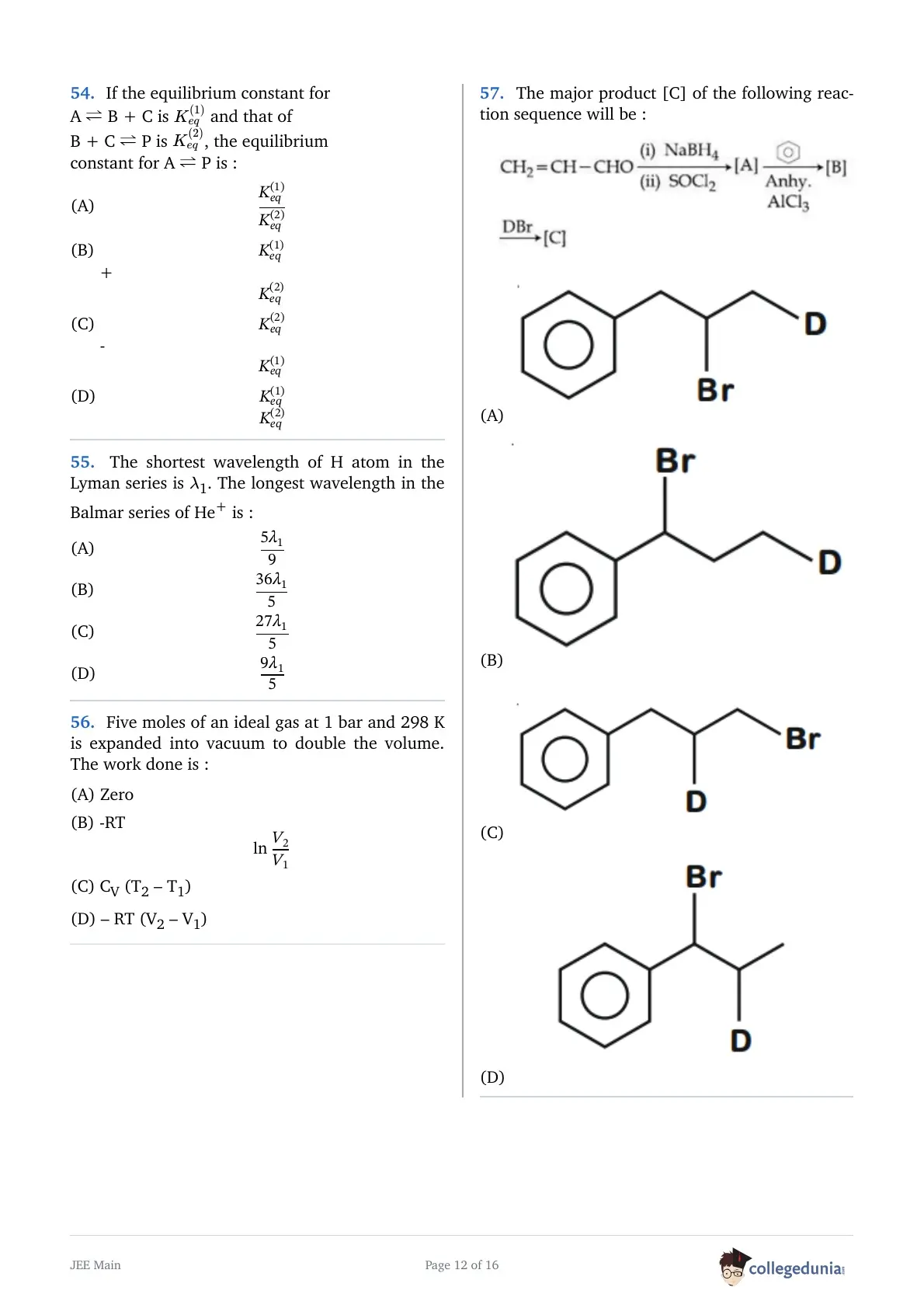
The major product [C] of the following reaction sequence will be :
\(\mathrm{CH_2{=}CH{-}CHO}\ \xrightarrow[\mathrm{(ii)\ SOCl_2}]{\mathrm{(i)\ NaBH_4}}\ \mathrm{[A]}\ \xrightarrow[\mathrm{Anhy.\ AlCl_3}]{\mathrm{Benzene}}\ \mathrm{[B]}\ \xrightarrow{\mathrm{DBr}}\ \mathrm{[C]}\)
- (1)
![]()
- (2)
![]()
- (3)
![]()
- (4)
![]()


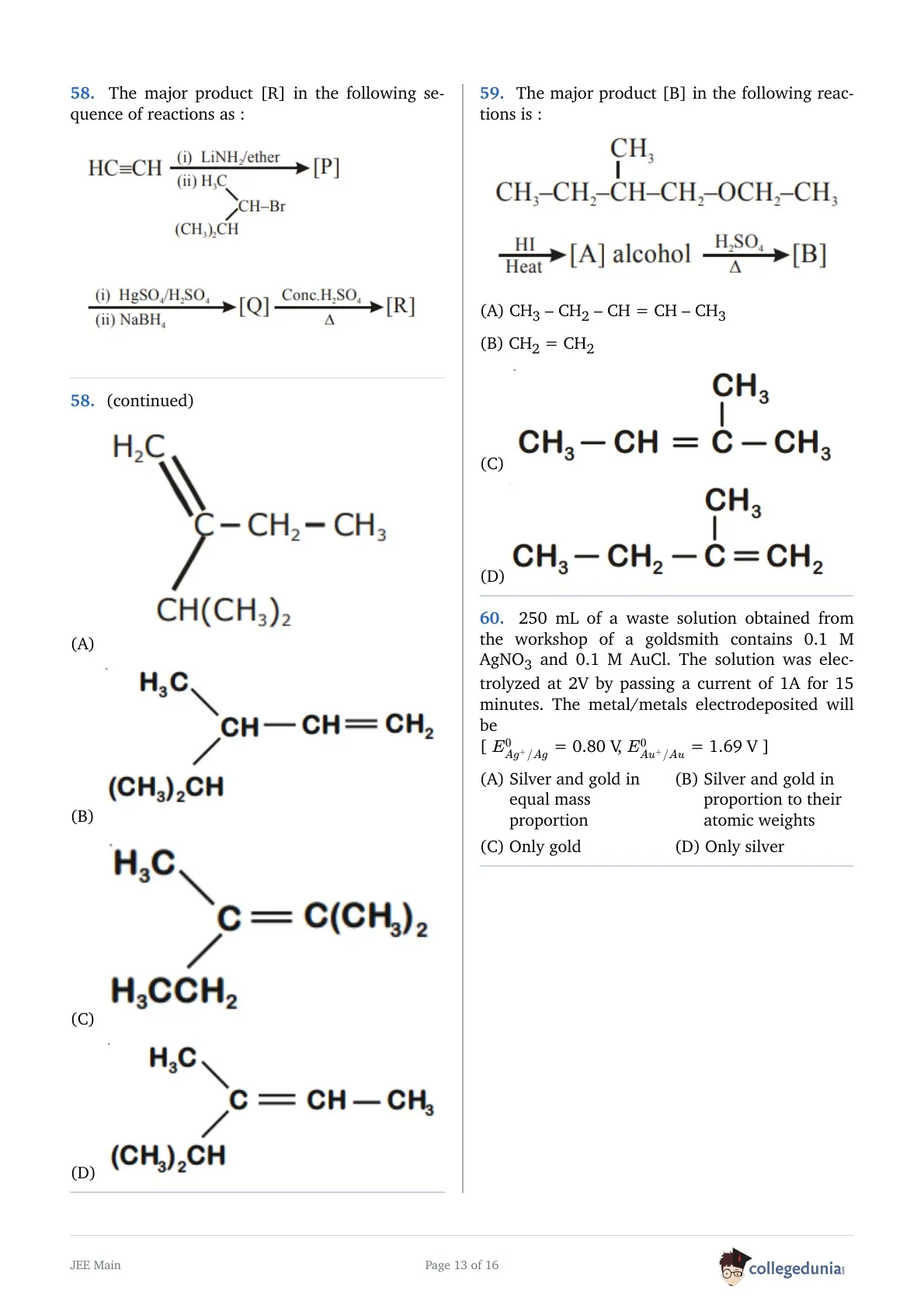
The major product [R] in the following sequence of reactions as :
\(\mathrm{HC{\equiv}CH}\ \xrightarrow[\mathrm{(ii)\ (CH_3)_2CH{-}CH(CH_3){-}Br}]{\mathrm{(i)\ LiNH_2/ether}}\ \mathrm{[P]}\ \xrightarrow[\mathrm{(ii)\ NaBH_4}]{\mathrm{(i)\ HgSO_4/H_2SO_4}}\ \mathrm{[Q]}\ \xrightarrow[\Delta]{\mathrm{Conc.\ H_2SO_4}}\ \mathrm{[R]}\)
The major product [B] in the following reactions is :
\(\mathrm{CH_3CH_2{-}CH(CH_3){-}CH_2{-}O{-}CH_2{-}CH_3}\ \xrightarrow[\mathrm{Heat}]{\mathrm{HI}}\ \mathrm{[A]\ alcohol}\ \xrightarrow[\Delta]{\mathrm{H_2SO_4}}\ \mathrm{[B]}\)
250 mL of a waste solution obtained from the workshop of a goldsmith contains 0.1 M AgNO3 and 0.1 M AuCl. The solution was electrolyzed at 2V by passing a current of 1A for 15 minutes. The metal/metals electrodeposited will be
[ \(E^0_{Ag^+/Ag} = 0.80\ \mathrm{V}\), \(E^0_{Au^+/Au} = 1.69\ \mathrm{V}\) ]
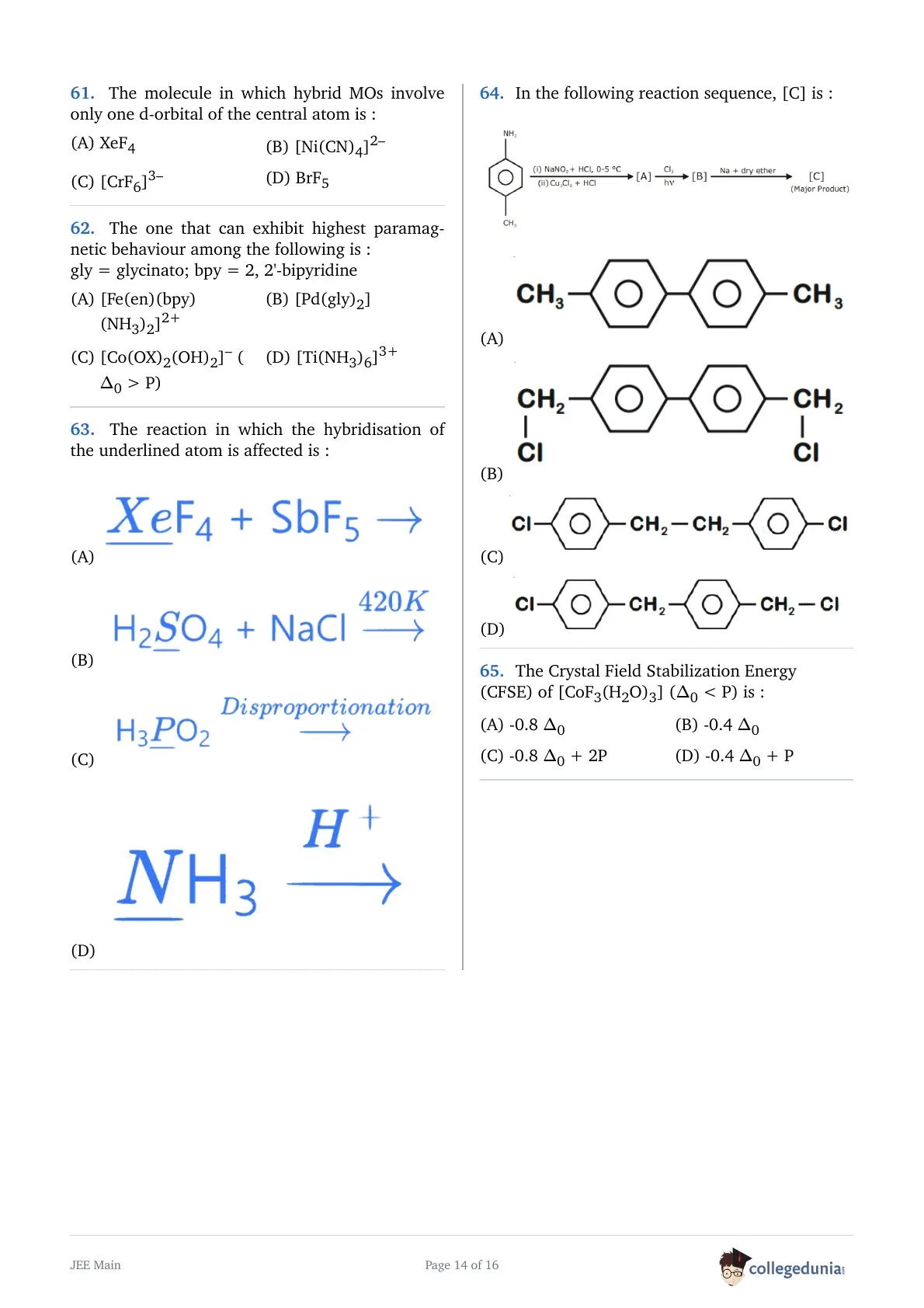
The molecule in which hybrid MOs involve only one d-orbital of the central atom is :
The one that can exhibit highest paramagnetic behaviour among the following is :
gly = glycinato; bpy = 2, 2'-bipyridine
The reaction in which the hybridisation of the underlined atom is affected is :
In the following reaction sequence, [C] is :
(Sequence: p-toluidine, (i) \(\mathrm{NaNO_2 + HCl}\), \(0-5^\circ\mathrm{C}\); (ii) \(\mathrm{Cu_2Cl_2 + HCl}\) gives [A]; [A] with \(\mathrm{Cl_2}\), \(h\nu\) gives [B]; [B] with Na + dry ether gives [C] (Major Product).)
- (1)
![]()
- (2)
![]()
- (3)
![]()
- (4)
![]()


The Crystal Field Stabilization Energy (CFSE) of \([\mathrm{CoF_3(H_2O)_3}]\) (\(\Delta_0 \lt P\)) is :
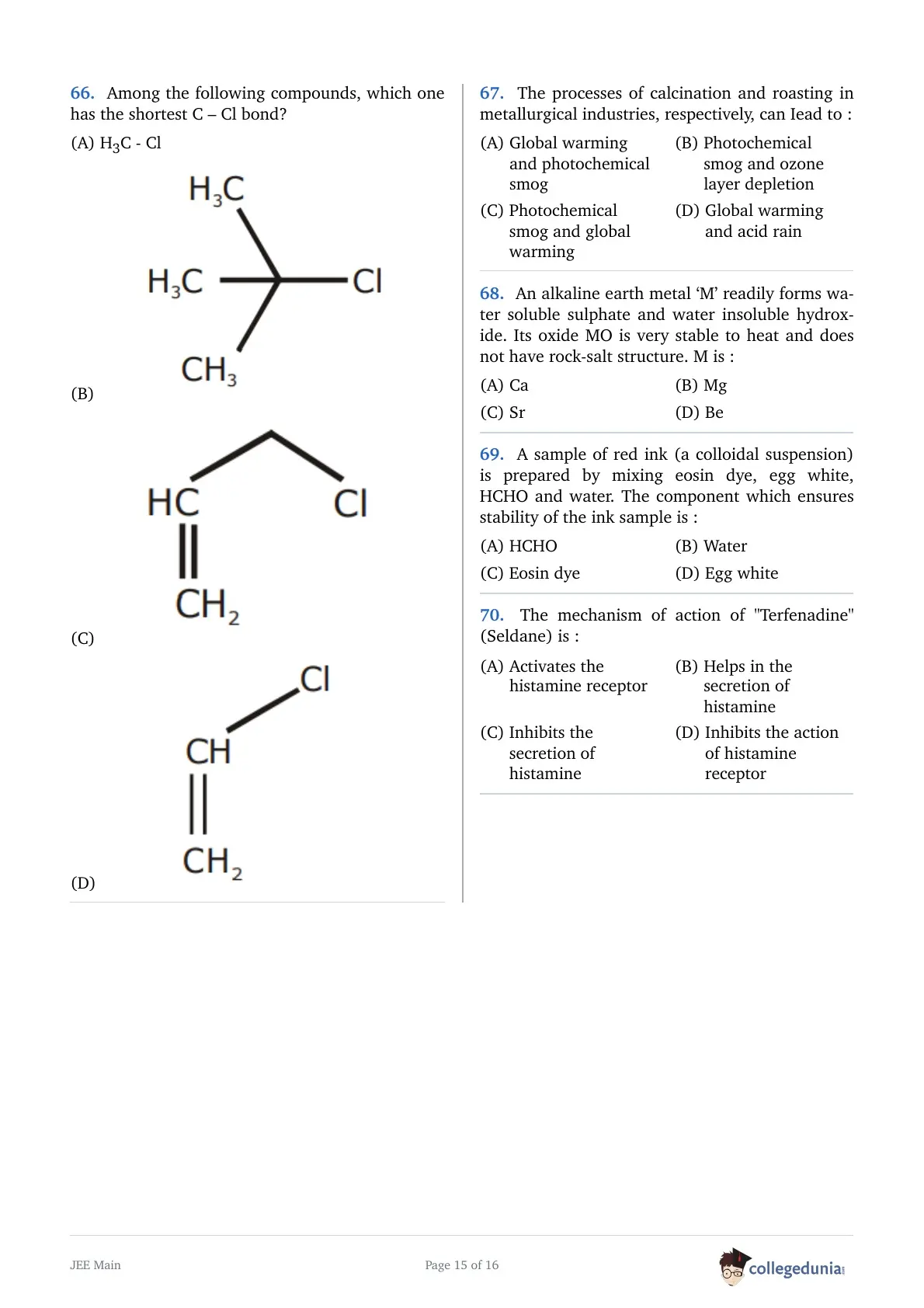
Among the following compounds, which one has the shortest C - Cl bond?
- (1) \(\mathrm{H_3C-Cl}\)
- (2)
![]()
- (3)
![]()
- (4)
![]()


The processes of calcination and roasting in metallurgical industries, respectively, can lead to :
An alkaline earth metal 'M' readily forms water soluble sulphate and water insoluble hydroxide. Its oxide MO is very stable to heat and does not have rock-salt structure. M is :
A sample of red ink (a colloidal suspension) is prepared by mixing eosin dye, egg white, \(HCHO \) and water. The component which ensures stability of the ink sample is :-
The mechanism of action of "Terfenadine" (Seldane) is :
Chemistry - Section B (Q71 - Q75)
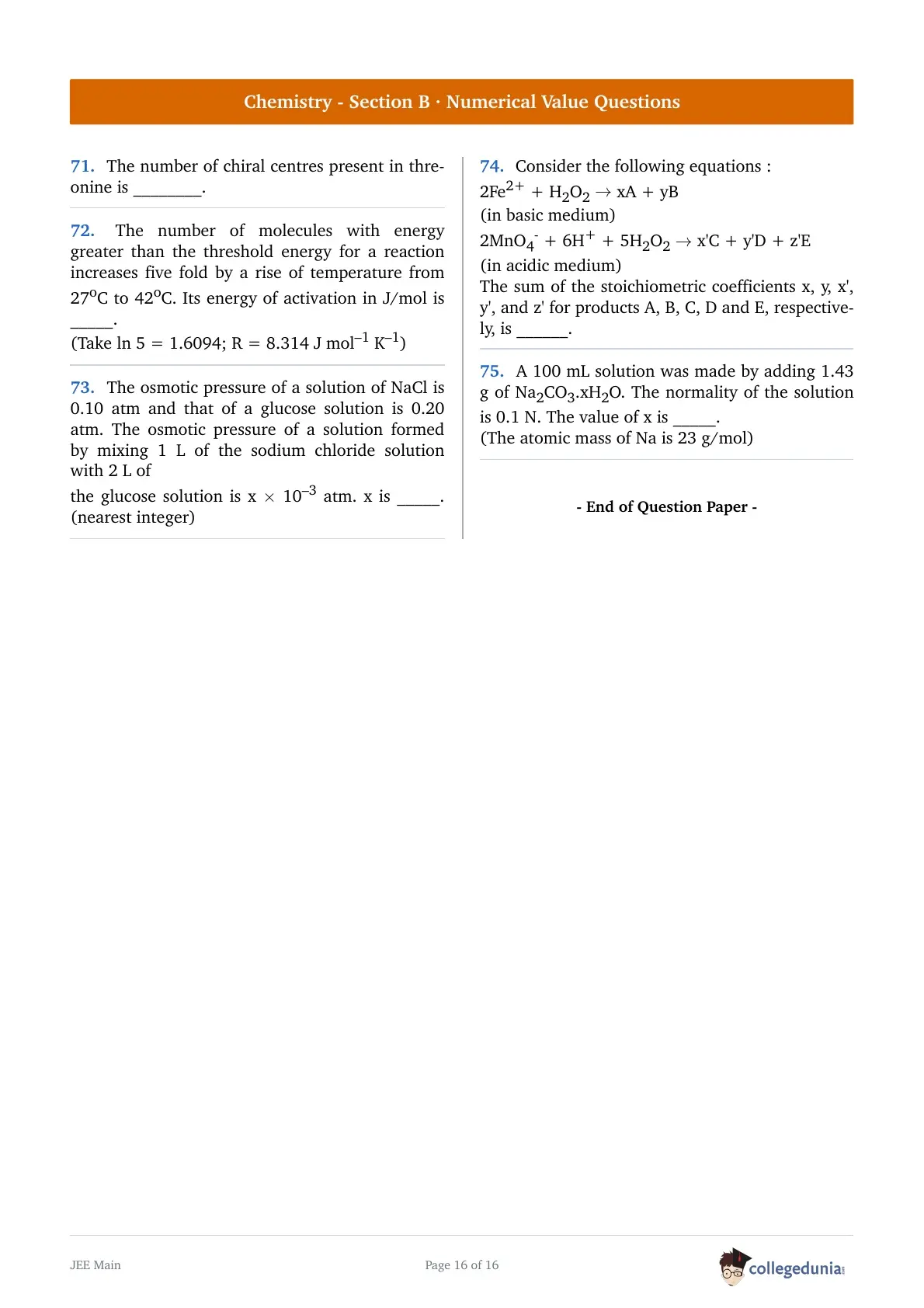
The number of chiral centres present in threonine is ________.
The number of molecules with energy greater than the threshold energy for a reaction increases five fold by a rise of temperature from \(27^\circ\mathrm{C}\) to \(42^\circ\mathrm{C}\). Its energy of activation in J/mol is ______.
(Take \(\ln 5 = 1.6094\); \(R = 8.314\ \mathrm{J\,mol^{-1}\,K^{-1}}\))
The osmotic pressure of a solution of NaCl is 0.10 atm and that of a glucose solution is 0.20 atm. The osmotic pressure of a solution formed by mixing 1 L of the sodium chloride solution with 2 L of the glucose solution is \(x \times 10^{-3}\) atm. x is ______. (nearest integer)
Consider the following equations :
\(\mathrm{2Fe^{2+} + H_2O_2 \to xA + yB}\) (in basic medium)
\(\mathrm{2MnO_4^- + 6H^+ + 5H_2O_2 \to x'C + y'D + z'E}\) (in acidic medium)
The sum of the stoichiometric coefficients x, y, x', y', and z' for products A, B, C, D and E, respectively, is ______.
A 100 mL solution was made by adding 1.43 g of \(\mathrm{Na_2CO_3 \cdot xH_2O}\). The normality of the solution is 0.1 N. The value of x is ______.
(The atomic mass of Na is 23 g/mol)
JEE Main 2020 Exam Pattern and Marking Scheme
| Particulars | Details |
|---|---|
| Exam Mode | Online (Computer-Based Test) |
| Paper | B.E./B.Tech (Paper 1) |
| Duration | 3 hours (180 minutes) |
| Type of Questions | Multiple Choice Questions (MCQs) + Numerical Value Questions |
| Subjects | Mathematics, Physics, Chemistry |
| Total Questions | 75 questions |
| Total Marks | 300 marks |
| Marking Scheme | +4 for correct answer & -1 for incorrect MCQ; no negative marking for Numerical Value Questions |
JEE Main 2020 September 4 Shift 2 Difficulty Level
JEE Main B.E/ B.Tech 2020 Question Paper on September 4 was conducted with three core sections Physics, Chemistry, and Mathematics. In accordance with the overall difficulty level of JEE Main B.E/ B.Tech 2020 previous session question papers, the question paper for September 4, ranged from moderate to difficult. As per the section-wise difficulty level, Physics and Chemistry were moderate whereas the Maths paper was tough.
JEE Main 2020 B.E./B.Tech Question Paper September 4 (AN): Weightage of Topics
JEE Main 2020 B.E./B.Tech September 4 Afternoon Session was conducted from 3.00 PM to 6.00 PM. The weightage of topics in JEE Main Syllabus was as follows:
Physics
| Chapter Name | Weightage |
|---|---|
| Electrodynamics | 30% |
| Heat and Thermodynamics | 4% |
| Mechanics | 32% |
| Modern Physics | 20% |
| Optics | 10% |
| SHM and Waves | 4% |
Chemistry
| Chapter Name | Weightage |
|---|---|
| Inorganic Chemistry | 32% |
| Organic Chemistry | 30% |
| Physical Chemistry | 38% |
Mathematics
| Chapter Name | Weightage |
|---|---|
| Binomial Theorem | 4% |
| Complex Numbers | 6% |
| Coordinate Geometry | 14% |
| Differential Calculus | 18% |
| Integral Calculus | 14% |
| Vector and 3D | 8% |
| Trigonometry | 4% |
| Matrix and Determinants | 4% |
| Permutation and Combination | 8% |
| Mathematical Reasoning | 4% |
| Statistics | 4% |
| Quadratic Equation | 4% |
| Sequence and Series | 8% |



Comments