




Since NTA has released the provisional answer key and response sheet, you must have already calculated your expected JEE Main 2026 score as well as your percentile.
Now, you might be wondering how to calculate JEE Main 2026 rank.
- To calculate your JEE Main rank 2026, you need to convert your raw score into a percentile (NTA Score) using a shift-wise normalization formula.
- Then using the percentile by the below mentioned formula you can estimate your JEE Main 2026 rank.
The Estimated AIR Formula is:
| Rank = [(100 − Percentile) × N] ÷ 100 |
where N is the total number of unique candidates who appeared.
Your final rank is assigned after combining Best of Two attempts (January + April) in decreasing order of percentile, not based on JEE Main 2026 raw marks.
Related Link:
- How Many Candidates applied for the JEE Mains 2026 Session 2 Exam
- Use collegedunia’s college predictor to check IIT and NIT chances
- JEE Main 2026 Marks Vs Percentile for all shifts
How to Calculate JEE Main 2026 Rank from Percentile?
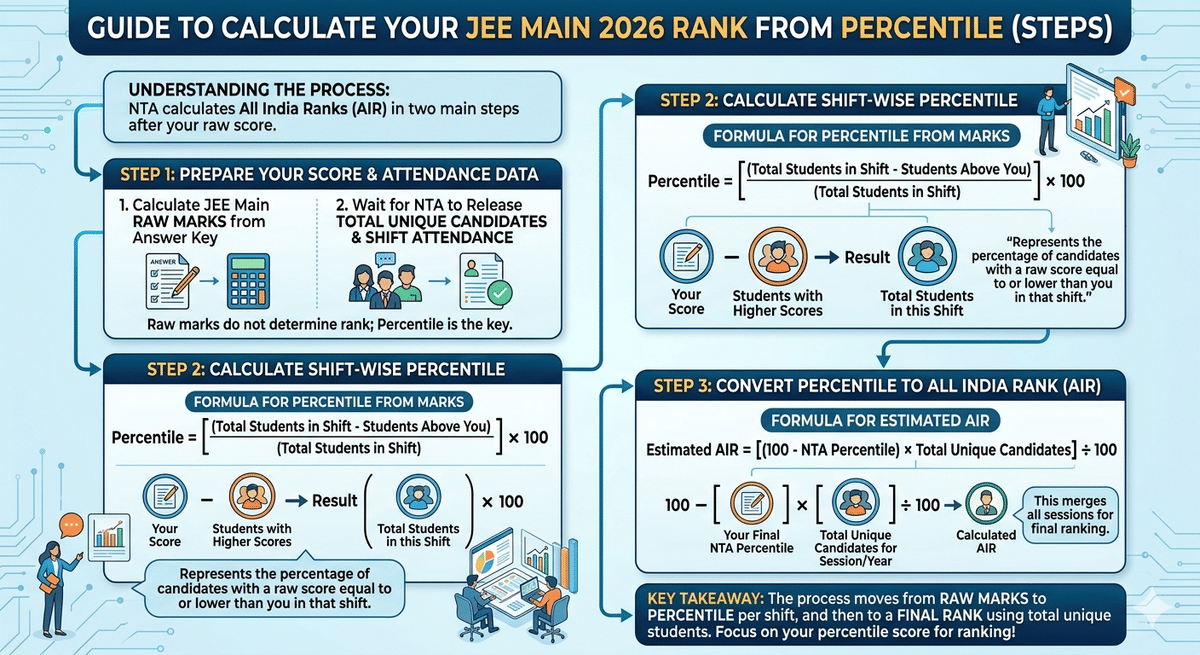
Understanding how to calculate JEE Main 2026 rank requires you to know that NTA never prepares JEE Main All India Ranks based on the raw marks. It usually uses a two-step process :
- First, you need to calculate your shift-wise percentile using your calculated raw score.
- Then you need to convert that percentile into an All India Rank (AIR) by merging all sessions.
Step 1:
Check How to calculate JEE Main marks from the answer key
Step 2: How to Calculate JEE Mains Percentile from Marks?
The JEE Main Percentile from marks is calculated using the following formula:
| Percentile = [ (Total students in shift − Students above you) ÷ (Total students in shift) ] × 100 |
Also Read: How to Calculate JEE Mains Percentile from Marks?
For example, if 1,30,000 students appeared in JEE Mains Session 2 Shift 1 (based on JEE Main 2026 Session 2 averages) and 1,300 scored above you,
Your percentile = (1,30,000 − 1,300) ÷ 1,30,000 × 100 = 99 percentile.
This means 99% of students in that shift scored below you.
With around 13 lakh students across 10 shifts, each shift averaged 1.30-1.35 lakh attendees
| Marks Scored | Students Above You | Shift Strength | Percentile |
|---|---|---|---|
| 200 | 1,300 | 1,30,000 | 99.00 |
| 175-180 | 2,600 | 1,30,000 | 98.00 |
| 155-160 | 3,900 | 1,30,000 | 97.00 |
| 160 | 1,270 | 1,27,000 | 99.00 (Day 1 Shift) |
| 140 | 2,540 | 1,27,000 | 98.00 (Day 1 Shift) |
Step 3: Can JEE Main rank be calculated from percentile score?
Yes. Once you know your final percentile from the above steps, you can estimate your rank using the formula below.
This is the only way to know how to calculate JEE Main 2026 rank before the official result.
| Estimated AIR = [(100 − NTA Percentile) × Total Unique Candidates] ÷ 100 |
Read More: How is All India Rank calculated in JEE Main 2026?
Assuming 10,04,000 total unique candidates for JEE Main 2026 Session 2 (approx.)
| NTA Score (Percentile) | Estimated AIR | Qualification chances |
|---|---|---|
| 99.90 | 1,004 | JEE Advanced likely |
| 99.00 | 10,040 | JEE Advanced likely |
| 98.00 | 20,080 | Borderline Advanced |
| 95.00 | 50,200 | Top NITs possible |
| 90.00 | 1,00,400 | Lower NITs/IIITs |
Note: Since percentile depends on shift difficulties, 200 marks in Shift 1 and 150 marks in Shift 2 can give the exact same rank if both give 99.9 percentile. So, Raw marks do not matter for ranking, only your percentile does.
Also check:
- JEE Main 2026 Marks vs Percentile vs Rank (Expected)
- JEE Main 2025 Marks Vs Percentile April Shift
- JEE Main Marks Vs Percentile Vs Rank Predictor 2026
Ques. How to calculate JEE Main rank from percentile without the official result?
Ans. Use the formula: Estimated AIR = [(100 − NTA Score) × 10,04,000] ÷ 100. This gives a close approximation; actual rank may vary slightly depending on total registered candidates.
Ques. Is JEE Main rank based on marks or percentile?
Ans. Rank is based entirely on percentile (NTA Score), not raw marks. Two students with different marks but the same percentile from different shifts will get the same rank.
How the Best of Two Attempts Merges into Final Rank
NTA uses the Best of Two policy across January and April sessions to determine your final percentile for rank calculation. Here is exactly how it works:
- You appear in the January session : percentile calculated shift-wise within that session.
- You appear in the April session : again, percentile calculated shift-wise within April.
- NTA picks your higher percentile from both attempts as your final NTA Score.
- All students' final NTA Scores are sorted in decreasing order to assign AIR.
- Category-wise ranks (EWS, OBC-NCL, SC, ST, PwD) are assigned from the same sorted list.
| Session | NTA Score Obtained | Final Score Used? |
|---|---|---|
| January 2026 | 99.00 | No (lower of the two) |
| April 2026 | 99.40 | Yes - Best of Two |
Check:
Ques. Why does the same percentile require different marks in different shifts?
Ans. Percentile measures your position relative to your shift's students. If your shift had a tougher paper or weaker students, a lower score can still yield 99 percentile.
Ques. Is January attempt percentile merged with April attempt for final rank?
Ans. Yes. NTA takes the Best of Two : whichever session gave you the higher percentile is used as your final NTA Score for AIR calculation.
JEE Main 2026 Tie-breaker Rules for Equal Percentile Scores
When two students have the same NTA Scores, NTA applies a sequential tie-breaker to determine who gets the better rank.
| Priority | Tie-breaker criterion | Preference given to |
|---|---|---|
| 1st | NTA Score in Mathematics | Higher subject percentile |
| 2nd | NTA Score in Physics | Higher subject percentile |
| 3rd | NTA Score in Chemistry | Higher subject percentile |
| 4th | Date of Birth | Older candidate ranked higher |
| 5th | Application number | Lower application number |
Check: JEE Main 2026 Marks Vs Percentile for all Session 2 Apr Shifts
Ques. What happens if two students have the exact same percentile and subject scores?
Ans. NTA falls back to Date of Birth as a tie-breaker, ranking the older candidate higher. If that is also equal, the lower application number takes precedence.
Ques. How many decimal places does NTA use in the percentile score?
Ans. NTA calculates percentile up to 7 decimal places so that even candidates with very similar performance can be differentiated and ranked uniquely.
How JEE Main 2026 Shift-wise Normalization Affects your Rank
The most important part of how to calculate JEE Main 2026 rank is that your competition is only within your shift, not across all 14 lakh students. This usually determines your overall percentile and cutoff.
| Factor | Under your control? | Impact on percentile |
|---|---|---|
| Your raw score / marks | Yes | Direct & primary |
| Paper difficulty level | No | High : easier paper raises cutoff |
| Quality of co-students in shift | No | Moderate : better peers lower your percentile |
| Which shift you are allotted | No | Moderate : random allocation by NTA |
| Number of students in your shift | No | Low : usually ~1.3–1.5 lakh per shift |
Ques. Does negative marking affect rank calculation?
Ans. Negative marking (−1 for wrong MCQ answers) directly reduces your raw score, which affects your position within your shift and thus your shift-wise percentile.
Ques. When is the All India Rank officially released?
Ans. AIR is only released after the April attempt results are declared. After the January session, NTA only provides shift-wise subject and total percentile, not the final rank.
Collegedunia JEE Main Rank Predictor
- Candidates can predict their expected score, percentile, and college easily by using the Collegedunia predictor.
- Paste your response sheet PDF URL to get your JEE Main 2026 score..
Once you get the score, enter your score in the link to find your rank/percentile.
Here are the steps to calculate your JEE Main expected percentile.
Related News:



Comments