




The high weightage chapters for JEE Main 2027 Chemistry are expected to account for nearly 18-22 of the 25 Chemistry questions, which is around 65-70% of the total Chemistry marks in recent JEE Main sessions.
- Class 12 Chemistry is expected to carry nearly 50–55% weightage, while Class 11 may contribute around 45–50% in JEE Main 2027.
- In Inorganic Chemistry, which is expected to be 30-35% of the chemistry section in which the important chapters are Coordination Compounds, Chemical Bonding, p Block Elements, d and f Block Elements and the Periodic Table and Periodicity.
- Physical Chemistry is expected to be 35-40% of the Chemistry paper with Mole Concept, Chemical Kinetics, Electrochemistry, Solutions, Thermodynamics and Chemical Equilibrium.
- Organic Chemistry is expected to have 30–35% weightage with General Organic Chemistry (GOC), Hydrocarbons, Aldehydes, Ketones, Carboxylic Acids, Amines and Biomolecules and Polymers.
- Analysis of the last five years shows that nearly 65–70% of the Chemistry questions have come from around 15–18 high weightage chapters.
- Candidates aiming to score 80+ marks in JEE Main 2027 Chemistry should complete these high-weightage chapters before focusing on the comparatively low weightage topics.
Related Links:
- JEE Main Preparation Guide: Study Plan, Strategy, Tips & Resources
- JEE Main Chemistry preparation: Check Preparation Plan, Syllabus, Weightage, Mock tests & Books
- Best Books for JEE Main Physics, Chemistry and Mathematics, NCERT PDF Download
Key Summary
- The high weightage chapters for JEE Mains 2027 Chemistry are expected to contribute nearly 18-22 questions out of the 25 Chemistry questions.
- Physical Chemistry offers strong scoring opportunity because of its numerical based questions and conceptual application.
- Organic Chemistry contributes a balanced mix of conceptual, mechanism and reaction based questions every year.
- Inorganic Chemistry carries direct NCERT based questions which makes it one of the easiest and quickest sections for scoring marks.
- Candidates should do revision using NCERT and regular mock tests is equally important for improving accuracy and speed.
Chapter-Wise Weightage for JEE Mains 2027 Chemistry
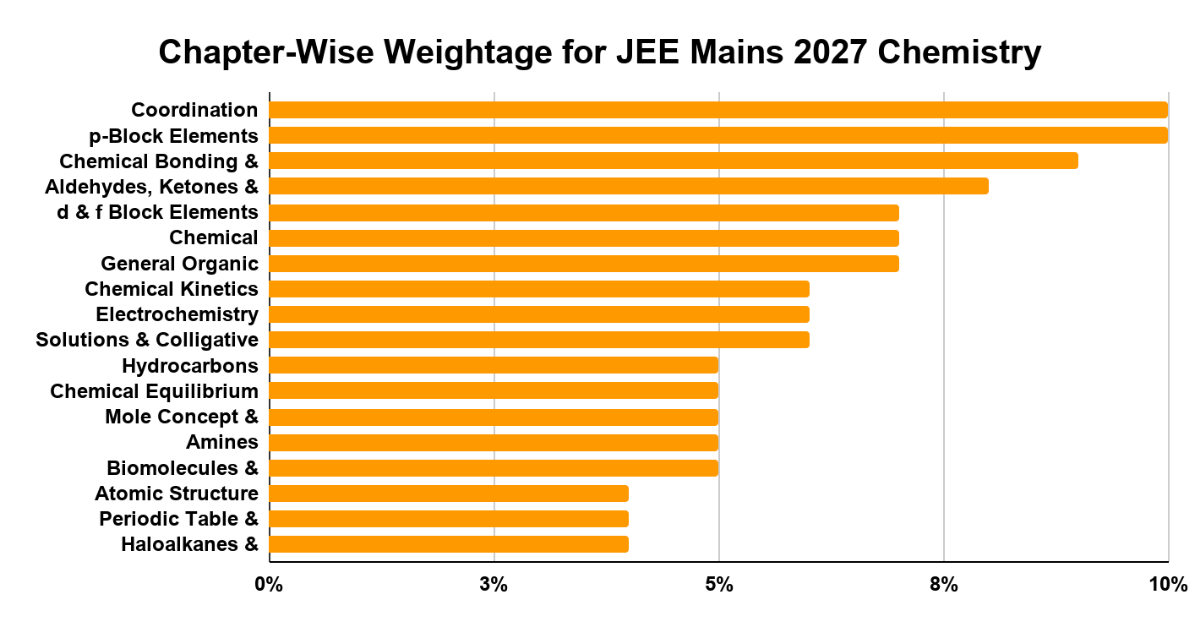
Coordination Compounds, p-Block Elements and Chemical Bonding & Molecular Structure are expected to carry the highest weightage in JEE Main 2027 Chemistry with 2–3 questions with weightage of 7–10% each.
- Aldehydes, Ketones & Carboxylic Acids is expected to contribute 2–3 questions with 6–8% weightage while d & f Block Elements, Chemical Thermodynamics and General Organic Chemistry (GOC) are expected to carry 1–2 questions each with 5–7% weightage.
| Chapter Name | Section | Expected Questions | Projected Weightage (%) | Priority |
|---|---|---|---|---|
| Coordination Compounds | Inorganic | 2–3 | 8–10% | Very High |
| p-Block Elements | Inorganic | 2–3 | 8–10% | Very High |
| Chemical Bonding & Molecular Structure | Inorganic/Physical | 2–3 | 7–9% | Very High |
| Aldehydes, Ketones & Carboxylic Acids | Organic | 2–3 | 6–8% | Very High |
| d & f Block Elements | Inorganic | 1–2 | 5–7% | High |
| Chemical Thermodynamics | Physical | 1–2 | 5–7% | High |
| General Organic Chemistry (GOC) | Organic | 1–2 | 5–7% | High |
| Chemical Kinetics | Physical | 1–2 | 4–6% | High |
| Electrochemistry | Physical | 1–2 | 4–6% | High |
| Solutions & Colligative Properties | Physical | 1–2 | 4–6% | High |
| Hydrocarbons | Organic | 1–2 | 4–5% | High |
| Chemical Equilibrium | Physical | 1–2 | 4–5% | High |
| Mole Concept & Stoichiometry | Physical | 1–2 | 3–5% | High |
| Amines | Organic | 1–2 | 3–5% | Medium-High |
| Biomolecules & Polymers | Organic | 1–2 | 3–5% | Medium-High |
| Atomic Structure | Physical | 1 | 3 - 4% | Medium |
| Periodic Table & Periodicity | Inorganic | 1 | 3 - 4% | Medium |
| Haloalkanes & Haloarenes | Organic | 1 | 3 - 4% | Medium |
Also Check:
- JEE Main Maths Preparation- Check 60 Days Study Plan, Important Books, Mock Tests and PYQs
- JEE Main Physics Preparation: Check Monthly Preparation Plan, Way to Score 100+, Weightage & Books
Ques. How many high-weightage Chemistry chapters should I complete for JEE Main 2027?
Ans. Candidates should aim to complete at least 12–15 high-weightage Chemistry chapters first. These chapters are expected to contribute the majority of questions in JEE Main 2027 and can help candidates secure a strong score with focused preparation.
Physical Chemistry: High Weightage Chapters for JEE Mains 2027
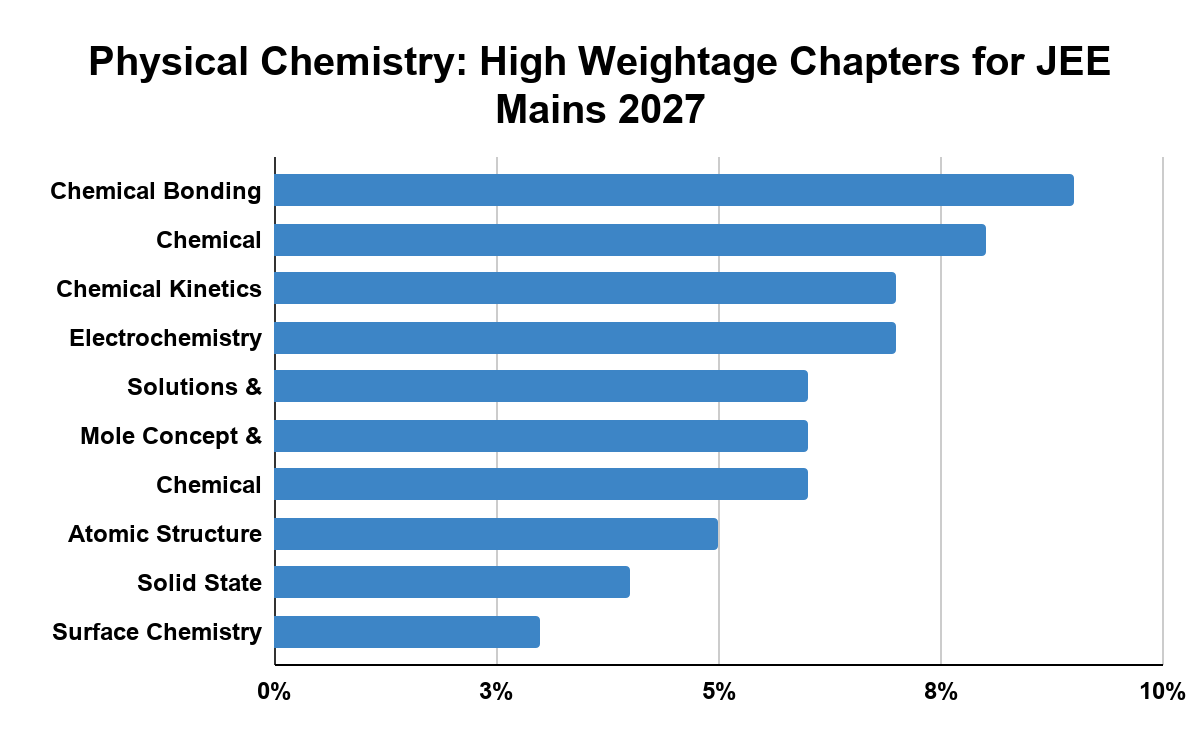
Chemical Bonding & Molecular Structure and Chemical Thermodynamics are expected to carry the highest weightage in Physical Chemistry with 2–3 questions each with weightage of 6–9%.
- Chemical Kinetics and Electrochemistry are expected to contribute 1–2 questions each with 5–7% weightage while Solutions & Colligative Properties is expected to carry 1–2 questions with 5–6% weightage.
| Chapter Name | Expected Questions | Projected Weightage (%) | Priority | Key Topics |
|---|---|---|---|---|
| Chemical Bonding & Molecular Structure | 2–3 | 7–9% | Very High | VSEPR, Hybridization, MO Theory, Hydrogen Bonding |
| Chemical Thermodynamics | 2–3 | 6–8% | Very High | Enthalpy, Entropy, Gibbs Free Energy, Hess’s Law |
| Chemical Kinetics | 1–2 | 5–7% | Very High | Rate Laws, Order & Molecularity, Activation Energy, Arrhenius Equation |
| Electrochemistry | 1–2 | 5–7% | Very High | Nernst Equation, Conductance, Cells, Faraday’s Laws |
| Solutions & Colligative Properties | 1–2 | 5–6% | High | Raoult’s Law, Osmotic Pressure, Elevation in BP, Depression in FP |
| Mole Concept & Stoichiometry | 1–2 | 4–6% | High | Mole, Equivalent Weight, Limiting Reagent, POAC |
| Chemical Equilibrium | 1–2 | 4–6% | High | Le Chatelier’s Principle, Kp & Kc, Equilibrium Constant |
| Atomic Structure | 1–2 | 3–5% | High | Quantum Numbers, Bohr’s Model, de Broglie, Heisenberg |
| Solid State | 1 | 3–4% | Medium-High | Packing Efficiency, Crystal Lattices, Defects |
| Surface Chemistry | 0–1 | 2–3% | Medium | Adsorption, Colloids, Catalysis |
Also Check:
- JEE Main Exam Pattern: Check Latest updates, Marking Scheme, Weightage & Syllabus
- JEE Main Chemistry Syllabus 2026
Ques. How can I score well in Physical Chemistry for JEE Main 2027?
Ans. The best strategy for Physical Chemistry is to master the concepts first and then practice numericals daily. Candidates should focus on formulas, derivations, and problem-solving techniques from chapters such as Chemical Thermodynamics, Electrochemistry, Chemical Kinetics, Mole Concept, and Chemical Equilibrium. Regular practice of NCERT exercises, previous years' questions (PYQs), and timed mock tests helps improve calculation speed, accuracy, and confidence in the exam.
Organic Chemistry: High Weightage Chapters for JEE Mains 2027
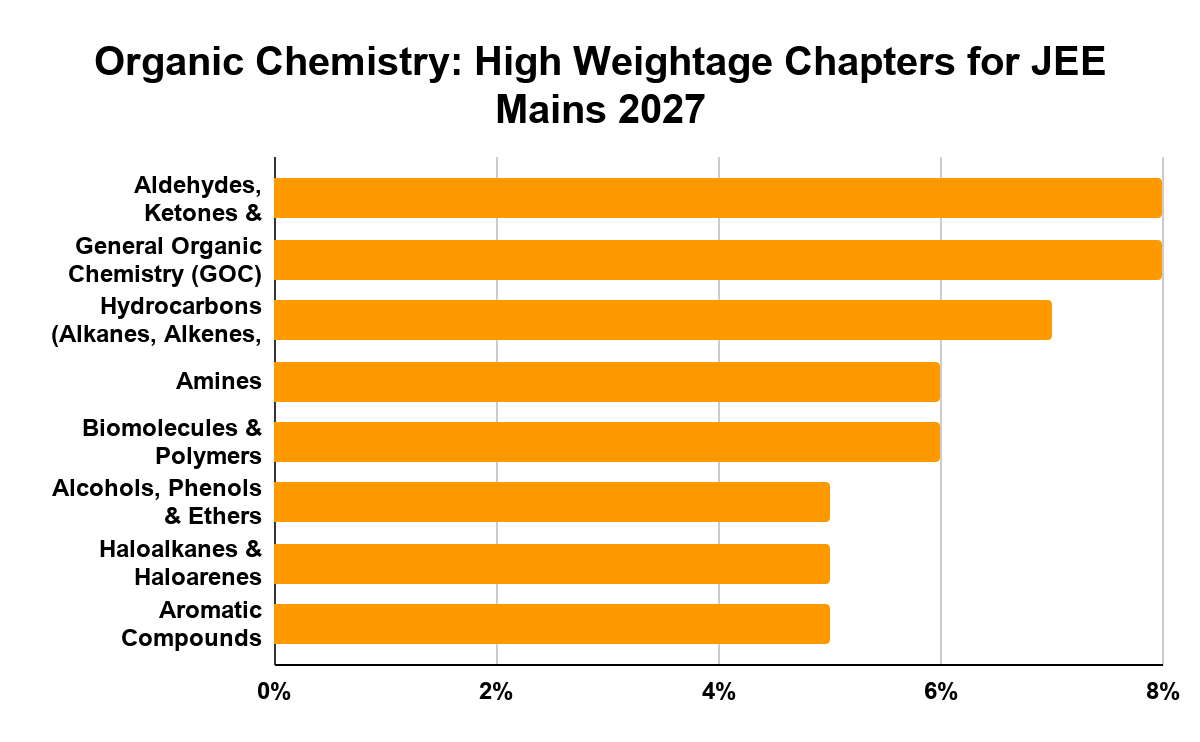
Aldehydes, Ketones & Carboxylic Acids and General Organic Chemistry (GOC) are expected to carry the highest weightage in Organic Chemistry with 2–3 questions each with weightage of 6–8%.
- Hydrocarbons are expected to contribute 1–2 questions with 5–7% weightage while Amines and Biomolecules & Polymers are expected to carry 1–2 questions each with 4–6% weightage.
| Chapter Name | Expected Questions | Projected Weightage (%) | Priority | Key Topics |
|---|---|---|---|---|
| Aldehydes, Ketones & Carboxylic Acids | 2–3 | 6–8% | Very High | Carbonyl reactions, Nucleophilic Addition, Aldol, Cannizzaro, HVZ |
| General Organic Chemistry (GOC) | 2–3 | 6–8% | Very High | Inductive Effect, Resonance, Hyperconjugation, Acidity/Basicity, Isomerism |
| Hydrocarbons (Alkanes, Alkenes, Alkynes) | 1–2 | 5–7% | Very High | Electrophilic Addition, Markovnikov, Ozonolysis, Aromaticity |
| Amines | 1–2 | 4–6% | High | Basicity, Diazotization, Hoffmann Bromamide, Carbylamine |
| Biomolecules & Polymers | 1–2 | 4–6% | High | Carbohydrates, Proteins, Nucleic Acids, Polymers & Uses |
| Alcohols, Phenols & Ethers | 1–2 | 4–5% | High | Reimer-Tiemann, Williamson Synthesis, Acidity of Phenols |
| Haloalkanes & Haloarenes | 1–2 | 3–5% | High | Nucleophilic Substitution (SN1/SN2), Elimination, Wurtz |
| Aromatic Compounds (Benzene & Derivatives) | 1–2 | 3–5% | Medium-High | Electrophilic Aromatic Substitution, Directive Influence |
Also Check:
- JEE Main Chemistry Pattern, Important Topics, Weightage, Marking Scheme
- JEE Main Chapter-wise Weightage- Check Chemistry, Physics and Maths weightage last 10 years
Ques. How can I improve my Organic Chemistry score in JEE Main 2027?
Ans. To score well in JEE Main 2027 Organic Chemistry, candidates should first strengthen their concepts in General Organic Chemistry (GOC) because it forms the foundation for most reaction-based chapters. Prepare short notes for named reactions, reaction mechanisms, reagents, and conversion techniques, revise them frequently, and solve NCERT examples and previous years' questions. Consistent practice of reaction-based problems is one of the most effective ways to improve accuracy and speed in the exam.
Inorganic Chemistry: High Weightage Chapters for JEE Mains 2027
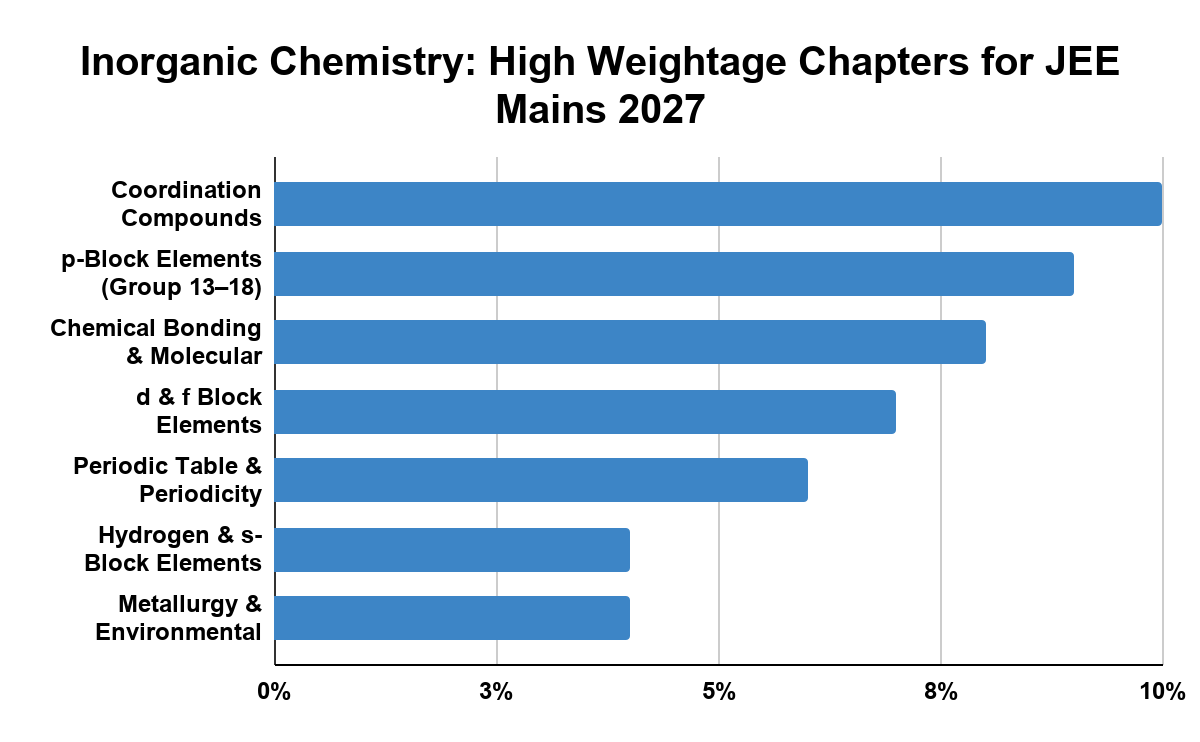
Coordination Compounds and p-Block Elements are expected to carry the highest weightage in Inorganic Chemistry with 2–3 questions each with weightage of 7–10%.
- Chemical Bonding & Molecular Structure is expected to contribute 2–3 questions with 6–8% weightage while d & f Block Elements is expected to carry 1–2 questions with 5–7% weightage.
| Chapter Name | Expected Questions | Projected Weightage (%) | Priority | Key Topics |
|---|---|---|---|---|
| Coordination Compounds | 2–3 | 8–10% | Very High | Nomenclature, Isomerism, VBT, CFT, Werner’s Theory, Stability |
| p-Block Elements (Group 13–18) | 2–3 | 7–9% | Very High | Boron Family, Carbon Family, Nitrogen Family, Oxygen Family, Halogens, Noble Gases |
| Chemical Bonding & Molecular Structure | 2–3 | 6–8% | Very High | Ionic & Covalent Bonding, VSEPR, Hybridization, MO Theory |
| d & f Block Elements | 1–2 | 5–7% | High | Properties, KMnO₄, K₂Cr₂O₇, Lanthanoid Contraction, Colour & Magnetism |
| Periodic Table & Periodicity | 1–2 | 4–6% | High | Trends in Properties, Ionisation Energy, Electronegativity, Atomic Radius |
| Hydrogen & s-Block Elements | 1 | 3–4% | Medium-High | Hydrides, Water, Alkali & Alkaline Earth Metals |
| Metallurgy & Environmental Chemistry | 0–1 | 2–4% | Medium | Extraction of Metals, Pollution, Ozone Depletion |
Also Check:
Ques. Is NCERT enough for Inorganic Chemistry in JEE Main 2027?
Ans. NCERT is the most important resource for JEE Main 2027 Inorganic Chemistry and should be completed thoroughly before using any reference books. Most direct questions are expected from Coordination Compounds, p-Block Elements, d & f Block Elements, Periodic Table, and Hydrogen & s-Block Elements. After completing NCERT, candidates should revise regularly with short notes and practice previous years' questions to improve accuracy and retention.
Class 11 vs Class 12: High Weightage Chapters for JEE Mains 2027 Chemistry
Class 12 Chemistry is expected to contribute 12–15 questions carrying 48–60 marks for nearly 50–55% of the Chemistry section in JEE Main 2027.
- Class 11 Chemistry is expected to contribute 10–13 questions with 40–52 marks which is around 45–50% of the total Chemistry paper.
| Class | Expected Questions | Expected Marks | % Contribution | Key Strength Area |
|---|---|---|---|---|
| Class 11 | 10–13 | 40–52 | ~45–50% | Physical + GOC + Bonding |
| Class 12 | 12–15 | 48–60 | ~50–55% | Inorganic + Organic |
Also Check:
Ques. Can I score well in JEE Main 2027 Chemistry by studying only Class 12 chapters?
Ans. No. Studying only Class 12 Chemistry is not sufficient for a high score in JEE Main 2027. While Class 12 carries a slightly higher weightage, Class 11 topics such as Chemical Bonding, General Organic Chemistry (GOC), Mole Concept, and Thermodynamics form the foundation for many Class 12 chapters and together contribute nearly 40–52 marks. Preparing both Class 11 and Class 12 Chemistry provides the best chance of scoring well in the exam.
Preparation Strategy for High Weightage Chapters for JEE Mains 2027 Chemistry
Candidates should plan to spend around 120–150 hours to complete all the high-weightage chapters of JEE Main 2027 Chemistry.
- Candidates should begin their preparation with the very high-priority chapters, as these topics can contribute significantly towards a score of 50+ marks in Chemistry.
- NCERT textbooks should be the primary study material followed by Previous Year Questions (PYQs) and one standard reference book for each section.
- Candidates should practice at least 30–40 questions every day from the high weightage chapters to strengthen accuracy and speed.
- Candidates should prepare short notes, reaction charts and formula sheets for regular revision during the final stages of preparation.
| Chapter Name | Section | Priority | Recommended Time | Strategy & Tips |
|---|---|---|---|---|
| Coordination Compounds | Inorganic | Very High | 8–10 hours | Master NCERT fully. Focus on isomerism, CFT, bonding, and previous year questions. |
| Chemical Bonding & Molecular Structure | Inorganic | Very High | 10–12 hours | Understand concepts deeply (VSEPR, Hybridization, MO Theory). Solve many numericals. |
| p-Block Elements | Inorganic | Very High | 12–15 hours | Memorize trends + exceptions. Make short notes for each group. |
| Aldehydes, Ketones & Carboxylic Acids | Organic | Very High | 12–15 hours | Learn all named reactions + mechanisms. Practice conversions heavily. |
| General Organic Chemistry (GOC) | Organic | Very High | 10–12 hours | Build strong foundation. Focus on acidity/basicity, resonance & effects. |
| Chemical Thermodynamics | Physical | Very High | 8–10 hours | Solve numericals daily. Understand concepts of entropy & free energy. |
| Chemical Kinetics | Physical | High | 6–8 hours | Master graphs, order of reactions & numericals. |
| Electrochemistry | Physical | High | 8–10 hours | Practice Nernst Equation & cell calculations thoroughly. |
| Hydrocarbons | Organic | High | 6–8 hours | Focus on reaction mechanisms & stereochemistry. |
| Solutions & Colligative Properties | Physical | High | 6–8 hours | Solve numericals based on Raoult’s Law & colligative properties. |
| d & f Block Elements | Inorganic | High | 6–8 hours | Memorize properties, KMnO₄ & K₂Cr₂O₇ reactions. |
| Mole Concept & Stoichiometry | Physical | High | 6–8 hours | Practice all types of numericals. Very scoring. |
| Chemical Equilibrium | Physical | High | 5–7 hours | Master Le Chatelier’s Principle & Kp/Kc calculations. |
| Amines | Organic | High | 5–7 hours | Learn preparation & reactions. Practice conversions. |
Also Check: Organic Chemistry Weightage in JEE Main: Must-Do Topics & Easy Scoring Strategy
Ques. Is NCERT enough for high-weightage Chemistry chapters in JEE Main 2027?
Ans. NCERT should be the primary source for JEE Main 2027 Chemistry preparation, especially for Inorganic Chemistry chapters such as Coordination Compounds, Chemical Bonding, and p-Block Elements. However, candidates should also practice Previous Year Questions (PYQs) and use one standard reference book for Organic and Physical Chemistry to strengthen concepts, reaction mechanisms, and numerical problem-solving.
High Weightage Chapters for JEE Mains 2027 Chemistry: Reddit Discussion
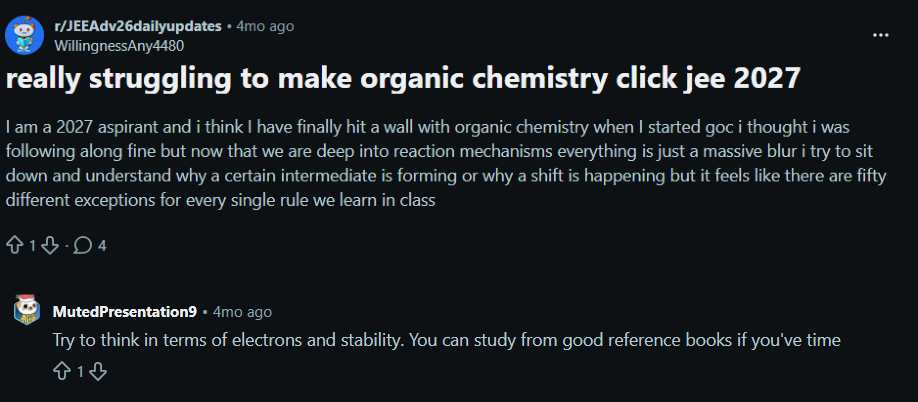
- The Reddit discussion centred on the high weightage chapters for JEE Mains 2027 Chemistry, with a major focus on Organic Chemistry. Candidates shared that reaction mechanisms, intermediates, rearrangements, and numerous exceptions make Organic Chemistry one of the most challenging sections during preparation.
- Another Reddit user advised candidates to focus on electron movement and the stability of intermediates rather than memorising reactions, while also recommending the use of good reference books to strengthen conceptual understanding if sufficient preparation time is available.
Source: Reddit



Comments