




The expected high weightage chapters for JEE Main 2027 Physics are Modern Physics, Electrostatics, Current Electricity, Magnetism and Moving Charges, Electromagnetic Induction and Ray Optics.
- You should start with class 12 topics: Modern Physics, Electrostatics, and Current Electricity, which account for nearly 70 per cent of the JEE Main 2027 Physics.
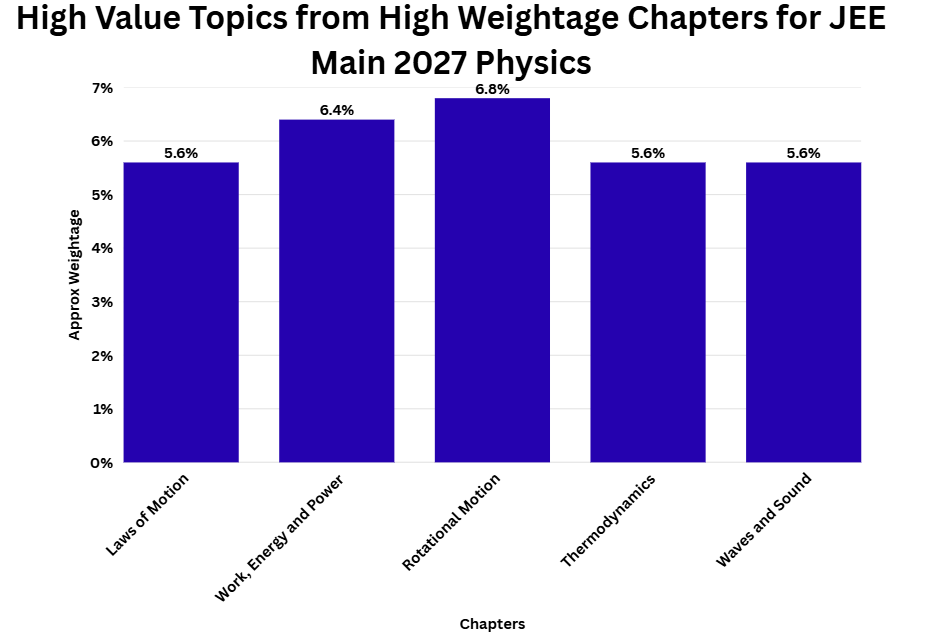
- Thermodynamics, Rotational Motion, Work, Power and Energy, Laws of Motion, Waves and Sound carry 30% of the weightage and are high-value topics for JEE Main 2027 Physics.
Follow books such as NCERT, HC Verma and DC Pandey to complete these high-weightage Physics topics for JEE Main 2027.
Related Articles:
- JEE Main Chapter Wise Weightage: Check Chemistry, Physics, and Maths Weightage Last 10 Years
- JEE Main Physics Preparation 2026: Check Monthly Preparation Plan, Way to Score 100+, Weightage & Books
- JEE Main 2027 Physics Mock Test- Attempt Free Physics test, Question Paper (2024-2011), JEE Main PYQ
Key Summary
- Modern Physics consistently contributes 10-12% of questions, and from class 11, Laws of Motion, Work, Power & Energy collectively give 7–8% of the paper.
- Start with the must-do topics, followed by high-value chapters and supporting topics to cover the high-weightage Physics syllabus 2027.
- Studying NCERT first, followed by HC Verma and DC Pandey, ensures coverage of both basics and advanced applications.
Class-Wise Breakdown of High Weightage Chapters for JEE Main 2027 Physics
The high weightage chapters for JEE Main 2027 Physics for Classes 11 and 12 are discussed below, which will help you score well in the Physics section.
Class 11 High Weightage Chapters for JEE Main 2027 Physics
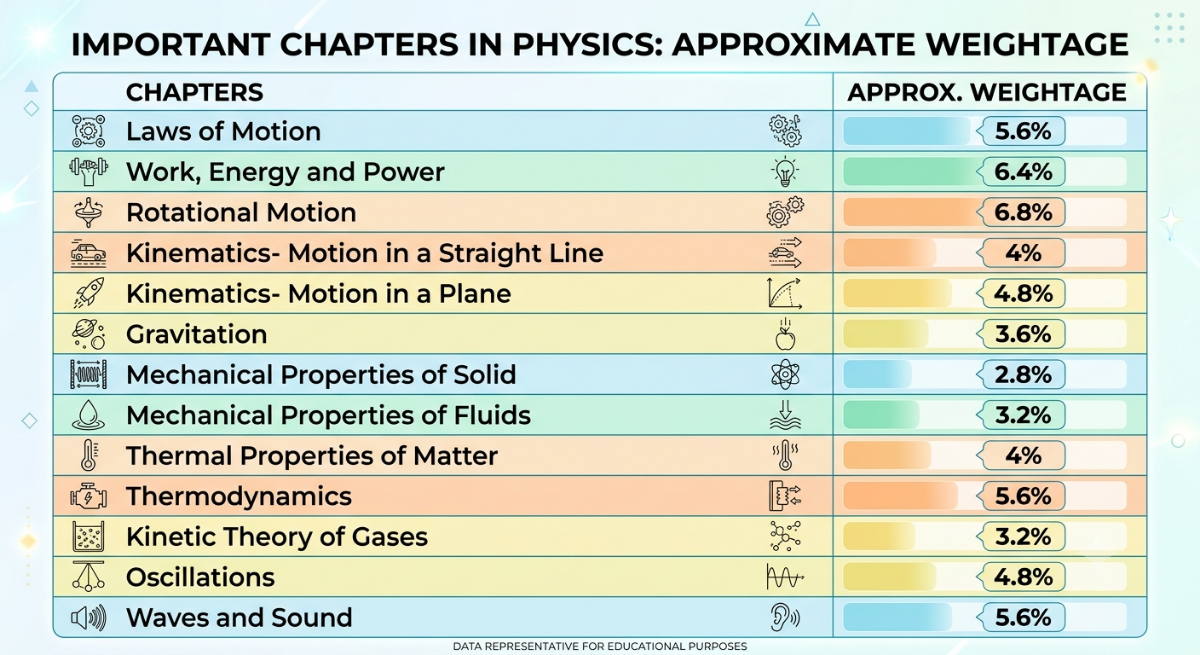
The table below shows the high weightage chapters for JEE Main 2027 Physics from class 11:
| Chapters | Approx Weightage |
|---|---|
| Laws of Motion | 5.6% |
| Work, Energy and Power | 6.4% |
| Rotational Motion | 6.8% |
| Kinematics- Motion in a Straight Line | 4% |
| Kinematics- Motion in a Plane | 4.8% |
| Gravitation | 3.6% |
| Mechanical Properties of Solid | 2.8% |
| Mechanical Properties of Fluids | 3.2% |
| Thermal Properties of Matter | 4% |
| Thermodynamics | 5.6% |
| Kinetic Theory of Gases | 3.2% |
| Oscillations | 4.8% |
| Waves and Sound | 5.6% |
Class 12 High Weightage Chapters for JEE Main 2027 Physics
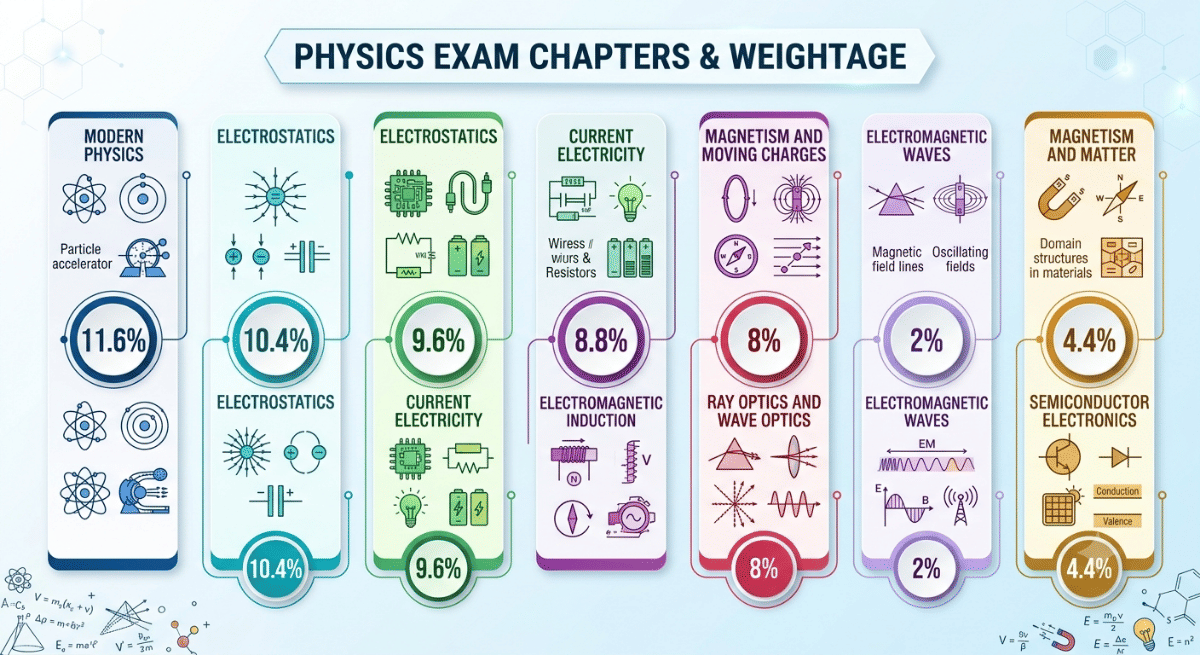
The table below shows the high weightage chapters for JEE Main 2027 Physics from class 12:
| Chapters | Approx Weightage |
|---|---|
| Modern Physics | 11.6% |
| Electrostatics | 10.4% |
| Current Electricity | 9.6% |
| Magnetism and Moving Charges | 8.8% |
| Magnetism and Matter | 2.4% |
| Electromagnetic Induction | 8.4% |
| Ray Optics and Wave Optics | 8% |
| Electromagnetic Waves | 2% |
| Semiconductor Electronics | 4.4% |
Source: The above table is prepared from a YouTube video by “Rohit Shaw IITD”. You can watch the video to understand the JEE Main 2027 Syllabus.
Related Articles:
- JEE Main Physics Syllabus- Download PDF, Class 11 and 12 Topics-Wise Weightage
- JEE Main Maths Syllabus: Download Syllabus PDF, Check Reduced Syllabus, Important Topics, Year-Wise
- JEE Main Chemistry Syllabus: Download PDF, Topic-wise weightage, Difficulty level & Important Topics
Ques. How should I prepare for Physics for JEE Main 2027?
Ans. Students should prepare for Physics by starting with NCERT for concepts, H.C. Verma and DC Pandey, along with practising mock tests and previous years' question papers to strengthen their weaknesses.
Priority Order Wise Breakdown of High Weightage Chapters for JEE Main 2027 Physics
Candidates need to prepare for JEE Main 2027 Physics by following the priority list below to fetch maximum marks, focusing on the most frequently asked questions from high-weightage topics.
Must Do Topics from High Weightage Chapters for JEE Main 2027 Physics
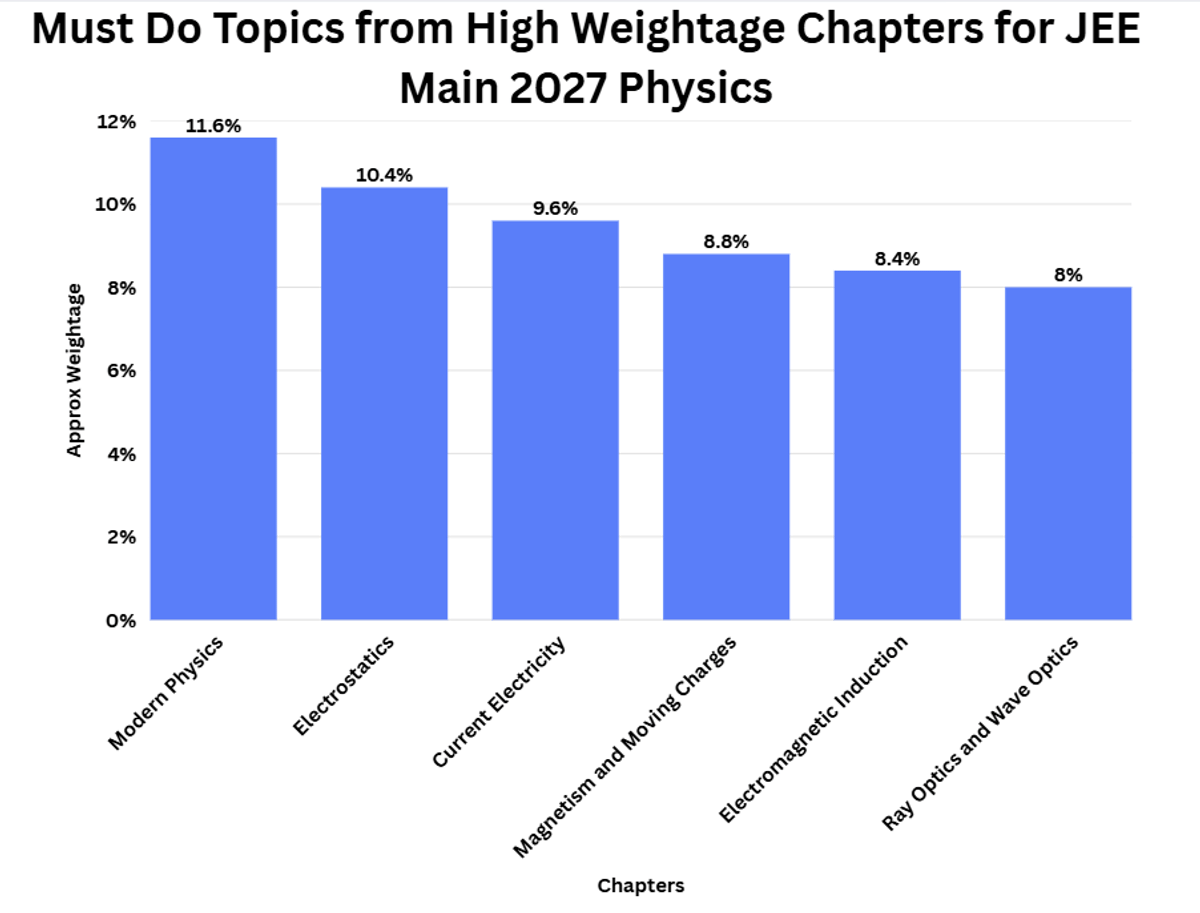
You should cover these topics first according to the JEE Main 2027 Physics Syllabus, as they cover 54% of the paper and are the highest weightage chapters for JEE Main 2027 Physics:
| Chapters | Approx Weightage |
|---|---|
| Modern Physics | 11.6% |
| Electrostatics | 10.4% |
| Current Electricity | 9.6% |
| Magnetism and Moving Charges | 8.8% |
| Electromagnetic Induction | 8.4% |
| Ray Optics and Wave Optics | 8% |
High Value Topics from High Weightage Chapters for JEE Main 2027 Physics
You should study these topics as they cover 30% of the paper and are equally high-weightage chapters for JEE Main 2027 Physics:
| Chapters | Approx Weightage |
|---|---|
| Laws of Motion | 5.6% |
| Work, Energy and Power | 6.4% |
| Rotational Motion | 6.8% |
| Thermodynamics | 5.6% |
| Waves and Sound | 5.6% |
Supporting Topics from High Weightage Chapters for JEE Main 2027 Physics
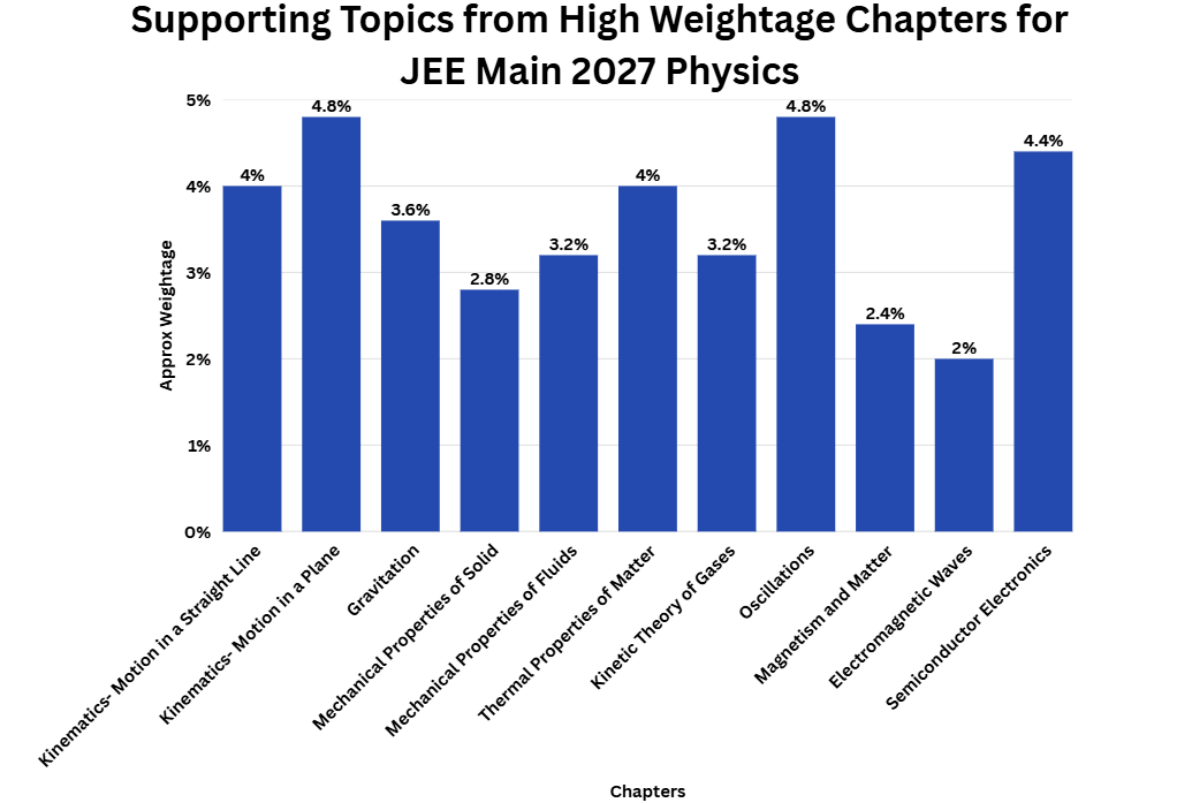
The following topic covers 16% of the paper for JEE Main 2027 Physics and is easy to cover:
| Chapters | Approx Weightage |
|---|---|
| Kinematics- Motion in a Straight Line | 4% |
| Kinematics- Motion in a Plane | 4.8% |
| Gravitation | 3.6% |
| Mechanical Properties of Solid | 2.8% |
| Mechanical Properties of Fluids | 3.2% |
| Thermal Properties of Matter | 4% |
| Kinetic Theory of Gases | 3.2% |
| Oscillations | 4.8% |
| Magnetism and Matter | 2.4% |
| Electromagnetic Waves | 2% |
| Semiconductor Electronics | 4.4% |
Source: The above table is prepared from a YouTube video by “Rohit Shaw IITD”. You can watch the video to understand the JEE Main 2027 Syllabus.
Related Articles:
- JEE Main Physics Exam Pattern: Check Marking Scheme, Total Marks, Latest Changes
- JEE Main Mathematics Pattern, Marking Scheme and Weightage of Topics
- JEE Main 2026 Chemistry Pattern, Important Topics, Weightage, Marking Scheme
Ques. Which chapters in Physics have the highest weightage in JEE?
Ans. Electrostatics, Modern Physics, and Optics are considered high-weightage areas. Optics contributes to 8-10 questions, 3- 4 questions come from Modern Physics and Semiconductor devices. Mechanics has the largest share of 30- 35%. Topics such as Laws of Motion, Work-Energy, and Rotation contribute to this share.
Best Resources for High Weightage Chapters for JEE Main 2027 Physics
The following study materials are considered to be beneficial for completing the JEE Main 2027 Physics syllabus:
| Books | Author |
|---|---|
| NCERT Physics (Class 11 & 12) | NCERT |
| Concepts of Physics (Vol 1 & 2) | H.C. Verma |
| Understanding Physics (5-book series) | D.C. Pandey (Arihant) |
| New Pattern Physics | D.C. Pandey (Arihant) |
| Problems in General Physics | I.E. Irodov |
Related Articles:
- Best Books for JEE Main Physics, Chemistry and Mathematics, NCERT PDF Download
- JEE Main Preparation Guide: Study Plan, Strategy, Tips & Resources
Ques. Which chapters should I complete first for JEE Main 2027 Physics?
Ans. Candidates should start with the must-do topics, which include Modern Physics, Electrostatics, Current Electricity, Magnetism and Moving Charges, Electromagnetic Induction and Ray Optics.
Preparation Strategy for High Weightage Chapters for JEE Main 2027 Physics
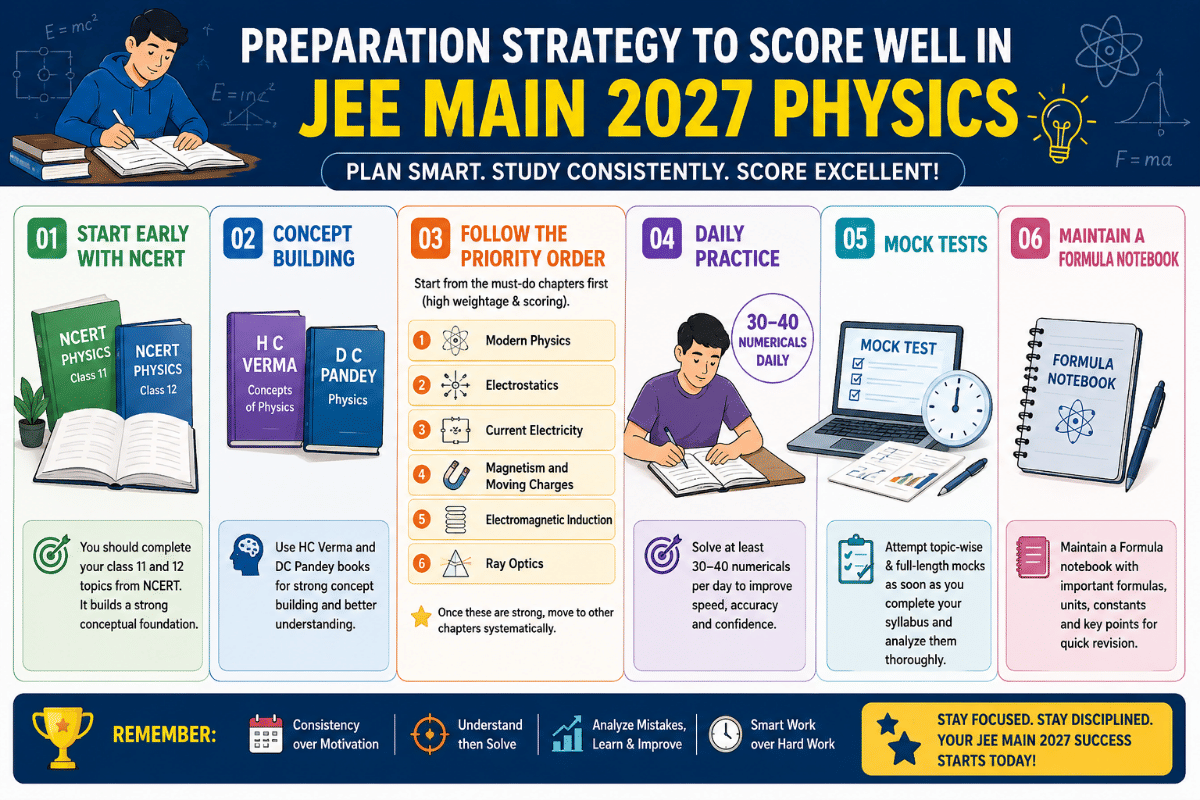
Candidates should follow the preparation strategy to score well in their JEE Main 2027 Physics:
- Start Early with NCERT: You should complete your class 11 and 12 topics from NCERT.
- Concept Building- Use HC Verma and DC Pandey books for concept building
- Follow the priority order- You should start from the must-do chapters first (Modern Physics, Electrostatics, Current Electricity, Magnetism and Moving Charges, Electromagnetic Induction and Ray Optics) as mentioned in the table above.
- Daily Practice- Solve at least 30–40 numericals per day
- Mock Tests- Attempt topic-wise & full-length mocks as soon as you complete your syllabus and analyze them
- Maintain a Formula notebook for a quick revision.
Related Articles:
- JEE Main Physics Preparation: Check Monthly Preparation Plan, Way to Score 100+, Weightage & Books
- JEE Main Maths Preparation: Check 60 Days Study Plan, Important Books, Mock Tests and PYQs
- JEE Main Chemistry preparation: Check Preparation Plan, Syllabus, Weightage, Mock tests & Books
Ques. Which is the best strategy to secure 99 percentile in JEE Main Math 2027?
Ans. The best strategy to score 99 percentile in JEE Main Math 2027 is to cover the NCERT syllabus, followed by DC Pandey, practising mock test papers for at least 2-3 hours a day, revising formulas and PYQs. Also, analyse the mocks to score well.
High Weightage Chapters for JEE Main 2027 Physics: Reddit Discussion
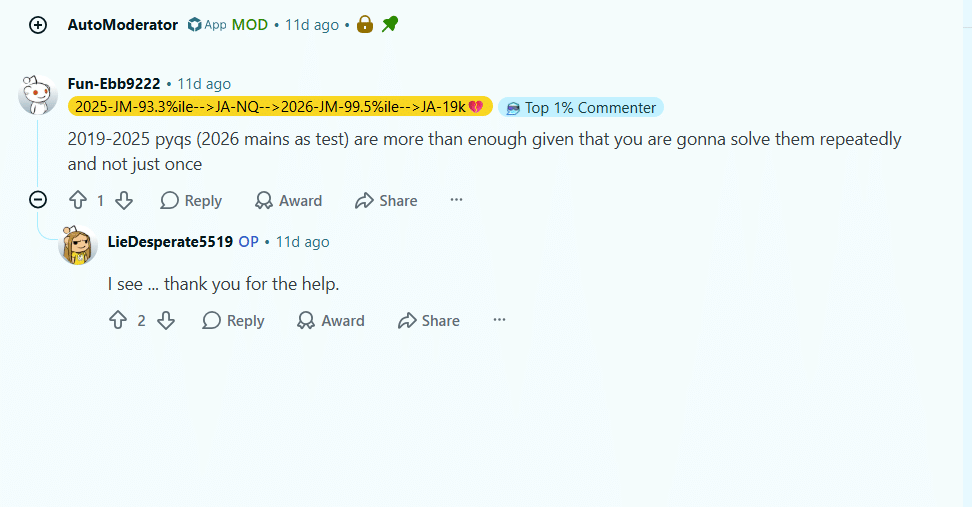
According to a Reddit post, a user asked about previous years’ questions around 4- 5 years, enough for JEE Main Physics.
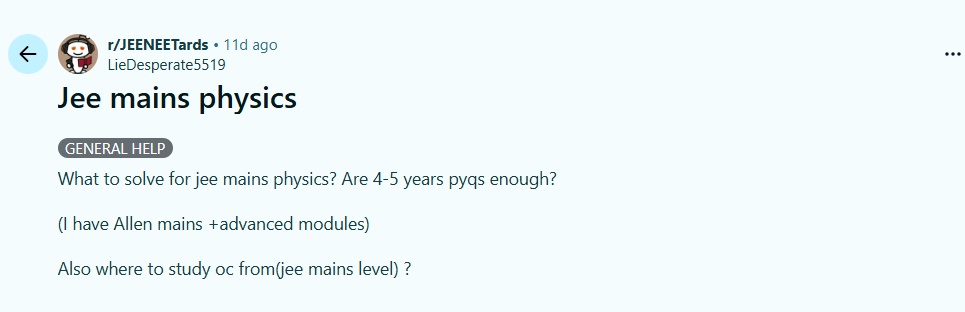
In the response, it was suggested that solving the previous years’ question papers from 2019 to 2025 is more than enough. But he/she should solve them repeatedly and not more than once.
Source: Reddit
Related Articles:
- JEE Main Mock Test- Attempt Free Chapterwise test, Question Paper (2026-2011), JEE Main PYQ
- JEE Main Chemistry Mock Test- Attempt Free Chemistry test, Question Paper (2024-2011), JEE Main PYQ
- JEE Main 2027 Exam Date: Session 1 and Session 2 Schedule, Registration and Admit Card Dates
Ques. Is NCERT enough for JEE Main 2027?
Ans. No, only NCERT is not enough for JEE Main 2027. You also need to solve previous years' questions and practice mock tests to score well.
Ques. Does Class 12 Physics have the highest weightage in JEE Main?
Ans. Yes, class 12 Physics has the highest weightage in JEE Main, which accounts for nearly 70% of the syllabus. Mechanics dominates nearly 7- 8 and Modern Physics topics, such as semiconductors, Atoms, and the photoelectric effect, are repeated every year.



Comments