



Content Curator
RNA interference is a process in which RNA molecules neutralise the targeted mRNA molecules and thereby hinder the organic phenomenon. A molecule similar to DNA is ribonucleic acid (RNA). RNA is one-stranded, unlike DNA. The backbone of an RNA strand is made up of sugar (ribose) and phosphate groups in alternating sequences.
| Table of Content |
Keyterms: RNA, Molecules, DNA, sugar, ribose, phosphate, gene coding, Gene, polymeric, mRNA, sugar, adenine, cytosine, guanine, uracil
Read More: Down’s Syndrome
What is RNA?
[Click Here for Sample Questions]
Ribonucleic acid (RNA) is a polymeric molecule that plays a variety of roles in biology, including gene coding, decoding, control, and expression.
Although RNA is transcribed with only four bases (adenine, cytosine, guanine, and uracil), these bases and the sugars connected to them can be altered in a variety of ways as the RNA matures.
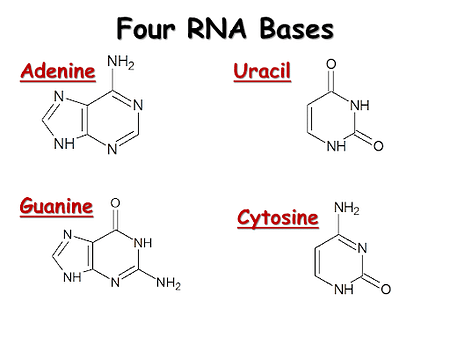
- Pseudouridine is a base where the C–N bond between uracil and ribose is replaced with a C–C bond.
- Ribothymidine (T) can be found in a variety of locations (the most noteworthy being the T–C loop of tRNA).
- Hypoxanthine, a deaminated adenine base with the nucleotide inosine, is another important modified base (I). The amino acid inosine is important in the wobble hypothesis of the genetic code.
What is RNA Interference?
[Click Here for Previous Year Questions]
RNA interference is a process in which RNA molecules neutralise the targeted mRNA molecules and thereby hinder the organic phenomenon.
RNA interference is an evolutionary conserved mechanism that is triggered by double-stranded RNA which turns off a gene by using the gene's own DNA sequence. Gene silence is the term for this process.

It is a gene-control system that regulates transcript levels in two ways:
- Suppressing transcription (Transcriptional gene silencing)
- Degrading the RNA produced (post-transcriptional gene silencing)
Andrew Z. Fire and Craig C. Mello, two American scientists, found the mechanism in C.elegans cells. They blocked the expression of specific genes by introducing short lengths of double-stranded RNA into C.elegans cells.
Mechanism of RNA Interference
[Click Here for Sample Questions]
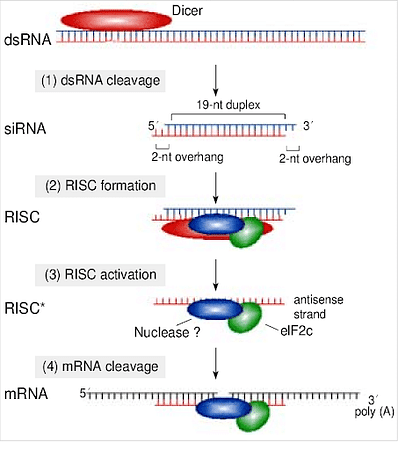
The biological mechanism through which small interfering RNA (siRNA) promotes gene silence by targeting complementary mRNA for degradation is known as RNA interference (RNAi). This method is changing the way scientists examine gene function. The following are the steps:
Step 1. Obtain Effective siRNAs
Gene silencing that is both powerful and specific is critical. Furthermore, appropriate experimental design necessitates the use of at least two efficient siRNAs in the experiment to ensure that the observed effects are the consequence of flattening the gene of interest.
Step 2. Maximize Gene Knockdown and Minimize Toxicity using siRNA Delivery
For successful RNAi research, efficient and repeatable siRNA delivery is essential. The first effective siRNA delivery strategy achieves good gene knockdown while keeping cell viability at a reasonable level. To determine potential non-specific impacts on natural phenomena generated by the introduction of any siRNA, negative control siRNAs are required.

Step 3. Test siRNA Silencing Efficiency
Because siRNAs work at the mRNA level, the most sensitive technique for siRNA validation is real-time RT-PCR, which compares target transcript levels in cells transfected with gene-specific siRNAs to cells transfected with negative control siRNAs.
Step 4. Investigate the Biological Consequences of Target Gene Silencing
Morphological, enzymatic, biochemical, and immunological assays are used to assess the effects of gene silencing. Although siRNAs have an effect on target mRNA levels, phenotypic alterations are mainly caused by a decrease in protein levels. Western blotting is used to correlate the reported phenotype with the amount of knockdown generated by siRNA-mediated silencing at the protein level.

RNA Interference Processing
RNA (RNA) polymerase transcribes an RNA copy of a gene, the primary transcript, in the appropriate cell type and developmental stage. The primary transcript, on the other hand, may contain more nucleotides than are required to make the desired protein.
RNA-degrading enzymes are prone to breaking down the original transcript. The initial transcript must be converted into a mature transcript, known as messenger RNA, before it can be used to guide protein production (mRNA). In eukaryotic cells, it could be real.
The 5′ (5-prime) end of an RNA molecule is known as the leading end, and the trailing end is known as the 3′ end. The first transcript's words are particularly vulnerable to exonucleases, a type of degradative enzyme. The CAP employs a unique nucleotide linkage.
Exonucleases are unable to remove the CAP because they do not recognise its unique structure. Since exonucleases only act from one end and the CAP nucleotide cannot be eliminated, the mRNA's entire 5′ end is preserved. The 5′ CAP also helps transport the mRNA out of the nucleus and bind it to the ribosome.
A poly-A tail x created by a poly-A polymerase protects the 3′ end against degradative exonucleases. Poly-A is a chain of adenine nucleotides that can be 100 to 200 units long. The poly-A tail possesses characteristic bonds that are vulnerable to exonuclease destruction.
Even so, because it has no protein-coding function, it doesn't matter if some of the A residues are destroyed. The poly-A tail takes a long time to completely disappear, so the protein-coding section of the mRNA is still intact.

The exonucleases would quickly breakdown the protein-coding section of the mRNA if it didn't have the poly-A tail. Histones, proteins that wrap desoxyribonucleic acid (DNA) into chromosomes, are an exception to the poly-A approach seen in mRNA.
Histone mRNA, rather than poly-A, has a much smaller structure that is controlled by variables present during DNA synthesis.
Also Read:
Application of RNA Interference
[Click Here for Previous Year Questions]
The following are some of the applications of RNA interference:
Gene Knockdown
In cell culture and model organisms, RNA interference is frequently utilised to investigate gene functions. This technique is used to lower the targeted gene's expression.

Functional Genomics
In plants, this approach is utilised for gene mapping and annotation. For the investigations in bread wheat, RNA interference was used.
Applications in Medicine
It became possible to silence individual gene sequences rather than the complete gene after the invention of synthetically manufactured short interfering RNA. RNAi has since been used to target specific gene sequences linked to cancer. It can also be used to treat bacterial infections, viruses, parasites, pain, and sleep disorders.

Things to Remember
- RNA interference is a mechanism in which RNA molecules neutralise the targeted mRNA molecules and thereby hinder the organic phenomenon.
- RNA interference is an evolutionary conserved mechanism that is triggered by double-stranded RNA which turns off a gene by using the gene's own DNA sequence. Gene silence is the term for this process.
- Because synthetic dsRNA put into cells may selectively and robustly induce suppression of certain genes of interest, RNAi is a significant research tool in both cell culture and living organisms.
- RNAi can be employed in large-scale screens to methodically shut down each gene in a cell, which can aid in identifying the components required for a specific cellular function or event like cell division. The route is also employed in biotechnology, medicine, and insecticides as a useful tool.
- RNA interference relies on two types of tiny ribonucleic acid (RNA) molecules: microRNA (miRNA) and small interfering RNA (siRNA). RNAs are the direct products of genes, and these short RNAs can guide enzyme complexes to destroy messenger RNA (mRNA) molecules, reducing their activity by blocking translation.
Sample Questions
Ques. Explain the RNA Interference Mechanism in detail. (2 marks)
Ans. The following steps are used to explain the mechanism of RNA interference:
- With the help of an enzyme called dicer, long double-stranded RNA gets diced into minute bits. Little interfering RNA, or siRNA, is the name for these small bits.
- The siRNA is an RNA-induced silencing complex that works well. Because the duplex unwinds, the RNA is triggered. These chemicals accelerate RNA breakdown while also inhibiting translation.
- When iRNA attaches to Argonaute protein, one of the double-stranded strands is eliminated. The Argonaute protein manages the target sequence by either cleaving the mRNA or recruiting additional components.
Ques. Is there any Natural Biological Function of RNA? (2 marks)
Ans. All animal and plant cells have an internal mechanism for using siRNA to suppress the expression of specific genes. The establishment of this system in cells that protects the genome against viral infections and endogenous transposable elements was aided by evolution. It may possibly play a role in limiting the expression of particular genes during development and growth in animal and plant cells.
Ques. What are microRNAs and lncRNAs? (2 marks)
Ans. MicroRNAs are nucleic acids that do not code for any proteins in living organisms. Their function is to silence genes and stop the translation process. RNA polymerase II and RNA polymerase III are responsible for the transcription of respective gene sequences. They start off as Pre-miRNAs, which are precursors to miRNAs. A microprocessor complex breaks down this precursor molecule. Any alteration in the function of these RNAs has the potential to cause cancer.
Long chains of ribonucleotides (lncRNAs) are ribonucleotides that are not employed in the translation process to make proteins. The number of nucleotides in such nucleic acids is usually greater than 200. They are primarily responsible for regulating the transcription process, which converts DNA into RNA. These molecules can alter a variety of transcription-related components, such as transcription activators and repressors.
Ques. What is the Medical Application of RNAi? (2 marks)
Ans. The majority of studies currently employ RNAi as a method for reverse genetics (gene function identification), however it has a wide range of applications: I disease control (viruses, bacterial illnesses, parasites, genetics, cancers), ii) commercial animal production, and iii) development of animal models for study. Controlling drug use, pain alleviation, and sleep modification are just a few of the potential future applications.
Ques. What is Polymerase Chain Reaction? (2 marks)
Ans. Polymerase Chain Reaction (PCR) helps in early detection of diseases or pathogens by the amplification of their nucleic acid.
Low concentration of pathogens (bacteria, viruses, etc) in the blood does not allow its detection.
PCR can amplify nucleic acids of such pathogens even when their concentration is very low.
PCR technique can be used for detecting HIV in suspected AIDS patients, genetic mutation in suspected cancer patients and in identifying genetic disorders.
Ques. What is Recombinant DNA technology? (2 marks)
Ans. Recombinant DNA technology is a modern molecular diagnostic technique. It is done in the following steps:
A single stranded DNA or RNA tagged with a radioactive molecule called probe, is allowed to hybridise to its complementary DNA in a clone of cells.
The cells are then detected by autoradiography.
The clone having mutated gene will not appear on the photographic film, because the probe will not have complementarity with the mutated gene.
Ques. How does ds RNA gain entry into eukaryotic cells to cause RNA interference? (CBSE 2011) (2 marks)
Ans. dsRNA gain entry into eukaryotic cell either through:
(i) infection by virus having RNA genome or
(ii) mobile genetic elements (transposons) that replicate via an RNA intermediate.
Ques. What is the host called that produces a foreign gene product? What is this product called? (CBSE 2010) (2 marks)
Ans. Transgenic organisms or genetically modified organisms are hosts that produce a foreign gene product.
Recombinant proteins are the product.
Ques. What is the significance of the process of RNA interference (RNAi) in eukaryotic organisms? (CBSE 2008) (2 marks)
Ans. RNA interference (RNAi) acts as cellular defence in all eukaryotic organisms
Ques. How does silencing of specific mRNA in RNA interference prevent parasitic infection? (CBSE 2008) (2 marks)
Ans. Parasitic infection can be prevented by using RNA interference (RNAi) process, as the nematode cannot live in the transgenic host that expresses the specific interfering RNA thus, making it double stranded and unable to translate the protein or product.
Ques. What is gene therapy? Name the first clinical case in which it was used. (CBSE 2014) (2 marks)
Ans. Gene therapy is a corrective therapy or technique of genetic engineering to replace a faulty or non-functional gene with a normal healthy functional gene,
The first clinical gene therapy was given to a 4 years old girl with ADA (Adenosine Deaminase) deficiency in 1900, due to the deletion of the gene coding for ADA.
Ques. (i) State the role of DNA ligase in biotechnology.
(ii) What happens when Meloidogyne incognita consumes cells with RNAi gene? (CBSE 2012) (2 marks)
Ans. (i) DNA ligase enzyme is used to join two DNA fragments from their ends.
(ii) When Meloidogyne incognita (parasite) consumes cells with RNAi gene, the parasite cannot survive and this prevents infection. The introduced DNA forms both sense and anti-sense RNA. These two strands are complementary to each other form of sRNA, leading to RNAi. Thus, the mRNA of nematodes is silenced and the parasite cannot survive there. This produces Meloidogyne incognita resistant tobacco plants.
Ques. Explain the process of RNA interference. (CBSE 2011) (2 marks)
Ans. Process of RNA interference (RNAi) is related to silencing of a specific mRNA. It is a method of cellular defence in all eukaryotes.
(i) A complementary RNA binds to the mRNA making it double stranded and prevent its translation.
(ii) This complementary RNA could be from an infection by viruses having RNA genomes or mobile genetic elements (transposons) that replicate via an RNA intermediate.
(iii) Using Agrobacterium vectors, nematode specific genes were introduced into the host plants.
(iv) It produces both sense and antisense RNA in the host cells.
(v) These two RNAs being complementary to each other form a double stranded RNA (dsRNA) that initiates RNAi, silencing the specific mRNA of the nematode.
(vii) Due to this, parasites could not survive in a transgenic host expressing interfering RNA. So, transgenic plants are protected.
Ques. How did the process of RNA interference help to control the nematode from infecting the roots of tobacco plants? (CBSE 2011) (2 marks)
Ans. When the nematode infects the roots of tobacco plants and feeds upon cells containing RNAi gene. This DNA produces both sense and antisense RNA in the host cells (tobacco plant) and is complementary to the functional mRNA of the nematode. This complementarity between both RNA makes it double stranded and, hence silenced by not being translated into protein. Interference with RNA expression and protein synthesis makes it difficult for the pathogen to survive in tobacco plants and hence be killed. In this way RNA interference protects and controls the nematode infection.
Ques. How does recombinant DNA technology help in detecting the presence of mutant genes in cancer patients? (CBSE 2011) (2 marks)
Ans. A single stranded DNA or RNA, tagged with a radioactive molecule (probe) is allowed to hybridise with its complementary DNA in a clone of cells followed by detection using autoradiography.
The clone having the mutated gene will not appear on photographic film, because the probe will not be complementary with the mutated gene thus, helpful in detecting the presence of mutated gene in cancer patients.
For Latest Updates on Upcoming Board Exams, Click Here:https://t.me/class_10_12_board_updates
Do Check Out:



Comments