



Education Journalist | Study Abroad Strategy Lead
Bioprocessing is a technology that utilizes living cells or their cellular components, viruses or an entire organism to obtain the products we desire. The entire process can be divided into two main parts- upstream processing and downstream processing. The Upstream processing involves the preparatory phases such as early cell isolation and cultivation, to cell banking and expansion of the cell culture until the final harvest i.e. termination of the culture and collection of the same takes place while the downstream processing incorporates the procedure where the cell mass from the upstream is processed to meet the quality and the purity requirements.
| Table of Content |
Also Read: Strategies for Enhancement in Food Production
Key Takeaways: Bioprocessing, Upstream processing, downstream processing, PFD, P&I diagrams, symbology.
Bioprocessing
[Click Here for Sample Questions]
Bioprocess can be defined as a particular process that utilizes living cells or their cellular components to obtain desired products. As the transfer of mass and energy is quite critical for all the biological and environmental processes the areas from pharmaceuticals to biomedical devices to pollution control and global warming require the knowledge of mass and energy transfer.

Application of Bioprocessing in various fields
Thus Bioprocessing, also known as biotechnology is being widely utilized in the creation of nourishments, flavours, synthetic biocatalysts, hereditary designing for the control of animals, plants or microorganisms.
The whole process is usually divided into three sections:
- Cell disruption
- Purification
- Polishing
Also Read:
| Related Articles | ||
|---|---|---|
| Plant Breeding | Inbreeding Depression | Species |
| Mendelian Inheritance | Monohybrid and Dihybrid | Chromosomes and Genes |
Cell Bioprocessing
[Click Here for Sample Questions]
Cell Therapy and bioprocessing (pharmaceutical manufacturing) are two of the fascinating areas of study that can be bridged by a discipline called Cell Therapy Bioprocessing which is a sub-field of Bioprocess engineering. The goals of cell therapy bioprocessing are to build up robust and reproducible manufacturing techniques for the production of therapeutic cells.

Stem cell bioprocessing
A commercially relevant bioprocess will:
- Create products to maintain the quality standards of the biopharmaceutical drugs.
- Supply therapeutic cells for both clinical and commercial purposes throughout various stages of development and scalable technologies.
- Control the cost of goods(CoGs) of the final materials which is a critical aspect to build the foundation for commercially viable industry.
Upstream Bioprocessing
[Click Here for Sample Questions]
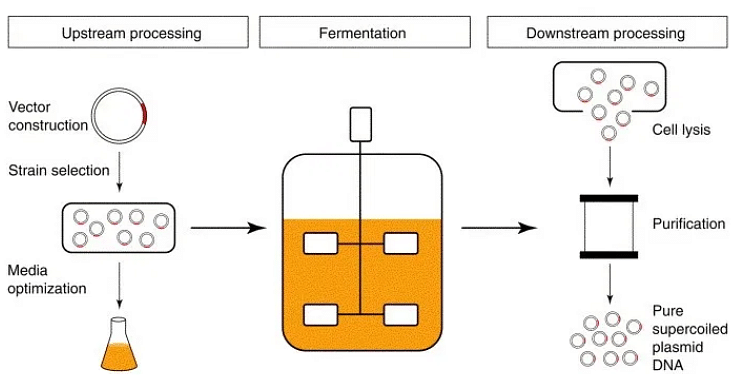
Bioprocessing hardware incorporates an extensive range of gear of explicit applications. In terms of procedure stream graph, it might be classified into three parts- upstream processing, downstream processing and support. The upstream process includes the procedures from early cell isolation and cultivation, to cell banking and expansion of the cell culture until the final harvest i.e. termination of the culture and collection of the same takes place.

Upstream Bioprocessing
The upstream processes are the first step in which the microbes or the cells are grown. For example, mammalian or bacterial cell lines, in bioreactors. Thus, it involves all the steps related to inoculum development, improvement of inoculum, media development, genetic engineering, optimization of growth kinetics for improvement of the product.
Downstream Bioprocessing
[Click Here for Sample Questions]
Downstream process, as important as the upstream process, refers to the part of the process where the cell mass from the upstream is processed to meet the quality and purity requirements. The whole process is usually divided into three sections: cell disruption, purification and polishing.
Downstream Processing
The volatile products are separated by distillation of the harvested culture without any pre-treatment. Distillation is done through continuous stills at reduced pressure. At such reduced pressure, the distillation of product directly from the fermenter is sometimes possible. The steps involved in the downstream processing are:
- Separation of biomass: It is generally carried out by centrifugation or ultra-centrifugation. If the product is biomass then it is recovered from further processing and the spent medium is discarded completely. In the case of extracellular, the biomass is discarded. Sometimes ultra-filtration can also be carried out as an alternative to centrifugation.
- Cell disruption: If the desired product is an intracellular component then the cell biomass is usually disrupted so that the product is released. Then centrifugation of filtration can be done to separate the solid and the liquid; the debris is discarded then.
- The spent medium is concentrated if the product is extracellular.
- Initial Purification: According to the physicochemical characteristics of the product molecule various recovery methods are applied for the recovery of the product.

Steps in Downstream Process
- De-watering: If a low amount of product is found in a very large quantity of spent medium, the volume is usually reduced by removing water to concentrate the product. It is usually done by vacuum drying or reverse osmosis.
- Polishing of metabolites: This is the final step to make the product of the highest purity (98-100%). The purified product is generally mixed with other inert ingredients named excipients. Then the product is packed and sent to the market for consumption.
Also Read: Artificial Pollination
P&I Diagrams and Process Flow Diagrams
[Click Here for Sample Questions]
In bioprocessing, the equipment and the process from the design phase through the life cycle of the process can be expressed with the help of several types of flow diagrams. This involves different levels of detailing from the stages of the conception to construction, engineering production etc.

Typical P&I diagram
Usually, simplified process flow diagrams are used in the early conceptual phase of a new process where generally they do not contain all details that the final version will have. PFD documents at this phase are only used for discussion until the design is finalized. Process and Instrumentation diagrams (P&I diagrams) are more detailed than that of PFD. Therefore, they are seen as primary documents in the documentation serving as support for the functioning and maintenance throughout the working span.
Read More: HIV & AIDS
Symbology
[Click Here for Sample Questions]
A standardized symbology is used in P&I diagrams and Process Flow Diagrams to indicate the components of instrumentations and others. The International Society of Automation (ISA) standard is the standard commonly used for such symbols.

Symbols used in P&I Diagrams
Components such as filters, pumps and all instrument loops which are typically assigned instrument loop numbers serve as unique identities for all elements of a system. Loop numbers are used in other parts of the engineering documentation. These are either made of stainless steel or plastic. Thus, all the components are linked to the right documentation to promote operation, qualification and maintenance of the equipment in future.
Things to Remember
- Bioprocess is a particular process that utilizes living cells or their cellular components to obtain the products we desire or require.
- Bioprocessing is being widely used in nourishments, flavours, synthetic biocatalysts, hereditary designing for the control of animals, plants or microorganisms.
- Cell Therapy Bioprocessing which is a sub-field of Bioprocess engineering bridges the fields like Cell Therapy and bioprocessing( pharmaceutical manufacturing).
- The upstream process incorporates the processes from early cell isolation and cultivation to cell banking and expansion of the cell culture until the final harvest i.e. termination of the culture and collection of the same takes place.
- The downstream process refers to the part of the process where the cell mass from the upstream is processed to meet the quality and purity requirements.
- The International Society of Automation (ISA) standard is the standard commonly used for symbols in PFD and P&I documents.
Also Read:
Sample Questions
Ques: What is bioprocessing? (2 marks)
Ans: Bioprocessing is a technology that utilizes living cells or their cellular components to obtain the products we desire or require.
Ques: What Is Upstream processing? (2 marks)
Ans: The upstream processing is the first step of the bioprocessing that includes the procedures from early cell isolation and cultivation, to cell banking and expansion of the cell culture until the final harvest i.e. termination of the culture and collection of the same takes place.
Ques: What is downstream processing? (2 marks)
Ans: In the simplest terms, downstream processing refers to the recovery and purification of the products at the end of the bioprocessing.
Ques: What is a PFD diagram? (2 marks)
Ans: A process flow diagram or PFD is a diagram commonly used in bioprocess engineering to indicate the general flow of plant processes and equipment.
Ques: What is Biotechnology? (2 marks)
Ans: Biotechnology is the broad area of Biology that uses living organisms and technology to develop, modify and produce useful products for human welfare.
Ques: What are the uses of Bioprocessing? (2 marks)
Ans: The use of bioprocessing technology is huge. It is widely utilized in the creation of nourishments, flavours, synthetic biocatalysts, hereditary designing for the control of animals, plants or microorganisms.
Ques: What is genetic engineering? (2 marks)
Ans: Genetic Engineering is a technique that is mainly employed to modify the genetic material of an organism and introduce it into the same or other organisms.
Ques: What is the second step of Downstream processing? (2 marks)
Ans: The second step of Downstream processing is product isolation.
Ques: What is a Bioreactor? (2 marks)
Ans: A bioreactor is a manufactured device or system that supports the biologically active process.
For Latest Updates on Upcoming Board Exams, Click Here: https://t.me/class_10_12_board_updates
Check-Out:



Comments