



Education Journalist | Study Abroad Strategy Lead
Gene therapy is a medical line involving the modification of the genes inside the body’s cells in order to treat genetic disorders, or impede diseases. Years of contributions to the medical bubble have led to gradually spiking low mortality rates, next to longer lifespans. Part of the innovative sphere has been led by Gene therapy, including but not limited to modifying defective cells in an effort to inhibit the growth of diseases.
| Table of Content |
Read More: Down’s Syndrome
Key Takeaways: Gene Therapy, DNA, Cancer cells, Germline, Somatic, Diseases, In Vivo, Ex Vivo, Gene, Genetic disorders, Cell
Gene Therapy
[Click Here for Sample Questions]
Gene therapy involves the partial or full replacement of defective genes in someone’s body with healthy ones in an effort to treat or hinder disease proliferation. The technique uses an artificial method to introduce DNA in the cells. DNA is usually found in genes – it is a double helix structure that is responsible to control and coordinate most of our body’s form, development and structural orientations.

Gene
Genes that usually do not perform fruitfully can potentially expose human bodies to contracting several diseases. In the technique, the cells with defective genes are scientifically injected with a healthy gene that facilitates its normal functioning and operation. For the most part, diseases like Cancer are minimised by the help of gene therapy. Cancer cells contain defective cells, which means, if the proteins possessed by these cells are not replaced as early as they are found, then it can be dreadfully lethal.
Also Read:
| Related Articles | ||
|---|---|---|
| Mutagens | Difference Between Gene and DNA | Enzymes |
Working of Gene Therapy
[Click Here for Sample Questions]
Gene therapy can work in multiple ways,
- The technique can work by the replacement of a mutated gene with a healthy one.
- It can also work by the introduction of a newly functioning gene to impede growth of diseases.
- Gene therapy can work by disabling a defective gene that is responsible for causing diseases.
Gene therapy initially requires the spotting of defective genes in the human body. After spotting the faulty genes, the damaged proteins that these genes usually contain undergoes replacement and are inserted with DNA to inhibit diseases. Gradually, the newly inserted DNA in the defective cells helps in restoring functionality, allowing the existing cells to revive back.
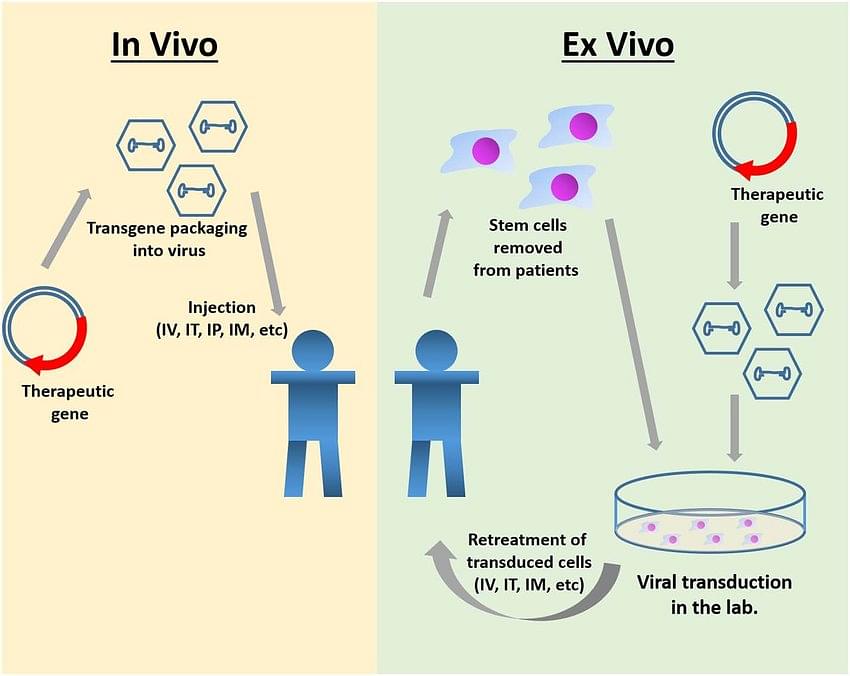
In Vivo and Ex Vivo
The DNA containing newly revived proteins enter the cells via vectors, and further help in the making of more useful proteins. Meanwhile, this technique helps the damaged cells to heal and eradicate any chain or source of disease.
Types of Gene Therapy
[Click Here for Sample Questions]
There are fundamentally two types of Gene Therapy that helps damaged cells to restore function, These are:
- Somatic Gene Therapy: Somatic Gene Therapy is generally introduced in the somatic cells of the human body. It allows the introduction of a genetic material (RNA) into the damaged cell type or tissue to facilitate replacement with healthy cells, much so for producing a therapeutic effect. It helps in altering the cell’s pattern of gene expression in one of the best and safest ways.

Somatic and Germline Gene Therapy
- Germline Gene Therapy: Germline Gene Therapy is a technique where the DNA is transmitted into the cells that are especially responsible in producing reproductive cells, much like eggs or sperms, in the human body. It typically takes place in the germline cell of the human body. This technique is usually undertaken as a way to treat genetic diseases, or disorders that are passed from parents to offspring. The risks of this therapy quite usually overrides many beneficial outcomes, so much so that the technique is found illegal in several countries.
Read More: Difference between Prokaryotic and Eukaryotic Transcription
Applications of Gene Therapy
[Click Here for Sample Questions]
With the emergence of clinical successes, the popularity of Gene Therapy is towering high. There are several applications of the newly devised technique, some include,
- Gene therapy has been proven to cure numerous genetic disorders passed from parents to children, one generation after another.
- It allows the treatment of several diseases, like Parkinson’s, Haemophilia, Cystic Fibrosis, Alzheimer’s, Brain Tumours, Cancer, AIDS, SCID and so much more. Gene therapy, quite evidently, upholds promise in the treatment of a wide spectrum of disorders and diseases.

Gene Therapy Applications in Dentistry
- It also supports treatment against diseases that apparently cannot be cured by traditionally applied medicines.
- Gene therapy is best known to impede any disease causing cells, without apparently affecting any healthy cell.
- It can be used on individuals, and on embryos too, making its goal efficient.
However, gene therapy may have a handful of temporal or permanent side effects as well.
Things to Remember
- Gene therapy is a medical line that helps in the modification of the genes inside the body’s cells in order to treat genetic disorders, or impede diseases, like cancer or AIDS.
- Gene therapy usually works to introduce DNA in defective cells, helping restore normal functioning of it.
- There are two fundamental types of Gene therapy: Somatic Gene Therapy and Germline Gene Therapy – out of which, the former is considered safer.
- DNA is a double helix structure that is responsible for controlling most of our body’s coordination, development and reproduction.
- This newly surfacing technique helps in treating diseases or disorders that are passed from parents to offspring, one generation after another.
- It can treat most diseases, from Cancer to Parkinson’s disease.
- Gene therapy may or may not incur temporal or permanent side effects.
Also Read:
Sample Questions
Ques: What is Gene Therapy? [2 Marks]
Ans: Gene therapy is an advanced medical line involving the modification of defective genes inside the cells in an effort to treat genetic disorders, or impede the growth of diseases in human bodies. The technique of Gene Therapy uses an artificial method to introduce DNA in the cells. Gene therapy allows medical professionals to treat a faulty gene by inserting a new and healthy gene into the human's cells to restore normal functionality, without using surgery or drugs.
Ques: Which was the first Gene therapy? Explain in brief. [2 Marks]
Ans: The first gene therapy was practised successfully to cure Adenosine deaminase (ADA) deficiency that is usually caused due to the unjust ADA gene deletion. In this technique, the Lymphocytes are clinically isolated from the blood and are separately grown in vitro culture. Later in the procedure, the defective ADA gene is separated out, whilst the further hybridization of the healthy ADA gene is introduced via Adenoviral vectors. Patients often require a repetitive infusion of genetically invented lymphocytes.
Ques: Define Somatic Gene Therapy. [3 Marks]
Ans: The strategy of Somatic Gene Therapy is extremely straightforward and simple. It involves replacement of abnormal gene expression with healthy, and normal expressions. Somatic Gene Therapy is introduced in the somatic cells of the human body. It helps the introduction of a genetic material (RNA) into the damaged cell type or tissue to facilitate replacement with healthy cells, which in turn produces a therapeutic effect. It was initially considered as a method that allowed introduction of a normally functioning gene copy into a person who contracted a genetic disease due to inheriting abnormal gene copies.
Ques: Define Germline Gene Therapy in brief. [3 Marks]
Ans: Germline Gene Therapy usually occurs in the germline cell of the human body. Germline Gene Therapy allows the correction of genetic variants residing in the reproductive cells of a person, that is either their egg or sperm. It is often passed down generation to generation. The goal of germline gene therapy is to introduce normal genes into the reproductive cells , or into the fertilised egg of the embryo. This allows the avoidance of any genetic disease that is likely to be passed down to the offspring; helping enhance genetic variation.
Ques: How Gene Therapy works? [3 Marks]
Ans: Gene therapy can work in multiple ways, Some are mentioned here:
- The technique can work by the replacement of a mutated gene with a healthy one.
- It can also work by the introduction of a newly functioning gene to impede growth of diseases.
- Gene therapy can work by disabling a defective gene that is responsible for causing diseases.
Ques: What are the several challenges that are faced during Gene Therapy? [5 Marks]
Ans: There are several challenges confronted during gene therapy, some include,
- - The genes are required to reach the most exact location after insertion.
- - Gene therapy might induce the human body to form unwanted immune system responses.
- - It can potentially target the wrong cells, even the healthy ones if not carefully adjusted.
- - Gene therapy may or may not be exposed to causing infection by the viruses.
- - It can adversely also give rise to forming tumours.
Ques: List at least 3 applications of Gene Therapy. [5 Marks]
Ans: Here are the three applications of Gene Therapy:
- Gene therapy has resulted in the curing of various genetic disorders passed from parents to offspring, one generation after another.
- Gene therapy has clinically progressed by treating disorders like Parkinson’s, Haemophilia, Cystic Fibrosis, Alzheimer’s, Brain Tumours, Cancer, AIDS, SCID and so much more. Gene therapy upholds promise in the treatment of a wide spectrum of disorders and diseases.
- Gene therapy has been proven to support treatment against diseases that apparently cannot be cured by traditionally applicable medicines. It is only used to treat diseases that cannot otherwise seek medical treatment.
Ques: Define the working principle of Gene Therapy. [5 Marks]
Ans: Gene therapy primarily needs the spotting of defective genes in the human body. After successfully spotting the defective genes, the damaged proteins that these genes usually contain undergoes replacement by means of DNA insertion to inhibit formation of diseases. Gradually, the newly inserted DNA in the defective cells helps in restoring functionality, allowing the existing cells to start behaving normally. Following that, the DNA containing newly functioning proteins enter the cells through vectors, and help in the making of more useful proteins to generate normal working. Meanwhile, this technique helps the damaged cells to heal and eradicate any chain or source of disease fundamentally inherited by parents (or ancestor gene expressions).
For Latest Updates on Upcoming Board Exams, Click Here: https://t.me/class_10_12_board_updates
Check-Out:




Comments