



Education Journalist | Study Abroad Strategy Lead
A cloning vector refers to a small DNA molecule in which a foreign DNA is inserted for replicating and cloning purposes. A cloning vector is a DNA molecule that is used to transport a foreign DNA molecule into a host cell. It has the ability to self-replicate and integrate into the host cell. The study of the molecular structure of DNA has been made easy by these vectors.
- The cloning vector has the capability of self-replication and can be integrated in the host cell.
- The target DNA is inserted at specific vector sites and joined by the DNA ligase.
- Cloning vector is an important part of Gene cloning.
- Cloning vectors are widely used in genetic engineering, biotechnology, and other areas of molecular biology research.
Also Read: Chromosomes and Genes
| Table of Content |
Key Terms: DNA, Replication, Cell, Vector, Plasmid, Transformation, Gene cloning, Gene, Enzyme, Biotechnology, Molecular biology, Genetic engineering, DNA ligase
What is a Cloning Vector?
[Click Here for Sample Questions]
A cloning vector is a small piece of DNA into which a piece of foreign DNA is inserted for cloning. A vector could be a DNA molecule that prevents foreign DNA from entering the host cell.
- It has the ability to self-replicate and integrate into the host cell.
- A cloning vector receives target DNA and then replicate it autonomously, increasing the number of copies.
- A plasmid from the bacterium is a common example of a vector.
- The target DNA is joint by DNA ligase and placed into the vector's exact locations.
- After that, the vector is inserted into the host cell for the process of transformation.
- Plasmids, bacteriophages, and artificial chromosomes are some common types of cloning vectors.
- Mulitple copies of a DNA fragment can be created for further analysis through a cloning vector.
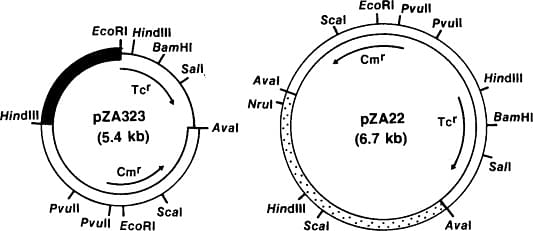
Cloning Vector
Read More:
| Related Topics | ||
|---|---|---|
| Model Organism | Translation Protein Synthesis | Double helix structure of DNA |
| DNA Polymerases | Gene Regulation | Difference Between Dna And Rna |
Features Of Cloning Vector
[Click Here for Previous Year Questions]
Cloning vectors have specific features that allow them to be used for the cloning of foreign DNA fragments. Some features of cloning vectors include:
- Cloning vectors must not be too large in size allowing for easy transfer of the vector between cells.
- It should be stable within the host cell, capable of maintaining the foreign DNA fragment during replication.
- It should be capable of working under the prokaryotic and eukaryotic systems.
- Restriction sites should be present to allow particular sequences to be broken up by restriction endonuclease.
- Cloning vectors should be compatible with the type of host cell to ensure efficient replication of the DNA fragment.
- The exact sequence of nucleotides in a DNA that acts as the origin of the replication process is the origin of replication (ORI). When foreign DNA is attached to this sequence, it begins reproducing independently within the host cell.
- A selectable marker gene such as antibiotic resistance genes, is required in the cloning vector because it enables the identification of host cells that carry the recombinant DNA.
- A cloning vector should have a specific region where the insertion of foreign DNA can occur. This region is called a multiple cloning site (MCS) or a polylinker.
With these features, cloning vectors can be efficiently used to clone foreign DNA fragments for research applications.
Also Read: Vector Borne Diseases
Types Of Cloning Vector
[Click Here for Sample Questions]
The differnet types of cloning vectors are as follows:
Plasmids
Plasmids were the first vectors that were used in gene cloning.
- Bacteria, eukaryotes, and archaea are the common sites of these vectors.
- These are self-replicating, extrachromosomal and natural DNA molecules.
- They have a large number of copies and genes that make them resistant to antibiotics.
- They produce proteins that are required for self-replication.
- Plasmid vectors include pBR322, pUC18, and F-plasmid.

Plasmids
Bacteriophage
Bacteriophage are more efficient than plasmids for the purpose of cloning of large DNA inserts.
- In gene cloning, bacteriophages such as Phage and M13 phage are commonly used.
- In the bacteriophage, 53 kb DNA can be packed.
- It is significantly easier to screen phage plaques than to screen recombinant bacterial colonies.
- Bacteriophage is a type of cloning vector, which is a virus that infects bacteria.
- Bacteriophages can infect a broad range of bacterial hosts and can be easily propagated in large quantities.
- Bacteriophage can be used to deliver DNA into bacterial cells, which can be used for genetic modification or genetic engineering.

Structure of Bacteriophage
Phagemids
Phagemids are artificial vectors.
- They are employed in combination with the M13 phage.
- They have several cloning sites as well as an inducible lac promoter.
- Blue-white screening is used to identify them.
- Phagemids combine the features of plasmids and bacteriophages (viruses that infect bacteria).

Phagemids
Bacterial Artificial Chromosomes
Bacterial Artificial Chromosomes (BACs) are a type of cloning vector that are similar to E.coli plasmids.
- It's made from naturally produced F' plasmid.
- These are utilised in the research of genetic abnormalities.
- Large DNA sequences can be accommodated without harm.
- BACs are derived from the F-factor plasmid of E. coli, which is a naturally occurring plasmid that can replicate independently of the host chromosome.
- BACs contain a selectable marker, multiple cloning sites, and an origin of replication that allows for the replication of the plasmid in bacterial cells

Bacterial Artificial Chromosomes
Other Cloning Vectors
- Artificial Yeast Chromosomes
- Retroviral Vectors
- Cosmids
- Artificial Human Chromosomes
Also Read: Biotechnology Principles and Processes Important Questions
Cloning Vector Gene Cloning
[Click Here for Previous Year Questions]
A cloning vector is a DNA molecule that is used to clone a foreign DNA fragment in a host organism.Gene Cloning is mostly utilised in DNA sequencing research.
- Gene cloning involves the isolation and amplification of a specific DNA fragment and the insertion of this fragment into a cloning vector.
- The resulting recombinant DNA molecule can then be introduced into a host cell, where it can replicate and express the cloned DNA.
- It is also used in gene therapy to treat disorders.
- In the agricultural industry, it is utilised to develop novel seed strains and enhanced fruit and vegetable varieties.
- In the pharmaceutical industry, bacteria with cloned plasmids are employed to produce vitamins and antibiotics.
Steps Involved in Gene Cloning
[Click Here for Sample Questions]
Gene cloning involves the isolation of genes from a donor cell, transferring them to a tiny carrier molecule called a vector and then replicating them in the host cell.
The steps involved are as follows:
-
Isolating the donor DNA fragment or gene
The DNA fragment is isolated using methods such as restriction enzymes or PCR. The DNA fragment can be extracted by two methods
- The restriction endonuclease enzyme, which has a specific restriction site for its action, is used in the first method. ‘
- The reverse transcriptase enzyme is used in the second method.
-
Selecting a specific vector
A gene that has been isolated is incapable of self-replication. As a result, a specific vector with features such as selectable marker, multiple cloning sites, and an origin of replication must be chosen before insertion into the host. This vector's primary purpose is to aid in the replication process.
-
Cutting of DNA fragment
The isolated DNA fragment is cut using the restriction enzyme to prepare the cloning vector. In the presence of DNA ligase, the vector and donor gene are combined, and a recombinant vector is generated in the mixture.
-
Ligation
The DNA fragment is ligated into the cloning vector at multiple cloning site. The ligation reaction creates a recombinant plasmid. The host organism is grown in the presence of an antibiotic that kills non-transformed cells, or contains a substrate that can only be utilized by transformed cells.
5. Transforming the recombinant vector to a host cell
The resulting recombinant vector is introduced into a host cell, bacteria or yeast, by transformation. Some other bacterias are not capable of natural transformation which further necessitates the use of an artificial technique.
-
Isolating the recombinant cell
Verification of the identity of the cloned DNA fragment can be confirmed through restriction enzyme digestion or sequencing. In this step, the host cell is allowed to develop in a culture medium. This could include both recombinant and non-recombinant cells. This mixture must be separated to determine which marker gene will be utilized. The cloned DNA fragment is transcribed and translated in the host organism to produce the desired protein.
Also Read:
Things To Remember
- A cloning vector is a small part of DNA extracted from any organism and used to insert a foreign DNA fragment for cloning.
- Plasmids and bacteriophages can reproduce in bacterial cells without relying on chromosomal DNA for regulation.
- If a foreign piece of DNA comes into contact with bacteriophage or plasmid DNA, its number gets doubled by the plasmid or bacteriophage's number.
- Cloning vectors are used to transfer foreign DNA from one cell to another and replicate it many times.
- The foreign DNA is replicated and expressed by the host cell's machinery.
- A single copy of DNA is multiplied into multiple copies.
Previous Year Questions
- Two microbes found to be very useful in genetic engineering are… (NEET 2006)
- A selectable marker is used to… (NEET 2019)
- Commonly used vectors for human genome sequencing are… (NEET 2014)
- Biolistics (gene-gun) is suitable for… (NEET 2012)
- During the process of isolation of DNA, chilled ethanol is added to… (NEET 2013)
- Some of the steps involved in the production of Humulin are given below… (Karnataka Common Entrance Test)
- First discovered restriction endonuclease that always cuts DNA… (National Eligibility Cum Entrance Test)
- Plasmid has been used as vector because… (NEET 2000)
- Introduction of food plants developed by genetic engineering is not desirable because… (NEET 2002)
- A gene whose expression helps to identify transformed cell is known as… (NEET 2017)
Sample Questions
Ques: Why is it essential to have a selectable marker in a cloning vector? (All India 2011, 1 Mark)
Ans: Selectable marker in a cloning vector is used to identify and select the recombinants and eliminate the non-recombinants.
Ques: Name the plasmids that have various copy numbers per cell. (1 Mark)
Ans: Relaxed plasmids have various copy numbers per cell.
Ques: Mention the uses of cloning vectors in biotechnology? (Delhi 2011, 2 Marks)
Ans: Uses of cloning vectors in biotechnology are as follows:
(i) It helps in the linking of foreign DNA with the host DNA.
(ii) Helps in the selection of recombinants and the elimination of non-recombinants.
Ques: Write the role of Ori and restriction site in a cloning vector pBR322. (Delhi 2014, 2 Marks)
Ans: Ori is a sequence/site of DNA. At Ori the replication of DNA starts. Every small piece of DNA which is needed to be replicated in the host cell has to be linked to it.
Cloning sites is the site/sequence of DNA where the foreign DNA is linked.
Ques: What are Cloning sites? (2 Marks)
Ans: The restriction enzymes' recognition sites are called cloning sites.
A restriction site located in one of the two antibiotic resistance genes is used to ligate foreign DNA.
For example, in the vector pBR322, ligation of a foreign DNA at the BamHI site of the tetracycline resistance gene.
Ques: What is a human artificial chromosome? (2 Marks)
Ans: Human artificial chromosome is an artificial chromosome that can carry a huge segment of DNA and is used to transfer human genes. It has no cloning restrictions because it can carry a large segment of DNA.
Ques: How do Ori and cloning sites facilitate cloning into a vector? (All India 2008C, 2 Marks)
Ans: Ori is a sequence/site of DNA where the replication of DNA starts. For the replication of every small piece of DNA in the host cell, it has to be linked to the Ori.
Cloning sites is the site/sequence of DNA where the foreign DNA is linked.
Ques: Name the various types of Cloning Vectors. (3 Marks)
Ans: The various types of Cloning Vectors are:
- Plasmids
- Bacteriophage
- Phagemids
- Bacterial Artificial Chromosomes
- Artificial Yeast Chromosomes
- Retroviral Vectors
- Cosmids
- Artificial Human Chromosomes
Ques: Explain the property of selectable markers with respect to cloning vectors? (5 Marks)
Ans: Selectable Markers aid in the detection and elimination of non-transformants, as well as the selective growth of transformants.
The process of introducing a fragment of DNA into a host bacterium is known as transformation.
Antibiotic resistance genes, such as those encoding resistance to ampicillin, chloramphenicol, tetracycline, or kanamycin, are important selectable markers for E. coli. Some of the properties of selectable markers are:
- Antibiotic resistance genes aid in the separation of recombinants from non-recombinants using a technique known as insertional inactivation, which involves inserting recombinant DNA into the coding sequence of an enzyme such as -galactosidase in the presence of a chromogenic substrate, resulting in the enzyme's inactivation.
- If the plasmid in the bacteria does not include an insert then the presence of a chromogenic substrate results in blue coloured colonies.
- The presence of an insert causes insertional inactivation of the galactosidase, and the colonies generate no colour which indicates that they are recombinant.
Ques: Explain the cloning limit, size of cloning vectors in a tabular form using examples. (5 Marks)
Ans: The cloning limit and size of cloning vectors are as tabulated below –
| Name | Size | Cloning limit | Marker gene | Example |
|---|---|---|---|---|
| Plasmid | 4361 bp | 0.1-10 kb | Ampicillin and tetracycline | PBR322 |
| Bacterial artificial Chromosome | 11827 bp | 35-300 kb | chloramphenicol and lactose metabolizing gene | pUvBBAC |
| Yeast Artificial Chromosome | 11400 bp | 100-1000 kb | Similar to yeast | – |
| Bacteriophage | 48502 bp | – | – | Lambda genome |
| Cosmid | 7900 bp | 30-50 kb | – | COS1 |
| Human Artificial | – | No limit | – | – |
For Latest Updates on Upcoming Board Exams, Click Here:https://t.me/class_10_12_board_updates
Do Check Out:




Comments