



Education Journalist | Study Abroad Strategy Lead
Plasmids refer to the small extrachromosomal molecules of DNA and were developed in 1952 by Joshua Lederberg, a molecular biologist. E.Coli plasmid is the most often used plasmid in Recombinant DNA Technology. The ability of the plasmid to self-replicate is considered an advantage for manipulating and transferring genes. In this article, we will understand what plasmids are, their types, structure, and components.
| Table of Content |
Keyterms: DNA, RNA, DNA Technology, Recombinant DNA Technology, genes, extrachromosomal molecules, chromosomal DNA, bacteria
What are Plasmids?
[Click Here for Sample Questions]
Plasmids are small, circular DNA molecules that can reproduce autonomously. As a result, they are frequently referred to as extrachromosomal DNA. They are small, round, and capable of self-replication. The replication of plasmids is not governed by chromosomal DNA. They are found primarily in bacteria. Plasmids are found in some eukaryotes, including yeast and plants. Because of their ability to replicate autonomously, plasmids are used as cloning vectors in recombinant DNA technology for gene transfer and manipulation.
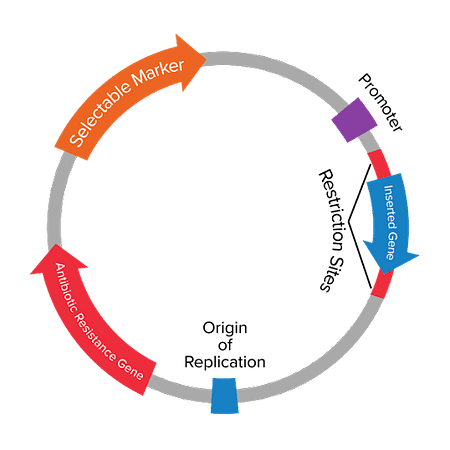
A plasmid produces enzymes that can break down antibiotics or heavy metals. Plasmids are classified into five types:
- Resistance plasmids,
- Fertility F-plasmids,
- Virulence plasmids,
- Col plasmids, and
- Degradative plasmids.
Also Read:
Types of Plasmids
[Click Here for Previous Year Questions]
- F-Plasmids for Fertility
Fertility plasmids (F-plasmids) include transfer genes that allow genes to be transferred from one bacteria to another via conjugation. They can be introduced in the episomes, which are also known as chromosomal DNA. Conjugative plasmids are a large type of plasmids. Bacteria containing the F-plasmid are known as F positive (F+), while bacteria without it are known as F negative (F-). When an F+ bacteria conjugate with an F- bacterium, it produces two F+ bacteria. Each bacteria can contain a single F-plasmid only.
- Resistance Plasmids
Resistance plasmids, often known as R plasmids, contain genes that assist a bacterial cell in defending itself against external influences such as toxins or antibiotics. When this happens, a strain of bacteria can develop antibiotic resistance. Recently, the type of bacteria that causes the sexually transmitted infection gonorrhea has become so resistant to a class of antibiotics known as quinolones that the World Health Organization proposed a new class of antibiotics known as cephalosporins instead. Within five years, the bacteria may grow resistant to these drugs. According to NPR, the misuse of antibiotics to treat other illnesses, such as urinary tract infections, may result in the spread of drug-resistant strains.
- Virulence Plasmids
When a virulence plasmid resides within a bacterium, it transforms the bacteria into a pathogen, which is a disease agent. Bacteria that cause disease are easily transferred and multiplied among those who are infected. There are numerous virulence plasmids in the bacteria such as Escherichia coli (E.Coli). Although E.Coli is naturally found in the human stomach and other animals, certain strains of E.Coli can cause severe diarrhea and vomiting. Salmonella enterica is yet another bacteria with virulence plasmids.
- Degradative Plasmids
Degradative plasmids aid the host bacteria in the process of digesting substances that are not present in nature, such as toluene, camphor, xylene, and salicylic acid. These plasmids include genes for enzymes that degrade certain substances. Conjugative plasmids are degradative plasmids.
- Col Plasmids
Col plasmids include genes that produce bacteriocins (also known as colicins), proteins that kill other bacteria and so protect the host bacterium. Bacteriocins are found in a wide variety of bacteria, including E.
Structure of Plasmids
[Click Here for Sample Questions]
- Plasmids are extrachromosomal but are not required for life. They are beneficial, but they are not always present in every organism of the species.
- Plasmids have their own replication origin (ORI) and multiply alongside the cell so that each daughter cell has a copy of the plasmid as well.
- Plasmids are not part of the genome, and the same plasmid can exist in multiple species and be transmitted from one to the other.
- Aside from the replication origin, it frequently contains genes for antibiotic resistance, toxin synthesis, and other valuable genes that may be essential for cell survival.
Applications of Plasmid
[Click Here for Previous Year Questions]
Humans have discovered numerous applications for plasmids and have developed software to record the DNA sequences of plasmids for use in a variety of procedures.
- Plasmids are employed in genetic engineering to amplify or duplicate specific genes.
- A plasmid is a form of vector in molecular cloning. A vector is a DNA sequence capable of transporting foreign genetic material from one cell to another, where the genes can be expressed and duplicated.
- Plasmids can be used to clone small regions of DNA.
- Plasmids can also be used to reproduce proteins in vast quantities, such as the protein that codes for insulin.
- Furthermore, plasmids are being studied as a means of transferring genes into human cells as part of gene therapy.
- Cells may be deficient in a certain protein if the patient has a genetic illness caused by a gene mutation. By inserting a plasmid into DNA, cells would be able to express a protein that they currently lack.
Components of Plasmids
[Click Here for Sample Questions]
Plasmids, in general, contain three main components, such as:
- Replication Origin (Replicon) - This component specifies the specific location inside the strand at which replication begins. In the case of plasmids, this area is largely made up of A-T base pairs, which easily split off during replication.
- Polylinker (multiple cloning sites) - A polylinker (multiple cloning sites) is an essential component of a plasmid. The rationale for this is that students can learn a lot about cloning. MCS is essentially a short stretch of DNA with many restriction enzyme sites for separation. As a result, polylinkers facilitate DNA insertion via restriction enzyme digestion or ligation. Multiple polylinkers can sever the chain at the point of separation. As a result, every restriction enzyme has the capacity to cut the plasmid and allow DNA insertion.
- Gene for Antibiotic Resistance - This is yet another significant plasmid component that has a role in drug resistance. Plasmids can be transferred from one type of bacteria to another via conjugation. They have the ability to pass on antibiotic resistance traits to other bacteria kinds throughout this process. As a result, treating a few disorders has grown more complex.
Plasmid Vector
[Click Here for Previous Year Questions]
Plasmid vectors are the vehicles that are used to deliver recombinant DNA into a host cell and are an important component in molecular cloning, which is the process of constructing DNA molecules and introducing them into a host cell. The term cloning is used simply because this procedure replicates the changed DNA (referred to as recombinant DNA) in cells, resulting in a group of cells having the same DNA strand.
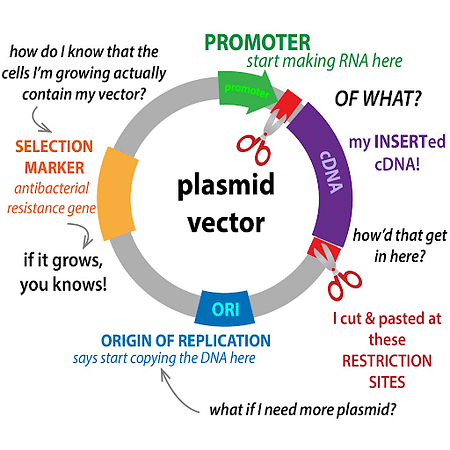
Such procedures are feasible since DNA is used by all living species and has the same overall structure. A vector is basically a molecule that ‘transports' foreign genetic material into another cell to be duplicated and expressed. In this situation, a plasmid is turned into recombinant DNA and then inserted by numerous methods, hence the term plasmid vector.
Also Read:
| Related Articles | ||
|---|---|---|
| Lipid Peroxidation | Proteolytic Enzyme | Enzymes Properties |
| Vitamin B12 | Peptide Bond | Fats and Oils |
pBR322
[Click Here for Sample Questions]
Bolivar and Rodriguez created the first artificial cloning vector, pBR322, in 1977. The pBR322 plasmid's nomenclature is as follows: P – Plasmid, BR – Bolivar, and Rodriguez, who created this plasmid, 322 – Number assigned to identify this plasmid from others made in the same laboratory.

The plasmid pBR322 contains two resistance genes:
- Ampicillin Resistance and
- Tetracycline resistance,
Both of these are thought to be beneficial for selectable markers. Selectable indicators aid in the selection of host cells that carry transformed vectors and the elimination of non-transformants. The restriction endonuclease recognition sites on plasmid pBR322 are diverse.
Ti Plasmid
[Click Here for Previous Year Questions]
Ti Plasmid, also known as the tumor-inducing plasmid is present in Agrobacterium tumifaciens bacteria. It is used to get transgenic plants by delivering the desirable genes to the host plants.
Ti Plasmid has one or more T-DNA regions. Its size is approximately 250 kbp and it can be molded as per the requirements in order to insert the desired genes. The host bacteria inserts a DNA piece (T-DNA) which transforms the normal cells into tumor cells by producing the required chemicals for the bacteria. After the insertion of genes, the pathogenic ability is lost but the desired gene is still inserted in the plant. The Agrobacterium tumifaciens bacteria is also known as “nature’s genetic engineer”.

Things to Remember
- Bacteria: Single-celled microorganisms that were among the first lifeforms to develop on Earth; they can exist alone or within larger species.
- In bacteria, an episome is a plasmid that can be introduced into the chromosome.
- Conjugative plasmids are plasmids that initiate the process of sexual conjugation in bacteria.
- Bacteriocin is a protein produced by a plasmid in a bacterium that kills other bacteria of the same strain.
- Multiple Cloning Site (MCS) - A short section of DNA that has numerous restriction sites that allow for simple DNA insertion. The MCS is frequently found downstream of a promoter in expression plasmids.
- The promoter region is responsible for driving the transcription of the target gene.
- Selectable Marker - The antibiotic resistance gene in bacteria allows for selection. However, many plasmids contain selectable markers that can be used in various cell types.
Sample Questions
Ques. Explain what plasmids are. (2 marks)
Ans. Plasmids are small, circular DNA molecules with the ability to replicate on their own. They are small, round, and are capable of self-replication. The replication of plasmids is not governed by chromosomal DNA. They are found primarily in bacteria. Plasmids are found in some eukaryotes, including yeast and plants.
Ques. Who was the first to discover plasmids? (1 mark)
Ans. Joshua Lederberg invented the term "plasmids" after discovering them in 1952.
Ques. Plasmids are found in which organisms? (1 mark)
Ans. Plasmids are found in bacteria, archaea, and a variety of eukaryotes (plants and yeast).
Ques. What does 322 in pBR322 stand for? (1 mark)
Ans. 322 in the pBR322 plasmid either distinguishes it from other types of plasmids or denotes the synthesis order.
Ques. Other than the five major types of plasmids, what are the other types of plasmids? (2 marks)
Ans. Apart from the primary ones, there are recombinant, cryptic, metabolic, conjugative, and suicide plasmids.
Ques. What are the Main Components of F Plasmid? (2 marks)
Ans. A transposable element, replication origin regions, replication sites, and a conjugative transfer origin are the main components of the F plasmid.
Ques. What do we understand by Cloning Vector? (2 marks)
Ans. The cloning vector is a short bit of DNA extracted from any organism into which a foreign DNA fragment can be put for the purpose of cloning. Plasmids and bacteriophages can replicate within bacterial cells without being controlled by chromosomal DNA. If we combine a foreign bit of DNA with bacteriophage or plasmid DNA, we can multiply its numbers by the plasmid or bacteriophage's copy number.
Ques. What are the names of the selectable markers in the cloning vector pBR322? Mention the function they play. (2 marks)
Ans. Ampicillin and tetracycline resistance genes are selected markers in the cloning vector pBR322. They perform a supportive function in the differentiation of transformed cells from non-transformed cells. They also aid in the differentiation of recombinant cells from non-recombinant cells.
Ques. Explain the structure of plasmids. (3 marks)
Ans. The structure of plasmids are:
- Plasmids are not part of the genome, and the same plasmid can exist in multiple species and be transmitted from one to the other.
- Aside from the replication origin, it frequently contains genes for antibiotic resistance, toxin synthesis, and other valuable genes that may be essential for cell survival.
- Plasmids are extrachromosomal but are not required for life. They are beneficial, but they are not always present in every organism of the species.
- Plasmids have their own replication origin (ORI) and multiply alongside the cell so that each daughter cell has a copy of the plasmid as well.
For Latest Updates on Upcoming Board Exams, Click Here:https://t.me/class_10_12_board_updates
Do Check Out:



Comments