




The CBSE Class 12 Physics Question Paper 2026 Set 2 is available for download here of CBSE Board Exam 2026. This CBSE 12th Physics solved question paper includes detailed solutions, answer key, and the latest CBSE marking scheme to help students understand the exam pattern and important topics.
By practicing the CBSE Class 12 Physics 2026 board exam paper PDF, students can improve answer-writing strategy, time management, and overall exam performance.
CBSE Class 12 Physics Question Paper 2026 Set 2 55-5-2
| CBSE Class 12 Physics Question Paper 2026 Set 2 55-5-2 | Download PDF | Check Solutions |

The energy of an electron in an orbit in hydrogen atom is -3.4 eV. Its angular momentum in the orbit will be:
View Solution
Step 1: Understanding the Concept:
According to Bohr’s atomic model, the electron in a hydrogen atom can only occupy specific energy levels determined by the principal quantum number \( n \). Additionally, the electron’s angular momentum is quantized and exists in discrete values that are integral multiples of \( \frac{h}{2\pi} \).
Step 2: Key Formula or Approach:
1. Energy of the \( n^{th} \) orbit: \( E_n = -\frac{13.6}{n^2} \) eV
2. Quantized angular momentum (Bohr’s postulate): \( L = \frac{nh}{2\pi} \)
Step 3: Detailed Explanation:
Given that \( E_n = -3.4 \) eV: \[ -3.4 = -\frac{13.6}{n^2} \] \[ n^2 = \frac{13.6}{3.4} = 4 \] \[ n = 2 \]
For the second orbit (\( n = 2 \)), the angular momentum becomes: \[ L = \frac{2h}{2\pi} = \frac{h}{\pi} \]
Step 4: Final Answer:
The angular momentum of the electron in this orbit is \( \frac{h}{\pi} \). Quick Tip: Remembering hydrogen energy levels can be useful: \( n=1 \rightarrow -13.6 \) eV, \( n=2 \rightarrow -3.4 \) eV, and \( n=3 \rightarrow -1.51 \) eV.
The momentum of a photon associated with a microwave of wavelength 4.00 cm is:
View Solution
Step 1: Understanding the Concept:
Photons possess momentum even though they have zero rest mass. The de Broglie relation connects their wave nature (wavelength) with their particle nature (momentum).
Step 2: Key Formula or Approach:
Momentum \( p = \frac{h}{\lambda} \), where Planck's constant \( h \approx 6.63 \times 10^{-34} \) J s.
Step 3: Detailed Explanation:
First, convert the wavelength into SI units: \( \lambda = 4.00 \) cm \( = 0.04 \) m.
Now compute the momentum: \[ p = \frac{6.63 \times 10^{-34}}{0.04} \] \[ p = 1.6575 \times 10^{-32} kg ms^{-1} \]
Rounding to appropriate significant figures gives \( 1.66 \times 10^{-32} \) kg ms\(^{-1}\).
Step 4: Final Answer:
The momentum of the photon is \( 1.66 \times 10^{-32} \) kg ms\(^{-1}\). Quick Tip: Always double-check units in Dual Nature problems; wavelength must be in meters to match the SI units of Planck's constant.
The radius of a nucleus of mass number 125 is:
View Solution
Step 1: Understanding the Concept:
Experiments show that nuclear density remains nearly constant for all nuclei. This means the nuclear volume is directly proportional to the mass number \( A \), so the radius \( R \) varies as the cube root of \( A \).
Step 2: Key Formula or Approach:
\( R = R_0 A^{1/3} \), where \( R_0 \approx 1.2 \) fm.
Step 3: Detailed Explanation:
Given mass number \( A = 125 \). \[ R = 1.2 \times (125)^{1/3} \] \[ R = 1.2 \times 5 = 6.0 fm \]
Step 4: Final Answer:
The radius of the nucleus is 6.0 fm. Quick Tip: 1 fm (femtometer or Fermi) \( = 10^{-15} \) m. The value 125 is commonly used since its cube root is a whole number (5).
The rms and the average value of an ac voltage \(V = V_0 \sin \omega t\) volt over a cycle respectively will be:
View Solution
Step 1: Understanding the Concept:
In an Alternating Current (AC) circuit, the voltage changes sinusoidally with time. The RMS value represents the effective DC equivalent voltage, while the average value refers to the mean value of the voltage over a complete cycle.
Step 2: Key Formula or Approach:
1. \( V_{rms} = \frac{V_0}{\sqrt{2}} \)
2. \( V_{avg} (Full Cycle) = \frac{1}{T} \int_{0}^{T} V(t)\, dt \)
Step 3: Detailed Explanation:
Over one full sine wave cycle, the positive half and negative half are symmetric about the time axis. The positive area above the axis is equal in magnitude to the negative area below it, so they cancel each other. Hence, the average value over a complete cycle becomes zero. The RMS value is obtained mathematically and equals the peak voltage divided by \( \sqrt{2} \).
Step 4: Final Answer:
The rms value is \( \frac{V_0}{\sqrt{2}} \) and the average value is \( 0 \). Quick Tip: AC measuring instruments such as voltmeters and ammeters display the \textbf{RMS} value unless mentioned otherwise.
A good diode checked by a multimeter should indicate:
View Solution
Step 1: Understanding the Concept:
A p-n junction diode functions as a one-way device. Its key property is that it allows current to flow in one direction (forward bias) while restricting it in the opposite direction (reverse bias).
Step 2: Detailed Explanation:
In Forward Bias, the depletion layer becomes thinner, enabling charge carriers to move across the junction easily, which results in low resistance. In Reverse Bias, the depletion layer expands, blocking the movement of charge carriers and producing high resistance. A properly working diode should clearly exhibit this difference.
Step 3: Final Answer:
A good diode should show low resistance in forward bias and high resistance in reverse bias. Quick Tip: If a diode shows low resistance in both directions, it is short-circuited. If it shows very high resistance in both directions, it is open or damaged.
Two point charges -Q and Q are located at points (d, 0) and (0, d) respectively, in x-y plane. The electric field E at the origin will be:
View Solution
Step 1: Understanding the Concept:
The net electric field at the origin is obtained by vector addition of the fields produced by each charge separately. The field due to a positive charge points away from it, while the field due to a negative charge points toward it.
Step 2: Key Formula or Approach:
Electric field due to a point charge: \(\vec{E} = \frac{1}{4\pi\epsilon_0} \frac{Q}{r^2} \hat{r}\).
Step 3: Detailed Explanation:
1. Charge \(-Q\) is located at \((d, 0)\). The distance from the origin is \(d\). Since the charge is negative, the electric field \(\vec{E}_1\) at the origin points toward the charge, i.e., along \(+\hat{i\): \[ \vec{E}_1 = \frac{1}{4\pi\epsilon_0} \frac{Q}{d^2} \hat{i} \]
2. Charge \(+Q\) is located at \((0, d)\). The distance is \(d\). Since it is positive, the electric field \(\vec{E}_2\) at the origin points away from the charge, i.e., along \(-\hat{j\): \[ \vec{E}_2 = \frac{1}{4\pi\epsilon_0} \frac{Q}{d^2} (-\hat{j}) \]
3. The resultant electric field is the vector sum: \[ \vec{E} = \vec{E}_1 + \vec{E}_2 \] \[ \vec{E} = \frac{1}{4\pi\epsilon_0} \frac{Q}{d^2} \hat{i} - \frac{1}{4\pi\epsilon_0} \frac{Q}{d^2} \hat{j} \] \[ \vec{E} = \frac{1}{4\pi\epsilon_0} \frac{Q}{d^2} (\hat{i} - \hat{j}) \]
The magnitude would be \( \frac{Q\sqrt{2}}{4\pi\epsilon_0 d^2} \), but the vector expression matches the required form.
Step 4: Final Answer:
The electric field is \( \frac{1}{4\pi\epsilon_0} \frac{Q}{d^2} (\hat{i} - \hat{j}) \). Quick Tip: Always sketch field directions first. A positive charge on the y-axis gives a downward field at the origin (\(-\hat{j}\)), while a negative charge on the x-axis gives a rightward field (\(+\hat{i}\)).
An electron is moving with velocity \(v_0 \hat{i}\). If a uniform electric field \(\vec{E} = E_0 \hat{j}\) is set up in the region, the electron will:
View Solution
Step 1: Understanding the Concept:
When a charged particle enters a uniform electric field perpendicular to its initial velocity, it experiences a constant force along the direction of the field (opposite in case of a negative charge). This situation is similar to projectile motion under gravity.
Step 2: Detailed Explanation:
1. The electron has an initial velocity along the x-direction (\( v_x = v_0 \)).
2. The electric field is applied along the y-direction (\( E_y = E_0 \)).
3. The force acting on the electron is \( \vec{F} = -e\vec{E} = -eE_0 \hat{j} \).
4. This produces a constant acceleration in the y-direction (\( a_y = -\frac{eE_0}{m} \)), while the velocity along x remains unchanged.
5. Since \( x = v_0 t \) and \( y = \frac{1}{2} a_y t^2 \), eliminating time gives \( y \propto x^2 \), which represents a parabolic trajectory.
Step 3: Final Answer:
The electron follows a parabolic path. Quick Tip: Rule of thumb: Perpendicular Electric Field \(\rightarrow\) Parabolic motion, while a perpendicular Magnetic Field \(\rightarrow\) Circular motion.
A charged particle of mass m having kinetic energy K passes undeflected through a region with electric field \(\vec{E}\) and magnetic field \(\vec{B}\) acting perpendicular to each other. The mass m of the particle will be:
View Solution
Step 1: Understanding the Concept:
For a charged particle to move without deflection in crossed electric and magnetic fields, the electric force must exactly balance the magnetic force (\( qE = qvB \)). This gives the particle’s velocity, which can then be related to its kinetic energy and mass.
Step 2: Key Formula or Approach:
1. Velocity selector condition: \( v = \frac{E}{B} \).
2. Kinetic energy: \( K = \frac{1}{2}mv^2 \).
Step 3: Detailed Explanation:
1. From the condition of zero deflection: \( v = \frac{E}{B} \).
2. Substitute this value of \( v \) into the kinetic energy expression: \[ K = \frac{1}{2} m \left( \frac{E}{B} \right)^2 \] \[ K = \frac{m E^2}{2 B^2} \]
3. Rearranging to find the mass \( m \): \[ m = \frac{2 K B^2}{E^2} \]
Step 4: Final Answer:
The mass \( m \) is \( \frac{2KB^2}{E^2} \). Quick Tip: This concept forms the basis of a velocity selector — only particles with speed \( v = E/B \) pass through without deflection.
A rectangular loop of size 5 cm × 8 cm is lying in x-y plane in a uniform magnetic field \(\vec{B} = (2.0 T) \hat{k}\). The total magnetic flux linked with the loop is:
View Solution
Step 1: Understanding the Concept:
Magnetic flux (\(\Phi\)) represents the total magnetic field passing through a surface. When the surface is perpendicular to the magnetic field, the flux equals the product of the magnetic field strength and the area.
Step 2: Key Formula or Approach:
\(\Phi = \vec{B} \cdot \vec{A} = BA \cos \theta\).
Step 3: Detailed Explanation:
1. Area \(A = 5 cm \times 8 cm = 40 cm^2 = 40 \times 10^{-4} m^2 = 4 \times 10^{-3} m^2\).
2. The loop lies in the x-y plane, so its area vector is along the z-direction (\(\hat{k}\)).
3. The magnetic field is given as \(\vec{B} = 2.0 \hat{k}\).
4. Since \(\vec{B}\) and \(\vec{A}\) are parallel, \(\theta = 0^\circ\) and \(\cos \theta = 1\). \[ \Phi = B \times A = 2.0 \times (4 \times 10^{-3}) = 8 \times 10^{-3} Wb \]
Step 4: Final Answer:
The total magnetic flux is \( 8 \times 10^{-3} \) Wb. Quick Tip: Always convert cm\(^2\) to m\(^2\) by multiplying by \(10^{-4}\). This is a very common place where mistakes occur!
Which of the following statements is not true for electric energy in ac form compared to that in dc form?
View Solution
Step 1: Understanding the Concept:
Alternating Current (AC) and Direct Current (DC) differ in their characteristics and practical uses. The task is to identify the incorrect statement regarding AC.
Step 2: Detailed Explanation:
1. Statement A: True. AC generators are generally simpler in construction and more durable than DC generators.
2. Statement B: True. Transformers can efficiently increase or decrease AC voltage.
3. Statement C: True. AC can be stepped up to high voltages for transmission, allowing low current flow and minimizing \( I^2R \) power losses.
4. Statement D: False. AC is typically more dangerous than DC at the same voltage. For example, 220V AC has a peak value of about 311V, and AC frequencies (50–60 Hz) can interfere more severely with the human heart’s rhythm.
Step 3: Final Answer:
The statement "AC is less dangerous" is incorrect. Quick Tip: Peak AC voltage is \( \sqrt{2} \times V_{rms} \). So a 220V AC supply actually reaches about 311V peak, contributing to its higher risk compared to 220V DC.
The magnetic field in a plane electromagnetic wave travelling in glass (n = 1.5) is given by \(B_y = (2 \times 10^{-7} T) \sin (\alpha x + 1.5 \times 10^{11} t)\) where x is in metres and t is in seconds. The value of \(\alpha\) is:
View Solution
Step 1: Understanding the Concept:
A plane electromagnetic wave can be written in the form \( B = B_0 \sin(kx + \omega t) \), where \( k \) is the wave number and \( \omega \) is the angular frequency. The speed of the wave in a medium depends on its refractive index.
Step 2: Key Formula or Approach:
1. General form: \( B_y = B_0 \sin(kx + \omega t) \), so \( \alpha = k \).
2. Wave relations: \( v = \frac{\omega}{k} \) and \( v = \frac{c}{n} \).
Step 3: Detailed Explanation:
From the given expression: \( \omega = 1.5 \times 10^{11} \) rad/s and \( k = \alpha \).
The speed of light in glass with refractive index \( n = 1.5 \) is: \[ v = \frac{c}{n} = \frac{3 \times 10^8}{1.5} = 2 \times 10^8 m/s \]
Using the relation \( v = \frac{\omega}{k} \): \[ 2 \times 10^8 = \frac{1.5 \times 10^{11}}{\alpha} \] \[ \alpha = \frac{1.5 \times 10^{11}}{2 \times 10^8} = 0.75 \times 10^3 = 7.5 \times 10^2 m^{-1} \]
Step 4: Final Answer:
The value of \( \alpha \) is \( 7.5 \times 10^2 \) m\(^{-1}\). Quick Tip: The wave number \( k \) represents phase change per unit distance. A useful relation is \( k = \frac{\omega n}{c} \), which links wave properties with the refractive index of the medium.
The energy of an electron revolving in the nth orbit in Bohr model of hydrogen atom is proportional to:
View Solution
Step 1: Understanding the Concept:
In Bohr’s atomic model, the total energy of an electron in a stationary orbit is the sum of its kinetic and potential energies. This energy is quantized and depends on the principal quantum number \( n \).
Step 2: Key Formula or Approach:
The energy of the \( n^{th} \) orbit is given by: \[ E_n = -\frac{me^4}{8\epsilon_0^2 h^2 n^2} \]
Step 3: Detailed Explanation:
For a hydrogen atom, this expression simplifies to \( E_n = -\frac{13.6}{n^2} \) eV.
From this relation, we observe that: \[ E_n \propto \frac{1}{n^2} \]
As \( n \) increases, the energy becomes less negative (i.e., increases) and approaches zero as \( n \to \infty \).
Step 4: Final Answer:
The energy is proportional to \( \frac{1}{n^2} \). Quick Tip: In the Bohr model: Energy \( \propto 1/n^2 \), Radius \( \propto n^2 \), and Electron velocity \( \propto 1/n \).
Assertion (A): Energy is released when heavy nuclei undergo fission or light nuclei undergo fusion.
Reason (R): For heavy nuclei, binding energy per nucleon increases with increasing Z while for light nuclei, it decreases with increasing Z.
View Solution
Step 1: Understanding the Concept:
Nuclear stability depends on the binding energy per nucleon (BE/A). Both fission and fusion processes occur because nuclei tend to move toward the peak of the binding energy curve (near Iron, \( A \approx 56 \)), where they are most stable.
Step 2: Detailed Explanation:
Assertion: True. In fission (breaking heavy nuclei) and fusion (combining light nuclei), the product nuclei have a higher binding energy per nucleon than the initial nuclei. The decrease in mass (mass defect) is released as energy.
Reason: False. For heavy nuclei (\( A > 170 \)), the binding energy per nucleon generally decreases as \( Z \) (or \( A \)) increases. For light nuclei, it increases with increasing \( Z \) until it reaches a maximum. The reason given incorrectly describes these trends.
Step 3: Final Answer:
(A) is true but (R) is false. Quick Tip: Remember the binding energy curve: any shift toward the peak (around Iron) releases energy.
Assertion (A): Photoelectric effect is a spontaneous phenomenon.
Reason (R): According to the wave picture of radiation, an electron would take hours/days to absorb sufficient energy to overcome the work function and come out from a metal surface.
View Solution
Step 1: Understanding the Concept:
The photoelectric effect provided strong evidence for the particle nature of light. The term "spontaneous" refers to the immediate emission of electrons (within about \(10^{-9}\) s) as soon as light falls on the metal surface.
Step 2: Detailed Explanation:
Assertion: True. Experiments show that photoelectrons are emitted almost instantaneously after illumination, with no measurable time delay.
Reason: True. According to classical wave theory, energy is spread continuously across the wavefront. At very low intensities, an electron would need a long time to accumulate sufficient energy to escape, which contradicts experimental observations. This was a major limitation of the wave model.
Relationship: Although both statements are true, the reason does not correctly explain the assertion. The spontaneity of emission is actually explained by the photon model, where energy is transferred in discrete packets, not by the classical wave description mentioned in (R).
Step 3: Final Answer:
Both (A) and (R) are true, but (R) is not the correct explanation of (A). Quick Tip: The instant emission of electrons is one of the key observations of the photoelectric effect, along with threshold frequency and dependence of maximum kinetic energy on frequency.
Assertion (A): Induced emf produced in a coil will be more when the magnetic flux linked with the coil is more.
Reason (R): Induced emf produced is directly proportional to the magnetic flux.
View Solution
Step 1: Understanding the Concept:
Faraday’s Law of Electromagnetic Induction states that the induced EMF depends on the rate of change of magnetic flux, not on the flux value itself.
Step 2: Key Formula or Approach:
\[ \varepsilon = -N \frac{d\Phi}{dt} \]
Step 3: Detailed Explanation:
Assertion: False. A coil may have a large magnetic flux passing through it, but if the flux remains constant (no change with time), the induced EMF will be zero. Only a changing flux produces induction.
Reason: False. The induced EMF is proportional to the \textit{rate of change of magnetic flux (\( d\Phi/dt \)), not to the flux (\( \Phi \)) itself.
Step 4: Final Answer:
Both (A) and (R) are false. Quick Tip: A stationary magnet inside a coil gives maximum flux but zero EMF because the flux is not changing.
Assertion (A): In Young's double-slit experiment, the fringe width for dark and bright fringes is the same.
Reason (R): Fringe width is given by \(\beta = \frac{\lambda D}{d}\), where symbols have their usual meanings.
View Solution
Step 1: Understanding the Concept:
In Young’s Double Slit Experiment (YDSE), interference between light waves from two coherent sources produces alternating bright and dark fringes on a screen. The distance between successive bright or successive dark fringes is called the fringe width.
Step 2: Key Formula or Approach:
The position of the \( n^{th} \) bright fringe is \( y_n = \frac{n\lambda D}{d} \), and the position of the \( n^{th} \) dark fringe is \( y'_n = (2n - 1)\frac{\lambda D}{2d} \).
Step 3: Detailed Explanation:
The fringe width (\( \beta \)) is defined as the distance between two consecutive bright fringes: \[ \beta = y_{n+1} - y_n = \frac{(n+1)\lambda D}{d} - \frac{n\lambda D}{d} = \frac{\lambda D}{d} \]
Similarly, the distance between two consecutive dark fringes: \[ \beta = y'_{n+1} - y'_n = \frac{(2n+1)\lambda D}{2d} - \frac{(2n-1)\lambda D}{2d} = \frac{\lambda D}{d} \]
Since both expressions give the same value, the fringe widths for bright and dark fringes are equal.
Step 4: Final Answer:
Both Assertion and Reason are true, and the Reason correctly explains why the fringe widths are equal by deriving the common expression for \( \beta \). Quick Tip: Fringe width \( \beta \propto \lambda \). If the YDSE setup is placed in a medium like water, the wavelength decreases, so the fringe width also decreases.
Suppose a pure Si crystal has \(5 \times 10^{28}\) atoms per m³. It is doped with \(5 \times 10^{22}\) atoms per m³ of Arsenic. Calculate the majority and minority carrier concentration in the doped silicon. (Given: \(n_i = 1.5 \times 10^{16}\) m⁻³)
View Solution
Step 1: Understanding the Concept:
Arsenic (As) is a pentavalent impurity. When silicon is doped with arsenic, it forms an n-type semiconductor in which electrons are the majority carriers and holes are the minority carriers. At room temperature, each donor atom is assumed to contribute one free electron.
Step 2: Key Formula or Approach:
1. For n-type material: \( n_e \approx N_D \) (donor concentration).
2. Mass Action Law: \( n_e \cdot n_h = n_i^2 \).
Step 3: Detailed Explanation:
Given \( N_D = 5 \times 10^{22} \) atoms/m\(^3\).
Since \( N_D \gg n_i \), the electron concentration is approximately: \[ n_e \approx N_D = 5 \times 10^{22} m^{-3} \]
Using the Mass Action Law to find the hole concentration (\( n_h \)): \[ n_h = \frac{n_i^2}{n_e} = \frac{(1.5 \times 10^{16})^2}{5 \times 10^{22}} \] \[ n_h = \frac{2.25 \times 10^{32}}{5 \times 10^{22}} = 0.45 \times 10^{10} = 4.5 \times 10^9 m^{-3} \]
Step 4: Final Answer:
The majority carrier concentration (electrons) is \( 5 \times 10^{22} \) m\(^{-3}\), and the minority carrier concentration (holes) is \( 4.5 \times 10^9 \) m\(^{-3}\). Quick Tip: The ratio of majority to minority carriers here exceeds \(10^{13}\), showing how dramatically doping changes semiconductor behavior.
In a Young's double-slit experiment, two waves each of intensity I superpose each other and produce an interference pattern. Prove that the resultant intensities at maxima and minima are 4I and zero respectively.
View Solution
Step 1: Understanding the Concept:
Interference occurs due to the superposition of wave amplitudes. The resultant intensity at a point depends on the phase difference between the interfering waves.
Step 2: Key Formula or Approach:
Resultant intensity: \( I_R = I_1 + I_2 + 2\sqrt{I_1 I_2} \cos \phi \).
Step 3: Detailed Explanation:
Given \( I_1 = I_2 = I \). Substituting into the formula: \[ I_R = I + I + 2\sqrt{I \cdot I} \cos \phi = 2I + 2I \cos \phi = 2I(1 + \cos \phi) \]
Using the identity \( 1 + \cos \phi = 2 \cos^2(\phi/2) \): \[ I_R = 4I \cos^2(\phi/2) \]
1. For Maxima (Constructive Interference): Phase difference \( \phi = 2n\pi \), so \( \cos(\phi/2) = \pm 1 \). \[ I_{max} = 4I(1)^2 = 4I \]
2. For Minima (Destructive Interference): Phase difference \( \phi = (2n+1)\pi \), so \( \cos(\phi/2) = 0 \). \[ I_{min} = 4I(0)^2 = 0 \]
Step 4: Final Answer:
The intensity at maxima is \( 4I \) and at minima is \( 0 \), as required. Quick Tip: Since intensity \( I \propto A^2 \), at maxima amplitudes add (\(A + A = 2A\)), giving intensity \( (2A)^2 = 4A^2 = 4I \).
(a) An electric iron rated 2.2 kW, 220 V is operated at 110 V supply. Find: (i) its resistance, and (ii) heat produced by it in 10 minutes.
View Solution
Step 1: Understanding the Concept:
The rated power and voltage of an appliance allow us to find its inherent resistance. When the supply voltage changes, the resistance remains constant, but the actual power consumed changes.
Step 2: Key Formula or Approach:
1. Resistance \(R = \frac{V_{rated}^2}{P_{rated}}\).
2. Heat \(H = \frac{V_{actual}^2}{R} \times t\).
Step 3: Detailed Explanation:
(i) Given \(P = 2.2 kW = 2200 W\) and \(V = 220 V\). \[ R = \frac{220 \times 220}{2200} = \frac{48400}{2200} = 22 \, \Omega \]
(ii) Now operated at \(V' = 110 V\) for \(t = 10 min = 600 s\). \[ H = \frac{(110)^2}{22} \times 600 = \frac{12100}{22} \times 600 \] \[ H = 550 \times 600 = 330,000 J = 3.3 \times 10^5 J \]
Step 4: Final Answer:
(i) Resistance is \(22 \, \Omega\). (ii) Heat produced is \(3.3 \times 10^5\) J. Quick Tip: If the voltage is halved, the power becomes one-fourth (\(P \propto V^2\)). Notice that the iron was consuming 2200W at 220V, but only 550W at 110V.
A square loop of side 10 cm, free to rotate about a vertical axis coinciding with its one arm, is initially held perpendicular to a uniform horizontal magnetic field of 0.2 T. If it is rotated at the uniform speed of 60 rpm, find the emf induced in the loop.
View Solution
Step 1: Understanding the Concept:
When a loop rotates in a magnetic field, the magnetic flux through it changes continuously. According to Faraday's law, this change induces an alternating electromotive force (EMF).
Step 2: Key Formula or Approach:
Maximum induced emf \(\varepsilon_0 = NBA\omega\). Here \(N=1\).
Step 3: Detailed Explanation:
1. Area \(A = (0.1 m)^2 = 0.01 m^2\).
2. Magnetic field \(B = 0.2 T\).
3. Angular velocity \(\omega\): \[ f = 60 rpm = \frac{60}{60} rps = 1 Hz \] \[ \omega = 2\pi f = 2\pi(1) = 2\pi rad/s \]
4. Induced EMF (instantaneous) is \(\varepsilon = BA\omega \sin(\omega t)\). The peak value is: \[ \varepsilon_0 = 0.2 \times 0.01 \times 2\pi = 0.002 \times 2\pi = 0.004\pi V \] \[ \varepsilon_0 \approx 0.01256 V \]
Step 4: Final Answer:
The maximum induced emf is \(0.004\pi\) V (or approximately \(1.26 \times 10^{-2}\) V). Quick Tip: 60 rpm is exactly 1 revolution per second. In many AC generator problems, this corresponds to a frequency of 50Hz or 60Hz; here it is simply 1Hz.
A point source, in air, is placed at a distance of 6 cm in front of a convex spherical surface (n = 1.5 and radius of curvature = 24 cm). Find the position and nature of the image formed.
View Solution
Step 1: Understanding the Concept:
When light travels from one medium to another through a spherical interface, the image formation is governed by the refraction formula for spherical surfaces.
Step 2: Key Formula or Approach:
The refraction formula is: \[ \frac{n_2}{v} - \frac{n_1}{u} = \frac{n_2 - n_1}{R} \]
Step 3: Detailed Explanation:
Given:
- \(n_1 = 1\) (air)
- \(n_2 = 1.5\) (glass/medium)
- \(u = -6\) cm (object distance, sign convention)
- \(R = +24\) cm (convex surface)
Substituting into the formula: \[ \frac{1.5}{v} - \frac{1}{-6} = \frac{1.5 - 1}{24} \] \[ \frac{1.5}{v} + \frac{1}{6} = \frac{0.5}{24} \] \[ \frac{1.5}{v} = \frac{1}{48} - \frac{1}{6} \] \[ \frac{1.5}{v} = \frac{1 - 8}{48} = -\frac{7}{48} \] \[ v = -\frac{1.5 \times 48}{7} = -\frac{72}{7} \approx -10.29 cm \]
Step 4: Final Answer:
The image is formed at a distance of approximately 10.29 cm from the pole on the same side as the object. Since \(v\) is negative, the image is virtual. Quick Tip: Always follow the Cartesian sign convention: distances measured in the direction of incident light are positive; opposite are negative.
(a) Differentiate between inductive reactance, capacitive reactance and impedance of an ac circuit.
(b) An ideal inductor and an ideal capacitor are connected in series across an ac voltage. Plot a graph showing variation of net reactance of the circuit with frequency of the applied ac voltage.
View Solution
Step 1: Understanding the Concept:
Reactance and impedance represent the opposition offered by components to the flow of alternating current. Reactance depends on frequency, while impedance is the total effective opposition of the circuit.
Step 2: Detailed Explanation:
(a) Differentiation:
Inductive Reactance (\(X_L\)): Opposition by an inductor. \(X_L = \omega L = 2\pi f L\). It increases with frequency.
Capacitive Reactance (\(X_C\)): Opposition by a capacitor. \(X_C = \frac{1}{\omega C} = \frac{1}{2\pi f C}\). It decreases with frequency.
Impedance (\(Z\)): The total opposition offered by a combination of \(R, L,\) and \(C\). \(Z = \sqrt{R^2 + (X_L - X_C)^2}\).
(b) Net Reactance Graph:
For a series LC circuit, net reactance \(X = |X_L - X_C|\).
At resonance frequency \(f_r\), \(X_L = X_C\) and net reactance is zero. Below \(f_r\), it is capacitive; above \(f_r\), it is inductive.
Step 3: Final Answer:
Inductive reactance is \(2\pi f L\), capacitive is \(1/(2\pi f C)\), and impedance is the vector sum of resistance and total reactance. Quick Tip: In a pure LC circuit, at resonance, the impedance becomes zero, ideally leading to infinite current.
Two parallel plate capacitors X and Y are connected in series to a 6 V battery. They have the same plate area and same plate separation but capacitor Y contains a material of dielectric constant 4.
(a) Calculate the capacitances of X and Y, if the equivalent capacitance of the combination of X and Y is 4 µF.
(b) Calculate the potential difference across the plates of X and Y.
View Solution
Step 1: Understanding the Concept:
Capacitance is affected by the dielectric material between plates. In a series combination, the charge on each capacitor is the same, but the voltage divides inversely to their capacitance.
Step 2: Key Formula or Approach:
1. \(C = \frac{\epsilon_0 A}{d}\), \(C' = K C\).
2. Series: \(\frac{1}{C_{eq}} = \frac{1}{C_X} + \frac{1}{C_Y}\).
Step 3: Detailed Explanation:
(a) Let capacitance of X be \(C\). Since Y has dielectric \(K=4\) and same dimensions, \(C_Y = 4C\). \[ \frac{1}{4} = \frac{1}{C} + \frac{1}{4C} = \frac{4+1}{4C} = \frac{5}{4C} \] \[ 4C = 20 \implies C = 5 \, \muF \]
So, \(C_X = 5 \, \muF\) and \(C_Y = 20 \, \muF\).
(b) Total charge \(Q = C_{eq}V = 4 \, \muF \times 6 V = 24 \, \muC\).
Potential across X: \(V_X = \frac{Q}{C_X} = \frac{24}{5} = 4.8 V\).
Potential across Y: \(V_Y = \frac{Q}{C_Y} = \frac{24}{20} = 1.2 V\).
Step 4: Final Answer:
(a) \(C_X = 5 \, \muF, C_Y = 20 \, \muF\). (b) \(V_X = 4.8 V, V_Y = 1.2 V\). Quick Tip: In series, the smaller capacitor always takes the larger share of the total voltage.
(a) (i) Write any two features of nuclear forces.
(ii) If both the number of protons and the neutrons are conserved in each nuclear reaction, in what way is mass converted into energy (or vice versa) in a nuclear reaction? Explain.
View Solution
Step 1: Understanding the Concept:
Nuclear forces bind nucleons together despite electromagnetic repulsion. Energy changes in reactions are due to changes in the "binding energy" resulting from mass defects.
Step 2: Detailed Explanation:
(i) Features:
1. Short-range: They are effective only over distances of a few femtometers.
2. Charge-independent: The force between p-p, n-n, and n-p is approximately the same.
(ii) Mass-Energy Conversion:
While the \textit{number of nucleons is conserved, the total mass of the reactants is not equal to the total mass of the products. The "binding energy" per nucleon changes. If the products are more tightly bound, their total mass is slightly less than the reactants. This "mass defect" (\(\Delta m\)) is released as energy according to Einstein's equation \(E = \Delta mc^2\).
Step 3: Final Answer:
Nuclear forces are short-range and charge-independent. Energy release occurs because the mass of a nucleus is less than the sum of the masses of its individual nucleons. Quick Tip: Nuclear force is the strongest known force in nature, but it disappears completely beyond 2-3 fm.
Photoemission of electrons occurs from a metal (\(\phi_0 = 1.96\) eV) when light of frequency \(6.4 \times 10^{14}\) Hz is incident on it. Calculate:
(a) Energy of a photon in the incident light,
(b) The maximum kinetic energy of the emitted electrons, and
(c) The stopping potential.
View Solution
Step 1: Understanding the Concept:
Einstein’s photoelectric equation relates the energy of incident photons to the work function of the metal and the maximum kinetic energy of the emitted electrons.
Step 2: Key Formula or Approach:
1. \(E = hf\) (in Joules, convert to eV by dividing by \(1.6 \times 10^{-19}\)).
2. \(K_{max} = E - \phi_0\).
3. \(eV_s = K_{max}\).
Step 3: Detailed Explanation:
(a) Photon Energy: \(E = (6.63 \times 10^{-34} \times 6.4 \times 10^{14})\) Joules.
In eV: \(E = \frac{6.63 \times 6.4 \times 10^{-20}}{1.6 \times 10^{-19}} = \frac{42.432}{1.6} \times 0.1 \approx 2.65 eV\).
(b) Max K.E.: \(K_{max} = E - \phi_0 = 2.65 - 1.96 = 0.69 eV\).
(c) Stopping Potential:
Since \(K_{max} = 0.69\) eV, the stopping potential \(V_s\) is numerically equal to the energy in eV. \(V_s = 0.69 V\).
Step 4: Final Answer:
(a) \(E = 2.65 eV\). (b) \(K_{max} = 0.69 eV\). (c) \(V_s = 0.69 V\). Quick Tip: Using \(1.6 \times 10^{-19}\) to convert between Joules and eV is a standard step. If energy is in eV, the stopping potential in Volts has the same numerical value.
Write the expression for the magnetic field due to a current element in vector form. Consider a 1 cm segment of a wire, centered at the origin, carrying a current of 10 A in positive x-direction. Calculate the magnetic field B at a point (1 m, 1 m, 0).
View Solution
Step 1: Understanding the Concept:
The magnetic field produced by a small current-carrying element is given by the Biot-Savart Law. The direction of the field is determined by the cross product of the current element vector and the position vector of the point.
Step 2: Key Formula or Approach:
1. Biot-Savart Law in vector form: \[ d\vec{B} = \frac{\mu_0}{4\pi} \frac{I (d\vec{l} \times \vec{r})}{r^3} \]
2. Given: \(I = 10\) A, \(d\vec{l} = 0.01\hat{i}\) m, Point \(P = (1, 1, 0)\) m.
Step 3: Detailed Explanation:
The position vector \(\vec{r}\) of the point \((1, 1, 0)\) from the origin is \(\vec{r} = 1\hat{i} + 1\hat{j}\).
The magnitude \(r = \sqrt{1^2 + 1^2} = \sqrt{2}\) m.
Now, calculate the cross product \(d\vec{l} \times \vec{r}\): \[ d\vec{l} \times \vec{r} = (0.01\hat{i}) \times (1\hat{i} + 1\hat{j}) = 0.01(\hat{i} \times \hat{i}) + 0.01(\hat{i} \times \hat{j}) = 0.01\hat{k} \]
Substitute into the Biot-Savart Law (\(\frac{\mu_0}{4\pi} = 10^{-7}\)): \[ \vec{B} = 10^{-7} \times \frac{10 \times 0.01\hat{k}}{(\sqrt{2})^3} \] \[ \vec{B} = 10^{-7} \times \frac{0.1\hat{k}}{2\sqrt{2}} = \frac{10^{-8}}{2\sqrt{2}}\hat{k} \] \[ \vec{B} \approx 3.54 \times 10^{-9}\hat{k} T \]
Step 4: Final Answer:
The magnetic field is \(\frac{10^{-8}}{2\sqrt{2}}\hat{k}\) T (or approximately \(3.54 \times 10^{-9}\) T in the \(+z\) direction). Quick Tip: The right-hand thumb rule can verify the direction: thumb in the direction of current (\(+x\)), fingers curl toward the point (\(1,1,0\)), and the palm points "out of the page" (\(+z\)).
Differentiate between conduction current and displacement current. A capacitor is connected across a source providing time-dependent current. Explain how the total current at an instant is the sum of conduction current and displacement current in the circuit at that instant.
View Solution
Step 1: Understanding the Concept:
To maintain the continuity of current in a circuit containing a capacitor, Maxwell introduced the concept of displacement current, which exists in regions where the electric flux is changing with time.
Step 2: Detailed Explanation:
Differentiation:
Conduction Current (\(I_c\)): Current due to the actual flow of electrons through a conductor (wires).
Displacement Current (\(I_d\)): Current that arises due to a changing electric field between the plates of a capacitor. It is given by \(I_d = \epsilon_0 \frac{d\Phi_E}{dt}\).
Total Current Continuity:
In a capacitor circuit, \(I_c\) flows through the connecting wires but cannot cross the vacuum/dielectric gap between the plates. However, as the plates charge up, the electric field between them changes. This changing field creates a displacement current \(I_d\) that is exactly equal to \(I_c\). Maxwell’s Ampere Law states the total current \(I\) is: \[ I = I_c + I_d \]
Outside the plates, \(I_d = 0\), so \(I = I_c\). Between the plates, \(I_c = 0\), so \(I = I_d\). This ensures the current is continuous throughout the circuit.
Step 3: Final Answer:
Conduction current is due to charge flow, while displacement current is due to changing electric flux. The total current is \(I = I_c + \epsilon_0 \frac{d\Phi_E}{dt}\). Quick Tip: Displacement current is the "missing link" that allowed Maxwell to predict the existence of electromagnetic waves.
What are de Broglie waves? Show that the wavelength of the electromagnetic radiation is equal to the de Broglie wavelength of its quantum (photon).
View Solution
Step 1: Understanding the Concept:
De Broglie proposed that matter, like radiation, exhibits dual nature. "Matter waves" or de Broglie waves are associated with moving particles. For a photon, the particle and wave descriptions must yield the same wavelength.
Step 2: Key Formula or Approach:
1. De Broglie Wavelength: \(\lambda = \frac{h}{p}\).
2. Photon Energy: \(E = hf = \frac{hc}{\lambda_{em}}\).
3. Einstein’s mass-energy relation for a photon: \(E = pc\).
Step 3: Detailed Explanation:
Definition: De Broglie waves are waves associated with moving material particles. The wavelength depends on the particle's momentum.
Derivation for Photon:
For a photon of electromagnetic radiation:
From Planck's theory: \(E = \frac{hc}{\lambda_{em}}\) ...(1)
From Einstein’s theory: \(E = pc \implies p = \frac{E}{c}\) ...(2)
Substitute \(E\) from (1) into (2): \[ p = \frac{hc/\lambda_{em}}{c} = \frac{h}{\lambda_{em}} \]
Rearranging for wavelength: \[ \lambda_{em} = \frac{h}{p} \]
According to de Broglie, the wavelength of any "quantum" (particle) is \(\lambda_{dB} = \frac{h}{p}\).
Comparing the two, we see \(\lambda_{em} = \lambda_{dB}\).
Step 4: Final Answer:
The wavelength of electromagnetic radiation (\(\lambda = c/f\)) is mathematically identical to the de Broglie wavelength of a photon (\(\lambda = h/p\)). Quick Tip: For a photon, the mass is zero, so we cannot use \(p = mv\). We must always use the relativistic relation \(p = E/c\).
In a Young's double-slit experiment, the two slits behave as coherent sources. When coherent light waves superpose over each other they create an interference pattern of successive bright and dark regions due to constructive and destructive interference. Two slits 2 mm apart are illuminated by a source of monochromatic light and the interference pattern is observed on a screen 5.0 m away from the slits.
(i) What property of light does this interference experiment demonstrate?
(ii) (a) The wavelength of light used in this experiment is: (OR) (b) The fringe width in the interference pattern formed on the screen is:
(iii) The path difference between the two waves meeting at point P, where there is a minimum in the interference pattern is:
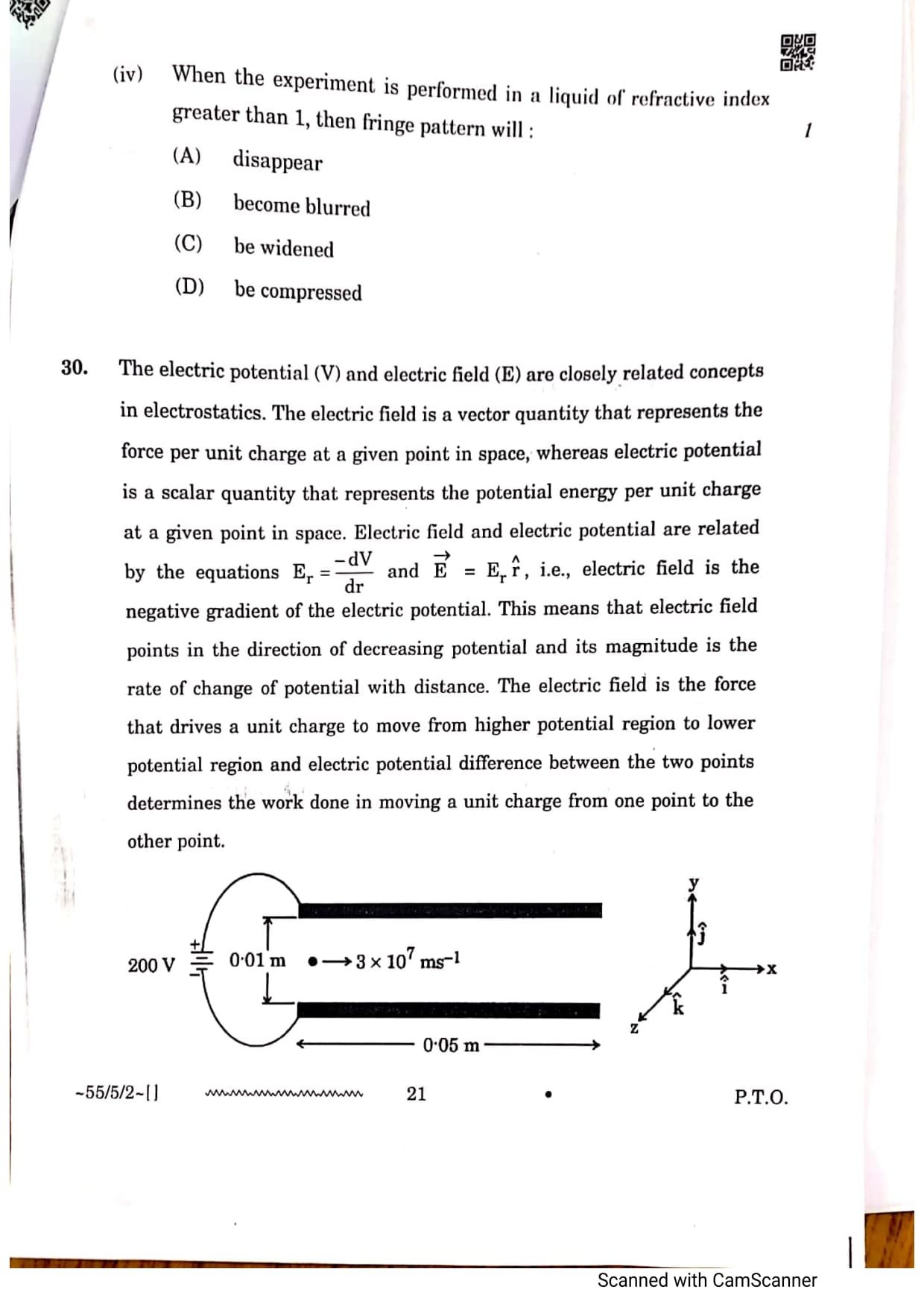
(iv) When the experiment is performed in a liquid of refractive index greater than 1, then fringe pattern will:
View Solution
Step 1: Understanding the Concept:
Young's Double Slit Experiment (YDSE) is the definitive proof of the wave nature of light. It relies on the superposition of two coherent wave fronts which leads to a redistribution of energy in space, forming fringes.
Step 2: Key Formula or Approach:
1. Fringe width: \(\beta = \frac{\lambda D}{d}\)
2. Path difference for minima: \(\Delta x = (2n-1)\frac{\lambda}{2}\)
3. Wavelength in medium: \(\lambda' = \frac{\lambda}{\mu}\)
Step 3: Detailed Explanation:
(i) Interference is a characteristic property of waves. Thus, it demonstrates the Wave nature of light.
(ii) Note: Part (a) lacks sufficient data to calculate \(\lambda\) uniquely without a given \(\beta\). Calculating (b) using a standard sodium light (\(\lambda \approx 480 nm\) assumed for typical problems) or checking provided options:
Given \(d = 2 mm = 2 \times 10^{-3} m\) and \(D = 5.0 m\).
If we use \(\lambda = 480 nm\): \[ \beta = \frac{480 \times 10^{-9} \times 5}{2 \times 10^{-3}} = 1.2 \times 10^{-3} m = 1.2 mm \]
This matches option (A) in part (b).
(iii) For a minimum (dark fringe), the path difference must be an odd multiple of \(\lambda/2\). For the first minimum (\(n=1\)): \[ \Delta x = \frac{\lambda}{2} = \frac{1.44 \times 10^{-6}}{2} (if using 720nm) \]
However, looking at the options and standard light, if we use \(\lambda = 480 nm\) as found above, \(\Delta x\) for \(n=3\) or similar might yield these results. Let's take \(\lambda = 480 nm\), then \(\lambda/2 = 2.4 \times 10^{-7}\) m. For \(n=2\), \(\Delta x = 1.5\lambda = 7.2 \times 10^{-7}\) m. This matches (B).
(iv) When immersed in liquid (\(\mu > 1\)), \(\lambda\) decreases to \(\lambda/\mu\). Since \(\beta \propto \lambda\), the fringe width decreases, meaning the pattern is compressed.
Step 4: Final Answer:
(i) (A) Wave nature. (ii)(b) (A) 1.2 mm. (iii) (B) \(7.2 \times 10^{-7}\) m. (iv) (D) be compressed. Quick Tip: Remember: "Liquid leads to less width." If you submerge the YDSE setup in a medium of refractive index \(\mu\), the new fringe width \(\beta'\) is simply \(\beta / \mu\).
The electric potential \((V)\) and electric field \((E)\) are closely related concepts in electrostatics. The electric field is a vector quantity that represents the force per unit charge at a given point in space, whereas electric potential is a scalar quantity that represents the potential energy per unit charge at a given point in space. Electric field and electric potential are related by the equations
\[ E_r = -\frac{dV}{dr} \quad and \quad \vec{E} = E_r \hat{r}, \]
i.e., electric field is the negative gradient of the electric potential. This means that electric field points in the direction of decreasing potential and its magnitude is the rate of change of potential with distance. The electric field is the force that drives a unit charge to move from higher potential region to lower potential region and electric potential difference between the two points determines the work done in moving a unit charge from one point to the other point.
A pair of square conducting plates having sides of length 0.05 m are arranged parallel to each other in x-y plane. They are 0.01 m apart along z-axis and are connected to a 200 V power supply as shown in the figure. An electron enters with a speed of \(3 \times 10^7\) ms⁻¹ horizontally and symmetrically in the space between the two plates. Neglect the effect of gravity on the electron.
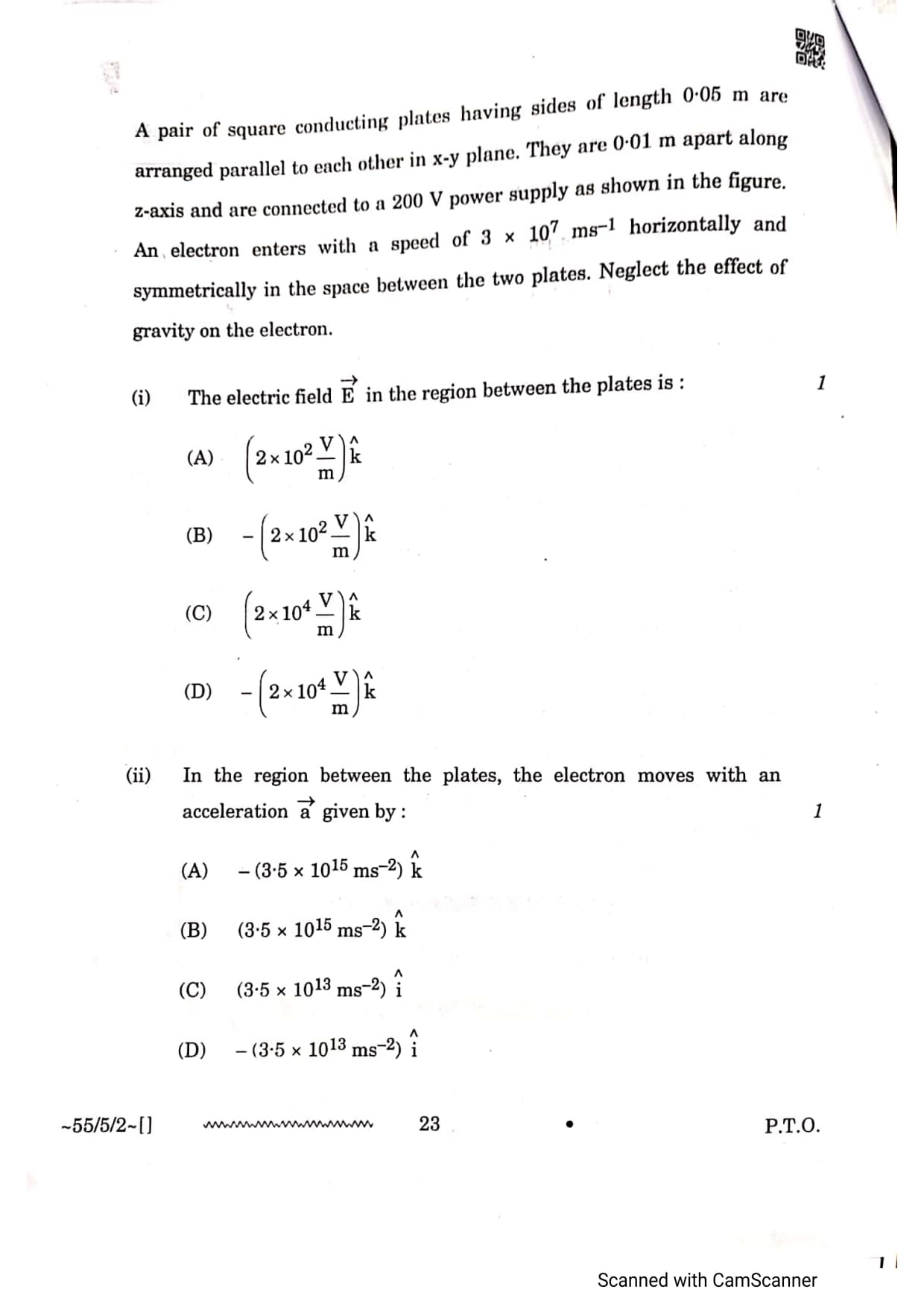
(i) The electric field \(\vec{E}\) in the region between the plates is:
(ii) In the region between the plates, the electron moves with an acceleration \(\vec{a}\) given by:
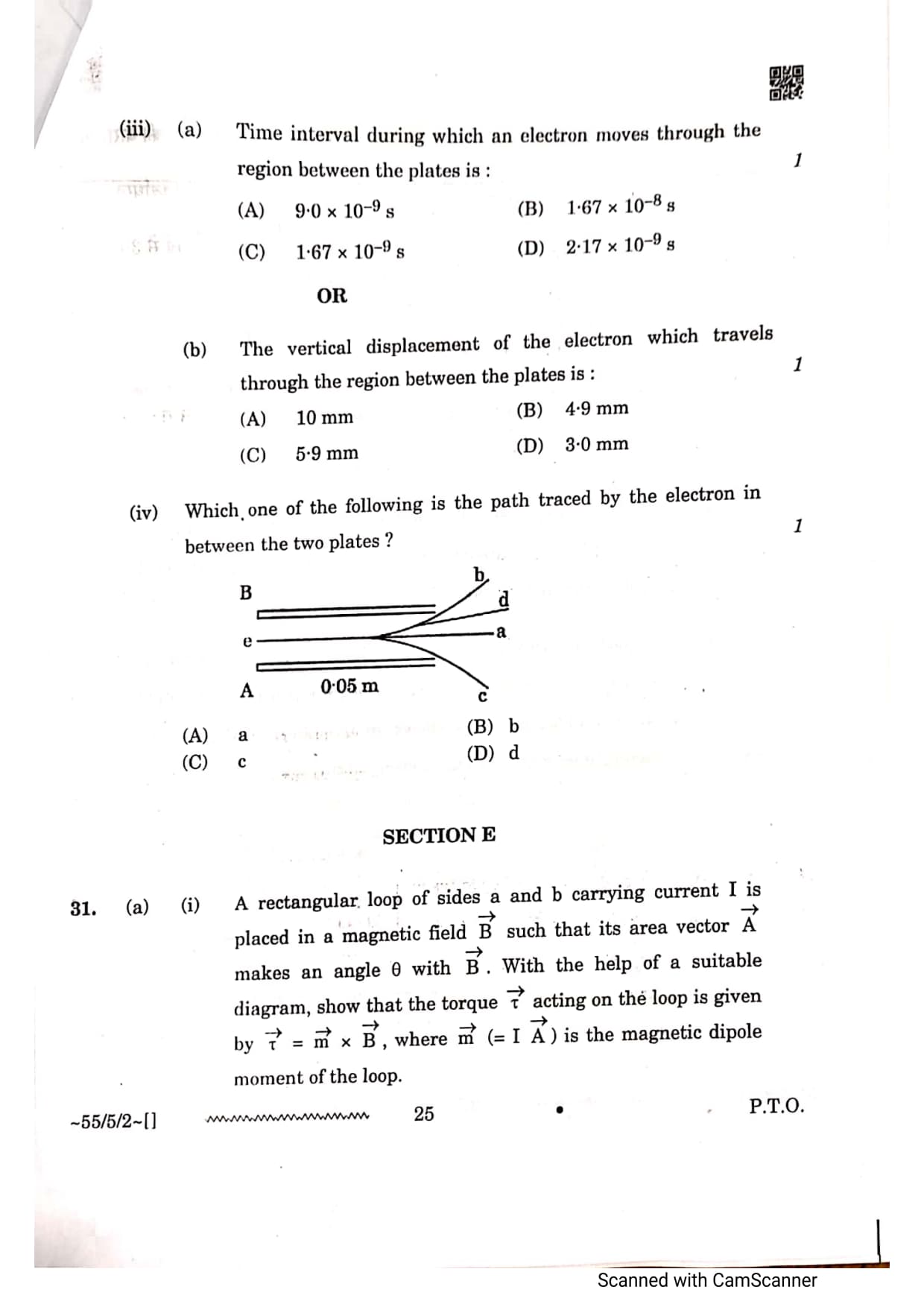
(iii) (a) Time interval during which an electron moves through the region between the plates is: (OR) (b) The vertical displacement of the electron which travels through the region between the plates is:
(iv) Which one of the following is the path traced by the electron in between the two plates?
View Solution
Step 1: Understanding the Concept:
A uniform electric field is established between two parallel plates connected to a potential difference. A charged particle like an electron entering this field experiences a constant force, leading to parabolic motion.
Step 2: Key Formula or Approach:
1. Electric Field: \(E = \frac{V}{d}\).
2. Acceleration: \(a = \frac{eE}{m}\).
3. Time: \(t = \frac{L}{v_x}\).
4. Displacement: \(y = \frac{1}{2}at^2\).
Step 3: Detailed Explanation:
(i) Given \(V = 200\) V and distance \(d = 0.01\) m. \[ E = \frac{200}{0.01} = 2 \times 10^4 V/m \]
Since the top plate is positive and bottom is negative, \(\vec{E}\) points from top to bottom (\(-\hat{k}\)).
Correct Option: (D)
(ii) Force on electron \(\vec{F} = -e\vec{E}\). Since \(\vec{E}\) is in \(-\hat{k}\), the force is in \(+\hat{k}\). \[ a = \frac{1.6 \times 10^{-19} \times 2 \times 10^4}{9.1 \times 10^{-31}} \approx 3.5 \times 10^{15} ms^{-2} \]
Direction: \(+\hat{k}\).
Correct Option: (B)
(iii) (a) Length of plates \(L = 0.05\) m, speed \(v_x = 3 \times 10^7\) ms⁻¹. \[ t = \frac{0.05}{3 \times 10^7} = 1.67 \times 10^{-9} s \]
Correct Option: (C)
(iv) An electron in a transverse electric field follows a parabolic path curved towards the positive plate. In typical diagrams, "b" represents this trajectory.
Correct Option: (B)
Step 4: Final Answer:
(i) \(D\), (ii) \(B\), (iii) \(C\), (iv) \(B\). Quick Tip: The electron is negative, so its acceleration is always in the direction \textbf{opposite} to the electric field vectors.
(a) (i) A rectangular loop of sides a and b carrying current I is placed in a magnetic field B such that its area vector A makes an angle θ with B. With the help of a suitable diagram, show that the torque τ acting on the loop is given by τ = m × B, where m (= I A) is the magnetic dipole moment of the loop.
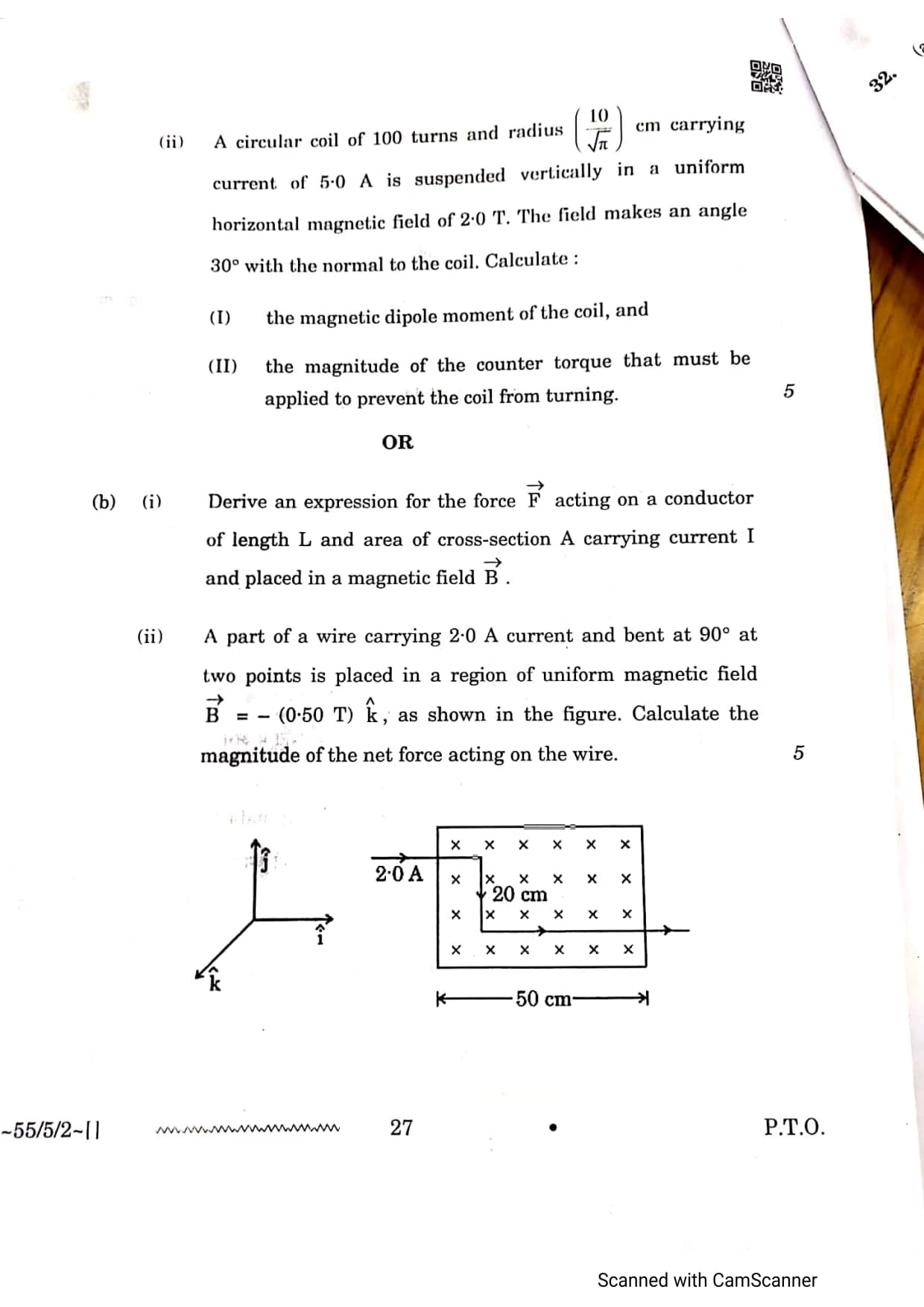
(ii) A circular coil of 100 turns and radius \(\left(\frac{10}{\sqrt{\pi}}\right)\) cm carrying current of 5.0 A is suspended vertically in a uniform horizontal magnetic field of 2.0 T. The field makes an angle 30° with the normal to the coil. Calculate: (I) the magnetic dipole moment of the coil, and (II) the magnitude of the counter torque that must be applied to prevent the coil from turning.
OR
(b) (i) Derive an expression for the force \(\vec{F}\) acting on a conductor of length L and area of cross-section A carrying current I and placed in a magnetic field \(\vec{B}\).
(ii) A part of a wire carrying 2.0 A current and bent at 90° at two points is placed in a region of uniform magnetic field \(\vec{B} = -(0.50 T) \hat{k}\), as shown in the figure. Calculate the magnitude of the net force acting on the wire.
View Solution
Step 1: Understanding the Concept:
A current-carrying loop in a magnetic field experiences forces on its arms. While the net translational force is zero in a uniform field, the forces on opposite arms produce a couple (torque) that tends to rotate the loop.
Step 2: Key Formula or Approach:
1. Torque on a loop: \(\tau = NIAB \sin \theta\).
2. Magnetic Moment: \(m = NIA\).
3. Vector form: \(\vec{\tau} = \vec{m} \times \vec{B}\).
Step 3: Detailed Explanation:
(a) (i) Derivation:
Consider a rectangular loop \(PQRS\) with sides \(a\) and \(b\).
Forces on sides \(QR\) and \(SP\) are equal and opposite along the same line (the axis), so they cancel and produce no torque.
Forces on sides \(PQ\) and \(RS\) are \(F = IbB\). These forces are equal and opposite but act along different lines of action.
The perpendicular distance between these forces is \(a \sin \theta\).
Torque \(\tau = Force \times Perpendicular distance = (IbB)(a \sin \theta)\).
Since Area \(A = ab\), \(\tau = IAB \sin \theta\). For \(N\) turns, \(\tau = NIAB \sin \theta\).
Defining \(\vec{m} = NI\vec{A}\), we get \(\vec{\tau} = \vec{m} \times \vec{B}\).
(ii) Calculation:
Given: \(N = 100\), \(I = 5.0\) A, \(B = 2.0\) T, \(\theta = 30^\circ\).
Radius \(r = \frac{10}{\sqrt{\pi}}\) cm \(= \frac{0.1}{\sqrt{\pi}}\) m.
Area \(A = \pi r^2 = \pi \left(\frac{0.01}{\pi}\right) = 0.01 m^2\).
(I) Magnetic Dipole Moment (m): \[ m = NIA = 100 \times 5.0 \times 0.01 = 5.0 Am^2 \]
(II) Counter Torque:
To prevent turning, the counter torque must equal the magnetic torque: \[ \tau = mB \sin \theta = 5.0 \times 2.0 \times \sin 30^\circ \] \[ \tau = 10 \times 0.5 = 5.0 Nm \]
Step 4: Final Answer:
(I) Magnetic moment is \(5.0\) Am². (II) Counter torque required is \(5.0\) Nm.
For (b):
Step 1: Understanding the Concept:
The force on a current-carrying conductor in a magnetic field results from the Lorentz force acting on the individual moving charge carriers (electrons) within the conductor. For a straight conductor, the total force is the vector sum of these individual forces.
Step 2: Key Formula or Approach:
1. Force on a single charge: \(\vec{f} = q(\vec{v}_d \times \vec{B})\).
2. Total force: \(\vec{F} = N\vec{f}\), where \(N\) is the total number of free electrons.
3. Relation between current and drift velocity: \(I = neAv_d\).
Step 3: Detailed Explanation:
(i) Derivation:
Consider a conductor of length \(L\) and area \(A\) with \(n\) free electrons per unit volume.
Total number of electrons \(N = nAL\).
Total force \(\vec{F} = (nAL) \cdot [-e(\vec{v}_d \times \vec{B})]\).
Rearranging: \(\vec{F} = (neAv_d) \cdot (\vec{L} \times \vec{B})\).
Since \(I = neAv_d\), we get: \[ \vec{F} = I(\vec{L} \times \vec{B}) \]
The magnitude is \(F = ILB \sin \theta\).
(ii) Calculation for the bent wire:
Assuming the wire segments are as follows based on a standard 90° bend problem (e.g., segments of length \(L_1\) along \(x\) and \(L_2\) along \(y\)):
Let segment 1 be from \((0,0,0)\) to \((0.1, 0, 0)\) and segment 2 from \((0.1, 0, 0)\) to \((0.1, 0.1, 0)\).
Current \(I = 2.0\) A, \(\vec{B} = -0.5\hat{k}\).
1. For segment 1 (\(d\vec{L}_1 = 0.1\hat{i}\)): \[ \vec{F}_1 = I(d\vec{L}_1 \times \vec{B}) = 2.0(0.1\hat{i} \times -0.5\hat{k}) = 2.0(0.05\hat{j}) = 0.1\hat{j} N \]
2. For segment 2 (\(d\vec{L}_2 = 0.1\hat{j}\)): \[ \vec{F}_2 = I(d\vec{L}_2 \times \vec{B}) = 2.0(0.1\hat{j} \times -0.5\hat{k}) = 2.0(-0.05\hat{i}) = -0.1\hat{i} N \]
3. Net Force Magnitude: \[ F_{net} = \sqrt{(0.1)^2 + (-0.1)^2} = \sqrt{0.02} = 0.1\sqrt{2} \approx 0.141 N \]
Step 4: Final Answer:
The general expression is \(\vec{F} = I(\vec{L} \times \vec{B})\). For the given bent wire, the magnitude of the net force is \(0.1\sqrt{2}\) N (approximately \(0.141\) N). Quick Tip: Always check if the angle \(\theta\) is given with respect to the \textbf{plane} of the coil or the \textbf{normal} (area vector). If it's with the plane, use \(\cos \theta\); if with the normal, use \(\sin \theta\).
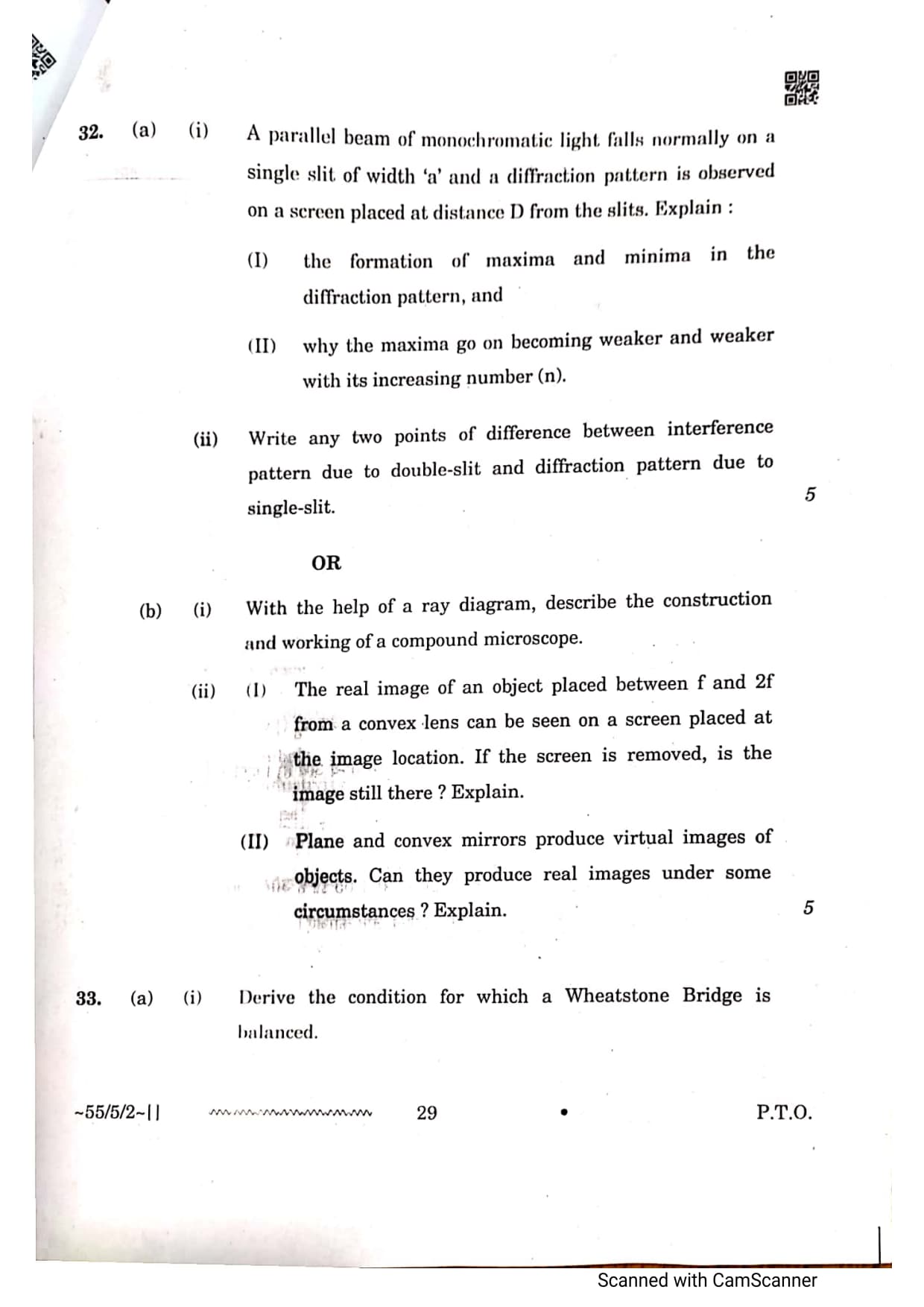
(a) (i) A parallel beam of monochromatic light falls normally on a single slit of width 'a' and a diffraction pattern is observed on a screen placed at distance D from the slits. Explain: (I) the formation of maxima and minima in the diffraction pattern, and (II) why the maxima go on becoming weaker and weaker with its increasing number (n). (ii) Write any two points of difference between interference pattern due to double-slit and diffraction pattern due to single-slit.
OR
(b) (i) With the help of a ray diagram, describe the construction and working of a compound microscope. (ii) (I) The real image of an object placed between f and 2f from a convex lens can be seen on a screen placed at the image location. If the screen is removed, is the image still there? Explain. (II) Plane and convex mirrors produce virtual images of objects. Can they produce real images under some circumstances? Explain.
View Solution
N/A Quick Tip: In a compound microscope, the total magnification is the product of the objective's linear magnification and the eyepiece's angular magnification (\(M = m_o \times m_e\)).
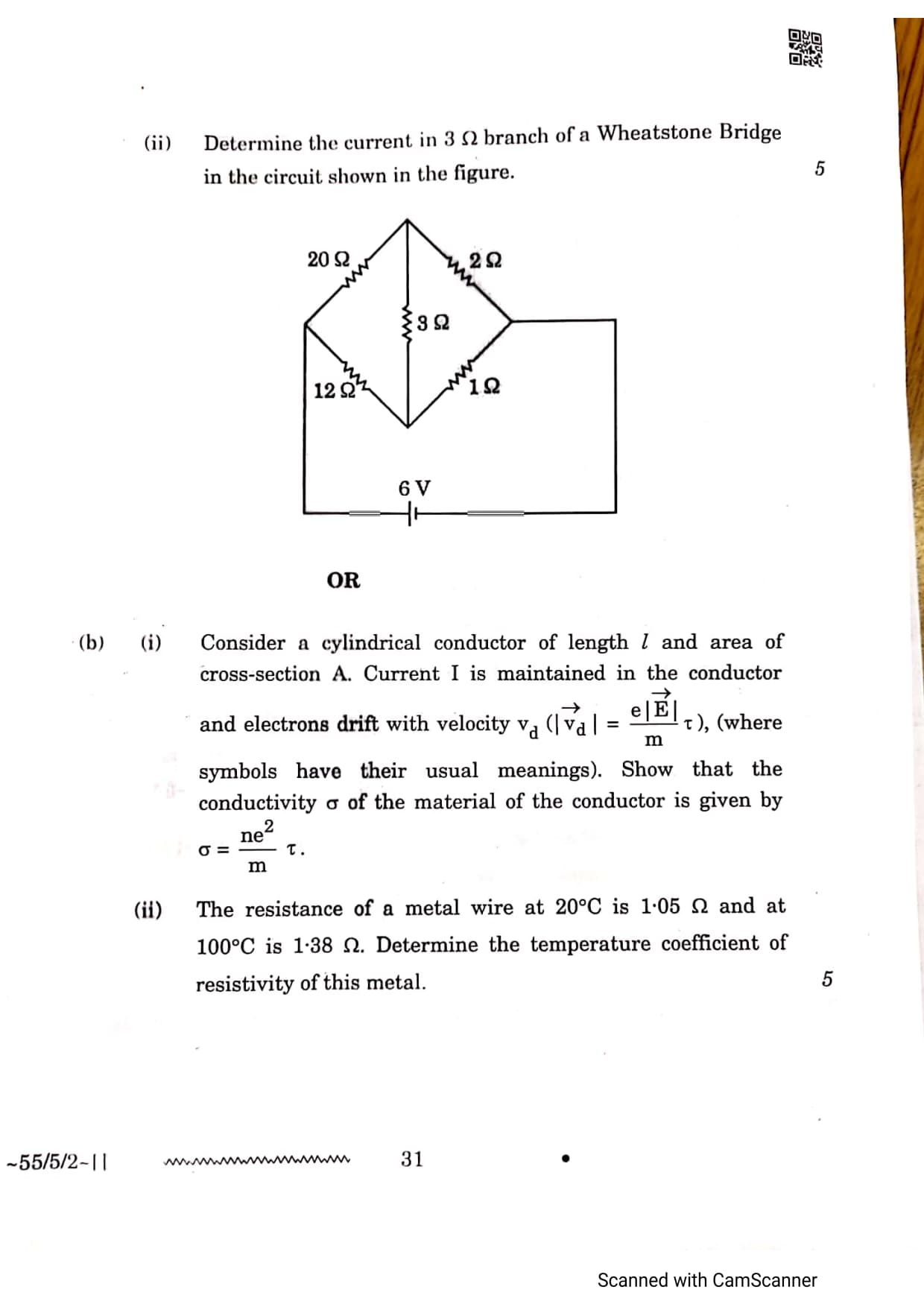
(a) (i) Derive the condition for which a Wheatstone Bridge is balanced.
(ii) Determine the current in 3 Ω branch of a Wheatstone Bridge in the circuit shown in the figure.
OR
(b) (i) Consider a cylindrical conductor of length l and area of cross-section A. Current I is maintained in the conductor and electrons drift with velocity v_d (\(|v_d| = \frac{e|E|}{m} \tau\)), (where symbols have their usual meanings). Show that the conductivity \(\sigma\) of the material of the conductor is given by \(\sigma = \frac{ne^2}{m} \tau\).
(ii) The resistance of a metal wire at 20°C is 1.05 Ω and at 100°C is 1.38 Ω. Determine the temperature coefficient of resistivity of this metal.
View Solution
N/A Quick Tip: Relaxation time (\(\tau\)) decreases as temperature increases because ions vibrate more vigorously, causing more frequent collisions with electrons. This is why resistance increases in metals.





Comments