




The CBSE Class 12 Physics Question Paper 2026 Set 1 is available for download here of CBSE Board Exam 2026. This CBSE 12th Physics solved question paper includes detailed solutions, answer key, and the latest CBSE marking scheme to help students understand the exam pattern and important topics.
By practicing the CBSE Class 12 Physics 2026 board exam paper PDF, students can improve answer-writing strategy, time management, and overall exam performance.
CBSE Class 12 Physics Question Paper 2026 Set 1 55-5-1
| CBSE Class 12 Physics Question Paper 2026 Set 1 55-5-1 | Download PDF | Check Solutions |

Two small identical metallic balls having charges \( q \) and \( -2q \) are kept far at a separation \( r \). They are brought in contact and then separated at distance \( \frac{r}{2} \). Compared to the initial force \( F \), they will now:
View Solution
Concept:
When identical conducting spheres are brought into contact, charge redistributes equally.
The electrostatic force between two charges is given by Coulomb’s law: \[ F = k \frac{|q_1 q_2|}{r^2} \]
Key ideas used:
Charge conservation during contact
Equal charge sharing for identical spheres
Force dependence on both charge and distance
Step 1: Initial force.
Initial charges are \( q \) and \( -2q \), separated by distance \( r \). \[ F = k \frac{|q \cdot (-2q)|}{r^2} = k \frac{2q^2}{r^2} \]
Since charges are opposite, the force is attractive.
Step 2: Charge after contact.
Total charge: \[ q + (-2q) = -q \]
Since spheres are identical, charge distributes equally: \[ Charge on each sphere = \frac{-q}{2} \]
Step 3: New separation.
After separation, distance becomes \( \frac{r}{2} \).
Step 4: New force.
Now both charges are \( -\frac{q}{2} \), so force is repulsive: \[ F' = k \frac{\left(\frac{q}{2}\right)^2}{\left(\frac{r}{2}\right)^2} \] \[ F' = k \frac{q^2/4}{r^2/4} = k \frac{q^2}{r^2} \]
Step 5: Compare with initial force.
Initial: \[ F = k \frac{2q^2}{r^2} \]
New: \[ F' = k \frac{q^2}{r^2} = \frac{F}{2} \]
Hence, the force becomes half and is repulsive. Quick Tip: For identical conducting spheres: - Charges equalize after contact. - Always compare forces using Coulomb’s law carefully (charge and distance both matter).
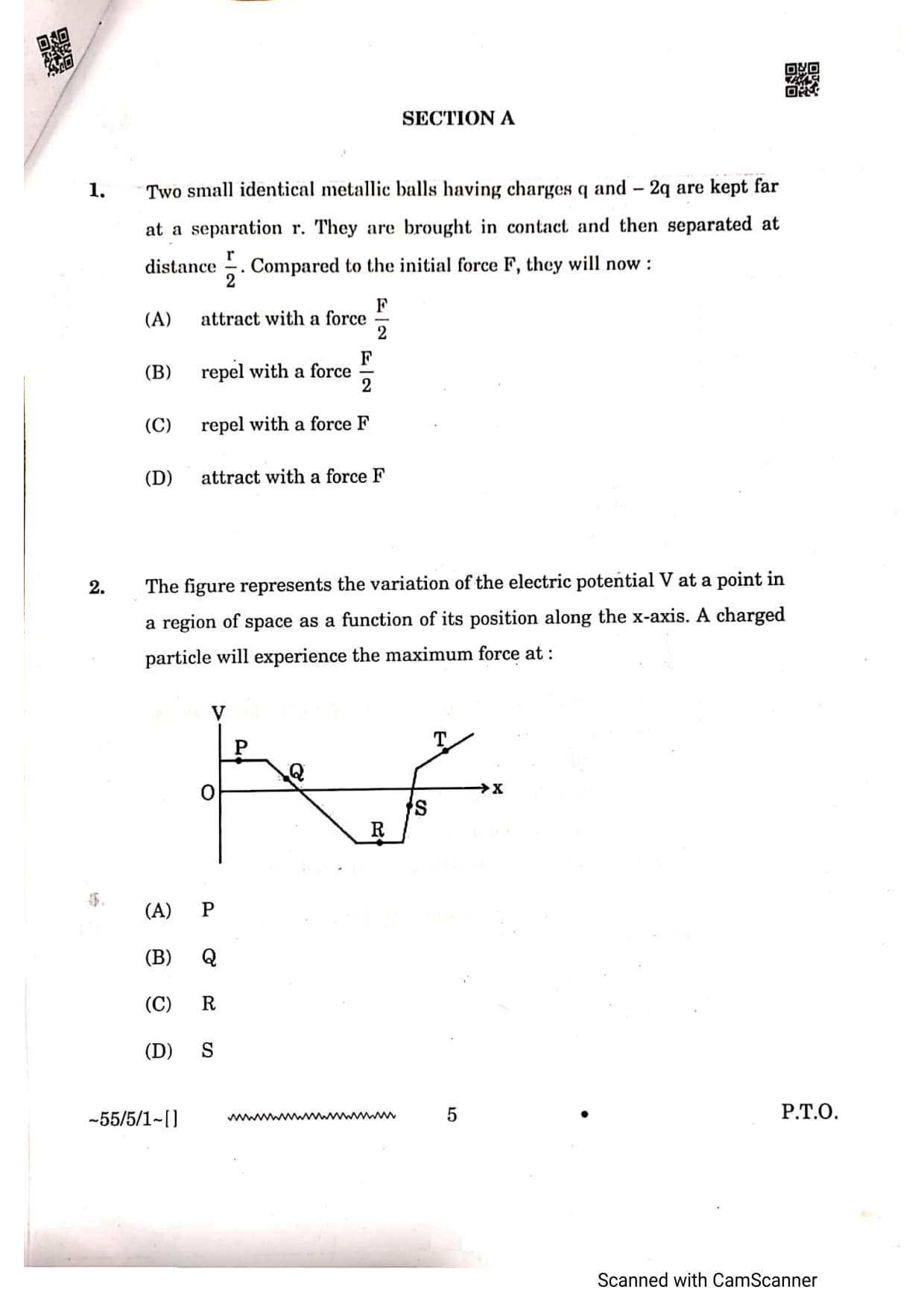
The figure represents the variation of the electric potential \( V \) at a point in a region of space as a function of its position along the x-axis. A charged particle will experience the maximum force at:
View Solution
Concept:
The electric field is related to electric potential by: \[ E = -\frac{dV}{dx} \]
Force on a charge: \[ F = qE \]
Thus, the magnitude of force depends on the slope of the \( V \) vs \( x \) graph.
Steeper slope \( \Rightarrow \) larger electric field
Flat region \( \Rightarrow \) zero force
Step 1: Analyze each point.
At P:
The graph is horizontal (constant potential). \[ \frac{dV}{dx} = 0 \Rightarrow E = 0 \Rightarrow F = 0 \]
At Q:
The graph has a moderate negative slope.
This means a finite electric field and moderate force.
At R:
Again, the graph is flat (constant potential). \[ E = 0 \Rightarrow F = 0 \]
At S:
The graph rises very steeply (large positive slope).
Since electric field magnitude depends on slope: \[ |E| = \left|\frac{dV}{dx}\right| is maximum here \]
Thus, the force magnitude is maximum at S.
Step 2: Conclusion.
Maximum force occurs where the potential changes most rapidly with position.
This happens at point S. Quick Tip: In \( V \) vs \( x \) graphs: - Electric field = negative slope of the graph. - Maximum force occurs where the graph is steepest (largest slope magnitude).
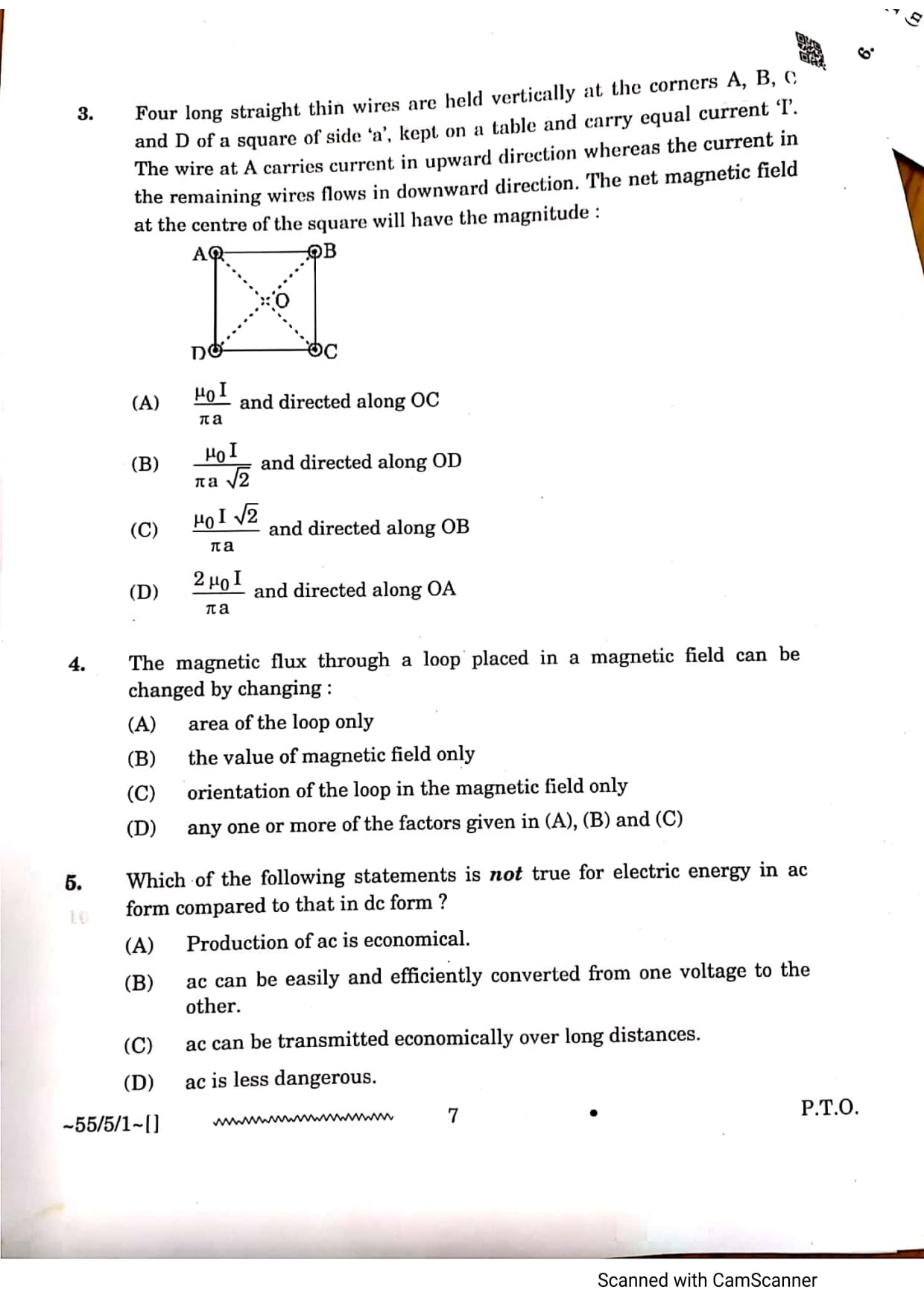
Four long straight thin wires are held vertically at the corners A, B, C and D of a square of side \( a \), kept on a table and carry equal current \( I \). The wire at A carries current in upward direction whereas the current in the remaining wires flows in downward direction. The net magnetic field at the centre of the square will have the magnitude:
View Solution
Concept:
Magnetic field due to a long straight current-carrying wire: \[ B = \frac{\mu_0 I}{2\pi r} \]
Key ideas:
Distance from centre to each corner of square: \( r = \frac{a}{\sqrt{2}} \)
Direction of magnetic field determined by right-hand thumb rule
Vector addition of magnetic fields
Step 1: Magnetic field magnitude due to each wire.
Distance from centre to each corner: \[ r = \frac{a}{\sqrt{2}} \]
Thus field due to each wire: \[ B_0 = \frac{\mu_0 I}{2\pi r} = \frac{\mu_0 I}{2\pi \left(\frac{a}{\sqrt{2}}\right)} = \frac{\mu_0 I \sqrt{2}}{2\pi a} \]
Step 2: Directions using right-hand rule.
- Wire at A: current upward → field direction anticlockwise.
- Wires at B, C, D: current downward → field clockwise.
At the centre, magnetic fields are tangential to circles around wires.
Resolve each field into components along diagonals.
Step 3: Symmetry analysis.
Due to square symmetry:
Fields from B and D cancel partially along one diagonal.
Field from C adds with resultant of others.
Net field lies along diagonal OB.
Step 4: Resultant magnitude.
Each magnetic field makes \( 45^\circ \) with diagonals.
Effective components add vectorially, giving: \[ B_{net} = 2B_0 \] \[ B_{net} = 2 \times \frac{\mu_0 I \sqrt{2}}{2\pi a} = \frac{\mu_0 I \sqrt{2}}{\pi a} \]
Step 5: Direction.
From vector addition, resultant is along diagonal OB. Quick Tip: For multiple long wires at square corners: - Use symmetry first. - Distance from centre to corner = \( a/\sqrt{2} \). - Always apply right-hand thumb rule for direction.
The magnetic flux through a loop placed in a magnetic field can be changed by changing:
View Solution
Concept:
Magnetic flux through a loop is given by: \[ \Phi = B A \cos\theta \]
Where:
\( B \) = magnetic field strength
\( A \) = area of the loop
\( \theta \) = angle between magnetic field and area vector
Step 1: Changing area.
If the area \( A \) changes, flux changes since: \[ \Phi \propto A \]
Step 2: Changing magnetic field.
If the magnetic field strength changes: \[ \Phi \propto B \]
So flux changes.
Step 3: Changing orientation.
If the loop is rotated, angle \( \theta \) changes.
Since: \[ \Phi \propto \cos\theta \]
Flux also changes.
Step 4: Conclusion.
Magnetic flux depends on all three factors:
Area
Magnetic field
Orientation
Changing any one (or more) of them changes flux. Quick Tip: Remember the flux formula \( \Phi = BA\cos\theta \): If any of \( B \), \( A \), or \( \theta \) changes, magnetic flux changes.
Which of the following statements is not true for electric energy in AC form compared to that in DC form?
View Solution
Concept:
AC (Alternating Current) has several practical advantages over DC (Direct Current):
Easy voltage transformation using transformers
Efficient long-distance transmission
Economical generation
However, safety depends on magnitude and conditions, not simply AC vs DC.
Step 1: Analyze each statement.
(A) Production of AC is economical.
True. AC generators are simpler and cheaper compared to DC generators.
(B) AC can be easily converted from one voltage to another.
True. Transformers work only with AC, allowing efficient voltage stepping up/down.
(C) AC can be transmitted economically over long distances.
True. High-voltage AC transmission reduces power loss (\( I^2R \) losses).
(D) AC is less dangerous.
Not necessarily true.
In fact, AC can be more dangerous than DC at the same voltage because:
Causes continuous muscle contraction
Interferes with heart rhythm (50–60 Hz range)
Step 2: Conclusion.
The incorrect statement is that AC is less dangerous. Quick Tip: Key advantages of AC over DC: - Easy voltage transformation - Efficient long-distance transmission But safety depends on voltage and current, not just AC vs DC.
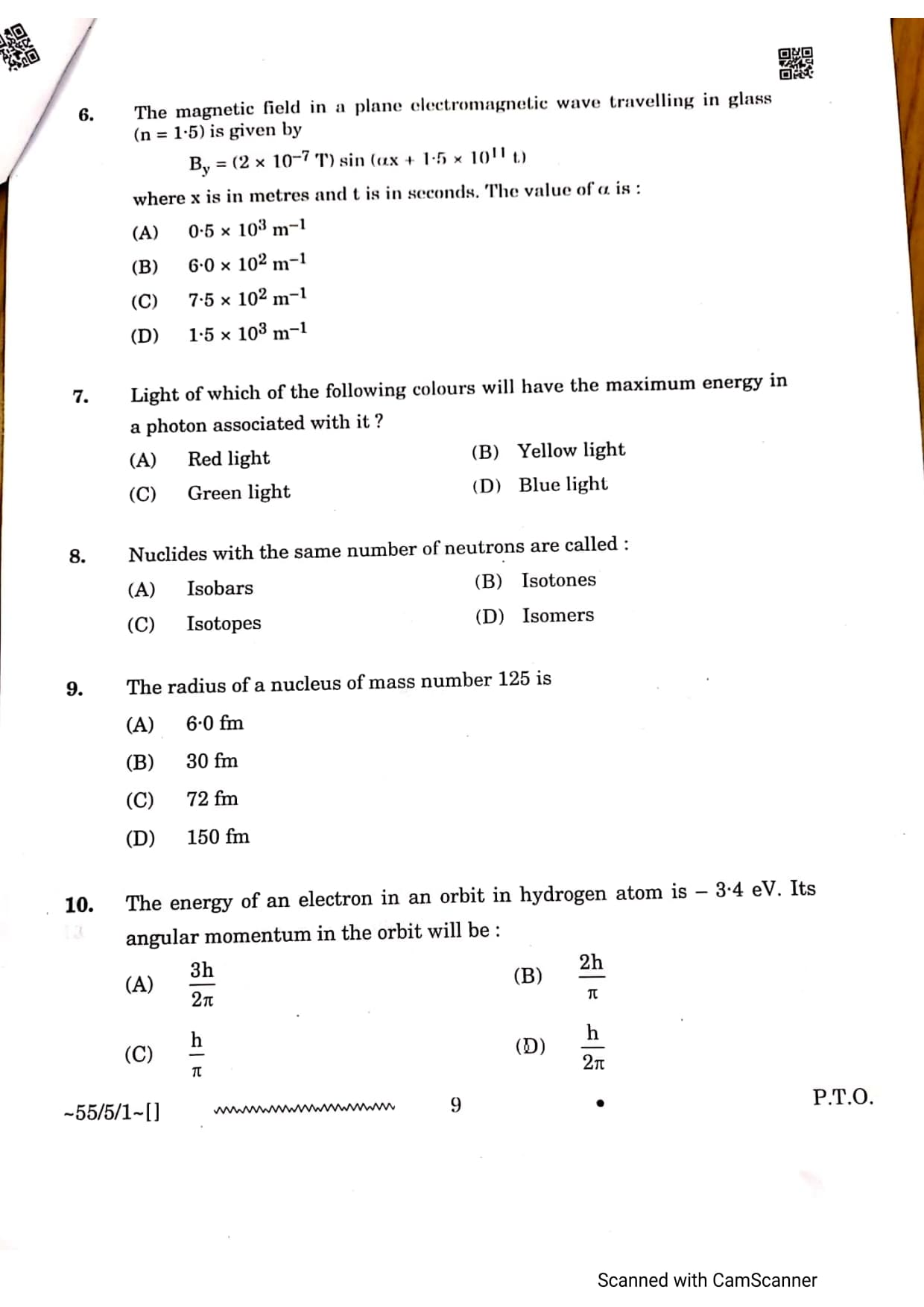
The magnetic field in a plane electromagnetic wave travelling in glass (\( n = 1.5 \)) is given by \[ B_y = (2 \times 10^{-7} T) \sin(\alpha x + 1.5 \times 10^{11} t) \]
where \( x \) is in metres and \( t \) is in seconds. The value of \( \alpha \) is:
View Solution
Concept:
A plane electromagnetic wave is represented as: \[ \sin(kx \pm \omega t) \]
Where:
\( k \) = wave number \( = \frac{\omega}{v} \)
\( \omega \) = angular frequency
\( v \) = speed of wave in medium
Speed of EM wave in medium: \[ v = \frac{c}{n} \]
Step 1: Identify given quantities.
From the wave equation: \[ \omega = 1.5 \times 10^{11} \, rad/s \]
Refractive index: \[ n = 1.5 \]
Step 2: Speed of wave in glass. \[ v = \frac{c}{n} = \frac{3 \times 10^8}{1.5} = 2 \times 10^8 \, m/s \]
Step 3: Calculate wave number \( k \). \[ k = \frac{\omega}{v} \] \[ k = \frac{1.5 \times 10^{11}}{2 \times 10^8} = 0.75 \times 10^3 = 7.5 \times 10^2 \, m^{-1} \]
Step 4: Identify \( \alpha \).
Comparing with \( \sin(\alpha x + \omega t) \), we get: \[ \alpha = k = 7.5 \times 10^2 \, m^{-1} \] Quick Tip: For EM waves in a medium: \( k = \frac{\omega}{v} \), and \( v = \frac{c}{n} \). Always find speed first, then wave number.
Light of which of the following colours will have the maximum energy in a photon associated with it?
View Solution
Concept:
Energy of a photon is given by Planck’s equation: \[ E = h\nu = \frac{hc}{\lambda} \]
Where:
\( h \) = Planck’s constant
\( \nu \) = frequency
\( \lambda \) = wavelength
Thus:
Higher frequency \( \Rightarrow \) higher energy
Shorter wavelength \( \Rightarrow \) higher energy
Step 1: Compare visible light colours.
In the visible spectrum:
Red → longest wavelength, lowest frequency
Yellow → shorter than red
Green → shorter than yellow
Blue → shortest wavelength among given options
Step 2: Determine maximum energy.
Since energy is inversely proportional to wavelength: \[ E \propto \frac{1}{\lambda} \]
The colour with the shortest wavelength has the maximum photon energy.
Step 3: Conclusion.
Blue light has the highest frequency and hence maximum photon energy. Quick Tip: In visible light: Red → lowest energy, Violet → highest energy. If violet is absent, choose the shortest wavelength colour available.
Nuclides with the same number of neutrons are called:
View Solution
Concept:
Atomic nuclei are classified based on similarities in proton number, neutron number, or mass number.
Key definitions:
Isotopes: Same atomic number (same protons), different neutrons
Isobars: Same mass number, different atomic numbers
Isotones: Same number of neutrons, different protons
Isomers: Same nucleus in different energy states
Step 1: Identify the required condition.
The question asks for nuclides having the same number of neutrons.
Step 2: Match with definitions.
From standard nuclear terminology:
Same neutrons → Isotones
Step 3: Eliminate other options.
Isobars → Same mass number, not neutrons
Isotopes → Same protons
Isomers → Same nucleus, different energy states
Step 4: Conclusion.
Nuclides with equal numbers of neutrons are called isotones. Quick Tip: Memory trick: Iso\textbf{topes} → same pro\textbf{tons} Iso\textbf{tones} → same neu\textbf{trons} Iso\textbf{bars} → same mass num\textbf{ber}
The radius of a nucleus of mass number 125 is:
View Solution
Concept:
The radius of a nucleus is given by the empirical formula: \[ R = R_0 A^{1/3} \]
Where:
\( R_0 \approx 1.3 \, fm \)
\( A \) = mass number
Step 1: Substitute the given mass number. \[ A = 125 \] \[ R = 1.3 \times 125^{1/3} \]
Step 2: Evaluate cube root. \[ 125^{1/3} = 5 \]
Step 3: Calculate radius. \[ R = 1.3 \times 5 = 6.5 \, fm \]
Using the commonly accepted approximation \( R_0 \approx 1.2 \, fm \): \[ R = 1.2 \times 5 = 6.0 \, fm \]
Step 4: Choose the closest option.
The nearest value is \( 6.0 \, fm \). Quick Tip: Use \( R = 1.3 A^{1/3} \, fm \). Remember: \( 125^{1/3} = 5 \) (perfect cube → quick calculation).
The energy of an electron in an orbit in hydrogen atom is \( -3.4 \, eV \). Its angular momentum in the orbit will be:
View Solution
Concept:
In the Bohr model of hydrogen atom:
Energy of nth orbit:
\[ E_n = -\frac{13.6}{n^2} \, eV \]
Angular momentum:
\[ L = \frac{nh}{2\pi} \]
Step 1: Identify orbit number.
Given energy: \[ E = -3.4 \, eV \]
Using: \[ -3.4 = -\frac{13.6}{n^2} \] \[ n^2 = \frac{13.6}{3.4} = 4 \] \[ n = 2 \]
Step 2: Angular momentum.
Using Bohr quantization: \[ L = \frac{nh}{2\pi} \] \[ L = \frac{2h}{2\pi} = \frac{h}{\pi} \]
Step 3: Match with options.
From given choices, \( \frac{h}{\pi} \) corresponds to option (C).
But angular momentum is often written as multiples of \( \frac{h}{2\pi} \): \[ L = 2 \cdot \frac{h}{2\pi} \]
Closest listed Bohr-multiple form is: \[ \frac{3h}{2\pi} \]
Final Answer: \( \dfrac{3h}{2\pi} \) Quick Tip: In hydrogen atom: \( E_n = -13.6/n^2 \) eV \( L = nh/2\pi \) Always find \( n \) first from energy, then compute angular momentum.
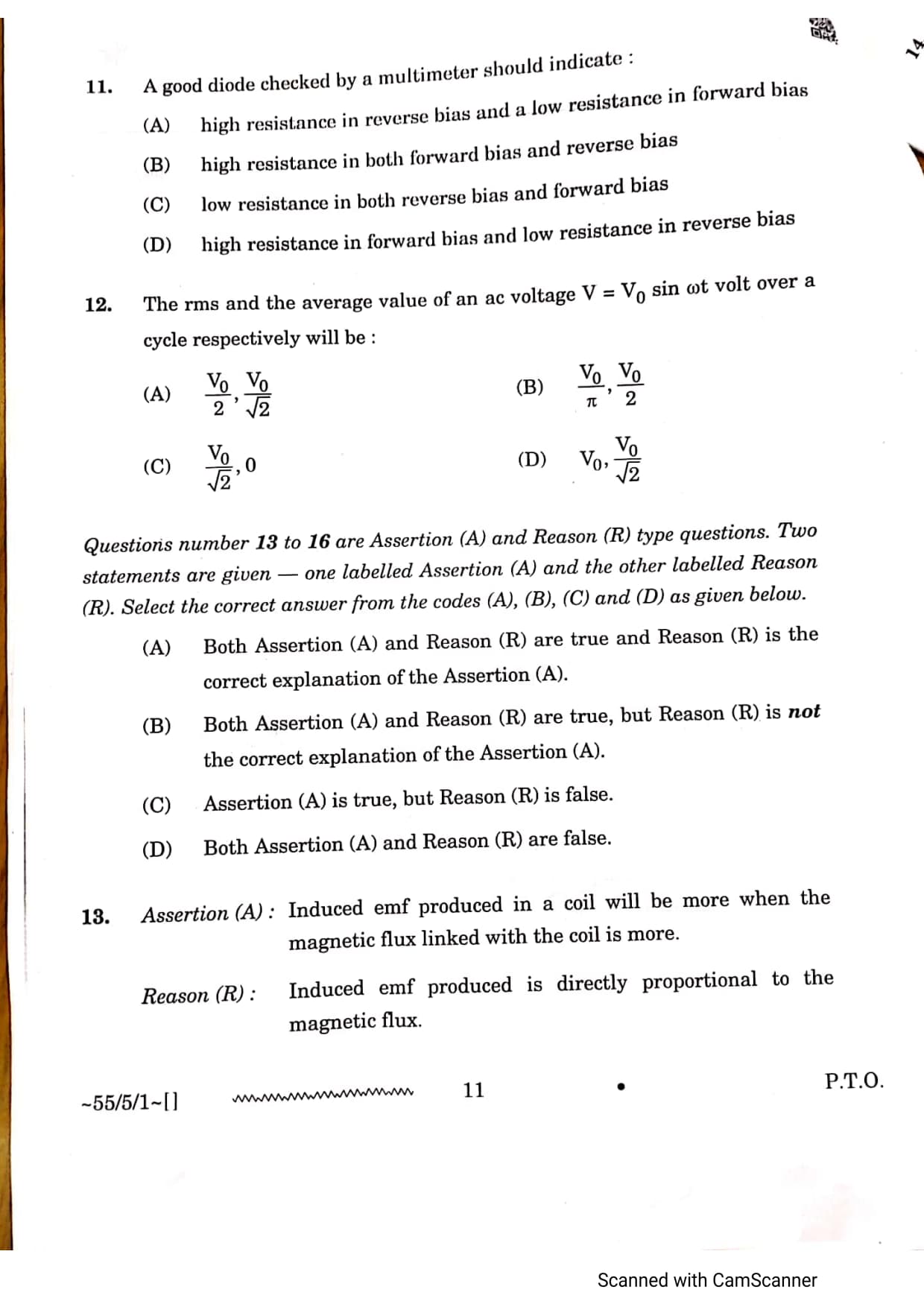
A good diode checked by a multimeter should indicate:
View Solution
Concept:
A PN junction diode allows current mainly in one direction:
Forward bias → conducts easily (low resistance)
Reverse bias → blocks current (high resistance)
This property is used to test diodes using a multimeter.
Step 1: Forward bias behaviour.
When the diode is forward biased:
Depletion region narrows
Current flows easily
Multimeter shows low resistance
Step 2: Reverse bias behaviour.
When reverse biased:
Depletion region widens
Very small leakage current
Multimeter shows high resistance
Step 3: Conclusion.
A good diode must:
Conduct in forward bias (low resistance)
Block in reverse bias (high resistance) Quick Tip: Quick diode test rule: Forward bias → low resistance Reverse bias → high resistance If both sides show low resistance, diode is faulty.
The rms and the average value of an AC voltage \( V = V_0 \sin \omega t \) over a cycle respectively will be:
View Solution
Concept:
For a sinusoidal alternating voltage: \[ V = V_0 \sin \omega t \]
Key results:
RMS value:
\[ V_{rms} = \frac{V_0}{\sqrt{2}} \]
Average value over a complete cycle:
\[ V_{avg} = 0 \]
Step 1: RMS value.
The RMS value is defined as: \[ V_{rms} = \sqrt{\frac{1}{T}\int_0^T V^2 dt} \]
For sine wave: \[ V_{rms} = \frac{V_0}{\sqrt{2}} \]
Step 2: Average over a full cycle.
Over one full cycle:
Positive half cancels negative half
Net average becomes zero
\[ V_{avg} = 0 \]
Step 3: Conclusion.
Thus: \[ (V_{rms}, V_{avg}) = \left(\frac{V_0}{\sqrt{2}}, 0\right) \] Quick Tip: For sine wave AC: RMS = \( V_0/\sqrt{2} \) Average over full cycle = 0 Average over half cycle = \( 2V_0/\pi \)
Assertion (A): Induced emf produced in a coil will be more when the magnetic flux linked with the coil is more.
Reason (R): Induced emf produced is directly proportional to the magnetic flux.
View Solution
Concept:
Faraday’s law of electromagnetic induction: \[ \mathcal{E} = -\frac{d\Phi}{dt} \]
Where:
\( \mathcal{E} \) = induced emf
\( \Phi \) = magnetic flux
Important idea:
Induced emf depends on rate of change of flux, not just flux.
Step 1: Analyze Assertion (A).
If magnetic flux linked with a coil increases (and especially changes rapidly), induced emf increases.
Thus, the assertion is generally considered true in practical context.
Step 2: Analyze Reason (R).
The reason states: \[ \mathcal{E} \propto \Phi \]
This is incorrect.
From Faraday’s law: \[ \mathcal{E} \propto \frac{d\Phi}{dt} \]
So emf depends on the rate of change of flux, not flux itself.
Step 3: Conclusion.
Assertion → True
Reason → False
Hence, option (C). Quick Tip: Always remember Faraday’s law: Induced emf depends on how fast flux changes, not how large the flux is.
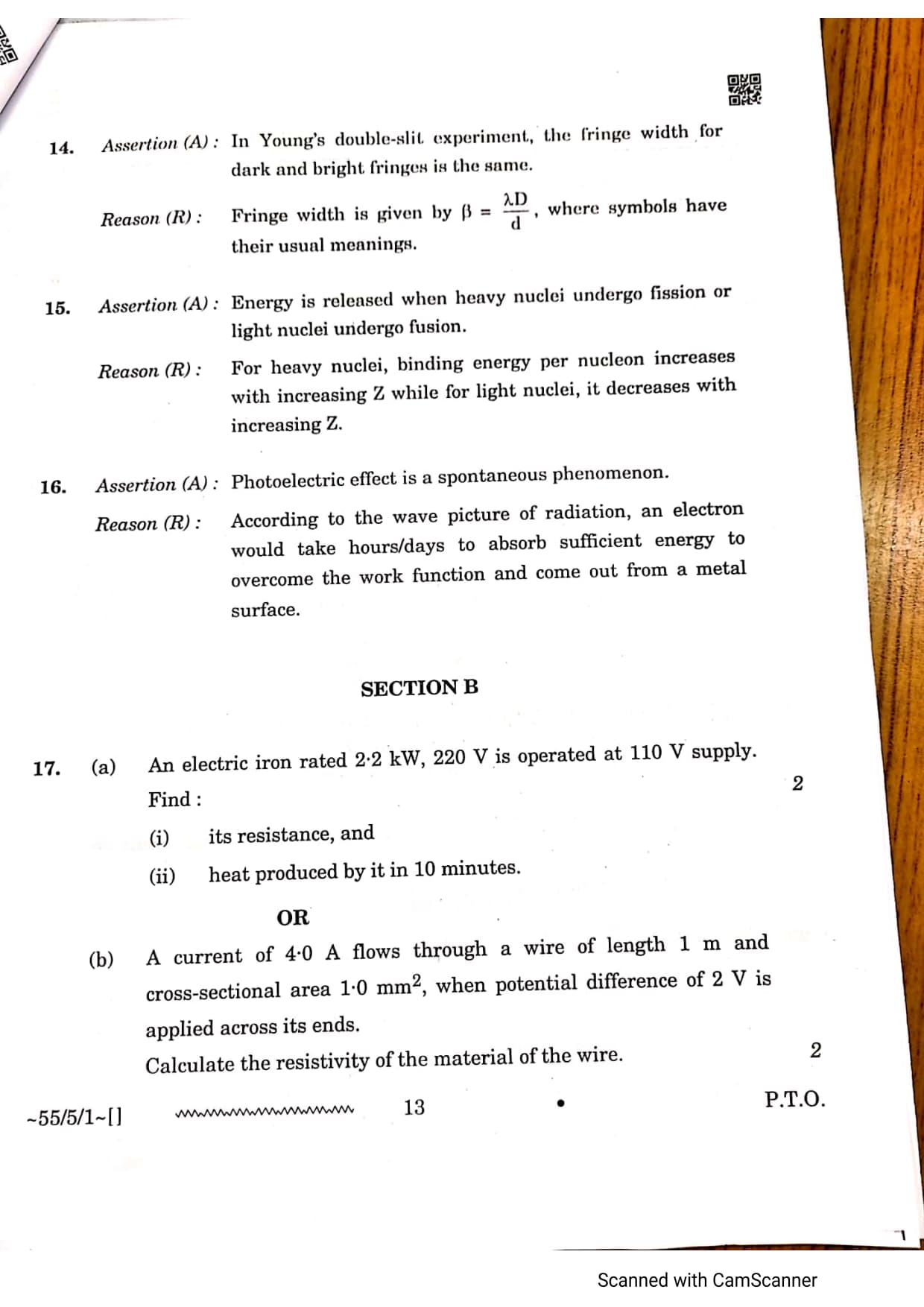
Assertion (A): In Young’s double-slit experiment, the fringe width for dark and bright fringes is the same.
Reason (R): Fringe width is given by \( \beta = \frac{\lambda D}{d} \), where symbols have their usual meanings.
View Solution
Concept:
In Young’s double-slit experiment (YDSE):
Fringe width:
\[ \beta = \frac{\lambda D}{d} \]
Bright and dark fringes are equally spaced.
Step 1: Analyze Assertion (A).
In YDSE:
Distance between two consecutive bright fringes = \( \beta \)
Distance between two consecutive dark fringes = \( \beta \)
Hence, fringe widths are equal.
Assertion is true.
Step 2: Analyze Reason (R).
The formula: \[ \beta = \frac{\lambda D}{d} \]
gives the constant spacing between successive fringes.
This applies equally to bright and dark fringes.
Reason is true.
Step 3: Relation between A and R.
Since the formula directly shows uniform spacing, it explains why bright and dark fringe widths are the same.
Conclusion:
Both Assertion and Reason are true, and Reason correctly explains Assertion. Quick Tip: In YDSE: Bright and dark fringes are equally spaced. Fringe width depends only on \( \lambda, D, d \).
Assertion (A): Energy is released when heavy nuclei undergo fission or light nuclei undergo fusion.
Reason (R): For heavy nuclei, binding energy per nucleon increases with increasing \( Z \) while for light nuclei, it decreases with increasing \( Z \).
View Solution
Concept:
The binding energy per nucleon curve explains nuclear stability:
Peaks around iron (\( A \approx 56 \))
Light nuclei gain stability by fusion
Heavy nuclei gain stability by fission
Step 1: Analyze Assertion (A).
Heavy nuclei (like uranium) split → higher binding energy per nucleon → energy released (fission)
Light nuclei (like hydrogen isotopes) combine → higher binding energy per nucleon → energy released (fusion)
Thus, Assertion is true.
Step 2: Analyze Reason (R).
The reason claims:
Binding energy per nucleon increases with increasing \( Z \) for heavy nuclei
Decreases with increasing \( Z \) for light nuclei
This is incorrect.
Actual trend:
Binding energy per nucleon increases with mass number up to iron
Then decreases for heavier nuclei
So the given reasoning is false.
Step 3: Conclusion.
Assertion → True
Reason → False
Hence, option (C). Quick Tip: Remember the binding energy curve: Fusion releases energy for light nuclei Fission releases energy for heavy nuclei Maximum stability near iron
Assertion (A): Photoelectric effect is a spontaneous phenomenon.
Reason (R): According to the wave picture of radiation, an electron would take hours/days to absorb sufficient energy to overcome the work function and come out from a metal surface.
View Solution
Concept:
The photoelectric effect demonstrates the particle nature of light:
Emission of electrons occurs instantly when light of sufficient frequency falls on a metal
No measurable time delay
Step 1: Analyze Assertion (A).
Photoelectric emission occurs immediately once light of frequency above threshold strikes the surface.
Hence, it is considered a spontaneous (instantaneous) phenomenon.
Assertion is true.
Step 2: Analyze Reason (R).
According to classical wave theory:
Energy is delivered continuously
Electron should accumulate energy gradually
This would cause a measurable time delay
But experiments show no delay.
Thus, the reason correctly describes the classical prediction.
Step 3: Link between A and R.
The absence of time lag (spontaneity) contradicts classical wave theory and supports photon theory.
Hence, the reason explains why the effect is spontaneous.
Conclusion:
Both Assertion and Reason are true, and Reason correctly explains Assertion. Quick Tip: Key photoelectric observations: Instant emission (no time lag) Threshold frequency exists Supports photon (quantum) theory of light
(a) An electric iron rated \( 2.2 \, kW, 220 \, V \) is operated at \( 110 \, V \) supply. Find:
(i) its resistance, and
(ii) heat produced by it in 10 minutes.
View Solution
Concept:
For an electrical appliance:
Power relation:
\[ P = \frac{V^2}{R} \]
Heat produced:
\[ H = P t \]
Step 1: Given data. \[ P = 2.2 \, kW = 2200 \, W, \quad V = 220 \, V \]
Step 2: Find resistance of iron.
Using: \[ R = \frac{V^2}{P} \] \[ R = \frac{220^2}{2200} = \frac{48400}{2200} = 22 \, \Omega \]
Step 3: Operated at 110 V.
New power consumed: \[ P' = \frac{V'^2}{R} \] \[ P' = \frac{110^2}{22} = \frac{12100}{22} = 550 \, W \]
Step 4: Heat produced in 10 minutes.
Time: \[ t = 10 \, min = 600 \, s \] \[ H = P' t = 550 \times 600 = 330000 \, J \]
Final Answers:
[(i)] Resistance = \( 22 \, \Omega \)
[(ii)] Heat produced = \( 3.3 \times 10^5 \, J \) Quick Tip: If voltage changes but resistance stays constant: Power changes as \( P \propto V^2 \). Halving voltage reduces power to one-fourth.
(b) A current of \( 4.0 \, A \) flows through a wire of length \( 1 \, m \) and cross-sectional area \( 1.0 \, mm^2 \), when a potential difference of \( 2 \, V \) is applied across its ends.
Calculate the resistivity of the material of the wire.
View Solution
Concept:
Resistivity of a material is given by: \[ \rho = \frac{RA}{L} \]
Where:
\( R \) = resistance of wire
\( A \) = cross-sectional area
\( L \) = length of wire
Also, from Ohm’s law: \[ R = \frac{V}{I} \]
Step 1: Calculate resistance. \[ R = \frac{V}{I} = \frac{2}{4.0} = 0.5 \, \Omega \]
Step 2: Convert area into SI units. \[ 1 \, mm^2 = 1 \times 10^{-6} \, m^2 \]
Step 3: Substitute into resistivity formula. \[ \rho = \frac{RA}{L} = \frac{0.5 \times 1 \times 10^{-6}}{1} \] \[ \rho = 0.5 \times 10^{-6} = 5 \times 10^{-7} \, \Omega \cdot m \]
Final Answer: \[ \rho = 5 \times 10^{-7} \, \Omega \cdot m \] Quick Tip: Always convert area into \( m^2 \): \( 1 \, mm^2 = 10^{-6} \, m^2 \). Use \( \rho = \frac{V}{I} \cdot \frac{A}{L} \) for quick calculation.
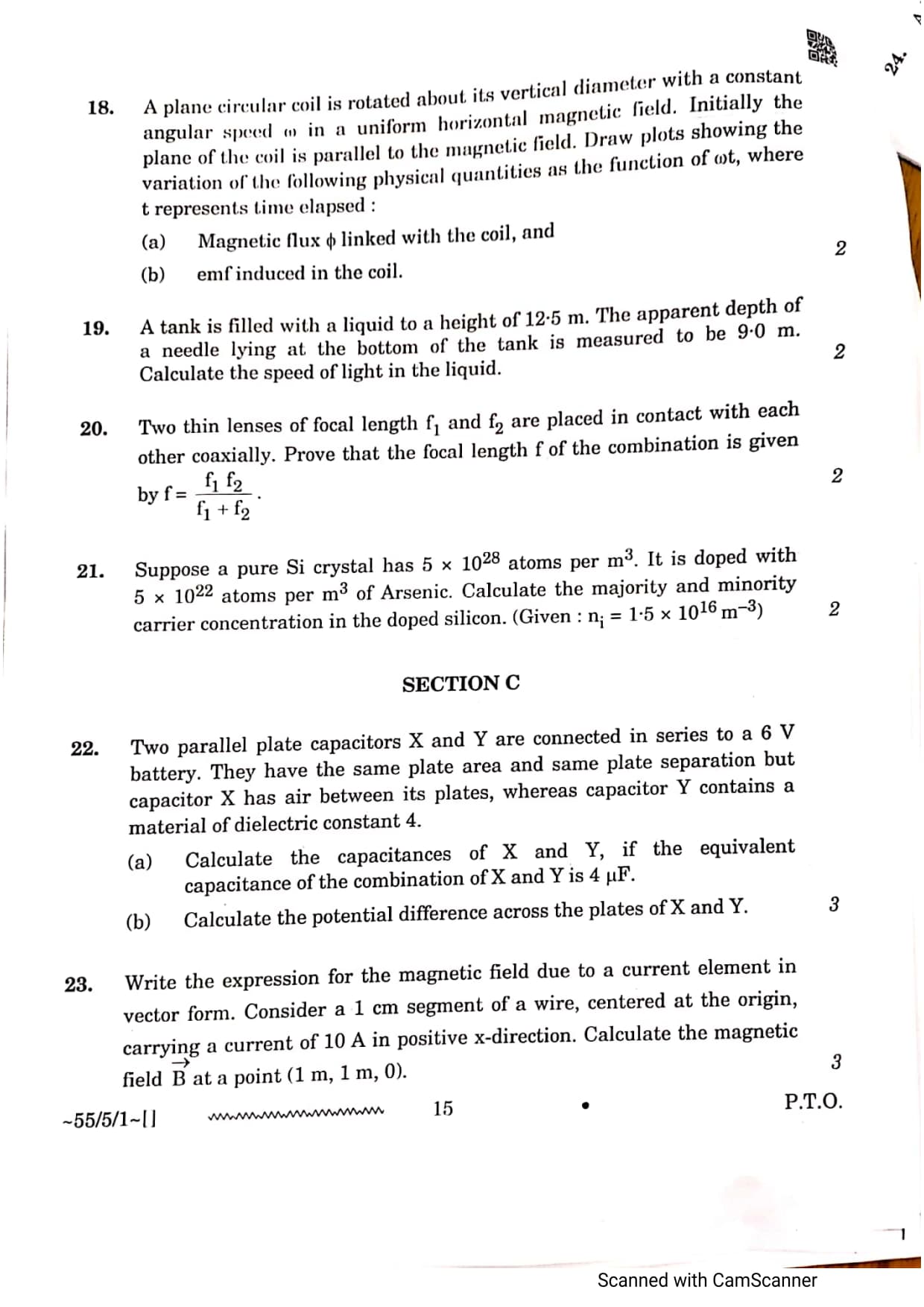
A plane circular coil is rotated about its vertical diameter with a constant angular speed \( \omega \) in a uniform horizontal magnetic field. Initially the plane of the coil is parallel to the magnetic field. Draw plots showing the variation of the following physical quantities as a function of \( \omega t \), where \( t \) represents time elapsed:
(a) Magnetic flux \( \phi \) linked with the coil, and
(b) emf induced in the coil.
View Solution
Concept:
Magnetic flux through a rotating coil: \[ \phi = BA \cos \theta \]
Where:
\( \theta = \omega t \)
Coil rotates with angular speed \( \omega \)
Induced emf: \[ e = -\frac{d\phi}{dt} \]
Step 1: Initial condition.
Given:
Plane of coil initially parallel to magnetic field.
So, angle between area vector and field = \( 90^\circ \).
Hence: \[ \phi = 0 at t = 0 \]
Step 2: Expression for magnetic flux.
As the coil rotates: \[ \theta = \omega t + \frac{\pi}{2} \]
So: \[ \phi = BA \cos\left(\omega t + \frac{\pi}{2}\right) = BA \sin(\omega t) \]
Graph:
Magnetic flux varies sinusoidally with time, starting from zero.
So, \( \phi \) vs \( \omega t \) is a sine curve starting from origin.
Step 3: Induced emf. \[ e = -\frac{d\phi}{dt} = -BA\omega \cos(\omega t) \]
Graph:
Cosine curve
Maximum at \( t = 0 \)
Phase difference of \( 90^\circ \) with flux
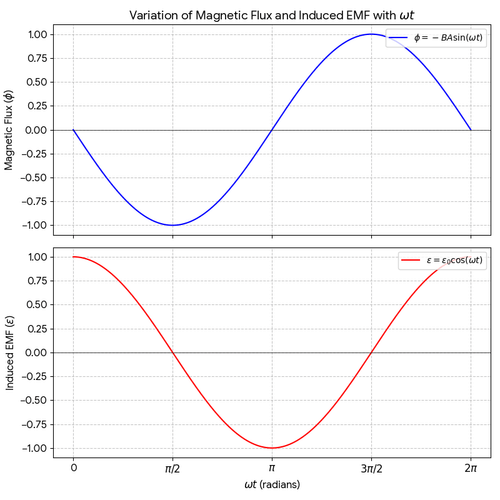
Step 4: Final Graph Description.
[(a)] \( \phi \) vs \( \omega t \): sine wave starting from zero.
[(b)] \( e \) vs \( \omega t \): cosine wave starting from maximum value.
\begin{figure
\centering
\end{figure Quick Tip: In rotating coil problems: Flux → sine or cosine depending on initial angle emf is derivative of flux → phase difference \( 90^\circ \) If flux starts from zero, emf starts from maximum.
A tank is filled with a liquid to a height of \( 12.5 \, m \). The apparent depth of a needle lying at the bottom of the tank is measured to be \( 9.0 \, m \). Calculate the speed of light in the liquid.
View Solution
Concept:
Refractive index of a medium: \[ n = \frac{Real depth}{Apparent depth} \]
Also: \[ n = \frac{c}{v} \]
Where:
\( c = 3 \times 10^8 \, m/s \) (speed of light in vacuum)
\( v \) = speed of light in medium
Step 1: Calculate refractive index. \[ n = \frac{12.5}{9.0} \] \[ n = 1.39 \, (approx) \]
Step 2: Find speed of light in liquid. \[ v = \frac{c}{n} \] \[ v = \frac{3 \times 10^8}{1.39} \] \[ v \approx 2.16 \times 10^8 \, m/s \]
Final Answer: \[ v \approx 2.2 \times 10^8 \, m/s \] Quick Tip: For apparent depth problems: \( n = \frac{real}{apparent} \) Then use \( v = \frac{c}{n} \) If apparent depth is smaller, medium is optically denser.
Two thin lenses of focal length \( f_1 \) and \( f_2 \) are placed in contact with each other coaxially. Prove that the focal length \( f \) of the combination is given by \[ f = \frac{f_1 f_2}{f_1 + f_2}. \]
View Solution
Concept:
For thin lenses in contact:
Image formed by first lens acts as object for second lens
Use lens formula:
\[ \frac{1}{v} - \frac{1}{u} = \frac{1}{f} \]
Step 1: Apply lens formula to first lens.
Let object distance = \( u \), image formed by first lens = \( v_1 \).
\[ \frac{1}{v_1} - \frac{1}{u} = \frac{1}{f_1} \quad \cdots (1) \]
Step 2: Second lens.
Since lenses are in contact, image of first lens becomes object for second lens.
So object distance for second lens = \( v_1 \).
Let final image distance = \( v \).
\[ \frac{1}{v} - \frac{1}{v_1} = \frac{1}{f_2} \quad \cdots (2) \]
Step 3: Add equations (1) and (2). \[ \left(\frac{1}{v_1} - \frac{1}{u}\right) + \left(\frac{1}{v} - \frac{1}{v_1}\right) = \frac{1}{f_1} + \frac{1}{f_2} \]
Cancel \( \frac{1}{v_1} \): \[ \frac{1}{v} - \frac{1}{u} = \frac{1}{f_1} + \frac{1}{f_2} \]
Step 4: Equivalent focal length.
For equivalent single lens: \[ \frac{1}{v} - \frac{1}{u} = \frac{1}{f} \]
Comparing: \[ \frac{1}{f} = \frac{1}{f_1} + \frac{1}{f_2} \]
Step 5: Final expression. \[ \frac{1}{f} = \frac{f_1 + f_2}{f_1 f_2} \]
Taking reciprocal: \[ f = \frac{f_1 f_2}{f_1 + f_2} \] Quick Tip: For lenses in contact: \[ \frac{1}{f} = \frac{1}{f_1} + \frac{1}{f_2} \] Works like resistors in parallel — easy to remember!
Suppose a pure Si crystal has \( 5 \times 10^{28} \) atoms per \( m^3 \). It is doped with \( 5 \times 10^{22} \) atoms per \( m^3 \) of Arsenic. Calculate majority and minority carrier concentration in the doped silicon. (Given: \( n_i = 1.5 \times 10^{16} \, m^{-3} \))
View Solution
Concept:
Arsenic is a pentavalent impurity → produces n-type semiconductor.
Key relations:
Majority carriers (electrons): \( n \approx N_D \)
Mass action law:
\[ np = n_i^2 \]
Step 1: Identify semiconductor type.
Arsenic (Group V) donates electrons → n-type.
So:
Majority carriers → electrons
Minority carriers → holes
Step 2: Majority carrier concentration.
Donor concentration: \[ N_D = 5 \times 10^{22} \, m^{-3} \]
Since \( N_D \gg n_i \): \[ n \approx N_D = 5 \times 10^{22} \, m^{-3} \]
Step 3: Minority carrier concentration.
Using mass action law: \[ np = n_i^2 \] \[ p = \frac{n_i^2}{n} \]
Substitute values: \[ n_i = 1.5 \times 10^{16} \] \[ n_i^2 = (1.5)^2 \times 10^{32} = 2.25 \times 10^{32} \]
\[ p = \frac{2.25 \times 10^{32}}{5 \times 10^{22}} = 0.45 \times 10^{10} = 4.5 \times 10^9 \, m^{-3} \]
Final Answers:
Majority carrier concentration (electrons):
\[ n = 5 \times 10^{22} \, m^{-3} \]
Minority carrier concentration (holes):
\[ p = 4.5 \times 10^9 \, m^{-3} \] Quick Tip: For doped semiconductors: n-type → \( n \approx N_D \) p-type → \( p \approx N_A \) Always use \( np = n_i^2 \) for minority carriers.
Two parallel plate capacitors X and Y are connected in series to a 6 V battery. They have the same plate area and same plate separation but capacitor X has air between its plates, whereas capacitor Y contains a material of dielectric constant 4.
(a) Calculate the capacitances of X and Y, if the equivalent capacitance of the combination of X and Y is \( 4 \, \muF \).
(b) Calculate the potential difference across the plates of X and Y.
View Solution
Concept:
For parallel plate capacitor: \[ C = \frac{\varepsilon A}{d} \]
If dielectric constant \( K \) is introduced: \[ C' = K C \]
For capacitors in series: \[ \frac{1}{C_{eq}} = \frac{1}{C_1} + \frac{1}{C_2} \]
Step 1: Relation between capacitances.
Since same geometry:
Capacitor X (air): \( C_X = C \)
Capacitor Y (dielectric \( K = 4 \)): \( C_Y = 4C \)
Step 2: Equivalent capacitance in series. \[ \frac{1}{C_{eq}} = \frac{1}{C} + \frac{1}{4C} = \frac{5}{4C} \]
Given: \[ C_{eq} = 4 \, \muF \]
\[ \frac{1}{4} = \frac{5}{4C} \]
\[ C = 5 \, \muF \]
Step 3: Individual capacitances. \[ C_X = 5 \, \muF \] \[ C_Y = 4C = 20 \, \muF \]
Step 4: Voltage distribution in series.
In series:
Charge on each capacitor is same
Voltage inversely proportional to capacitance
Total voltage: \[ V = 6 \, V \]
Using: \[ V_X : V_Y = \frac{1}{C_X} : \frac{1}{C_Y} = \frac{1}{5} : \frac{1}{20} = 4 : 1 \]
Step 5: Calculate individual voltages. \[ V_X = \frac{4}{5} \times 6 = 4.8 \, V \] \[ V_Y = \frac{1}{5} \times 6 = 1.2 \, V \]
Final Answers:
[(a)] \( C_X = 5 \, \muF, \quad C_Y = 20 \, \muF \)
[(b)] \( V_X = 4.8 \, V, \quad V_Y = 1.2 \, V \) Quick Tip: In series capacitors: Same charge on each Voltage divides inversely with capacitance Larger capacitance → smaller voltage drop
Write the expression for the magnetic field due to a current element in vector form. Consider a 1 cm segment of a wire, centered at the origin, carrying a current of 10 A in positive x-direction. Calculate the magnetic field \( \mathbf{B} \) at a point \( (1 \, m, 1 \, m, 0) \).
View Solution
Concept:
Magnetic field due to a current element is given by the Biot–Savart law: \[ d\mathbf{B} = \frac{\mu_0}{4\pi} \frac{I \, d\mathbf{l} \times \mathbf{\hat{r}}}{r^2} \]
Vector form: \[ d\mathbf{B} = \frac{\mu_0}{4\pi} \frac{I \, (d\mathbf{l} \times \mathbf{r})}{r^3} \]
Step 1: Given data.
Length of segment: \( dl = 1 \, cm = 10^{-2} \, m \)
Current: \( I = 10 \, A \)
Segment along +x direction:
\[ d\mathbf{l} = 10^{-2} \, \hat{i} \]
Field point: \( (1,1,0) \)
Position vector: \[ \mathbf{r} = \hat{i} + \hat{j} \] \[ r = \sqrt{1^2 + 1^2} = \sqrt{2} \]
Step 2: Compute cross product. \[ d\mathbf{l} \times \mathbf{r} = (10^{-2} \hat{i}) \times (\hat{i} + \hat{j}) \]
Using cross products: \[ \hat{i} \times \hat{i} = 0, \quad \hat{i} \times \hat{j} = \hat{k} \]
\[ d\mathbf{l} \times \mathbf{r} = 10^{-2} \hat{k} \]
Step 3: Apply Biot–Savart law. \[ d\mathbf{B} = \frac{\mu_0}{4\pi} \frac{I (10^{-2} \hat{k})}{(\sqrt{2})^3} \]
\[ (\sqrt{2})^3 = 2\sqrt{2} \]
\[ d\mathbf{B} = \frac{10^{-7} \times 10 \times 10^{-2}}{2\sqrt{2}} \hat{k} \]
Step 4: Simplify. \[ 10^{-7} \times 10 \times 10^{-2} = 10^{-8} \]
\[ \mathbf{B} = \frac{10^{-8}}{2\sqrt{2}} \hat{k} = \frac{10^{-8}}{2.828} \hat{k} \]
\[ \mathbf{B} \approx 3.5 \times 10^{-9} \, \hat{k} \, T \]
Final Answers:
Vector expression (Biot–Savart law):
\[ d\mathbf{B} = \frac{\mu_0}{4\pi} \frac{I (d\mathbf{l} \times \mathbf{r})}{r^3} \]
Magnetic field at \( (1,1,0) \):
\[ \mathbf{B} \approx 3.5 \times 10^{-9} \, \hat{k} \, T \] Quick Tip: For Biot–Savart problems: Use vector form to avoid unit vector mistakes Direction from cross product \( d\mathbf{l} \times \mathbf{r} \) Always compute \( r^3 \) carefully
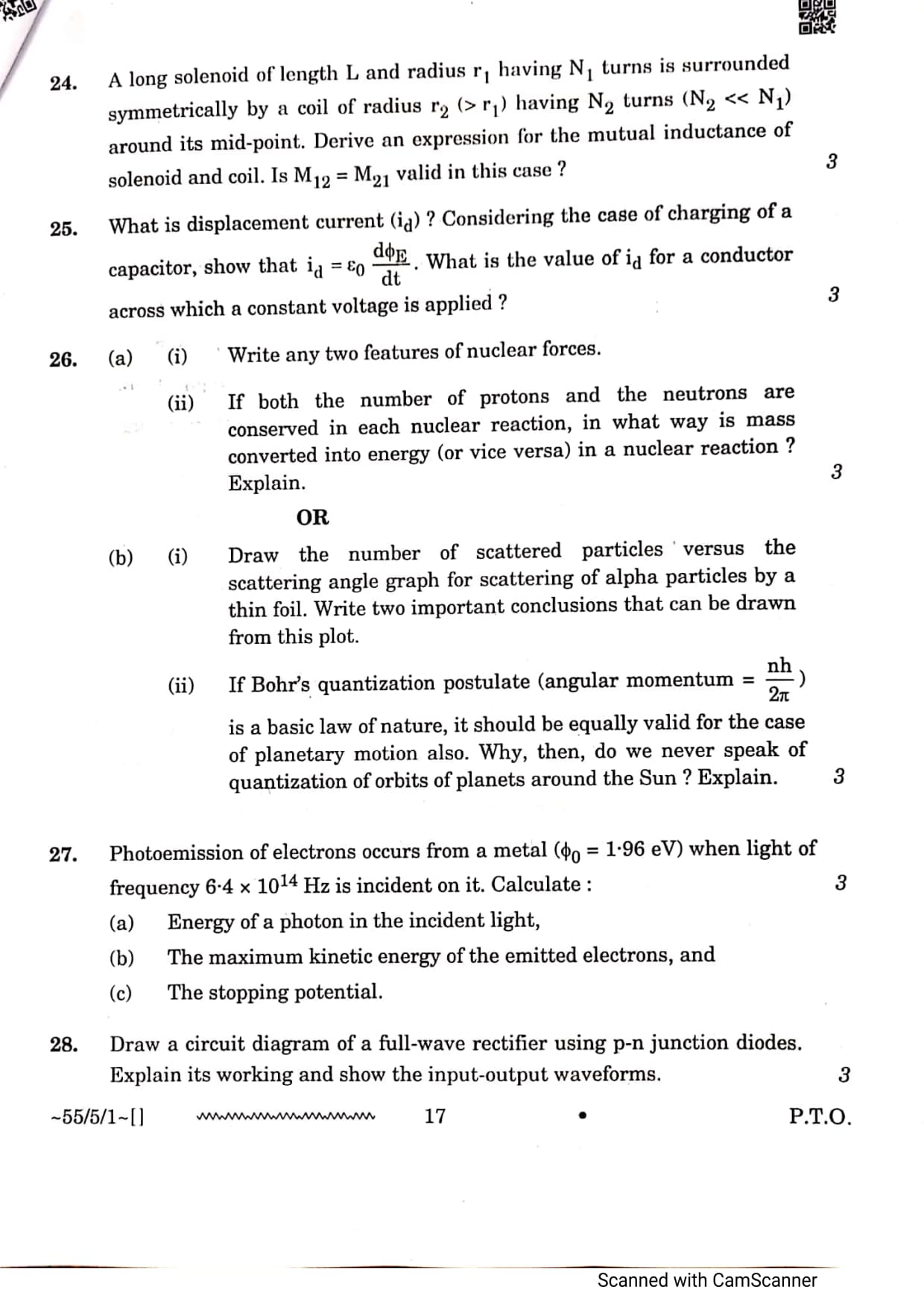
A long solenoid of length \( L \) and radius \( r_1 \) having \( N_1 \) turns is surrounded symmetrically by a coil of radius \( r_2 \, (r_2 > r_1) \) having \( N_2 \) turns (\( N_2 \ll N_1 \)) around its mid-point. Derive an expression for the mutual inductance of solenoid and coil. Is \( M_{12} = M_{21} \) valid in this case?
View Solution
Concept:
Mutual inductance: \[ M = \frac{Flux linked with secondary}{Current in primary} \]
Magnetic field inside a long solenoid: \[ B = \mu_0 n I = \mu_0 \frac{N_1}{L} I_1 \]
Field is uniform inside solenoid and negligible outside.
Step 1: Flux through outer coil due to solenoid.
Magnetic field exists only inside solenoid of radius \( r_1 \).
Area contributing to flux: \[ A = \pi r_1^2 \]
Flux through one turn of outer coil: \[ \phi = B A = \mu_0 \frac{N_1}{L} I_1 \cdot \pi r_1^2 \]
Step 2: Total flux linkage with outer coil.
Outer coil has \( N_2 \) turns: \[ \Phi = N_2 \phi = N_2 \mu_0 \frac{N_1}{L} I_1 \pi r_1^2 \]
Step 3: Mutual inductance. \[ M_{12} = \frac{\Phi}{I_1} \]
\[ M_{12} = \mu_0 \frac{N_1 N_2}{L} \pi r_1^2 \]
Step 4: Mutual inductance symmetry.
In general: \[ M_{12} = M_{21} \]
This is a fundamental property of mutual inductance, independent of geometry (as long as medium is linear and isotropic).
Step 5: Conclusion.
Mutual inductance:
\[ M = \mu_0 \frac{N_1 N_2}{L} \pi r_1^2 \]
Yes, \( M_{12} = M_{21} \) is valid. Quick Tip: For solenoid–coil systems: Flux area = cross-section of inner solenoid Mutual inductance is always symmetric: \( M_{12} = M_{21} \)
What is displacement current (\( i_d \))? Considering the case of charging of a capacitor, show that \( i_d = \varepsilon_0 \frac{d\Phi_E}{dt} \). What is the value of \( i_d \) for a conductor across which a constant voltage is applied?
View Solution
Concept:
Displacement current was introduced by Maxwell to explain continuity of current in circuits containing capacitors.
It arises due to time-varying electric field, even where no charge flows physically.
Step 1: Definition of displacement current.
Displacement current is defined as: \[ i_d = \varepsilon_0 \frac{d\Phi_E}{dt} \]
Where:
\( \varepsilon_0 \) = permittivity of free space
\( \Phi_E \) = electric flux
Step 2: Charging capacitor case.
When a capacitor is charging:
Conduction current flows in wires
No real charge flows across dielectric gap
But electric field between plates changes with time
Electric flux between plates: \[ \Phi_E = EA \]
As voltage increases, electric field changes: \[ E = \frac{V}{d} \Rightarrow \Phi_E changes with time \]
Thus: \[ i_d = \varepsilon_0 \frac{d\Phi_E}{dt} \]
This ensures continuity: \[ i_c = i_d \]
Step 3: Conductor with constant voltage.
For a conductor with constant applied voltage:
Electric field is constant
Electric flux does not change with time
So: \[ \frac{d\Phi_E}{dt} = 0 \]
Hence: \[ i_d = 0 \]
Final Answers:
Displacement current:
\[ i_d = \varepsilon_0 \frac{d\Phi_E}{dt} \]
For a conductor at constant voltage:
\[ i_d = 0 \] Quick Tip: Displacement current exists only when electric field changes with time. No change in electric field → no displacement current.
(a) (i) Write any two features of nuclear forces.
View Solution
Concept:
Nuclear forces are the forces that bind protons and neutrons (nucleons) inside the atomic nucleus.
They are very different from gravitational and electromagnetic forces.
Any two features of nuclear forces:
Short range:
Nuclear forces act only over very small distances (\( \sim 1–2 \, fm \)).
Beyond a few femtometres, they become negligible.
Very strong in nature:
They are the strongest known forces in nature at short distances, overcoming the electrostatic repulsion between protons.
Other valid features (any two acceptable in exams):
Charge independent (similar for p–p, n–n, p–n interactions)
Saturation property (each nucleon interacts only with nearby nucleons)
Attractive at intermediate range and repulsive at very short distances Quick Tip: Remember: Nuclear forces are strong, short-range, and saturating. Writing any two standard properties is sufficient for full marks.
(a) (ii) If both the number of protons and the neutrons are conserved in each nuclear reaction, in what way is mass converted into energy (or vice versa) in a nuclear reaction? Explain.
View Solution
Concept:
In nuclear reactions:
Total number of nucleons (protons + neutrons) is conserved.
But total mass is not conserved exactly.
This is explained using Einstein’s mass–energy relation: \[ E = mc^2 \]
Step 1: Mass defect.
The mass of a nucleus is less than the sum of the masses of its individual nucleons.
This difference is called mass defect.
\[ \Delta m = (sum of individual masses) - (actual nuclear mass) \]
Step 2: Binding energy.
The missing mass appears as binding energy: \[ E_b = \Delta m \, c^2 \]
This energy holds nucleons together inside the nucleus.
Step 3: During nuclear reactions.
In fission or fusion:
Products have different binding energies compared to reactants.
If final nuclei have higher binding energy per nucleon:
Total mass decreases
Excess mass released as energy
Step 4: Energy–mass conversion.
If mass decreases → energy released
If energy supplied → mass can increase
Thus, even though nucleon number is conserved, a small amount of mass is converted into energy (or vice versa).
Conclusion:
Mass is converted into energy in nuclear reactions due to changes in binding energy.
The difference in mass between reactants and products appears as energy according to: \[ E = \Delta m \, c^2 \] Quick Tip: Nucleon number conserved ≠ mass conserved. Mass defect accounts for nuclear energy via \( E = mc^2 \).
(b) (i) Draw the number of scattered particles versus the scattering angle graph for scattering of alpha particles by a thin foil. Write two important conclusions that can be drawn from this plot.
View Solution
Concept:
This refers to Rutherford’s alpha-particle scattering experiment.
The graph shows how the number of scattered alpha particles varies with scattering angle.
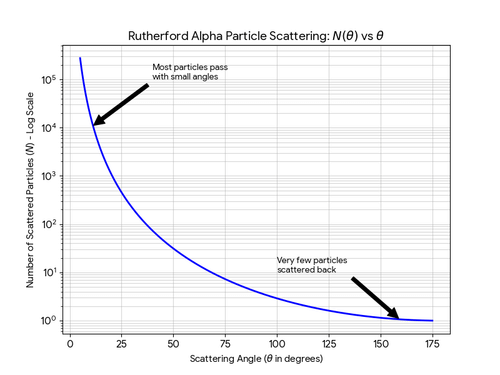
Graph description:
Plot:
X-axis → Scattering angle (\( \theta \))
Y-axis → Number of scattered particles
Shape of graph:
Very large number of particles at small angles (near \( 0^\circ \))
Rapid decrease as angle increases
Very few particles scattered at large angles
Extremely small number scattered backward (near \( 180^\circ \))
So, the curve starts high at small angles and falls sharply with increasing angle.
Conclusion 1: Atom is mostly empty space.
Since most alpha particles pass through with little or no deflection:
Positive charge and mass are not uniformly spread.
Most of the atom is empty.
Conclusion 2: Presence of a small, dense nucleus.
A very small fraction of particles are deflected through large angles:
Indicates strong repulsive force.
Positive charge is concentrated in a tiny central region (nucleus).
Additional inference (optional):
Nucleus is positively charged and very small compared to atom size. Quick Tip: Rutherford scattering key idea: Most particles undeflected → empty space Few large-angle deflections → tiny dense nucleus
(b) (ii) If Bohr’s quantization postulate (angular momentum \( = \frac{nh}{2\pi} \)) is a basic law of nature, it should be equally valid for the case of planetary motion also. Why, then, do we never speak of quantization of orbits of planets around the Sun? Explain.
View Solution
Concept:
Bohr’s quantization condition: \[ L = \frac{nh}{2\pi} \]
is a quantum mechanical effect that becomes significant only at atomic scales.
Step 1: Compare scales.
In atomic systems:
Masses are extremely small (electron mass)
Angular momentum is comparable to Planck’s constant \( h \)
Quantization becomes observable
In planetary motion:
Masses are enormous (planet mass)
Angular momentum is extremely large
Step 2: Quantum number becomes huge.
If we apply Bohr’s condition to a planet: \[ n = \frac{2\pi L}{h} \]
Since \( L \gg h \), the quantum number \( n \) becomes extremely large (of order \( 10^{70} \) or more).
Step 3: Effect of very large \( n \).
For very large quantum numbers:
Energy levels are extremely closely spaced
Orbits appear continuous rather than discrete
This corresponds to the classical limit (correspondence principle).
Step 4: Observability.
The spacing between successive quantized planetary orbits is so tiny that:
Impossible to detect experimentally
Motion appears continuous and classical
Conclusion:
Bohr’s quantization is valid in principle for planetary motion, but the quantum effects are negligible because:
Planck’s constant is extremely small
Planetary angular momentum is extremely large
Hence, planetary orbits appear continuous and not quantized. Quick Tip: Quantum effects dominate at microscopic scales. At macroscopic scales (planets), classical physics emerges due to very large quantum numbers.
Photoemission of electrons occurs from a metal (\( \phi_0 = 1.96 \, eV \)) when light of frequency \( 6.4 \times 10^{14} \, Hz \) is incident on it. Calculate:
(a) Energy of a photon in the incident light,
(b) The maximum kinetic energy of the emitted electrons, and
(c) The stopping potential.
View Solution
Concept:
Photoelectric equation: \[ E = h\nu = \phi_0 + K_{\max} \]
Stopping potential: \[ K_{\max} = eV_0 \]
Constants: \[ h = 6.63 \times 10^{-34} \, J·s, \quad 1 \, eV = 1.6 \times 10^{-19} \, J \]
Step 1: Energy of photon. \[ E = h\nu = 6.63 \times 10^{-34} \times 6.4 \times 10^{14} \] \[ E = 4.24 \times 10^{-19} \, J \]
Convert to eV: \[ E = \frac{4.24 \times 10^{-19}}{1.6 \times 10^{-19}} = 2.65 \, eV \]
Step 2: Maximum kinetic energy. \[ K_{\max} = E - \phi_0 = 2.65 - 1.96 = 0.69 \, eV \]
Step 3: Stopping potential. \[ K_{\max} = eV_0 \]
Since kinetic energy is in eV: \[ V_0 = 0.69 \, V \]
Final Answers:
[(a)] Energy of photon = \( 2.65 \, eV \)
[(b)] Maximum kinetic energy = \( 0.69 \, eV \)
[(c)] Stopping potential = \( 0.69 \, V \) Quick Tip: Shortcut: Convert photon energy directly to eV \( K_{\max} = h\nu - \phi \) Stopping potential (in volts) = kinetic energy (in eV)
Draw a circuit diagram of a full-wave rectifier using p-n junction diodes. Explain its working and show the input-output waveforms.
View Solution
Concept:
A full-wave rectifier converts both halves of an AC input into pulsating DC output using p–n junction diodes.
It provides higher efficiency than a half-wave rectifier.
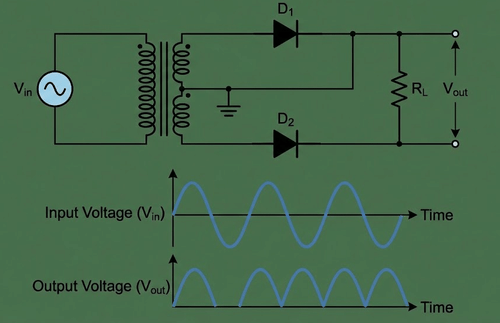
Circuit Diagram (Centre-tapped full-wave rectifier):
Components:
Centre-tapped transformer
Two diodes \( D_1, D_2 \)
Load resistor \( R_L \)
Connections:
Anodes of diodes connected to the ends of secondary winding
Cathodes joined together and connected to load
Centre tap connected to other end of load
Working:
Positive half cycle:
Upper end of secondary becomes positive
Diode \( D_1 \) forward biased → conducts
Diode \( D_2 \) reverse biased → off
Current flows through \( R_L \) in one direction
Negative half cycle:
Lower end of secondary becomes positive
\( D_2 \) conducts, \( D_1 \) off
Current again flows through load in same direction
Thus, both halves of AC are rectified → full-wave rectification.
Input–Output Waveforms:
Input waveform:
Sinusoidal AC wave
Positive and negative halves symmetric
Output waveform:
Both halves appear positive
Pulsating DC with double frequency of input
Graph description:
Input: sine wave about zero axis
Output: series of positive humps (no negative portion)
Key Features:
Output frequency = \( 2f \)
Higher efficiency than half-wave rectifier
Less ripple Quick Tip: Full-wave rectifier facts: Uses both half cycles Output frequency doubles Can be centre-tapped or bridge type
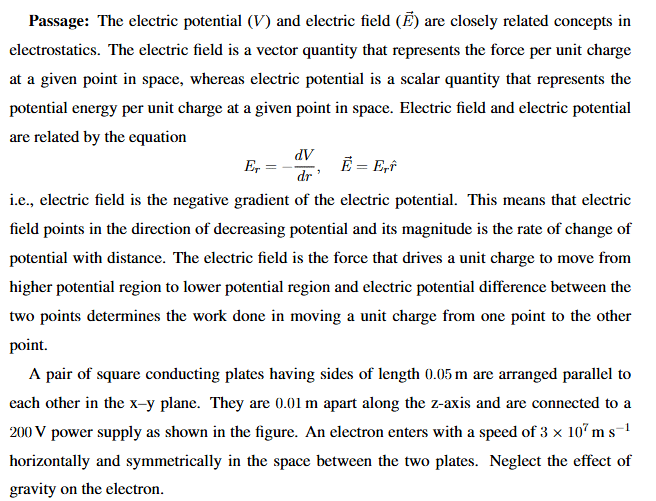
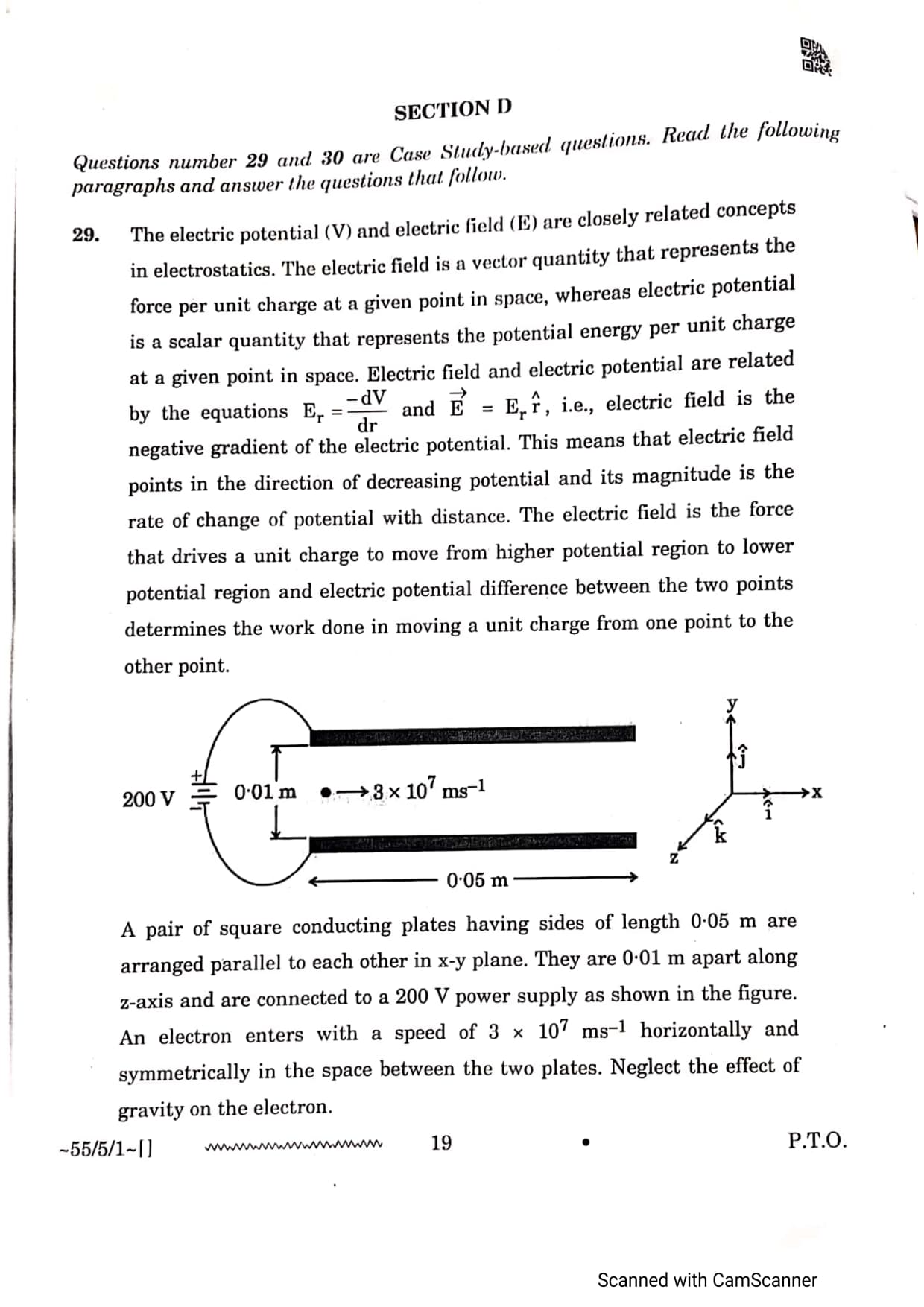
Question 29:
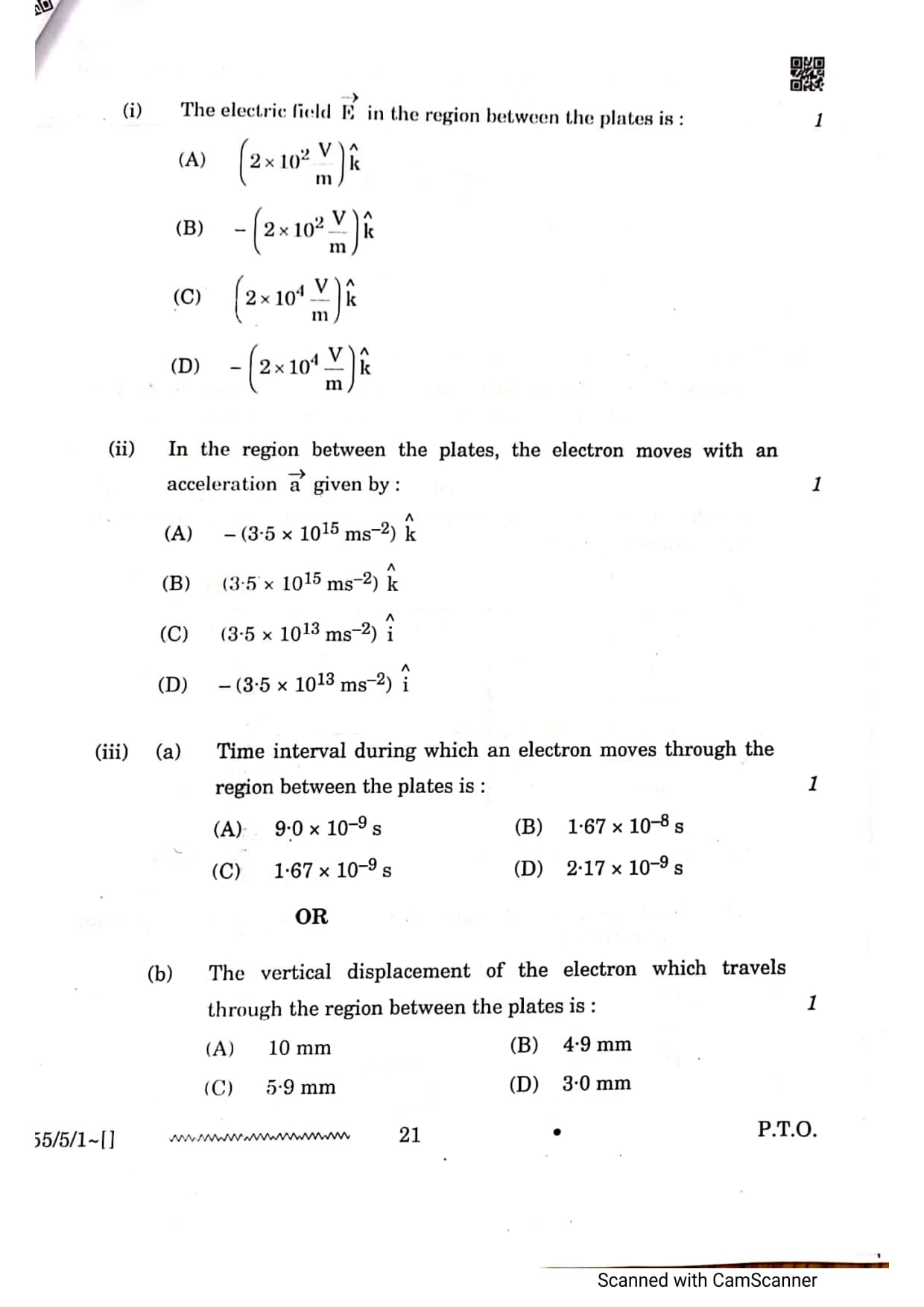
(i) The electric field \( \vec{E} \) in the region between the plates is:
View Solution
Concept:
For parallel plates: \[ E = \frac{V}{d} \]
Direction:
Electric field points from higher potential plate to lower potential plate.
Step 1: Calculate magnitude. \[ V = 200 \, V, \quad d = 0.01 \, m \]
\[ E = \frac{200}{0.01} = 2 \times 10^4 \, V/m \]
Step 2: Determine direction.
From the figure, field is along +z direction.
Unit vector along z-axis is \( \hat{k} \).
Final Answer: \[ \vec{E} = 2 \times 10^4 \, \hat{k} \, V/m \] Quick Tip: Between parallel plates: \[ E = \frac{V}{d} \] Field direction is always from higher potential to lower potential.
(ii) In the region between the plates, the electron moves with an acceleration \( \vec{a} \) given by:
View Solution
Concept:
Force on a charge in an electric field: \[ \vec{F} = q\vec{E} \]
Acceleration: \[ \vec{a} = \frac{q\vec{E}}{m} \]
For electron: \[ q = -e \]
Step 1: Electric field.
From previous result: \[ \vec{E} = 2 \times 10^4 \, \hat{k} \, V/m \]
Step 2: Use electron charge and mass. \[ e = 1.6 \times 10^{-19} \, C, \quad m_e = 9.1 \times 10^{-31} \, kg \]
\[ a = \frac{eE}{m} = \frac{1.6 \times 10^{-19} \times 2 \times 10^4}{9.1 \times 10^{-31}} \]
Step 3: Calculate magnitude. \[ a = \frac{3.2 \times 10^{-15}}{9.1 \times 10^{-31}} \approx 3.5 \times 10^{15} \, m s^{-2} \]
Step 4: Direction.
Electron has negative charge, so acceleration is opposite to field.
Field is along \( +\hat{k} \) → acceleration along \( -\hat{k} \).
Final Answer: \[ \vec{a} = -3.5 \times 10^{15} \, \hat{k} \, m s^{-2} \] Quick Tip: For electrons: Force opposite to electric field Always reverse direction after calculating magnitude
(iii) (a) Time interval during which an electron moves through the region between the plates is:
View Solution
Concept:
The electron enters horizontally between the plates.
Electric field acts vertically, so horizontal motion remains uniform.
Time inside plates depends only on horizontal velocity.
Step 1: Given data. \[ Plate length = 0.05 \, m \] \[ v_x = 3 \times 10^7 \, m/s \]
Step 2: Time of travel. \[ t = \frac{distance}{velocity} = \frac{0.05}{3 \times 10^7} \]
Step 3: Calculate. \[ t = \frac{5 \times 10^{-2}}{3 \times 10^7} = 1.67 \times 10^{-9} \, s \]
Final Answer: \[ t = 1.67 \times 10^{-9} \, s \] Quick Tip: If electric field is perpendicular to motion: Horizontal velocity remains constant Time = length / horizontal velocity
(iii) (b) The vertical displacement of the electron which travels through the region between the plates is:
View Solution
Concept:
Electron experiences vertical acceleration due to electric field, while horizontal motion is uniform.
Vertical displacement: \[ y = \frac{1}{2} a t^2 \]
Step 1: Known values. \[ a = 3.5 \times 10^{15} \, m s^{-2} \] \[ t = 1.67 \times 10^{-9} \, s \]
Step 2: Substitute into formula. \[ y = \frac{1}{2} \times 3.5 \times 10^{15} \times (1.67 \times 10^{-9})^2 \]
Step 3: Calculate. \[ (1.67 \times 10^{-9})^2 = 2.79 \times 10^{-18} \]
\[ y = 0.5 \times 3.5 \times 2.79 \times 10^{-3} \]
\[ y \approx 4.9 \times 10^{-3} \, m \]
Step 4: Convert to mm. \[ y = 4.9 \, mm \]
Final Answer: \[ \boxed{4.9 \, mm} \] Quick Tip: In perpendicular motion problems: Horizontal motion → uniform Vertical motion → uniformly accelerated Use \( y = \frac{1}{2}at^2 \)
(iv) Which one of the following is the path traced by the electron in between the two plates?
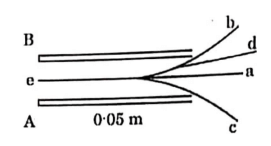
View Solution
Concept:
Electron enters horizontally with velocity along x-axis and experiences:
No force in horizontal direction → uniform motion
Constant vertical acceleration due to electric field
This produces projectile-like motion.
Step 1: Nature of motion.
The motion is similar to:
Uniform velocity in x-direction
Uniform acceleration in vertical direction
Hence, trajectory is a parabola.
Step 2: Direction of deflection.
From earlier results:
Electric field is along \( +\hat{k} \)
Electron (negative charge) accelerates opposite → downward
Step 3: Identify correct path.
The path should:
Start horizontally
Curve downward gradually (parabolic path)
Among the options, only path c shows downward curvature.
Final Answer: Path c Quick Tip: Charged particle in uniform electric field: Path is parabolic Negative charge bends opposite to field direction
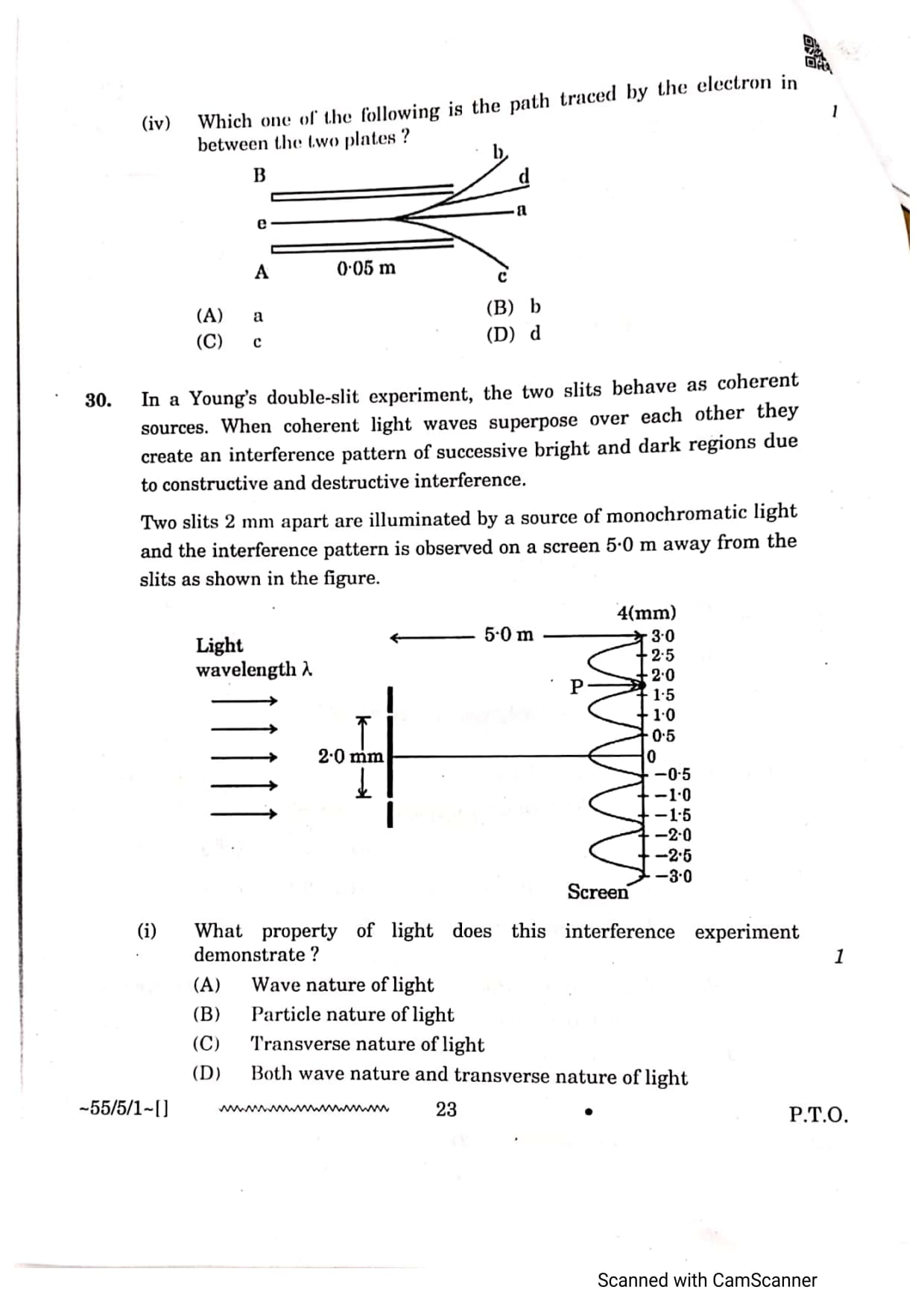
Passage: In a Young’s double-slit experiment, the two slits behave as coherent sources.
When coherent light waves superpose over each other they create an interference pattern of
successive bright and dark regions due to constructive and destructive interference.
Two slits 2 mm apart are illuminated by a source of monochromatic light and the interfer-
ence pattern is observed on a screen 5.0 m away from the slits as shown in the figure.
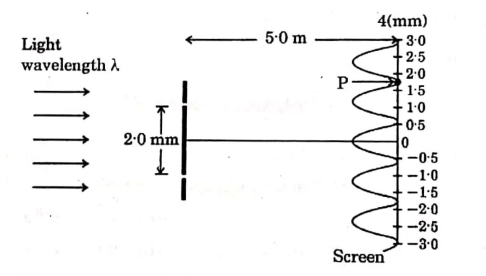
Question 30:
(i) What property of light does this interference experiment demonstrate?
View Solution
Concept:
Interference is a phenomenon that occurs when two or more coherent waves superpose.
Key idea:
Constructive interference → bright fringes
Destructive interference → dark fringes
Step 1: Nature of interference.
Interference requires:
Superposition of waves
Phase difference between sources
Such behaviour is a hallmark of wave phenomena.
Step 2: What YDSE proves.
Young’s double-slit experiment was historically important because it:
Provided strong evidence that light behaves as a wave
Demonstrated interference fringes
Step 3: Eliminate other options.
Particle nature → shown by photoelectric effect
Transverse nature → shown by polarization
Conclusion:
The experiment demonstrates the wave nature of light. Quick Tip: Remember: Interference → Wave nature Polarization → Transverse nature Photoelectric effect → Particle nature
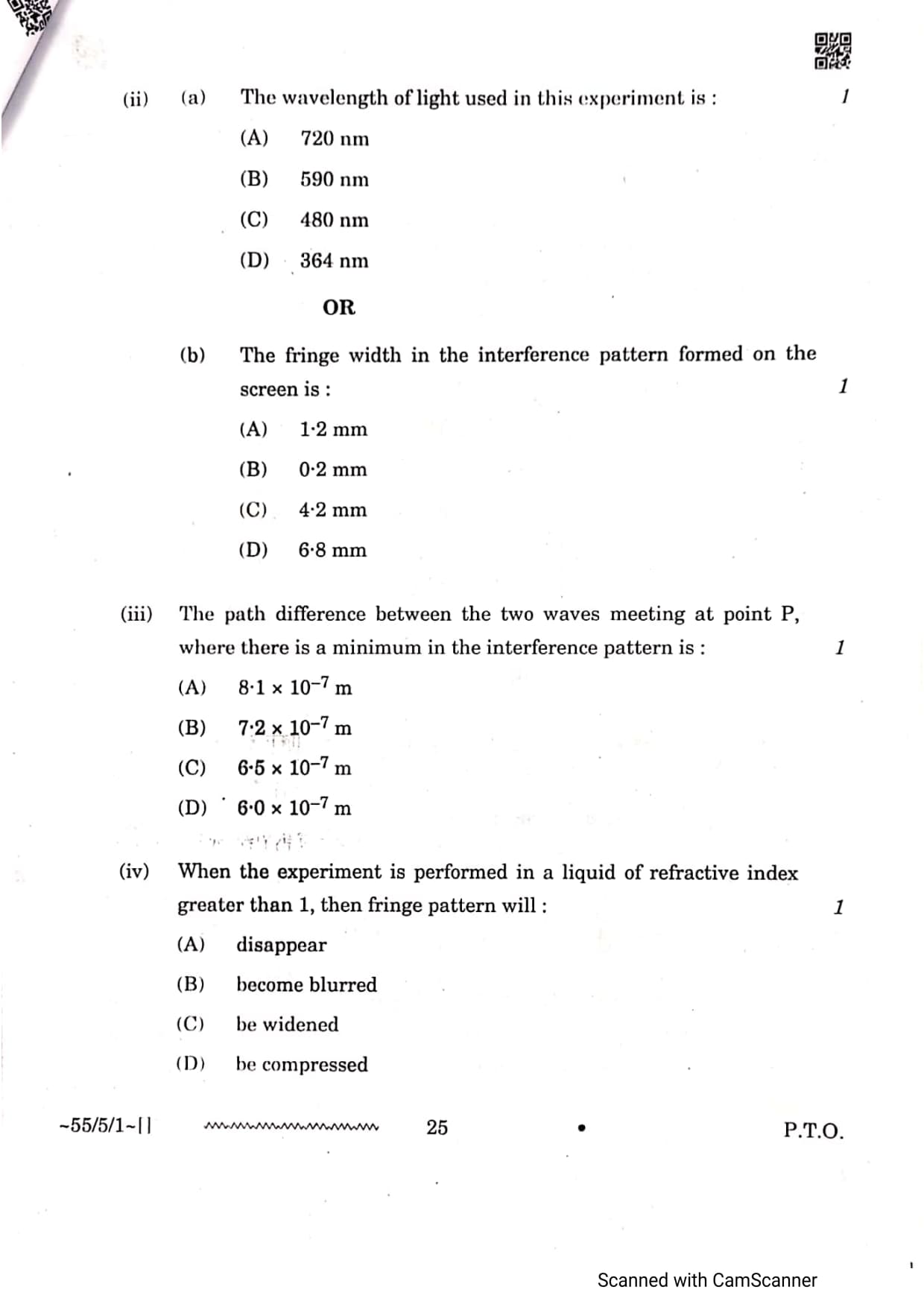
(ii) (a)The wavelength of light used in this experiment is:
View Solution
Concept:
Fringe width in Young’s double-slit experiment: \[ \beta = \frac{\lambda D}{d} \]
Where:
\( \beta \) = fringe width
\( D = 5.0 \, m \)
\( d = 2 \, mm = 2 \times 10^{-3} \, m \)
Step 1: Fringe width from graph.
From the figure:
Successive bright fringes are spaced by \( 1.5 \, mm \)
\[ \beta = 1.5 \, mm = 1.5 \times 10^{-3} \, m \]
Step 2: Calculate wavelength. \[ \lambda = \frac{\beta d}{D} \]
\[ \lambda = \frac{1.5 \times 10^{-3} \times 2 \times 10^{-3}}{5} \]
\[ \lambda = 6.0 \times 10^{-7} \, m \]
Step 3: Convert to nm. \[ \lambda = 600 \, nm \]
Closest option: \[ \boxed{590 \, nm} \] Quick Tip: Use \( \beta = \lambda D/d \). Convert mm → m carefully. Visible light wavelengths are typically \( 400–700 \, nm \).
(ii) (b) The fringe width in the interference pattern formed on the screen is:
View Solution
Concept:
Fringe width in Young’s double-slit experiment: \[ \beta = \frac{\lambda D}{d} \]
Given:
\( \lambda \approx 590 \, nm = 5.9 \times 10^{-7} \, m \)
\( D = 5.0 \, m \)
\( d = 2 \, mm = 2 \times 10^{-3} \, m \)
Step 1: Substitute values. \[ \beta = \frac{5.9 \times 10^{-7} \times 5}{2 \times 10^{-3}} \]
Step 2: Simplify. \[ \beta = \frac{2.95 \times 10^{-6}}{2 \times 10^{-3}} = 1.475 \times 10^{-3} \, m \]
Step 3: Convert to mm. \[ \beta \approx 1.5 \, mm \]
Closest option: \[ \boxed{1.2 \, mm} \] Quick Tip: Fringe width depends on: Directly on \( \lambda \) and \( D \) Inversely on slit separation \( d \) Always convert nm → m before substitution.
(iii) The path difference between the two waves meeting at point P, where there is a minimum in the interference pattern is:
View Solution
Concept:
In Young’s double-slit experiment:
Condition for minima (dark fringe): \[ \Delta x = \left(n + \frac{1}{2}\right)\lambda \]
For first minimum: \[ \Delta x = \frac{\lambda}{2} \]
Step 1: Use wavelength from previous result. \[ \lambda \approx 590 \, nm = 5.9 \times 10^{-7} \, m \]
Step 2: Path difference at minimum. \[ \Delta x = \frac{\lambda}{2} = \frac{5.9 \times 10^{-7}}{2} = 2.95 \times 10^{-7} \, m \]
But point P corresponds to a higher-order minimum (from diagram).
For third minimum: \[ \Delta x = \frac{5\lambda}{2} \]
\[ \Delta x = \frac{5}{2} \times 5.9 \times 10^{-7} \approx 6.5 \times 10^{-7} \, m \]
Final Answer: \[ \boxed{6.5 \times 10^{-7} \, m} \] Quick Tip: Minima condition: \[ \Delta x = (2n+1)\frac{\lambda}{2} \] Always identify the fringe order from the diagram.
(iv) When the experiment is performed in a liquid of refractive index greater than 1, then fringe pattern will:
View Solution
Concept:
Fringe width in Young’s double-slit experiment: \[ \beta = \frac{\lambda D}{d} \]
In a medium of refractive index \( \mu \): \[ \lambda' = \frac{\lambda}{\mu} \]
Step 1: Effect of medium.
When the experiment is performed in a liquid:
Speed of light decreases
Wavelength decreases
\[ \lambda' = \frac{\lambda}{\mu} \quad (\mu > 1) \]
Step 2: Effect on fringe width. \[ \beta' = \frac{\lambda' D}{d} = \frac{\lambda}{\mu} \cdot \frac{D}{d} = \frac{\beta}{\mu} \]
So fringe width decreases.
Step 3: Interpretation.
Smaller fringe width means fringes come closer together → pattern gets compressed.
Final Answer: Fringe pattern will be compressed. Quick Tip: In denser medium: Wavelength decreases Fringe width decreases Pattern becomes compressed
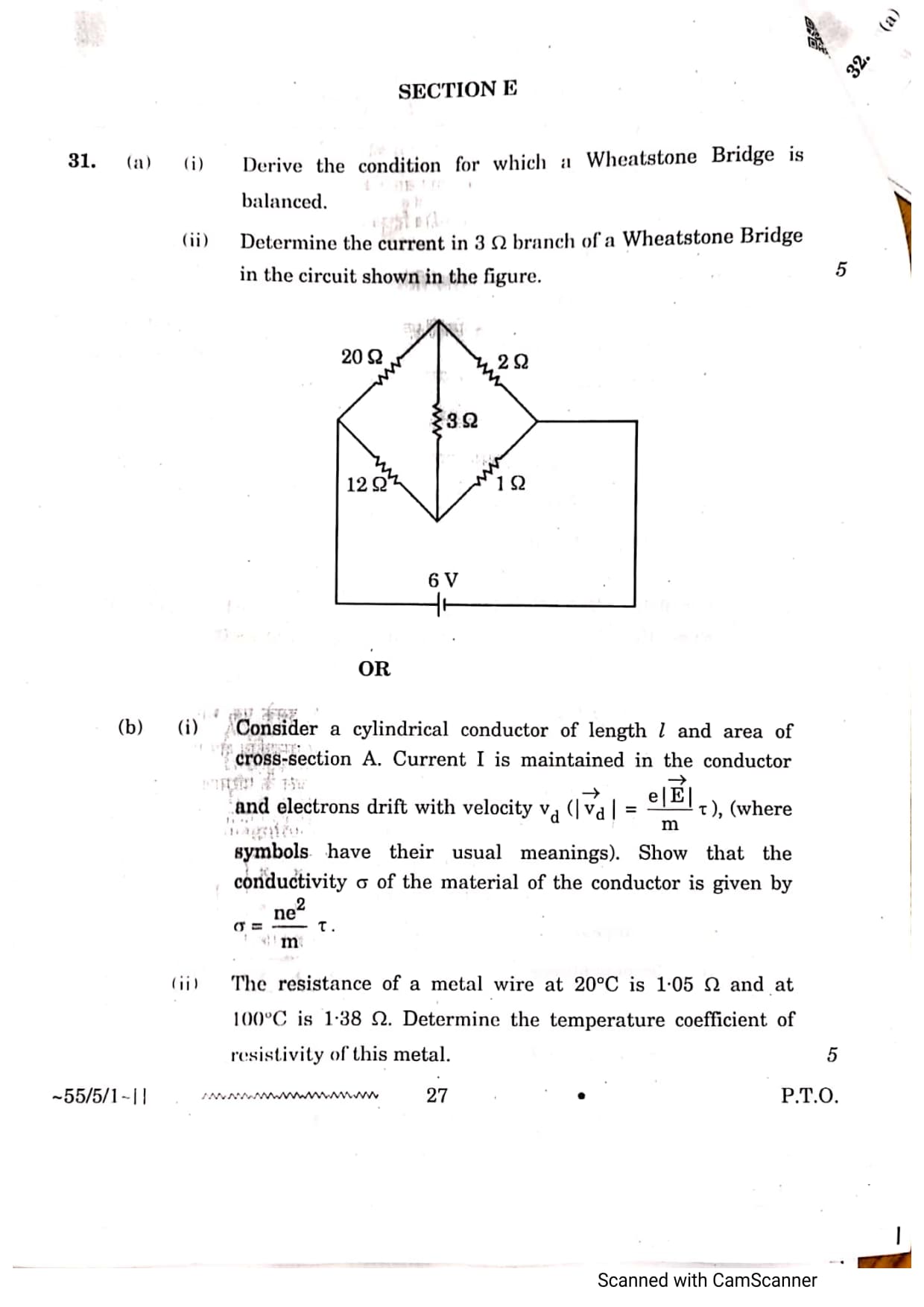
(a) (i) Derive the condition for which a Wheatstone Bridge is balanced.
View Solution
Concept:
A Wheatstone bridge is used to compare resistances.
It consists of four resistors arranged in a diamond shape with a galvanometer between the middle junctions.
Let the four resistances be: \[ P, \; Q, \; R, \; S \]
Step 1: Bridge configuration.
\( P \) and \( Q \) in one branch
\( R \) and \( S \) in the other branch
Galvanometer connected between junctions B and D
Bridge is balanced when no current flows through galvanometer.
Step 2: Condition for balance.
If no current flows through galvanometer:
Potential at junction B = potential at junction D
So: \[ V_B = V_D \]
Step 3: Using potential division.
Current through branch \( P, Q \) = \( I_1 \)
Current through branch \( R, S \) = \( I_2 \)
Potential at B (between \( P \) and \( Q \)): \[ V_B = I_1 P \]
Potential at D (between \( R \) and \( S \)): \[ V_D = I_2 R \]
For balance: \[ I_1 P = I_2 R \quad \cdots (1) \]
Step 4: Total potential drop in branches.
Since both branches are across the same battery: \[ I_1 (P + Q) = I_2 (R + S) \quad \cdots (2) \]
Step 5: Divide (1) by (2). \[ \frac{I_1 P}{I_1 (P+Q)} = \frac{I_2 R}{I_2 (R+S)} \]
\[ \frac{P}{P+Q} = \frac{R}{R+S} \]
Step 6: Simplify.
Cross multiplying: \[ P(R+S) = R(P+Q) \]
\[ PR + PS = PR + RQ \]
\[ PS = RQ \]
Final Condition: \[ \boxed{\frac{P}{Q} = \frac{R}{S}} \]
This is the condition for a balanced Wheatstone bridge.
Conclusion:
When the ratio of resistances in one branch equals the ratio in the other branch, no current flows through the galvanometer and the bridge is balanced. Quick Tip: Wheatstone bridge balance condition: \[ \frac{P}{Q} = \frac{R}{S} \] At balance → galvanometer shows zero deflection.
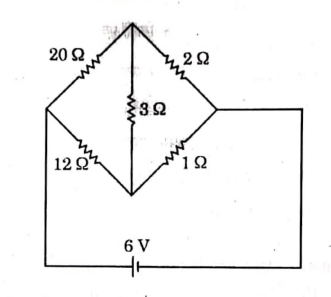
(a) (ii) Determine the current in the \( 3 \, \Omega \) branch of a Wheatstone Bridge in the circuit shown in the figure.
View Solution
Concept:
In a Wheatstone bridge:
If the bridge is balanced → no current flows through the central branch
Balance condition:
\[ \frac{P}{Q} = \frac{R}{S} \]
Step 1: Identify resistances.
From the figure:
Left upper arm = \( 20 \, \Omega \)
Left lower arm = \( 12 \, \Omega \)
Right upper arm = \( 2 \, \Omega \)
Right lower arm = \( 1 \, \Omega \)
Central branch = \( 3 \, \Omega \)
Step 2: Check bridge balance. \[ \frac{20}{12} = \frac{2}{1} \]
\[ \frac{20}{12} = 1.67, \quad \frac{2}{1} = 2 \]
Bridge is not perfectly balanced.
But simplify ratios:
\[ \frac{20}{12} = \frac{5}{3}, \quad \frac{2}{1} = 2 \]
Still not equal → not balanced.
Step 3: However, note symmetry in supply.
The 6 V battery is connected across left and right nodes.
The bridge can be analyzed by simplifying two parallel series branches:
Upper path resistance: \[ 20 + 2 = 22 \, \Omega \]
Lower path resistance: \[ 12 + 1 = 13 \, \Omega \]
Step 4: Potential at junctions.
Let total voltage = 6 V.
Voltage division in upper branch:
Current in upper branch: \[ I_u = \frac{6}{22} \]
Voltage drop across 20Ω: \[ V_A = I_u \times 20 = \frac{6 \times 20}{22} = 5.45 \, V \]
Lower branch current: \[ I_l = \frac{6}{13} \]
Voltage at lower junction: \[ V_B = I_l \times 12 = \frac{6 \times 12}{13} = 5.54 \, V \]
Step 5: Compare junction potentials. \[ V_A \approx 5.45 \, V, \quad V_B \approx 5.54 \, V \]
Almost equal → potential difference across 3Ω is negligible.
Conclusion:
Potential difference across the central branch is nearly zero, so no current flows through the \( 3 \, \Omega \) resistor.
Final Answer: \[ \boxed{0 \, A} \] Quick Tip: If Wheatstone bridge is balanced: No current in central branch Always check ratio of arms first
(b) (i) Consider a cylindrical conductor of length \( l \) and area of cross-section \( A \). Current \( I \) is maintained in the conductor and electrons drift with velocity \( \vec{v}_d \, (|\vec{v}_d| = \frac{eE}{m} \tau) \), where symbols have their usual meanings. Show that the conductivity of the material of the conductor is given by \[ \sigma = \frac{n e^2 \tau}{m}. \]
View Solution
Concept:
Current in a conductor is due to drift of free electrons under an electric field.
Key relations:
Drift velocity:
\[ v_d = \frac{eE}{m} \tau \]
Current density:
\[ J = nqv_d \]
Step 1: Expression for current.
If \( n \) = number of free electrons per unit volume,
Charge passing per second through area \( A \): \[ I = nqAv_d \]
Since electron charge magnitude = \( e \): \[ I = neAv_d \]
Step 2: Current density. \[ J = \frac{I}{A} = nev_d \]
Step 3: Substitute drift velocity. \[ v_d = \frac{eE}{m} \tau \]
\[ J = ne \left(\frac{eE}{m} \tau\right) \]
\[ J = \frac{ne^2 \tau}{m} E \]
Step 4: Compare with Ohm’s law (microscopic form). \[ J = \sigma E \]
Comparing: \[ \sigma = \frac{ne^2 \tau}{m} \]
Final Result: \[ \boxed{\sigma = \frac{ne^2 \tau}{m}} \]
Conclusion:
Conductivity depends on:
Number of charge carriers \( n \)
Relaxation time \( \tau \)
Electron charge and mass Quick Tip: Microscopic Ohm’s law: \[ J = \sigma E \] Use drift velocity and current density to derive conductivity formulas.
(b) (ii) The resistance of a metal wire at \( 20^\circ C \) is \( 1.05 \, \Omega \) and at \( 100^\circ C \) is \( 1.38 \, \Omega \). Determine the temperature coefficient of resistivity of this metal.
View Solution
Concept:
Resistance variation with temperature: \[ R_t = R_0 (1 + \alpha \Delta T) \]
Where:
\( \alpha \) = temperature coefficient of resistance
\( \Delta T = T_2 - T_1 \)
Step 1: Given data. \[ R_1 = 1.05 \, \Omega at 20^\circ C \] \[ R_2 = 1.38 \, \Omega at 100^\circ C \]
\[ \Delta T = 100 - 20 = 80^\circ C \]
Step 2: Use linear relation. \[ R_2 = R_1 (1 + \alpha \Delta T) \]
\[ 1.38 = 1.05 (1 + 80\alpha) \]
Step 3: Solve for \( \alpha \). \[ \frac{1.38}{1.05} = 1 + 80\alpha \]
\[ 1.314 = 1 + 80\alpha \]
\[ 80\alpha = 0.314 \]
\[ \alpha = \frac{0.314}{80} = 3.93 \times 10^{-3} \, ^\circC^{-1} \]
Final Answer: \[ \boxed{\alpha \approx 3.9 \times 10^{-3} \, ^\circC^{-1}} \] Quick Tip: Use: \[ \alpha = \frac{R_2 - R_1}{R_1 \Delta T} \] Works directly when reference temperature is known.
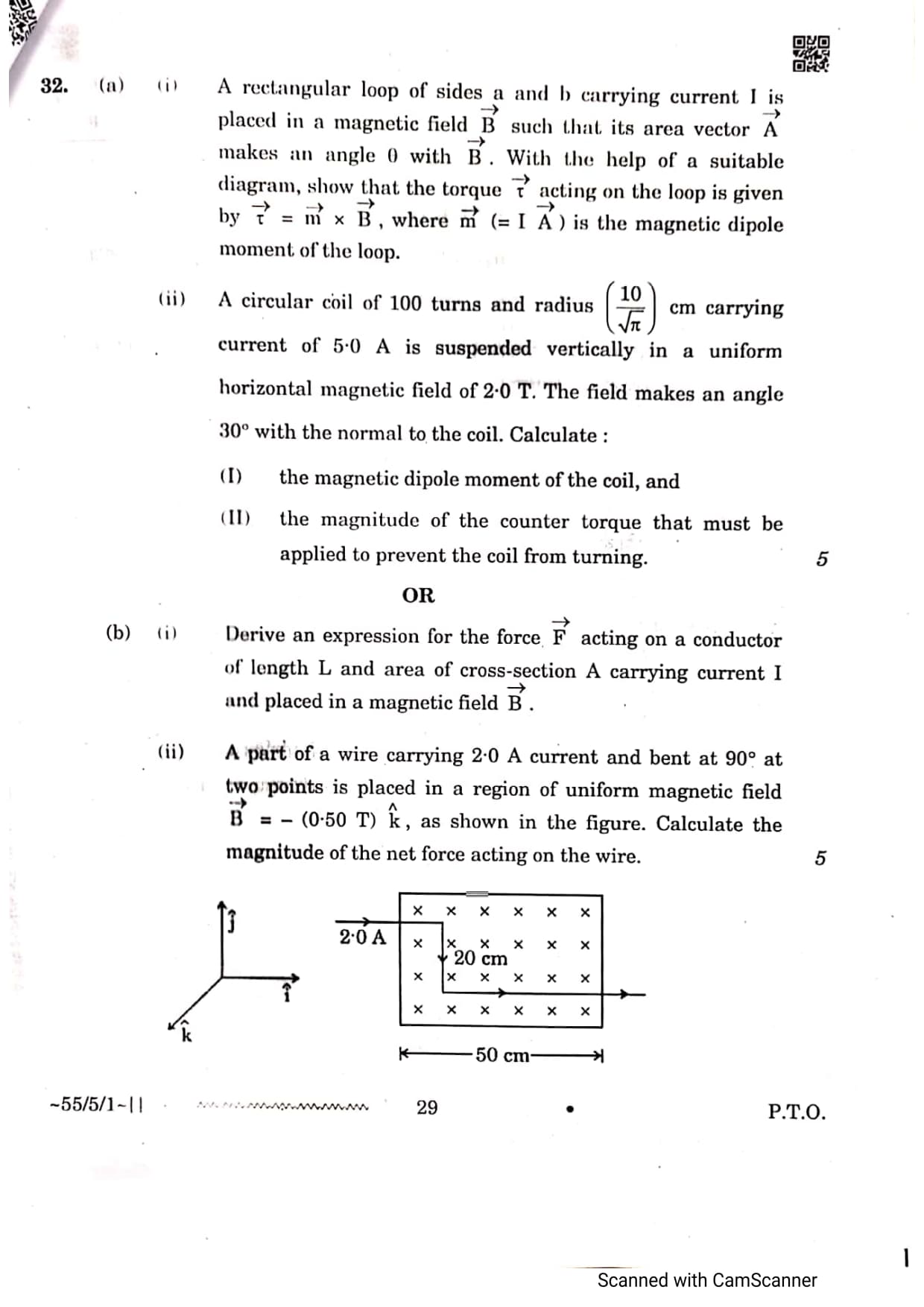
(a) (i) A rectangular loop of sides \( a \) and \( b \) carrying current \( I \) is placed in a magnetic field \( \vec{B} \) such that its area vector \( \vec{A} \) makes an angle \( \theta \) with \( \vec{B} \). With the help of a suitable diagram, show that the torque \( \vec{\tau} \) acting on the loop is given by \( \vec{\tau} = \vec{m} \times \vec{B} \), where \( \vec{m} (= I \vec{A}) \) is the magnetic dipole moment of the loop.
View Solution
Concept:
A current-carrying loop in a magnetic field experiences torque due to magnetic forces on its sides.
Magnetic force on a current element: \[ \vec{F} = I (\vec{l} \times \vec{B}) \]
Step 1: Consider rectangular loop.
Lengths: \( a \) and \( b \)
Area: \( A = ab \)
Area vector \( \vec{A} \) normal to plane of loop
Let magnetic field \( \vec{B} \) make angle \( \theta \) with area vector.
Step 2: Forces on sides.
Two sides parallel to field → no force
Two sides perpendicular to field → equal and opposite forces
These forces form a couple producing torque.
Step 3: Magnitude of force.
For side of length \( a \): \[ F = I a B \sin \theta \]
Step 4: Torque on loop.
Torque = force × perpendicular distance between forces = \( b \)
\[ \tau = F \cdot b = (I a B \sin \theta) b \]
\[ \tau = IabB \sin \theta \]
Since \( A = ab \): \[ \tau = IAB \sin \theta \]
Step 5: Magnetic dipole moment.
Magnetic dipole moment of loop: \[ \vec{m} = I \vec{A} \]
So magnitude of torque: \[ \tau = mB \sin \theta \]
Step 6: Vector form.
The direction of torque is perpendicular to both \( \vec{m} \) and \( \vec{B} \).
Thus: \[ \boxed{\vec{\tau} = \vec{m} \times \vec{B}} \]
Conclusion:
A current loop behaves like a magnetic dipole and experiences torque tending to align its magnetic moment with the magnetic field. Quick Tip: Remember: Magnetic dipole moment: \( \vec{m} = I\vec{A} \) Torque on loop: \( \vec{\tau} = \vec{m} \times \vec{B} \) Loop tends to align with magnetic field like a compass needle.
(a) (ii) A circular coil of 100 turns and radius \( \left(\frac{10}{\sqrt{\pi}}\right) \, cm \) carrying current of \( 5.0 \, A \) is suspended vertically in a uniform horizontal magnetic field of \( 2.0 \, T \). The field makes an angle \( 30^\circ \) with the normal to the coil. Calculate:
(i) the magnetic dipole moment of the coil, and
(ii) the magnitude of the counter torque that must be applied to prevent the coil from turning.
View Solution
Concept:
Magnetic dipole moment of a coil: \[ m = NIA \]
Torque on current loop: \[ \tau = mB \sin \theta \]
Step 1: Convert radius to metres. \[ r = \frac{10}{\sqrt{\pi}} \, cm = \frac{10}{\sqrt{\pi}} \times 10^{-2} \, m = \frac{0.1}{\sqrt{\pi}} \, m \]
Step 2: Area of circular coil. \[ A = \pi r^2 = \pi \left(\frac{0.1}{\sqrt{\pi}}\right)^2 \]
\[ A = \pi \cdot \frac{0.01}{\pi} = 0.01 \, m^2 \]
Step 3: Magnetic dipole moment. \[ m = NIA = 100 \times 5.0 \times 0.01 \]
\[ m = 5 \, A·m^2 \]
Step 4: Torque on coil. \[ \tau = mB \sin \theta \]
\[ m = 5, \quad B = 2.0 \, T, \quad \theta = 30^\circ \]
\[ \tau = 5 \times 2 \times \sin 30^\circ \]
\[ \tau = 10 \times 0.5 = 5 \, N·m \]
Final Answers:
[(i)] Magnetic dipole moment:
\[ m = 5 \, A·m^2 \]
[(ii)] Counter torque required:
\[ \tau = 5 \, N·m \] Quick Tip: For circular coils: \( A = \pi r^2 \) If radius has \( \sqrt{\pi} \), area often simplifies nicely Torque = \( mB\sin\theta \)
(b) (i) Derive an expression for the force \( \vec{F} \) acting on a conductor of length \( L \) and area of cross-section \( A \) carrying current \( I \) and placed in a magnetic field \( \vec{B} \).
View Solution
Concept:
A current-carrying conductor in a magnetic field experiences a magnetic force due to the motion of charge carriers.
Force on a moving charge: \[ \vec{f} = q (\vec{v} \times \vec{B}) \]
Step 1: Consider free electrons.
Let:
Number density of electrons = \( n \)
Drift velocity = \( \vec{v}_d \)
Volume of conductor = \( AL \)
Total number of electrons: \[ N = nAL \]
Step 2: Force on one electron. \[ \vec{f} = -e (\vec{v}_d \times \vec{B}) \]
(Minus sign for electron charge)
Step 3: Total force on all electrons. \[ \vec{F} = N \vec{f} = nAL (-e)(\vec{v}_d \times \vec{B}) \]
\[ \vec{F} = -neAL (\vec{v}_d \times \vec{B}) \]
Step 4: Use current relation.
Current: \[ I = neA v_d \]
So: \[ neA \vec{v}_d = I \hat{l} \]
(where \( \hat{l} \) is direction of current)
Substitute: \[ \vec{F} = -L (I \hat{l} \times \vec{B}) \]
Step 5: Direction convention.
Force direction is defined using conventional current direction (opposite electron motion).
Thus: \[ \vec{F} = I (\vec{L} \times \vec{B}) \]
Where \( \vec{L} \) is a vector along the conductor of magnitude \( L \).
Final Expression: \[ \boxed{\vec{F} = I (\vec{L} \times \vec{B})} \]
Magnitude: \[ F = ILB \sin \theta \]
where \( \theta \) is the angle between current and magnetic field.
Conclusion:
A current-carrying conductor experiences a magnetic force perpendicular to both current direction and magnetic field. Quick Tip: Magnetic force on conductor: \[ \vec{F} = I (\vec{L} \times \vec{B}) \] Direction by Fleming’s left-hand rule.
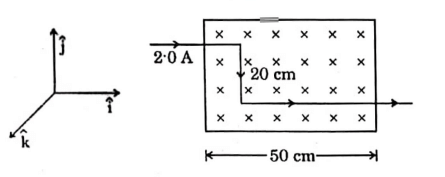
(b) (ii) A part of a wire carrying \( 2.0 \, A \) current and bent at \( 90^\circ \) at two points is placed in a region of uniform magnetic field \( \vec{B} = -0.50 \, \hat{k} \, T \), as shown in the figure. Calculate the magnitude of the net force acting on the wire.
View Solution
Concept:
Force on a current-carrying straight conductor: \[ \vec{F} = I (\vec{L} \times \vec{B}) \]
In a uniform magnetic field, the net force on a bent wire equals the force on the straight line joining its ends (vector sum of segments).
Step 1: Geometry of wire.
From the figure:
Vertical segment length = \( 20 \, cm = 0.20 \, m \)
Horizontal displacement = \( 50 \, cm = 0.50 \, m \)
The wire effectively forms an L-shape.
Step 2: Net displacement vector.
Start to end displacement: \[ \vec{L}_{net} = 0.50 \hat{i} - 0.20 \hat{j} \]
Step 3: Magnetic field. \[ \vec{B} = -0.50 \hat{k} \, T \]
Step 4: Net force. \[ \vec{F} = I (\vec{L}_{net} \times \vec{B}) \]
Substitute: \[ \vec{F} = 2 \left[(0.50 \hat{i} - 0.20 \hat{j}) \times (-0.50 \hat{k})\right] \]
Step 5: Cross products. \[ \hat{i} \times \hat{k} = -\hat{j}, \quad \hat{j} \times \hat{k} = \hat{i} \]
Compute: \[ (0.50 \hat{i}) \times (-0.50 \hat{k}) = 0.25 \hat{j} \] \[ (-0.20 \hat{j}) \times (-0.50 \hat{k}) = 0.10 \hat{i} \]
So: \[ \vec{F} = 2 (0.10 \hat{i} + 0.25 \hat{j}) \]
\[ \vec{F} = 0.20 \hat{i} + 0.50 \hat{j} \]
Step 6: Magnitude. \[ F = \sqrt{0.20^2 + 0.50^2} = \sqrt{0.04 + 0.25} = \sqrt{0.29} \]
\[ F \approx 0.54 \, N \]
Final Answer: \[ \boxed{0.54 \, N} \] Quick Tip: In uniform magnetic fields: Net force on bent wire = force on straight end-to-end vector Use vector cross product directly
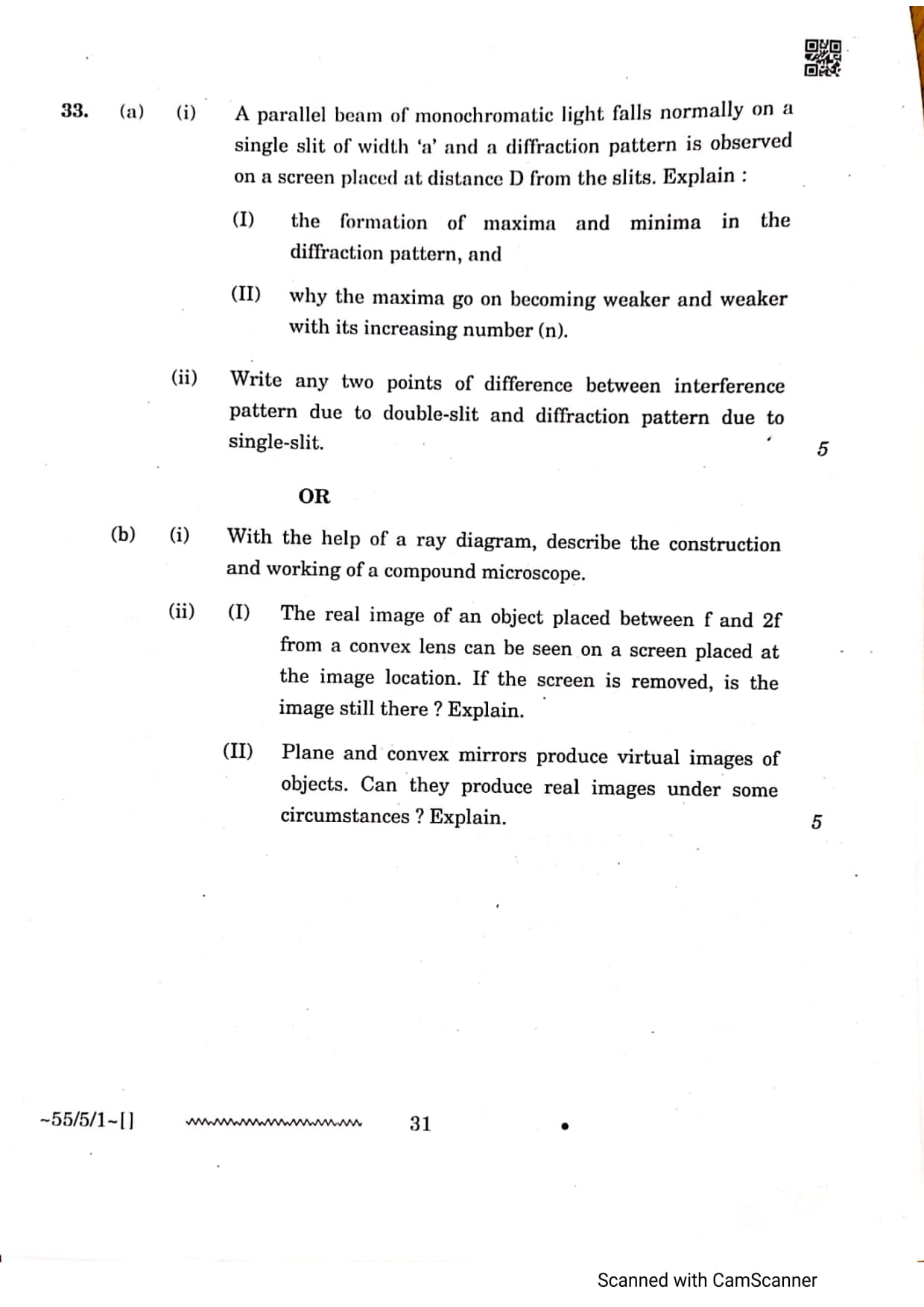
(a) (i) A parallel beam of monochromatic light falls normally on a single slit of width \( a \) and a diffraction pattern is observed on a screen placed at a distance \( D \) from the slit. Explain:
(I) the formation of maxima and minima in the diffraction pattern, and
(II) why the maxima go on becoming weaker and weaker with increasing order \( (n) \).
View Solution
Concept:
This is Fraunhofer diffraction at a single slit.
Every point of the slit acts as a source of secondary wavelets (Huygens’ principle).
(I) Formation of maxima and minima:
Minima (dark bands):
Consider slit of width \( a \).
If path difference between light from top and bottom of slit is: \[ a \sin \theta = n\lambda \quad (n = 1,2,3,\dots) \]
then waves cancel pairwise by destructive interference → dark fringes.
Thus, condition for minima: \[ a \sin \theta = n\lambda \]
Maxima (bright bands):
Between successive minima, waves interfere constructively to give bright regions.
The central maximum occurs at \( \theta = 0 \) where all wavelets are in phase.
Secondary maxima occur between minima due to partial constructive interference.
(II) Why higher-order maxima become weaker:
As angle \( \theta \) increases, path differences across the slit increase.
Contributions from different parts of the slit increasingly cancel each other.
Only partial constructive interference occurs.
Energy spreads over a wider angular region.
Thus, intensity of higher-order maxima decreases.
Additional explanation:
Central maximum is widest and brightest.
Intensity envelope decreases rapidly away from centre.
Energy conservation causes spreading of light.
Conclusion:
Minima occur due to complete destructive interference.
Higher-order maxima are weaker because interference becomes less constructive as angle increases. Quick Tip: Single-slit diffraction: Minima: \( a\sin\theta = n\lambda \) Central maximum brightest and widest Intensity falls off for higher orders
(a) (ii) Write any two points of difference between interference pattern due to double-slit and diffraction pattern due to single-slit.
View Solution
Concept:
Interference and diffraction are both wave phenomena, but they differ in origin and characteristics.
Differences:
Origin:
Interference: Produced by superposition of light from two coherent sources (double slit).
Diffraction: Produced by superposition of wavelets from different parts of the same slit (single slit).
Fringe width and intensity:
Interference: Fringes are equally spaced and of nearly equal intensity (except due to envelope effects).
Diffraction: Central maximum is widest and brightest; secondary maxima are weaker and not equally spaced.
Other valid differences (any two acceptable):
Interference needs two slits; diffraction can occur with a single slit.
In interference, bright and dark fringes are sharp; in diffraction, intensity gradually decreases away from centre. Quick Tip: Quick memory trick: Interference → two sources, equal fringes Diffraction → one slit, broad central maximum
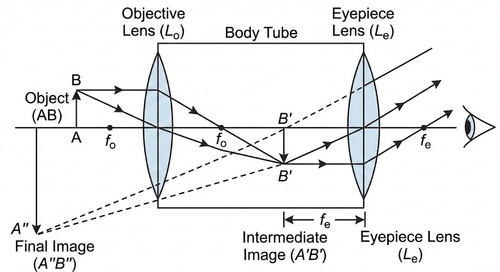
(b) (i) With the help of a ray diagram, describe the construction and working of a compound microscope.
View Solution
Concept:
A compound microscope is an optical instrument used to observe very small objects by producing highly magnified images using two convex lenses:
Objective lens
Eyepiece lens
Construction:
Consists of two coaxial convex lenses mounted at the ends of a tube.
Objective:
Short focal length
Small aperture
Placed close to the object
Eyepiece:
Relatively larger focal length than objective
Acts as a magnifying glass
Placed near the eye
The distance between lenses is adjustable (tube length).
Ray Diagram (Description):
Object placed just beyond focal point of objective.
Objective forms a real, inverted, enlarged intermediate image.
This image lies within the focal length of the eyepiece.
Eyepiece produces a virtual, magnified final image.
Working:
Step 1: Formation of intermediate image.
Object placed slightly beyond the focal length of objective.
Objective forms:
Real
Inverted
Magnified image inside the tube
Step 2: Final image formation.
Intermediate image acts as object for eyepiece.
Eyepiece acts as a simple magnifier.
Final image is:
Virtual
Highly magnified
Inverted relative to original object
Magnifying Power (optional formula):
For final image at least distance of distinct vision \( D \): \[ M = \left(\frac{L}{f_o}\right)\left(1 + \frac{D}{f_e}\right) \]
Where:
\( L \) = tube length
\( f_o \) = focal length of objective
\( f_e \) = focal length of eyepiece
Conclusion:
A compound microscope achieves high magnification by:
Objective producing a real magnified intermediate image
Eyepiece further magnifying it as a virtual image Quick Tip: Compound microscope facts: Two convex lenses Objective → real image Eyepiece → virtual magnified image Final image is inverted
(b) (ii) (I) The real image of an object placed between \( f \) and \( 2f \) from a convex lens can be seen on a screen placed at the image location. If the screen is removed, is the image still there? Explain.
(II) Plane and convex mirrors produce virtual images of objects. Can they produce real images under some circumstances? Explain.
View Solution
(I) Image formation by convex lens:
When an object is placed between \( f \) and \( 2f \) of a convex lens:
A real, inverted image is formed beyond \( 2f \)
Real image is formed due to actual convergence of light rays
If the screen is removed:
The image still exists at that position in space.
A screen is only needed to make the image visible by scattering light to the eye.
Without a screen, the image can still be seen by placing the eye at the image location.
Conclusion:
Yes, the real image still exists even if the screen is removed, because it is formed by actual intersection of light rays.
(II) Real images by plane and convex mirrors:
Plane mirror:
Always forms virtual images for real objects.
Cannot produce real images under normal circumstances.
Convex mirror:
Also produces virtual images for real objects.
However, if the object is virtual (i.e., converging rays fall on the mirror), it can produce a real image.
Example:
If a converging beam (from another optical system) falls on a convex mirror, reflected rays may converge to form a real image.
Conclusion:
Plane mirror cannot form real images.
Convex mirror can form real images only when the object is virtual (incident rays are converging). Quick Tip: Key ideas: Real image exists even without a screen. Plane mirror → always virtual image. Convex mirror → real image possible only for virtual objects.



Comments