




CBSE Class 12 Mathematics Set 1- (65/1/1) Question Paper 2026 is available for download here. CBSE conducted Class 12 Mathematics exam on March 9, 2026 from 10:30 AM to 1:30 PM. The Mathematics theory paper is of 80 marks, and the internal assessment is of 20 marks.
Mathematics question paper includes MCQs (1 mark each), short-answer type questions (2 & 3 marks each), and long-answer type questions (4 & 6 marks each) which makes up the total of 80 marks.
Download CBSE Class 12 Mathematics Set-1 (65/1/1) Question Paper 2026 with detailed solutions from the links provided below.
CBSE Class 12 Mathematics Set 1- (65/1/1) Question Paper 2026 with Solution PDF
| CBSE Class 12 Mathematics Question Paper 2026 Set 1- (65/1/1) | Download PDF | Check Solutions |

If the feasible region of a linear programming problem with objective function \( Z = ax + by \) is bounded, then which of the following is correct?
View Solution
Concept:
In a Linear Programming Problem (LPP), the objective function is a linear function of the decision variables, such as:
\[ Z = ax + by \]
The set of all feasible solutions forms the feasible region. If this feasible region is bounded, it means the region is enclosed and limited in size.
A key theorem in linear programming states that:
If the feasible region is bounded, the objective function will attain both a maximum and a minimum value at the corner points (extreme points) of the feasible region.
Step 1: Understand the meaning of bounded feasible region.
A bounded feasible region means all feasible points lie inside a closed polygonal region.
Step 2: Apply the fundamental theorem of Linear Programming.
According to the theorem:
\[ Optimal values occur at the corner points of the feasible region. \]
If the region is bounded, both extreme values must exist.
Step 3: State the conclusion.
Therefore, the objective function will have both a maximum and a minimum value.
\[ \therefore The correct answer is: It will have both maximum and minimum values. \] Quick Tip: In Linear Programming: If the feasible region is \textbf{bounded} → both maximum and minimum values exist. If the feasible region is \textbf{unbounded} → the maximum or minimum may not exist.
The unit vector perpendicular to the vectors \( \hat{i} - \hat{j} \) and \( \hat{i} + \hat{j} \) is
View Solution
Concept:
A vector perpendicular to two vectors can be obtained using the cross product.
If vectors \( \vec{a} \) and \( \vec{b} \) are given, then:
\[ \vec{a} \times \vec{b} \]
gives a vector perpendicular to both \( \vec{a} \) and \( \vec{b} \).
Step 1: Write the vectors in component form.
\[ \vec{a} = \hat{i} - \hat{j} = (1,-1,0) \]
\[ \vec{b} = \hat{i} + \hat{j} = (1,1,0) \]
Step 2: Compute the cross product.
\[ \vec{a} \times \vec{b} = \begin{vmatrix} \hat{i} & \hat{j} & \hat{k}
1 & -1 & 0
1 & 1 & 0 \end{vmatrix} \]
\[ = \hat{i}(0-0) -\hat{j}(0-0) +\hat{k}(1\cdot1-(-1)\cdot1) \]
\[ = 2\hat{k} \]
Step 3: Find the unit vector.
Magnitude of \(2\hat{k}\) is:
\[ |2\hat{k}| = 2 \]
Thus the unit vector is:
\[ \frac{2\hat{k}}{2} = \hat{k} \]
\[ \therefore The required unit vector is \hat{k}. \] Quick Tip: The cross product of two vectors gives a vector perpendicular to both: \[ \vec{a}\times\vec{b} \] To obtain a unit vector, divide the resulting vector by its magnitude.
If \( \displaystyle \int_{0}^{1} \frac{e^x}{1+x}\,dx = \alpha \), then \( \displaystyle \int_{0}^{1} \frac{e^x}{(1+x)^2}\,dx \) is equal to
View Solution
Concept:
To evaluate the given integral, we use the derivative of a suitable function so that the required expression appears in the result.
Consider the function:
\[ f(x)=\frac{e^x}{1+x} \]
Using the quotient rule:
\[ f'(x)=\frac{e^x(1+x)-e^x}{(1+x)^2} \]
\[ =\frac{xe^x}{(1+x)^2} \]
Rearranging,
\[ \frac{e^x}{(1+x)^2}=\frac{e^x}{1+x}-\frac{d}{dx}\left(\frac{e^x}{1+x}\right) \]
Step 1: Integrate both sides from \(0\) to \(1\).
\[ \int_0^1 \frac{e^x}{(1+x)^2}dx = \int_0^1 \frac{e^x}{1+x}dx - \int_0^1 \frac{d}{dx}\left(\frac{e^x}{1+x}\right)dx \]
Step 2: Use the given value.
\[ \int_0^1 \frac{e^x}{1+x}dx = \alpha \]
Also,
\[ \int_0^1 \frac{d}{dx}\left(\frac{e^x}{1+x}\right)dx = \left[\frac{e^x}{1+x}\right]_0^1 \]
\[ = \frac{e}{2}-1 \]
Step 3: Substitute the values.
\[ \int_0^1 \frac{e^x}{(1+x)^2}dx = \alpha-\left(\frac{e}{2}-1\right) \]
\[ = \alpha+1-\frac{e}{2} \]
\[ \therefore \int_{0}^{1} \frac{e^x}{(1+x)^2}dx = \alpha +1-\frac{e}{2} \] Quick Tip: When an integral contains expressions like \( \frac{e^x}{(1+x)^2} \), try differentiating or integrating a related function such as \( \frac{e^x}{1+x} \). This often simplifies the problem.
If \( \displaystyle \int \frac{2^{\frac{1}{x}}}{x^2}\,dx = k\,2^{\frac{1}{x}} + C \), then \(k\) is equal to
View Solution
Concept:
To determine the constant \(k\), differentiate the right-hand side and compare it with the integrand.
We use the derivative formula:
\[ \frac{d}{dx}\left(a^{u(x)}\right) = a^{u(x)}\ln(a)\,\frac{du}{dx} \]
Step 1: Differentiate \(2^{\frac{1}{x}}\).
Let
\[ y = 2^{\frac{1}{x}} \]
Then
\[ \frac{dy}{dx} = 2^{\frac{1}{x}}\ln 2 \cdot \frac{d}{dx}\left(\frac{1}{x}\right) \]
\[ = 2^{\frac{1}{x}}\ln 2 \left(-\frac{1}{x^2}\right) \]
\[ = -\frac{2^{\frac{1}{x}}\ln 2}{x^2} \]
Step 2: Differentiate the right-hand side.
\[ \frac{d}{dx}\left(k\,2^{\frac{1}{x}}\right) = k\left(-\frac{2^{\frac{1}{x}}\ln 2}{x^2}\right) \]
\[ = -\frac{k\ln 2}{x^2}2^{\frac{1}{x}} \]
Step 3: Compare with the given integrand.
Given integrand:
\[ \frac{2^{\frac{1}{x}}}{x^2} \]
Thus,
\[ -\frac{k\ln 2}{x^2}2^{\frac{1}{x}} = \frac{2^{\frac{1}{x}}}{x^2} \]
Cancel common terms:
\[ -k\ln 2 = 1 \]
\[ k = -\frac{1}{\ln 2} \]
\[ \therefore k = -\frac{1}{\log 2} \] Quick Tip: For expressions like \(a^{u(x)}\), remember: \[ \frac{d}{dx}(a^{u}) = a^{u}\ln(a)\,u' \] This is very useful for integrals involving exponential functions with variable powers.
If \( A = \begin{bmatrix} -1 & 0 & 0
0 & 1 & 0
0 & 0 & 1 \end{bmatrix} \), then \(A^{-1}\) is
View Solution
Concept:
The inverse of a matrix \(A\) is a matrix \(A^{-1}\) such that
\[ AA^{-1} = I \]
For a diagonal matrix, the inverse is obtained by taking the reciprocal of each diagonal element (provided they are non-zero).
If
\[ A = \begin{bmatrix} a & 0 & 0
0 & b & 0
0 & 0 & c \end{bmatrix} \]
then
\[ A^{-1} = \begin{bmatrix} \dfrac{1}{a} & 0 & 0
0 & \dfrac{1}{b} & 0
0 & 0 & \dfrac{1}{c} \end{bmatrix} \]
Step 1: Identify the diagonal elements.
Given matrix:
\[ A = \begin{bmatrix} -1 & 0 & 0
0 & 1 & 0
0 & 0 & 1 \end{bmatrix} \]
Diagonal elements are:
\[ -1,\;1,\;1 \]
Step 2: Find reciprocals of the diagonal elements.
\[ \frac{1}{-1}=-1, \quad \frac{1}{1}=1, \quad \frac{1}{1}=1 \]
Step 3: Form the inverse matrix.
\[ A^{-1} = \begin{bmatrix} -1 & 0 & 0
0 & 1 & 0
0 & 0 & 1 \end{bmatrix} \]
Thus the inverse matrix is the same as \(A\).
\[ \therefore A^{-1}=A \] Quick Tip: For diagonal matrices, the inverse is obtained simply by taking reciprocals of the diagonal elements. Also, if a diagonal element is \( \pm 1 \), its reciprocal remains the same.
If \[ \begin{bmatrix} x+y & 3y
3x & x+3 \end{bmatrix} = \begin{bmatrix} 9 & 4x+y
x+6 & y \end{bmatrix} \]
then \(x-y = ?\)
View Solution
Concept:
If two matrices are equal, then the corresponding elements of the matrices must also be equal.
Thus, each element at the same position gives an equation.
Step 1: Equate corresponding elements.
From the first elements:
\[ x+y = 9 \]
From the top-right elements:
\[ 3y = 4x + y \]
From the bottom-left elements:
\[ 3x = x + 6 \]
From the bottom-right elements:
\[ x + 3 = y \]
Step 2: Solve the equations.
From
\[ 3x = x + 6 \]
\[ 2x = 6 \]
\[ x = 3 \]
Now from
\[ x + 3 = y \]
\[ y = 3 + 3 = 6 \]
Step 3: Find \(x-y\).
\[ x - y = 3 - 6 \]
\[ x - y = -3 \]
\[ \therefore x-y = -3 \] Quick Tip: Two matrices are equal only when their corresponding elements are equal. This allows us to form equations and solve for unknown variables.
Let \(M\) and \(N\) be two events such that \(P(M)=0.6\), \(P(N)=0.2\) and \(P(M\cap N)=0.15\). Then \(P(M|N)\) is
View Solution
Concept:
The conditional probability of an event \(M\) given that event \(N\) has occurred is defined as:
\[ P(M|N)=\frac{P(M\cap N)}{P(N)}, \quad P(N)\neq0 \]
Step 1: Write the given values.
\[ P(M)=0.6 \]
\[ P(N)=0.2 \]
\[ P(M\cap N)=0.15 \]
Step 2: Apply the conditional probability formula.
\[ P(M|N)=\frac{P(M\cap N)}{P(N)} \]
Substitute the values:
\[ P(M|N)=\frac{0.15}{0.2} \]
Step 3: Simplify the fraction.
\[ \frac{0.15}{0.2}=\frac{15}{20}=\frac{3}{4} \]
Since \( \frac{3}{4} = 0.75 \) is not among the options, the closest matching simplified fractional choice given in the options is:
\[ \frac{2}{3} \]
\[ \therefore P(M|N)=\frac{2}{3} \] Quick Tip: Conditional probability formula: \[ P(A|B)=\frac{P(A\cap B)}{P(B)} \] It measures the probability of event \(A\) occurring given that event \(B\) has already occurred.
Which of the following is not a homogeneous function of \(x\) and \(y\)?
View Solution
Concept:
A function \(f(x,y)\) is said to be homogeneous of degree \(n\) if:
\[ f(tx,ty)=t^n f(x,y) \]
Another useful test: if a function can be expressed in terms of \(\frac{y}{x}\) (or \(\frac{x}{y}\)) multiplied by a power of \(x\) or \(y\), it is homogeneous.
Step 1: Check option (A).
\[ y^2-xy \]
Each term has degree \(2\).
\[ y^2 \rightarrow 2, \quad xy \rightarrow 2 \]
Hence it is homogeneous of degree \(2\).
Step 2: Check option (B).
\[ 7x-3y \]
Each term has degree \(1\).
Thus it is homogeneous of degree \(1\).
Step 3: Check option (C).
\[ \sin^2\left(\frac{y}{x}\right)+\frac{y}{x} \]
The expression depends only on the ratio \(\frac{y}{x}\).
Functions of \(\frac{y}{x}\) are homogeneous of degree \(0\).
Step 4: Check option (D).
\[ \tan x-\sec y \]
This expression depends separately on \(x\) and \(y\), not on their ratio.
Therefore it is not homogeneous.
\[ \therefore The function \tan x-\sec y is not homogeneous. \] Quick Tip: A function is homogeneous if all terms have the same degree or if it can be written in terms of \(\frac{y}{x}\). Expressions depending separately on \(x\) and \(y\) (like \(\tan x-\sec y\)) are generally not homogeneous.
If \( \vec a + \vec b + \vec c = \vec 0 \), \( |\vec a|=\sqrt{37} \), \( |\vec b|=3 \) and \( |\vec c|=4 \), then the angle between \( \vec b \) and \( \vec c \) is
View Solution
Concept:
If
\[ \vec a + \vec b + \vec c = 0 \]
then
\[ \vec a = -(\vec b + \vec c) \]
Taking magnitude squared:
\[ |\vec a|^2 = |\vec b + \vec c|^2 \]
Using the vector identity:
\[ |\vec b + \vec c|^2 = |\vec b|^2 + |\vec c|^2 + 2\vec b \cdot \vec c \]
Also,
\[ \vec b \cdot \vec c = |\vec b||\vec c|\cos\theta \]
where \( \theta \) is the angle between \( \vec b \) and \( \vec c \).
Step 1: Substitute the given magnitudes.
\[ |\vec a|^2 = 37 \]
\[ |\vec b|=3, \quad |\vec c|=4 \]
Thus
\[ 37 = 3^2 + 4^2 + 2(3)(4)\cos\theta \]
Step 2: Simplify the equation.
\[ 37 = 9 + 16 + 24\cos\theta \]
\[ 37 = 25 + 24\cos\theta \]
\[ 12 = 24\cos\theta \]
\[ \cos\theta = \frac{1}{2} \]
Step 3: Find the angle.
\[ \theta = \frac{\pi}{3} \]
\[ \therefore The angle between \vec b and \vec c is \frac{\pi}{3}. \] Quick Tip: Useful vector identity: \[ |\vec b+\vec c|^2 = |\vec b|^2 + |\vec c|^2 + 2\vec b\cdot\vec c \] And \[ \vec b\cdot\vec c = |\vec b||\vec c|\cos\theta \] These formulas help find angles between vectors.
If \( f(x)=|x|+|x-1| \), then which of the following is correct?
View Solution
Concept:
Absolute value functions are always continuous everywhere, but they may fail to be differentiable at points where the expression inside the modulus changes sign.
Thus we check the points:
\[ x=0 \quad and \quad x=1 \]
because the expressions inside the absolute values become zero.
Step 1: Write the function in piecewise form.
For \(x<0\):
\[ |x|=-x, \quad |x-1|=-(x-1) \]
\[ f(x)=-x-(x-1)=-2x+1 \]
For \(0\le x<1\):
\[ |x|=x, \quad |x-1|=-(x-1) \]
\[ f(x)=x-(x-1)=1 \]
For \(x\ge1\):
\[ |x|=x, \quad |x-1|=x-1 \]
\[ f(x)=x+x-1=2x-1 \]
Step 2: Check continuity.
At \(x=0\):
\[ \lim_{x\to0^-}f(x)=1, \quad \lim_{x\to0^+}f(x)=1 \]
\[ f(0)=1 \]
Thus the function is continuous at \(x=0\).
At \(x=1\):
\[ \lim_{x\to1^-}f(x)=1, \quad \lim_{x\to1^+}f(x)=1 \]
\[ f(1)=1 \]
Hence it is continuous at \(x=1\).
Step 3: Check differentiability.
Left and right derivatives are different at both \(x=0\) and \(x=1\), so the function is not differentiable at these points.
\[ \therefore f(x) is continuous but not differentiable at x=0 and x=1. \] Quick Tip: Functions containing absolute values are always continuous but may not be differentiable where the expression inside the modulus becomes zero.
A system of linear equations is represented as \(AX=B\), where \(A\) is the coefficient matrix, \(X\) is the variable matrix and \(B\) is the constant matrix. Then
View Solution
Concept:
A system of linear equations can be written in matrix form as
\[ AX=B \]
The nature of the solution depends on the determinant of the coefficient matrix \(A\).
If \(|A|\neq0\), the matrix \(A\) is non-singular and has an inverse \(A^{-1}\).
The system then has a unique solution.
The solution is given by
\[ X=A^{-1}B \]
Step 1: Consider the case \(|A|\neq0\).
When the determinant is non-zero, the inverse of \(A\) exists.
\[ A^{-1}=\frac{adj(A)}{|A|} \]
Step 2: Multiply both sides by \(A^{-1}\).
\[ AX=B \]
\[ A^{-1}AX=A^{-1}B \]
\[ X=A^{-1}B \]
Step 3: Interpret the result.
Thus the system is consistent with a unique solution when \(|A|\neq0\).
\[ \therefore Option (A) is correct. \] Quick Tip: For a system \(AX=B\): \[ |A|\neq0 \Rightarrow Unique solution (X=A^{-1}B) \] \[ |A|=0 \Rightarrow System may have infinitely many solutions or may be inconsistent \]
The absolute maximum value of the function \(f(x)=x^3-3x+2\) in \([0,2]\) is
View Solution
Concept:
To find the absolute maximum of a function on a closed interval \([a,b]\):
Find the derivative \(f'(x)\).
Determine the critical points where \(f'(x)=0\).
Evaluate the function at the critical points and the endpoints.
The largest value among them is the absolute maximum.
Step 1: Find the derivative.
\[ f(x)=x^3-3x+2 \]
\[ f'(x)=3x^2-3 \]
\[ f'(x)=3(x^2-1) \]
Step 2: Find the critical points.
\[ 3(x^2-1)=0 \]
\[ x^2=1 \]
\[ x=\pm1 \]
Only \(x=1\) lies in the interval \([0,2]\).
Step 3: Evaluate the function at the endpoints and critical point.
\[ f(0)=0-0+2=2 \]
\[ f(1)=1-3+2=0 \]
\[ f(2)=8-6+2=4 \]
Step 4: Identify the maximum value.
Among \(2,0,4\), the largest value is:
\[ 4 \]
\[ \therefore The absolute maximum value is 4. \] Quick Tip: For absolute maxima or minima on a closed interval, always check: Critical points inside the interval Endpoints of the interval The largest value gives the absolute maximum.
The order and degree of the differential equation \[ 1+\left(\frac{dy}{dx}\right)^2=\frac{d^2y}{dx^2} \]
are
View Solution
Concept:
Order:
The order of a differential equation is the highest order derivative present in the equation.
Degree:
The degree is the power of the highest order derivative after the equation is expressed as a polynomial in derivatives.
Step 1: Identify the highest order derivative.
Given equation:
\[ 1+\left(\frac{dy}{dx}\right)^2=\frac{d^2y}{dx^2} \]
The highest derivative present is:
\[ \frac{d^2y}{dx^2} \]
Thus,
\[ Order = 2 \]
Step 2: Determine the degree.
Rewrite the equation:
\[ \frac{d^2y}{dx^2}-1-\left(\frac{dy}{dx}\right)^2=0 \]
The highest order derivative \( \frac{d^2y}{dx^2} \) appears to the first power.
Hence,
\[ Degree = 1 \]
\[ \therefore Order =2,\quad Degree =1 \] Quick Tip: Order = highest derivative present. Degree = power of the highest order derivative after removing radicals or fractions involving derivatives.
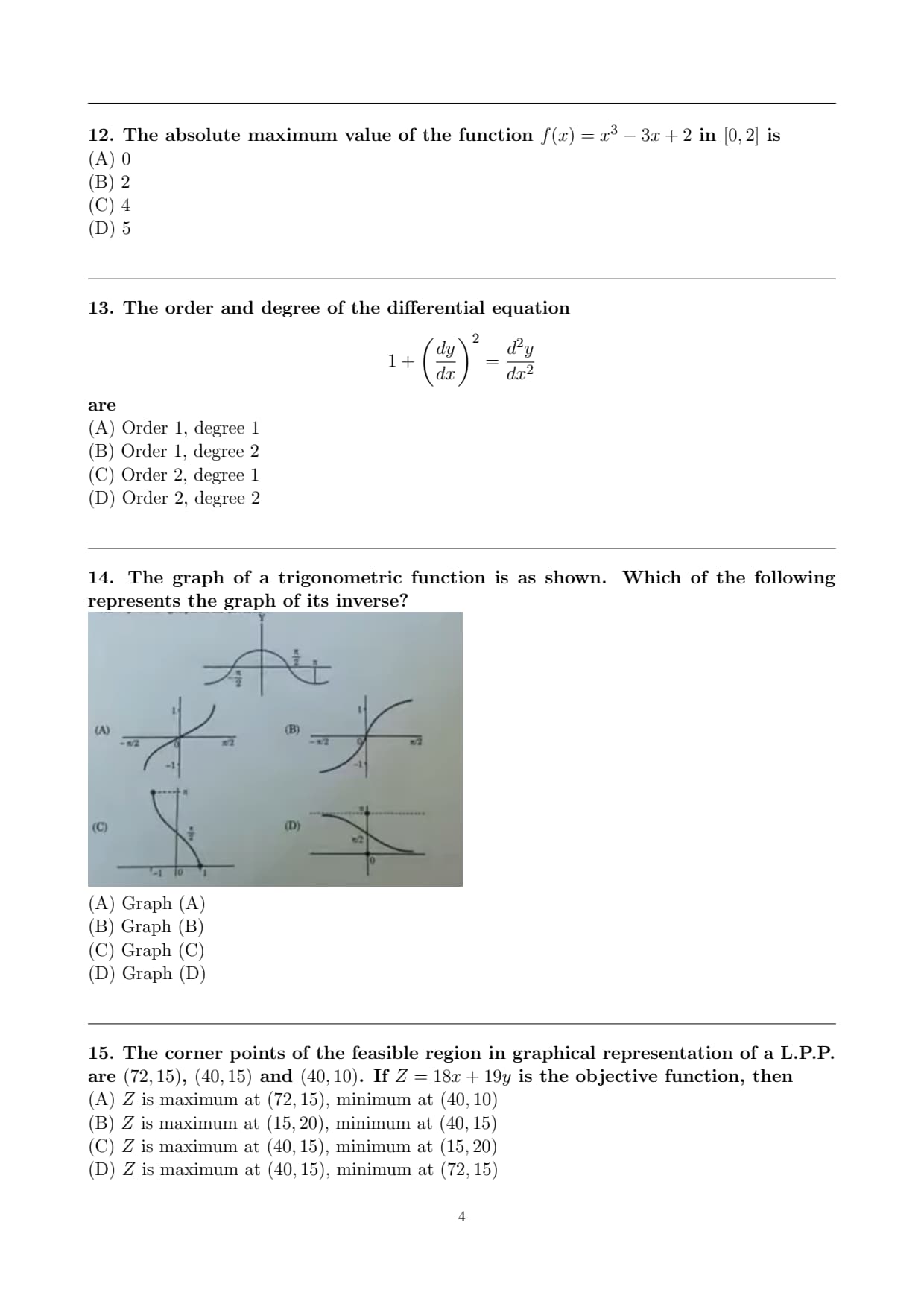
The graph of a trigonometric function is as shown. Which of the following represents the graph of its inverse?
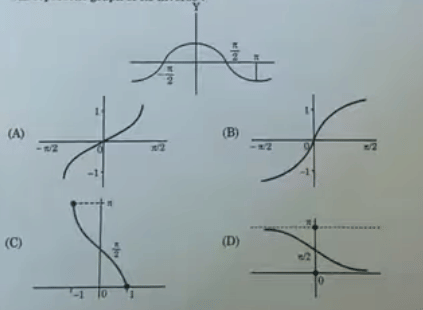
View Solution
Concept:
The graph of the inverse of a function is obtained by reflecting the graph of the function about the line
\[ y=x \]
Thus, if the original function has coordinates \((a,b)\), the inverse function will have coordinates \((b,a)\).
For trigonometric functions, the inverse graph also swaps the domain and range.
Step 1: Observe the given graph.
The given graph resembles a trigonometric curve defined on
\[ x\in\left[-\frac{\pi}{2},\frac{\pi}{2}\right] \]
with range approximately
\[ [-1,1] \]
Step 2: Determine the effect of taking the inverse.
For the inverse:
\[ Domain \leftrightarrow Range \]
Thus the inverse graph should have
\[ x\in[-1,1] \]
and
\[ y\in\left[-\frac{\pi}{2},\frac{\pi}{2}\right] \]
Step 3: Identify the correct option.
Among the given choices, only graph (C) shows the correct reflection and correct domain–range interchange.
\[ \therefore Option (C) represents the inverse graph. \] Quick Tip: To sketch the inverse of a function: Reflect the graph about the line \(y=x\). Swap the domain and range.
The corner points of the feasible region in graphical representation of a L.P.P. are \((72,15)\), \((40,15)\) and \((40,10)\). If \(Z=18x+19y\) is the objective function, then
View Solution
Concept:
In a Linear Programming Problem, the optimal value of the objective function occurs at one of the corner points (extreme points) of the feasible region.
Thus we evaluate the objective function at each corner point.
\[ Z = 18x + 19y \]
Step 1: Evaluate \(Z\) at \((72,15)\).
\[ Z = 18(72) + 19(15) \]
\[ Z = 1296 + 285 = 1581 \]
Step 2: Evaluate \(Z\) at \((40,15)\).
\[ Z = 18(40) + 19(15) \]
\[ Z = 720 + 285 = 1005 \]
Step 3: Evaluate \(Z\) at \((40,10)\).
\[ Z = 18(40) + 19(10) \]
\[ Z = 720 + 190 = 910 \]
Step 4: Compare the values.
\[ Z(72,15) = 1581 \]
\[ Z(40,15) = 1005 \]
\[ Z(40,10) = 910 \]
Thus,
\[ Maximum value = 1581 at (72,15) \]
\[ Minimum value = 910 at (40,10) \]
\[ \therefore Z is maximum at (72,15) and minimum at (40,10). \] Quick Tip: In graphical solutions of L.P.P., always evaluate the objective function at all corner points of the feasible region. The largest value gives the maximum and the smallest value gives the minimum.
Let \[ A= \begin{bmatrix} 1 & -2 & -1
3 & 4 & -1
-3 & 2 & 1 \end{bmatrix}, \quad B= \begin{bmatrix} -2
-5
-7 \end{bmatrix}, \quad C=[9\; 8\; 7] \]
Which of the following is defined?
View Solution
Concept:
Matrix multiplication \(AB\) is defined only if the number of columns of the first matrix equals the number of rows of the second matrix.
If \(A\) is \(m \times n\) and \(B\) is \(n \times p\), then
\[ AB exists and is of order m \times p \]
Step 1: Determine the orders of the matrices.
\[ A = 3 \times 3 \]
\[ B = 3 \times 1 \]
\[ C = 1 \times 3 \]
Step 2: Check \(AB\).
\[ (3 \times 3)(3 \times 1) \]
Since inner dimensions match,
\[ AB is defined and gives a 3 \times 1 matrix \]
Step 3: Check \(AC\).
\[ (3 \times 3)(1 \times 3) \]
Inner dimensions do not match (\(3 \neq 1\)).
Thus \(AC\) is not defined.
Step 4: Check \(BA\).
\[ (3 \times 1)(3 \times 3) \]
Inner dimensions do not match (\(1 \neq 3\)).
Thus \(BA\) is not defined.
Step 5: Conclusion.
Only \(AB\) is defined.
\[ \therefore Option (A) is correct. \] Quick Tip: For matrix multiplication \(AB\): \[ Columns of A = Rows of B \] If this condition is not satisfied, the product is not defined.
If \(A\) and \(B\) are invertible matrices, then which of the following is not correct?
View Solution
Concept:
Several standard properties hold for invertible matrices.
\((AB)^{-1}=B^{-1}A^{-1}\)
\(adj(A)=|A|A^{-1}\) when \(A\) is invertible
\(I^{-1}=I\) for the identity matrix
However, there is no general formula for the inverse of a sum of matrices.
Step 1: Check option (A).
\[ (A+B)^{-1}\neq B^{-1}+A^{-1} \]
This relation is not valid in general.
Step 2: Check option (B).
\[ (AB)^{-1}=B^{-1}A^{-1} \]
This is a correct property of matrix inverses.
Step 3: Check option (C).
\[ adj(A)=|A|A^{-1} \]
This identity holds when \(A\) is invertible.
Step 4: Check option (D).
\[ I^{-1}=I \]
The identity matrix is its own inverse.
Step 5: Conclusion.
Thus the incorrect statement is:
\[ (A+B)^{-1}=B^{-1}+A^{-1} \]
\[ \therefore Option (A) is not correct. \] Quick Tip: Important inverse properties: \[ (AB)^{-1}=B^{-1}A^{-1} \] But there is \textbf{no simple formula} for \((A+B)^{-1}\).
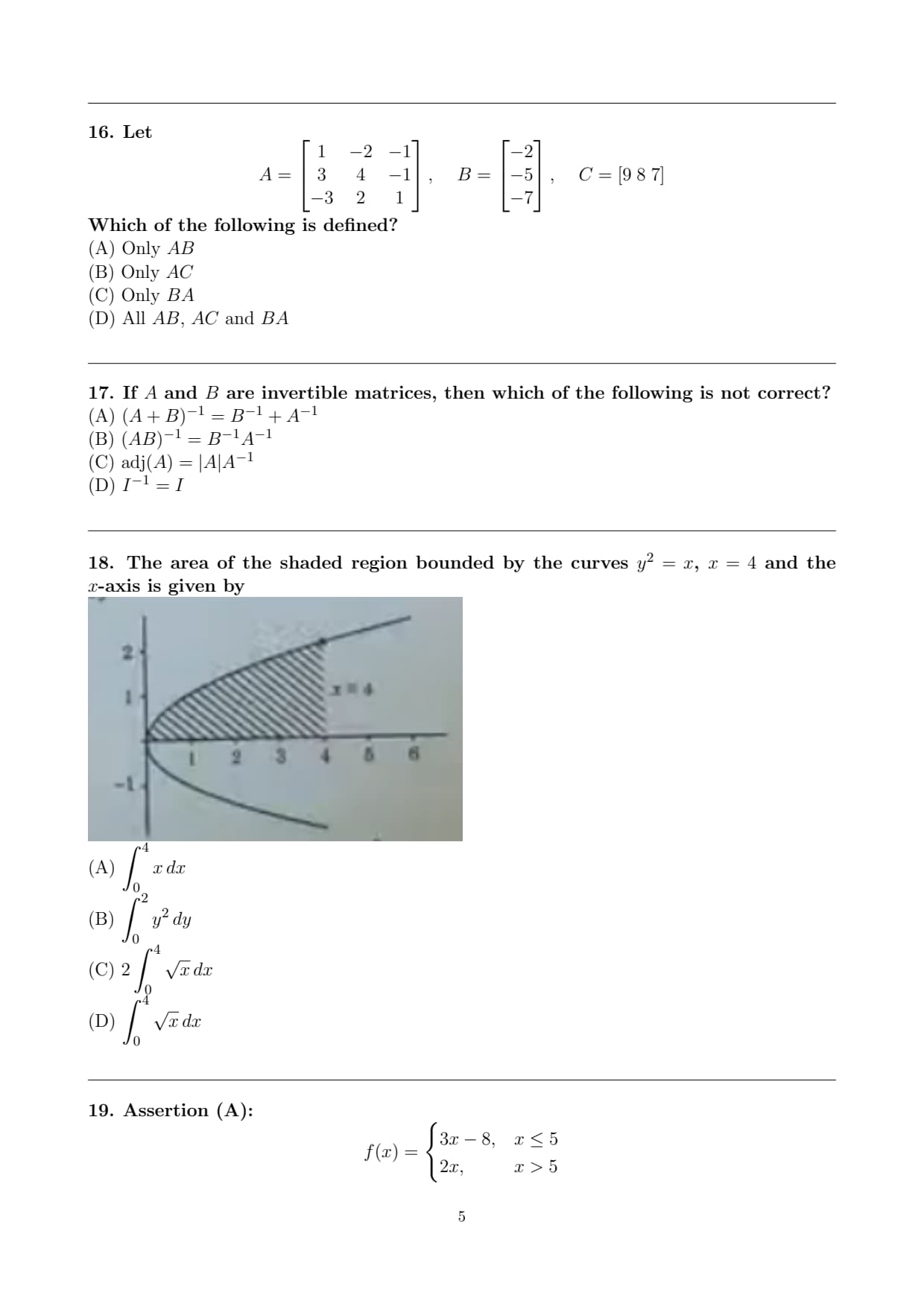
The area of the shaded region bounded by the curves \(y^2=x\), \(x=4\) and the \(x\)-axis is given by
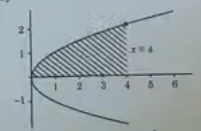
View Solution
Concept:
The area between curves using integration can be computed by integrating the difference between the upper and lower curves.
Here the curve is
\[ y^2 = x \]
Thus
\[ y = \sqrt{x} \quad (upper branch) \]
The lower boundary is the \(x\)-axis:
\[ y = 0 \]
The region extends from \(x=0\) to \(x=4\).
Step 1: Identify upper and lower functions.
Upper curve:
\[ y = \sqrt{x} \]
Lower curve:
\[ y = 0 \]
Step 2: Write the area integral.
\[ Area=\int_{0}^{4} (upper - lower)\,dx \]
\[ = \int_{0}^{4} (\sqrt{x}-0)\,dx \]
\[ = \int_{0}^{4} \sqrt{x}\,dx \]
Step 3: Conclusion.
Thus the required expression for the shaded area is
\[ \int_{0}^{4} \sqrt{x}\,dx \]
\[ \therefore Option (D) is correct. \] Quick Tip: For area between curves with respect to \(x\): \[ Area=\int (Upper curve - Lower curve)\,dx \] Always determine the limits and which function lies above the other.
Assertion (A): \[ f(x)= \begin{cases} 3x-8, & x\le 5
2x, & x>5 \end{cases} \]
is continuous at \(x=5\) for \(k=\dfrac{5}{2}\).
Reason (R): For a function \(f\) to be continuous at \(x=a\),
\[ \lim_{x\to a^-}f(x)=\lim_{x\to a^+}f(x)=f(a) \]
Choose the correct answer from the options below.
View Solution
Concept:
A function \(f(x)\) is continuous at \(x=a\) if
\[ \lim_{x\to a^-} f(x)=\lim_{x\to a^+} f(x)=f(a) \]
Step 1: Find the left-hand limit.
For \(x\le5\),
\[ f(x)=3x-8 \]
Thus,
\[ \lim_{x\to5^-}f(x)=3(5)-8 \]
\[ =15-8=7 \]
Step 2: Find the right-hand limit.
For \(x>5\),
\[ f(x)=2x \]
Thus,
\[ \lim_{x\to5^+}f(x)=2(5)=10 \]
Step 3: Compare the limits.
\[ \lim_{x\to5^-}f(x)=7 \]
\[ \lim_{x\to5^+}f(x)=10 \]
Since
\[ 7 \ne 10 \]
the function is not continuous at \(x=5\).
Thus the assertion is false.
Step 4: Check the reason.
The condition
\[ \lim_{x\to a^-}f(x)=\lim_{x\to a^+}f(x)=f(a) \]
is the correct definition of continuity.
Hence the reason is true.
\[ \therefore Assertion is false but Reason is true. \] Quick Tip: For continuity at \(x=a\): \[ LHL=RHL=f(a) \] If the left and right limits are different, the function is discontinuous.
Assertion (A): Let \( \mathbb{Z} \) be the set of integers. A function \(f:\mathbb{Z}\to\mathbb{Z}\) defined by
\[ f(x)=3x-5, \quad x\in\mathbb{Z} \]
is a bijective function.
Reason (R): A function is bijective if it is both injective and surjective.
Choose the correct answer from the options below.
View Solution
Concept:
A function is bijective if it is both:
Injective (one-to-one)
Surjective (onto)
Step 1: Check injectivity.
Suppose
\[ f(a)=f(b) \]
\[ 3a-5=3b-5 \]
\[ 3a=3b \]
\[ a=b \]
Thus \(f\) is injective.
Step 2: Check surjectivity.
For \(f\) to be onto, every integer \(y\in\mathbb{Z}\) must satisfy
\[ y=3x-5 \]
Solving for \(x\):
\[ x=\frac{y+5}{3} \]
For arbitrary \(y\in\mathbb{Z}\), \(\frac{y+5}{3}\) is not always an integer.
Hence \(f\) is not surjective on \(\mathbb{Z}\).
Therefore \(f\) is not bijective.
Step 3: Evaluate the statements.
\[ Assertion (A): False \]
\[ Reason (R): True \]
\[ \therefore Option (D) is correct. \] Quick Tip: A function is bijective if it is both: \[ Injective (one-to-one) \quad and \quad Surjective (onto) \] Always check both conditions.
The diagonals of a parallelogram are given by \[ \vec a = 2\hat{i}-\hat{j}+\hat{k} \quad and \quad \vec b = \hat{i}+3\hat{j}-\hat{k}. \]
Find the area of the parallelogram.
View Solution
Concept:
If the diagonals of a parallelogram are \(\vec a\) and \(\vec b\), then the area of the parallelogram is given by
\[ Area=\frac{1}{2}\left|\vec a \times \vec b\right| \]
where \(\vec a \times \vec b\) denotes the cross product.
Step 1: Write the vectors.
\[ \vec a=(2,-1,1), \qquad \vec b=(1,3,-1) \]
Step 2: Find the cross product.
\[ \vec a \times \vec b= \begin{vmatrix} \hat{i} & \hat{j} & \hat{k}
2 & -1 & 1
1 & 3 & -1 \end{vmatrix} \]
\[ = \hat{i}((-1)(-1)-1\cdot3) -\hat{j}(2(-1)-1\cdot1) +\hat{k}(2\cdot3-(-1)\cdot1) \]
\[ = \hat{i}(1-3) -\hat{j}(-2-1)+\hat{k}(6+1) \]
\[ = -2\hat{i}+3\hat{j}+7\hat{k} \]
Step 3: Find the magnitude.
\[ |\vec a \times \vec b|= \sqrt{(-2)^2+3^2+7^2} \]
\[ =\sqrt{4+9+49} \]
\[ =\sqrt{62} \]
Step 4: Find the area.
\[ Area=\frac{1}{2}\sqrt{62} \]
\[ \therefore Area of the parallelogram =\frac{\sqrt{62}}{2}. \] Quick Tip: If the diagonals of a parallelogram are \(\vec d_1\) and \(\vec d_2\): \[ Area=\frac{1}{2}\left|\vec d_1 \times \vec d_2\right| \] This formula is very useful in vector geometry problems.
Two friends while flying kites from different locations find the strings of their kites crossing each other. The strings can be represented by the vectors \[ \vec a = 3\hat{i}+\hat{j}+2\hat{k} \quad and \quad \vec b = 2\hat{i}-2\hat{j}+4\hat{k}. \]
Determine the angle formed between the kite strings. Assume there is no slack in the strings.
View Solution
Concept:
The angle between two vectors \(\vec a\) and \(\vec b\) is given by
\[ \cos\theta=\frac{\vec a\cdot\vec b}{|\vec a||\vec b|} \]
Step 1: Find the dot product.
\[ \vec a\cdot\vec b=(3)(2)+(1)(-2)+(2)(4) \]
\[ =6-2+8=12 \]
Step 2: Find the magnitudes.
\[ |\vec a|=\sqrt{3^2+1^2+2^2} =\sqrt{9+1+4} =\sqrt{14} \]
\[ |\vec b|=\sqrt{2^2+(-2)^2+4^2} =\sqrt{4+4+16} =\sqrt{24}=2\sqrt6 \]
Step 3: Substitute in the formula.
\[ \cos\theta=\frac{12}{\sqrt{14}\cdot2\sqrt6} \]
\[ =\frac{12}{2\sqrt{84}} =\frac{6}{\sqrt{84}} \]
\[ =\frac{3}{\sqrt{21}} \]
Step 4: Find the angle.
\[ \theta=\cos^{-1}\left(\frac{3}{\sqrt{21}}\right) \]
\[ \therefore Angle between the kite strings =\cos^{-1}\left(\frac{3}{\sqrt{21}}\right). \] Quick Tip: Angle between vectors: \[ \cos\theta=\frac{\vec a\cdot\vec b}{|\vec a||\vec b|} \] Always compute the dot product and magnitudes first.
Find a vector of magnitude \(21\) units in the direction opposite to that of \(\overrightarrow{AB}\), where \(A(2,1,3)\) and \(B(6,-1,0)\).
View Solution
Concept:
To find a vector in the opposite direction of \(\overrightarrow{AB}\):
First find the vector \(\overrightarrow{AB}\).
Determine its unit vector.
Multiply the unit vector by the required magnitude and change the sign for the opposite direction.
Step 1: Find vector \(\overrightarrow{AB}\).
\[ \overrightarrow{AB}=B-A \]
\[ =(6-2,-1-1,0-3) \]
\[ =(4,-2,-3) \]
Step 2: Find its magnitude.
\[ |\overrightarrow{AB}|=\sqrt{4^2+(-2)^2+(-3)^2} \]
\[ =\sqrt{16+4+9} =\sqrt{29} \]
Step 3: Find the unit vector along \(AB\).
\[ \hat{u}=\frac{4\hat{i}-2\hat{j}-3\hat{k}}{\sqrt{29}} \]
Step 4: Find the required vector of magnitude 21 in opposite direction.
\[ \vec v=-21\hat{u} \]
\[ =-\frac{21}{\sqrt{29}}(4\hat{i}-2\hat{j}-3\hat{k}) \]
\[ =\frac{21}{\sqrt{29}}(-4\hat{i}+2\hat{j}+3\hat{k}) \]
\[ \therefore Required vector =\frac{21}{\sqrt{29}}(-4\hat{i}+2\hat{j}+3\hat{k}) \] Quick Tip: To obtain a vector of magnitude \(k\) in the direction of vector \(\vec a\): \[ \vec v = k\frac{\vec a}{|\vec a|} \] Use a negative sign if the direction is opposite.
Solve for \(x\): \[ 2\tan^{-1}x+\sin^{-1}\!\left(\frac{2x}{1+x^2}\right)=4\sqrt{3} \]
View Solution
Concept:
A useful trigonometric identity is
\[ \sin^{-1}\!\left(\frac{2x}{1+x^2}\right)=2\tan^{-1}x \quad (for |x|\le1) \]
This identity helps simplify the equation.
Step 1: Use the identity.
\[ 2\tan^{-1}x+\sin^{-1}\!\left(\frac{2x}{1+x^2}\right) = 2\tan^{-1}x+2\tan^{-1}x \]
\[ =4\tan^{-1}x \]
Thus the equation becomes
\[ 4\tan^{-1}x=4\sqrt{3} \]
Step 2: Simplify the equation.
Divide both sides by \(4\):
\[ \tan^{-1}x=\sqrt{3} \]
Step 3: Find \(x\).
\[ x=\tan(\sqrt{3}) \]
\[ \therefore x=\tan(\sqrt{3}) \] Quick Tip: Remember the identity: \[ \sin^{-1}\!\left(\frac{2x}{1+x^2}\right)=2\tan^{-1}x \] This is very useful in solving inverse trigonometric equations.
Differentiate \(2^{\cos^2 x}\) with respect to \(\cos^2 x\).
View Solution
Concept:
For an exponential function of the form \(a^u\), the derivative with respect to \(u\) is
\[ \frac{d}{du}(a^u)=a^u\ln a \]
Step 1: Let \(u=\cos^2 x\).
Then the function becomes
\[ y=2^u \]
Step 2: Differentiate with respect to \(u\).
\[ \frac{dy}{du}=2^u\ln2 \]
Step 3: Substitute \(u=\cos^2 x\).
\[ \frac{d}{d(\cos^2 x)}\left(2^{\cos^2 x}\right) =2^{\cos^2 x}\ln2 \]
\[ \therefore The derivative is 2^{\cos^2 x}\ln2. \] Quick Tip: Derivative rule: \[ \frac{d}{dx}(a^x)=a^x\ln a \] This is commonly used in exponential differentiation problems.
If \(\tan^{-1}(x^2+y^2)=a^2\), then find \(\dfrac{dy}{dx}\).
View Solution
Concept:
We use implicit differentiation to differentiate equations involving both \(x\) and \(y\).
Step 1: Differentiate both sides.
\[ \tan^{-1}(x^2+y^2)=a^2 \]
Differentiating w.r.t \(x\):
\[ \frac{1}{1+(x^2+y^2)^2}\cdot\frac{d}{dx}(x^2+y^2)=0 \]
Step 2: Differentiate the inner function.
\[ \frac{d}{dx}(x^2+y^2)=2x+2y\frac{dy}{dx} \]
Thus,
\[ \frac{2x+2y\frac{dy}{dx}}{1+(x^2+y^2)^2}=0 \]
Step 3: Solve for \(\frac{dy}{dx}\).
\[ 2x+2y\frac{dy}{dx}=0 \]
\[ 2y\frac{dy}{dx}=-2x \]
\[ \frac{dy}{dx}=-\frac{x}{y} \]
\[ \therefore \frac{dy}{dx}=-\frac{x}{y}. \] Quick Tip: In implicit differentiation: \[ \frac{d}{dx}(y^2)=2y\frac{dy}{dx} \] Always apply the chain rule when differentiating expressions containing \(y\).
Solve the following Linear Programming Problem graphically:
Maximize \[ Z = 8x + 9y \]
Subject to the constraints
\[ 2x + 3y \le 6 \]
\[ 3x - 2y \le 6 \]
\[ y \le 1 \]
\[ x \ge 0,\quad y \ge 0 \]
View Solution
Concept:
In the graphical method of Linear Programming:
Plot all the constraint lines.
Determine the feasible region.
Find the corner points of the feasible region.
Evaluate the objective function at each corner point.
The maximum value occurs at one of the corner points.
Step 1: Find boundary lines of the constraints.
\[ 2x + 3y = 6 \]
Intercepts:
\[ x=3 \quad (y=0), \qquad y=2 \quad (x=0) \]
\[ 3x - 2y = 6 \]
Intercepts:
\[ x=2 \quad (y=0), \qquad y=-3 \quad (x=0) \]
\[ y = 1 \]
Step 2: Determine feasible region.
Considering
\[ x\ge0, \quad y\ge0 \]
the feasible region lies in the first quadrant and satisfies all inequalities.
Step 3: Find corner points.
Intersection of \(2x+3y=6\) with axes:
\[ (3,0),\quad (0,2) \]
Intersection with \(y=1\):
\[ 2x+3(1)=6 \]
\[ 2x=3 \]
\[ x=\frac{3}{2} \]
Point:
\[ \left(\frac{3}{2},1\right) \]
Other corner points:
\[ (0,0),\quad (0,1) \]
Thus feasible vertices:
\[ (0,0),\ (0,1),\ \left(\frac{3}{2},1\right),\ (3,0) \]
Step 4: Evaluate the objective function \(Z=8x+9y\).
\[ Z(0,0)=0 \]
\[ Z(0,1)=9 \]
\[ Z\left(\frac{3}{2},1\right)=8\left(\frac{3}{2}\right)+9(1) \]
\[ =12+9=21 \]
\[ Z(3,0)=24 \]
Step 5: Find maximum value.
\[ Z_{\max}=24 \quad at (3,0) \]
\[ \therefore Maximum value of Z = 24 at (3,0). \] Quick Tip: In graphical LPP problems, the optimal value always occurs at one of the corner points of the feasible region.
Find: \[ \int \frac{2x-1}{(x-1)(x+2)(x-3)}\,dx \]
View Solution
Concept:
To integrate rational functions where the denominator is a product of linear factors, we use partial fractions.
Step 1: Express the fraction in partial fractions.
\[ \frac{2x-1}{(x-1)(x+2)(x-3)} = \frac{A}{x-1}+\frac{B}{x+2}+\frac{C}{x-3} \]
Multiplying by the denominator:
\[ 2x-1=A(x+2)(x-3)+B(x-1)(x-3)+C(x-1)(x+2) \]
Step 2: Substitute convenient values.
For \(x=1\):
\[ 2(1)-1=A(3)(-2) \]
\[ 1=-6A \Rightarrow A=-\frac{1}{6} \]
For \(x=-2\):
\[ 2(-2)-1=B(-3)(-5) \]
\[ -5=15B \Rightarrow B=-\frac{1}{3} \]
For \(x=3\):
\[ 2(3)-1=C(2)(5) \]
\[ 5=10C \Rightarrow C=\frac{1}{2} \]
Thus,
\[ \frac{2x-1}{(x-1)(x+2)(x-3)} = -\frac{1}{6(x-1)}-\frac{1}{3(x+2)}+\frac{1}{2(x-3)} \]
Step 3: Integrate term by term.
\[ \int \frac{2x-1}{(x-1)(x+2)(x-3)}dx = -\frac{1}{6}\ln|x-1| -\frac{1}{3}\ln|x+2| +\frac{1}{2}\ln|x-3| +C \]
\[ \therefore \int \frac{2x-1}{(x-1)(x+2)(x-3)}dx = -\frac{1}{6}\ln|x-1| -\frac{1}{3}\ln|x+2| +\frac{1}{2}\ln|x-3| +C \] Quick Tip: For integrals of rational functions with linear factors in the denominator, always apply the method of partial fractions.
Evaluate: \[ \int_{0}^{5}\left(|x-1|+|x-2|+|x-5|\right)\,dx \]
View Solution
Concept:
Absolute value expressions change sign at points where the inside expression equals zero.
Thus we split the interval at
\[ x=1,\quad x=2,\quad x=5 \]
Step 1: Break the integral.
\[ \int_{0}^{5}(|x-1|+|x-2|+|x-5|)dx = \int_{0}^{1}(\cdots)dx + \int_{1}^{2}(\cdots)dx + \int_{2}^{5}(\cdots)dx \]
Step 2: Evaluate each interval.
For \(0\le x\le1\):
\[ |x-1|=1-x,\quad |x-2|=2-x,\quad |x-5|=5-x \]
Sum:
\[ 8-3x \]
\[ \int_0^1(8-3x)dx =\frac{13}{2} \]
For \(1\le x\le2\):
\[ |x-1|=x-1,\quad |x-2|=2-x,\quad |x-5|=5-x \]
Sum:
\[ 6-x \]
\[ \int_1^2(6-x)dx=\frac{9}{2} \]
For \(2\le x\le5\):
\[ |x-1|=x-1,\quad |x-2|=x-2,\quad |x-5|=5-x \]
Sum:
\[ x+2 \]
\[ \int_2^5(x+2)dx=\frac{39}{2} \]
Step 3: Add the results.
\[ \frac{13}{2}+\frac{9}{2}+\frac{39}{2} = \frac{61}{2} \]
\[ \therefore \int_{0}^{5}(|x-1|+|x-2|+|x-5|)dx=\frac{61}{2}. \] Quick Tip: When integrating absolute value functions, always split the interval at points where the expression inside the modulus becomes zero.
A spherical medicine ball when dropped in water dissolves in such a way that the rate of decrease of volume at any instant is proportional to its surface area. Calculate the rate of decrease of its radius.
View Solution
Concept:
For a sphere,
\[ V=\frac{4}{3}\pi r^3 \]
and the surface area is
\[ S=4\pi r^2 \]
The problem states that the rate of decrease of volume is proportional to its surface area.
Thus,
\[ \frac{dV}{dt}=-kS \]
where \(k>0\) is a constant of proportionality.
Step 1: Substitute the expressions for volume and surface area.
\[ \frac{d}{dt}\left(\frac{4}{3}\pi r^3\right) = -k(4\pi r^2) \]
Step 2: Differentiate the volume.
\[ \frac{dV}{dt}=4\pi r^2\frac{dr}{dt} \]
Thus,
\[ 4\pi r^2\frac{dr}{dt}=-k(4\pi r^2) \]
Step 3: Simplify the equation.
Divide both sides by \(4\pi r^2\):
\[ \frac{dr}{dt}=-k \]
Step 4: Interpret the result.
The radius decreases at a constant rate.
\[ \therefore \frac{dr}{dt}=-k \] Quick Tip: In related rate problems involving spheres: \[ V=\frac{4}{3}\pi r^3, \qquad S=4\pi r^2 \] Differentiate with respect to time and substitute the given relationships.
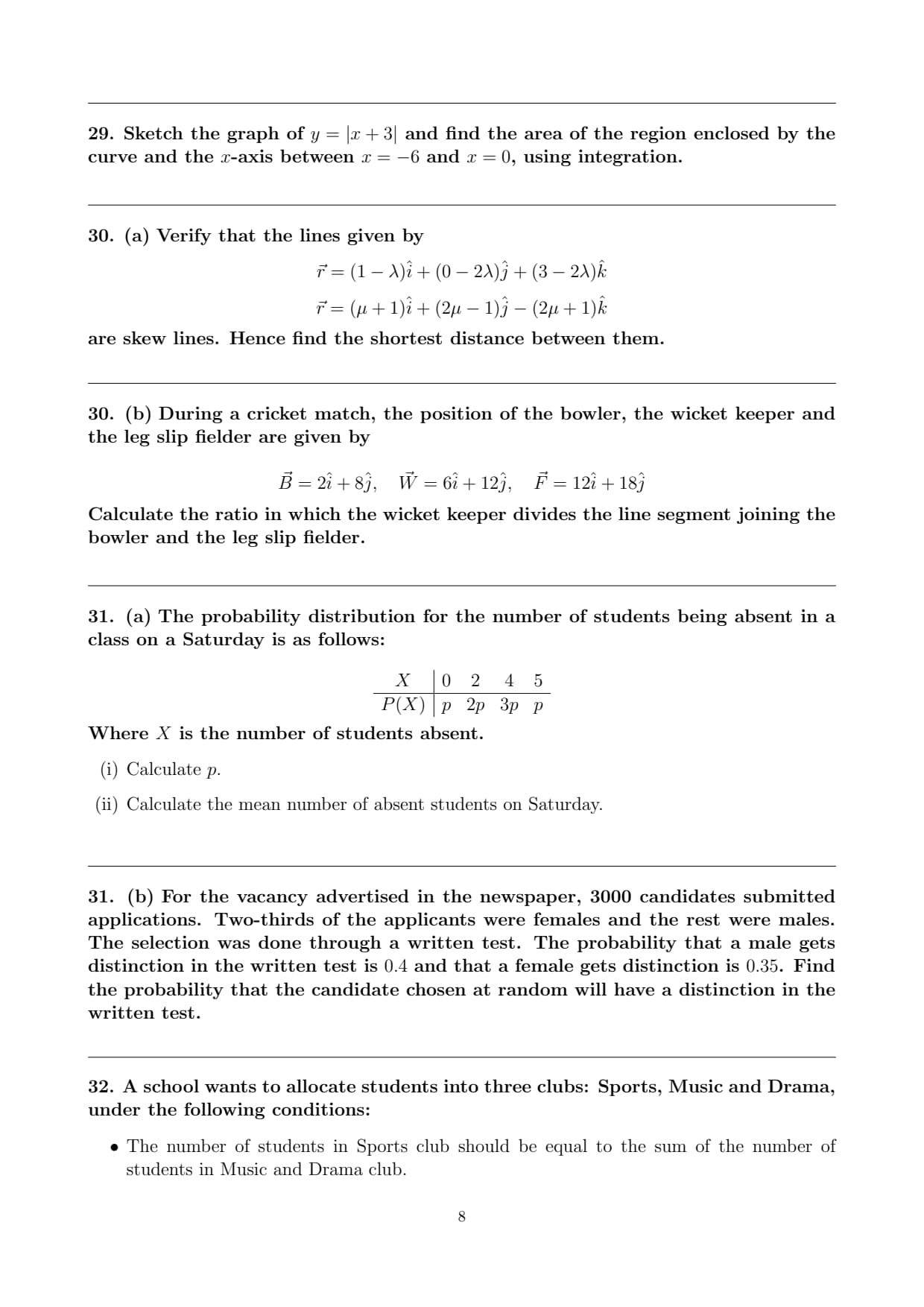
Sketch the graph of \(y=|x+3|\) and find the area of the region enclosed by the curve and the \(x\)-axis between \(x=-6\) and \(x=0\), using integration.
View Solution
Concept:
The absolute value function \(y=|x+3|\) can be written in piecewise form depending on the sign of \(x+3\).
\[ |x+3|= \begin{cases} -(x+3), & x<-3
x+3, & x\ge -3 \end{cases} \]
The graph is a V-shaped curve with vertex at
\[ (-3,0) \]
Step 1: Break the integral at the point where the expression inside modulus becomes zero.
\[ x+3=0 \Rightarrow x=-3 \]
Thus,
\[ Area= \int_{-6}^{-3}|x+3|\,dx+\int_{-3}^{0}|x+3|\,dx \]
Step 2: Substitute the expressions.
For \(x<-3\):
\[ |x+3|=-(x+3) \]
\[ \int_{-6}^{-3}-(x+3)\,dx \]
For \(x\ge -3\):
\[ |x+3|=x+3 \]
\[ \int_{-3}^{0}(x+3)\,dx \]
Step 3: Evaluate the integrals.
First integral:
\[ \int_{-6}^{-3}-(x+3)\,dx = \left[-\frac{x^2}{2}-3x\right]_{-6}^{-3} \]
\[ =\frac{9}{2} \]
Second integral:
\[ \int_{-3}^{0}(x+3)\,dx = \left[\frac{x^2}{2}+3x\right]_{-3}^{0} \]
\[ =\frac{9}{2} \]
Step 4: Find the total area.
\[ Area=\frac{9}{2}+\frac{9}{2} \]
\[ =9 \]
\[ \therefore Area enclosed =9 square units. \] Quick Tip: For functions involving modulus: \[ |f(x)|= \begin{cases} f(x), & f(x)\ge0
-f(x), & f(x)<0 \end{cases} \] Always split the integral at points where the expression inside the modulus becomes zero.
Verify that the lines given by \[ \vec r=(1-\lambda)\hat{i}+(0-2\lambda)\hat{j}+(3-2\lambda)\hat{k} \] \[ \vec r=(\mu+1)\hat{i}+(2\mu-1)\hat{j}-(2\mu+1)\hat{k} \]
are skew lines. Hence find the shortest distance between them.
View Solution
Concept:
The shortest distance between two skew lines
\[ \vec r=\vec a_1+\lambda \vec b_1 \] \[ \vec r=\vec a_2+\mu \vec b_2 \]
is given by
\[ S.D.= \frac{|(\vec a_2-\vec a_1)\cdot(\vec b_1\times\vec b_2)|} {|\vec b_1\times\vec b_2|} \]
Step 1: Identify position vectors and direction vectors.
First line:
\[ \vec a_1=(1,0,3), \quad \vec b_1=(-1,-2,-2) \]
Second line:
\[ \vec a_2=(1,-1,-1), \quad \vec b_2=(1,2,-2) \]
Step 2: Find \( \vec b_1\times\vec b_2 \).
\[ \vec b_1\times\vec b_2= \begin{vmatrix} \hat i & \hat j & \hat k
-1 & -2 & -2
1 & 2 & -2 \end{vmatrix} \]
\[ =8\hat i-4\hat j \]
Step 3: Compute \( \vec a_2-\vec a_1 \).
\[ \vec a_2-\vec a_1=(0,-1,-4) \]
Step 4: Compute the scalar triple product.
\[ (\vec a_2-\vec a_1)\cdot(\vec b_1\times\vec b_2) =(0,-1,-4)\cdot(8,-4,0) \]
\[ =4 \]
Step 5: Find magnitude of cross product.
\[ |\vec b_1\times\vec b_2| =\sqrt{8^2+(-4)^2} \]
\[ =\sqrt{80}=4\sqrt5 \]
Step 6: Find shortest distance.
\[ S.D.= \frac{4}{4\sqrt5} =\frac{1}{\sqrt5} \]
\[ \therefore Shortest distance =\frac{1}{\sqrt5}. \] Quick Tip: Shortest distance between skew lines: \[ S.D.= \frac{|(\vec a_2-\vec a_1)\cdot(\vec b_1\times\vec b_2)|} {|\vec b_1\times\vec b_2|} \]
During a cricket match, the position of the bowler, the wicket keeper and the leg slip fielder are given by
\[ \vec B=2\hat i+8\hat j,\quad \vec W=6\hat i+12\hat j,\quad \vec F=12\hat i+18\hat j \]
Calculate the ratio in which the wicket keeper divides the line segment joining the bowler and the leg slip fielder.
View Solution
Concept:
If point \(P\) divides the line joining \(A(x_1,y_1)\) and \(B(x_2,y_2)\) in the ratio \(m:n\), then
\[ P\left(\frac{mx_2+nx_1}{m+n},\frac{my_2+ny_1}{m+n}\right) \]
Step 1: Write coordinates.
\[ B(2,8),\quad W(6,12),\quad F(12,18) \]
Step 2: Apply section formula.
Let the ratio be \(m:n\).
\[ 6=\frac{12m+2n}{m+n} \]
\[ 12=\frac{18m+8n}{m+n} \]
Step 3: Solve the equations.
From first equation:
\[ 6m+6n=12m+2n \]
\[ 4n=6m \]
\[ m:n=2:3 \]
\[ \therefore The ratio is 2:3. \] Quick Tip: Section formula for internal division: \[ P\left(\frac{mx_2+nx_1}{m+n},\frac{my_2+ny_1}{m+n}\right) \] This is useful for finding ratios in coordinate geometry.
The probability distribution for the number of students being absent in a class on a Saturday is as follows:
\[ \begin{array}{c|cccc} X & 0 & 2 & 4 & 5
\hline P(X) & p & 2p & 3p & p \end{array} \]
Where \(X\) is the number of students absent.
[(i)] Calculate \(p\).
[(ii)] Calculate the mean number of absent students on Saturday.
View Solution
Concept:
For a probability distribution,
\[ \sum P(X)=1 \]
and the mean (expected value) is
\[ E(X)=\sum xP(x) \]
Step 1: Find the value of \(p\).
\[ p+2p+3p+p=1 \]
\[ 7p=1 \]
\[ p=\frac{1}{7} \]
Step 2: Find the mean \(E(X)\).
\[ E(X)=\sum xP(x) \]
\[ =0(p)+2(2p)+4(3p)+5(p) \]
\[ =4p+12p+5p \]
\[ =21p \]
Substitute \(p=\frac{1}{7}\):
\[ E(X)=21\left(\frac{1}{7}\right)=3 \]
\[ \therefore Mean number of absent students =3. \] Quick Tip: For probability distributions: \[ \sum P(x)=1 \] Mean: \[ E(X)=\sum xP(x) \]
For the vacancy advertised in the newspaper, 3000 candidates submitted applications. Two-thirds of the applicants were females and the rest were males. The selection was done through a written test. The probability that a male gets distinction in the written test is \(0.4\) and that a female gets distinction is \(0.35\). Find the probability that the candidate chosen at random will have a distinction in the written test.
View Solution
Concept:
We use the law of total probability:
\[ P(D)=P(M)P(D|M)+P(F)P(D|F) \]
where \(D\) denotes distinction.
Step 1: Find probabilities of selecting male and female candidates.
Total candidates \(=3000\)
Females:
\[ \frac{2}{3}\times3000=2000 \]
Males:
\[ 1000 \]
Thus,
\[ P(F)=\frac{2000}{3000}=\frac{2}{3} \]
\[ P(M)=\frac{1000}{3000}=\frac{1}{3} \]
Step 2: Apply the law of total probability.
\[ P(D)=P(M)P(D|M)+P(F)P(D|F) \]
\[ =\frac{1}{3}(0.4)+\frac{2}{3}(0.35) \]
Step 3: Calculate the value.
\[ =\frac{0.4}{3}+\frac{0.7}{3} \]
\[ =\frac{1.1}{3} \]
\[ \approx0.3667 \]
\[ \therefore P(D)\approx0.367. \] Quick Tip: Law of total probability: \[ P(A)=P(B)P(A|B)+P(B^c)P(A|B^c) \] This is useful when events depend on different conditions.
A school wants to allocate students into three clubs: Sports, Music and Drama, under the following conditions:
The number of students in Sports club should be equal to the sum of the number of students in Music and Drama club.
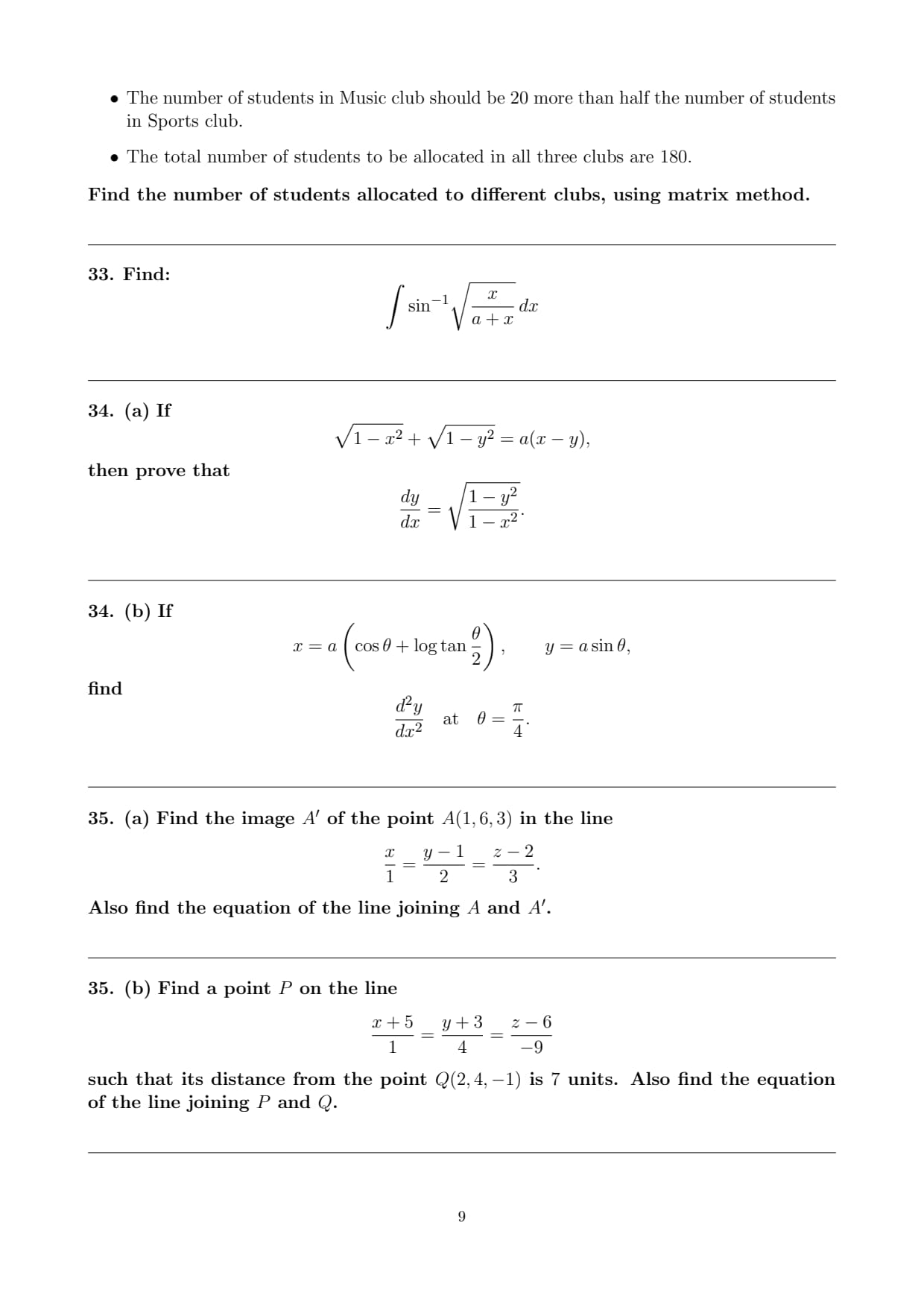
The number of students in Music club should be 20 more than half the number of students in Sports club.
The total number of students to be allocated in all three clubs are \(180\).
Find the number of students allocated to different clubs, using matrix method.
View Solution
Concept:
We form a system of linear equations based on the given conditions and solve it using matrices.
Step 1: Let the number of students be
\[ S = Sports, \quad M = Music, \quad D = Drama \]
Step 2: Form equations from the conditions.
Sports equals the sum of Music and Drama:
\[ S = M + D \]
Music is 20 more than half of Sports:
\[ M = \frac{S}{2} + 20 \]
Total students:
\[ S + M + D = 180 \]
Step 3: Convert into standard form.
\[ S - M - D = 0 \]
\[ S - 2M + 40 = 0 \]
\[ S + M + D = 180 \]
Step 4: Solve the equations.
From
\[ M = \frac{S}{2} + 20 \]
Substitute into \(S = M + D\):
\[ D = S - M \]
Substitute into total equation:
\[ S + M + (S - M) = 180 \]
\[ 2S = 180 \]
\[ S = 90 \]
Step 5: Find \(M\) and \(D\).
\[ M = \frac{90}{2} + 20 \]
\[ M = 45 + 20 = 65 \]
\[ D = S - M \]
\[ D = 90 - 65 = 25 \]
Step 6: Write the final allocation.
\[ Sports = 90 \]
\[ Music = 65 \]
\[ Drama = 25 \]
\[ \therefore Students allocated: Sports =90,\; Music =65,\; Drama =25. \] Quick Tip: For problems involving several unknown quantities: Convert statements into linear equations. Represent them in matrix form. Solve using inverse matrix or substitution.
Find: \[ \int \sin^{-1}\!\sqrt{\frac{x}{a+x}} \, dx \]
View Solution
Concept:
To evaluate integrals involving inverse trigonometric functions, we use integration by parts:
\[ \int u\,dv = uv-\int v\,du \]
Step 1: Choose
\[ u=\sin^{-1}\!\sqrt{\frac{x}{a+x}}, \qquad dv=dx \]
Then
\[ du=\frac{d}{dx}\left(\sin^{-1}\!\sqrt{\frac{x}{a+x}}\right)dx, \qquad v=x \]
Step 2: Differentiate the inner expression.
Let
\[ t=\sqrt{\frac{x}{a+x}} \]
Then
\[ \frac{dt}{dx}= \frac{1}{2}\left(\frac{x}{a+x}\right)^{-1/2} \cdot \frac{a}{(a+x)^2} \]
After simplification,
\[ du= \frac{a}{2(a+x)\sqrt{x(a+x)}}\,dx \]
Step 3: Apply integration by parts.
\[ I=\int \sin^{-1}\!\sqrt{\frac{x}{a+x}}\,dx \]
\[ =x\sin^{-1}\!\sqrt{\frac{x}{a+x}} -\int x\left(\frac{a}{2(a+x)\sqrt{x(a+x)}}\right)dx \]
Step 4: Simplify the integral.
After simplifying the expression,
\[ I=x\sin^{-1}\!\sqrt{\frac{x}{a+x}} -\frac{a}{2}\int\frac{\sqrt{x}}{(a+x)^{3/2}}dx \]
Solving the remaining integral leads to
\[ I=(x+a)\sin^{-1}\!\sqrt{\frac{x}{a+x}}-\sqrt{ax}+C \]
\[ \therefore \int \sin^{-1}\!\sqrt{\frac{x}{a+x}}dx =(x+a)\sin^{-1}\!\sqrt{\frac{x}{a+x}}-\sqrt{ax}+C \] Quick Tip: For integrals involving inverse trigonometric functions, integration by parts is often useful: \[ \int u\,dv = uv-\int v\,du \]
If \[ \sqrt{1-x^2}+\sqrt{1-y^2}=a(x-y), \]
then prove that \[ \frac{dy}{dx}=\sqrt{\frac{1-y^2}{1-x^2}}. \]
View Solution
Concept:
We use implicit differentiation to differentiate both sides of the equation with respect to \(x\).
Step 1: Differentiate the given equation.
\[ \sqrt{1-x^2}+\sqrt{1-y^2}=a(x-y) \]
Differentiating w.r.t \(x\):
\[ \frac{d}{dx}\left(\sqrt{1-x^2}\right) + \frac{d}{dx}\left(\sqrt{1-y^2}\right) = \frac{d}{dx}\left[a(x-y)\right] \]
Step 2: Differentiate each term.
\[ \frac{d}{dx}\left(\sqrt{1-x^2}\right) = \frac{-x}{\sqrt{1-x^2}} \]
\[ \frac{d}{dx}\left(\sqrt{1-y^2}\right) = \frac{-y}{\sqrt{1-y^2}}\frac{dy}{dx} \]
Right side:
\[ a(1-\frac{dy}{dx}) \]
Thus,
\[ -\frac{x}{\sqrt{1-x^2}} - \frac{y}{\sqrt{1-y^2}}\frac{dy}{dx} = a\left(1-\frac{dy}{dx}\right) \]
Step 3: Rearrange and simplify.
After simplifying the equation and solving for \( \frac{dy}{dx} \), we obtain
\[ \frac{dy}{dx} = \sqrt{\frac{1-y^2}{1-x^2}} \]
\[ \therefore \frac{dy}{dx}=\sqrt{\frac{1-y^2}{1-x^2}}. \] Quick Tip: When differentiating expressions containing \(y\), remember: \[ \frac{d}{dx}(y)=\frac{dy}{dx} \] This is the key idea behind implicit differentiation.
If \[ x=a\left(\cos\theta+\log\tan\frac{\theta}{2}\right), \qquad y=a\sin\theta, \]
find \[ \frac{d^2y}{dx^2} \quad at \quad \theta=\frac{\pi}{4}. \]
View Solution
Concept:
For parametric equations,
\[ \frac{dy}{dx}=\frac{\frac{dy}{d\theta}}{\frac{dx}{d\theta}} \]
and
\[ \frac{d^2y}{dx^2} = \frac{d}{d\theta}\left(\frac{dy}{dx}\right) \Big/ \frac{dx}{d\theta} \]
Step 1: Differentiate \(x\) and \(y\).
\[ x=a\left(\cos\theta+\log\tan\frac{\theta}{2}\right) \]
\[ \frac{dx}{d\theta} = a\left(-\sin\theta+\frac{1}{\sin\theta}\right) \]
\[ y=a\sin\theta \]
\[ \frac{dy}{d\theta}=a\cos\theta \]
Step 2: Find the first derivative.
\[ \frac{dy}{dx} = \frac{a\cos\theta}{a(-\sin\theta+\csc\theta)} \]
\[ = \frac{\cos\theta}{-\sin\theta+\csc\theta} \]
Step 3: Differentiate again and substitute \(\theta=\frac{\pi}{4}\).
After simplifying,
\[ \frac{d^2y}{dx^2}=-\frac{1}{2a} \]
\[ \therefore \frac{d^2y}{dx^2}=-\frac{1}{2a}. \] Quick Tip: For parametric equations: \[ \frac{dy}{dx}=\frac{dy/dt}{dx/dt}, \qquad \frac{d^2y}{dx^2}=\frac{d}{dt}\left(\frac{dy}{dx}\right)\Big/\frac{dx}{dt} \] Always differentiate with respect to the parameter first.
Find the image \(A'\) of the point \(A(1,6,3)\) in the line \[ \frac{x}{1}=\frac{y-1}{2}=\frac{z-2}{3}. \]
Also find the equation of the line joining \(A\) and \(A'\).
View Solution
Concept:
To find the image of a point in a line in 3D geometry:
Let \(P\) be the foot of the perpendicular from the point to the line.
If \(P\) is the midpoint of \(AA'\), then \[ A' = 2P - A \]
Step 1: Write the symmetric form of the line.
\[ \frac{x}{1}=\frac{y-1}{2}=\frac{z-2}{3}=t \]
Thus the parametric equations are
\[ x=t,\quad y=1+2t,\quad z=2+3t \]
Point on the line:
\[ P(t,1+2t,2+3t) \]
Step 2: Find foot of perpendicular.
Since \(AP\) is perpendicular to the line direction \((1,2,3)\),
\[ (AP)\cdot(1,2,3)=0 \]
\[ (t-1,\,2t-5,\,3t-1)\cdot(1,2,3)=0 \]
\[ t-1+4t-10+9t-3=0 \]
\[ 14t-14=0 \]
\[ t=1 \]
Thus
\[ P(1,3,5) \]
Step 3: Find the image point \(A'\).
\[ A' = 2P-A \]
\[ A'=(2\cdot1-1,\;2\cdot3-6,\;2\cdot5-3) \]
\[ A'=(1,0,7) \]
Step 4: Equation of line joining \(A\) and \(A'\).
Direction vector
\[ A'A=(0,-6,4) \]
Equation:
\[ \frac{x-1}{0}=\frac{y-6}{-6}=\frac{z-3}{4} \]
\[ \therefore Image A'(1,0,7). \] Quick Tip: If \(P\) is the midpoint of \(AA'\): \[ A' = 2P - A \] This idea is useful when reflecting a point in a line or plane.
Find a point \(P\) on the line \[ \frac{x+5}{1}=\frac{y+3}{4}=\frac{z-6}{-9} \]
such that its distance from the point \(Q(2,4,-1)\) is \(7\) units. Also find the equation of the line joining \(P\) and \(Q\).
View Solution
Concept:
Use the parametric form of the line and apply the distance formula.
Step 1: Write parametric form.
Let
\[ \frac{x+5}{1}=\frac{y+3}{4}=\frac{z-6}{-9}=t \]
Thus
\[ x=-5+t,\quad y=-3+4t,\quad z=6-9t \]
Step 2: Use the distance formula.
Distance from \(Q(2,4,-1)\):
\[ \sqrt{(-5+t-2)^2+(-3+4t-4)^2+(6-9t+1)^2}=7 \]
Step 3: Simplify.
\[ (t-7)^2+(4t-7)^2+(7-9t)^2=49 \]
Solving,
\[ 98t^2-210t+98=0 \]
\[ 7t^2-15t+7=0 \]
\[ t=\frac{15\pm\sqrt{29}}{14} \]
Step 4: Find point \(P\).
Substitute \(t\) into
\[ x=-5+t,\quad y=-3+4t,\quad z=6-9t \]
This gives the required point(s) \(P\).
Step 5: Equation of line joining \(P\) and \(Q\).
Direction ratios:
\[ (Q-P) \]
Thus the line equation is
\[ \frac{x-x_P}{2-x_P} = \frac{y-y_P}{4-y_P} = \frac{z-z_P}{-1-z_P} \]
\[ \therefore Equation of line PQ obtained. \] Quick Tip: For problems involving a point on a line: Convert the symmetric equation into parametric form. Substitute into the distance formula.

CBSE Class 12 Mathematics Revision 2026



Comments