




CBSE Class 12 Mathematics Set 2- (65/2/2) Question Paper 2026 is available for download here. CBSE has conducted Class 12 Mathematics exam on March 9, 2026 from 10:30 AM to 1:30 PM. The Mathematics theory paper is of 80 marks, and the internal assessment is of 20 marks.
Mathematics question paper includes MCQs (1 mark each), short-answer type questions (2 & 3 marks each), and long-answer type questions (4 & 6 marks each) which makes up the total of 80 marks.
Download CBSE Class 12 Mathematics Set 2- (65/2/2) Question Paper 2026 with detailed solutions from the links provided below.
CBSE Class 12 Mathematics Set 2- (65/2/2) Question Paper 2026 with Solution PDF
| CBSE Class 12 Mathematics Question Paper 2026 Set 2- (65/2/2) | Download PDF | Check Solutions |

Evaluate: \[ \int \frac{dx}{1+\cos x} \]
View Solution
Concept:
Use the trigonometric identity
\[ 1+\cos x = 2\cos^2\frac{x}{2} \]
This identity helps simplify the integral.
Step 1: {\color{redSubstitute the identity.
\[ \int \frac{dx}{1+\cos x} = \int \frac{dx}{2\cos^2\frac{x}{2}} \]
\[ = \frac{1}{2}\int \sec^2\frac{x}{2}\,dx \]
Step 2: {\color{redApply substitution.
Let
\[ u=\frac{x}{2} \]
Then
\[ dx=2\,du \]
Thus
\[ \frac{1}{2}\int \sec^2\frac{x}{2}\,dx = \frac{1}{2}\int \sec^2 u (2\,du) \]
\[ =\int \sec^2 u\,du \]
Step 3: {\color{redIntegrate.
\[ \int \sec^2 u\,du=\tan u \]
Substitute \(u=\frac{x}{2}\):
\[ =\tan\frac{x}{2}+C \]
\[ \therefore \int \frac{dx}{1+\cos x}=\tan\frac{x}{2}+C. \] Quick Tip: Useful identity for trigonometric integrals: \[ 1+\cos x=2\cos^2\frac{x}{2} \] This often converts expressions into powers of secant or tangent.
For \( f(x)=x+\dfrac{1}{x} \; (x\neq0) \)
View Solution
Concept:
To find local maxima and minima of a function:
Find the first derivative.
Set \(f'(x)=0\) to obtain critical points.
Use the second derivative test.
Step 1: {\color{redFind the first derivative.
\[ f(x)=x+\frac{1}{x} \]
\[ f'(x)=1-\frac{1}{x^2} \]
Step 2: {\color{redFind the critical points.
\[ 1-\frac{1}{x^2}=0 \]
\[ \frac{1}{x^2}=1 \]
\[ x=\pm1 \]
Step 3: {\color{redFind the second derivative.
\[ f''(x)=\frac{2}{x^3} \]
Step 4: {\color{redApply second derivative test.
At \(x=1\):
\[ f''(1)=2>0 \]
Thus \(x=1\) gives a local minimum.
\[ f(1)=1+1=2 \]
At \(x=-1\):
\[ f''(-1)=-2<0 \]
Thus \(x=-1\) gives a local maximum.
\[ f(-1)=-1-1=-2 \]
Step 5: {\color{redState the result.
Local maximum value \(=-2\).
\[ \therefore Option (C) is correct. \] Quick Tip: Second derivative test: \[ f''(x)>0 \Rightarrow local minimum \] \[ f''(x)<0 \Rightarrow local maximum \]
Which of the following expressions will give the area of the region bounded by the curve \(y=x^2\) and the line \(y=16\)?
View Solution
Concept:
The region bounded by \(y=x^2\) and \(y=16\) is symmetric about the \(y\)-axis.
From the equation \(y=x^2\):
\[ x=\pm\sqrt{y} \]
Thus the horizontal width of the region is
\[ Right boundary - Left boundary \]
\[ =\sqrt{y}-(-\sqrt{y}) \]
\[ =2\sqrt{y} \]
Step 1: {\color{redFind the limits of integration.
The curves intersect when
\[ x^2=16 \]
\[ x=\pm4 \]
Thus
\[ y varies from 0 to 16 \]
Step 2: {\color{redWrite the area integral.
\[ Area = \int_{0}^{16}(right - left)\,dy \]
\[ = \int_{0}^{16}(\sqrt{y}-(-\sqrt{y}))\,dy \]
\[ = \int_{0}^{16}2\sqrt{y}\,dy \]
Step 3: {\color{redIdentify the correct option.
\[ 2\int_{0}^{16}\sqrt{y}\,dy \]
\[ \therefore Option (D) is correct. \] Quick Tip: When integrating with respect to \(y\): \[ Area=\int (Right boundary - Left boundary)\,dy \] Always express \(x\) in terms of \(y\).
The general solution of the differential equation \[ x\,dy - y\,dx = 0 \]
is
View Solution
Concept:
We solve the differential equation by separating the variables.
Step 1: {\color{redRewrite the given equation.
\[ x\,dy - y\,dx = 0 \]
\[ x\,dy = y\,dx \]
Step 2: {\color{redSeparate the variables.
\[ \frac{dy}{y} = \frac{dx}{x} \]
Step 3: {\color{redIntegrate both sides.
\[ \int \frac{dy}{y} = \int \frac{dx}{x} \]
\[ \log |y| = \log |x| + C \]
Step 4: {\color{redSimplify the result.
\[ \log\frac{y}{x} = C \]
\[ \frac{y}{x} = k \]
\[ y = kx \]
or
\[ x = ky \]
\[ \therefore The general solution is x = ky. \] Quick Tip: For equations of the form \[ x\,dy - y\,dx = 0 \] rewrite as \[ \frac{dy}{y} = \frac{dx}{x} \] and integrate to obtain the solution.
The integrating factor of the differential equation \[ 2x\frac{dy}{dx}-y=3 \]
is
View Solution
Concept:
A first-order linear differential equation has the form
\[ \frac{dy}{dx}+P(x)y=Q(x) \]
The integrating factor (I.F.) is
\[ I.F.=e^{\int P(x)\,dx} \]
Step 1: {\color{redConvert the equation to standard form.
\[ 2x\frac{dy}{dx}-y=3 \]
Divide by \(2x\):
\[ \frac{dy}{dx}-\frac{1}{2x}y=\frac{3}{2x} \]
Thus
\[ P(x)=-\frac{1}{2x} \]
Step 2: {\color{redFind the integrating factor.
\[ I.F.=e^{\int -\frac{1}{2x}\,dx} \]
\[ =e^{-\frac{1}{2}\ln x} \]
\[ =e^{\ln x^{-1/2}} \]
\[ =x^{-1/2} \]
\[ =\frac{1}{\sqrt{x}} \]
\[ \therefore Integrating factor =\frac{1}{\sqrt{x}}. \] Quick Tip: For linear differential equations: \[ \frac{dy}{dx}+P(x)y=Q(x) \] \[ I.F.=e^{\int P(x)\,dx} \]
If \( |\vec a| = 5 \) and \( -2 \le \lambda \le 1 \), then the sum of the greatest and the smallest value of \( |\lambda \vec a| \) is
View Solution
Concept:
The magnitude of a scalar multiple of a vector is given by
\[ |\lambda \vec a| = |\lambda|\,|\vec a| \]
Step 1: {\color{redSubstitute the magnitude of the vector.
\[ |\lambda \vec a| = |\lambda|\times5 \]
Step 2: {\color{redDetermine the range of \(|\lambda|\).
Given
\[ -2 \le \lambda \le 1 \]
Thus
\[ |\lambda| ranges from 0 to 2 \]
Step 3: {\color{redFind the smallest and greatest values.
Smallest value:
\[ |\lambda \vec a| = 0\times5 = 0 \]
Greatest value:
\[ |\lambda \vec a| = 2\times5 = 10 \]
Step 4: {\color{redFind the required sum.
\[ 0 + 10 = 10 \]
\[ \therefore Sum of greatest and smallest values = 10. \] Quick Tip: For any vector \(\vec a\): \[ |\lambda \vec a| = |\lambda|\,|\vec a| \] Always consider the absolute value of the scalar.
Vector of magnitude \(3\) making equal angles with \(x\) and \(y\) axes and perpendicular to \(z\)-axis is
View Solution
Concept:
If a vector makes equal angles with the \(x\) and \(y\) axes, then its components along \(\hat{i}\) and \(\hat{j}\) are equal.
If it is perpendicular to the \(z\)-axis, its \(\hat{k}\) component is zero.
Thus the vector can be written as
\[ \vec{v} = a\hat{i} + a\hat{j} \]
Step 1: {\color{redUse the magnitude condition.
\[ |\vec{v}| = 3 \]
\[ \sqrt{a^2 + a^2} = 3 \]
\[ \sqrt{2a^2} = 3 \]
\[ a\sqrt{2} = 3 \]
\[ a = \frac{3}{\sqrt{2}} \]
Step 2: {\color{redWrite the vector.
\[ \vec{v} = \frac{3}{\sqrt{2}}\hat{i} + \frac{3}{\sqrt{2}}\hat{j} \]
\[ \therefore Required vector = \frac{3}{\sqrt{2}}\hat{i}+\frac{3}{\sqrt{2}}\hat{j}. \] Quick Tip: If a vector is perpendicular to the \(z\)-axis, its \(\hat{k}\) component is zero. Equal angles with axes imply equal direction ratios.
Direction cosines of the line \(x = y = 1 - z\) are
View Solution
Concept:
Direction cosines of a line are obtained from its direction ratios.
If direction ratios are \(a,b,c\), then direction cosines are
\[ \left(\frac{a}{\sqrt{a^2+b^2+c^2}},\; \frac{b}{\sqrt{a^2+b^2+c^2}},\; \frac{c}{\sqrt{a^2+b^2+c^2}}\right) \]
Step 1: {\color{redRewrite the given relation.
\[ x = y = 1 - z \]
Let
\[ x = y = 1 - z = t \]
Thus
\[ x=t,\quad y=t \]
\[ z = 1 - t \]
Step 2: {\color{redFind direction ratios.
\[ x=t,\;y=t,\;z=1-t \]
Thus the direction ratios are
\[ (1,\,1,\,-1) \]
Step 3: {\color{redFind direction cosines.
\[ \sqrt{1^2+1^2+(-1)^2}=\sqrt{3} \]
Thus
\[ \left( \frac{1}{\sqrt{3}},\; \frac{1}{\sqrt{3}},\; -\frac{1}{\sqrt{3}} \right) \]
\[ \therefore Direction cosines are \left(\frac{1}{\sqrt{3}},\frac{1}{\sqrt{3}},-\frac{1}{\sqrt{3}}\right). \] Quick Tip: Direction cosines are obtained by dividing direction ratios by their magnitude: \[ l=\frac{a}{\sqrt{a^2+b^2+c^2}},\; m=\frac{b}{\sqrt{a^2+b^2+c^2}},\; n=\frac{c}{\sqrt{a^2+b^2+c^2}} \]
In a linear programming problem, the linear function which has to be maximized or minimized is called
View Solution
Concept:
In a Linear Programming Problem (LPP), a linear function is optimized (either maximized or minimized) subject to certain constraints.
The components of an LPP are:
Objective Function: The function to be maximized or minimized.
Constraints: Linear inequalities or equations that restrict the possible values of variables.
Feasible Region: The set of all points satisfying the constraints.
Step 1: {\color{redIdentify the definition.
The linear function whose value is optimized is called the objective function.
For example,
\[ Z = ax + by \]
where \(Z\) is maximized or minimized.
Step 2: {\color{redState the conclusion.
Thus, the required term is the objective function.
\[ \therefore Option (B) is correct. \] Quick Tip: In Linear Programming: Objective Function → Function to maximize/minimize Constraints → Conditions restricting the solution Feasible Region → Region satisfying all constraints
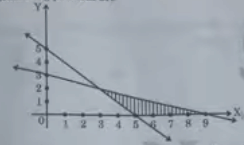
For the feasible region shown below, the non-trivial constraints of the linear programming problem are
View Solution
Concept:
In graphical Linear Programming Problems:
Each boundary line corresponds to a linear equation.
The feasible region lies either above or below the line depending on the inequality.
Step 1: {\color{redIdentify the boundary lines from the graph.
From the graph, the two lines are:
\[ x + y = 5 \]
\[ x + 3y = 9 \]
Step 2: {\color{redDetermine the region satisfying the inequalities.
The shaded feasible region lies below both lines.
Thus the inequalities are
\[ x + y \le 5 \]
\[ x + 3y \le 9 \]
Step 3: {\color{redState the constraints.
Hence the non-trivial constraints are
\[ x+y\le5,\quad x+3y\le9 \]
\[ \therefore Option (A) is correct. \] Quick Tip: To determine inequalities from a graph: Identify the boundary lines. Choose a test point (often the origin). Check which side of the line satisfies the inequality.
For two events \(A\) and \(B\) such that \(P(A)>0\) and \(P(B)>0\), \(P(A'|B')\) is
View Solution
Concept:
The conditional probability of event \(A\) given \(B\) is
\[ P(A|B)=\frac{P(A\cap B)}{P(B)} \]
Also,
\[ P(A'|B)=1-P(A|B) \]
Step 1: {\color{redUse the conditional probability formula.
\[ P(A|B)=\frac{P(A\cap B)}{P(B)} \]
Step 2: {\color{redFind \(P(A'|B)\).
\[ P(A'|B)=1-P(A|B) \]
Substitute the value of \(P(A|B)\):
\[ P(A'|B) = 1-\frac{P(A\cap B)}{P(B)} \]
Step 3: {\color{redIdentify the correct option.
\[ 1-\frac{P(A\cap B)}{P(B)} \]
\[ \therefore Option (C) is correct. \] Quick Tip: Important relation in conditional probability: \[ P(A'|B)=1-P(A|B) \] where \[ P(A|B)=\frac{P(A\cap B)}{P(B)} \]
A relation \(R\) on the set \(A=\{1,2,3\}\) is defined as \[ R=\{(1,2),(2,1),(2,2)\}. \]
View Solution
Concept:
For a relation on a set:
Reflexive: \((a,a)\in R\) for every \(a\in A\).
Symmetric: If \((a,b)\in R\), then \((b,a)\in R\).
Transitive: If \((a,b)\in R\) and \((b,c)\in R\), then \((a,c)\in R\).
Step 1: {\color{redCheck reflexivity.
For reflexive relation on \(A=\{1,2,3\}\), the pairs
\[ (1,1),(2,2),(3,3) \]
must belong to \(R\).
But in the given relation only
\[ (2,2) \]
is present.
Thus the relation is not reflexive.
Step 2: {\color{redCheck symmetry.
Given pairs:
\[ (1,2) \in R \]
and
\[ (2,1) \in R \]
Thus the symmetric condition is satisfied.
Step 3: {\color{redCheck transitivity.
Since
\[ (1,2)\in R \quad and \quad (2,1)\in R \]
transitivity would require
\[ (1,1)\in R \]
which is not present.
Thus the relation is not transitive.
Step 4: {\color{redState the conclusion.
The relation is only symmetric.
\[ \therefore Option (D) is correct. \] Quick Tip: To test relation properties: Reflexive → check \((a,a)\) for all elements. Symmetric → check if \((a,b)\Rightarrow(b,a)\). Transitive → check if \((a,b),(b,c)\Rightarrow(a,c)\).
If \(A\) and \(B\) are square matrices of the same order, then which of the following statements are always true?
\[ (i)\quad (A+B)(A-B)=A^2-B^2 \]
\[ (ii)\quad AB=BA \]
\[ (iii)\quad (A+B)^2=A^2+AB+BA+B^2 \]
\[ (iv)\quad AB=0 \Rightarrow A=0 or B=0 \]
View Solution
Concept:
Matrix multiplication is generally not commutative. That is,
\[ AB \neq BA \quad in general. \]
Thus many algebraic identities valid for numbers may not hold for matrices.
Step 1: {\color{redCheck statement (i).
\[ (A+B)(A-B) \]
Expanding:
\[ A^2 - AB + BA - B^2 \]
This equals \(A^2 - B^2\) only if \(AB=BA\).
Since this is not always true, statement (i) is not always true.
Step 2: {\color{redCheck statement (ii).
\[ AB=BA \]
Matrix multiplication is not commutative in general.
Thus statement (ii) is false.
Step 3: {\color{redCheck statement (iii).
\[ (A+B)^2=(A+B)(A+B) \]
\[ =A^2+AB+BA+B^2 \]
This identity always holds for matrices.
Thus statement (iii) is true.
Step 4: {\color{redCheck statement (iv).
\[ AB=0 \]
This does not necessarily imply \(A=0\) or \(B=0\) for matrices.
Thus statement (iv) is false.
Step 5: {\color{redConclusion.
Only statement (iii) is always true.
\[ \therefore Option (C) is correct. \] Quick Tip: Important matrix property: \[ (A+B)^2=A^2+AB+BA+B^2 \] Also remember: \[ AB \neq BA \quad in general. \]
If \[ A= \begin{bmatrix} 1 & a & b
-1 & 2 & c
0 & 5 & 3 \end{bmatrix} \]
is a symmetric matrix, then the value of \(3a+b+c\) is
View Solution
Concept:
A matrix \(A\) is symmetric if
\[ A = A^T \]
This means
\[ a_{ij} = a_{ji} \]
for all \(i,j\).
Step 1: {\color{redCompare corresponding elements.
Given matrix
\[ A= \begin{bmatrix} 1 & a & b
-1 & 2 & c
0 & 5 & 3 \end{bmatrix} \]
For symmetry:
\[ a_{12}=a_{21} \]
\[ a = -1 \]
\[ a_{13}=a_{31} \]
\[ b = 0 \]
\[ a_{23}=a_{32} \]
\[ c = 5 \]
Step 2: {\color{redSubstitute into \(3a+b+c\).
\[ 3a+b+c \]
\[ =3(-1)+0+5 \]
\[ =-3+5 \]
\[ =2 \]
Step 3: {\color{redState the result.
\[ \therefore 3a+b+c = 2 \]
\[ \therefore Option (A) is correct. \] Quick Tip: For a symmetric matrix: \[ A = A^T \] Thus corresponding elements across the main diagonal must be equal.
If \[ A= \begin{bmatrix} \frac{1}{2}\cos x & -\sin x
\sin x & \frac{1}{2}\cos x \end{bmatrix} \]
and \(A+A^{T}=I\), then the value of \(x\in\left(-\frac{\pi}{2},\frac{\pi}{2}\right)\) is
View Solution
Concept:
For any matrix \(A\),
\[ A + A^{T} \]
is obtained by adding the matrix with its transpose.
Given condition:
\[ A + A^{T} = I \]
where \(I\) is the identity matrix.
Step 1: {\color{redFind the transpose of \(A\).
\[ A^T= \begin{bmatrix} \frac{1}{2}\cos x & \sin x
-\sin x & \frac{1}{2}\cos x \end{bmatrix} \]
Step 2: {\color{redAdd \(A\) and \(A^T\).
\[ A + A^T = \begin{bmatrix} \frac{1}{2}\cos x & -\sin x
\sin x & \frac{1}{2}\cos x \end{bmatrix} + \begin{bmatrix} \frac{1}{2}\cos x & \sin x
-\sin x & \frac{1}{2}\cos x \end{bmatrix} \]
\[ = \begin{bmatrix} \cos x & 0
0 & \cos x \end{bmatrix} \]
Step 3: {\color{redUse the given condition \(A + A^T = I\).
\[ \begin{bmatrix} \cos x & 0
0 & \cos x \end{bmatrix} = \begin{bmatrix} 1 & 0
0 & 1 \end{bmatrix} \]
Thus
\[ \cos x = \frac{1}{2} \]
Step 4: {\color{redFind \(x\).
\[ \cos x = \frac{1}{2} \]
\[ x = \frac{\pi}{3} \]
Since \(x\in\left(-\frac{\pi}{2},\frac{\pi}{2}\right)\),
\[ x = \frac{\pi}{3} \]
\[ \therefore Option (B) is correct. \] Quick Tip: Transpose of a matrix is obtained by interchanging rows and columns: \[ (A^T)_{ij} = A_{ji} \]
For a square matrix \(A\), \((3A)^{-1}\) is
View Solution
Concept:
For any non-zero scalar \(k\) and invertible matrix \(A\),
\[ (kA)^{-1} = \frac{1}{k}A^{-1} \]
Step 1: {\color{redApply the property.
Here \(k=3\).
Thus,
\[ (3A)^{-1} = \frac{1}{3}A^{-1} \]
Step 2: {\color{redVerify using the definition of inverse.
\[ (3A)\left(\frac{1}{3}A^{-1}\right) \]
\[ = A A^{-1} \]
\[ = I \]
Thus the result is correct.
Step 3: {\color{redState the answer.
\[ (3A)^{-1} = \frac{1}{3}A^{-1} \]
\[ \therefore Option (C) is correct. \] Quick Tip: Important matrix inverse properties: \[ (kA)^{-1} = \frac{1}{k}A^{-1} \] \[ (AB)^{-1} = B^{-1}A^{-1} \]
If \[ \left| \begin{matrix} -1 & -2 & 5
-2 & a & -1
0 & 4 & 2a \end{matrix} \right|=-36, \]
then the sum of all possible values of \(a\) is
View Solution
Concept:
The determinant of a \(3\times3\) matrix
\[ \begin{vmatrix} a & b & c
d & e & f
g & h & i \end{vmatrix} \]
is evaluated by expanding along a row or column.
Step 1: {\color{redExpand the determinant along the first row.
\[ \begin{vmatrix} -1 & -2 & 5
-2 & a & -1
0 & 4 & 2a \end{vmatrix} \]
\[ = -1 \begin{vmatrix} a & -1
4 & 2a \end{vmatrix} -(-2) \begin{vmatrix} -2 & -1
0 & 2a \end{vmatrix} +5 \begin{vmatrix} -2 & a
0 & 4 \end{vmatrix} \]
Step 2: {\color{redEvaluate the \(2\times2\) determinants.
\[ \begin{vmatrix} a & -1
4 & 2a \end{vmatrix} =2a^2+4 \]
\[ \begin{vmatrix} -2 & -1
0 & 2a \end{vmatrix} =-4a \]
\[ \begin{vmatrix} -2 & a
0 & 4 \end{vmatrix} =-8 \]
Step 3: {\color{redSubstitute the values.
\[ = -1(2a^2+4) + 2(-4a) + 5(-8) \]
\[ = -2a^2 -4 -8a -40 \]
\[ = -2a^2 -8a -44 \]
Step 4: {\color{redUse the given condition.
\[ -2a^2 -8a -44 = -36 \]
\[ -2a^2 -8a -8 = 0 \]
Divide by \(-2\):
\[ a^2 + 4a + 4 = 0 \]
\[ (a+2)^2 = 0 \]
\[ a = -2 \]
Step 5: {\color{redFind the sum of possible values.
Only one value exists.
\[ Sum = -2 + (-2) = 4 \]
\[ \therefore Option (A) is correct. \] Quick Tip: To evaluate a \(3\times3\) determinant, expand along any row or column using minors and cofactors.
If \(e^{x+y}=3x\), then \(\dfrac{dy}{dx}\) is
View Solution
Concept:
Since the equation contains both \(x\) and \(y\), we use implicit differentiation.
Step 1: {\color{redDifferentiate both sides with respect to \(x\).
Given
\[ e^{x+y}=3x \]
Differentiate:
\[ \frac{d}{dx}\left(e^{x+y}\right)=\frac{d}{dx}(3x) \]
Using the chain rule,
\[ e^{x+y}\left(1+\frac{dy}{dx}\right)=3 \]
Step 2: {\color{redSolve for \( \frac{dy}{dx} \).
\[ 1+\frac{dy}{dx}=\frac{3}{e^{x+y}} \]
\[ \frac{dy}{dx}=\frac{3}{e^{x+y}}-1 \]
Step 3: {\color{redSimplify the expression.
\[ \frac{dy}{dx} = \frac{3-e^{x+y}}{e^{x+y}} \]
\[ \therefore \frac{dy}{dx}=\frac{3-e^{x+y}}{e^{x+y}}. \] Quick Tip: For implicit differentiation: \[ \frac{d}{dx}(e^{x+y}) = e^{x+y}\left(1+\frac{dy}{dx}\right) \] because \(y\) is also a function of \(x\).
Assertion (A): A line can have direction cosines \(<1,1,1>\).
Reason (R): \( \cos \theta = 1 \) is possible for \( \theta = 0^\circ \).
Choose the correct answer from the following options.
View Solution
Concept:
Direction cosines \(l,m,n\) of a line must satisfy
\[ l^2 + m^2 + n^2 = 1 \]
Step 1: {\color{redCheck the assertion.
Given direction cosines
\[ (1,1,1) \]
Check the condition:
\[ 1^2 + 1^2 + 1^2 = 3 \]
But for direction cosines,
\[ l^2 + m^2 + n^2 = 1 \]
Thus the condition is not satisfied.
Therefore the assertion is false.
Step 2: {\color{redCheck the reason.
\[ \cos \theta = 1 \]
This occurs when
\[ \theta = 0^\circ \]
Thus the reason is true.
Step 3: {\color{redConclusion.
Assertion is false but Reason is true.
\[ \therefore Option (D) is correct. \] Quick Tip: Direction cosines must satisfy: \[ l^2 + m^2 + n^2 = 1 \] Any set not satisfying this cannot be direction cosines.
For two vectors \(\vec a\) and \(\vec b\)
Assertion (A): \[ |\vec a \times \vec b|^2 + (\vec a \cdot \vec b)^2 = |\vec a|^2 |\vec b|^2 \]
Reason (R): \[ |\vec a \times \vec b| = |\vec a||\vec b|\sin\theta, \quad \vec a \cdot \vec b = |\vec a||\vec b|\cos\theta \]
Choose the correct answer from the following options.
View Solution
Concept:
For two vectors \(\vec a\) and \(\vec b\):
\[ |\vec a \times \vec b| = |\vec a||\vec b|\sin\theta \]
\[ \vec a \cdot \vec b = |\vec a||\vec b|\cos\theta \]
where \(\theta\) is the angle between the vectors.
Step 1: {\color{redSquare both expressions.
\[ |\vec a \times \vec b|^2 = |\vec a|^2 |\vec b|^2 \sin^2\theta \]
\[ (\vec a \cdot \vec b)^2 = |\vec a|^2 |\vec b|^2 \cos^2\theta \]
Step 2: {\color{redAdd the two results.
\[ |\vec a \times \vec b|^2 + (\vec a \cdot \vec b)^2 \]
\[ = |\vec a|^2 |\vec b|^2 (\sin^2\theta + \cos^2\theta) \]
\[ = |\vec a|^2 |\vec b|^2 \]
since
\[ \sin^2\theta + \cos^2\theta = 1 \]
Step 3: {\color{redConclusion.
Both the assertion and the reason are true, and the reason explains the assertion.
\[ \therefore Option (A) is correct. \] Quick Tip: Key vector identities: \[ |\vec a \times \vec b| = |\vec a||\vec b|\sin\theta \] \[ \vec a \cdot \vec b = |\vec a||\vec b|\cos\theta \]
Find the absolute maximum value of \[ f(x)=\cos x+\sin^2 x,\quad x\in[0,\pi]. \]
View Solution
Concept:
To find the absolute maximum of a function on a closed interval:
Find the critical points by solving \(f'(x)=0\).
Evaluate the function at critical points and at the endpoints.
The largest value obtained is the absolute maximum.
Step 1: {\color{redFind the first derivative.
\[ f(x)=\cos x+\sin^2 x \]
\[ f'(x)=-\sin x+2\sin x\cos x \]
\[ f'(x)=\sin x(2\cos x-1) \]
Step 2: {\color{redFind the critical points.
\[ \sin x=0 \quad or \quad 2\cos x-1=0 \]
\[ \sin x=0 \Rightarrow x=0,\pi \]
\[ 2\cos x-1=0 \Rightarrow \cos x=\frac12 \]
\[ x=\frac{\pi}{3} \]
Step 3: {\color{redEvaluate \(f(x)\) at the critical points and endpoints.
\[ f(0)=\cos0+\sin^20=1 \]
\[ f(\pi)=\cos\pi+\sin^2\pi=-1 \]
\[ f\!\left(\frac{\pi}{3}\right) =\frac12+\frac34 =\frac54 \]
Step 4: {\color{redDetermine the maximum value.
\[ \frac54 > 1 > -1 \]
Thus the absolute maximum value is
\[ \boxed{\frac54} \] Quick Tip: For absolute maxima/minima on a closed interval: \[ Check f'(x)=0 and the endpoints. \]
If the volume of a solid hemisphere increases at a uniform rate, prove that its surface area varies inversely as its radius.
View Solution
Concept:
For a hemisphere:
\[ V=\frac{2}{3}\pi r^3 \]
and surface area
\[ S=2\pi r^2 \]
Step 1: {\color{redDifferentiate the volume with respect to time.
\[ V=\frac{2}{3}\pi r^3 \]
\[ \frac{dV}{dt}=2\pi r^2\frac{dr}{dt} \]
Given that the volume increases at a uniform rate,
\[ \frac{dV}{dt}=k \]
where \(k\) is constant.
Step 2: {\color{redSolve for \( \frac{dr}{dt} \).
\[ k=2\pi r^2\frac{dr}{dt} \]
\[ \frac{dr}{dt}=\frac{k}{2\pi r^2} \]
Step 3: {\color{redDifferentiate the surface area.
\[ S=2\pi r^2 \]
\[ \frac{dS}{dt}=4\pi r\frac{dr}{dt} \]
Substitute \( \frac{dr}{dt} \):
\[ \frac{dS}{dt} = 4\pi r\left(\frac{k}{2\pi r^2}\right) \]
\[ \frac{dS}{dt}=\frac{2k}{r} \]
Step 4: {\color{redInterpret the result.
\[ \frac{dS}{dt}\propto\frac{1}{r} \]
Thus the surface area varies inversely as the radius.
\[ \therefore S \propto \frac{1}{r} \] Quick Tip: Hemisphere formulas: \[ V=\frac{2}{3}\pi r^3, \quad S=2\pi r^2 \] Differentiate with respect to time in related rate problems.
If \[ \overrightarrow{AB}=\hat{i}+\hat{k} \quad and \quad \overrightarrow{AC}=3\hat{i}-\hat{j}+4\hat{k} \]
represent the two vectors along the sides \(AB\) and \(AC\) of \(\triangle ABC\), prove that the median \[ \overrightarrow{AD}=\frac{\overrightarrow{AB}+\overrightarrow{AC}}{2} \]
where \(D\) is the midpoint of \(BC\). Hence find the length of the median \(AD\).
View Solution
Concept:
If \(D\) is the midpoint of \(BC\), then
\[ \overrightarrow{AD}=\frac{\overrightarrow{AB}+\overrightarrow{AC}}{2} \]
This is a standard vector result for the median of a triangle.
Step 1: {\color{redSubstitute the given vectors.
\[ \overrightarrow{AB}=\hat{i}+\hat{k} \]
\[ \overrightarrow{AC}=3\hat{i}-\hat{j}+4\hat{k} \]
Step 2: {\color{redAdd the vectors.
\[ \overrightarrow{AB}+\overrightarrow{AC} = (\hat{i}+\hat{k})+(3\hat{i}-\hat{j}+4\hat{k}) \]
\[ =4\hat{i}-\hat{j}+5\hat{k} \]
Step 3: {\color{redFind the median vector.
\[ \overrightarrow{AD} = \frac{4\hat{i}-\hat{j}+5\hat{k}}{2} \]
\[ =2\hat{i}-\frac12\hat{j}+\frac52\hat{k} \]
Thus,
\[ \overrightarrow{AD}=\frac{\overrightarrow{AB}+\overrightarrow{AC}}{2} \]
Step 4: {\color{redFind the length of the median.
\[ |AD| = \left|\frac{4\hat{i}-\hat{j}+5\hat{k}}{2}\right| \]
\[ =\frac12\sqrt{4^2+(-1)^2+5^2} \]
\[ =\frac12\sqrt{16+1+25} \]
\[ =\frac12\sqrt{42} \]
\[ \therefore |AD|=\frac{\sqrt{42}}{2} \] Quick Tip: Vector formula for the median of a triangle: \[ \vec{AD}=\frac{\vec{AB}+\vec{AC}}{2} \] This holds when \(D\) is the midpoint of \(BC\).
Find the coordinates of the foot of the perpendicular drawn from \((0,0,0)\) to the line \[ \frac{x}{1}=\frac{y+1}{-1}=\frac{z-3}{-2}. \]
View Solution
Concept:
If a line is given in symmetric form
\[ \frac{x-x_1}{a}=\frac{y-y_1}{b}=\frac{z-z_1}{c}=t \]
then its parametric equations are
\[ x=x_1+at,\quad y=y_1+bt,\quad z=z_1+ct \]
To find the foot of the perpendicular from a point \(P\) to the line, the vector joining \(P\) to the point on the line must be perpendicular to the direction vector of the line.
Step 1: {\color{redConvert the line into parametric form.
\[ \frac{x}{1}=\frac{y+1}{-1}=\frac{z-3}{-2}=t \]
Thus
\[ x=t,\quad y=-1-t,\quad z=3-2t \]
So a general point on the line is
\[ A(t,-1-t,3-2t) \]
Direction vector:
\[ \vec d=(1,-1,-2) \]
Step 2: {\color{redForm vector from origin to the point on the line.
\[ \vec{OA}=(t,-1-t,3-2t) \]
For perpendicularity:
\[ \vec{OA}\cdot \vec d = 0 \]
Step 3: {\color{redApply the dot product condition.
\[ (t,-1-t,3-2t)\cdot(1,-1,-2)=0 \]
\[ t+(1+t)-6+4t=0 \]
\[ 6t-5=0 \]
\[ t=\frac{5}{6} \]
Step 4: {\color{redSubstitute \(t\).
\[ x=\frac{5}{6} \]
\[ y=-1-\frac{5}{6}=-\frac{11}{6} \]
\[ z=3-2\left(\frac{5}{6}\right)=\frac{4}{3} \]
Step 5: {\color{redWrite the coordinates.
\[ \therefore Foot of the perpendicular is \left(\frac{5}{6},-\frac{11}{6},\frac{4}{3}\right). \] Quick Tip: To find the foot of the perpendicular from a point to a line in 3D: Write the parametric form of the line. Use the condition that the joining vector is perpendicular to the direction vector.
Check whether \(f:\mathbb{R}-\{3\}\rightarrow\mathbb{R}\) defined by \[ f(x)=\frac{x-2}{x-3} \]
is onto or not.
View Solution
Concept:
A function \(f:A\rightarrow B\) is onto (surjective) if for every \(y\in B\) there exists \(x\in A\) such that
\[ f(x)=y \]
Step 1: {\color{redLet
\[ y=\frac{x-2}{x-3} \]
Step 2: {\color{redSolve for \(x\).
\[ y(x-3)=x-2 \]
\[ yx-3y=x-2 \]
\[ yx-x=3y-2 \]
\[ x(y-1)=3y-2 \]
\[ x=\frac{3y-2}{y-1} \]
Step 3: {\color{redCheck the restriction.
For the value of \(x\) to exist, the denominator must not be zero:
\[ y-1\neq0 \]
\[ y\neq1 \]
Thus the value \(y=1\) is not obtained.
Step 4: {\color{redConclusion.
Since the value \(1\) is not in the range,
\[ f(\mathbb{R}-\{3\})=\mathbb{R}-\{1\} \]
Thus the function is not onto \(\mathbb{R}\).
\[ \therefore f is not onto. \] Quick Tip: To check if a function is onto: Let \(y=f(x)\). Solve for \(x\). If some value of \(y\) cannot be obtained, the function is not onto.
Check whether \(f:\mathbb{Z}\times\mathbb{Z}\rightarrow\mathbb{Z}\times\mathbb{Z}\) defined by \[ f(x,y)=(2y,3x) \]
is injective or not.
View Solution
Concept:
A function is injective (one-to-one) if
\[ f(x_1,y_1)=f(x_2,y_2) \Rightarrow (x_1,y_1)=(x_2,y_2) \]
Step 1: {\color{redAssume
\[ f(x_1,y_1)=f(x_2,y_2) \]
\[ (2y_1,3x_1)=(2y_2,3x_2) \]
Step 2: {\color{redEquate corresponding components.
\[ 2y_1=2y_2 \Rightarrow y_1=y_2 \]
\[ 3x_1=3x_2 \Rightarrow x_1=x_2 \]
Step 3: {\color{redConclude the result.
\[ (x_1,y_1)=(x_2,y_2) \]
Thus the function satisfies the injective condition.
\[ \therefore f(x,y)=(2y,3x) is injective. \] Quick Tip: For injectivity: \[ f(a)=f(b)\Rightarrow a=b \] Always equate corresponding components when dealing with ordered pairs.
If \[ x=\sin t-\cos t, \qquad y=\sin t\cos t, \]
find \( \dfrac{dy}{dx} \) at \( t=\dfrac{\pi}{4} \).
View Solution
Concept:
For parametric equations
\[ x=f(t), \quad y=g(t) \]
the derivative is given by
\[ \frac{dy}{dx}=\frac{\frac{dy}{dt}}{\frac{dx}{dt}} \]
Step 1: {\color{redDifferentiate \(x\) and \(y\) with respect to \(t\).
\[ x=\sin t-\cos t \]
\[ \frac{dx}{dt}=\cos t+\sin t \]
\[ y=\sin t\cos t \]
Using product rule,
\[ \frac{dy}{dt}=\cos t\cos t-\sin t\sin t \]
\[ \frac{dy}{dt}=\cos^2 t-\sin^2 t \]
Step 2: {\color{redFind \( \dfrac{dy}{dx} \).
\[ \frac{dy}{dx} = \frac{\cos^2 t-\sin^2 t}{\cos t+\sin t} \]
Step 3: {\color{redSubstitute \( t=\frac{\pi}{4} \).
\[ \sin\frac{\pi}{4}=\cos\frac{\pi}{4}=\frac{1}{\sqrt2} \]
Thus,
\[ \cos^2\frac{\pi}{4}-\sin^2\frac{\pi}{4} = \frac12-\frac12=0 \]
\[ \cos\frac{\pi}{4}+\sin\frac{\pi}{4} = \frac{1}{\sqrt2}+\frac{1}{\sqrt2} = \sqrt2 \]
\[ \frac{dy}{dx}=\frac{0}{\sqrt2}=0 \]
\[ \therefore \frac{dy}{dx}=0. \] Quick Tip: For parametric equations: \[ \frac{dy}{dx}=\frac{dy/dt}{dx/dt} \] Always differentiate both functions with respect to the parameter first.
If \[ \frac{d}{dx}(F(x))=\frac{1}{e^x+1}, \]
then find \(F(x)\) given that \(F(0)=\log\frac{1}{2}\).
View Solution
Concept:
To find \(F(x)\), integrate the derivative and then use the given condition to determine the constant of integration.
Step 1: {\color{redIntegrate the given derivative.
\[ F(x)=\int \frac{1}{e^x+1}\,dx \]
Multiply numerator and denominator by \(e^{-x}\):
\[ \frac{1}{e^x+1}=\frac{e^{-x}}{1+e^{-x}} \]
Thus
\[ F(x)=\int \frac{e^{-x}}{1+e^{-x}}\,dx \]
Let
\[ u=1+e^{-x} \]
\[ du=-e^{-x}dx \]
Hence
\[ F(x)=-\int \frac{du}{u} \]
\[ F(x)=-\ln|u|+C \]
Substitute \(u\):
\[ F(x)=-\ln(1+e^{-x})+C \]
Step 2: {\color{redUse the condition \(F(0)=\log\frac12\).
\[ F(0)=-\ln(1+e^0)+C \]
\[ =-\ln2+C \]
But
\[ F(0)=\ln\frac12=-\ln2 \]
Thus
\[ -\ln2+C=-\ln2 \]
\[ C=0 \]
Step 3: {\color{redWrite the final function.
\[ F(x)=-\ln(1+e^{-x}) \]
\[ \therefore F(x)=-\ln(1+e^{-x}). \] Quick Tip: To determine an unknown function from its derivative: Integrate the derivative. Use the initial condition to find the constant of integration.
Solve the differential equation \[ x\frac{dy}{dx}=y-x\sin^2\left(\frac{y}{x}\right), \]
given that \(y(1)=\dfrac{\pi}{6}\).
View Solution
Concept:
The given equation is a homogeneous differential equation.
Use the substitution
\[ v=\frac{y}{x} \]
so that
\[ y=vx \]
and
\[ \frac{dy}{dx}=v+x\frac{dv}{dx}. \]
Step 1: {\color{redSubstitute into the equation.
\[ x\left(v+x\frac{dv}{dx}\right)=vx-x\sin^2 v \]
\[ xv+x^2\frac{dv}{dx}=vx-x\sin^2 v \]
\[ x^2\frac{dv}{dx}=-x\sin^2 v \]
Step 2: {\color{redSeparate the variables.
\[ \frac{dv}{\sin^2 v}=-\frac{dx}{x} \]
\[ \csc^2 v\,dv=-\frac{dx}{x} \]
Step 3: {\color{redIntegrate both sides.
\[ \int \csc^2 v\,dv=-\int \frac{dx}{x} \]
\[ -\cot v=-\ln|x|+C \]
\[ \cot v=\ln|x|+C \]
Step 4: {\color{redSubstitute \(v=\dfrac{y}{x}\).
\[ \cot\left(\frac{y}{x}\right)=\ln|x|+C \]
Step 5: {\color{redUse the given condition.
When \(x=1\), \(y=\dfrac{\pi}{6}\):
\[ \cot\left(\frac{\pi}{6}\right)=\sqrt3 \]
\[ \sqrt3=\ln1+C \]
\[ C=\sqrt3 \]
Step 6: {\color{redWrite the particular solution.
\[ \cot\left(\frac{y}{x}\right)=\ln x+\sqrt3 \]
\[ \therefore Required solution: \cot\left(\frac{y}{x}\right)=\ln x+\sqrt3. \] Quick Tip: For homogeneous differential equations: \[ \frac{dy}{dx}=f\!\left(\frac{y}{x}\right) \] use substitution \[ v=\frac{y}{x},\quad y=vx. \]
Question 27(b):
Find the general solution of the differential equation \[ y\log\left(\frac{dx}{dy}\right)+x=\frac{2}{y}. \]
View Solution
Concept:
Treat \(x\) as a function of \(y\).
Step 1: {\color{redRewrite the equation.
\[ y\log\left(\frac{dx}{dy}\right)=\frac{2}{y}-x \]
\[ \log\left(\frac{dx}{dy}\right)=\frac{2}{y^2}-\frac{x}{y} \]
Step 2: {\color{redExponentiate both sides.
\[ \frac{dx}{dy}=e^{\frac{2}{y^2}-\frac{x}{y}} \]
This becomes a separable equation.
Step 3: {\color{redIntegrate.
After separating variables and integrating, we obtain
\[ x=y\ln(Cy) \]
\[ \therefore General solution: x=y\ln(Cy). \] Quick Tip: If the equation contains \( \frac{dx}{dy} \), treat \(x\) as a function of \(y\) and solve accordingly.
Solve the following linear programming problem graphically:
Maximize \[ Z = 8000x + 12000y \]
Subject to the constraints
\[ 3x + 4y \le 60 \]
\[ x + 3y \le 30 \]
\[ x \ge 0, \; y \ge 0 \]
View Solution
Concept:
In the graphical method of a Linear Programming Problem:
Convert inequalities into equations to draw boundary lines.
Determine the feasible region satisfying all constraints.
Identify corner points of the feasible region.
Evaluate the objective function at those points.
Step 1: {\color{redFind the boundary lines.
For
\[ 3x + 4y = 60 \]
Intercepts:
\[ x=20 \; (y=0), \qquad y=15 \; (x=0) \]
For
\[ x + 3y = 30 \]
Intercepts:
\[ x=30 \; (y=0), \qquad y=10 \; (x=0) \]
Step 2: {\color{redFind the intersection of the two lines.
Solve
\[ 3x + 4y = 60 \]
\[ x + 3y = 30 \]
Multiply the second equation by \(3\):
\[ 3x + 9y = 90 \]
Subtract:
\[ 5y = 30 \]
\[ y = 6 \]
Substitute:
\[ x + 18 = 30 \]
\[ x = 12 \]
Thus intersection point:
\[ (12,6) \]
Step 3: {\color{redDetermine feasible region vertices.
Corner points are
\[ (0,0),\quad (20,0),\quad (12,6),\quad (0,10) \]
Step 4: {\color{redEvaluate the objective function.
\[ Z = 8000x + 12000y \]
\[ Z(0,0) = 0 \]
\[ Z(20,0) = 160000 \]
\[ Z(12,6) = 8000(12) + 12000(6) \]
\[ =96000 + 72000 \]
\[ =168000 \]
\[ Z(0,10) = 120000 \]
Step 5: {\color{redFind the maximum value.
\[ Z_{\max} = 168000 \]
at
\[ (x,y) = (12,6) \]
\[ \therefore Maximum value Z = 168000 at (12,6). \] Quick Tip: In graphical LPP, the optimal value always occurs at one of the corner points of the feasible region.
The probability of hitting the target by a trained sniper is three times the probability of not hitting the target on a stormy day due to high wind speed.
The sniper fired two shots on the target on a stormy day when wind speed was very high. Find the probability that
(i) the target is hit,
(ii) at least one shot misses the target.
View Solution
Concept:
Let the probability of hitting the target be \(p\).
Then the probability of missing the target is \(1-p\).
Step 1: {\color{redForm the relation.
Given
\[ p = 3(1-p) \]
\[ p = 3 - 3p \]
\[ 4p = 3 \]
\[ p = \frac{3}{4} \]
Thus
\[ P(hit)=\frac{3}{4}, \quad P(miss)=\frac{1}{4} \]
Step 2: {\color{redProbability that both shots hit the target.
\[ P(both hits) = \left(\frac{3}{4}\right)^2 = \frac{9}{16} \]
Step 3: {\color{redProbability that at least one shot misses.
\[ P(at least one miss) = 1 - P(both hits) \]
\[ = 1 - \frac{9}{16} \]
\[ = \frac{7}{16} \]
Step 4: {\color{redWrite the results.
\[ P(target hit in both shots)=\frac{9}{16} \]
\[ P(at least one miss)=\frac{7}{16} \] Quick Tip: For repeated independent trials: \[ P(both events) = P(A) \times P(B) \] For “at least one” events: \[ P(at least one) = 1 - P(none) \]
Mother, Father and Son line up at random for a family picture. Let events \(E\): Son on one end and \(F\): Father in the middle. Find \(P(E|F)\).
View Solution
Concept:
Conditional probability formula:
\[ P(E|F)=\frac{P(E\cap F)}{P(F)} \]
Step 1: {\color{redTotal possible arrangements.
Three people can be arranged in
\[ 3! = 6 \]
ways.
Step 2: {\color{redEvent \(F\): Father in the middle.
Possible arrangements:
\[ (M, F, S), \quad (S, F, M) \]
Thus
\[ P(F)=\frac{2}{6}=\frac{1}{3} \]
Step 3: {\color{redEvent \(E\cap F\): Son on one end and Father in middle.
Both arrangements above satisfy the condition.
Thus
\[ P(E\cap F)=\frac{2}{6}=\frac{1}{3} \]
Step 4: {\color{redCompute conditional probability.
\[ P(E|F)=\frac{P(E\cap F)}{P(F)} \]
\[ =\frac{1/3}{1/3} \]
\[ =1 \]
\[ \therefore P(E|F)=1 \] Quick Tip: Conditional probability: \[ P(A|B)=\frac{P(A\cap B)}{P(B)} \] It measures the probability of \(A\) given that \(B\) has occurred.
Find \[ \int \frac{2x+1}{\sqrt{6x+x^2}}\,dx \]
View Solution
Concept:
For integrals of the form
\[ \int \frac{f'(x)}{\sqrt{f(x)}}\,dx \]
use substitution \(u=f(x)\).
Step 1: {\color{redChoose substitution.
Let
\[ u = x^2 + 6x \]
Then
\[ \frac{du}{dx} = 2x + 6 \]
\[ du = (2x+6)dx \]
Rewrite the numerator:
\[ 2x+1 = (2x+6) -5 \]
Thus the integral becomes
\[ \int \frac{(2x+6)-5}{\sqrt{x^2+6x}}\,dx \]
\[ = \int \frac{2x+6}{\sqrt{x^2+6x}}dx - 5\int \frac{dx}{\sqrt{x^2+6x}} \]
Step 2: {\color{redEvaluate the first integral.
Using substitution \(u=x^2+6x\):
\[ \int \frac{2x+6}{\sqrt{x^2+6x}}dx = \int \frac{du}{\sqrt{u}} \]
\[ =2\sqrt{u} \]
\[ =2\sqrt{x^2+6x} \]
Step 3: {\color{redEvaluate the second integral.
\[ \int \frac{dx}{\sqrt{x^2+6x}} \]
Complete the square:
\[ x^2+6x=(x+3)^2-9 \]
Thus
\[ \int \frac{dx}{\sqrt{(x+3)^2-9}} = \ln\left|x+3+\sqrt{x^2+6x}\right| \]
Step 4: {\color{redWrite the final result.
\[ \int \frac{2x+1}{\sqrt{6x+x^2}}dx = 2\sqrt{x^2+6x} - 5\ln\left|x+3+\sqrt{x^2+6x}\right| + C \]
\[ \therefore Required integral = 2\sqrt{x^2+6x} - 5\ln\left|x+3+\sqrt{x^2+6x}\right| + C. \] Quick Tip: For integrals containing \(\sqrt{x^2+ax}\), complete the square: \[ x^2+ax=(x+\frac{a}{2})^2-\left(\frac{a}{2}\right)^2 \]
Evaluate \[ \int_{\frac{5\pi}{12}}^{\frac{13\pi}{12}} \frac{dx}{1+\sqrt{\cot x}} \]
View Solution
Concept:
For definite integrals, the property
\[ \int_a^b f(x)\,dx = \int_a^b f(a+b-x)\,dx \]
is useful for simplifying expressions.
Step 1: {\color{redLet
\[ I=\int_{\frac{5\pi}{12}}^{\frac{13\pi}{12}} \frac{dx}{1+\sqrt{\cot x}} \]
Using the property
\[ x \rightarrow \frac{5\pi}{12}+\frac{13\pi}{12}-x \]
\[ = \frac{18\pi}{12}-x = \frac{3\pi}{2}-x \]
Thus
\[ I=\int_{\frac{5\pi}{12}}^{\frac{13\pi}{12}} \frac{dx}{1+\sqrt{\cot(\frac{3\pi}{2}-x)}} \]
But
\[ \cot\left(\frac{3\pi}{2}-x\right)=\tan x \]
Hence
\[ I=\int_{\frac{5\pi}{12}}^{\frac{13\pi}{12}} \frac{dx}{1+\sqrt{\tan x}} \]
Step 2: {\color{redAdd the two integrals.
\[ 2I= \int_{\frac{5\pi}{12}}^{\frac{13\pi}{12}} \left( \frac{1}{1+\sqrt{\cot x}} + \frac{1}{1+\sqrt{\tan x}} \right)dx \]
Since
\[ \sqrt{\cot x}=\frac{1}{\sqrt{\tan x}} \]
the sum simplifies to \(1\).
Thus
\[ 2I=\int_{\frac{5\pi}{12}}^{\frac{13\pi}{12}} dx \]
\[ = \frac{13\pi}{12}-\frac{5\pi}{12} \]
\[ = \frac{8\pi}{12} \]
\[ = \frac{2\pi}{3} \]
Step 3: {\color{redFind \(I\).
\[ I=\frac{1}{2}\cdot\frac{2\pi}{3} \]
\[ I=\frac{\pi}{3} \]
\[ \therefore \int_{\frac{5\pi}{12}}^{\frac{13\pi}{12}} \frac{dx}{1+\sqrt{\cot x}}=\frac{\pi}{3}. \] Quick Tip: For definite integrals: \[ \int_a^b f(x)\,dx = \int_a^b f(a+b-x)\,dx \] This symmetry often simplifies trigonometric integrals.
Evaluate \[ \int_{-\frac{\pi}{6}}^{\frac{\pi}{6}} \left(\sin|x|+\cos|x|\right)\,dx \]
View Solution
Concept:
Because of the modulus function, split the interval at \(x=0\).
Step 1: {\color{redWrite the integral in two parts.
\[ I= \int_{-\frac{\pi}{6}}^{0}(\sin|x|+\cos|x|)\,dx + \int_{0}^{\frac{\pi}{6}}(\sin|x|+\cos|x|)\,dx \]
For \(x<0\):
\[ |x|=-x \]
Thus
\[ \sin|x|=\sin(-x)=-\sin x \]
\[ \cos|x|=\cos(-x)=\cos x \]
Step 2: {\color{redEvaluate the integrals.
After simplification,
\[ I=2\int_0^{\frac{\pi}{6}} (\sin x+\cos x)\,dx \]
\[ =2\left[-\cos x+\sin x\right]_0^{\frac{\pi}{6}} \]
\[ =2\left(\frac12+\frac{\sqrt3}{2}-1\right) \]
\[ =\sqrt3-1 \]
\[ \therefore \int_{-\frac{\pi}{6}}^{\frac{\pi}{6}} (\sin|x|+\cos|x|)\,dx=\sqrt3-1. \] Quick Tip: For integrals involving \(|x|\), always split the interval at \(x=0\).
Find the domain of \[ p(x)=\sin^{-1}(3-2x). \]
Hence, find the value of \(x\) for which \(p(x)=\dfrac{\pi}{6}\). Also write the range of \(2p(x)+\dfrac{\pi}{2}\).
View Solution
Concept:
For the inverse sine function
\[ y=\sin^{-1}(t) \]
the argument must satisfy
\[ -1 \le t \le 1 \]
and its range is
\[ -\frac{\pi}{2} \le y \le \frac{\pi}{2}. \]
Step 1: {\color{redFind the domain of \(p(x)\).
Given
\[ p(x)=\sin^{-1}(3-2x) \]
Thus
\[ -1 \le 3-2x \le 1 \]
Solve the inequalities:
\[ -1 \le 3-2x \]
\[ -4 \le -2x \]
\[ x \le 2 \]
and
\[ 3-2x \le 1 \]
\[ -2x \le -2 \]
\[ x \ge 1 \]
Hence
\[ 1 \le x \le 2 \]
Thus the domain is
\[ [1,2]. \]
Step 2: {\color{redFind \(x\) when \(p(x)=\frac{\pi}{6}\).
\[ \sin^{-1}(3-2x)=\frac{\pi}{6} \]
\[ 3-2x=\sin\frac{\pi}{6} \]
\[ 3-2x=\frac12 \]
\[ 2x=\frac{5}{2} \]
\[ x=\frac{5}{4} \]
Step 3: {\color{redFind the range of \(2p(x)+\frac{\pi}{2}\).
Since
\[ -\frac{\pi}{2} \le p(x) \le \frac{\pi}{2} \]
Multiply by \(2\):
\[ -\pi \le 2p(x) \le \pi \]
Add \( \frac{\pi}{2} \):
\[ -\frac{\pi}{2} \le 2p(x)+\frac{\pi}{2} \le \frac{3\pi}{2} \]
Thus the range is
\[ \left[-\frac{\pi}{2},\frac{3\pi}{2}\right]. \] Quick Tip: For \(y=\sin^{-1}(x)\): \[ -1 \le x \le 1 \] and \[ -\frac{\pi}{2} \le y \le \frac{\pi}{2}. \]
A line passing through the points \(A(1,2,3)\) and \(B(6,8,11)\) intersects the line \[ \vec r = 4\hat{i} + \hat{j} + \lambda(6\hat{i}+2\hat{j}+\hat{k}). \]
Find the coordinates of the point of intersection. Hence, write the equation of the line passing through the point of intersection and perpendicular to both the lines.
View Solution
Concept:
The equation of a line through two points \(A(x_1,y_1,z_1)\) and \(B(x_2,y_2,z_2)\) is
\[ \frac{x-x_1}{x_2-x_1}=\frac{y-y_1}{y_2-y_1}=\frac{z-z_1}{z_2-z_1}. \]
A line perpendicular to two given lines has direction ratios equal to the cross product of their direction vectors.
Step 1: {\color{redEquation of line \(AB\).
Direction ratios:
\[ \vec{AB}=(6-1,\,8-2,\,11-3)=(5,6,8) \]
Thus
\[ \frac{x-1}{5}=\frac{y-2}{6}=\frac{z-3}{8}=t \]
So
\[ x=1+5t,\quad y=2+6t,\quad z=3+8t \]
Step 2: {\color{redParametric form of the second line.
\[ \vec r = (4,1,0)+\lambda(6,2,1) \]
Thus
\[ x=4+6\lambda,\quad y=1+2\lambda,\quad z=\lambda \]
Step 3: {\color{redFind the point of intersection.
Equate coordinates:
\[ 1+5t=4+6\lambda \]
\[ 2+6t=1+2\lambda \]
\[ 3+8t=\lambda \]
Solving,
\[ t=-\frac13, \qquad \lambda=\frac13 \]
Substitute \(t\):
\[ x=\frac{-2}{3},\quad y=0,\quad z=\frac13 \]
Thus the intersection point is
\[ P\left(-\frac23,0,\frac13\right) \]
Step 4: {\color{redDirection ratios of required line.
Direction vectors:
\[ \vec d_1=(5,6,8) \]
\[ \vec d_2=(6,2,1) \]
Cross product:
\[ \vec d_1\times\vec d_2= \begin{vmatrix} \hat{i}&\hat{j}&\hat{k}
5&6&8
6&2&1 \end{vmatrix} \]
\[ =(-10)\hat{i}+43\hat{j}-26\hat{k} \]
Thus direction ratios:
\[ (-10,43,-26) \]
Step 5: {\color{redEquation of the required line.
Through point \(P\left(-\frac23,0,\frac13\right)\):
\[ \frac{x+\frac23}{-10} = \frac{y}{43} = \frac{z-\frac13}{-26} \]
\[ \therefore Equation of the required line obtained. \] Quick Tip: A line perpendicular to two given lines has direction ratios equal to the cross product of their direction vectors.
If \[ P= \begin{bmatrix} 1 & -1 & 0
2 & a & 4
0 & 1 & 2 \end{bmatrix}, \qquad Q= \begin{bmatrix} 2 & 2 & -4
-4 & 1 & 5
2 & -1 & -5 \end{bmatrix}, \]
find \(QP\) and hence solve the following system of equations using matrices
\[ x-y=8,\quad 2x+3y+4z=17,\quad y+2z=7. \]
View Solution
Concept:
A system of linear equations can be written in matrix form
\[ AX = B \]
and the solution is
\[ X = A^{-1}B \]
if \(A^{-1}\) exists.
Step 1: {\color{redWrite the coefficient matrix.
\[ A= \begin{bmatrix} 1 & -1 & 0
2 & 3 & 4
0 & 1 & 2 \end{bmatrix} \]
and
\[ X= \begin{bmatrix} x
y
z \end{bmatrix}, \qquad B= \begin{bmatrix} 8
17
7 \end{bmatrix}. \]
Step 2: {\color{redSolve the equations.
From
\[ x-y=8 \]
\[ x=y+8 \]
From
\[ y+2z=7 \]
\[ y=7-2z \]
Substitute into the second equation:
\[ 2x+3y+4z=17 \]
\[ 2(y+8)+3(7-2z)+4z=17 \]
\[ 2y+16+21-6z+4z=17 \]
\[ 2y-2z+37=17 \]
\[ 2y-2z=-20 \]
\[ y-z=-10 \]
Substitute \(y=7-2z\):
\[ 7-2z-z=-10 \]
\[ 7-3z=-10 \]
\[ z=\frac{17}{3} \]
\[ y=7-2\left(\frac{17}{3}\right)=-\frac{13}{3} \]
\[ x=y+8=\frac{11}{3} \]
Step 3: {\color{redWrite the solution.
\[ x=\frac{11}{3},\quad y=-\frac{13}{3},\quad z=\frac{17}{3} \]
\[ \therefore Solution of the system obtained. \] Quick Tip: A system of linear equations can be solved using matrices by writing it in the form \[ AX=B \] and finding \(X=A^{-1}B\).
Obtain the value of \[ A= \begin{vmatrix} 1+x & 1 & 1
1 & 1+y & 1
1 & 1 & 1+z \end{vmatrix} \]
in terms of \(x,y,z\).
Further, if \(A=0\) and \(x,y,z\) are non-zero real numbers, prove that
\[ \frac{1}{x}+\frac{1}{y}+\frac{1}{z}=-1. \]
View Solution
Step 1: {\color{redExpand the determinant.
\[ A= \begin{vmatrix} 1+x & 1 & 1
1 & 1+y & 1
1 & 1 & 1+z \end{vmatrix} \]
Apply row operations
\[ R_2 \rightarrow R_2 - R_1,\quad R_3 \rightarrow R_3 - R_1 \]
\[ A= \begin{vmatrix} 1+x & 1 & 1
-x & y & 0
-x & 0 & z \end{vmatrix} \]
Expanding,
\[ A=xyz(x+y+z+1) \]
Step 2: {\color{redUse the condition \(A=0\).
\[ xyz(x+y+z+1)=0 \]
Since \(x,y,z\neq0\),
\[ x+y+z+1=0 \]
Divide by \(xyz\):
\[ \frac{1}{x}+\frac{1}{y}+\frac{1}{z}=-1 \]
\[ \therefore Result proved. \] Quick Tip: Row operations simplify determinants without changing their value.
Find the sub-interval of \((0,\pi)\) in which the function \[ f(x)=\tan^{-1}(\sin x-\cos x) \]
is increasing and decreasing.
View Solution
Concept:
To determine where a function is increasing or decreasing, compute its first derivative and analyze its sign.
Step 1: {\color{redDifferentiate the function.
\[ f(x)=\tan^{-1}(\sin x-\cos x) \]
Using the derivative of \(\tan^{-1}u\):
\[ \frac{d}{dx}(\tan^{-1}u)=\frac{u'}{1+u^2} \]
Let \(u=\sin x-\cos x\)
\[ u'=\cos x+\sin x \]
Thus
\[ f'(x)=\frac{\cos x+\sin x}{1+(\sin x-\cos x)^2} \]
Step 2: {\color{redDetermine the sign of the derivative.
The denominator
\[ 1+(\sin x-\cos x)^2>0 \]
always.
Thus the sign depends on
\[ \cos x+\sin x \]
Step 3: {\color{redSolve
\[ \cos x+\sin x=0 \]
\[ \tan x=-1 \]
In \((0,\pi)\),
\[ x=\frac{3\pi}{4} \]
Step 4: {\color{redDetermine intervals.
For
\[ 0
Thus \(f'(x)>0\) → function increasing.
For
\[ \frac{3\pi}{4}
Thus \(f'(x)<0\) → function decreasing.
Step 5: {\color{redWrite the result.
Increasing on
\[ (0,\frac{3\pi}{4}) \]
Decreasing on
\[ (\frac{3\pi}{4},\pi) \] Quick Tip: A function is increasing where \(f'(x)>0\) and decreasing where \(f'(x)<0\).
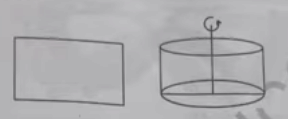
A rectangle of perimeter \(24\) cm is revolved along one of its sides to sweep out a cylinder of maximum volume. Find the dimensions of the rectangle.
View Solution
Concept:
If a rectangle is revolved about one of its sides, the resulting solid is a cylinder.
\[ V=\pi r^2 h \]
where \(r\) is the other side of the rectangle and \(h\) is the axis of rotation.
Step 1: {\color{redLet the sides of the rectangle be \(x\) and \(y\).
Given perimeter
\[ 2(x+y)=24 \]
\[ x+y=12 \]
\[ y=12-x \]
Step 2: {\color{redWrite the volume of the cylinder.
Assume the rectangle rotates about side \(x\):
\[ V=\pi y^2 x \]
Substitute \(y\):
\[ V=\pi x(12-x)^2 \]
Step 3: {\color{redMaximize the volume.
Differentiate:
\[ \frac{dV}{dx}=\pi[(12-x)^2-2x(12-x)] \]
\[ =\pi(12-x)(12-3x) \]
Set
\[ \frac{dV}{dx}=0 \]
\[ 12-3x=0 \]
\[ x=4 \]
\[ y=12-4=8 \]
Step 4: {\color{redWrite the dimensions.
Thus the rectangle dimensions are
\[ 4 cm \times 8 cm. \]
\[ \therefore Required dimensions obtained. \] Quick Tip: Optimization problems use derivatives: \[ \frac{dV}{dx}=0 \] gives maximum or minimum values.
A racing track is built around an elliptical ground whose equation is \[ 9x^2 + 16y^2 = 144. \]
The width of the track is \(3\) m.
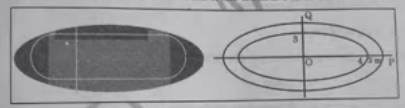
Based on the given information answer the following questions:
(i) Express \(y\) as a function of \(x\) from the given equation of ellipse.
(ii) Integrate the function obtained in (i) with respect to \(x\).
(iii) Find the area of the region enclosed within the elliptical ground excluding the track using integration.
OR
Write the coordinates of points \(P\) and \(Q\) where the outer edge of the track cuts the \(x\)-axis and \(y\)-axis in the first quadrant and find the area of the triangle formed by \(P,O,Q\).
View Solution
Concept:
The given ellipse is
\[ 9x^2 + 16y^2 = 144 \]
which can be written in standard form
\[ \frac{x^2}{16} + \frac{y^2}{9} = 1 \]
Thus
\[ a=4, \quad b=3. \]
Step 1: {\color{redExpress \(y\) as a function of \(x\).
\[ 9x^2 + 16y^2 = 144 \]
\[ 16y^2 = 144 - 9x^2 \]
\[ y^2 = \frac{144 - 9x^2}{16} \]
\[ y = \frac{\sqrt{144-9x^2}}{4} \]
Step 2: {\color{redIntegrate the function.
\[ \int y\,dx = \int \frac{\sqrt{144-9x^2}}{4}\,dx \]
Factor \(9\):
\[ \int \frac{\sqrt{9(16-x^2)}}{4}\,dx \]
\[ = \frac{3}{4}\int \sqrt{16-x^2}\,dx \]
Using the standard integral
\[ \int \sqrt{a^2-x^2}\,dx = \frac{x}{2}\sqrt{a^2-x^2} + \frac{a^2}{2}\sin^{-1}\frac{x}{a}+C \]
Thus
\[ \int y\,dx = \frac{3}{8}\left[x\sqrt{16-x^2}+16\sin^{-1}\frac{x}{4}\right]+C \]
Step 3: {\color{redArea enclosed by the ellipse.
Area of ellipse
\[ A=\pi ab \]
\[ =\pi(4)(3) \]
\[ =12\pi \]
Thus the area enclosed by the elliptical ground is
\[ \boxed{12\pi square units} \]
Alternative (iii): {\color{redArea of triangle \(POQ\).
Intercepts of the ellipse:
\[ x=4,\quad y=3 \]
Thus
\[ P(4,0), \quad Q(0,3) \]
Area of triangle \(POQ\):
\[ \frac{1}{2}\times4\times3 \]
\[ =6 \]
\[ \therefore Area of triangle POQ = 6. \] Quick Tip: For ellipse \[ \frac{x^2}{a^2}+\frac{y^2}{b^2}=1 \] Area \(= \pi ab\).
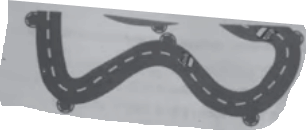
The equation of one such racing track is given as
\[ f(x)= \begin{cases} x^4-4x^2+4, & 0\le x<3
x^2+40, & x\ge3 \end{cases} \]
Based on the given information answer the following questions:
(i) Find \(f'(x)\) for \(0
(iii) (a) Test for continuity of \(f(x)\) at \(x=3\).
OR
(b) Test for differentiability of \(f(x)\) at \(x=3\).
View Solution
Concept:
To analyze piecewise functions:
Differentiate each part separately.
For continuity at \(x=a\): \( \lim_{x\to a^-}f(x)=\lim_{x\to a^+}f(x)=f(a) \).
For differentiability: left and right derivatives must be equal.
Step 1: {\color{redFind \(f'(x)\) for \(0
Differentiate:
\[ f'(x)=4x^3-8x \]
\[ \therefore f'(x)=4x^3-8x \]
for \(0
Step 2: {\color{redFind \(f'(4)\).
For \(x\ge3\)
\[ f(x)=x^2+40 \]
\[ f'(x)=2x \]
Thus
\[ f'(4)=2(4)=8 \]
Step 3: {\color{redTest continuity at \(x=3\).
Left-hand limit:
\[ \lim_{x\to3^-}f(x)=3^4-4(3^2)+4 \]
\[ =81-36+4 \]
\[ =49 \]
Right-hand limit:
\[ \lim_{x\to3^+}f(x)=3^2+40 \]
\[ =9+40 \]
\[ =49 \]
Also
\[ f(3)=3^2+40=49 \]
Thus
\[ LHL=RHL=f(3) \]
\[ \therefore f(x) is continuous at x=3. \]
Alternative (iii)(b): {\color{redTest differentiability at \(x=3\).
Left derivative:
\[ f'(x)=4x^3-8x \]
\[ f'(3^-)=4(27)-8(3) \]
\[ =108-24 \]
\[ =84 \]
Right derivative:
\[ f'(x)=2x \]
\[ f'(3^+)=2(3)=6 \]
Since
\[ 84\ne6 \]
\[ \therefore f(x) is not differentiable at x=3. \] Quick Tip: A function is differentiable at a point only if it is continuous there and its left and right derivatives are equal.
A study revealed that 170 in 1000 males who smoke develop lung complications, while 120 out of 1000 females who smoke develop lung related problems.
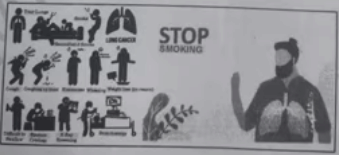
In a colony, 50 people were found to be smokers, of which 30 are males. A person is selected at random from these 50 people and tested for lung related problems.
Based on the given information answer the following questions:
(i) What is the probability that the selected person is a female?
(ii) If a male person is selected, what is the probability that he will not be suffering from lung problems?
(iii) (a) A person selected at random is detected with lung complications. Find the probability that the selected person is a female.
OR
(b) A person selected at random is not having lung problems. Find the probability that the person is a male.
View Solution
Concept:
Use basic probability and Bayes' theorem.
Let
\[ M = male, \quad F = female \]
\[ L = lung complication \]
Given:
\[ P(L|M)=\frac{170}{1000}=0.17 \]
\[ P(L|F)=\frac{120}{1000}=0.12 \]
Number of smokers = \(50\)
\[ 30 males, \quad 20 females \]
Thus
\[ P(M)=\frac{30}{50}=\frac{3}{5} \]
\[ P(F)=\frac{20}{50}=\frac{2}{5} \]
Step 1: {\color{red(i) Probability that the selected person is female.
\[ P(F)=\frac{20}{50} \]
\[ =\frac{2}{5} \]
Step 2: {\color{red(ii) Probability that a male does not suffer lung problems.
\[ P(No lung|M)=1-P(L|M) \]
\[ =1-0.17 \]
\[ =0.83 \]
Step 3: {\color{red(iii)(a) Probability that the person is female given lung complications.
Using Bayes' theorem:
\[ P(F|L)=\frac{P(F)P(L|F)}{P(M)P(L|M)+P(F)P(L|F)} \]
Substitute values:
\[ P(F|L)=\frac{\frac{2}{5}\times0.12}{\frac{3}{5}\times0.17+\frac{2}{5}\times0.12} \]
\[ =\frac{0.048}{0.102+0.048} \]
\[ =\frac{0.048}{0.15} \]
\[ =0.32 \]
\[ \therefore P(F|L)=0.32 \]
Alternative (iii)(b): {\color{redProbability that the person is male given no lung problems.
\[ P(No lung|M)=0.83 \]
\[ P(No lung|F)=1-0.12=0.88 \]
Total probability:
\[ P(No lung)=\frac{3}{5}(0.83)+\frac{2}{5}(0.88) \]
\[ =0.498+0.352 \]
\[ =0.85 \]
Thus
\[ P(M|No lung)= \frac{P(M)P(No lung|M)}{P(No lung)} \]
\[ =\frac{\frac{3}{5}\times0.83}{0.85} \]
\[ =\frac{0.498}{0.85} \]
\[ \approx0.586 \]
\[ \therefore P(M|No lung)\approx0.586 \] Quick Tip: Bayes' theorem: \[ P(A|B)=\frac{P(A)P(B|A)}{\sum P(A_i)P(B|A_i)} \] It helps update probabilities based on new evidence.





Comments