




The CBSE Class 12 Food Production (Subject Code 809) exam for 2026, scheduled for March 10, 2026, is a 3-hour skill paper worth 100 marks (60 Theory + 40 Practical). The exam includes objective, short-answer, and long-answer questions covering menu planning, culinary methods, hygiene, and regional/global cuisine, emphasizing practical, industry-ready knowledge.
The official question paper of CBSE Class 12 Food Production Board Exam 2026 is provided below. Students can download the official paper in PDF format for reference.
CBSE Class 12 2026 Food Production Question Paper with Solution PDF
| CBSE Class 12 2026 Food Production Question Paper with Solution PDF | Download PDF | Check Solution |
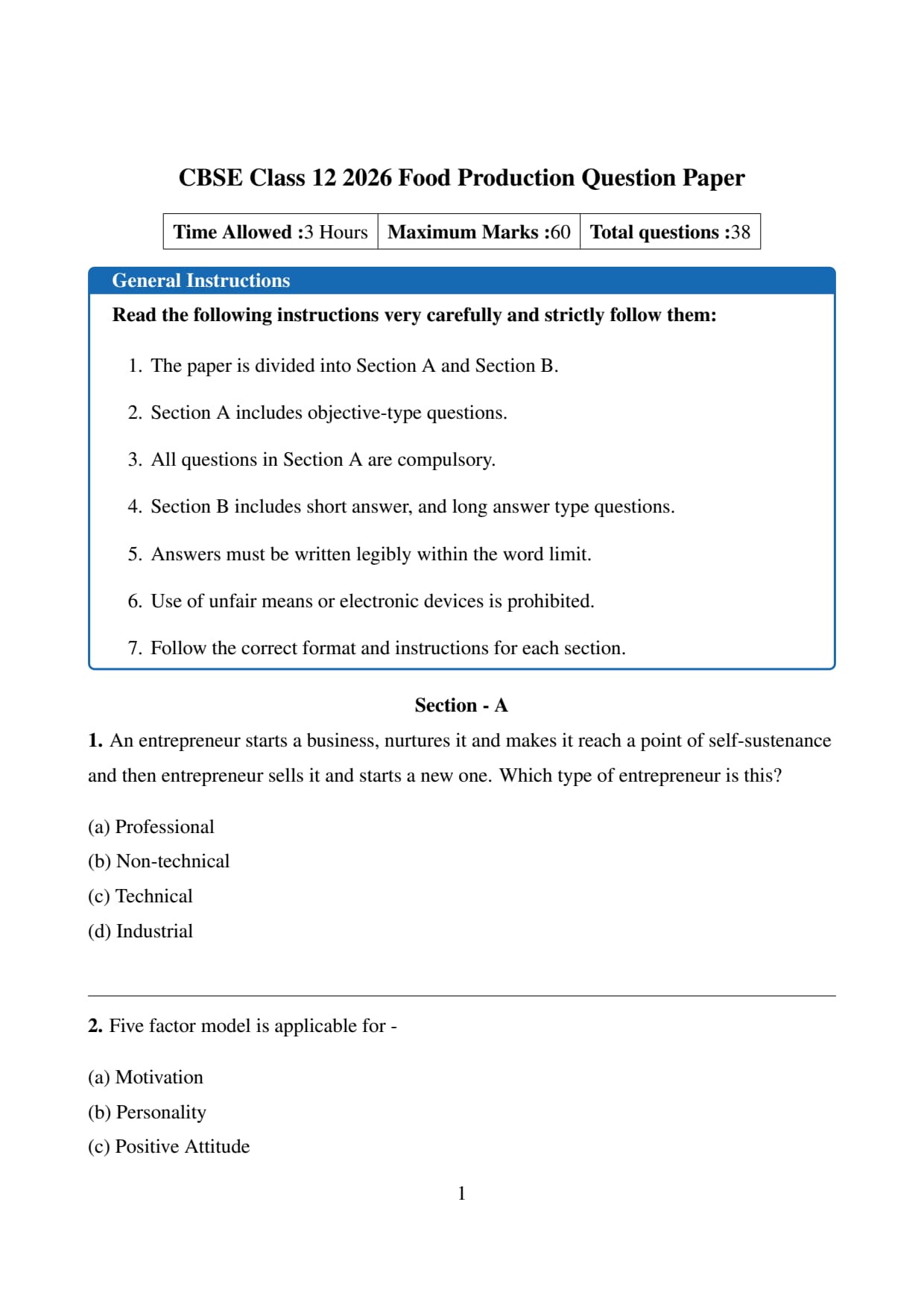
An entrepreneur starts a business, nurtures it and makes it reach a point of self-sustenance and then entrepreneur sells it and starts a new one.
Which type of entrepreneur is this?
View Solution
Step 1: Understanding the question.
The question refers to an entrepreneur who builds a business, nurtures it to become self-sustaining, and then sells it to start a new one. This type of entrepreneur is known for creating businesses, nurturing them, and selling them for profit before moving on to the next venture.
Step 2: Identifying the type of entrepreneur.
A professional entrepreneur is someone who is involved in multiple businesses, starting, nurturing, and eventually selling them. This individual may have expertise in identifying profitable ventures and is focused on creating value.
Step 3: Conclusion.
Thus, the correct answer is (a) Professional.
Final Answer:
\boxed{(a) Professional Quick Tip: Professional entrepreneurs are those who create businesses, make them self-sustaining, and then sell them to start new ventures.
Five factor model is applicable for -
View Solution
Step 1: Understanding the question.
The Five Factor Model (also known as the Big Five personality traits) is a model of personality that describes five broad dimensions that are used to describe human personality. These factors are: openness, conscientiousness, extraversion, agreeableness, and neuroticism.
Step 2: Identifying the applicable area.
The Five Factor Model is specifically used to describe and assess personality, not motivation, attitude, or stress management. It provides a broad understanding of an individual’s personality and behavior.
Step 3: Conclusion.
Thus, the correct answer is (b) Personality.
Final Answer:
\boxed{(b) Personality Quick Tip: The Five Factor Model (Big Five) is used to assess personality and consists of openness, conscientiousness, extraversion, agreeableness, and neuroticism.
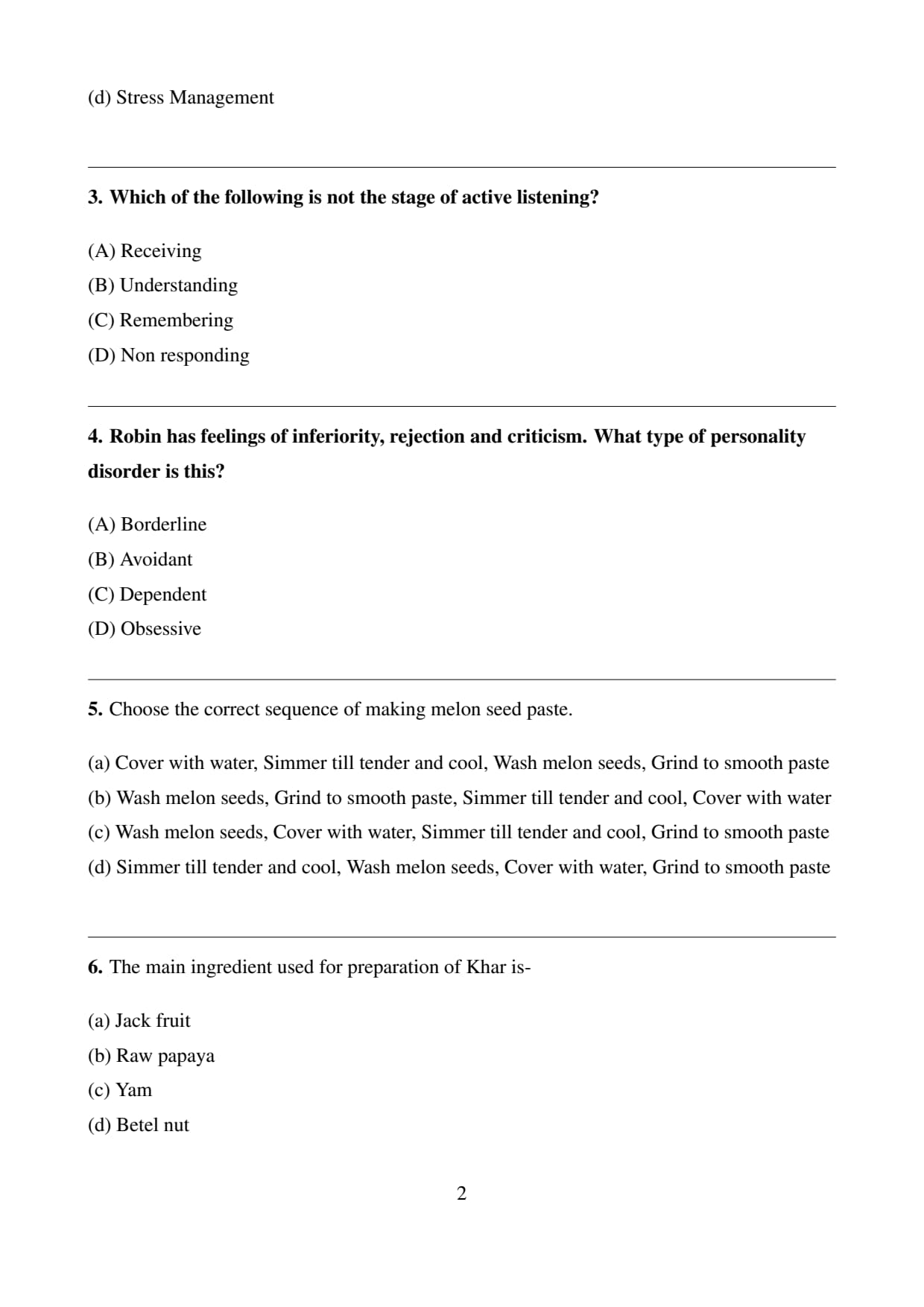
Which of the following is not the stage of active listening?
View Solution
Step 1: Understanding active listening.
Active listening involves being fully engaged and concentrating on what the speaker is saying, and it typically consists of stages such as receiving, understanding, remembering, and responding.
Step 2: Analysis of options.
(A) Receiving: Correct. Receiving is one of the initial stages of active listening where the listener receives the message from the speaker.
(B) Understanding: Correct. Understanding is another crucial stage of active listening where the listener comprehends the message being conveyed.
(C) Remembering: Correct. Remembering is another stage of active listening that involves retaining information for later use.
(D) Non responding: Incorrect. Non responding does not fit as a stage of active listening, as active listening requires active engagement and response from the listener.
Step 3: Conclusion.
Non responding is not a stage of active listening, as the process requires a response and active engagement from the listener.
Final Answer: Non responding. Quick Tip: Active listening includes receiving, understanding, remembering, and responding. Non responding is not a stage of active listening.
Robin has feelings of inferiority, rejection and criticism. What type of personality disorder is this?
View Solution
Step 1: Understanding personality disorders.
Personality disorders are characterized by enduring patterns of behavior, cognition, and inner experience that deviate markedly from the expectations of the individual's culture.
Step 2: Analysis of options.
(A) Borderline: Incorrect. Borderline personality disorder is characterized by instability in relationships, self-image, and emotions, but it does not primarily focus on feelings of inferiority and rejection.
(B) Avoidant: Correct. Avoidant personality disorder is characterized by feelings of inferiority, extreme sensitivity to criticism, and a tendency to avoid social interactions due to fear of rejection.
(C) Dependent: Incorrect. Dependent personality disorder involves a pervasive and excessive need to be taken care of, leading to submissive and clinging behaviors, but it does not emphasize feelings of inferiority.
(D) Obsessive: Incorrect. Obsessive-compulsive personality disorder involves a preoccupation with orderliness, perfectionism, and control, which is different from feelings of rejection and inferiority.
Step 3: Conclusion.
Robin’s feelings of inferiority, rejection, and criticism point to Avoidant Personality Disorder, as these are key traits of this condition.
Final Answer: Avoidant. Quick Tip: Avoidant personality disorder involves fear of criticism and rejection, often resulting in social withdrawal and feelings of inadequacy.
Choose the correct sequence of making melon seed paste.
View Solution
Step 1: Understanding the process.
The correct order involves washing the melon seeds first, then covering them with water. After simmering the mixture until tender, the paste is allowed to cool, and finally, it is ground to a smooth paste. Thus, the correct sequence is (c).
Step 2: Explanation of other options.
- Option (a): The sequence starts with covering with water, but washing the seeds should come before that.
- Option (b): Grinding the seeds before simmering and cooling is incorrect.
- Option (d): Simmering before washing the seeds is not the proper order for making melon seed paste.
Final Answer:
\boxed{(c) Wash melon seeds, Cover with water, Simmer till tender and cool, Grind to smooth paste Quick Tip: For making pastes, always start by preparing the ingredients and follow a logical order for the best results.
The main ingredient used for preparation of Khar is-
View Solution
Step 1: Understanding Khar preparation.
Khar is a traditional dish from Assam, which is made with raw papaya as a key ingredient. The raw papaya is often boiled with pulses, and the dish is flavored with various spices.
Step 2: Explanation of other options.
- Option (a): Jackfruit is not used in the preparation of Khar.
- Option (c): Yam is not a traditional ingredient in Khar.
- Option (d): Betel nut is not used in the preparation of Khar.
Final Answer:
\boxed{(b) Raw papaya Quick Tip: Khar is a famous Assamese dish made primarily with raw papaya and is known for its distinctive flavor.
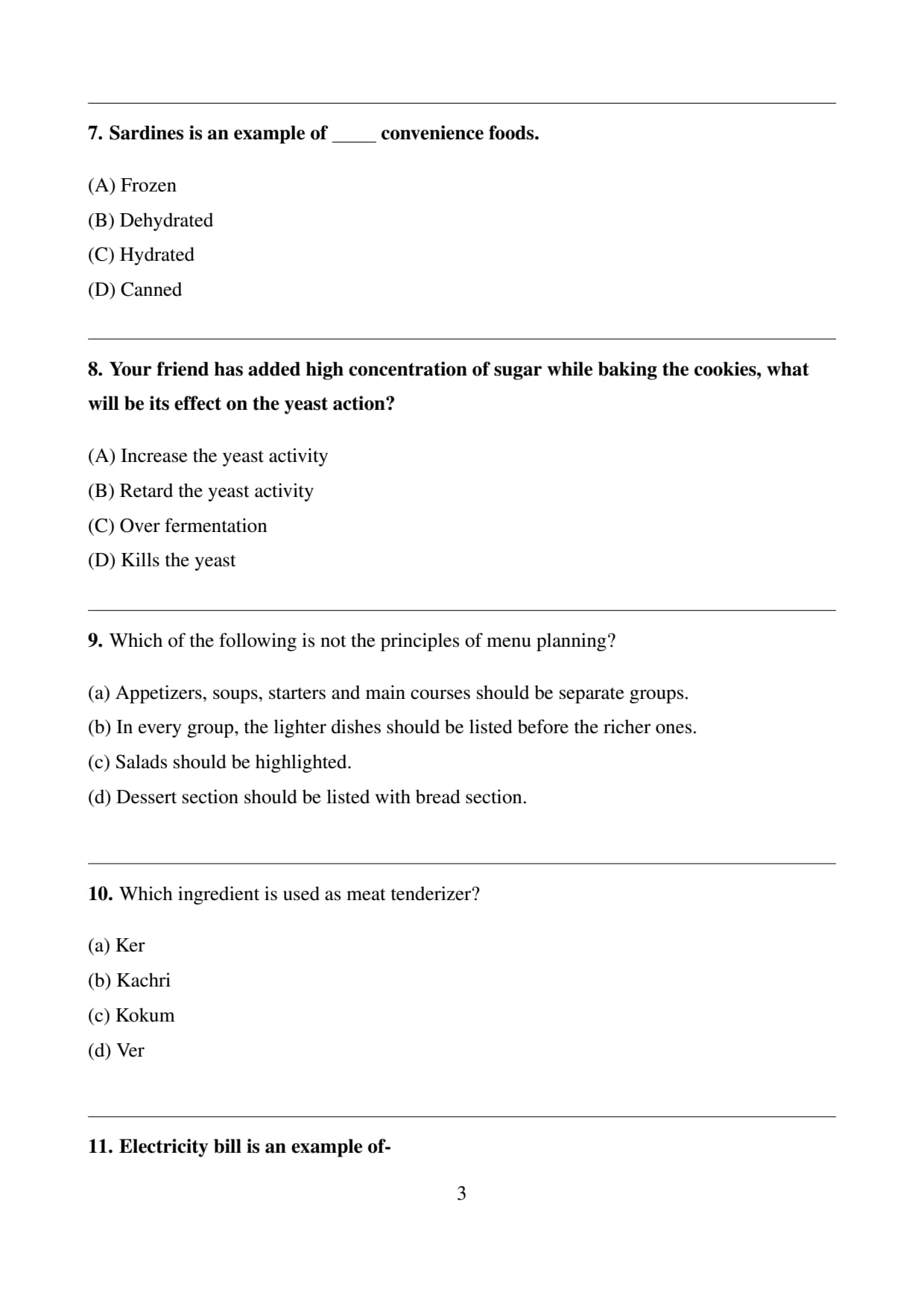
Sardines is an example of \hspace{1cm} convenience foods.
View Solution
Step 1: Understanding convenience foods.
Convenience foods are those that are processed or prepared in a way that makes them easy to store and consume. Sardines, as a form of seafood, are typically preserved by canning, which makes them a convenient food.
Step 2: Analysis of options.
(A) Frozen: Incorrect. Frozen foods are preserved by freezing, but sardines are typically not frozen for convenience.
(B) Dehydrated: Incorrect. Dehydration is a preservation method, but sardines are not commonly dehydrated for convenience.
(C) Hydrated: Incorrect. Hydrated foods are typically dried foods that are rehydrated before use. Sardines are not hydrated.
(D) Canned: Correct. Canning is the most common preservation method for sardines, making them convenient to store and consume.
Step 3: Conclusion.
Sardines are an example of canned convenience foods because they are preserved by canning, making them easy to store and use.
Final Answer: Canned. Quick Tip: Convenience foods are often processed and preserved in ways that make them easy to store and consume, with canning being a common method for fish products like sardines.
Your friend has added high concentration of sugar while baking the cookies, what will be its effect on the yeast action?
View Solution
Step 1: Understanding yeast activity.
Yeast is a microorganism used in baking that ferments sugars to produce carbon dioxide, causing dough to rise. However, excessive sugar can disrupt yeast activity.
Step 2: Analysis of options.
(A) Increase the yeast activity: Incorrect. High concentrations of sugar do not increase yeast activity, as too much sugar can inhibit yeast growth.
(B) Retard the yeast activity: Incorrect. While high sugar concentrations may slow down yeast fermentation, it does not completely halt the process.
(C) Over fermentation: Incorrect. Over fermentation occurs when yeast ferments too much, which typically happens with an adequate sugar concentration, not excessive sugar.
(D) Kills the yeast: Correct. High concentrations of sugar create an osmotic pressure that draws water out of the yeast cells, leading to their dehydration and ultimately killing them.
Step 3: Conclusion.
High concentrations of sugar can create osmotic stress on yeast cells, leading to dehydration and killing the yeast, thus halting fermentation.
Final Answer: Kills the yeast. Quick Tip: Excessive sugar can create osmotic pressure that dehydrates yeast cells, leading to reduced or halted fermentation. Always balance sugar concentrations in recipes.
Which of the following is not the principles of menu planning?
View Solution
Step 1: Understanding menu planning principles.
Menu planning is a key aspect of culinary practices, ensuring that the dishes complement each other and create a balanced, enjoyable dining experience. There are several principles involved in planning a menu, including the structure of courses, the sequence of dishes, and visual appeal. The general principles include organizing appetizers, soups, starters, and main courses into separate sections, listing lighter dishes before richer ones, and giving prominence to salads for their fresh and visually appealing qualities. The dessert section, however, is typically treated separately and should not be listed with the bread section, as they represent different courses.
Step 2: Analyzing each option.
- Option (a): Appetizers, soups, starters, and main courses should indeed be listed as separate groups in the menu. This helps in organizing the meal logically and allows the diner to easily navigate through the choices. This principle ensures clarity in the menu's structure.
- Option (b): Lighter dishes should be listed before the richer or heavier ones. This principle ensures a proper progression of flavors and textures, starting with refreshing, lighter dishes and moving on to heartier, richer dishes. It also helps in not overwhelming the palate with too heavy or intense flavors early in the meal.
- Option (c): Salads are often highlighted in menus, especially in modern dining. This is done to emphasize their role as a refreshing, light, and healthy dish, which can complement the main courses. Highlighting salads adds visual appeal and draws attention to their importance in the meal.
- Option (d): The dessert section should not be listed with the bread section. This is incorrect because the dessert course is traditionally served after the main courses, while bread is typically served either as an accompaniment to the main course or as part of the starter section. Mixing the two sections would confuse the course progression and disrupt the flow of the meal. Therefore, the correct answer is (d).
Final Answer:
\boxed{(d) Dessert section should be listed with bread section. Quick Tip: When planning a menu, always ensure that the courses are organized logically. Keep appetizers, soups, starters, and main courses separate, and ensure lighter dishes precede richer ones for the best dining experience.
Which ingredient is used as meat tenderizer?
View Solution
Step 1: Understanding meat tenderization.
Meat tenderizers are substances that are used to break down the muscle fibers and connective tissue in meat, making it softer and easier to chew. Different ingredients contain enzymes or acids that can aid in this process. Some fruits, like papaya and pineapple, contain enzymes (papain and bromelain) that naturally tenderize meat. Similarly, Kachri, a wild plant found in India, contains an enzyme called "kachrin" that helps in breaking down the tough fibers of meat, making it more tender.
Step 2: Analyzing the options.
- Option (a): Ker is a fruit that is typically used in pickles and preserves, but it is not known for its tenderizing properties. Therefore, it is not an ingredient that is commonly used as a meat tenderizer.
- Option (b): Kachri is a plant widely used in Indian cooking, particularly in traditional meat dishes. The dried form of Kachri contains enzymes that help tenderize meat. This makes it an effective and widely used natural meat tenderizer, especially in Indian cuisine. Therefore, the correct answer is (b).
- Option (c): Kokum is a fruit primarily used to add a tangy flavor to dishes. While it is commonly used in curries and drinks, it does not have meat tenderizing properties. Therefore, it is not a meat tenderizer.
- Option (d): Ver is a plant used in some traditional dishes, but it is not known for its meat tenderizing properties. Therefore, it is not a suitable meat tenderizer.
Step 3: Conclusion.
Kachri is the correct choice, as it contains natural enzymes that break down the fibers in meat, making it softer and easier to cook. Thus, the correct answer is (b).
Final Answer:
\boxed{(b) Kachri Quick Tip: Kachri is a natural meat tenderizer, commonly used in Indian cuisine, and is especially effective in making tough meats more tender.
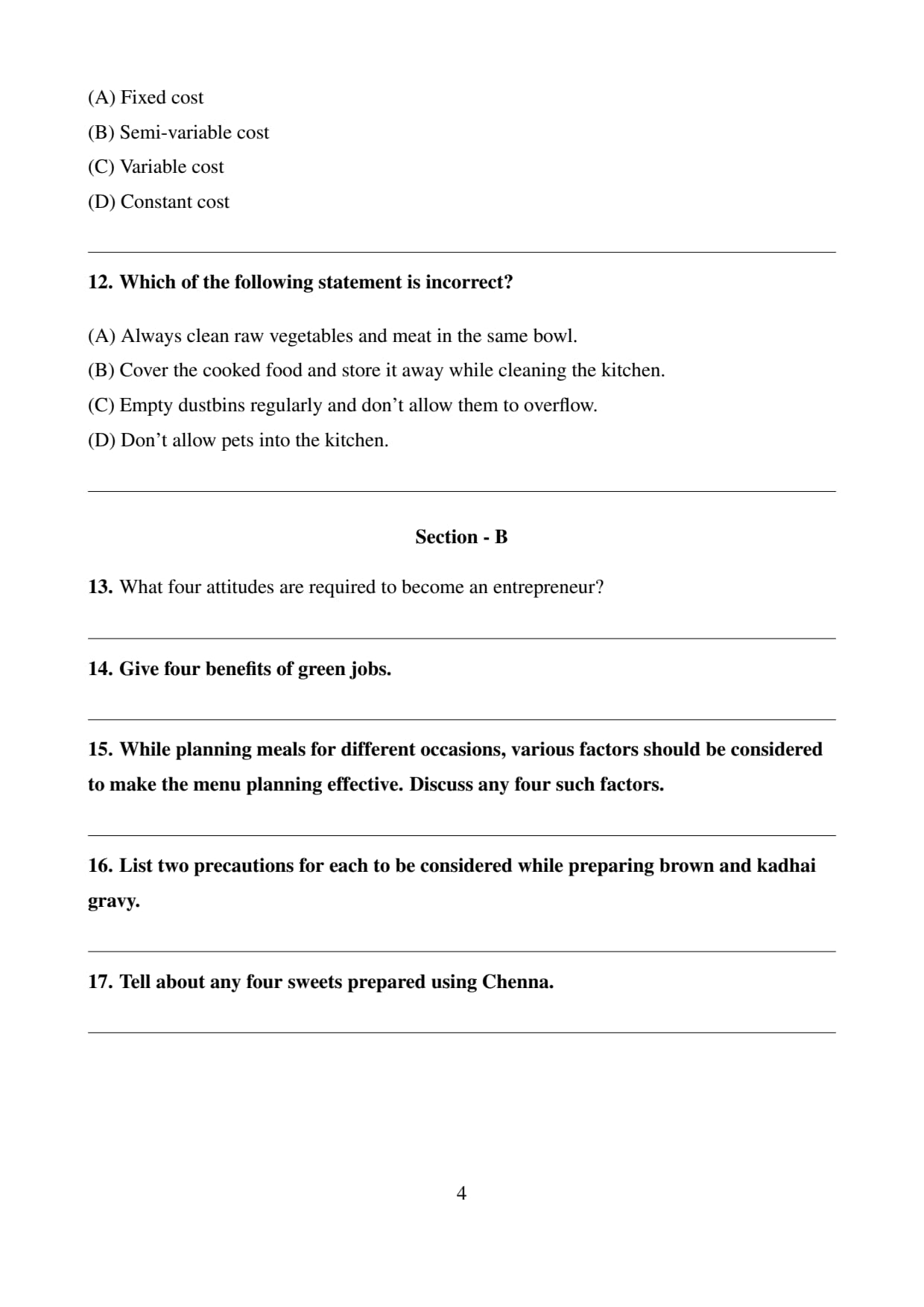
Electricity bill is an example of-
View Solution
Step 1: Understanding electricity bills.
An electricity bill typically varies depending on the amount of electricity consumed. This makes it a variable cost, as the amount paid changes with usage.
Step 2: Analysis of options.
(A) Fixed cost: Incorrect. A fixed cost remains constant regardless of the level of usage. Electricity bills do not remain fixed as they depend on consumption.
(B) Semi-variable cost: Incorrect. A semi-variable cost is partially fixed and partially variable, which is not the case with electricity bills.
(C) Variable cost: Correct. Electricity bills increase or decrease depending on consumption, making it a variable cost.
(D) Constant cost: Incorrect. A constant cost is one that remains unchanged over time, which does not apply to electricity bills.
Step 3: Conclusion.
Since electricity bills vary with consumption, they are considered variable costs.
Final Answer: Variable cost. Quick Tip: Variable costs change based on the level of usage, whereas fixed costs remain constant regardless of usage.
Which of the following statement is incorrect?
View Solution
Step 1: Understanding food safety.
When handling food, proper food safety practices are essential to prevent contamination. Raw vegetables and meat should be cleaned separately to avoid cross-contamination.
Step 2: Analysis of options.
(A) Always clean raw vegetables and meat in the same bowl: Incorrect. Raw vegetables and meat should never be cleaned in the same bowl to prevent cross-contamination from harmful bacteria.
(B) Cover the cooked food and store it away while cleaning the kitchen: Correct. Covering and storing cooked food away prevents contamination during cleaning.
(C) Empty dustbins regularly and don’t allow them to overflow: Correct. Regularly emptying dustbins helps maintain cleanliness and prevent hygiene issues.
(D) Don’t allow pets into the kitchen: Correct. Pets should not be allowed into the kitchen to maintain hygiene and prevent contamination.
Step 3: Conclusion.
The correct answer is (A), as cleaning raw vegetables and meat in the same bowl can lead to contamination.
Final Answer: Always clean raw vegetables and meat in the same bowl. Quick Tip: To avoid contamination, always clean raw meat and vegetables separately and store cooked food away from raw ingredients.
What four attitudes are required to become an entrepreneur?
View Solution
Step 1: Define the attitude required for entrepreneurship.
Entrepreneurs need specific attitudes to succeed in business. These attitudes help them stay focused, motivated, and resilient.
Step 2: Identify four key attitudes.
The four attitudes required to become an entrepreneur are:
1. Self-motivation: Entrepreneurs need to be self-driven, especially when there are no external forces pushing them.
2. Risk-taking: They must be comfortable taking calculated risks and learning from failure.
3. Innovation: Creativity and the ability to think outside the box are crucial for identifying business opportunities.
4. Resilience: Entrepreneurs must be able to bounce back from setbacks and persist in the face of adversity. Quick Tip: Remember: The key to entrepreneurial success lies in a combination of self-motivation, risk-taking, innovation, and resilience.
Give four benefits of green jobs.
View Solution
Step 1: Define green jobs.
Green jobs are positions that contribute to the preservation or restoration of the environment, either through direct or indirect efforts.
Step 2: Identify four benefits of green jobs.
The four benefits of green jobs are:
1. Environmental protection: Green jobs help reduce pollution and conserve natural resources, contributing to a healthier planet.
2. Economic growth: They create new industries and job opportunities, stimulating local and global economies.
3. Sustainability: These jobs focus on sustainable practices that ensure long-term ecological balance.
4. Improved quality of life: Green jobs improve the quality of life by promoting cleaner air, water, and safer living environments. Quick Tip: Green jobs play a vital role in both environmental sustainability and economic development, ensuring a cleaner future.
While planning meals for different occasions, various factors should be considered to make the menu planning effective. Discuss any four such factors.
View Solution
Step 1: Identify the factors involved in menu planning.
When planning meals for different occasions, various factors such as nutritional value, cost, preparation time, and guest preferences need to be considered.
Step 2: Nutritional value.
The menu should balance the nutrients required for a healthy meal. It should include proteins, carbohydrates, fats, vitamins, and minerals, ensuring the meal is nutritious.
Step 3: Cost.
The cost of ingredients and the overall cost of the meal should be within the budget allocated for the event. Careful selection of ingredients can help in reducing unnecessary expenses.
Step 4: Preparation time.
The time required to prepare the meal must be considered based on the number of guests and the type of event. Time management is crucial for effective meal planning.
Step 5: Guest preferences.
Considering the dietary preferences, allergies, and dislikes of the guests ensures that everyone enjoys the meal. Customizing the menu to suit guests' tastes is an important factor. Quick Tip: Remember: Menu planning is effective when you consider nutritional balance, cost, preparation time, and guest preferences.
List two precautions for each to be considered while preparing brown and kadhai gravy.
View Solution
Step 1: Brown gravy precautions.
When preparing brown gravy, it is important to avoid burning the roux (flour mixture) while browning it. Additionally, use low heat to avoid splattering and to give the gravy a smooth consistency.
Step 2: Kadhai gravy precautions.
For kadhai gravy, ensure the correct balance of spices for authentic flavor. Also, avoid overcooking the gravy as it could become too thick or lose its fresh flavor. Quick Tip: For gravies, controlling heat is essential to avoid burning and ensure the right consistency.
Tell about any four sweets prepared using Chenna.
View Solution
Step 1: Define Chenna.
Chenna is a fresh, soft, and crumbly form of cheese made from curdled milk, widely used in the preparation of Indian sweets.
Step 2: List four sweets made using Chenna.
The four sweets prepared using Chenna are:
1. Rasgulla: A famous Bengali sweet made by boiling Chenna balls in sugar syrup.
2. Chamcham: A cylindrical sweet from Bengal made of Chenna, often flavored with saffron or cardamom.
3. Sandesh: A Bengali dessert made from Chenna, often flavored with saffron or rose water.
4. Pantua: Similar to Gulab Jamun, this sweet is made from Chenna, deep-fried, and soaked in sugar syrup. Quick Tip: Chenna-based sweets are popular for their soft texture and ability to absorb flavors like saffron, cardamom, and rose.





Comments