




CBSE successfully conducted the Class 12 Economics Set 1 Exam 2026. The CBSE Board Class 12 Economics Set 1 Question Paper with Solution PDF is now available for download.
The CBSE Class 12 Economics Set 1 paper covered key topics from microeconomics, macroeconomics, Indian economy, and economic development. Students should focus on understanding economic theories, interpreting data, and applying concepts to real-life situations. The exam is marked out of 100, with 80 marks for the theory paper and 20 for internal assessment.
CBSE Class 12 2026 Economics Set 1 Question Paper with Solution PDF
| CBSE Class 12 Economics Set 1 Question Paper 2026 | Download PDF | Check Solution |

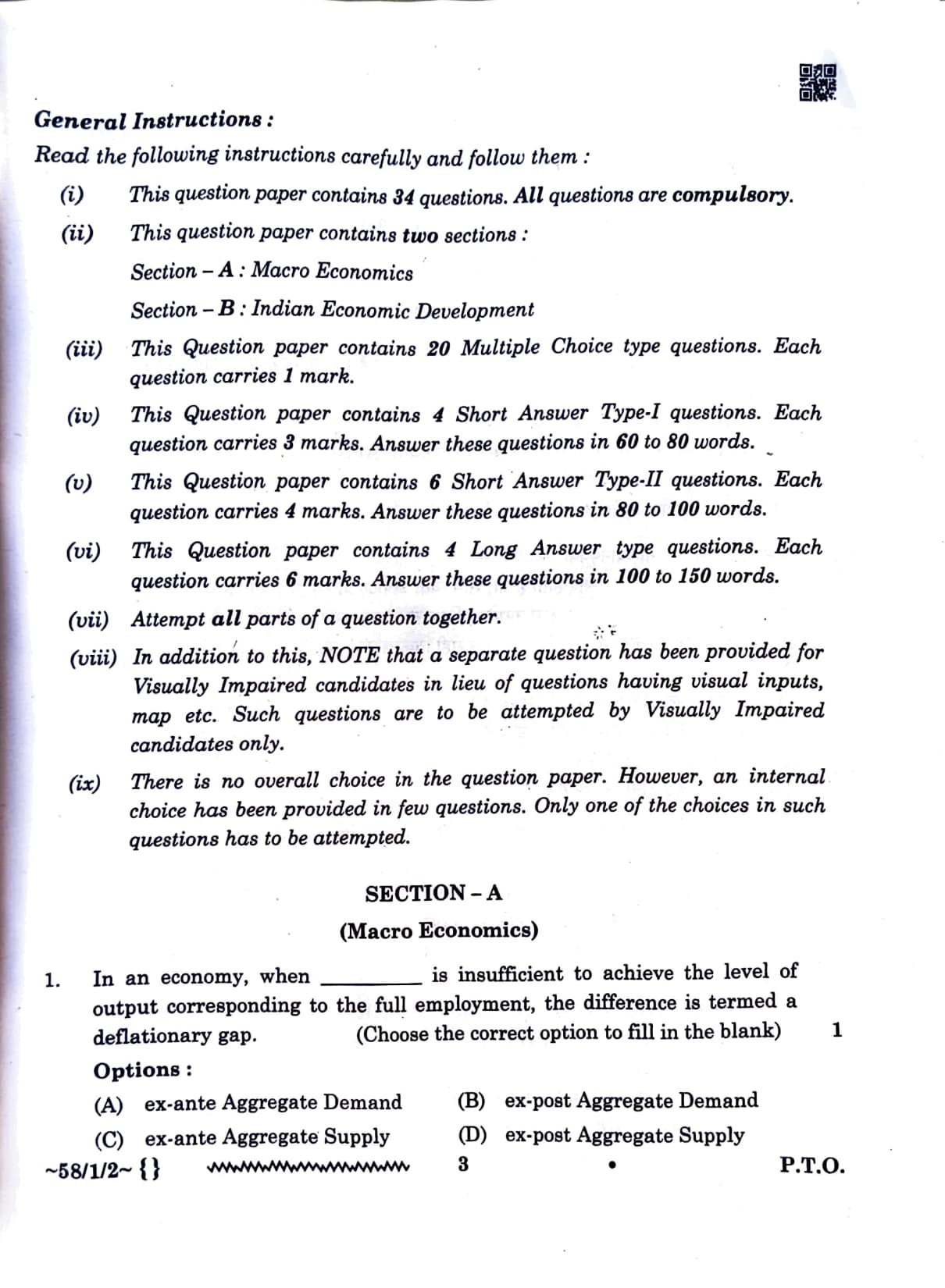
In an economy, when _____ is insufficient to achieve the level of output corresponding to the full employment, the difference is termed a deflationary gap.
View Solution
Step 1: Understanding the concept.
A deflationary gap arises when aggregate demand is insufficient to reach the level of output that corresponds to full employment. This gap represents the shortfall in demand relative to the full capacity of the economy.
Step 2: Ex-ante vs. ex-post concepts.
- Ex-ante Aggregate Demand: This refers to the planned or intended level of aggregate demand in the economy before any real economic activities take place.
- Ex-post Aggregate Demand: This refers to the actual level of aggregate demand that occurs in the economy after the fact.
- Ex-ante Aggregate Supply: This is the planned supply of goods and services before actual economic activities.
- Ex-post Aggregate Supply: This is the actual supply of goods and services that results from economic activity.
Step 3: Conclusion.
The correct answer is (A) ex-ante Aggregate Demand, as a deflationary gap occurs when the planned demand falls short of the full employment output.
Final Answer: ex-ante Aggregate Demand. Quick Tip: A deflationary gap occurs when the economy's planned aggregate demand is not enough to achieve full employment. Always distinguish between ex-ante (planned) and ex-post (actual) values.
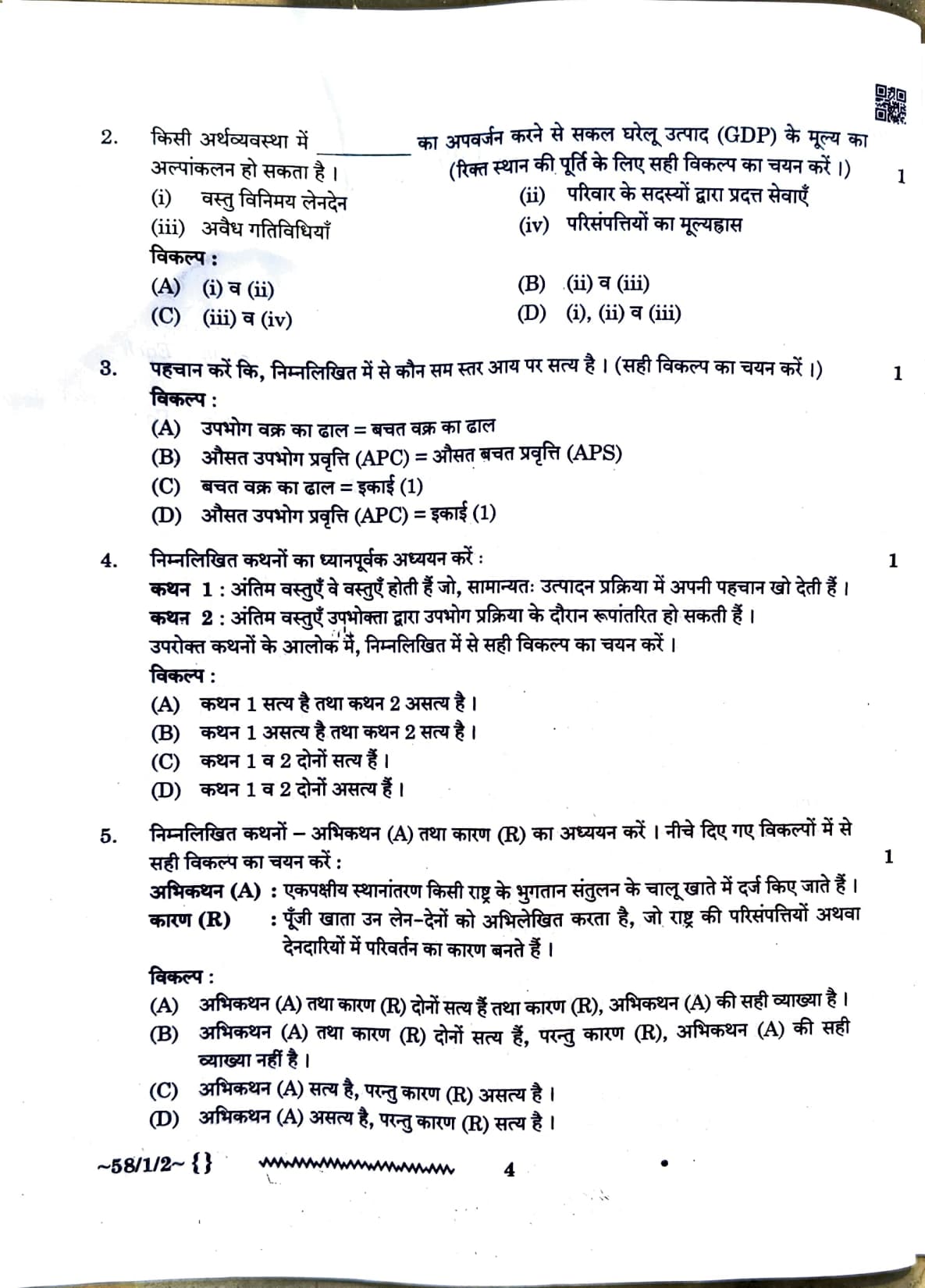
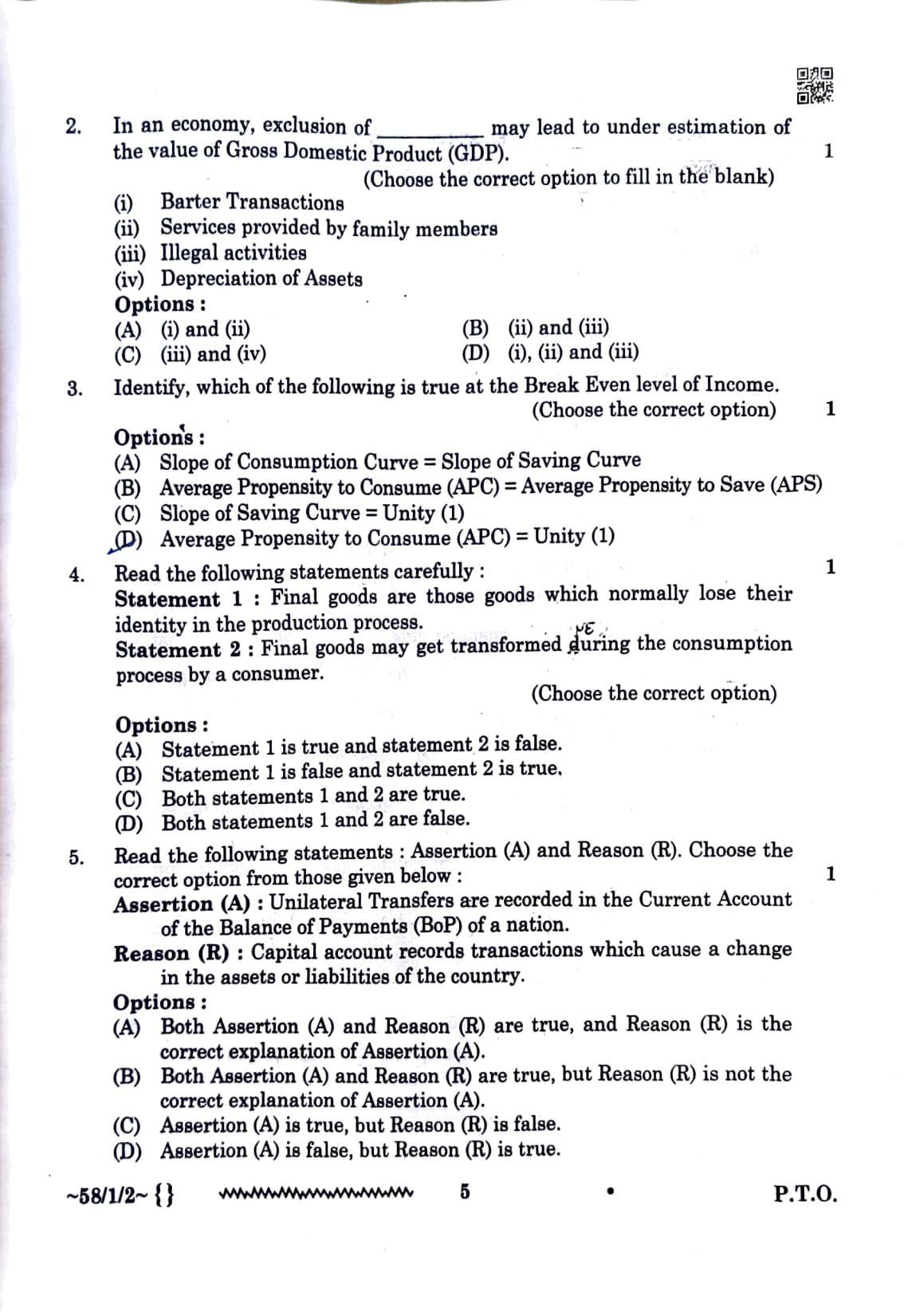
In an economy, exclusion of _____ may lead to under estimation of the value of Gross Domestic Product (GDP).
View Solution
Step 1: Understanding GDP and exclusions.
GDP is a measure of all economic activity in a country. Certain activities, such as barter transactions, family-provided services, and illegal activities, are not recorded in the official GDP calculations.
Step 2: Evaluation of the options.
(A) Barter Transactions: Correct. Barter transactions are not accounted for in official GDP calculations because they do not involve monetary exchange.
(B) Services provided by family members: Correct. Services provided by family members, such as childcare or housework, are not included in GDP as they are not market transactions.
(C) Illegal activities: Correct. Illegal activities are also excluded from GDP calculations as they are not officially recorded in the economy.
(D) Depreciation of Assets: Incorrect. Depreciation is a measure of the loss of value of capital goods over time but is not excluded from GDP. It is used to calculate Net Domestic Product (NDP).
Step 3: Conclusion.
Exclusion of barter transactions, family-provided services, and illegal activities leads to the underestimation of GDP.
Final Answer: (i), (ii), and (iii). Quick Tip: GDP does not account for non-market transactions such as barter, family services, or illegal activities, which may result in an underestimation of the total economic activity.
Identify, which of the following is true at the Break Even level of Income.
View Solution
Step 1: Understanding Break Even Level of Income.
At the Break Even level of income, total consumption equals total income, and the savings are zero. At this point, the Average Propensity to Consume (APC) is equal to one.
Step 2: Evaluation of the options.
(A) Slope of Consumption Curve = Slope of Saving Curve: Incorrect. The slope of the consumption curve and saving curve are not equal at the break-even point.
(B) APC = APS: Incorrect. At the break-even level, APC is equal to 1, while APS is 0, as there is no saving.
(C) Slope of Saving Curve = Unity (1): Incorrect. The slope of the saving curve is not necessarily equal to 1 at the break-even level.
(D) APC = Unity (1): Correct. At the break-even level of income, the average propensity to consume (APC) is equal to 1 because all income is being spent on consumption.
Step 3: Conclusion.
At the Break Even level of income, the APC is unity, meaning that the entire income is consumed, and savings are zero.
Final Answer: APC = Unity (1). Quick Tip: At the Break Even level of income, all income is spent on consumption, and savings are zero. Hence, Average Propensity to Consume (APC) equals 1.
Read the following statements carefully:
Statement 1: Final goods are those goods which normally lose their identity in the production process.
Statement 2: Final goods may get transformed during the consumption process by a consumer.
View Solution
Step 1: Understanding final goods.
Final goods are goods that retain their identity and are ready for final consumption or investment. They do not lose their identity during production.
Step 2: Transformation of final goods.
Final goods, during consumption, can be transformed (e.g., food being eaten, or a car being driven), which means they may undergo changes during the consumption process. Therefore, Statement 2 is true.
Step 3: Conclusion.
Thus, Statement 1 is false, while Statement 2 is true.
Final Answer: Statement 1 is false and statement 2 is true. Quick Tip: Final goods retain their identity in production and are not transformed until consumed. Intermediate goods, however, lose their identity in production.
Read the following statements: Assertion (A) and Reason (R). Choose the correct option from those given below:
Assertion (A): Unilateral Transfers are recorded in the Current Account of the Balance of Payments (BoP) of a nation.
Reason (R): Capital account records transactions which cause a change in the assets or liabilities of the country.
View Solution
Step 1: Understanding Assertion (A).
Unilateral transfers refer to one-way transfers of money or goods, such as remittances or foreign aid, which are recorded in the Current Account of the Balance of Payments.
Step 2: Understanding Reason (R).
The capital account records transactions that involve changes in the country's assets or liabilities, such as foreign investments or loans, which is unrelated to unilateral transfers.
Step 3: Conclusion.
Both Assertion (A) and Reason (R) are true, but Reason (R) is not the correct explanation for Assertion (A) because unilateral transfers do not relate to the capital account.
Final Answer: Both Assertion (A) and Reason (R) are true, but Reason (R) is not the correct explanation of Assertion (A). Quick Tip: Unilateral transfers are recorded in the Current Account, while the Capital Account deals with investments, loans, and changes in assets and liabilities.
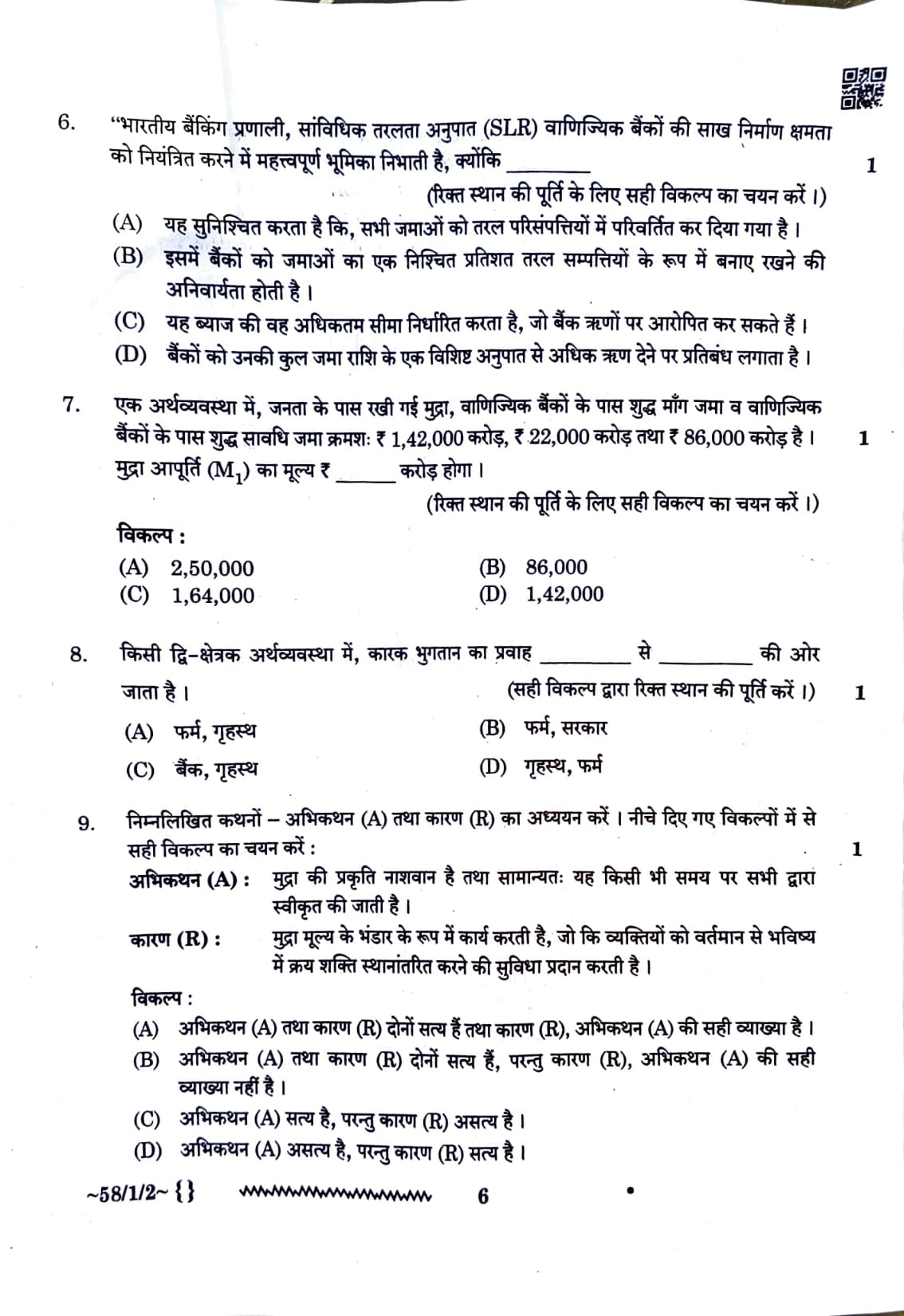
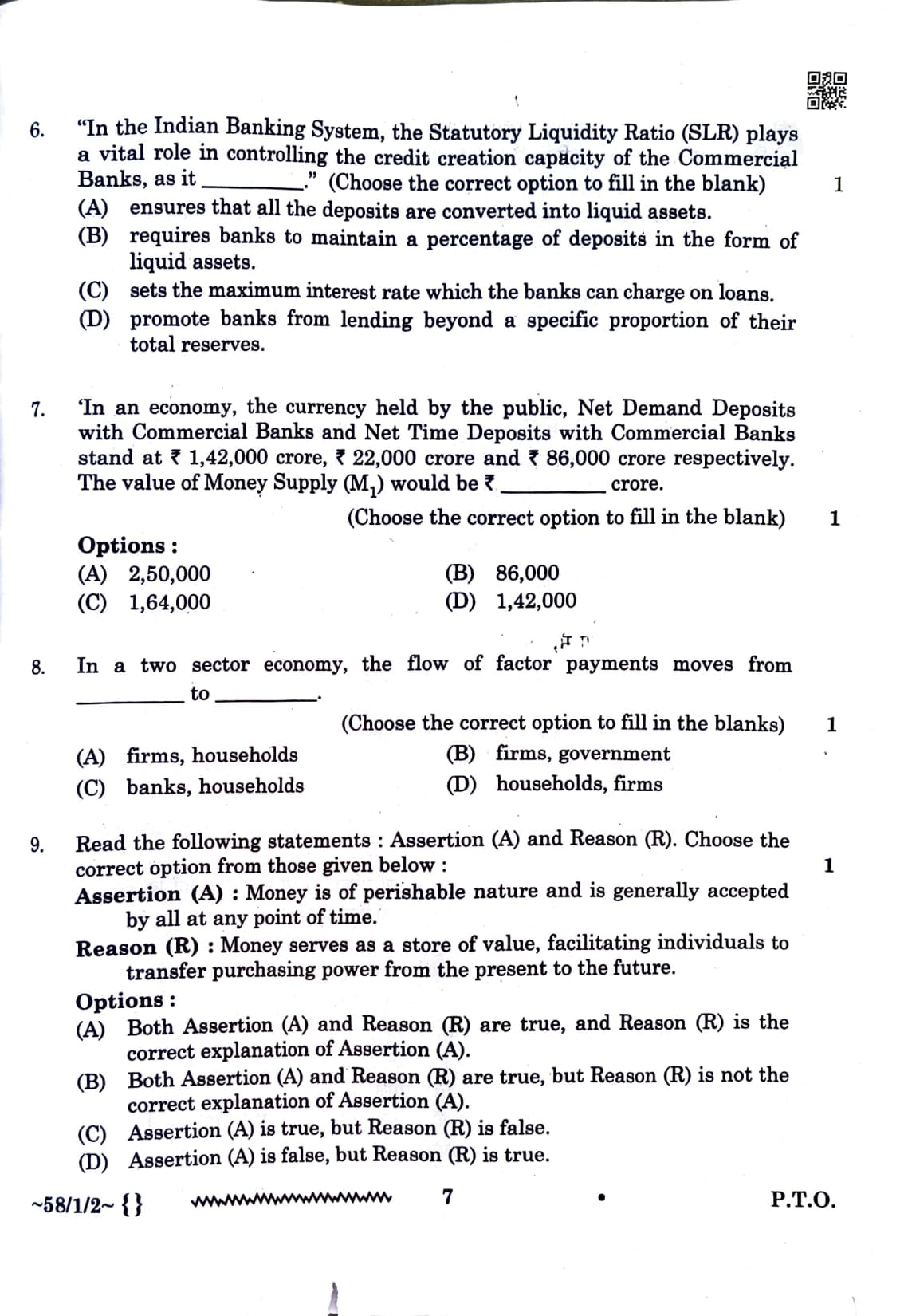
"In the Indian Banking System, the Statutory Liquidity Ratio (SLR) plays a vital role in controlling the credit creation capacity of the Commercial Banks, as it \hspace{2cm}."
View Solution
Step 1: Understanding the Statutory Liquidity Ratio (SLR).
The Statutory Liquidity Ratio (SLR) is the percentage of a bank's total deposits that must be maintained in the form of liquid assets, such as cash, gold, or government securities.
Step 2: Explanation of other options.
- (A) Incorrect: SLR does not ensure all deposits are converted into liquid assets, but it mandates a minimum percentage.
- (C) Incorrect: SLR does not set the interest rate; it relates to liquidity and reserves.
- (D) Incorrect: SLR does not directly restrict lending but ensures liquidity.
Step 3: Conclusion.
The correct answer is (B), as SLR requires banks to maintain a certain percentage of deposits in the form of liquid assets to ensure financial stability.
Final Answer: requires banks to maintain a percentage of deposits in the form of liquid assets. Quick Tip: SLR ensures banks maintain enough liquidity to meet withdrawal demands and maintain financial stability.
In an economy, the currency held by the public, Net Demand Deposits with Commercial Banks and Net Time Deposits with Commercial Banks stand at ₹ 1,42,000 crore, ₹ 22,000 crore and ₹ 86,000 crore respectively. The value of Money Supply (M1) would be ₹ \hspace{2cm} crore.
View Solution
Step 1: Understanding Money Supply (M1).
Money Supply (M1) is the sum of currency held by the public, demand deposits with commercial banks, and other liquid assets in the economy.
Step 2: Calculation of Money Supply (M1).
M1 = Currency held by the public + Net Demand Deposits + Net Time Deposits
M1 = ₹ 1,42,000 crore + ₹ 22,000 crore + ₹ 86,000 crore = ₹ 1,64,000 crore.
Step 3: Conclusion.
Therefore, the value of Money Supply (M1) is ₹ 1,64,000 crore.
Final Answer: ₹ 1,64,000 crore. Quick Tip: Money Supply (M1) includes currency held by the public, demand deposits, and other liquid assets. It represents the most liquid forms of money in an economy.
In a two sector economy, the flow of factor payments moves from \hspace{1cm} to \hspace{1cm}.
View Solution
Step 1: Understanding the flow of payments in a two-sector economy.
In a two-sector economy, there are only two main economic agents: firms and households. The firms pay for the factors of production (like labor, capital, etc.) to the households, and in return, households provide these factors (labor, capital, etc.) to the firms.
Step 2: Evaluation of the options.
(A) firms, households: Incorrect. While firms make factor payments, they are made to households, not from firms to households in the flow of factor payments.
(B) firms, government: Incorrect. In a two-sector economy, there is no government involved in the flow of factor payments.
(C) banks, households: Incorrect. The banks are not directly involved in the flow of factor payments between firms and households.
(D) households, firms: Correct. The flow of factor payments moves from households to firms in exchange for factors of production like labor and capital.
Step 3: Conclusion.
In a two-sector economy, the factor payments flow from households to firms.
Final Answer: households, firms. Quick Tip: In a two-sector economy, households provide factors of production to firms, and firms make factor payments to households.
Read the following statements: Assertion (A) and Reason (R). Choose the correct option from those given below:
Assertion (A): Money is of perishable nature and is generally accepted by all at any point of time.
Reason (R): Money serves as a store of value, facilitating individuals to transfer purchasing power from the present to the future.
View Solution
Step 1: Understanding Assertion (A).
Money is not perishable in nature. While it can lose value over time due to inflation, it does not perish like physical goods. The assertion that money is perishable is incorrect.
Step 2: Understanding Reason (R).
Money does indeed serve as a store of value. This is one of the key functions of money, as it allows individuals to transfer purchasing power from the present to the future by saving money.
Step 3: Evaluation of the options.
(A) Both Assertion (A) and Reason (R) are true, and Reason (R) is the correct explanation of Assertion (A): Incorrect. While Reason (R) is true, Assertion (A) is false.
(B) Both Assertion (A) and Reason (R) are true, but Reason (R) is not the correct explanation of Assertion (A): Incorrect. Reason (R) is true, but it does not explain why Assertion (A) is false.
(C) Assertion (A) is true, but Reason (R) is false: Incorrect. Assertion (A) is false, while Reason (R) is true.
(D) Assertion (A) is false, but Reason (R) is true: Correct. Assertion (A) is false, but Reason (R) is true and correctly describes one of the functions of money.
Step 4: Conclusion.
Assertion (A) is false, but Reason (R) is true, as money serves as a store of value.
Final Answer: Assertion (A) is false, but Reason (R) is true. Quick Tip: Money serves as a store of value, allowing individuals to save and transfer purchasing power to the future. However, it is not perishable.
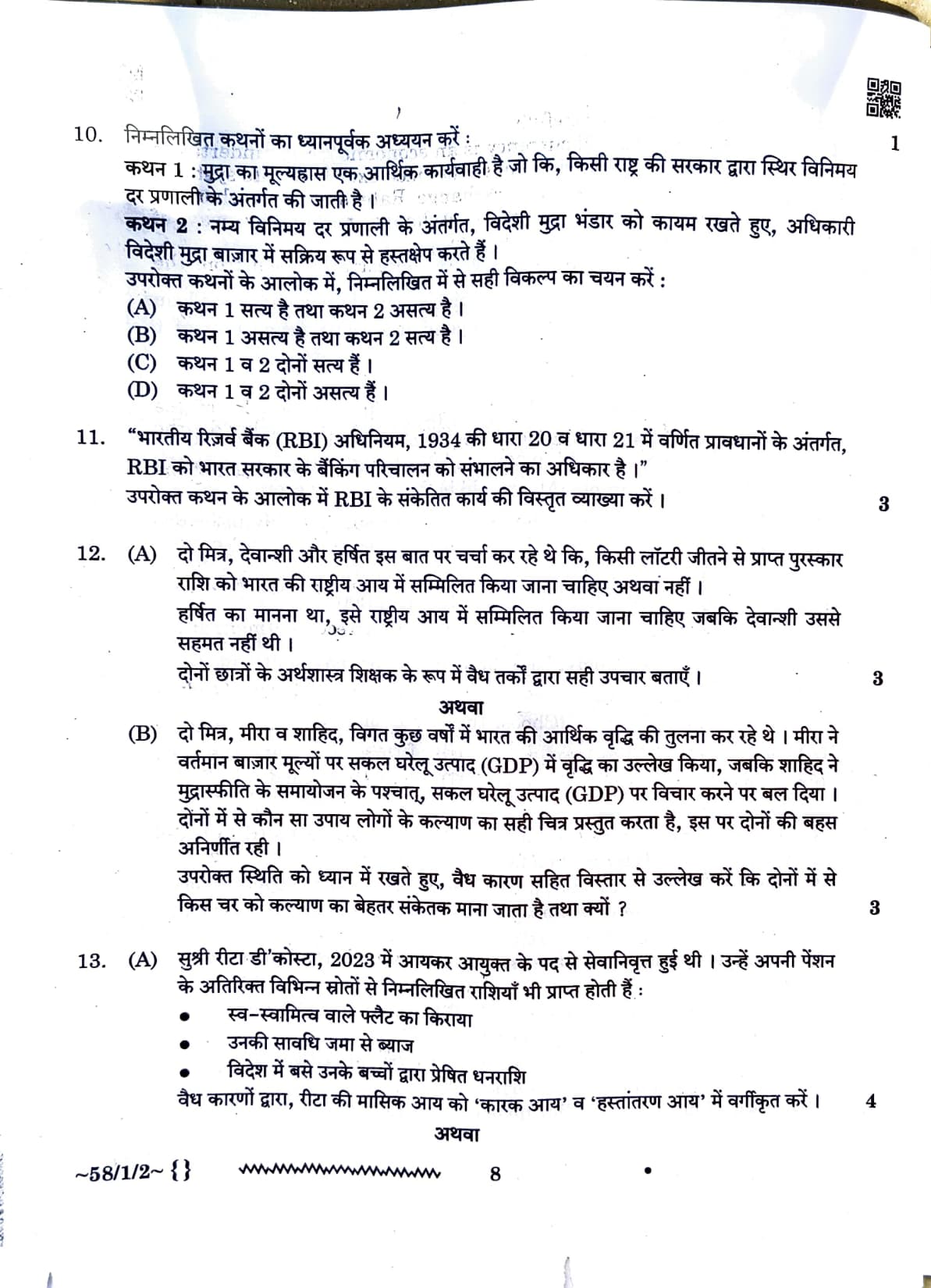
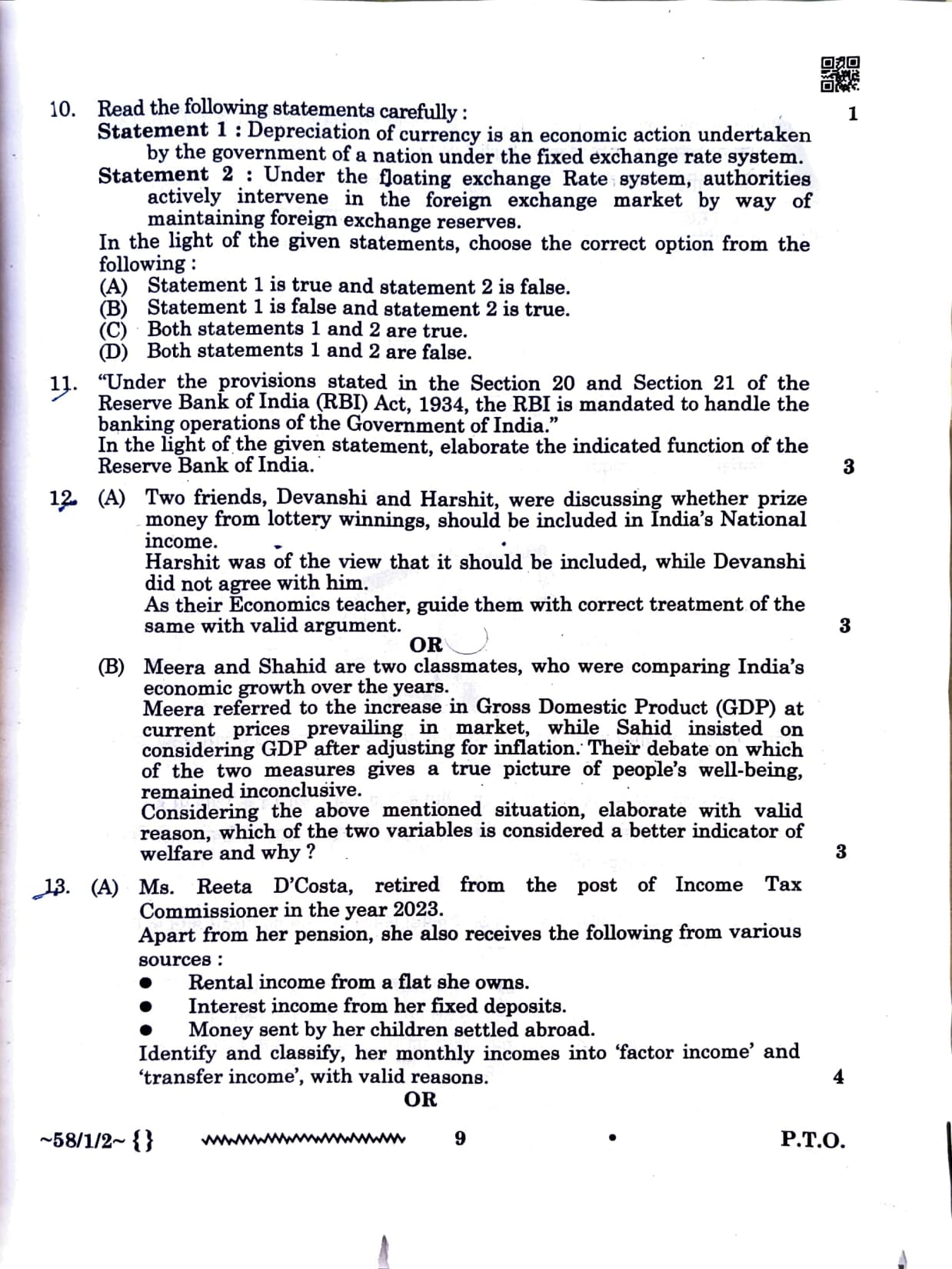
Read the following statements carefully:
Statement 1: Depreciation of currency is an economic action undertaken by the government of a nation under the fixed exchange rate system.
Statement 2: Under the floating exchange rate system, authorities actively intervene in the foreign exchange market by way of maintaining foreign exchange reserves.
View Solution
Step 1: Understanding Statement 1.
Statement 1 is incorrect. Depreciation of currency happens naturally in a floating exchange rate system where the value of the currency is determined by market forces. Under a fixed exchange rate system, the government or central bank sets the exchange rate and must actively intervene to maintain the value of its currency.
Step 2: Understanding Statement 2.
Statement 2 is correct. In a floating exchange rate system, currency values are determined by market supply and demand, and authorities may intervene to stabilize the exchange rate by maintaining foreign exchange reserves or through market operations.
Step 3: Evaluation of the options.
(A) Statement 1 is true and statement 2 is false: Incorrect. Statement 1 is false, and Statement 2 is true.
(B) Statement 1 is false and statement 2 is true: Correct. Statement 1 is false, and Statement 2 is true.
(C) Both statements 1 and 2 are true: Incorrect. Statement 1 is false.
(D) Both statements 1 and 2 are false: Incorrect. Statement 2 is true.
Step 4: Conclusion.
Statement 1 is false, and Statement 2 is true.
Final Answer: Statement 1 is false and statement 2 is true. Quick Tip: In a fixed exchange rate system, the government or central bank controls the currency value, while in a floating exchange rate system, the market determines it, with possible government interventions to maintain stability.
"Under the provisions stated in Section 20 and Section 21 of the Reserve Bank of India (RBI) Act, 1934, the RBI is mandated to handle the banking operations of the Government of India."
In the light of the given statement, elaborate the indicated function of the Reserve Bank of India.
View Solution
Step 1: Role of RBI under Section 20 and 21 of the RBI Act.
According to Section 20 of the RBI Act, the Reserve Bank of India is authorized to act as the banker to the government, managing its accounts, public debt, and foreign exchange reserves. Section 21 further provides the RBI the mandate to carry out these functions as required by the government, ensuring a smooth flow of funds.
Step 2: Handling Government Accounts.
As the banker to the government, the RBI handles the receipt and disbursement of government funds. This includes managing revenue collection, payment of government salaries, pensions, and interest on government loans, as well as other financial transactions.
Step 3: Management of Public Debt.
The RBI is responsible for managing the public debt of the government. This includes issuing government securities, managing their payments, and ensuring the timely servicing of the debt, contributing to fiscal discipline.
Step 4: Currency Management.
The RBI plays a vital role in managing the currency in circulation, including the issuance and exchange of government notes. It ensures that there is adequate currency to meet the needs of the economy, while controlling inflation and maintaining price stability.
Step 5: Managing Foreign Exchange Reserves.
The RBI also acts as the custodian of India's foreign exchange reserves, which includes facilitating the government’s international payments and ensuring a stable exchange rate through currency management and interventions in the forex markets. Quick Tip: Remember: The RBI's function as the banker to the government is essential for maintaining financial stability and managing the government's monetary operations.
Two friends, Devanshi and Harshit, were discussing whether prize money from lottery winnings, should be included in India's National income.
Harshit was of the view that it should be included, while Devanshi did not agree with him.
As their Economics teacher, guide them with correct treatment of the same with valid argument.
View Solution
Step 1: Define National Income.
National income refers to the total value of goods and services produced by a country in a given period. It includes wages, salaries, profits, rents, and other income generated by productive activities.
Step 2: Lottery Winnings and National Income.
Lottery winnings are considered unearned income, as they are not the result of any productive economic activity. According to the principles of national income accounting, only income generated from production is included in national income.
Step 3: Clarifying the Argument.
Harshit's view is incorrect as lottery winnings do not represent production. Devanshi is correct because national income should only include income generated through productive activities. Therefore, lottery winnings should not be included in national income.
Step 4: Conclusion.
As their economics teacher, you should explain that the correct treatment of lottery winnings is to exclude them from national income, as they are not earned through productive economic activities. Quick Tip: National income only includes income earned through the production of goods and services, and lottery winnings are not the result of productive activity.
Meera and Shahid are two classmates, who were comparing India's economic growth over the years.
Meera referred to the increase in Gross Domestic Product (GDP) at current prices prevailing in market, while Shahid insisted on considering GDP after adjusting for inflation. Their debate on which of the two measures gives a true picture of people’s well-being, remained inconclusive.
Considering the above mentioned situation, elaborate with valid reason, which of the two variables is considered a better indicator of welfare and why?
View Solution
Step 1: Define GDP and its two measures.
GDP at current prices, also known as nominal GDP, measures the total market value of goods and services produced in an economy, using the prices that are currently prevailing in the market. However, it does not account for inflation.
GDP at constant prices, or real GDP, adjusts the nominal GDP for inflation, providing a more accurate representation of an economy's true growth over time.
Step 2: Which measure is better for welfare?
Real GDP (GDP adjusted for inflation) is considered a better indicator of welfare as it reflects the actual growth in the economy without being distorted by price increases. It gives a more realistic view of the increase in the standard of living and purchasing power over time.
Step 3: Conclusion.
You should guide Meera and Shahid that while nominal GDP shows the market value, real GDP provides a clearer picture of people's well-being by eliminating the effects of inflation. Quick Tip: Real GDP, adjusted for inflation, is a more accurate measure of economic growth and welfare as it reflects the actual increase in goods and services, rather than just price increases.
Ms. Reeta D’Costa, retired from the post of Income Tax Commissioner in the year 2023.
Apart from her pension, she also receives the following from various sources:
- Rental income from a flat she owns.
- Interest income from her fixed deposits.
- Money sent by her children settled abroad.
Identify and classify her monthly incomes into 'factor income' and 'transfer income', with valid reasons.
View Solution
Step 1: Definition of Factor Income.
Factor income refers to the income earned by providing productive services or factors of production, such as land, labor, capital, and entrepreneurship. It includes wages, rent, interest, and profit that arise from production activities.
Step 2: Definition of Transfer Income.
Transfer income refers to income received without providing any productive services in return. It includes gifts, pensions, and remittances, as they are transfers of income from one individual to another without any productive activity involved.
Step 3: Classifying the Income Sources.
- Rental income from a flat she owns: This is factor income, as it is earned from the use of her property (land) and involves the productive use of her asset.
- Interest income from her fixed deposits: This is factor income, as it is earned from the capital she has invested in the form of fixed deposits.
- Money sent by her children settled abroad: This is transfer income, as it is a remittance from her children without any exchange of goods or services.
Quick Tip: Remember: Factor income is earned through the use of productive factors, while transfer income involves income received as a gift or transfer with no productive input.
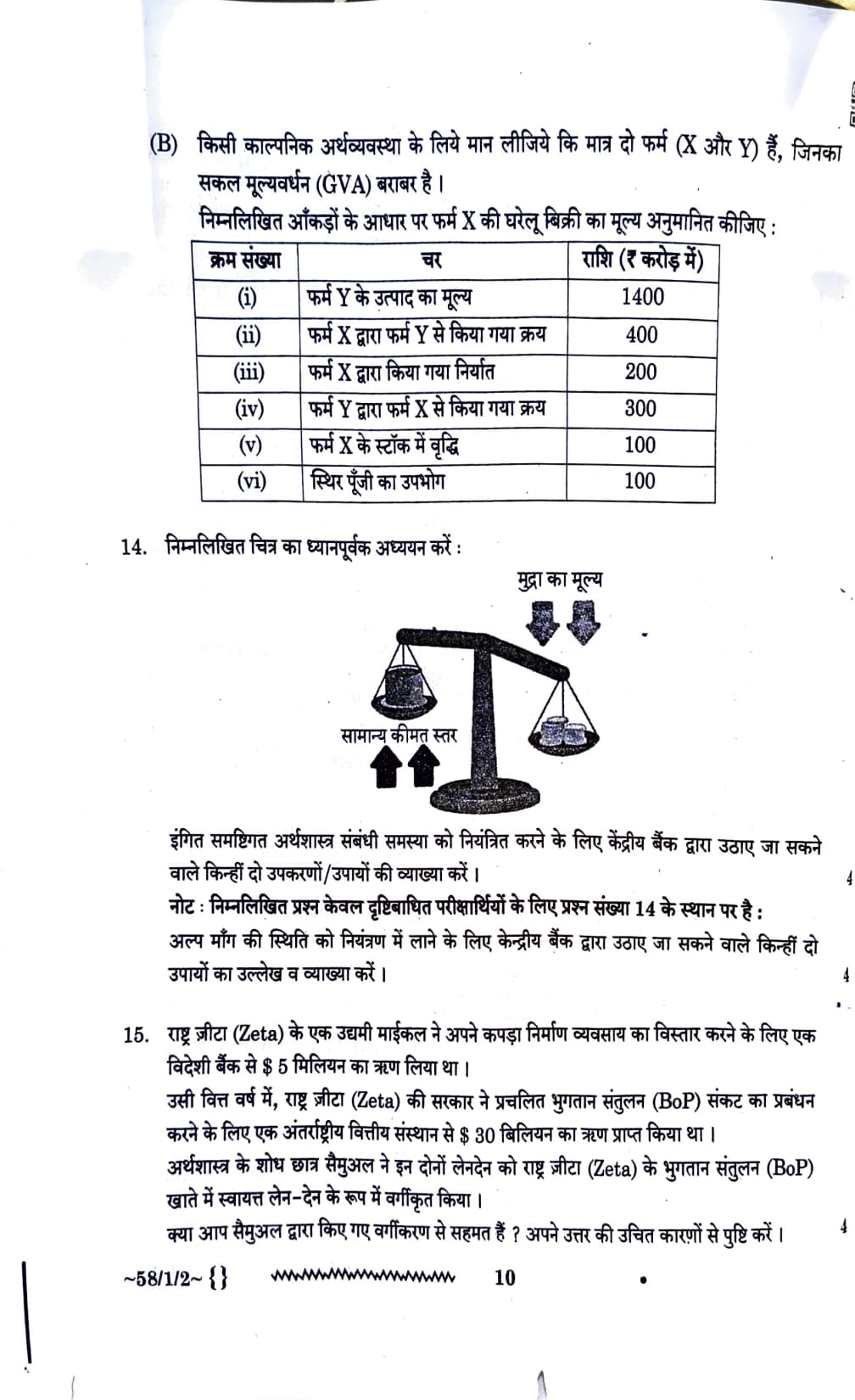
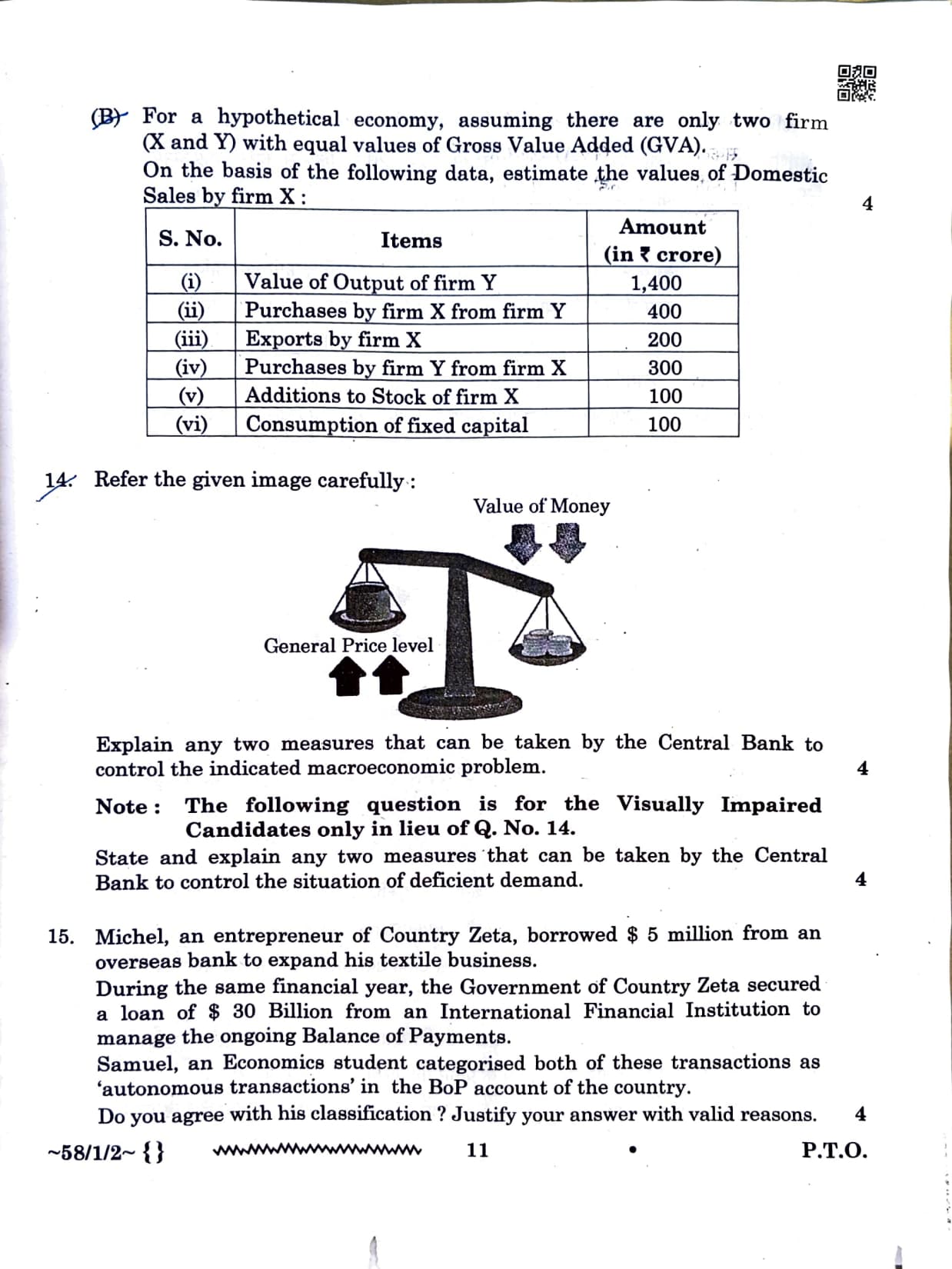
For a hypothetical economy, assuming there are only two firms (X and Y) with equal values of Gross Value Added (GVA).
On the basis of the following data, estimate the values of Domestic Sales by firm X:
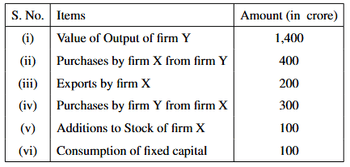
View Solution
Step 1: Formula for Domestic Sales of Firm X.
The Domestic Sales of firm X can be calculated using the following formula:
\[ Domestic Sales of Firm X = Value of Output of Firm X - Exports by Firm X \]
Step 2: Calculation of Value of Output of Firm X.
We know that the value of output of Firm X includes the value of its sales to other firms and households. To estimate it, we use the following:
\[ Value of Output of Firm X = Purchases by Firm X from Firm Y + Purchases by Firm Y from Firm X + Additions to Stock of Firm X \]
Substituting the values from the table:
\[ Value of Output of Firm X = 400 + 300 + 100 = 800 \, crore \]
Step 3: Substitution in the Domestic Sales Formula.
Now, we can calculate the Domestic Sales of Firm X:
\[ Domestic Sales of Firm X = 800 - 200 = 600 \, crore \] Quick Tip: Remember: Domestic sales exclude exports and only account for transactions within the country.
Refer the given image carefully:
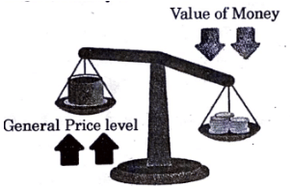
Explain any two measures that can be taken by the Central Bank to control the indicated macroeconomic problem.
View Solution
Step 1: Identifying the macroeconomic problem.
The image depicts the relationship between the value of money and the general price level. It indicates a situation of "deficient demand," where the demand for goods and services in the economy is insufficient, leading to a decrease in the value of money and lower price levels.
Step 2: Measures to control deficient demand.
Two main measures that the Central Bank can take to control deficient demand are:
1. Lowering the interest rates: The Central Bank can reduce the interest rates to make borrowing cheaper. Lower interest rates encourage consumers and businesses to take loans, which leads to an increase in spending and investment, thus stimulating demand in the economy.
2. Open Market Operations (OMOs): The Central Bank can buy government securities from the open market. This increases the money supply in the economy, as it injects money into the banking system. With more money in circulation, people have more money to spend, which increases demand and helps address deficient demand. Quick Tip: Remember: The Central Bank uses tools like interest rate adjustments and open market operations to manage inflation, stimulate demand, and stabilize the economy.
Michel, an entrepreneur of Country Zeta, borrowed
(5 million from an overseas bank to expand his textile business.
During the same financial year, the Government of Country Zeta secured a loan of
)30 Billion from an International Financial Institution to manage the ongoing Balance of Payments.
Samuel, an Economics student categorised both of these transactions as 'autonomous transactions' in the BoP account of the country.
Do you agree with his classification? Justify your answer with valid reasons.
View Solution
Step 1: Define Autonomous Transactions.
Autonomous transactions in the Balance of Payments (BoP) refer to those transactions that are carried out for commercial, trade, or financial purposes, without being influenced by the balance of payments itself. These transactions involve a real exchange of goods, services, or capital, and are not the result of government policies or decisions.
Step 2: Analyze the First Transaction.
Michel's loan of
(5 million from an overseas bank is a financial transaction between a private entity and a foreign bank. This is an autonomous transaction because it is a borrowing made for expanding business operations, driven by the entrepreneur's personal business interests.
Step 3: Analyze the Second Transaction.
The
)30 billion loan secured by the Government of Country Zeta from an international financial institution is a government borrowing to manage the country's Balance of Payments. This transaction is classified as a 'counter-cyclical' or 'official' transaction rather than an autonomous one, because it is driven by government policy aimed at managing the country's external balance, rather than for private trade or financial purposes.
Step 4: Conclusion.
I do not agree with Samuel’s classification. While Michel’s loan qualifies as an autonomous transaction, the government’s loan is more appropriately categorized as an official transaction, aimed at balancing the country's payments. Thus, only Michel's loan should be classified as autonomous. Quick Tip: Autonomous transactions are driven by private sector decisions (e.g., business loans, trade transactions), while official transactions are influenced by government policies (e.g., loans for Balance of Payments management).
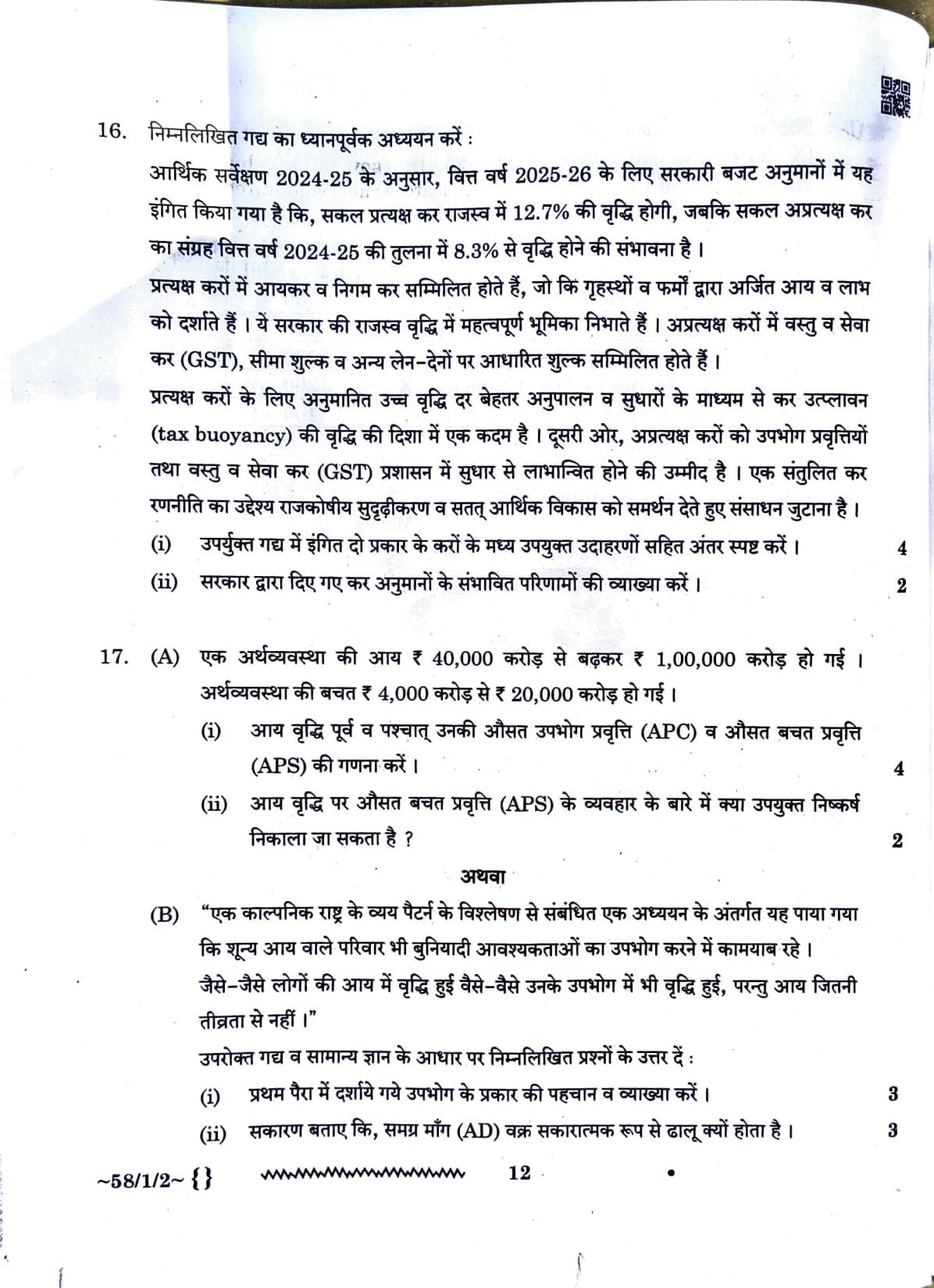
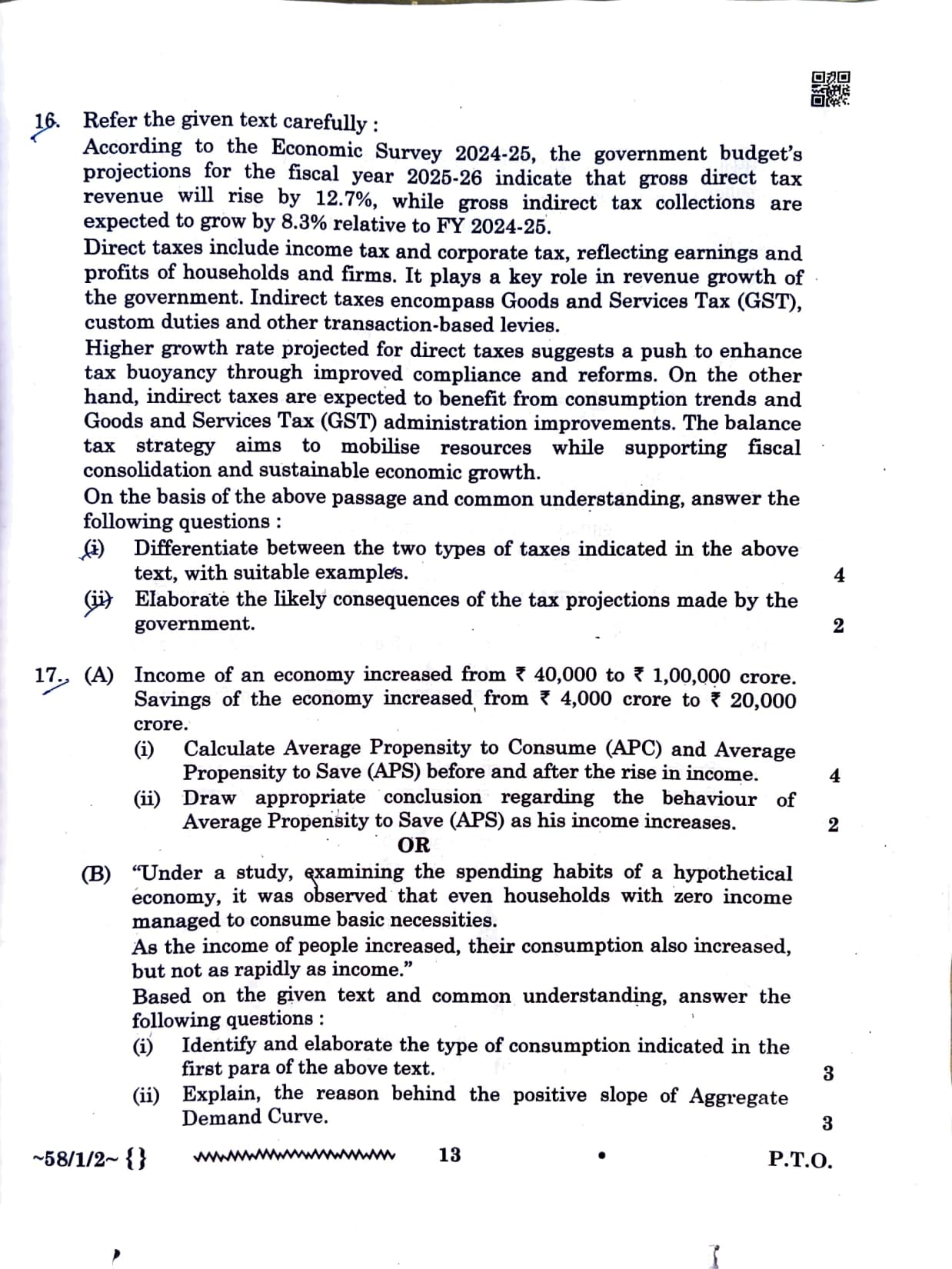
Refer the given text carefully:
According to the Economic Survey 2024-25, the government budget’s projections for the fiscal year 2025-26 indicate that gross direct tax revenue will rise by 12.7%, while gross indirect tax collections are expected to grow by 8.3% relative to FY 2024-25. Direct taxes include income tax and corporate tax, reflecting earnings and profits of households and firms. It plays a key role in revenue growth of the government. Indirect taxes encompass Goods and Services Tax (GST), custom duties and other transaction-based levies. Higher growth rate projected for direct taxes suggests a push to enhance tax buoyancy through improved compliance and reforms. On the other hand, indirect taxes are expected to benefit from consumption trends and Goods and Services Tax (GST) administration improvements. The balance tax strategy aims to mobilize resources while supporting fiscal consolidation and sustainable economic growth.
On the basis of the above passage and common understanding, answer the following questions:
(i) Differentiate between the two types of taxes indicated in the above text, with suitable examples.
(ii) Elaborate the likely consequences of the tax projections made by the government.
View Solution
Step 1: Differentiating between direct and indirect taxes.
- Direct Taxes: These are taxes levied directly on the income or wealth of individuals or businesses. Examples include Income Tax and Corporate Tax, where the tax liability is directly borne by the taxpayer. Direct taxes are typically progressive, meaning they increase with income or profit levels.
- Indirect Taxes: These are taxes levied on goods and services, which are paid by the consumer but collected by an intermediary (like a business) from the consumer at the point of sale. Examples include Goods and Services Tax (GST) and custom duties. The burden of indirect taxes can be shifted to consumers, as businesses often pass on the tax costs in the form of higher prices.
Step 2: Likely consequences of the tax projections.
The government's projections of increasing direct and indirect taxes indicate a robust plan to boost revenue. The likely consequences could be:
1. Economic Growth: The increase in direct tax collections is expected to result from higher compliance and reforms, which could lead to a more equitable distribution of wealth and improved tax buoyancy.
2. Increased Consumption: The projected growth in indirect taxes, especially GST, could reflect an increase in consumption trends, providing more revenue to the government.
3. Fiscal Consolidation: The balance between direct and indirect tax collections aims to maintain fiscal discipline, support public finances, and help in sustainable economic growth.
4. Inflationary Pressure: A higher reliance on indirect taxes could lead to inflationary pressures, as businesses may pass on the higher tax burden to consumers. Quick Tip: Remember: Direct taxes are paid directly by individuals and businesses based on their income or wealth, while indirect taxes are passed on to the consumer as part of the price of goods and services.
(A) Income of an economy increased from ₹40,000 crore to ₹1,00,000 crore. Savings of the economy increased from ₹4,000 crore to ₹20,000 crore.
(i) Calculate Average Propensity to Consume (APC) and Average Propensity to Save (APS) before and after the rise in income.
(ii) Draw appropriate conclusion regarding the behaviour of Average Propensity to Save (APS) as his income increases.
View Solution
Step 1: Formula for APC and APS.
The Average Propensity to Consume (APC) is calculated as: \[ APC = \frac{Consumption}{Income} \]
The Average Propensity to Save (APS) is calculated as: \[ APS = \frac{Savings}{Income} \]
Step 2: Before the increase in income.
Before the increase in income, Income = ₹40,000 crore and Savings = ₹4,000 crore.
Assuming that Consumption is the remaining income after Savings: \[ Consumption = 40,000 - 4,000 = 36,000 \, crore \]
Now, calculate APC and APS before the increase in income: \[ APC = \frac{36,000}{40,000} = 0.9 \] \[ APS = \frac{4,000}{40,000} = 0.1 \]
Step 3: After the increase in income.
After the increase in income, Income = ₹1,00,000 crore and Savings = ₹20,000 crore.
Assuming that Consumption is the remaining income after Savings: \[ Consumption = 1,00,000 - 20,000 = 80,000 \, crore \]
Now, calculate APC and APS after the increase in income: \[ APC = \frac{80,000}{1,00,000} = 0.8 \] \[ APS = \frac{20,000}{1,00,000} = 0.2 \]
Step 4: Conclusion.
From the calculations, we observe that before the increase in income, the APC was 0.9 and the APS was 0.1. After the increase in income, the APC decreased to 0.8, and the APS increased to 0.2. This suggests that as the income of the economy increases, the Average Propensity to Save (APS) rises, while the Average Propensity to Consume (APC) falls. This is because, with higher income, people tend to save a larger proportion of their income. Quick Tip: As income increases, the tendency to consume decreases slightly, and the tendency to save increases, which is reflected in the rise of APS and the fall in APC.
"Under a study, examining the spending habits of a hypothetical economy, it was observed that even households with zero income managed to consume basic necessities.
As the income of people increased, their consumption also increased, but not as rapidly as income."
Based on the given text and common understanding, answer the following questions:
(i) Identify and elaborate the type of consumption indicated in the first para of the above text.
(ii) Explain, the reason behind the positive slope of Aggregate Demand Curve.
View Solution
Step 1: Type of Consumption.
The type of consumption indicated in the first paragraph of the text is autonomous consumption. Autonomous consumption refers to the consumption of goods and services that households make even when their income is zero. This kind of consumption typically focuses on the consumption of basic necessities, such as food, shelter, and clothing, that are essential for survival, regardless of the household's income level.
Step 2: Explanation of Autonomous Consumption.
Even when a household has zero income, they may still borrow money or use savings to meet their basic needs. This indicates that basic consumption remains necessary even in the absence of income, and the level of consumption does not drop to zero when income is absent.
Step 3: Reason Behind the Positive Slope of Aggregate Demand Curve.
The positive slope of the Aggregate Demand (AD) curve is explained by the wealth effect, interest rate effect, and exchange rate effect. As the income level increases, households tend to consume more goods and services. The positive slope indicates that, with a rise in income, consumption increases, which in turn raises the overall demand for goods and services in the economy. When people have more income, they are able to spend more, and as consumption increases, the overall aggregate demand in the economy also increases. Quick Tip: Autonomous consumption is the consumption that occurs even when income is zero, often funded through borrowing or savings. The positive slope of the AD curve reflects the increase in total demand as income rises.
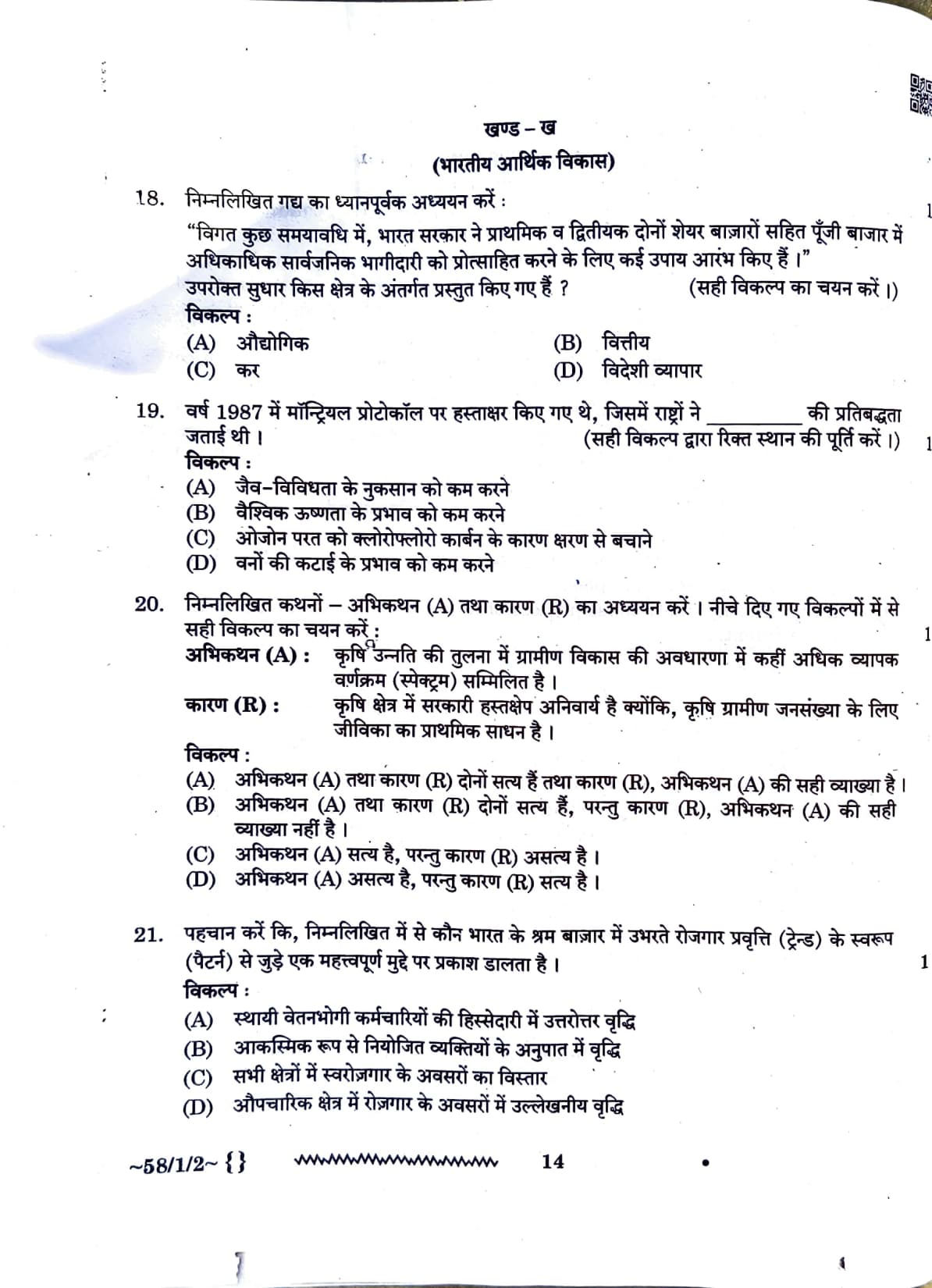
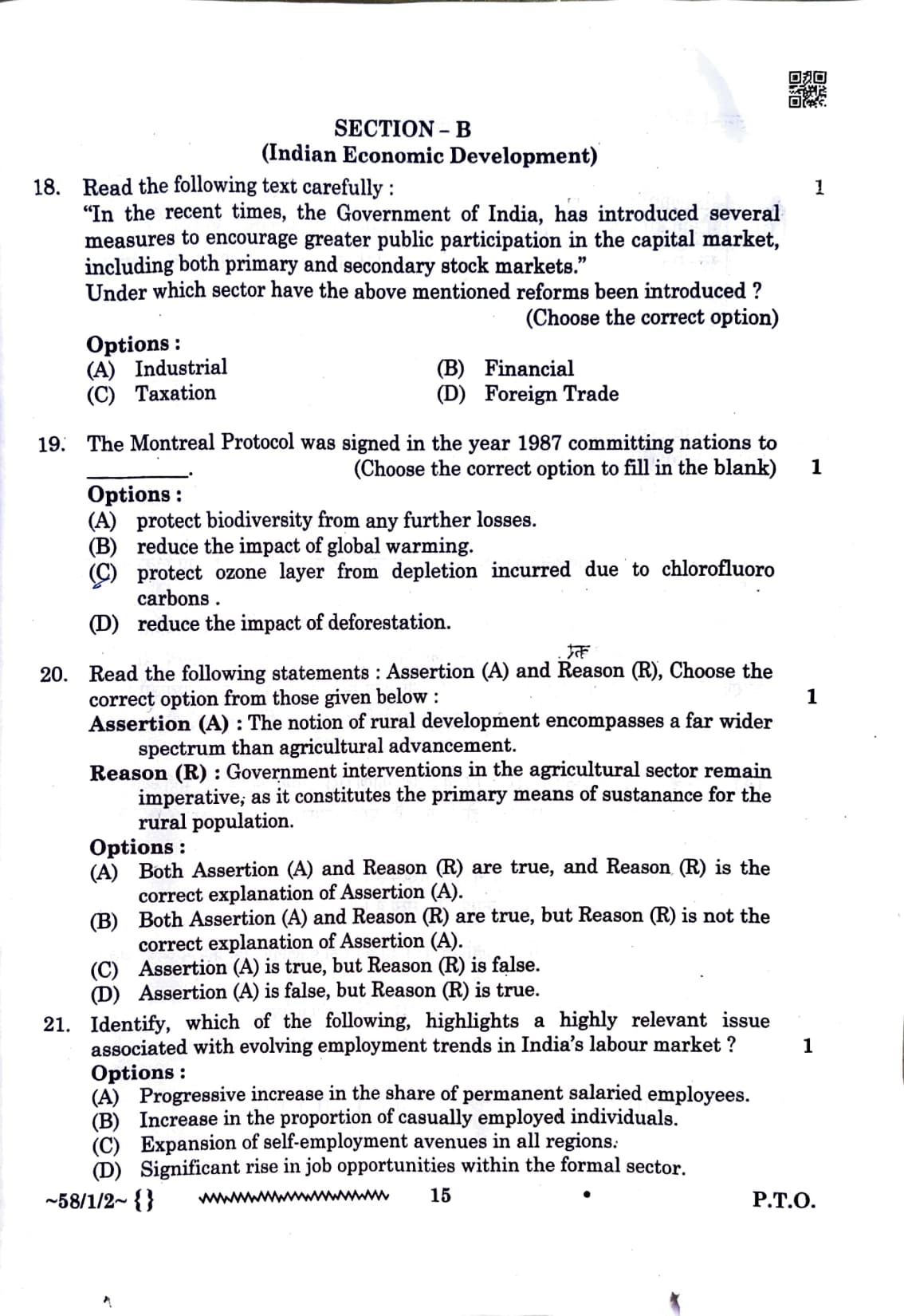
Read the following text carefully:
"In the recent times, the Government of India, has introduced several measures to encourage greater public participation in the capital market, including both primary and secondary stock markets."
Under which sector have the above mentioned reforms been introduced?
View Solution
Step 1: Understanding the context.
The Government of India has introduced reforms aimed at increasing public participation in the stock markets. These reforms primarily target the capital market, which falls under the financial sector.
Step 2: Analysis of options.
- (A) Industrial: Incorrect. The reforms are focused on the capital markets, not industrial policies.
- (B) Financial: Correct. The reforms introduced are related to the financial sector, specifically targeting the stock markets.
- (C) Taxation: Incorrect. The reforms are not focused on taxation but on encouraging public participation in stock markets.
- (D) Foreign Trade: Incorrect. The reforms do not specifically relate to foreign trade but to the financial markets.
Step 3: Conclusion.
The correct answer is (B) Financial, as the reforms are related to encouraging participation in the financial markets, particularly the stock markets.
Final Answer: Financial. Quick Tip: The reforms encouraging participation in the capital markets are part of the financial sector, aimed at improving market liquidity and accessibility.
The Montreal Protocol was signed in the year 1987 committing nations to \hspace{2cm}.
View Solution
Step 1: Understanding the Montreal Protocol.
The Montreal Protocol, signed in 1987, is an international treaty aimed at reducing the use of substances that deplete the ozone layer, such as chlorofluorocarbons (CFCs).
Step 2: Explanation of options.
- (A) Incorrect. The Montreal Protocol does not focus on biodiversity loss but on ozone layer protection.
- (B) Incorrect. While the Montreal Protocol helps indirectly with global warming by protecting the ozone layer, it is not specifically focused on reducing global warming.
- (C) Correct. The protocol directly addresses the depletion of the ozone layer caused by chemicals like CFCs.
- (D) Incorrect. The Montreal Protocol does not focus on deforestation, but on ozone layer protection.
Step 3: Conclusion.
The correct answer is (C), as the Montreal Protocol specifically targets the protection of the ozone layer from depletion caused by harmful chemicals.
Final Answer: protect ozone layer from depletion incurred due to chlorofluorocarbons. Quick Tip: The Montreal Protocol is a critical international agreement aimed at protecting the ozone layer and reducing the use of ozone-depleting chemicals.
Read the following statements: Assertion (A) and Reason (R), Choose the correct option from those given below:
Assertion (A): The notion of rural development encompasses a far wider spectrum than agricultural advancement.
Reason (R): Government interventions in the agricultural sector remain imperative; as it constitutes the primary means of sustenance for the rural population.
View Solution
Step 1: Understanding Assertion (A).
Assertion (A) is correct. Rural development indeed covers a broader spectrum than agricultural advancement, as it also includes aspects like education, healthcare, infrastructure, and rural industries.
Step 2: Understanding Reason (R).
Reason (R) is also true. Government intervention is crucial in the agricultural sector, as it provides essential support for the sustenance of the rural population. This intervention can involve subsidies, policy changes, and infrastructure development.
Step 3: Conclusion.
Both the assertion and the reason are true, and Reason (R) explains why rural development is broader than just agricultural advancement.
Final Answer: Both Assertion (A) and Reason (R) are true, and Reason (R) is the correct explanation of Assertion (A). Quick Tip: Rural development goes beyond agricultural growth and includes other aspects such as healthcare, education, and infrastructure. Government intervention in agriculture is essential for supporting the rural economy.
Identify, which of the following, highlights a highly relevant issue associated with evolving employment trends in India’s labour market?
View Solution
Step 1: Understanding the employment trends.
The most significant issue in India's evolving labor market is the increasing proportion of casually employed individuals. Casual employment refers to informal or temporary work with limited job security and benefits, which is a growing trend in India.
Step 2: Evaluation of the options.
(A) Progressive increase in the share of permanent salaried employees: Incorrect. While permanent salaried positions are important, this trend is not the major issue in India's labor market. The rise of casual employment is a more pressing issue.
(B) Increase in the proportion of casually employed individuals: Correct. The informal sector and casual employment are growing rapidly, which is a significant concern for job security and social benefits.
(C) Expansion of self-employment avenues in all regions: Incorrect. Although self-employment opportunities are growing, they are often informal and do not offer the same security or benefits as formal sector jobs.
(D) Significant rise in job opportunities within the formal sector: Incorrect. While there are some increases in formal sector jobs, casual and informal employment remains a larger concern.
Step 3: Conclusion.
The increasing proportion of casually employed individuals is the most relevant issue in India's labor market today.
Final Answer: Increase in the proportion of casually employed individuals. Quick Tip: Casual employment is a growing issue in India's labor market, leading to job insecurity and lack of benefits for a large segment of workers.
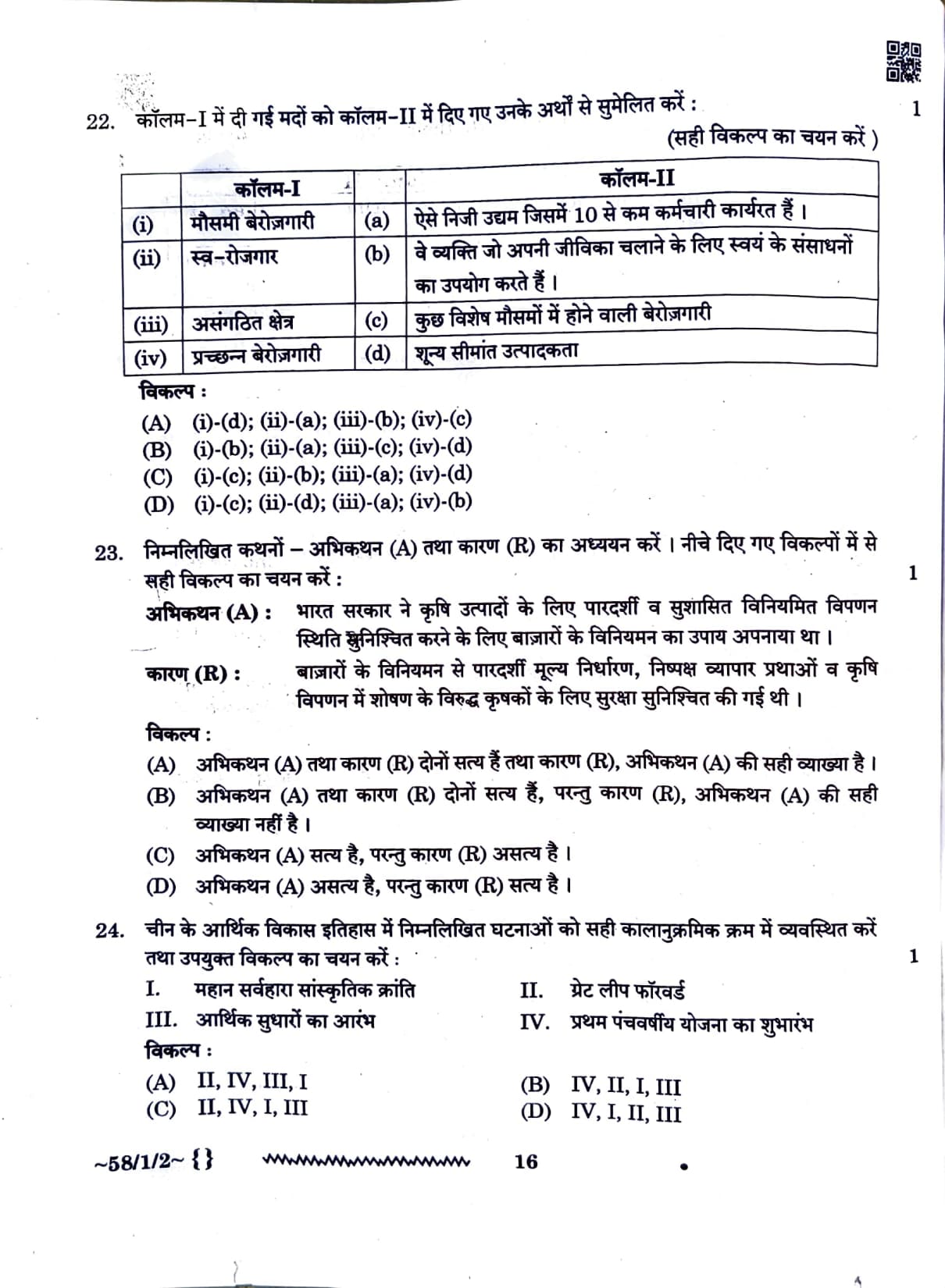
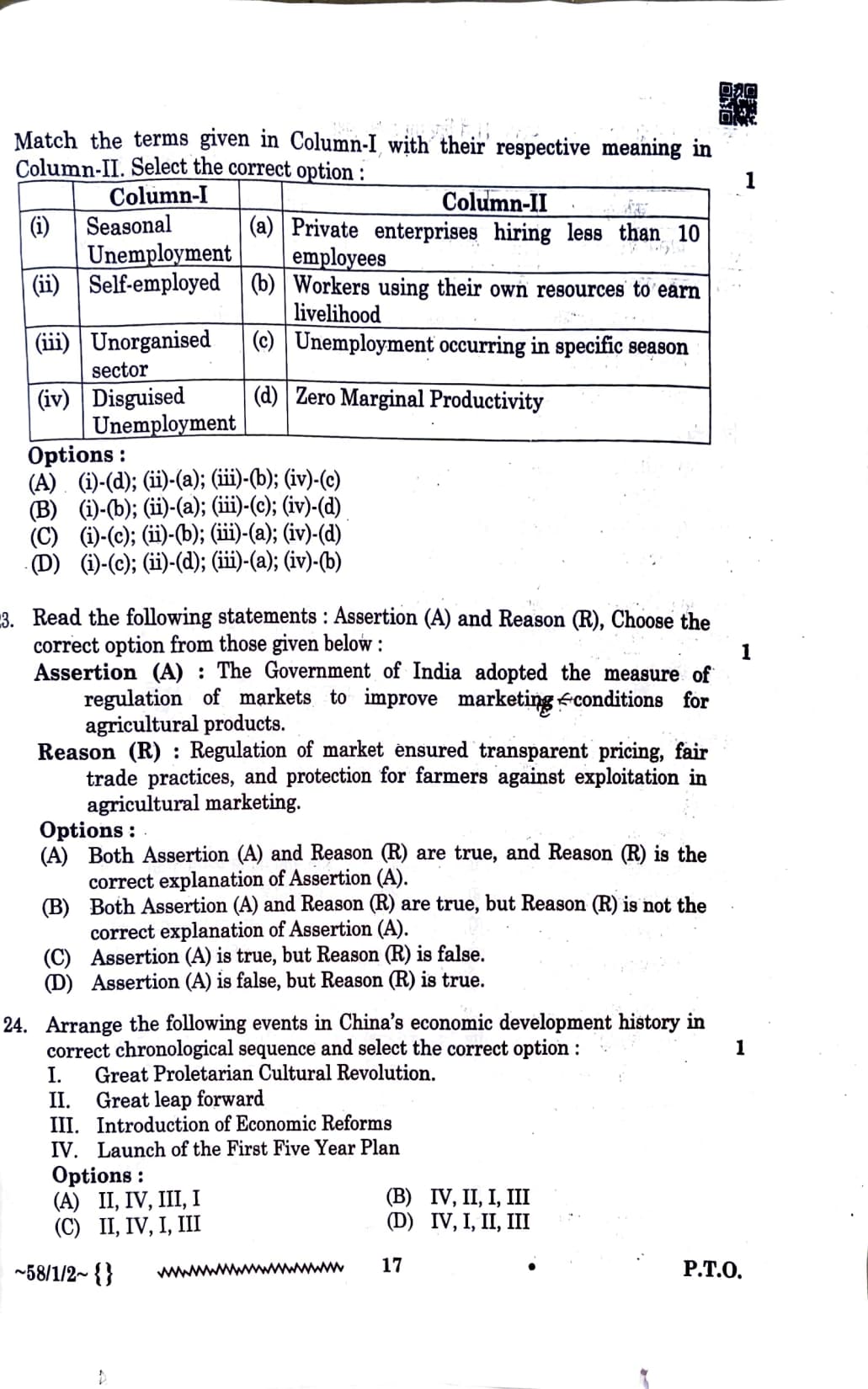
Match the terms given in Column-I with their respective meaning in Column-II. Select the correct option:
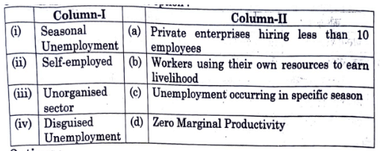
View Solution
Step 1: Seasonal Unemployment.
Seasonal unemployment occurs during specific seasons when demand for labor decreases in certain sectors, such as agriculture during the off-season.
Step 2: Self-employed.
Self-employed individuals use their own resources, like skills and assets, to earn a livelihood, typically without working for someone else.
Step 3: Unorganised Sector.
The unorganised sector consists of small-scale businesses and workers who typically have less than 10 employees and work in informal conditions.
Step 4: Disguised Unemployment.
Disguised unemployment occurs when people are employed in jobs where their productivity is zero or very low, often seen in agriculture during peak labor seasons.
Step 5: Conclusion.
The correct matching is (i)-(c); (ii)-(b); (iii)-(a); (iv)-(d).
Final Answer: (i)-(c); (ii)-(b); (iii)-(a); (iv)-(d). Quick Tip: Seasonal and disguised unemployment are key concepts in labor economics. Seasonal unemployment is temporary, while disguised unemployment often leads to inefficiencies in labor use.
Read the following statements: Assertion (A) and Reason (R). Choose the correct option from those given below:
Assertion (A): The Government of India adopted the measure of regulation of markets to improve marketing conditions for agricultural products.
Reason (R): Regulation of market ensured transparent pricing, fair trade practices, and protection for farmers against exploitation in agricultural marketing.
View Solution
Step 1: Understanding Assertion (A).
The Government of India has implemented measures to regulate markets, ensuring a fair and transparent system for agricultural products, which benefits both producers and consumers.
Step 2: Understanding Reason (R).
Regulation of markets ensures transparent pricing and safeguards against exploitation, which directly relates to improving conditions for agricultural products, as stated in Assertion (A).
Step 3: Conclusion.
Both Assertion (A) and Reason (R) are true, and Reason (R) correctly explains the need for market regulation as stated in Assertion (A).
Final Answer: Both Assertion (A) and Reason (R) are true, and Reason (R) is the correct explanation of Assertion (A). Quick Tip: Regulation of markets plays a vital role in ensuring fair pricing and preventing exploitation in the agricultural sector, benefiting farmers and consumers alike.
Arrange the following events in China’s economic development history in correct chronological sequence and select the correct option:
I. Great Proletarian Cultural Revolution.
II. Great Leap Forward.
III. Introduction of Economic Reforms.
IV. Launch of the First Five Year Plan.
View Solution
Step 1: Understanding the events.
- The First Five Year Plan (IV) was launched in 1953, aiming at industrialization and collectivization. This was the beginning of economic planning in China.
- The Great Leap Forward (II), a campaign for collective farming and industrialization, occurred in 1958 but failed due to poor planning and management.
- The Great Proletarian Cultural Revolution (I) began in 1966 and was aimed at preserving Chinese Communism by removing capitalist and traditional elements from Chinese society.
- The Introduction of Economic Reforms (III) started in 1978 under Deng Xiaoping, marking a shift towards a more market-oriented economy.
Step 2: Evaluation of the options.
(A) II, IV, III, I: Incorrect. The First Five Year Plan should come before the Great Leap Forward.
(B) IV, II, I, III: Correct. The sequence is correct: The First Five Year Plan, followed by the Great Leap Forward, then the Cultural Revolution, and finally the economic reforms.
(C) II, IV, I, III: Incorrect. The First Five Year Plan must come before the Great Leap Forward.
(D) IV, I, II, III: Incorrect. The Great Leap Forward should come after the First Five Year Plan, not after the Cultural Revolution.
Step 3: Conclusion.
The correct chronological order is: Launch of the First Five Year Plan, Great Leap Forward, Great Proletarian Cultural Revolution, and Introduction of Economic Reforms.
Final Answer: IV, II, I, III. Quick Tip: The correct order of China's economic milestones is: (1) Launch of the First Five Year Plan, (2) Great Leap Forward, (3) Cultural Revolution, and (4) Economic Reforms.
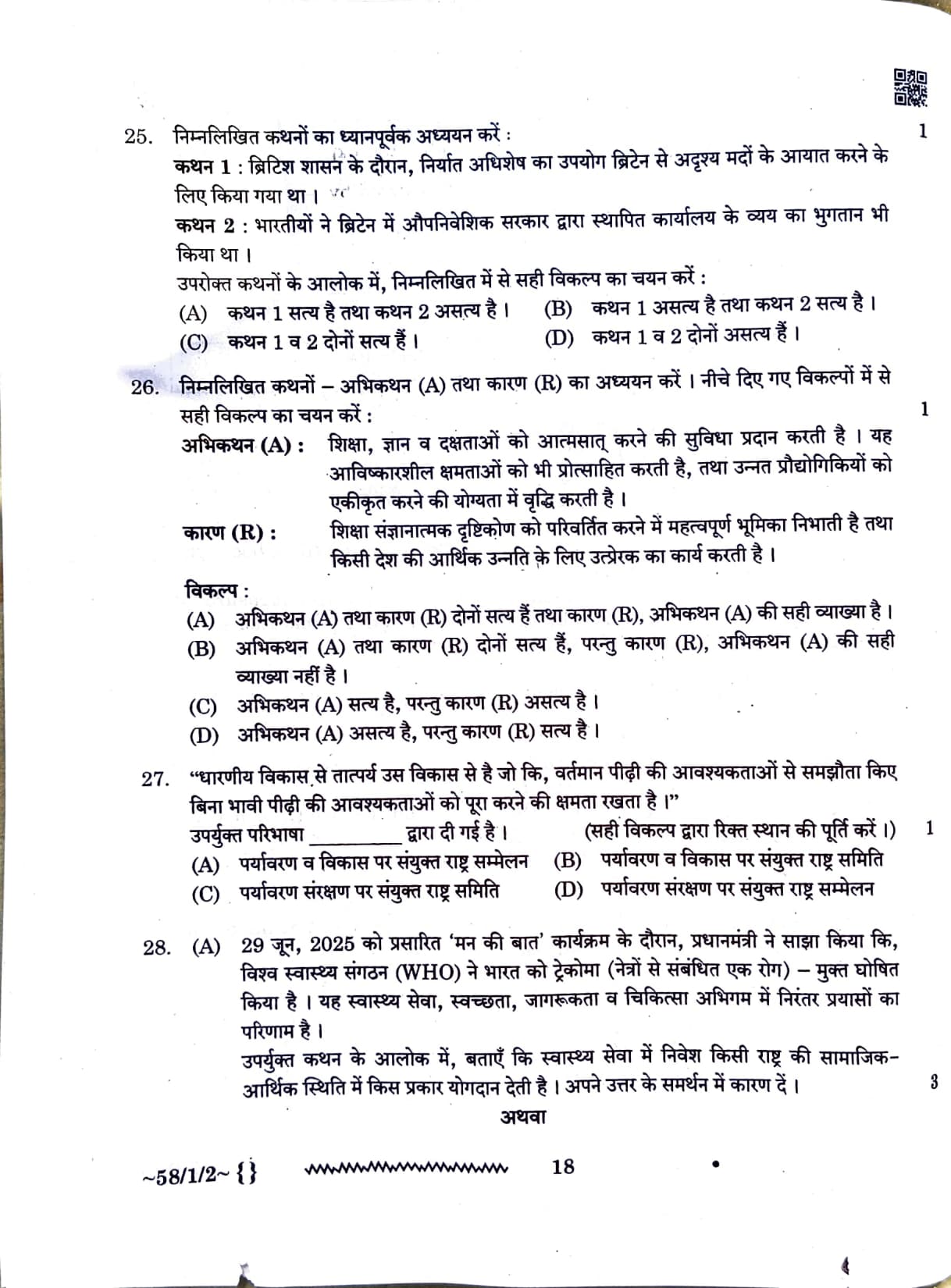
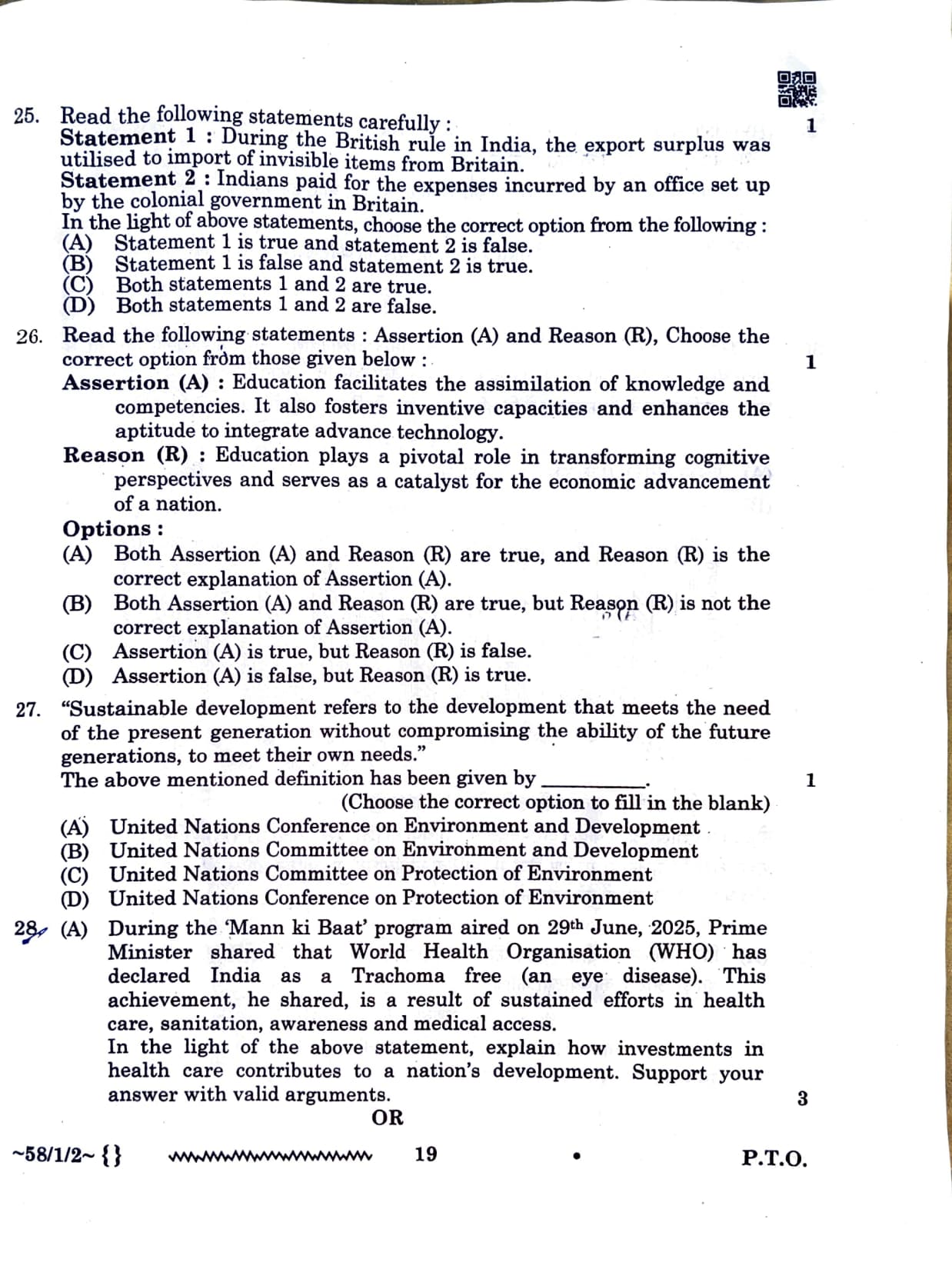
Read the following statements carefully:
Statement 1: During the British rule in India, the export surplus was utilised to import invisible items from Britain.
Statement 2: Indians paid for the expenses incurred by an office set up by the colonial government in Britain.
In the light of above statements, choose the correct option from the following:
View Solution
Step 1: Understanding the statements.
During British rule, the export surplus from India was used to finance the import of goods that were not physically visible, like services or royalties, which were referred to as invisible items.
Step 2: Analysis of Statement 2.
The second statement is incorrect because the expenses incurred by the British colonial government were not paid directly by Indians for their offices in Britain.
Step 3: Conclusion.
Therefore, Statement 1 is true, and Statement 2 is false.
Final Answer: Statement 1 is true and statement 2 is false. Quick Tip: The export surplus during the British rule was primarily used to fund invisible imports, such as services and payments to Britain.
Read the following statements: Assertion (A) and Reason (R). Choose the correct option from those given below:
Assertion (A): Education facilitates the assimilation of knowledge and competencies. It also fosters inventive capacities and enhances the aptitude to integrate advance technology.
Reason (R): Education plays a pivotal role in transforming cognitive perspectives and serves as a catalyst for the economic advancement of a nation.
View Solution
Step 1: Understanding Assertion (A).
Education provides individuals with the skills, knowledge, and competencies needed to contribute to society and adapt to the evolving world. It also enhances the capacity to use advanced technologies effectively.
Step 2: Understanding Reason (R).
Reason (R) accurately highlights how education helps transform cognitive perspectives and drives the economic development of a nation by preparing its people for productive roles in society.
Step 3: Conclusion.
Both Assertion (A) and Reason (R) are true, and Reason (R) explains the importance of education in transforming society and boosting the economy.
Final Answer: Both Assertion (A) and Reason (R) are true, and Reason (R) is the correct explanation of Assertion (A). Quick Tip: Education is a key driver for economic growth and technological innovation, helping individuals adapt to changing environments and fostering national progress.
"Sustainable development refers to the development that meets the need of the present generation without compromising the ability of the future generations, to meet their own needs."
The above mentioned definition has been given by ________.
View Solution
Step 1: Understanding the concept of sustainable development.
The concept of sustainable development, as defined in the question, was introduced by the Brundtland Commission, formally known as the United Nations Conference on Environment and Development (UNCED) in 1987. The goal was to ensure that development meets present needs without compromising the ability of future generations to meet their own needs.
Step 2: Evaluation of the options.
(A) United Nations Conference on Environment and Development: Correct. This is the correct organization that provided the definition of sustainable development in 1987, also known as the Brundtland Report.
(B) United Nations Committee on Environment and Development: Incorrect. There is no such committee that defined sustainable development.
(C) United Nations Committee on Protection of Environment: Incorrect. This is not the correct committee that provided the definition of sustainable development.
(D) United Nations Conference on Protection of Environment: Incorrect. This is not the correct organization.
Step 3: Conclusion.
The correct organization that provided the definition of sustainable development is the United Nations Conference on Environment and Development.
Final Answer: United Nations Conference on Environment and Development. Quick Tip: Sustainable development is the concept of meeting the needs of the present without compromising future generations' ability to meet their own needs. This definition was provided by the United Nations Conference on Environment and Development in 1987.
During the 'Mann ki Baat' program aired on 29th June, 2025, the Prime Minister shared that World Health Organisation (WHO) has declared India as a Trachoma free (an eye disease). This achievement, he shared, is a result of sustained efforts in health care, sanitation, awareness and medical access.
In light of the above statement, explain how investments in health care contribute to a nation's development. Support your answer with valid arguments.
View Solution
Step 1: Importance of health care in national development.
Health care is a fundamental factor for a nation's development. A healthy population is essential for productive labor, which directly impacts the country's economic growth. Investments in health care, including sanitation, disease prevention, and medical access, lead to improvements in public health, productivity, and overall prosperity.
Step 2: Impact of improved public health.
Improved public health through targeted investments, like eradicating diseases such as trachoma, ensures a workforce that is free from debilitating health issues. This enhances the overall economic output as people are more capable of contributing to various sectors such as agriculture, industry, and services.
Step 3: Contribution of sanitation and awareness.
Sanitation and awareness campaigns help in preventing the spread of diseases and ensure that people can access the right information to protect their health. These measures lead to long-term health benefits, reducing the burden on the healthcare system and improving quality of life. Quick Tip: Remember: Health care investments lead to a healthier workforce, reduced health costs, and long-term economic benefits.
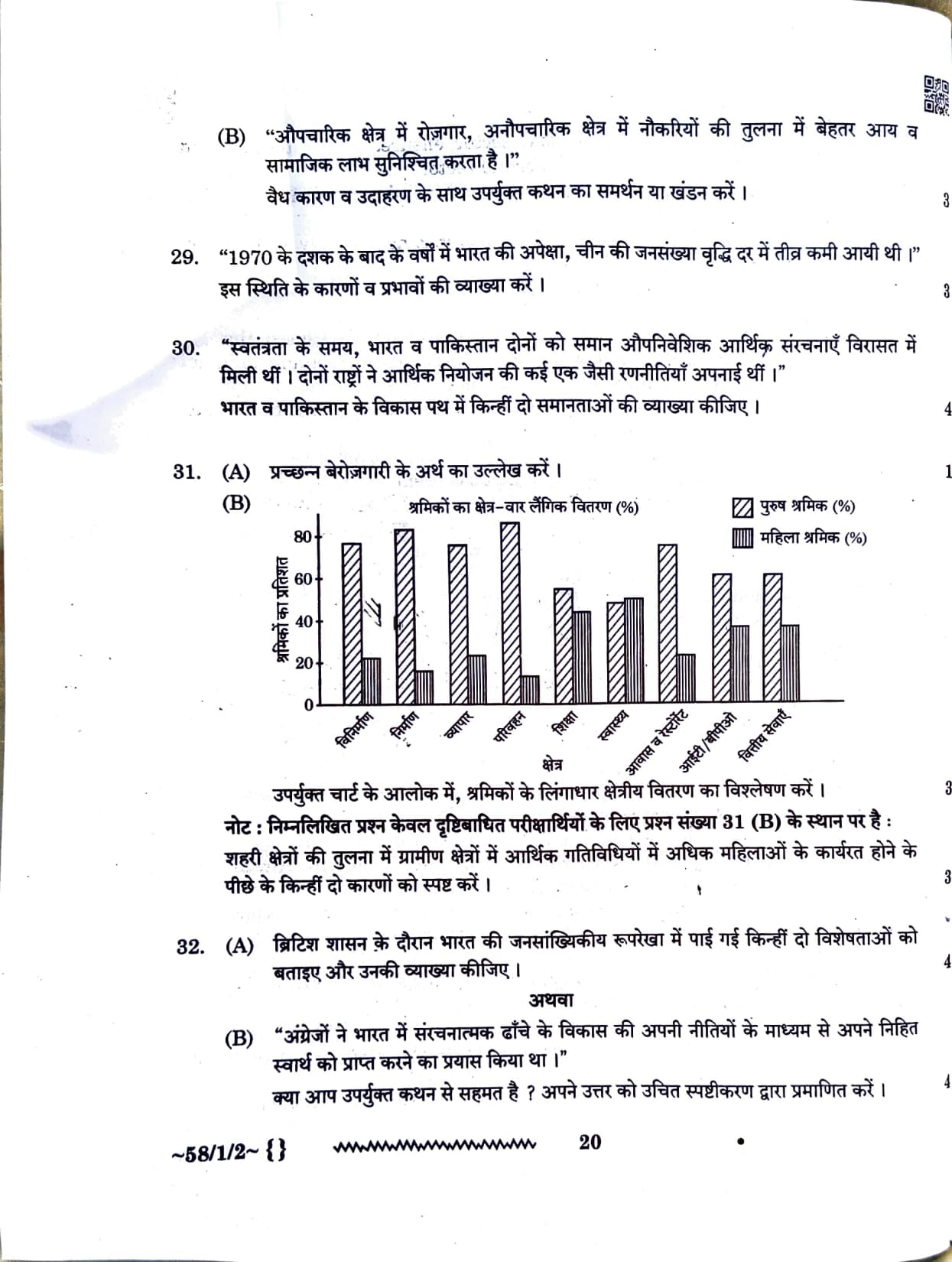
"Employment within the formal sector ensures better income and social benefits as against the informal sector."
Defend or refute the above statement with valid reasons and examples.
View Solution
Step 1: Understanding the formal and informal sectors.
The formal sector refers to businesses that are regulated by the government, and employees in this sector are entitled to benefits such as job security, health insurance, and pension plans. In contrast, the informal sector consists of unregistered businesses or self-employed individuals without access to legal protections or benefits.
Step 2: Defending the statement.
Employees in the formal sector enjoy higher income stability due to legal protections, regulated working hours, and social security benefits such as medical insurance and retirement plans. For example, a formal sector worker in a corporate job has fixed working hours and legal rights to paid leave and other benefits, which are not typically available in the informal sector.
Step 3: Refuting the statement.
While the formal sector offers better income and benefits, the informal sector plays a crucial role in providing livelihood opportunities for millions, especially in developing countries. Many workers in the informal sector may not have access to the same benefits, but they may still earn a significant income, especially in sectors such as retail, transport, and construction. Quick Tip: Remember: The formal sector offers job security and benefits, while the informal sector provides flexibility and opportunities, albeit with fewer legal protections.
"In the late 1970’s China’s population growth rate has sharply declined as compared to India."
Elucidate the reasons and impacts of this situation.
View Solution
Step 1: Reasons Behind the Decline in Population Growth Rate in China.
The significant decline in China's population growth rate can be attributed to the government's strict One-Child Policy, which was introduced in 1979 to control population growth. The policy aimed to limit most families to having only one child, which significantly reduced birth rates. Other factors such as improved education, increased urbanization, and better healthcare also contributed to the decline in the population growth rate.
Step 2: Impacts of This Situation.
The impacts of the declining population growth rate are both positive and negative. On the positive side, a lower growth rate helped alleviate the strain on resources and contributed to higher living standards. The country was able to focus on economic development and investment in infrastructure and education. On the negative side, the policy led to an aging population, which is now a challenge for China, as it faces a shrinking workforce and increasing dependency ratio. Quick Tip: The One-Child Policy significantly impacted China’s population growth rate. While it alleviated resource strain, it also created challenges due to an aging population.
"At the time of independence, both India and Pakistan inherited similar colonial economic structures. Both the nations adopted many similar economic planning strategies."
Explain any two such similarities in the developmental path of India and Pakistan.
View Solution
Step 1: Similarity in Economic Planning - Focus on Industrialization.
Both India and Pakistan adopted industrialization as a key strategy to promote economic growth and self-sufficiency. At the time of independence, both countries had predominantly agricultural economies. Therefore, both nations focused on building heavy industries, including steel, machinery, and chemicals, to lay the foundation for future economic growth.
Step 2: Similarity in Economic Planning - Land Reforms.
Both countries recognized the importance of land reforms to address economic inequality. In India, land reforms were aimed at redistributing land to the poor and abolishing feudal landholding systems. Similarly, in Pakistan, land reforms were introduced to reduce the concentration of land in the hands of a few landlords and promote agricultural productivity. Quick Tip: Despite differences in political structures, India and Pakistan both followed similar economic strategies, focusing on industrialization and land reforms to improve their economies after independence.
State the meaning of 'Disguised Unemployment'.
View Solution
Step 1: Definition of Disguised Unemployment.
Disguised unemployment refers to a situation where more people are employed than are actually needed in a given sector or job, resulting in a situation where individuals do not contribute significantly to production or income. These workers may appear to be employed, but they are underutilized or redundant.
Step 2: Example of Disguised Unemployment.
In agriculture, many people may work on the farm but are not contributing significantly to the overall production. For example, if a family farm can produce the same amount of crops with fewer workers, the extra workers are considered to be "disguisedly" unemployed. Quick Tip: Remember: Disguised unemployment often occurs in sectors where labor is abundant, but the work is inefficient, leading to underutilized workers.
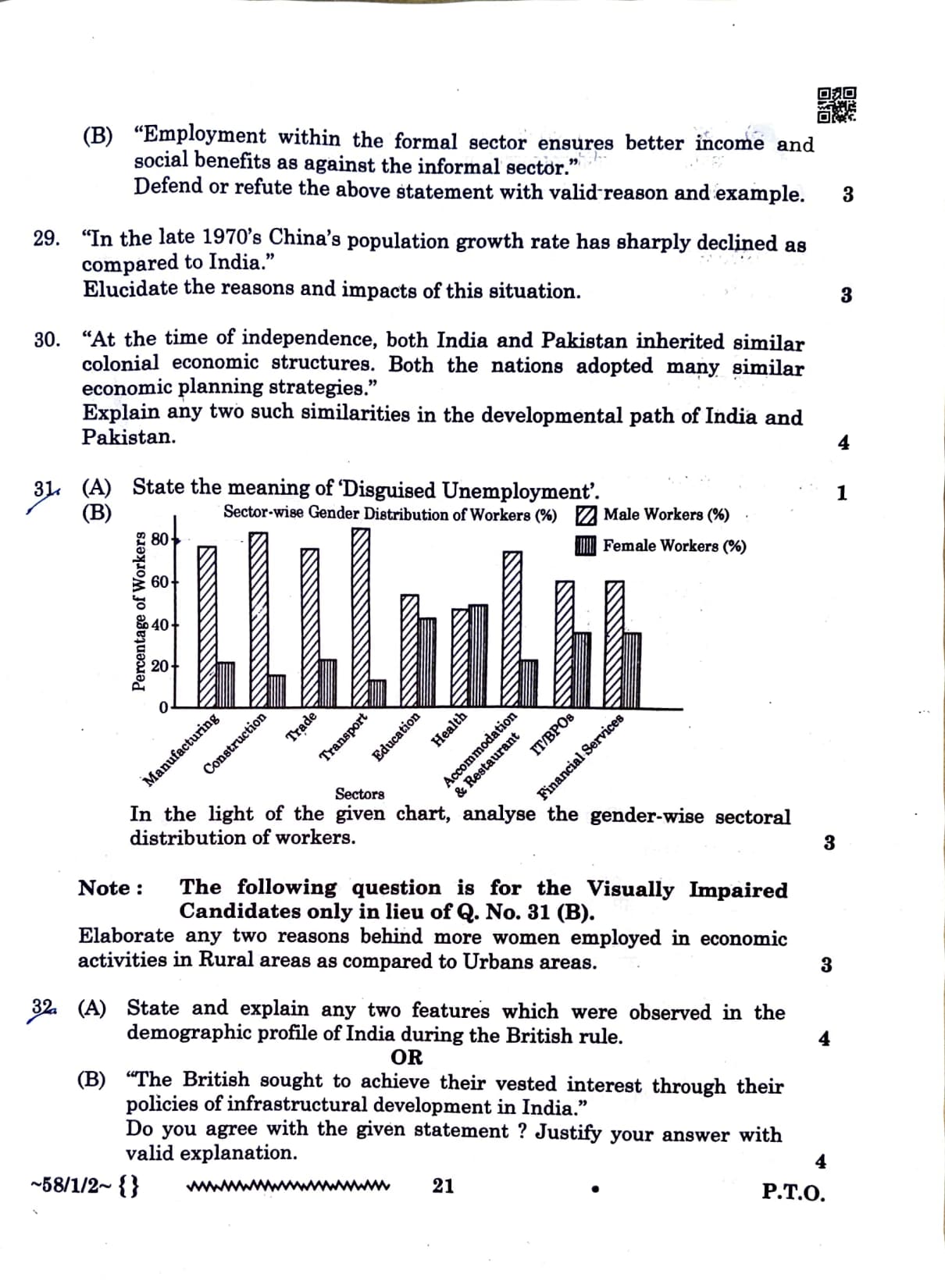
In the light of the given chart, analyse the gender-wise sectoral distribution of workers.
View Solution
Step 1: Understanding the chart.
The chart shows the gender-wise distribution of workers across various sectors. It highlights the percentage of male and female workers in different sectors, such as manufacturing, construction, transport, education, health, and others.
Step 2: Observing the trends.
- In sectors like construction, trade, and transport, male workers dominate the workforce, with much lower female representation.
- Conversely, in sectors like health, education, and accommodation \& restaurant, the proportion of female workers is relatively higher, indicating that these sectors may be more inclusive of women.
- Sectors like IT/BPO and financial services show a more balanced distribution of male and female workers, suggesting more equal participation in these sectors.
Step 3: Gender disparity in certain sectors.
The sectors where women have lower representation, such as construction and transport, may face cultural, societal, or physical barriers that limit women's participation in these jobs. On the other hand, sectors like education and healthcare have been more inclusive, offering opportunities for women to work in various roles. Quick Tip: Remember: The gender distribution in different sectors is influenced by cultural norms, access to opportunities, and the nature of the work involved.
(A) State and explain any two features which were observed in the demographic profile of India during the British rule.
View Solution
Step 1: Feature 1 - High Birth and Death Rates.
During British rule, India experienced high birth and death rates. The population grew slowly, as the high mortality rate, due to poor healthcare, famines, and diseases, offset the high birth rate. The British policies failed to significantly address these issues, resulting in persistent poverty and underdevelopment.
Step 2: Feature 2 - Uneven Population Distribution.
The demographic profile of India during British rule showed significant regional disparities in population distribution. Some areas, particularly in the south and west, were more developed, while other regions, particularly in the north and east, were largely rural with limited access to basic services. These disparities were exacerbated by the British policies, which focused development in areas that served their interests. Quick Tip: During British rule, India experienced high birth and death rates, as well as uneven population distribution, due to underdeveloped infrastructure and healthcare systems.
"The British sought to achieve their vested interest through their policies of infrastructural development in India."
Do you agree with the given statement? Justify your answer with valid explanation.
View Solution
Step 1: British Infrastructural Policies in India.
The British did invest in infrastructure development in India, including railways, ports, and roads. However, these developments were primarily aimed at serving British economic interests. The railways, for example, were built to transport raw materials from Indian hinterlands to ports for export to Britain, rather than to promote domestic trade or economic development in India.
Step 2: The British Vested Interests.
The primary goal of British infrastructural policies was to extract resources from India for the benefit of Britain. While some infrastructure improvements did benefit the Indian population, they were secondary to the British goal of maintaining control over the economy. These infrastructural developments were mainly designed to facilitate colonial exploitation rather than addressing the long-term needs of the Indian people.
Step 3: Conclusion.
I agree with the given statement. The British used infrastructure development as a tool to serve their vested interests, and although there were some benefits for India, these developments were largely designed to maintain British dominance and control over Indian resources. Quick Tip: The British developed infrastructure in India primarily to serve colonial interests, such as resource extraction and trade facilitation, rather than promoting the welfare of the Indian people.
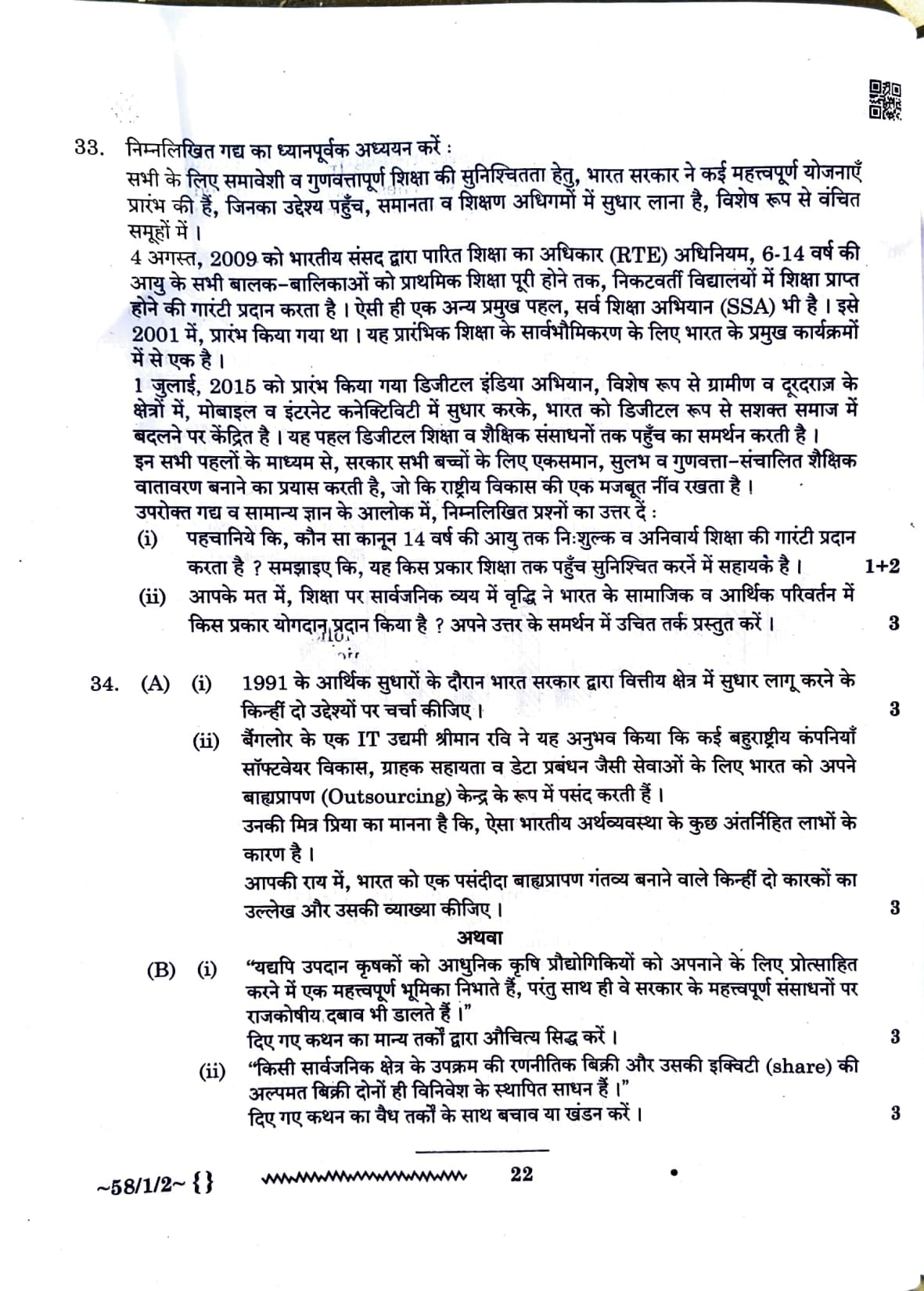
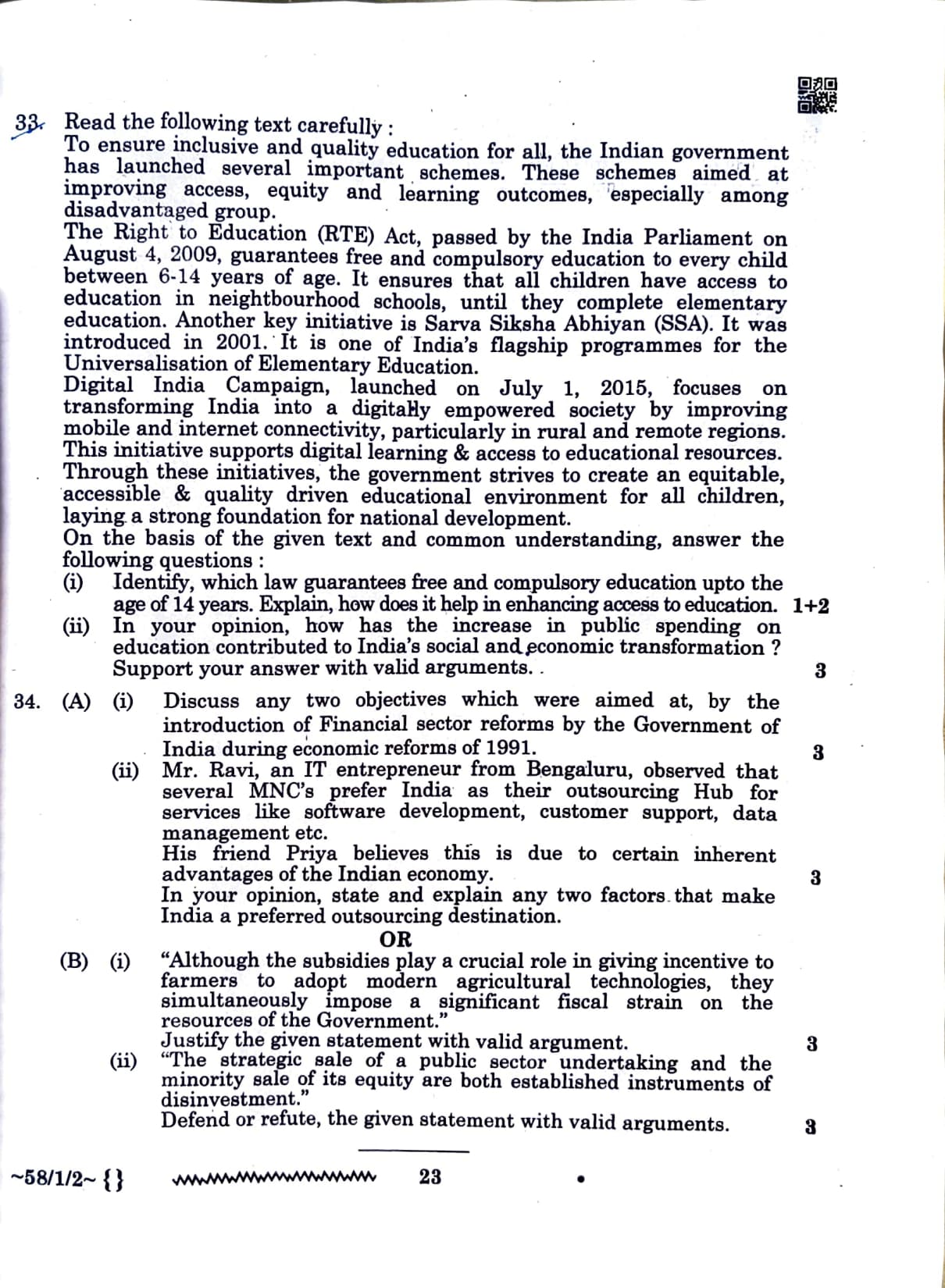
Read the following text carefully:
To ensure inclusive and quality education for all, the Indian government has launched several important schemes. These schemes aimed at improving access, equity, and learning outcomes, especially among disadvantaged groups.
Read More
The Right to Education (RTE) Act, passed by the India Parliament on August 4, 2009, guarantees free and compulsory education to every child between 6-14 years of age. It ensures that all children have access to education in neighbourhood schools, until they complete elementary education. Another key initiative is Sarva Shiksha Abhiyan (SSA). It was introduced in 2001. It is one of India’s flagship programmes for the Universalisation of Elementary Education.Digital India Campaign, launched on July 1, 2015, focuses on transforming India into a digitally empowered society by improving mobile and internet connectivity, particularly in rural and remote regions. This initiative supports digital learning & access to educational resources.
Through these initiatives, the government strives to create an equitable, accessible & quality driven educational environment for all children, laying a strong foundation for national development.
On the basis of the given text and common understanding, answer the following questions:
(i) Identify, which law guarantees free and compulsory education upto the age of 14 years. Explain, how does it help in enhancing access to education.
(ii) In your opinion, how has the increase in public spending on education contributed to India’s social and economic transformation? Support your answer with valid arguments.
View Solution
Step 1: Identifying the law and its purpose.
The law that guarantees free and compulsory education up to the age of 14 years is the Right to Education (RTE) Act, passed by the Government of India in 2009. This law mandates that all children between 6-14 years of age receive free education in elementary schools.
Step 2: How it enhances access to education.
The RTE Act ensures that children, especially from disadvantaged groups, have access to schooling. It prohibits discrimination and provides infrastructure support to ensure every child can complete elementary education. This initiative helps improve literacy rates and reduces educational inequalities.
Step 3: Impact of public spending on education.
Increased public spending on education has contributed significantly to India’s social and economic transformation by providing equitable opportunities for education. Better educational infrastructure, teacher training, and improved access to digital learning have enabled a wider section of society to participate in the workforce. The boost in education has led to better-skilled labor, more innovation, and improved economic growth, contributing to the country’s overall development. Quick Tip: Remember: The Right to Education (RTE) Act is crucial in ensuring that every child has the right to free and compulsory education, and it plays a key role in creating an equitable society.
Discuss any two objectives which were aimed at, by the introduction of Financial sector reforms by the Government of India during economic reforms of 1991.
View Solution
Step 1: Objective 1 - Liberalization of Financial Markets.
One of the key objectives of financial sector reforms in 1991 was to liberalize and modernize the financial markets in India. This involved removing government controls over the financial markets, allowing private sector participation, and encouraging competition. The aim was to improve efficiency and better allocate resources, thereby promoting economic growth.
Step 2: Objective 2 - Strengthening the Banking Sector.
Another objective was to strengthen the banking sector. The reforms included measures like capital adequacy norms, improved supervisory mechanisms, and enhancing the operational efficiency of public sector banks. These reforms aimed to improve the financial health of banks and ensure their ability to withstand shocks. Quick Tip: The financial sector reforms of 1991 aimed to liberalize markets and strengthen the banking sector to promote efficiency, growth, and financial stability.
(ii) Mr. Ravi, an IT entrepreneur from Bengaluru, observed that several MNCs prefer India as their outsourcing hub for services like software development, customer support, data management etc.
His friend Priya believes this is due to certain inherent advantages of the Indian economy.
In your opinion, state and explain any two factors that make India a preferred outsourcing destination.
View Solution
Step 1: Factor 1 - Availability of Skilled Workforce.
India has a large pool of highly skilled professionals, particularly in fields like software development, customer support, and data management. The country has a strong educational system, producing a significant number of engineers, software developers, and other IT professionals each year. This highly skilled workforce is one of the key reasons why MNCs prefer outsourcing to India.
Step 2: Factor 2 - Cost Advantage.
India offers a significant cost advantage compared to other outsourcing destinations. Labor costs in India are much lower than in developed countries, making it an attractive destination for MNCs looking to cut costs. This allows companies to maintain high-quality services at a fraction of the cost, which is particularly important for IT and customer support services. Quick Tip: India's large pool of skilled professionals and its cost-effective workforce make it a top choice for outsourcing services across various sectors.
"Although the subsidies play a crucial role in giving incentive to farmers to adopt modern agricultural technologies, they simultaneously impose a significant fiscal strain on the resources of the Government."
Justify the given statement with valid arguments.
View Solution
Step 1: Importance of subsidies.
Subsidies play a critical role in encouraging farmers to adopt modern agricultural technologies. By providing financial support, they make expensive technologies more accessible, leading to increased productivity, higher yields, and ultimately greater food security.
Step 2: Fiscal strain due to subsidies.
However, subsidies impose a significant fiscal burden on the government. The cost of these subsidies can limit the funds available for other important sectors like education, health, and infrastructure. Large-scale subsidies can also create inefficiencies in the market and distort economic incentives, leading to a misallocation of resources.
Step 3: Need for better targeting.
While subsidies are necessary, they should be carefully targeted to ensure that they reach the farmers who need them the most. Otherwise, subsidies can lead to a drain on public finances and may not be sustainable in the long run. Quick Tip: Remember: Subsidies can promote agricultural development, but they must be well-targeted to avoid significant fiscal pressure on government finances.
"The strategic sale of a public sector undertaking and the minority sale of its equity are both established instruments of disinvestment."
Defend or refute, the given statement with valid arguments.
View Solution
Step 1: Understanding disinvestment.
Disinvestment refers to the process of selling or liquidating the government’s equity stake in public sector undertakings (PSUs). It aims to reduce the financial burden on the government, encourage private sector participation, and improve the efficiency of these enterprises.
Step 2: Strategic sale of PSUs.
The strategic sale involves transferring management control of a PSU to the private sector, along with the sale of a significant stake. This can bring in much-needed capital for the government and help improve the operational efficiency of the PSU by leveraging private sector expertise.
Step 3: Minority sale of equity.
Minority sale of equity refers to the sale of a smaller percentage of shares, typically less than 50%, while the government retains control. This method generates revenue for the government but does not transfer control, allowing the government to retain influence over the PSU’s functioning.
Step 4: Argument for disinvestment.
Both strategic sales and minority equity sales are effective tools of disinvestment. They reduce the government’s financial burden and can generate resources for other essential sectors like education, health, and infrastructure. Additionally, private ownership often leads to better performance, efficiency, and profitability of the enterprises.
Step 5: Conclusion.
The statement is accurate in highlighting that both strategic sales and minority sales are well-established instruments of disinvestment, with each offering distinct benefits depending on the goals of the government. Quick Tip: Remember: Disinvestment helps reduce fiscal deficits and encourages private sector involvement, but it should be done in a manner that ensures long-term growth and public welfare.
CBSE 2026 Class 12 Economics Exam Pattern - Set 1
| Section | Description | Marks |
|---|---|---|
| Section A | Short Answer Questions | 20 marks |
| Section B | Long Answer Questions | 30 marks |
| Section C | Case-Based and Application Questions | 20 marks |
| Section D | Diagram and Data Interpretation | 10 marks |



Comments