




The CUET Mass Media 2025 exam was conducted from 13th May to 3rd June, and the question paper, answer key, and solution PDF are available for download here.The Mass Media paper in CUET assessed a student's knowledge of media literacy, communication theories, journalism, advertising, public relations, digital media, and the role of media in society.
As per the revised exam pattern, students needed to attempt all 50 questions within 60 minutes, with the paper carrying a total of 250 marks. Each correct answer awarded +5 marks, while every incorrect response incurred a –1 mark penalty.
CUET Mass Media 2025 Question Paper with Solutions PDF
| CUET UG 2025 Mass Media Question Paper with Solutions PDF | Download PDF | Check Solutions |
Who is the author of the book, ``Public Opinion"?
Early human beings expressed their feelings and experiences using:
Which of the following statements are correct?
In which year did Printing come to India?
``Many Voices One World" is an UNESCO report on _________?
Identify the criterion which is not considered as a news value?
Which among the following is a news agency?
Arrange the following newspapers in correct sequence according to their year of launch, beginning from the first.
Which of the following is not a feature of "Yellow journalism"?
'Freedom of speech and expression' comes under which article of the constitution of India?
Match List-I with List-II
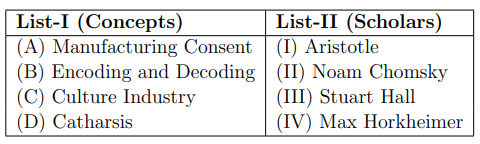
Choose the correct answer from the options given below:
"Making tomorrow brighter" is the slogan of:
The pre-shooting stage does not consist of_________________?
The post-shooting stage in film-making consists of:
'Proxemics' is the study of____________.
Which of the following is not a characteristic of a radio script?
The ability of the audience to resist being persuaded by a commercial or a news program if they are warned beforehand about an attempt to persuade them, is about to occur is called__________?
When episodes of the same syndicated series are scheduled Monday through Friday at the same time, it is called_________?
Which of the following provides all the support that is required for the functioning of a radio station?
Which was the first television soap opera to be telecast on Doordarshan?
The ability to sift through and analyse media messages that inform, entertain and sell to us every day is called ____________?
Identify the film based on the suicide of cotton farmers in Vidarbha.
The issue of "embedding journalists with the military" first emerged as a turning point in Journalism in __________?
Identify the scholar associated with the concept of "Public Sphere"?
Who is the author of the book "Digital democracy"?
The systematic study of texts on the basis of their language and how people interpret texts is known as ___________?
Which of the following films is an example of a story in a linear form?
What do you understand about information overload?
What is the correct order of the process of mass communication?
(A) Communicator
(B) Message
(C) Channel
(D) Receiver
Choose the correct answer from the options given below:
Arrange the following movies chronologically, according to their release year beginning from the first:
(A) Taare Zameen Par
(B) Swades
(C) Gadar
(D) Border
Choose the correct answer from the options given below:
Arrange the following sites chronologically, according to their launching year, starting from the first:
(A) Facebook
(B) YouTube
(C) Snapchat
(D) Twitter (now X)
Choose the correct answer from the options given below:
Arrange the following technological developments according to their launch beginning from the first.
(A) Google Chrome
(B) Yahoo
(C) Mozilla Firefox
(D) Internet Explorer
Choose the correct answer from the options given below:
A good news report should have the following qualities:
(A) Ambiguity
(B) Objectivity
(C) Subjectivity
(D) Credibility
Choose the correct answer from the options given below:
Which of the following is not an ethical practice?
(A) Sensationalism
(B) Plagiarism
(C) Paid news
(D) Fake news
Choose the correct answer from the options given below:
Advertising is a paid form of communication to inform and persuade people to buy:
(A) An idea
(B) A product
(C) A service
(D) A fantasy
Choose the correct answer from the options given below:
Identify the option which has all journalistic terms listed together.
(A) Byline, Headline, Dateline, Beat
(B) Cub, Sub editor, Editor, Reporter
(C) Undermine, Byline, Headline, Masthead
(D) Masthead, Beat, Stringer, Sub Editor
Choose the correct answer from the options given below:
Match List-I with List-II

Choose the correct answer from the options given below:
Match List-I with List-II

Choose the correct answer from the options given below:
Match List-I with List-II

Choose the correct answer from the options given below:
Match List-I with List-II
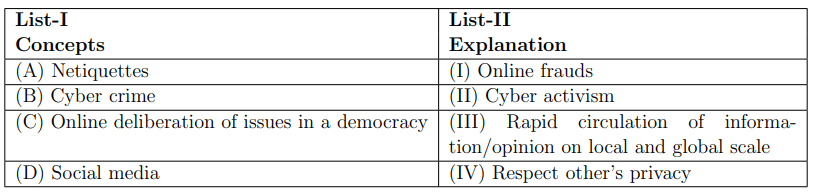
Choose the correct answer from the options given below:
Social impact of social media
The social impact of social media is by far the biggest, as social media work through the
formation of social networks by users in a virtual world. Its most significant impact is the
formation of networks which span space and time and leads to the free-flowing of cultures
and formation of new cultures which impacts the world. It has impacted how people consume
information, how the consumption of media has gone from public to private and personal.
However, on the flip side, social media work on algorithms. The information a user gets
through social media is determined by the user preferences, which is self-declared by the user
and detected by the algorithm. Hence, if one is an environmentalist, then one will get news
and user-generated content on environmental activism. This selective exposure of information
is harmful to the user as the user is not able to get alternate perspectives, for example, the
trade-off between development and the environment. In politics, this can lead to things like
political polarization, being associated with a political party or ideology which is detrimental to
democracy. This is also what is called the ”echo chamber” effect. Meanwhile, research has also
shown evidence that social media use leads to the persuasion of political beliefs, i.e., individuals
who use social media were more likely to have their political beliefs persuaded than those who
did not.
Question 41:
According to the passage, selective exposure of information leads to ___________?
Social media functions on:
Who determines the information which a user gets through social media?
Social media works through:
What is the most significant impact of social media?
Community Engagement on the Internet for Social Change
The arena of community media has become much broader with the addition of the Internet.
The medium is a great source to increase outreach through converging technology and trans-
forming the content into a ’multimedia’ format. We find fine instances of civil society and
non-governmental organizations leading community-based newspapers and participatory video
practices going for their online editions. For example, the newspaper Khabar Lahariya is pub-
lished by the rural communities of Bundelkhand. This newspaper is also published on a portal
in a multimedia format, including YouTube videos. This is being widely appreciated for being
an ’alternative voice,’ sensitizing, and mainstreaming the people. All of Khabar Lahariya’s
reporters are women who draw from their own experiences to share stories often ignored by the
mainstream media. Similarly, with the local engagement of children in the age group of 15-18
years from marginalized tribal communities of northern Chhattisgarh, a UNICEF initiative -
Sangwari Khabariya uses the medium of participatory videos to bring about social change in
society. These children run their YouTube channel to post short news stories.
Question 46:
Which of the following is not associated with 'Khabar Lahariya'?
Which of the following is incorrect about 'Sanwari Khabariya'?
According to the passage, which of the following has all women reporters?
The newspaper 'Khabar Lahariya' is published by:
Which of the following has helped the community media to become much broader?



Comments