




CUET 2027 Biology syllabus is based on NCERT curriculum for Class 12 Biology. As per the CUET 2027 syllabus for Biology, a total of 5 units will form the base of CUET UG 2027 Biology question paper.
- Units in CUET 2027 Biology syllabus include Reproduction, Genetics & Evolution, Biology and Human Welfare, Biotechnology and its Applications, and Ecology and Environment.
- Each of these units in the CUET 2027 Biology syllabus includes 2-3 chapters, for a total of 13 chapters.
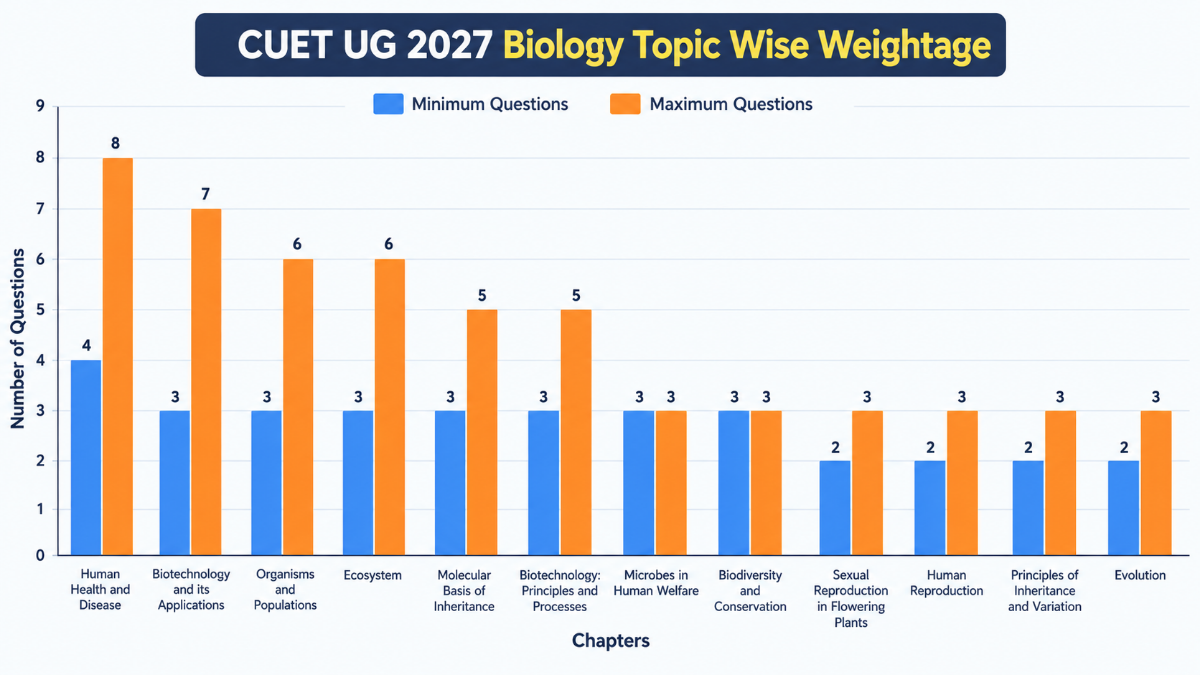
- High-weightage chapters in the CUET UG Biology syllabus 2027 include Human Health and Disease, Biotechnology and its Applications, Organisms and Populations, Ecosystem, Molecular Basis of Inheritance, and Biotechnology: Principles and Processes.
- Each of the high-weightage chapters carries a minimum of 3 questions and can go up to 8 questions each.
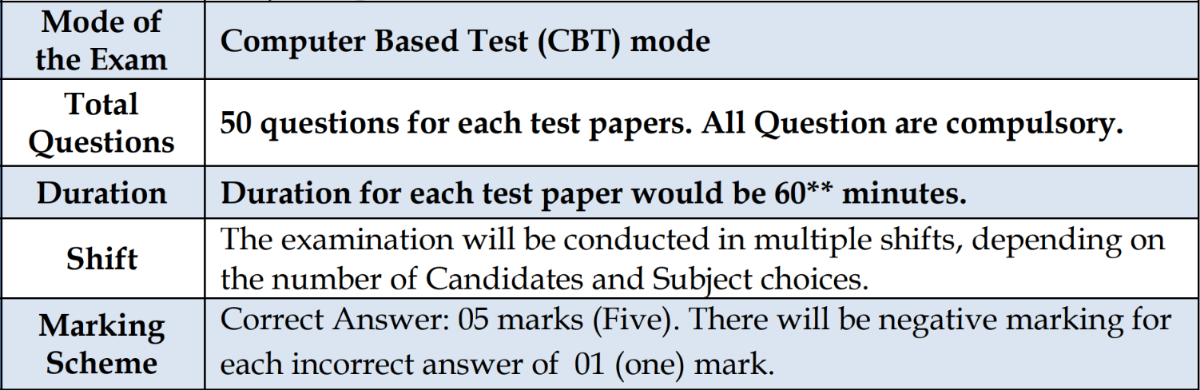
- You will have to answer a total of 50 questions in 60 minutes (1 hour).
- You will be awarded +5 marks for a correct response and -1 mark for each incorrect response
Related Articles:
Key Summary
- CUET UG Biology question paper will include a total of 50 questions, with maximum weightage given to chapters like Human Health and Disease, Biotechnology and its Applications, Organisms and Populations, etc.
- You can score a maximum of 250 marks in the CUET UG Biology syllabus.
- 80% of CUET 2027 question paper for Biology is likely to be solvable using NCERT textbook for Biology.
- You should consider reference books like Trueman’s Elementary Biology and Pradeep’s Biology to get a deeper understanding of concepts and easily solve the remaining 20% of the questions.
CUET UG Syllabus 2027 for Biology
CUET UG Biology syllabus 2027 is divided into 5 units, with each unit carrying 2-3 chapters.
- Reproduction unit carries 3 chapters, including Sexual Reproduction in Flowering Plants, Human Reproduction, and Reproductive Health.
- Genetics and Evolution unit in CUET Biology syllabus 2027 includes 3 chapters: Principles of Inheritance and Variation, Molecular Basis of Inheritance, and Evolution
- Chapters like Human Health and Disease and Microbes in Human Welfare are included in the Biology and Human Welfare unit of CUET UG Biology syllabus 2027.
- 2 chapters are included in Biotechnology and its Applications are Biotechnology: Principles and Processes, and Biotechnology and its Applications.
- Ecology and Environment also carries 3 units, including Organisms and Populations, Ecosystem, and Biodiversity and Conservation.
Reproduction CUET Biology Syllabus
| Chapters | Topics |
|---|---|
| Sexual Reproduction in Flowering Plants | Pre-fertilisation: structure and events – stamen, microsporangium and pollen grain, pistil, megasporangium and embryo sac; Development of male (microsporogenesis) and female gametophyte (megasporogenesis); Pollination – types, agents and examples; Outbreeding devices; Pollen-pistil interaction; Double fertilisation; Post-fertilisation: structure and events – development of endosperm and embryo; Formation of seed and fruit and parthenocarpy; Significance of seed in angiosperms; Apomixis and polyembryony |
| Human Reproduction | Male and female reproductive system; Microscopic anatomy of testis and ovary; Gametogenesis – spermatogenesis and oogenesis; Menstrual cycle; Fertilisation, embryo development up to blastocyst formation, implantation; Pregnancy and embryonic development and placenta; Parturition and lactation |
| Reproductive Health | Problems and strategies – amniocentesis; Population stabilisation and birth control – various methods of contraception; Medical termination of pregnancy (MTP); Sexually transmitted infections (STIs); Infertility – Assisted reproductive technologies (IVF, ZIFT, GIFT, ICSI and IUI) |
Genetics and Evolution CUET Biology Syllabus
| Chapters | Topics |
|---|---|
| Principles of Inheritance and Variation | Mendel’s law of inheritance: Inheritance of one gene – Law of dominance, law of segregation (test and back cross); Deviation from Mendelism – incomplete dominance and co-dominance; Multiple alleles and inheritance of blood groups; Inheritance of two genes – law of independent assortment, dihybrid cross; Chromosomal theory of inheritance; Linkage and recombination; Polygenic inheritance; Pleiotropy; Sex determination in humans, birds and honey bee; Mutation; Genetic disorders – pedigree analysis, Mendelian disorders (colour blindness, haemophilia, sickle-cell anaemia, phenylketonuria and thalassemia), chromosomal disorders in humans (aneuploidy, polyploidy, Down's syndrome, Turner's syndrome and Klinefelter's syndrome) |
| Molecular Basis of Inheritance | Structure and packaging of DNA helix; Search for genetic material (transforming principle and Hershey-Chase experiment); Properties of genetic material; Replication (Meselson and Stahl’s experiment); Transcription – transcription unit and gene; RNA world – types of RNA and process of transcription; Genetic code and mutations; tRNA; Translation; Regulation of gene expression – Lac operon; Human Genome Project (goals, salient features and applications); DNA fingerprinting (polymorphism and VNTR) |
| Evolution | Origin of life – Miller’s experiment; Concepts of evolution (Darwin's contribution); Evidence for evolution (embryology, paleontology, comparative anatomy, divergent and convergent evolution and industrial evolution); Adaptive radiation; Biological evolution; Natural selection; Mechanism of evolution; Hardy-Weinberg principle and affecting factors (gene migration, genetic drift, mutation, recombination and natural selection); Evolution of plants and vertebrates through geological periods; Origin and evolution of man |
Biology and Human Welfare CUET Biology Syllabus
| Chapters | Topics |
|---|---|
| Human Health and Disease | Introduction about health; Common diseases in humans (typhoid, pneumonia, common cold, malaria, amoebiasis, ascariasis, filariasis and ringworm); Immunity – innate and acquired immunity, active and passive immunity, vaccination and immunisation, allergies, auto-immunity and immune system in humans; AIDS; Cancer; Drugs and alcohol abuse - adolescence, addiction, effects of drug abuse, prevention and control |
| Microbes in Human Welfare | Microbes in household products; Microbes in industrial products – beverages, antibiotics, enzymes and bioactive molecules; Microbes in sewage treatment and production of biogas; Microbes as biocontrol agents and biofertilisers |
Biotechnology and its Applications CUET Biology Syllabus
| Chapters | Topics |
|---|---|
| Biotechnology: Principles and Processes | Principles of biotechnology; Tools of recombinant DNA technology – restriction enzymes, cloning vectors, competent host; Processes of rDNA technology – isolation, amplification of gene (PCR), insertion of rDNA in host and bioreactors; Downstream processing |
| Biotechnology and its Applications | Application of biotechnology in agriculture – tissue culture, genetically modified organisms, Bt cotton, RNA interference; Biotechnology in medicine – insulin, gene therapy and molecular diagnosis; Transgenic animals; Ethical issues – biopiracy and patents |
Ecology and Environment CUET Biology Syllabus
| Chapters | Topics |
|---|---|
| Organisms and Populations | Population attributes – birth and death rate, age pyramids; Population growth – exponential and logistic growth; Life history variation; Population interactions – predation, competition, parasitism, commensalism, mutualism and amensalism |
| Ecosystem | Structure and function; Productivity; Decomposition; Energy flow – different trophic levels, food chain and food web; Ecological pyramids – pyramid of energy, biomass and number |
| Biodiversity and Conservation | Biodiversity – concept, patterns and importance; Causes of biodiversity loss; Biodiversity conservation – approaches (narrowly utilitarian, broadly utilitarian and ethical); Methods of biodiversity conservation – in situ (endemism, hotspots and sacred groves etc.), ex situ (Wildlife safaris, zoological parks and cryopreservation etc.) |
Ques. Is CUET Biology syllabus based on Class 11 or Class 12?
Ans. As per the official CUET Biology syllabus currently published on the official CUET website, the syllabus is based on the NCERT Class 12 syllabus for Biology.
CUET UG Biology Syllabus 2027: Topic-Wise Weightage
A tutor from “Adda247 CUET” shared an analysis of CUET Biology topic-wise weightage based on the weightage analysis in the past few years. Based on the analysis, chapters with high weightage in CUET Biology syllabus 2027 include Human Health and Disease, Biotechnology and its Applications, Organisms and Populations, Ecosystem, Molecular Basis of Inheritance, and Biotechnology: Principles and Processes.
- You can expect around 4-8 questions from Human Health and Disease in CUET Biology question paper.
- Biotechnology and its Applications carries around 3-7 questions in CUET Biology syllabus 2027.
- Ecosystem, Molecular Basis of Inheritance, and Biotechnology: Principles and Processes each carry around 3-6 questions in CUET UG Biology paper.
| Chapters | Chapter-Wise Weightage |
|---|---|
| Human Health and Disease | 4-8 |
| Biotechnology and its Applications | 3-7 |
| Organisms and Populations | 3-6 |
| Ecosystem | 3-6 |
| Molecular Basis of Inheritance | 3-5 |
| Biotechnology: Principles and Processes | 3-5 |
| Microbes in Human Welfare | 3 |
| Biodiversity and Conservation | 3 |
| Sexual Reproduction in Flowering Plants | 2-3 |
| Human Reproduction | 2-3 |
| Principles of Inheritance and Variation | 2-3 |
| Evolution | 2-3 |
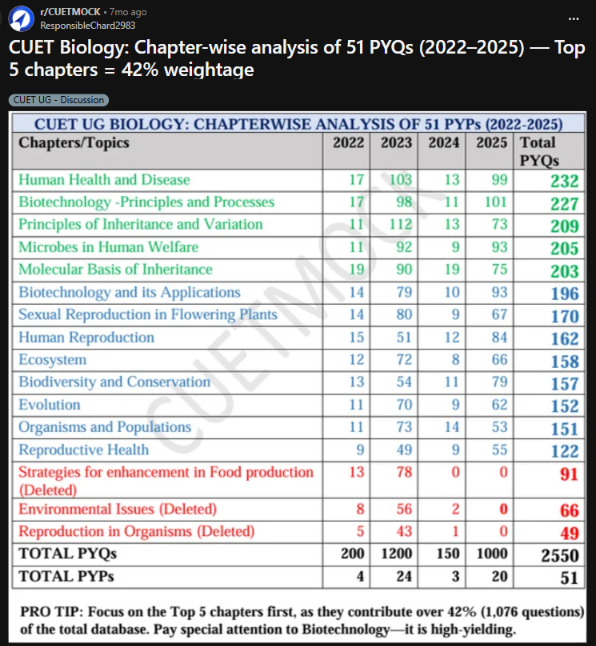
In a Reddit post by published in “r/CUETMOCK”, user gave an analysis of the past 4 years’ question papers from 2022-2025. In the post, the user noted the chapter-wise number of questions asked in these 4 years after analyzing 51 PYPs, and the summary is discussed below.
- Human Health and Disease has got 232 questions, the highest in 4 years.
- From Biotechnology: Principles and Process, 227 questions were asked.
- User noted 209 PYQs from Principles of Inheritance and Variation, and 205 in Microbes in Human Welfare.
- 203 questions were asked from Molecular Basis of Inheritance.
- Chapters with more than 160 PYQs include Biotechnology and its Applications (196), Sexual Reproduction in Flowering Plants (170), and Human Reproduction (162).
- Chapters in CUET Biology Syllabus with 120+ PYQs in the past 4 years include Ecosystem (158), Biodiversity and Conservation (157), Evolution (152), Organisms and Population (151), and Reproductive Health (122).
Source: Reddit
CUET UG Biology Important Books
As per experts, most of the questions in CUET Biology question paper are asked directly from the NCERT textbook for Biology Class 12.
- You can expect questions from Text Statements, Line Diagrams, and Summary Tables from the NCERT Class 12 Biology textbook.
- You can expect around 80% of the total questions in CUET UG 2027 Biology question paper from NCERT textbook.
- For the remaining 20% of questions, you may require using reference books like Trueman’s Elementary Biology, Pradeep’s Biology, etc.
| Book Name | Author/Publisher |
|---|---|
| NCERT Biology (Class 12) | NCERT |
| Trueman’s Elementary Biology (Vol. 1 & 2) | K.N. Bhatia & M.P. Tyagi (Trueman) |
| MTG NCERT at Your Fingertips – Biology | MTG Editorial Board |
| Dinesh Objective Biology | Dinesh / S. Chand Publications |
| Pradeep’s Biology (Vol. 1 & 2) | P.S. Dhami, G. Chopra, H.N. Srivastava (Pradeep Publications) |
| Arihant CUET UG Biology (Chapterwise Notes & Question Bank / Handbook) | Arihant Publications / Dr. Sanjay Sharma |
| Oswaal NTA CUET (UG) Chapter-wise Question Bank – Biology | Oswaal Editorial Board |
| Go-To Guide for CUET (UG) Biology | Disha Experts |
CUET UG 2027 Biology Exam Pattern
CUET Biology examination will be conducted in CBT mode, with medium of question paper being English, Hindi, Urdu, and other regional languages. Type of questions asked in CUET UG Biology question paper is MCQs.
- You will have to answer a total of 50 questions in 60 minutes (1 hour).
- With CUET Biology marking scheme of +5 marks for a correct response and -1 mark for each incorrect response, you can score a maximum of 250 marks in CUET UG Biology question paper.
| Particulars | Details |
|---|---|
| Mode of Examination | CBT mode |
| Medium of Examination | English, Hindi, Urdu, and other regional languages |
| Type of Questions | MCQs |
| CUET Biology Total Questions | 50 |
| CUET Biology Total Marks | 250 |
| CUET Biology Exam Duration | 60 Minutes |
| CUET Biology Marking Scheme |
|
Source: CUET UG Information Bulletin
How to Prepare CUET UG Biology Syllabus 2027
- Check CUET 2027 Biology Syllabus: Go through the CUET UG syllabus 2027 and check the units and chapters.
- Identify High Weightage Chapters: Go through the analysis of CUET Biology papers in past years and identify chapters that got the highest weightage.
- Prioritize High Weightage Topics: Create a study plan and prioritize chapters with high weightage like genetics, Biotechnology, Ecology, etc.
- Read NCERT Carefully: For CUET Biology, NCERT is a must-do, and you must mark each line in the textbook that generates questions for revision purposes.
- Revise: Revise each concept in CUET Biology to get a good hold on concepts.
- Solve Previous Years’ Papers: Solve question papers from past years to know type of questions and their difficulty level in the CUET Biology question paper.
- Attempt Mock Tests: Mock tests must be attempted regularly after each chapter/unit. This will help you improve time management and identify weak areas.
CUET UG Biology Previous Years’ Papers
| CUET UG Exam Year | CUET Biology Question Paper |
|---|---|
| CUET UG 2026 | Download PDF |
| CUET UG 2025 | Download PDF |
| CUET UG 2024 | Download PDF |
| CUET UG 2023 | Download PDF |
| CUET UG 2022 | Download PDF |
| CUET UG 2021 | Download PDF |
Also Check
CUET UG Biology Syllabus 2027 FAQs
Ques. How many questions come from Biotechnology in CUET?
Ans. You can expect around 6-12 questions from 3 chapters of Biotechnology. Biotechnology and its Applications carries around 3-7 questions, and Biotechnology: Principles and Processes carries around 3-5 questions in CUET UG Biology question paper.
Ques. Which universities accept CUET Biology score?
Ans. Around 250+ universities accept CUET UG Biology scores for admission to their courses. Some of the top universities accepting CUET UG Biology scores include DU, BHU, JNU, AMU, JMI, etc.
Ques. What is the CUET Biology exam duration and marking scheme?
Ans. CUET UG 2027 Biology exam duration is 60 minutes. As per the CUET UG marking scheme, +5 marks will be awarded for each correct answer and -1 mark will be deducted for each incorrect answer from the overall score.
Ques. What are the CUET Biology syllabus changes for 2027 vs 2026?
Ans. NTA has yet to announce the CUET UG Biology syllabus for 2027 on the official website. This year, no major changes are expected in the syllabus.
Ques. What is good score in CUET Biology?
Ans. 180-200 is considered to be a good score in CUET Biology and above 200 marks is considered to be an excellent score. A good score in CUET UG Biology depends mainly on the difficulty level of the question paper and the number of students.



Comments