




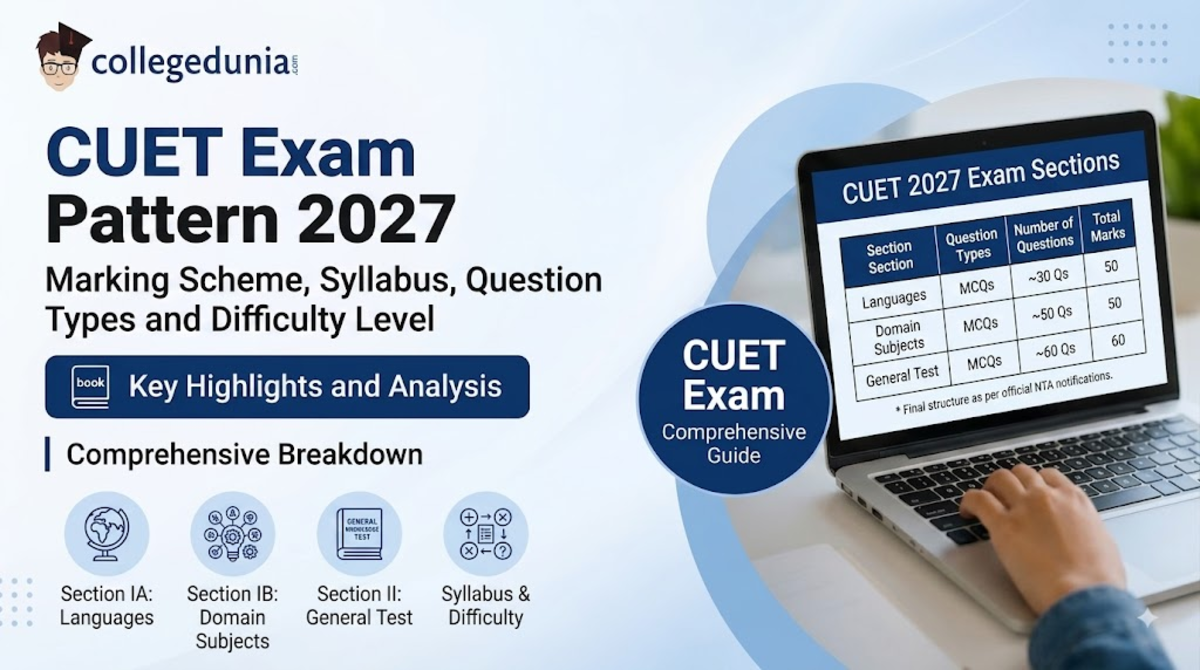
CUET Exam Pattern includes 50 compulsory MCQs, for 250 marks, with +5 for every correct answer and -1 for an incorrect response. Candidates can now select a maximum of 5 subjects to attempt in the CUET exam. The CUET Exam Pattern 2027 is conducted in CBT mode, with 13 language papers, 23 domain subjects, and 1 General Aptitude Test, giving students multiple combinations based on their target university and programme requirements.
- With roughly 72 seconds per question in CUET Exam Pattern 2027, speed and accuracy become critical. Focus on calculation-heavy subjects such as Mathematics and Physics and reading-intensive sections such as English, in the CUET exam.
- Some of the high-weightage topics in the CUET syllabus are Reading Comprehension (15–18 questions) in English; Organic Chemistry (16–18 questions) in Chemistry ; Electrostatics & Current Electricity (12–14 questions) in Physics; and Calculus (18–20 questions) in Mathematics.
- Six domain/vocational subjects, including Entrepreneurship, Teaching Aptitude, Fashion Studies, Tourism, Legal Studies, and Engineering Graphics, have been removed from the CUET exam subjects list for this cycle, as per the CUET exam pattern 2027.
Related Links:
- CUET 2027 Syllabus: Expected January 2027, Subject-wise Topics, Weightage and PDF Download
- CUET Previous Year Question Papers with Solutions- Download PDF [2026-2022]
- CUET Preparation Tips 2026: Check How to Prepare, Study Plan, Timetable & Book
Key Summary
- CUET total marks per subject is 250, built from 50 compulsory questions marked +5 for correct and -1 for incorrect answers.
- A candidate can now register for a maximum of 5 subjects, so the CUET total marks for 5 subjects tops out at 1,250, down from the higher subject ceiling allowed in earlier CUET cycles.
- The CUET syllabus for science students remains fully mapped to the Class 12 NCERT curriculum across Physics, Chemistry, Mathematics, and English, with no material outside the board textbook being tested.
- Six domain/vocational subjects, including Entrepreneurship, Teaching Aptitude, Fashion Studies, Tourism, Legal Studies, and Engineering Graphics, have been removed from the CUET exam subject list for this cycle.
CUET Exam Pattern 2027: Overview
The CUET exam pattern 2027 runs as a Computer-Based Test (CBT) with 37 separate paper options, including 13 languages, 23 domain-specific subjects, and 1 General Aptitude Test.
- Every one of the 37 CUET test papers follows the same fixed structure: 50 compulsory questions, 60 minutes, 250 marks.
- Compensatory time for eligible PwBD candidates is set at 20 minutes per hour of exam time, applied consistently across every language, domain, and GAT paper.
| Parameter | Details |
|---|---|
| Exam Mode | Computer-Based Test (CBT) |
| Total Test Papers | 37 (13 Languages + 23 Domain-specific subjects + 1 General Aptitude Test) |
| Duration per Paper | 60 minutes (+20 minutes per hour for PwBD candidates) |
| Total Questions per Paper | 50 (all compulsory MCQs) |
| Total Marks per Paper | 250 |
| Sections per Paper | Section I (Languages), Section II (Domain Subjects), Section III (General Aptitude Test) |
| Medium | 13 languages: English, Hindi, Assamese, Bengali, Gujarati, Kannada, Malayalam, Marathi, Odia, Punjabi, Tamil, Telugu, Urdu |
| Negative Marking | +5 for correct -1 for incorrect 0 for unattempted |
| Calculator | Not allowed (no physical or on-screen calculator) |
| Scribe Facility | Available for eligible PwD/PwBD candidates under NTA guidelines, with registration and supporting documents |
| Papers per Student | Maximum 5 subjects (languages, domain subjects, and/or GAT, based on programme requirements) |
Ques. What is the CUET exam full form?
Ans. CUET stands for Common University Entrance Test; CUET UG refers specifically to its undergraduate-admission version.
Ques. How many questions are in CUET Exam Pattern 2027?
Ans. Each CUET subject paper carries 50 compulsory questions, so total questions in CUET scale with the number of papers a candidate registers for up to 250 questions across the maximum 5 subjects.
Also Check:
CUET Exam Pattern 2027: What's New?
The CUET UG exam pattern for this cycle carries two structural changes over previous years: a lower subject cap and a shorter domain-subject list.
- The maximum subject limit has been reduced to 5, which is a sharp cut from the up to 10 subjects candidates could register for in earlier CUET cycles.
- Six domain and vocational subjects have been discontinued:
- Entrepreneurship
- Teaching Aptitude
- Fashion Studies
- Tourism
- Legal Studies
- Engineering Graphics
- The CUET Exam Pattern 2027 itself has been standardised across every subject: all 37 CUET test papers now carry the same 50-question, 60-minute, 250-mark structure, removing the subject-to-subject duration differences seen in older cycles.
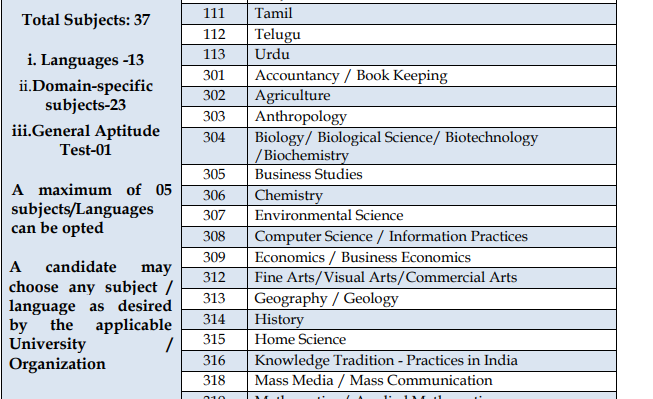
Source: CUET Information Brochure 2026
Ques. How many subjects can a candidate choose in CUET?
Ans. A maximum of 5 subjects, combining languages, domain subjects, and/or the General Aptitude Test, based on the target university's requirements.
Also Check:
CUET Exam Pattern: Syllabus 2027- Download PDF
What is the CUET exam syllabus for science students?
| Subject | Download Pdf |
|---|---|
| CUET Physics | Download Pdf |
| CUET Chemistry | Download Pdf |
| CUET Biology | Download Pdf |
| CUET Mathematics | Download Pdf |
What is the CUET exam syllabus for commerce students?
| Subject | Download Pdf |
|---|---|
| CUET Accountancy | Download Pdf |
| CUET Business Studies | Download Pdf |
| CUET Economics | Download Pdf |
| CUET Mathematics | Download Pdf |
What is the CUET 2025 Syllabus for Arts Stream?
| Subjects | Syllabus |
|---|---|
| Psychology | Download Pdf |
| History | Download Pdf |
| Political Science | Download Pdf |
| Mass Communication and Journalism | Download Pdf |
| Home Arts | Download Pdf |
| Sanskrit | Download Pdf |
| Sociology | Download Pdf |
| Physical Education | Download Pdf |
| Performing Arts | Download Pdf |
CUET Exam Pattern 2027: Marking Scheme
The CUET marking scheme awards +5 marks for every correct answer and deducts -1 mark for every incorrect answer, with 0 marks for unattempted questions.
- CUET Exam Pattern 2027 has a −1 negative marking for incorrect answers against +5 marks for a correct answer. This means a wrong answer costs only 20% of the marks awarded for a correct answer, making calculated attempts relatively less risky.
- If NTA drops a question or declares it invalid, all candidates get +5 marks, whether or not they attempted it.
- If a question has more than one correct answer, candidates get +5 marks if they selected any of the correct options.
- The raw score formula stays constant across every subject paper:
- (Total Correct × 5) − (Total Incorrect × 1), which produces the 250 marks per paper.
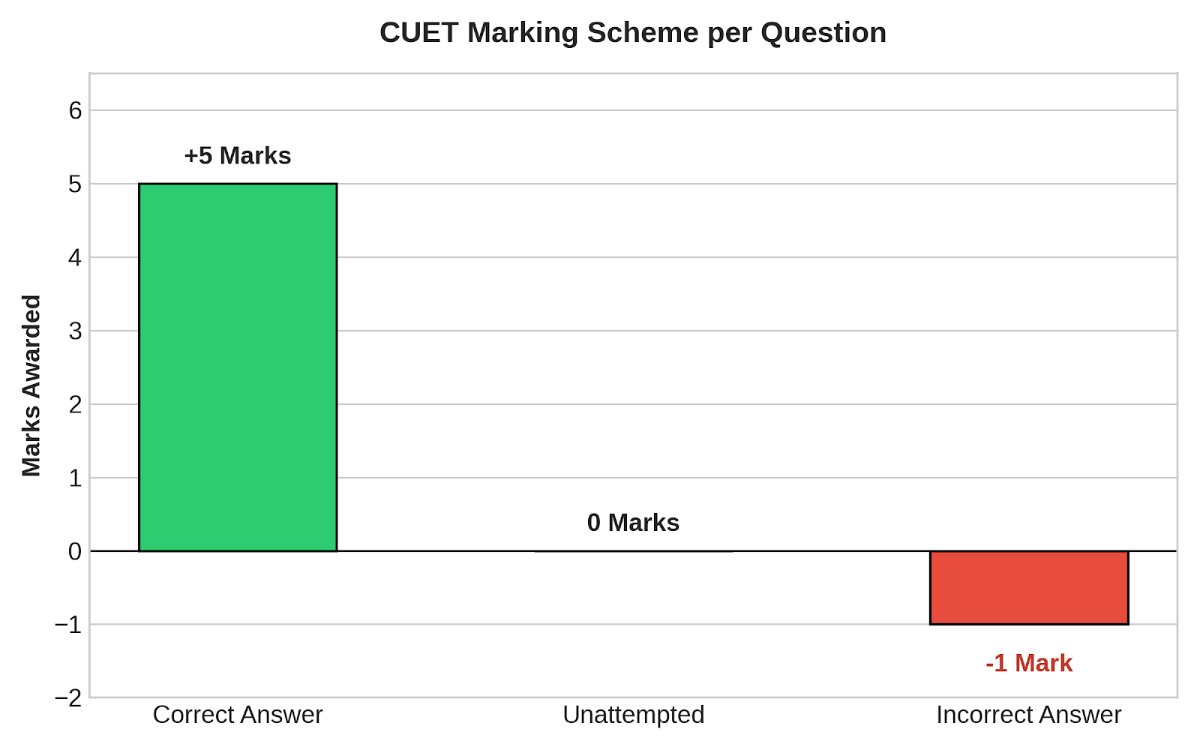
| Answer Status | Evaluation Policy | Marks Awarded |
|---|---|---|
| Correct Answer | Selected option matches the official NTA answer key | +5 Marks |
| Incorrect Answer | Selected option is incorrect | -1 Mark |
| Unattempted Question | Left blank or marked for review without an answer | 0 Marks |
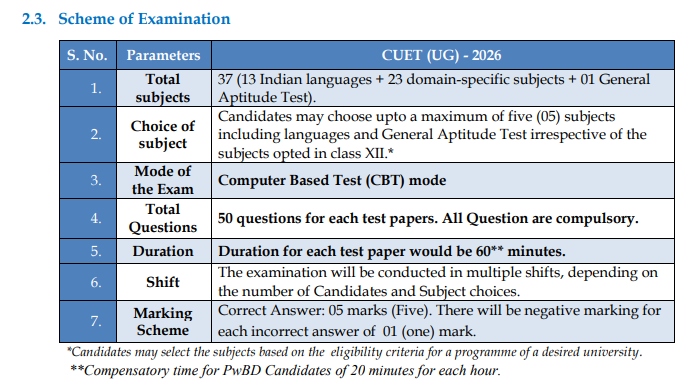
Source: CUET Information Brochure 2026
Ques. What is the CUET marking scheme?
Ans. +5 marks for a correct answer and -1 mark for an incorrect one; unattempted questions score zero.
Ques. How many marks does a wrong answer cost in the CUET exam?
Ans. Exactly 1 mark is deducted for every incorrect answer, against a gain of 5 marks for a correct one.
Also Check:
CUET Exam Pattern 2027: Subjects and Marks Distribution 2027
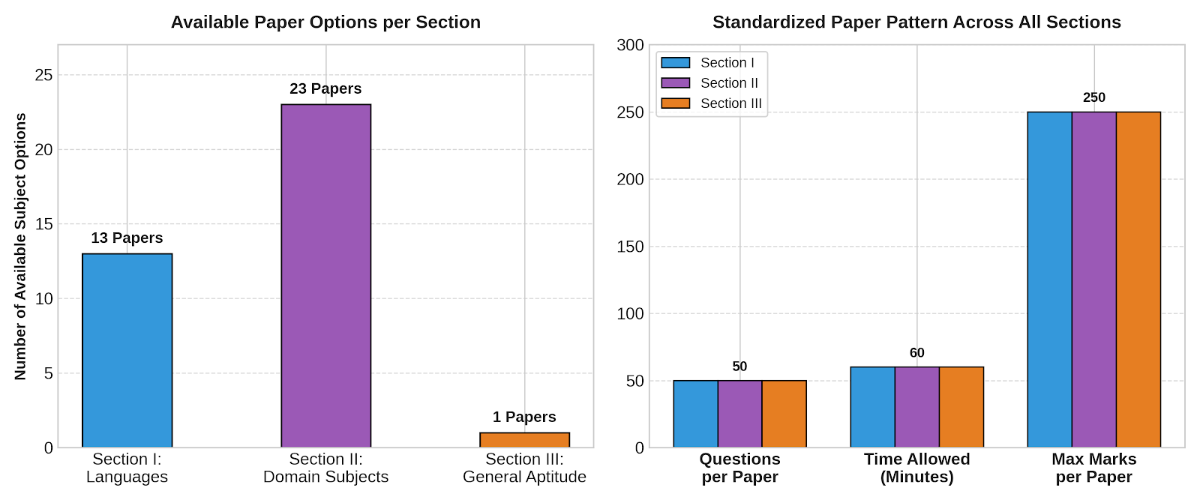
CUET exam subjects are split across three sections, and a candidate's total marks of CUET depend entirely on which combination they pick from these three.
- Section I (Languages) offers 13 options, and at least one language paper is compulsory for every candidate. It is a fixed requirement that hasn't changed across recent CUET cycles.
- Section II (Domain Subjects) has narrowed to 23 options after the six discontinued subjects were removed, keeping the CUET syllabus for science students concentrated on core NCERT subjects like Physics, Chemistry, Mathematics, and Biology.
- Every section carries an identical 50-question, 250-mark structure, so the total marks in the CUET Exam Pattern 2027 scale are purely based on the number of papers chosen, not which section they fall under.
| Section | Total Paper Options | Questions per Paper | Time Allowed | Max Marks per Paper |
|---|---|---|---|---|
| Section I: Languages | 13 (English, Hindi, regional languages) | 50 | 60 minutes | 250 Marks |
| Section II: Domain Subjects | 23 (NCERT Class 12 based) | 50 | 60 minutes | 250 Marks |
| Section III: General Aptitude Test | 1 (Common Aptitude) | 50 | 60 minutes | 250 Marks |
Ques. What are the CUET section 1 subjects?
Ans. Section I covers 13 language papers: English, Hindi, Assamese, Bengali, Gujarati, Kannada, Malayalam, Marathi, Odia, Punjabi, Tamil, Telugu, and Urdu.
Ques. What is the CUET total marks for 3 subjects?
Ans. Since each subject paper is worth 250 marks, 3 subjects add up to 750 marks; 5 subjects, the current maximum, add up to 1,250 marks.
Also Check:
CUET Exam Pattern for UG: High-Weightage Topics 2027
Across every domain subject, the CUET question pattern rewards NCERT-literal preparation over external reference material — a pattern most visible in how English and the science subjects are tested.
CUET English: High-Weightage Topics
- CUET's English paper consistently dedicates 15–18 of its 50 questions to three passage types: Factual, Narrative, and Literary; a split that has held steady across recent cycles.
- Unlike school English exams, CUET does not test literature chapters; it tests raw language proficiency via sections like Vocabulary, Verbal Ability, etc.
| Topic / Component | Sub-Topics & Question Focus | Expected Questions |
|---|---|---|
| Reading Comprehension | Factual, Literary, and Narrative passages (approx. 3 passages) | 15–18 |
| Vocabulary | Synonyms, Antonyms, Contextual meanings | 6–8 |
| Verbal Ability & Grammar | Spotting errors, Active/Passive voice, Direct/Indirect speech | 5–7 |
| Rearranging Sentences | Para-jumbles and logical ordering | 4–5 |
| Choosing the Correct Word | Fill in the blanks (Prepositions, Tenses, Articles) | 4–5 |
| Idioms and Phrases | Meaning and usage of common idioms/phrases | 3–4 |
| Literary Devices & Figures of Speech | Metaphor, Simile, Personification, Alliteration, Oxymoron | 2–3 |
| Total | All sub-topics combined | 50 |
Also Check:
- CUET UG English Syllabus 2027: Subject-Wise Topics, Topic-Wise Weightage and PDF Download
- CUET English Question Paper 2026 (Available): Download Previous Years’ Question Papers PDF
CUET Exam Pattern 2027 Chemistry: High-Weightage Topics
- Organic Named Reactions consistently appear as match-the-following questions, pairing reaction names (Rosenmund, Reimer-Tiemann, Kolbe's, Aldol) against their reactants or products, a common feature across previous CUET papers.
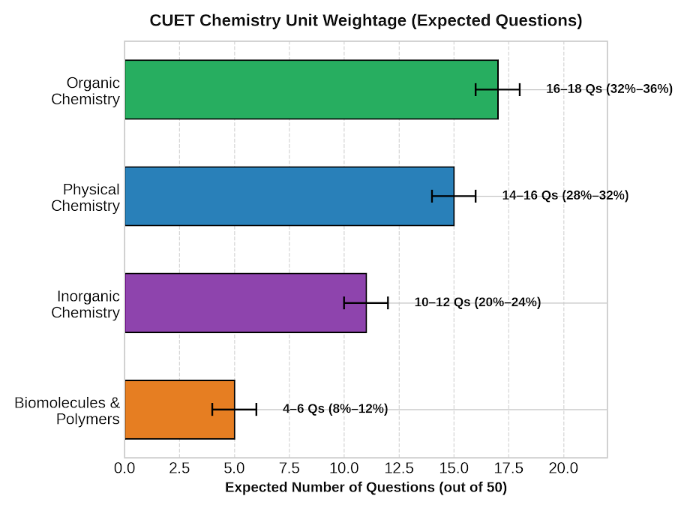
- Biomolecules and Polymers shouldn’t be skipped by students, as NTA pulls 4–6 direct, questions from this unit every cycle, making it one of the highest return-on-effort sections in the CUET syllabus for science students.

| Unit Name | High-Weightage Core Chapters | Expected Questions |
|---|---|---|
| Organic Chemistry | Haloalkanes and Haloarenes; Alcohols, Phenols, Ethers; Aldehydes, Ketones, Carboxylic Acids; Amines | 16–18 |
| Physical Chemistry | Solutions; Electrochemistry; Chemical Kinetics | 14–16 |
| Inorganic Chemistry | d- and f-Block Elements; Coordination Compounds | 10–12 |
| Biomolecules & Polymers | Carbohydrates, Proteins, Nucleic Acids; Polymer classification | 4–6 |
| Total | All units combined | 50 |
CUET Exam Pattern 2027 Physics: High-Weightage Topics
- Electrodynamics and Optics together account for more than half of the Physics paper, a concentration that has stayed consistent across cycles and makes these two units the highest-priority area of the CUET exam pattern for science students.
- Topics deleted from CBSE board syllabi are still fully active in the CUET blueprint. NTA follows the complete NCERT Class 12 textbook regardless of what individual boards have trimmed.
| Unit Name | High-Weightage Core Chapters & Concepts | Expected Questions |
|---|---|---|
| Electrostatics & Current Electricity | Electric Charges, Fields, Electrostatic Potential; Capacitors; Ohm's Law, Kirchhoff's Rules, Potentiometer | 12–14 |
| Optics | Ray Optics (Lenses, Prisms, Microscopes, Telescopes); Wave Optics (Interference, Diffraction, YDSE) | 8–10 |
| Magnetic Effects & Induction | Moving Charges and Magnetism; EMI; AC circuits, LCR, Resonance | 8–10 |
| Modern Physics | Dual Nature of Matter & Radiation; Atoms and Nuclei | 8–10 |
| Electronic Devices & EM Waves | Semiconductor Electronics; EM Waves spectrum | 6–8 |
| Total | All units combined | 50 |
Also Check:
- CUET Physics Syllabus 2027: Subject-Wise Topics, Topic-Wise Weightage and PDF Download
- CUET Physics Question Paper 2026 (Available), Check Previous Years’ Question Papers PDF
CUET Exam Pattern 2027 Mathematics: High-Weightage Topics
- Calculus alone accounts for nearly 40% of the Mathematics paper. It has the largest concentration of weightage in any CUET domain subject, making it the clear first-priority topic for science-stream candidates.
| Unit Name | High-Weightage Core Chapters & Concepts | Expected Questions |
|---|---|---|
| Calculus | Continuity & Differentiability; Applications of Derivatives; Integrals; Applications of Integrals; Differential Equations | 18–20 |
| Vectors and 3D Geometry | Vector Algebra; Three-Dimensional Geometry | 8–10 |
| Algebra | Matrices; Determinants | 6–8 |
| Probability | Conditional Probability, Bayes' Theorem; Random Variables & Binomial Distribution | 5–7 |
| Relations and Functions | Types of Relations and Functions; Inverse Trigonometric Functions | 4–5 |
| Linear Programming (LPP) | Formulation, Graphical method, Feasible regions | 2–3 |
| Total | All units combined | 50 |
CUET Economics: High-Weightage Topics
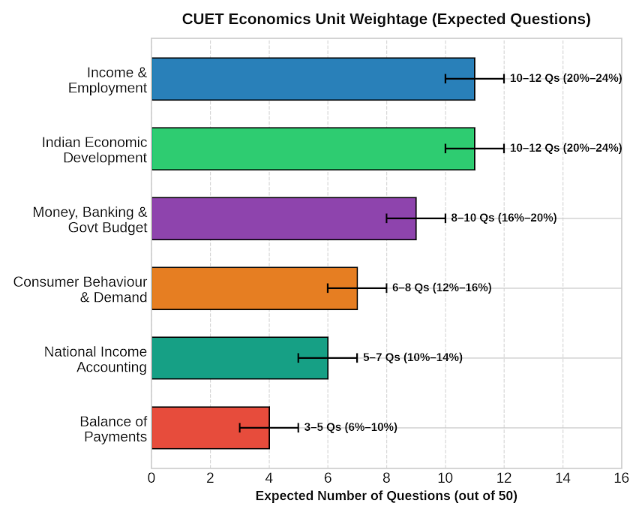
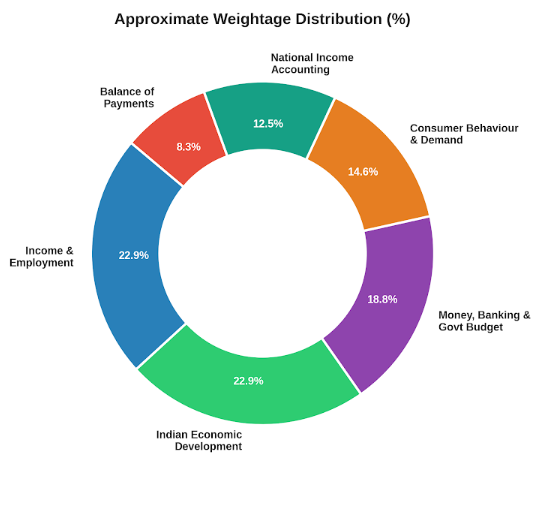
- Macroeconomics and Indian Economic Development together carry the largest share of the Economics paper, and direct calculation questions on the Investment Multiplier or GDP-to-NNP conversions appear every single year.
- NTA frequently tests chronological ordering of policy events: the Planning Commission, the Green Revolution, LPG Reforms, and NITI Aayog's establishment, rather than isolated fact recall.
| Unit Name | High-Weightage Core Topics & Concepts | Expected Questions |
|---|---|---|
| Macroeconomics: Income & Employment | Determination of Income and Employment; Multiplier mechanism; AD and AS | 10–12 |
| Indian Economic Development | Current challenges; Development Experience (1947–1990) & Reforms (1991) | 10–12 |
| Macroeconomics: Money, Banking & Government Budget | RBI and Commercial Bank functions; Credit control; Budget components and Deficits | 8–10 |
| Microeconomics: Consumer Behaviour & Demand | Law of Demand and Elasticity; Consumer's Equilibrium | 6–8 |
| National Income Accounting | GDP, NDP, GNP, NNP; Methods of calculating National Income | 5–7 |
| Balance of Payments (BoP) | Foreign Exchange Rate determination; Current and Capital Account | 3–5 |
| Total | All units combined | 50 |
Ques. What is the CUET syllabus for science students?
Ans. It is strictly mapped to the Class 12 NCERT curriculum for Physics, Chemistry, Mathematics, and English, with no material tested outside the prescribed textbooks.
Also Check:
What Types of Questions Are Asked in the CUET Exam Pattern 2027?
Every question in the CUET UG exam is a Multiple Choice Question (MCQs) with four options and a single correct answer, but the CUET question pattern varies how that MCQ format is applied across subjects:
- NTA consistently varies MCQ framing by subject to test different skills such as direct recall in domain subjects, contextual inference in English, and calculation speed in Mathematics and Physics, rather than using one uniform question style across the paper.
Ques. What types of questions are asked in the CUET exam?
Ans. All CUET questions are single-correct MCQs, though NTA varies their framing by subject to test recall, inference, or calculation speed depending on the paper.
CUET UG 2026 Question Paper with Solutions
| Subject | Question Paper PDF | Solution PDF |
|---|---|---|
| CUET 2026 English Question Paper June 6 Shift 1 | Download PDF | View Solution |
| CUET 2026 General Aptitude Test Question Paper June 6 Shift 1 | Download PDF | View Solution |
| CUET 2026 Physics Question Paper June 6 Shift 1 | Download PDF | View Solution |
| CUET 2026 Chemistry Question Paper June 6 Shift 1 | Download PDF | View Solution |
| CUET 2026 Biology Question Paper June 6 Shift 1 | Download PDF | View Solution |
| CUET 2026 Accountancy Question Paper June 6 Shift 1 | Download PDF | View Solution |
| CUET 2026 Economics Question Paper June 6 Shift 1 | Download PDF | View Solution |
| CUET 2026 Business Studies Question Paper June 6 Shift 1 | Download PDF | View Solution |
CUET UG 2025 Question Paper with Solutions
| Subject | Question Paper PDF | Solution PDF |
|---|---|---|
| CUET 2025 Political Science Question Paper with Answer Key | Download PDF | View solution |
| CUET 2025 Physics Question Paper with Answer Key | Download PDF | View solution |
| CUET 2025 Mathematics Question Paper with Answer Key | Download PDF | View solution |
| CUET 2025 General Aptitude Test Question Paper with Answer Key | Download PDF | View solution |
| CUET 2025 Economics Question Paper with Answer Key | Download PDF | View solution |
| CUET 2025 Computer Science Question Paper with Answer Key | Download PDF | View solution |
| CUET 2025 Chemistry Question Paper with Answer Key | Download PDF | View solution |
| CUET 2025 Business Studies Question Paper with Answer Key | Download PDF | View solution |
| CUET 2025 Biology Question Paper with Answer Key | Download PDF | View solution |
| CUET 2025 Accountancy Question Paper with Answer Key | Download PDF | View solution |
What Is the Difficulty Level of CUET?
CUET's conceptual difficulty stays close to Class 12 board level, but time pressure and competition make the exam harder in practice than the syllabus alone suggests.
- Unlike JEE or NEET, which demand deep application and trick calculations, CUET tests direct textbook facts and standard formulas, thus, candidates who have prepared thoroughly for their boards already know roughly 90% of what CUET domain subjects require.
- The real constraint is time: 50 compulsory questions in 60 minutes gives just over a minute per question, and calculation-heavy subjects like Mathematics, Accountancy, and Physics, or reading-heavy sections like English RC, make that minute feel tight.
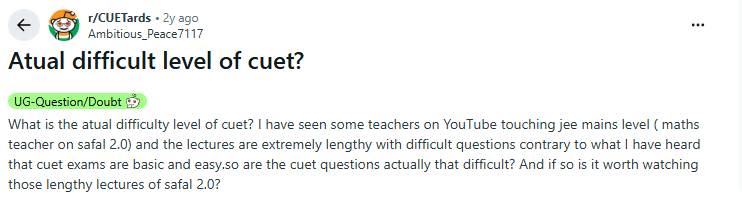
Candidates consistently describe CUET as easier in content than JEE or NEET, and this gap between "easy syllabus" and "hard cutoff" comes up again and again.
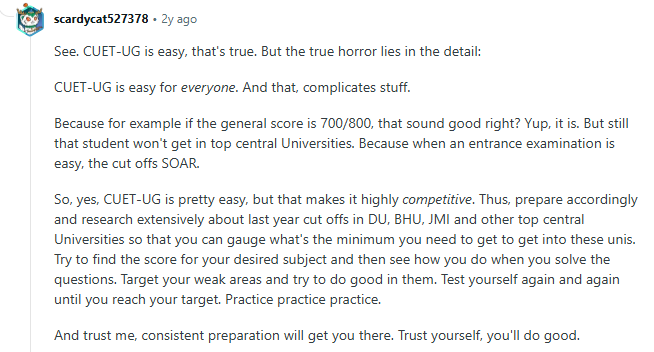
- Students preparing for CUET UG repeatedly note that the syllabus itself is straightforward, but because it's manageable for a large pool of candidates, competition becomes the real challenge.
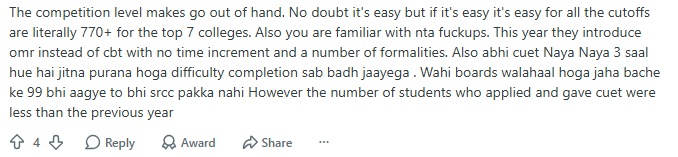
- Recent cycles have seen cutoffs for top universities like DU, BHU, and JMI climb past 770 out of 800.
Source: Reddit
Ques. Is CUET tougher than JEE or NEET?
Ans. Conceptually, no as CUET stays close to Class 12 NCERT level. The difficulty instead comes from time pressure and the high competition bar at top colleges.
Also Check: CUET Mock Test 2027, Practice English, GAT, Hindi, Economics, Biology and more Tests for Free
CUET UG Sample Paper 2027: Download PDF
| CUET UG Subject Wise Sample Paper | Direct Link |
|---|---|
| CUET UG Mass Media Sample Paper (Latest) | Download PDF |
| CUET UG Physical Education Sample Paper | Download PDF |
| CUET UG Geography Sample Paper | Download PDF |
| CUET UG English Sample Paper | Download PDF |
| CUET UG GAT Sample Paper | Download PDF |
| CUET UG Biology Sample Paper | Download PDF |
| CUET UG Computer Science Sample Paper | Download PDF |
| CUET UG Information Practices Sample Paper | Download PDF |
| CUET UG Sociology Sample Paper | Download PDF |
| CUET UG Hindi Sample Paper | Download PDF |
| CUET UG Psychology Sample Paper | Download PDF |
| CUET UG Chemistry Sample Paper | Download PDF |
| CUET UG Maths Sample Paper | Download PDF |
| CUET UG Business Studies Sample Paper | Download PDF |
| CUET UG Physics Sample Paper | Download PDF |
| CUET UG Economics Sample Paper | Download PDF |
| CUET UG Applied Mathematics Sample Paper | Download PDF |
| CUET UG Political Science Sample Paper | Download PDF |
| CUET UG Accountancy Sample Paper | Download PDF |
| CUET UG History Sample Paper | Download PDF |
| CUET UG Agriculture Sample Paper | Download PDF |
CUET Exam Pattern vs CLAT Exam Pattern 2027
CUET and CLAT sit at opposite ends of the entrance-exam spectrum as one is subject-centric and NCERT-bound, the other is aptitude-centric with no fixed syllabus.
- CLAT is a highly specialized test for entry into professional law colleges, while CUET is an exam for broad undergraduate and postgraduate courses across central, state, and private universities.
- CLAT is strictly conducted only in English. CUET is highly accessible and can be attempted in 13 different languages.
| Feature | CUET UG 2027 | CLAT 2027 |
|---|---|---|
| Primary Purpose | Admission to general UG courses across Central, State, and Private Universities | Admission to 5-year Integrated Law programmes at National Law Universities (NLUs) |
| Exam Mode | Computer-Based Test (CBT) | Pen-and-Paper Test (Offline OMR sheet) |
| Core Structure | Subject-centric (Languages + Domain Subjects + General Test) | Aptitude-centric (Comprehension and Reasoning across 5 sections) |
| Number of Papers | Multiple individual papers (up to 5 chosen by the student) | Single, consolidated paper |
| Total Questions | 50 compulsory questions per paper | 120 compulsory questions total |
| Total Time | 60 minutes per paper | 120 minutes (2 hours) total |
| Marking Scheme | +5 for correct-1 for wrong | +1 for correct-0.25 for wrong |
| Syllabus Baseline | Strictly mapped to Class 12 NCERT curriculum | No prescribed textbook; focuses on application, reading speed, and reasoning |
Ques. Which is easier, CUET or CLAT?
Ans. CUET's content stays closer to the Class 12 NCERT syllabus, while CLAT has no fixed syllabus and tests reading speed and reasoning applied to unfamiliar passages — the two exams demand fundamentally different preparation styles.
CUET 2027 Preparation Tips
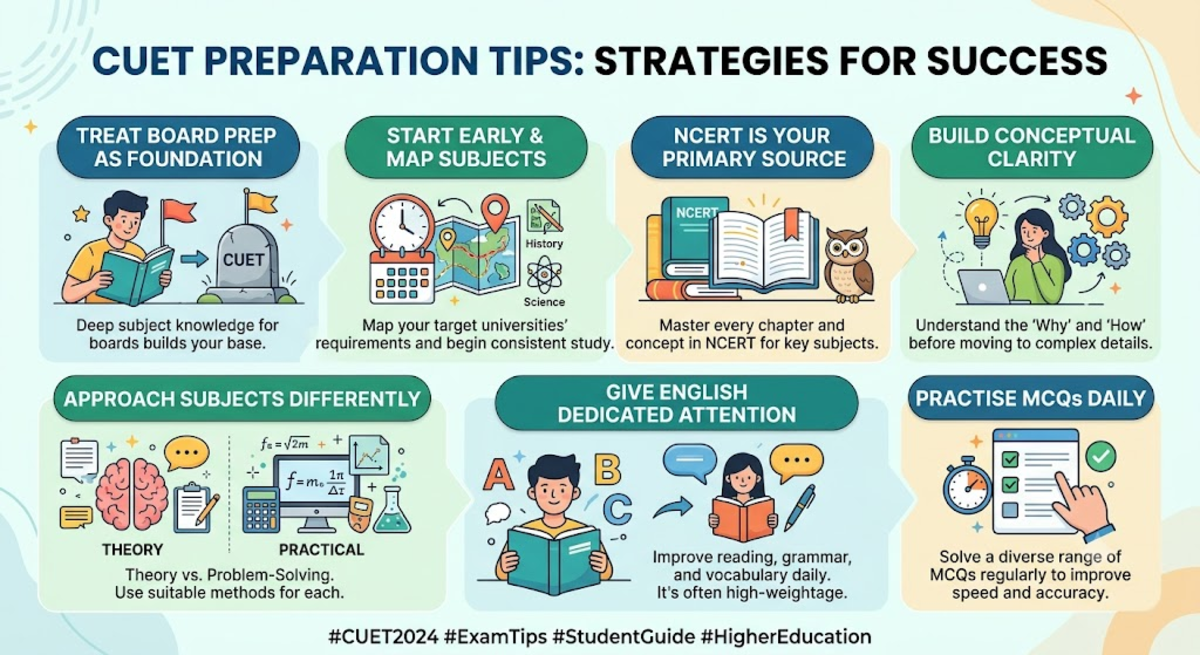
Cracking the CUET UG exam pattern comes down to treating board preparation as the foundation, then layering CUET-specific MCQ practice on top of it.
- Treat board preparation as your CUET foundation. Aim for 90%+ in boards if targeting competitive colleges, and build CUET prep on top of that base rather than treating the two as separate efforts.
- Start early and target-map your subjects. Download the official CUET syllabus, identify exactly which subjects your target course and university require, and begin well before the exam window opens.
- Make NCERT your primary study source. Read textbooks line by line rather than relying on chapter summaries; CUET frequently frames questions from small details and sub-headings rather than headline concepts.
- Build conceptual clarity before attempting detail-level questions. Understand the core concept first, then study the finer details around it; this matters especially for theory-heavy subjects.
- Prepare theory and practical subjects differently. For subjects like Accountancy and Mathematics, don't skip the theoretical portions; for theory-heavy subjects, don't ignore the numerical or applied sections either.
- Give English dedicated attention. It can swing overall CUET scores significantly — focus on synonyms, antonyms, vocabulary, and idioms, and supplement with regular newspaper reading.
- Practise MCQs daily. Roughly 30 minutes of daily MCQ practice after studying both revises the day's material and builds familiarity with CUET's question style.
Ujjwal Sharma, an SRCC student, shares practical insights and strategies to help CUET aspirants prepare effectively for the exam. Learn how to structure your preparation, choose the right resources, and improve your chances of securing a top DU college.
CUET Exam Pattern FAQs
Ques. What is the CUET exam full form?
Ans. CUET stands for Common University Entrance Test, run by the NTA (National Testing Agency) for undergraduate admissions across Indian universities.
Ques. What is the CUET UG full form?
Ans. CUET UG stands for Common University Entrance Test (Undergraduate) — the version of the exam used for undergraduate admissions, as opposed to postgraduate entrance tests.
Ques. Who is the CUET exam for?
Ans. The CUET exam is for students seeking undergraduate admission into Central, State, and participating private universities across India, across language, domain-subject, and general aptitude papers.
Ques. How many marks of CUET exam can a candidate score in total?
Ans. It depends on the number of subjects chosen — each paper is worth 250 marks, so total marks of CUET scale from 250 for a single subject up to 1,250 for the current maximum of 5 subjects.
Ques. What is the CUET total marks for 6 subjects?
Ans. CUET no longer permits 6 subjects — the maximum has been reduced to 5, capping total marks at 1,250; candidates who registered for 6 or more subjects in earlier cycles operated under a higher, now-discontinued limit.
Ques. What is the CUET ug exam pattern 2025 compared to CUET exam pattern 2027?
Ans. Both follow the same 50-question, 60-minute, 250-mark-per-paper structure with +5/-1 marking; the main change entering 2027 is the reduced 5-subject cap and the discontinuation of six domain subjects.
Ques. How many total questions in CUET does a candidate attempt?
Ans. 50 compulsory questions per subject paper, so total questions in CUET scale with how many of the maximum 5 subjects a candidate registers for — up to 250 questions overall.



Comments