




With CUET UG 2027 expected to be conducted in May 2027, students have around 8 months from September 2026 to complete the syllabus, revise, and practise mock tests. CUET is conducted by the National Testing Agency (NTA) for a total of 200 marks. Every correct answer yields +5 marks, while an incorrect answer deducts -1 mark.
- Domain papers, like Hindi and English, give you 45 minutes for 40 questions.
- You get 60 minutes for calculation-heavy CUET exam subjects like Mathematics, Physics, Accountancy, Economics, and the General Test.
- Prepare Class 12 concepts for Boards while simultaneously practising CUET-style MCQs.
- Compare the CUET syllabus with your Board syllabus and separately cover topics that may not be included in Boards.
- Read NCERT thoroughly, including text, diagrams, tables, captions, examples, and important boxes for domain subjects.
- Avoid collecting too many advanced books; use one CUET-focused practice source for MCQs and PYQs after completing NCERT.
- Begin with chapter-wise and sectional tests, then move to full-length mocks after completing most of the syllabus.
- Maintain an error log, identify conceptual and careless mistakes, revise the relevant topics, and use each test to improve speed and accuracy.
Related Links:
- CUET Exam Pattern 2027: Marking Scheme, Syllabus, Question Types and Difficulty Level
- CUET UG Sample Paper 2027 PDF: Download Subject Wise PDF with Solutions
- CUET 2027 Syllabus: Expected January 2027, Subject-wise Topics, Weightage and PDF Download
Key Summary
- CUET preparation 2027 should center on NCERT Class 12 textbooks first, since the CUET test draws its questions directly from the core text rather than external reference material.
- CUET exam subjects are split into Languages, Domain Subjects, and the CUET General Test, each carrying its own time limit and marking scheme of +5 for correct answers and -1 for incorrect ones.
- CUET preparation books should be chosen selectively, one or two focused resources per subject, with NCERT remaining the primary source and CUET-specific practice books used only for MCQs and PYQs.
- CUET study material should include a physical or digital error log, since reviewing mistakes after every mock test is what separates a good score from a 100 percentile CUET attempt.
CUET Preparation 2027: Subject-wise Guide
Below are some subject-wise tips to employ in your CUET preparation 2027:
Science Domains (Physics, Chemistry, Biology, Mathematics)
- NCERT Line-by-Line: CUET domain papers are drawn strictly from Class 12 NCERT textbooks. Pay close attention to side notes, diagrams, and summary tables.
- Formulae & Reactions: Maintain a separate notebook for direct formulas (Physics/Mathematics) and reaction mechanisms/named reactions (Organic Chemistry).
Commerce Domains (Accountancy, Business Studies, Economics)
- Accountancy: Focus heavily on company accounts, partnership concepts, and ratio analysis. Practice speed-solving format-based questions.
- Business Studies: Practice case-study-style MCQs to identify management principles and functions quickly.
- Economics: Memorize definitions, graph trends (Macroeconomics), and facts/dates (Indian Economic Development).
Humanities Domains (History, Political Science, Sociology, Geography)
- Timeline Maps: Create chronologies for History and Political Science events (e.g., Cold War era, Indian independence movements).
- Map & Data Work: Practice identifying locations and demographic trends directly from NCERT Geography maps and tables.
CUET Preparation: Subject-wise Strategies
Below are some popular CUET subjects, their important areas of study, and preparation strategies to apply:
| Subject / Section | High-Yield Areas | Preparation Strategy for CUET Preparation 2027 |
|---|---|---|
| English | Reading Comprehension, Verbal Ability, Vocabulary |
|
| General Test | Arithmetic (up to Class 8), Logical Reasoning, GK |
|
| Chemistry | Organic Name Reactions, Solutions, Coordination Compounds |
|
| Physics | Modern Physics, Electrostatics, Optics, Current Electricity |
|
| Mathematics | Calculus, Vectors & 3D Geometry, Matrices |
|
| Biology | Genetics & Evolution, Biotechnology, Ecology |
|
| Economics | Macroeconomics, Indian Economic Development |
|
| Business Studies | Principles of Management, Marketing, Case Studies |
|
| Accountancy | Partnership Firms, Company Accounts, Ratios |
|
| Political Science | Contemporary World Politics, India Since Independence |
|
Ques. What is the best book for CUET General Test preparation alongside NCERT?
Ans. For the CUET General Test, R.S. Aggarwal's Quantitative Aptitude and A Modern Approach to Verbal & Non-Verbal Reasoning, paired with Lucent's General Knowledge, cover the core areas most CUET preparation 2027 candidates need.
Also Check:
How to prepare for the CUET General Test?
To score well in the CUET General Test (Section III), you need speed, accuracy, and sharp mental processing, since the paper gives you 60 minutes to solve 50 questions out of 60.
High-yield topics in the CUET General Test include:
- Quantitative Aptitude: Percentages, Profit & Loss, Ratio & Proportion, Time-Speed-Distance, and Averages.
- Logical & Analytical Reasoning: Blood Relations, Coding-Decoding, Number & Alphabet Series, Direction Sense, and Seating Arrangements.
- General Knowledge & Current Affairs: Awards, Sports Tournaments, Key Appointments, and Static GK covering National Parks, Capitals, Rivers/Dams, and Constitutional Amendments.
The CUET General Test covers everything from basic math to logical puzzles and general knowledge.
- Quantitative Aptitude: Focus on Arithmetic, improve calculation speed, and use shortcuts like option elimination and unit-digit checks.
- Logical Reasoning: Practise patterns regularly and use quick diagrams for blood relations and directions.
- GK & Current Affairs: Cover the last 10–12 months using concise monthly/weekly current-affairs capsules.
| Section | Core Strategy & Tactics | Time-Saving Hacks |
|---|---|---|
| Quantitative Aptitude (Basic Math) |
|
|
| Logical & Analytical Reasoning |
|
|
| General Knowledge & Current Affairs |
|
|
Ques. How to score 100 percentile in CUET General Test?
Ans. A 100 percentile CUET General Test attempt usually comes from combining fast, memorized arithmetic shortcuts with disciplined, buckets-first current affairs revision, both practiced under strict timing rather than open-ended study.
Also Check:
- CUET Accountancy Syllabus 2027: Subject-Wise Topics, PDF Download, Weightage and General Test Syllabus
- CUET Political Science Syllabus 2027: 37 Subjects, Topic-Wise Weightage, Subject-Wise List and PDF Download
- CUET UG Economics Syllabus 2027: 37 Subjects, Subject-Wise PDF Download and Topic-Wise Weightage
CUET Preparation 2027: 8 Months Study Plan
A structured study plan can help you balance Class 12 Board preparation with CUET’s speed-based MCQ format. With CUET UG 2027 expected in May 2027, you can follow an 8-month preparation plan starting from September 2026.
- Do not depend only on the board syllabus. Compare it with the official CUET syllabus and identify chapters or topics that your board may have removed. Reserve dedicated weekly study time for these additional topics.
- Practise Reading Comprehension twice a week and spend some time each day improving basic calculations, percentages, ratios, squares, and other General Test fundamentals.
- After board exams, focus on speed, accuracy, revision, and mock tests rather than subjective answer writing. Maintain an error log, revise the concepts behind mistakes, and use mock-test analysis to improve performance before the next test.
| Phase | Timeline | Primary Focus | Prep tips |
|---|---|---|---|
| Phase 1: Foundation | Sep–Nov 2026 | Complete around 80% of the Class 12 syllabus |
|
| Phase 2: Board Preparation | Dec 2026–Feb 2027 | Focus on Pre-Boards and Board Exams |
|
| Phase 3: CUET Sprint | Mar–Apr 2027 | Shift focus to fast and accurate MCQ solving |
|
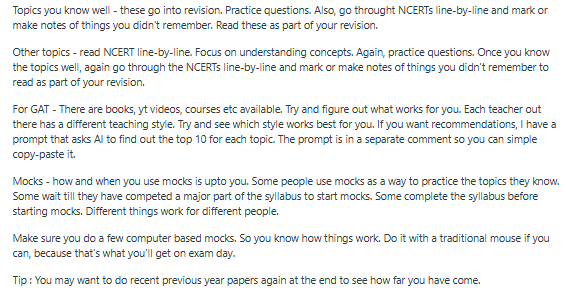
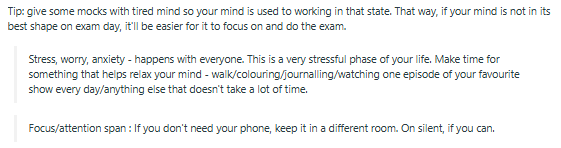
As per Reddit discussions, students share the following tips for effective CUET preparation:
- Manage Exam Stress: Schedule quick daily relaxing activities—like walking, journaling, coloring, or watching a single TV episode, to keep anxiety in check.
- Practice taking mock tests while tired so your brain gets conditioned to focus even if you aren't feeling 100% on exam day.
- Keep your phone in another room on silent, or use focus apps and the Pomodoro technique (25 minutes of study followed by a 5-minute break) to build your attention span.
Source: Reddit
Also Check:
CUET UG 2026 Question Paper with Solutions
| Subject | Question Paper PDF | Solution PDF |
|---|---|---|
| CUET 2026 English Question Paper June 7 Shift 2 | Download PDF | View Solution |
| CUET 2026 Business Studies Question Paper June 7 Shift 2 | Download PDF | View Solution |
| CUET 2026 Accountancy Question Paper June 7 Shift 2 | Download PDF | View Solution |
| CUET 2026 Economics Question Paper June 7 Shift 2 | Download PDF | View Solution |
| CUET 2026 English Question Paper June 6 Shift 1 | Download PDF | View Solution |
| CUET 2026 General Aptitude Test Question Paper June 6 Shift 1 | Download PDF | View Solution |
| CUET 2026 Physics Question Paper June 6 Shift 1 | Download PDF | View Solution |
| CUET 2026 Chemistry Question Paper June 6 Shift 1 | Download PDF | View Solution |
| CUET 2026 Biology Question Paper June 6 Shift 1 | Download PDF | View Solution |
| CUET 2026 Accountancy Question Paper June 6 Shift 1 | Download PDF | View Solution |
| CUET 2026 Economics Question Paper June 6 Shift 1 | Download PDF | View Solution |
| CUET 2026 Business Studies Question Paper June 6 Shift 1 | Download PDF | View Solution |
| CUET Year-wise Question Paper Download | |
|---|---|
| CUET 2025 Question Paper | CUET 2024 Question Paper |
| CUET 2023 Question Paper | CUET 2022 Question Paper |
What are the Topics to Prioritize in CUET Preparation 2027?
Below are the high-weightage topics for CUET domain subjects to focus on during CUET preparation 2027.
- The subject-wise topics cover both core Class 12 concepts and application-based areas, giving students a structured view of what to prioritise.
- Study top-priority topics first, then cover secondary-priority topics once the core concepts are strong.
Across Science, Commerce, and Humanities, the listed topics mix conceptual understanding, factual knowledge, numerical/problem-solving, and analytical questions.
Section I & III: Language & General Test
| Subject | High-Yield Topics |
|---|---|
| English |
|
| General Test |
|
Science Domain
| Subject | High-Yield Topics |
|---|---|
| Chemistry |
|
| Physics |
|
| Mathematics |
|
| Biology |
|
Commerce Domain
| Subject | High-Yield Topics |
|---|---|
| Accountancy |
|
| Business Studies |
|
| Economics |
|
Humanities Domain
| Subject | Top Priority / High-Yield Topics |
|---|---|
| Political Science |
|
| History |
|
Also Check:
CUET UG Sample Paper 2027: Download PDF
| CUET UG Subject-Wise Sample Paper | Direct Link |
|---|---|
| CUET UG Mass Media Sample Paper (Latest) | Download PDF |
| CUET UG Physical Education Sample Paper (Latest) | Download PDF |
| CUET UG Geography Sample Paper (Latest) | Download PDF |
| CUET UG English Sample Paper (Latest) | Download PDF |
| CUET UG GAT Sample Paper | Download PDF |
| CUET UG Biology Sample Paper | Download PDF |
| CUET UG Computer Science Sample Paper (Latest) | Download PDF |
| CUET UG Information Practices Sample Paper (Latest) | Download PDF |
| CUET UG Sociology Sample Paper | Download PDF |
| CUET UG Hindi Sample Paper | Download PDF |
| CUET UG Psychology Sample Paper | Download PDF |
| CUET UG Chemistry Sample Paper | Download PDF |
| CUET UG Maths Sample Paper | Download PDF |
| CUET UG Business Studies Sample Paper | Download PDF |
| CUET UG Physics Sample Paper | Download PDF |
| CUET UG Economics Sample Paper | Download PDF |
| CUET UG Applied Mathematics Sample Paper | Download PDF |
| CUET UG Political Science Sample Paper | Download PDF |
| CUET UG Accountancy Sample Paper | Download PDF |
| CUET UG History Sample Paper | Download PDF |
| CUET UG Agriculture Sample Paper | Download PDF |
CUET Preparation 2027: What Toppers Suggest?
Toppers advise students not to rely heavily on bulky reference books, as CUET questions are largely based on the core syllabus and NCERT content. This makes thorough NCERT preparation an important part of CUET 2027 preparation.
- NCERT Focus: Many CUET questions are based directly on NCERT text, diagrams, captions, and highlighted boxes. Read each core chapter 2–3 times before starting mock tests.
- Deleted Chapters: Check the CUET syllabus separately from your board syllabus and cover any topics deleted from your school curriculum.
Most average students solve a 45-minute mock test and look only at their final score. Toppers approach CUET preparation 2027 differently:
- Keep an Error Log: Note every mistake and identify whether it was due to a concept gap or a careless error.
- Review Before the Next Mock: Analyse and correct mistakes from one mock before attempting the next full-length test.
- Practise with Time Limits: Try completing 40 questions in 40 minutes during practice to improve speed and time management.
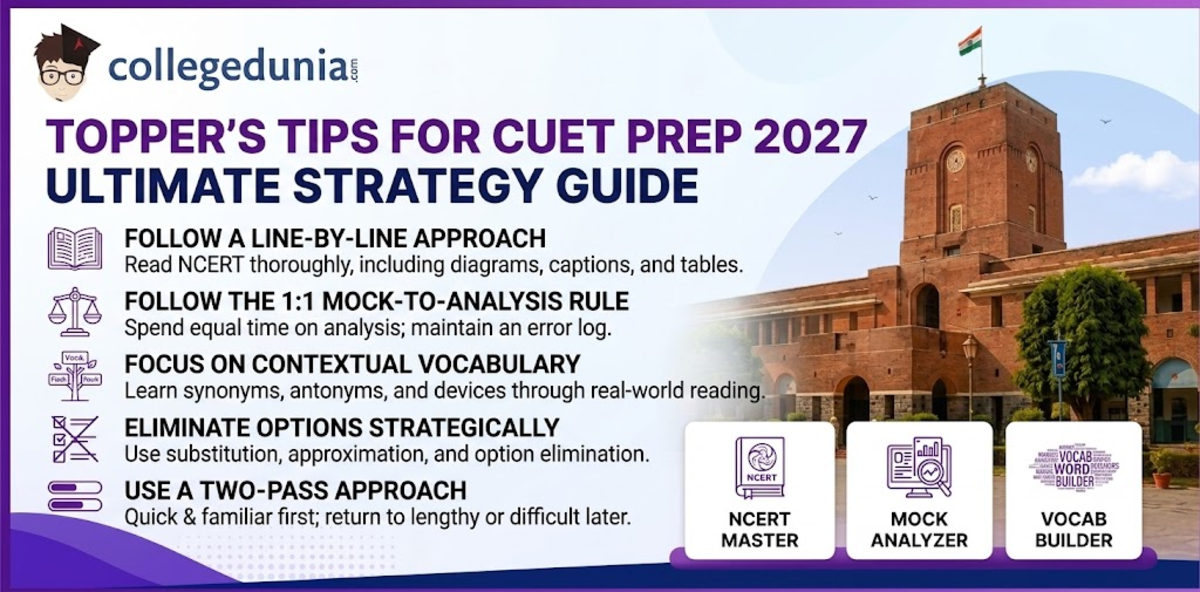
| Area | Topper's Tip | What to Do |
|---|---|---|
| NCERT Preparation | Follow a line-by-line approach | Read NCERT thoroughly, including diagrams, captions, tables, and highlighted boxes |
| Mock Tests | Follow the 1:1 mock-to-analysis rule | Spend as much time analysing mistakes as solving the mock; maintain an error log |
| English | Focus on contextual vocabulary | Learn synonyms, antonyms, and literary devices through passages and real-world reading |
| General Test | Eliminate options strategically | Use substitution, approximation, and option elimination to solve questions faster |
| Exam Strategy | Use a two-pass approach | Attempt quick and familiar questions first, then return to lengthy or difficult questions |
Ques. What is the CUET UG preparation strategy for science students specifically?
Ans. Science-stream CUET preparation 2027 should prioritize Modern Physics, Organic Chemistry name reactions, and Biology diagrams/captions from NCERT first, since these high-weightage topics for CUET domain subjects are both scoring and frequently tested.
Also Check:
- CUET UG Business Studies Syllabus 2027: Subject-wise Syllabus, Topic-wise Weightage and PDF Download
- CUET Courses List 2027: University-wise Programmes, Stream-wise UG Courses for Science, Commerce, and Humanities
In this video, Class 12 CBSE toppers scoring 95%–99% share their exact tips, strategy, and resources for the English Board Exam 2025. Learn how toppers prepare for English daily, their complete section-wise strategy for Reading, Grammar, Literature, and Writing, and how they write high-scoring answers that get full marks.
How to Attempt Mock Tests Effectively?
To attempt mock tests effectively and see scores rise with every paper, treat mocks as diagnostic tools rather than simple practice sessions.
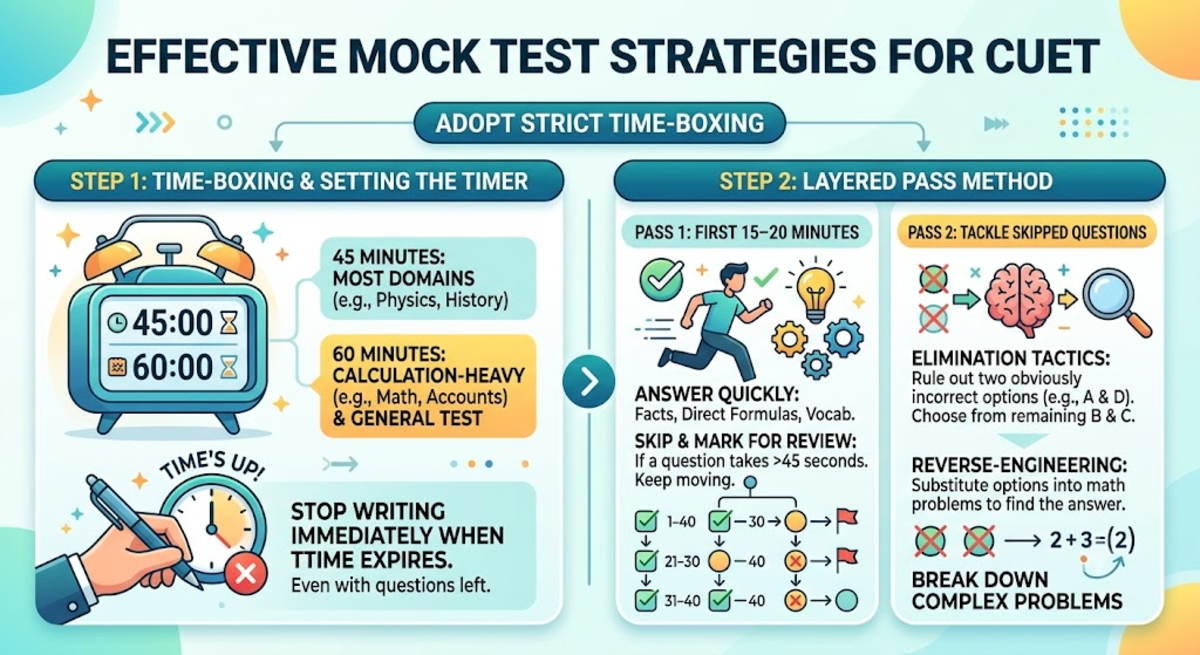
Adopt Strict Time-Boxing: CUET gives 45 minutes for most domains and 60 minutes for calculation-heavy domains and the General Test. Set a countdown timer, and if time runs out, stop writing immediately, even with 5 questions left.
Do not solve a multiple-choice paper sequentially from question 1 to 40. Use a layered pass method instead:
- Pass 1: Spend the first 15–20 minutes running through the paper to answer questions you know instantly, factual statements, direct formulas, or quick vocabulary matching. If a question takes more than 45 seconds, mark it for review and skip it.
- Pass 2: Go back to the skipped questions. Use elimination tactics (ruling out two obviously incorrect options) or reverse-engineering (substituting options into a math problem) to break down complex word problems or numerical questions.
Taking a mock test without a thorough review is not beneficial. Create a physical Error Log Notebook or spreadsheet and categorize every mistake into one of three buckets:
| Error Type | What it Means | The Instant Fix |
|---|---|---|
| Conceptual Gap | You forgot the formula, rule, or historical date entirely | Re-read that specific sub-topic page inside your NCERT immediately |
| Execution Error | You knew the concept but misread the question or made a calculation mistake | Write the step-by-step calculation out clearly next time; don't skip mental math stages |
| Time Trap | You got stuck on a difficult question for 5 minutes and ran out of time at the end | Train yourself to ruthlessly skip and flag questions the moment they stall you |
Ques. Where can I download CUET previous year question papers with answers PDF?
Ans. CUET previous year question papers with answers PDF are available on the official CUET website and through CUET preparation books and practice-set publishers like Arihant, Oswaal, and Disha, which compile PYQs alongside solutions.
Also Check:
Best Books to Prepare for CUET 2027
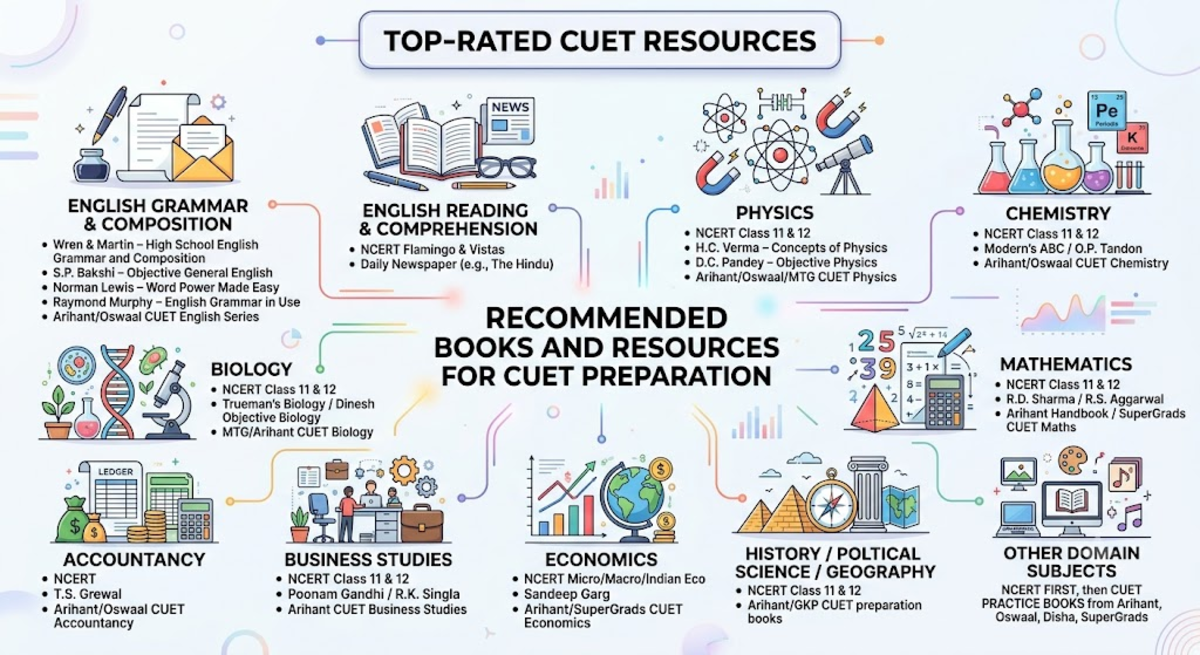
For domain subjects, NCERT should remain the primary CUET study material, with one CUET-specific MCQ/practice book used for question practice and PYQs. Choose one or two focused books per subject for concept building, MCQs, and additional practice instead of relying on multiple resources.
- Prioritise CUET Practice: Use CUET-specific guides from Arihant, Oswaal, MTG, Disha for mock tests, practice questions, and PYQs after completing the core syllabus.
| Subject | Recommended Books / Resources |
|---|---|
| English |
|
| English Reading |
|
| Physics |
|
| Chemistry |
|
| Biology |
|
| Mathematics |
|
| Accountancy |
|
| Business Studies |
|
| Economics |
|
| History/ Political Science/ Geography |
|
Best Books for CUET General Test
| Section | Recommended Books / Resources |
|---|---|
| Quantitative Aptitude (GAT) |
|
| Logical & Analytical Reasoning (GAT) |
|
| GK & Current Affairs (GAT) |
|
| GAT – CUET Practice |
|
Ques. What is the best book for CUET General Test preparation overall?
Ans. Among the best books for CUET General Test preparation, R.S. Aggarwal's Quantitative Aptitude and Reasoning titles, paired with Lucent's General Knowledge, cover arithmetic, logical reasoning, and static GK in one structured set.
Ques. Which book is best for CUET preparation in Mathematics?
Ans. NCERT Class 11 & 12 remains the base for CUET Mathematics preparation, supplemented by R.D. Sharma or R.S. Aggarwal for practice and an Arihant CUET Maths handbook for exam-pattern MCQs.
Common Mistakes to Avoid in CUET Preparation 2027
Since CUET tests speed, accuracy, and syllabus coverage rather than long-answer writing, avoiding common preparation mistakes is important for achieving a strong score in CUET 2027.
- Ignoring Deleted Chapters: Compare the official CUET syllabus with your school syllabus and prepare the missing topics separately.
- Depending Too Much on Reference Books: Keep NCERT as your main study source and use reference books mainly for practice.
- Blind Guessing: Use option elimination and avoid random guesses when you have no idea about the answer.
- Delaying Mock Tests: Start chapter-wise or sectional mocks once you have covered a good portion of the syllabus and gradually move to full-length tests.
| Mistake | Reality | How to Avoid It |
|---|---|---|
| Ignoring Deleted Chapters | Board and CUET syllabi may differ, so relying only on the school syllabus can leave gaps | Compare the official CUET syllabus with the board syllabus and separately cover omitted topics |
| Over-reliance on Reference Books | Excessive use of JEE/NEET-level books adds unnecessary content and consumes preparation time | Keep NCERT as the primary source and use reference books mainly for practice |
| Blind Guessing | With +5/-1 marking, random guesses can reduce the overall score | Use option elimination and avoid attempting questions with no reasonable basis for choosing an answer |
| Delaying Mock Tests | Waiting until the end leaves little time to develop speed, accuracy, and exam stamina | Start sectional or chapter-wise mocks once a substantial portion of the syllabus is covered, and gradually move to full-length tests |
CUET Preparation 2027 FAQs
Ques. How to prepare for CUET exam from the start?
Ans. Start CUET preparation 2027 by mapping the CUET syllabus for each chosen domain against NCERT chapters, build a daily timetable across languages, domain subjects, and the CUET General Test, and begin sectional mock tests once roughly half the syllabus is covered.
Ques. What are the main CUET exam subjects candidates choose from?
Ans. CUET exam subjects span Languages, Domain Subjects (Physics, Chemistry, Biology, Mathematics, Accountancy, Business Studies, Economics, History, Political Science, Geography, and others), and the CUET General Test, based on the courses a candidate wants to apply for.
Ques. Is there any official CUET preparation online support?
Ans. The CUET website hosts the official syllabus, information bulletin, and mock test links, while CUET preparation online options from coaching platforms and publishers offer additional practice sets and video lessons alongside NCERT study.
Ques. How to score 100 percentile in CUET overall?
Ans. A 100 percentile CUET score generally comes from near-complete NCERT mastery in chosen domain subjects, disciplined negative-marking-aware attempts, and a strict error-log-driven mock test routine repeated consistently through CUET preparation 2027.



Comments
Found 1 Comment
It is not compulsory, but many prestigious colleges do accept CUET as a sole way for selecting students into their programs icluding for B.Com. Check here to know more. CUET 2024