


Education Journalist | Study Abroad Strategy Lead
CBSE Class 12 Biology Principles of Inheritance and Variation Important Questions have been provided in this article along with their detailed solutions. The important topics covered in the chapter like Inheritance, Variation, Principles or Laws of Inheritance, Mendel’s Law of Inheritance, Chromosomal Theory of Inheritance, Sex Determination, and Genetic Disorders.
Inheritance can be defined as the process by which specific characteristics are passed on from the parents to their offspring, whereas, the degree by which the offspring differs from their parents is called Variation. Inheritance is the basis of heredity. The variation can be seen in terms of morphology, cytology, physiology and behavioural traits of individuals belonging to the same species. Variations arise due to various factors such as the reshuffling of genes or chromosomes, crossing over or recombination, mutation and effects of the environment.
Very Short Answer Questions (1 Mark Questions)
Ques. What are the two reasons behind Mendel selecting pea plants to conduct his experiments?
Ans. The two reasons behind the selection of pea plants by Mendel to conduct his experiments are
- Many varieties are present with contrasting traits.
- They can easily be both artificially pollinated/ cross-pollinated and self-pollinated.
Ques. During the inheritance of flower colour, which plant shows the occurrence of incomplete dominance?
Ans. The plant that shows incomplete dominance during the inheritance of flower colour is dog flower/snapdragon/Antirrhinum sps.
Ques. What is test cross, and what is its advantage?
Ans. It is a test cross when an organism showing a dominant phenotype is crossed with the recessive parent instead of self-crossing. The advantage of such a cross is that the progenies can easily be analysed to predict the genotype of the test organism.
Ques. What is the phenomenon known as when homologous chromosomes do not separate during meiosis?
Ans. When homologous chromosomes do not separate during meiosis, the process is called non-disjunction.
Ques. Mention Mendel’s monohybrid ratio for phenotypes.
Ans. 3:1 is Mendel’s monohybrid ratio for phenotypes.

Mendel’s Monohybrid Cross
Read More: Steps of the Monohybrid Cross
Ques. What is a human disorder caused by a single gene mutation?
Ans. Phenylketonuria is a human disorder caused by a single gene mutation.
Ques. What is Aneuploidy?
Ans. During meiosis, the failure of segregation of chromatids which results in the gain or loss of chromosomes is called aneuploidy.
Ques. What is the cause of sickle-cell anaemia?
Ans. Sickle-cell anaemia is caused by the substitution of Glutamic acid by Valine at the 6th position of the beta-globin chain of the haemoglobin molecule.
Ques. What is the chromosomal theory of inheritance?
Ans. The fundamental theory of genetics, which recognizes chromosomes as the carrier of genetic material is called the chromosomal theory of inheritance.
Ques. What is mutagen? Give 1 example.
Ans. Many chemical and physical factors that induce mutations are referred to as mutagens. For e.g. X-Ray.
Ques. Aarti’s parents suffer from obesity and have high blood pressure. Aarti is also worried about her health. Do you think Aarti can inherit this characteristic from her parents? Suggest two measures Aarti can adapt to avoid obesity and high blood pressure.
Ans. The above-given diseases are lifestyle-related diseases. Any two measures which Aarti can adapt to change food habits, exercising regularly and meditation.
Ques. Identify the dominant traits in the given situation: A garden pea plant produced round green seeds. Another one produced wrinkled yellow seeds.
Ans. The dominant traits in the given situation would be round and yellow.
Learn More About:
Short Answer Questions (2 Marks Questions)
Ques. Define Down’s Syndrome.
Ans. The cause of this genetic disorder is the presence of an additional copy of chromosome number 21. This condition not only affects an individual physically, but it affects them mentally too. Children born with Down’s syndrome have a flat nose and small ears and are short.
Ques. Mention Mendel’s Law of Independent Assortment.
Ans. Mendel’s law of Independent Assortment states that ‘when two pairs of traits are combined in a hybrid, segregation of one pair of characters is independent of the other pair of characters.
Ques. Define dihybrid cross.
Ans. A Dihybrid cross is a cross in which 2 different traits of characters are taken into consideration during the experiment.
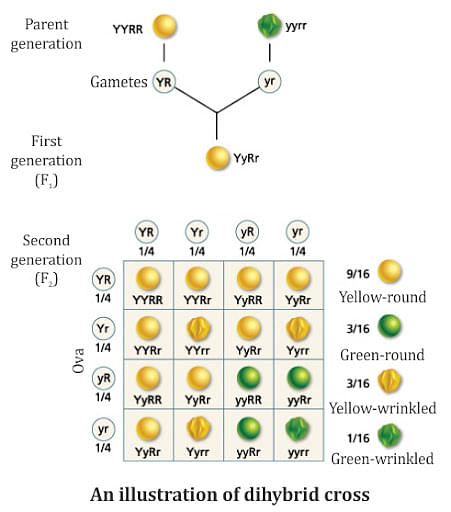
Dihybrid Cross
Ques. State the difference between Gene and Allele?
Ans. The difference between Gene and Allele is that Allele (Allelomorphs) refers to the alternate form of a gene pair present on the same loci in the homologous chromosome, whereas Gene is the smallest part of an organism capable of transmitting genetic information and expressing the same.
Ques. Why does the male human never transfers the gene for haemophilia to his son?
Ans. The male human never transfers the gene for haemophilia to his son because the gene for haemophilia is present on the X chromosome. A male has one chromosome each of X & Y which he receives from his mother and father respectively. The human male passes the X chromosome to his daughters or female offspring and not to the sons or male offspring.
Ques. How to identify a homozygous plant and a heterozygous plant?
Ans. To identify if a plant is homozygous or heterozygous, a test cross is performed in which an individual is crossed with homozygous recessive for the trait. If a plant is heterozygous, 1:1 would be the ratio of the offspring of a test cross consisting of tall and dwarf plants.
Ques. Mention the difference between frameshift mutations and point mutations.
Ans. The difference between frameshift mutation and point mutation is that frameshift mutation arises due to deletion or insertion or duplication or addition of one or two bases in DNA whereas point mutation arises due to a change in a single base pair of DNA e.g., sickle cell anaemia.
Ques. Which is the universally accepted law of Mendel? State the Law.
Ans. Mendel’s law of segregation is universally accepted. According to the law– “A recessive character that was not expressed in heterozygous condition may be expressed again when it becomes homozygous. Hence, characters segregate while the formation of gametes”.
Read More: Mendelian Genetics
Long Answer Questions (3 Marks Questions)
Ques. Answer the subsequent question in the given situation: A homozygous tall pea plant with green seeds is crossed with a dwarf pea plant with yellow seeds.
- Mention the genotype and phenotype of the F1 generation?
- With the help of Punnett square, work out the phenotypic ratio of the F2 generation.
Ans. (a)The genotype of all the plants would be Tt Gg. i.e. a hybrid tall plant with green seeds and the phenotype of all the plants of F1 generation would be tall with green seeds.
(b) For F2 generation
| T | t | |
| G | TG | tg |
| g | Tg | tg |
| TG | tg | Tg | tg | |
| Tg | TTGG | TtGG | TTGg | TtGg |
| tg | TtGG | ttGG | TtGg | ttGg |
| Tg | TTGg | TtGg | TTgg | Ttgg |
| tg | ttGg | Ttgg | Ttgg | ttgg |
- Tall plants with green seeds: 9
- Dwarf plants with green seeds: 3
- Tall plants with yellow seeds: 3
- Dwarf plant with yellow seeds: 1
- Phenotypic ratio: 9 : 3 : 3 : 1
Ques. What are the advantages of selecting the pea plant (Pisum sativum) for the experiments by Mendel?
Ans. The advantages of selecting the pea plant (Pisum sativum) for the experiment by Mendel are as follows:
- There are as many as 14 varieties with observable forms or traits.
- Pea plants self-pollinate as their corolla completely encloses the reproductive organs until pollination is complete.
- Easily available.
- It has pure lines for experimental purposes.
- It has contrasting characteristics like the seed colour, pod shape, flower shape, pod colour, the position of the flower, seed shape and plant height.
- Its life cycle was short and produced a large number of off-springs.
- Except at the time of pollination the plant can be grown easily and does not require any care.
Read More: Difference Between Cross-Pollination and Self Pollination
Ques. Differentiate back cross and test cross.
Ans. Differences between the back cross and test cross are as follows:
| Back Cross | Test Cross |
|---|---|
| It is the hybridisation process between F1 progeny and one of its parents. | It represents the hybridisation between F1 progeny with the homozygous recessive parent. |
| The ratio of F2 progeny may be 1: 1. | The ratio of F2 progeny is 1:1. |
| It is used to develop a good hybrid particularly through recurring back cross. | It is used to testify to the genotype of the F1 progeny. |
Ques. How is sex determined in human beings?
Ans. Sex chromosomes determine the sex in human beings. There are 44+XY chromosomes in males, whereas, in females, there are 44+XX chromosomes. The determination of sex happens with the X and Y chromosomes in human beings.
Two types of gametes are formed in males, one type is having 50% X-chromosome, whereas another type is having Y-chromosome. A female, contain X-chromosomes and gametes are of one type. Thus, males are classified as heterogametic and females are homogametic. If a male gamete having a Y-chromosome undergoes fusion with the female gamete having an X-chromosome, the zygote will have an XY chromosome and this gives rise to a male child.
If a male gamete having X-chromosome undergoes fusion with a female gamete having X-chromosome, the zygote will be having XX-chromosome and this gives rise to the female child.

Sex Determination in Humans
Read More: What is Triple Fusion?
Very Long Answer Questions (5 Marks Questions)
Ques. A double recessive plant was crossed with a dihybrid heterozygous round, yellow seeded garden pea (Pisum sativum).
- What type of cross is this?
- Find out the phenotype and genotype of the progeny
- Which of Mendel’s principles is illustrated through the result of this cross?
Ans. (a) When a double recessive plant was crossed with a dihybrid heterozygous round, yellow seeded garden pea (Pisum sativum) then, this type of cross is called a dihybrid test cross.
(b) Below given is the Work-out the phenotype and genotype of the progeny-

(c) Through the result of the dihybrid test cross Mendel’s principle of independent assortment is illustrated.
Ques. Dogs' barking traits are dominant over silent traits and erect ears are dominant over drooping ears. What is the expected phenotypic ratio of progeny when dogs heterozygous for both the traits are crossed?
Ans. When dogs are heterozygous for both (erect ears/drooping ears and barking/silent trait), the traits are crossed, then, the expected phenotypic ratio of offspring will be given as 9 : 3 : 3: 1 where traits for barking & erect ears = 9, barking & drooping ears =3, silent & erect ears = 3, and silent & drooping ears =1.

Ques. What is the difference between dominance, codominance and incomplete dominance with one example each?
Ans. Below are the differences between dominance, codominance and incomplete dominance with one example each:
| Dominance | Codominance | Incomplete Dominance |
|---|---|---|
| When 2 characters are crossed in which one character is dominant over the other character in the progeny, then this phenomenon is called dominance. | If the two equally dominant genes are present together, which are then expressed equally, this phenomenon is called codominance. | When a cross is made between 2 characters between which none of them is completely dominant then an intermediate character develops in the off-spring, this phenomenon is called Incomplete dominance. |
| Example: When the true-breeding tall pea plant is crossed with the true-breeding dwarf pea plant, all the plants in the F1F1 generation are tall; this shows that the tall character is dominant over the dwarf in the progeny. | Example: Alleles of the blood group, IAIA and IBIB are dominant over IOIO but when both the alleles are present together, both of them will equally express and form a phenotype AB. | Example: When a cross is made between a white flower & a red flower in a snapdragon flower an intermediate pink colour appears in the offspring. |
Read More: Difference between Incomplete Dominance and Codominance
Ques. Thalassemia and Haemophilia are both blood-related disorders in humans. Write their difference and causes between the two. What is the category of genetic disorder they both come under?
Ans. Both haemophilia and thalassemia are Mendelian disorders .
Haemophilia is a sex-linked recessive disorder. On X-chromosome, the gene for haemophilia is located. The gene transfers from a bearer female to her son. Thalassemia is an autosomal-linked recessive disease. It occurs due to either deletion or mutation resulting in the reduced rate of synthesis of one of the globin chains of haemoglobin.
In haemophilia, clotting is affected, i.e. even after a minor cut, there can be non-stop bleeding. Anaemia is the characteristic of Thalassemia disease which is caused by faulty haemoglobin synthesis.
Ques. What are the 3 reasons for Mendel’s work on the inheritance of characters remaining unrecognised till 1900 though it was published in 1865?
Ans. Mendel’s work published as “Experiments on plant hybridisation” remained unrecognized and unappreciated for approximately 34 years because of:
- Limited circulation of the “Proceedings of Brunn Natural Science Society” in which it was published.
- Because of the non-availability of pure lines.
- Absence of aggressiveness in his personality.
Also check:



Comments