



Content Curator
Alleles are a pair of genes that are located in a specific position called the Gene Locus in particular chromosomes. They are responsible for controlling the same traits in offspring.
| Table of Content |
Keyterms: Gene, Gene Locus, Chromosomes, Genotype, Heterozygous genotypes, Diploid organisms, DNA, Alleles, Heredity
Also Read: Chromosomes and Genes
What is Allele?
[Click Here for Sample Questions]
Allele is a variant form of a gene. The structural unit of chromosomes that inherit heredity From one generation to another generation is called a gene. And the pair of genes found on the same place of chromosome raised by the mutation are known as Alleles. These appear either in the form of pairs or other multiple forms and are inhabited at a specific location on the chromosome.
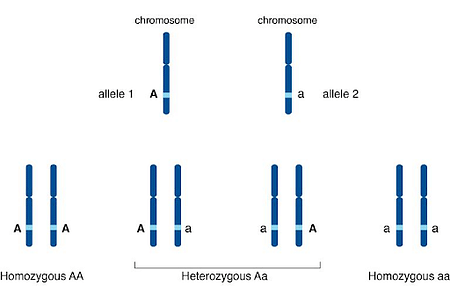
Genotype
[Click Here for Previous Year Questions]
These alleles exhibit the same trait. An example is hair color, one allele infers for black hair and other allele infers for white hair. The pair of alleles build up a genotype. When the pair of alleles are similar it is called homozygous genotype. And the different pairs of alleles are called heterozygous genotype.

In heterozygous genotypes, one of the alleles is dominant and the other remains recessive. The characteristics of dominant alleles are more than the characteristics of recessive alleles. While in some traits none of the allele remains either dominant or recessive.

Due to the presence of a pair of alleles, humans are referred to as the Diploid organisms. Out of the two alleles one is inherited from the parents. So, though the alleles may be of two or multiple variant forms of a gene, they all share the same trait.
Examples of Allele
[Click Here for Sample Questions]
Alleles describe the characteristics of individuals. The dominant allele characteristics are exhibited among a given pair. So, the two alleles in the human gene infer different codes. The traits and examples of the alleles are as follows:
- Blue, Hazel, brown and green eyes. One allele codes for one eye color.
- Black and blonde hair.
- Dark and fair skin.
- AB and O blood type. One allele codes for A blood group and other allele codes for B blood group. People having neither blood type code for O blood type.
- Color of green pea flowers will be either purple or white. The particular alleles are responsible for gene coding of white or purple color.
- Height of the individuals.
Also Read:
Difference between Gene and Allele
[Click Here for Previous Year Questions]
The structural unit of chromosomes that inherit heredity from one generation to another generation is called gene. Humans have two types of genes. This pair of genes is known as allele. Out of the two alleles, one is carried by each from the parents.
| Character | Gene | Allele |
|---|---|---|
| Definition | The particular section of a DNA responsible for exhibiting certain traits among individuals inherited from one generation to another is called Gene. | A variant of the gene formed by the mutation is called Allele. |
| Infers | Determines traits of different individuals. | Determine various features of the traits. |
| Types | Alleles | Homozygous, Heterozygous, Dominant and Recessive. |
| Role | They build up the traits in an individual making them identical to their parents | They shape the features of traits, bring up changes and give recognition to the individuals. |
| Number per genus locus | One | Two |
| Pairing | Doesn’t Occur in pairs | Occur in pairs |
| Examples | Eye color Skin complexion Hair color | Blonde hair Hazel and blue eyes Dark skin |
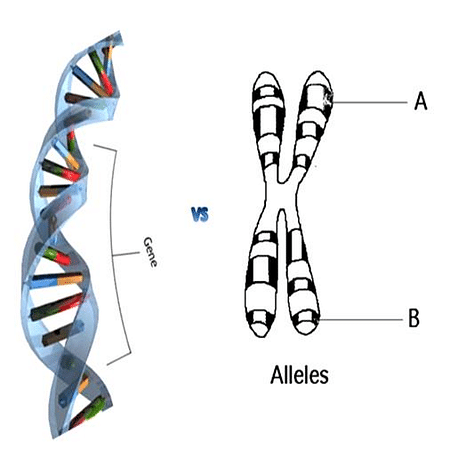
Difference between Gene and Allele
Things to Remember
- Alleles are the variant form of genes found on some place of chromosome either in the form of pairs or multiple forms.
- The pair of alleles build up genotype. The similar type of alleles are known as Homozygous genotypes and the different types of alleles are known as heterozygous genotypes.
- Humans are referred to as diploid organisms due to the presence of alleles.
- The alleles are responsible for shaping the features of traits, bringing about changes among the individuals.
- Two alleles encode for different or similar characteristics. The Dominant alleles overrule the characteristics more than the Recessive alleles.
- Some of the examples for alleles are Blonde hair, black hair, Hazel eyes, blue eyes, dark skin, green pea flowers either in purple or white and etc.
Read More: Difference Between DNA and RNA
Previous Year Questions
- Identify the wrong statement with reference to the gene T that controls ABO blood groups….[NEET 2020]
- Select the correct match...[NEET 2020]
- One of the parents of a cross has mutation in its mitochondrion. In that cross, that parent is taken as male. During segregation of F2 progenies that mutation is found in...[NEET 2004]
- The recessive genes located on X-chromosomes of humans are always….[NEET 2004]
- What is the probability that their second child will also be an albino?...[NEET 1998]
- Incorrect statement with regard to haemophilia is….[NEET 2013]
- Match the terms in Column-I with their description in Column-II and choose the correct option :….[NEET 2016]
- A colour blind girl is rare because she will be born only when….[NEET 1991]
- What is the probability of their grandson being colour blind ?...[NEET 2015]
- The phenomenon in which an allele of one gene supresses the activity of an allele of another gene is known as….[NEET 1995]
- A disease caused by an autosomal primary non- disjunction is:….[NEET 2017]
- Which of the following conditions correctly describes the manner of determining the sex in the given example ?...[NEET 2011]
- Lack of independent assortment of two genes- A and B in fruit fly-Drosophila is due to...[NEET 2004]
- A gene is said to be dominant if :-...[NEET 2002]
- A gene pair hides the effect of another gene. The phenomenon is called….[NEET 1999]
- A gene showing codominance has….[NEET 2015]
- A human female with Turner's syndrome….[NEET 2014]
- A woman has an X -linked condition on one of her X chromosomes. This chromosome can be inherited by...[NEET 2018]
- A person with the sex chromosomes XXY suffers from….[NEET 1997]
- A plant of F1 generation with genotype "AABbCC". On selfing of this plant what is the phenotypic ratio in F2 -generation : -...[NEET 2002]
Sample Questions
Ques. How are the two alleles of a gene different from each other? (3 marks)
Ans. Alleles are the variant forms of genes. They encode for a specific characteristic of an individual. For example, a gene for skin color comprises two alleles , one for dark and the other for fair skin. So, they differ from each other and are called as homozygous or heterozygous genotypes.
Though the alleles comprise different nucleotide sequences, they are ultimately responsible for shaping the characteristics in individuals. In short, they study the behavior and sequence of the patterns of genes exhibiting the different characteristics of different individuals.
Ques. How many alleles does an individual have? (2 marks)
Ans. Humans have two copies of chromosomes of each gene. Due to the presence of a pair of alleles, humans are referred to as the Diploid organisms. Genes may be in more than one form, so an individual consists of two alleles of similar or different types.
Sometimes, humans may have more than two alleles. Three or more variant forms of gene are called Multiple alleles. Multiple alleles may exist in a population level and so different individuals may have multiple alleles.
Ques. Why are alleles important in Genetics? (2 marks)
Ans. Alleles are the structures that hold our genes. They are located on chromosomes and a part of the genetic sequence. They are responsible for work of body cells, determining traits and characteristics like hair color, skin complexion, eye color, height and etc.,
The inheritance patterns can also be studied with the alleles. From some observations, alleles are considered to be crucial in finding out about human evolution. With the change in frequencies of alleles, the change in evolution over time can also be found. So, the alleles are very important in Genetics.
Ques. How many types of alleles are there? (2 marks)
Ans. Alleles are variant forms of genes. There are two types of alleles that are: Homozygous and Heterozygous.
If both the alleles are similar they are called Homozygous and if both the alleles are different they are called Heterozygous.
Some of the alleles may be dominant and recessive. The allele which is responsible for more characteristics among the individual is called Dominant allele and the other allele is called Recessive allele. If the dominant allele is more, the individual may have the characteristics that the allele encodes.
Ques. Where do alleles come from? (2 marks)
Ans. One allele of all genes is inherited from the parents. They may be similar or different. Ans. Sometimes, the children may get the same allele from both their parents. Genes in the body can randomly mutate or fertilize or combine. That is when new alleles are formed within. This mutation leads to entirely new alleles.
Ques. What are alleles made of? (2 marks)
Ans. Allele is a variable DNA found at a particular location on the chromosome. They are genetic sequences that refer to a particular code for the genes. They are responsible for transmission of traits. Among humans there are small differences in the sequences of their DNA. These features change and are responsible for different physical features of a person.
Ques. Who discovered Allele? (2 marks)
Ans. Gregor Mendel is the scientist who has observed and discovered the Alleles in 1865. While studying the genetics by mating the crosses of pea plants, he has segregated the genes and identified the different features of traits. Through this experiment he has developed three principles of inheritance.
In his study he has concluded that alleles are variant forms of genes that are responsible for exhibiting different features of characteristics among individuals.
For Latest Updates on Upcoming Board Exams, Click Here:https://t.me/class_10_12_board_updates
Do Check Out:





Comments