NCERT Solutions for Class 12 Maths Chapter 6 Applications of Derivatives Exercise 6.5

Jasmine Grover logo

Jasmine Grover Study Abroad Expert

Study Abroad Expert

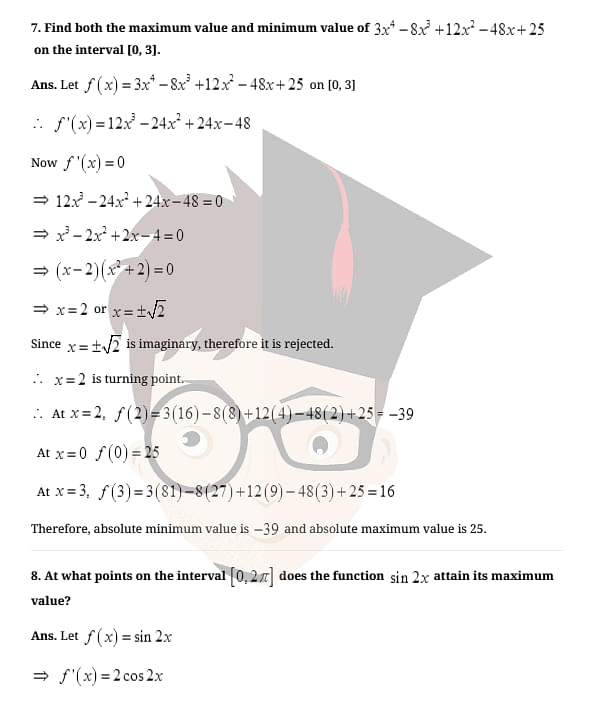
NCERT Solutions for Class 12 Maths Chapter 6 Applications of Derivatives Exercise 6.5 is given in this article. Chapter 6 Exercise 6.5 includes questions that deal with concepts of maxima and minima and maximum and Minimum Values of a Function in a Closed Interval.

Download PDF: NCERT Solutions for Class 12 Maths Chapter 6 Exercise 6.5

Check out the Class 12 Maths NCERT solutions chapter 6 Exercise 6.5:

Read More: NCERT Solutions For Class 12 Mathematics Chapter 6 Applications of Derivatives

Check out other exercise solutions of Class 12 Maths Chapter 6 Applications of Derivatives:

Class 12 Chapter 6 Applications of Derivatives Topics:

CBSE Class 12 Mathematics Study Guides:

CBSE CLASS XII Related Questions

  • 1.
    The diagonals of a parallelogram are given by \( \mathbf{a} = 2 \hat{i} - \hat{j} + \hat{k} \) and \( \mathbf{b} = \hat{i} + 3 \hat{j} - \hat{k}\) . Find the area of the parallelogram.


      • 2.
        Evaluate : \[ I = \int_0^{\frac{\pi}{4}} \frac{dx}{\cos^3 x \sqrt{2 \sin 2x}} \]


          • 3.
            Solve the following linear programming problem graphically: Maximise \( Z = 20x + 30y \) Subject to the constraints: \[ x + y \leq 0, \quad 2x + 3y \geq 100, \quad x \geq 14, \quad y \geq 14. \]


              • 4.
                The integrating factor of the differential equation \( \frac{dy}{dx} + y = \frac{1 + y}{x} \) is:


                  • 5.
                    Let $f'(x) = 3(x^2 + 2x) - \frac{4}{x^3} + 5$, $f(1) = 0$. Then, $f(x)$ is:

                      • $x^3 + 3x^2 + \frac{2}{x^2} + 5x + 11$
                      • $x^3 + 3x^2 + \frac{2}{x^2} + 5x - 11$
                      • $x^3 + 3x^2 - \frac{2}{x^2} + 5x - 11$
                      • $x^3 - 3x^2 - \frac{2}{x^2} + 5x - 11$

                    • 6.
                      Let $f(x) = |x|$, $x \in \mathbb{R}$. Then, which of the following statements is incorrect?

                        • $f$ has a minimum value at $x = 0$
                        • $f$ has no maximum value in $\mathbb{R}$
                        • $f$ is continuous at $x = 0$
                        • $f$ is differentiable at $x = 0$
                      CBSE CLASS XII Previous Year Papers

                      Comments


                      No Comments To Show