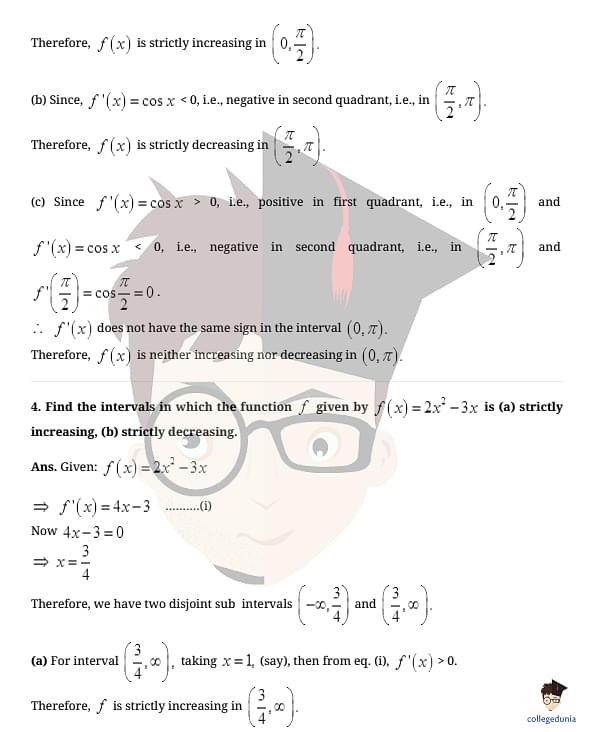
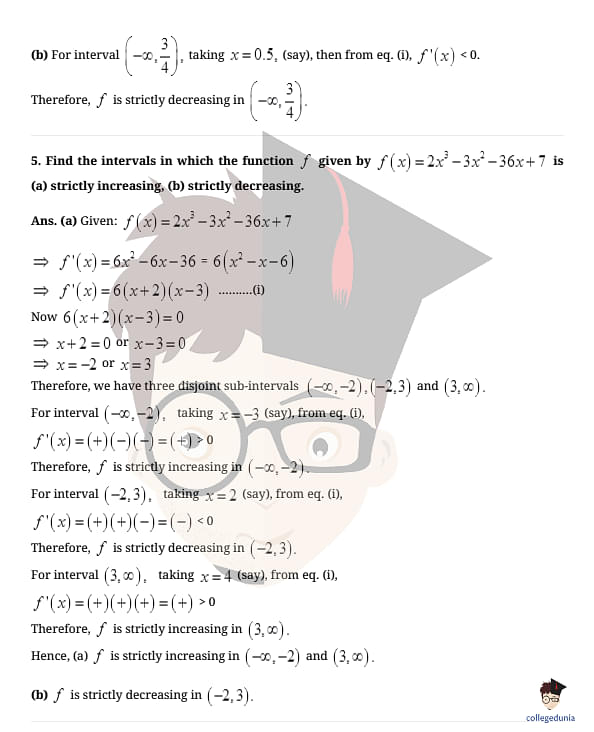
NCERT Solutions for Class 12 Maths Chapter 6 Applications of Derivatives Exercise 6.2

Jasmine Grover logo

Jasmine Grover

Education Journalist | Study Abroad Strategy Lead

NCERT Solutions for Class 12 Maths Chapter 6 Applications of Derivatives Exercise 6.2 is provided in this article. Chapter 6 Exercise 6.2 includes questions that deal with concepts of increasing and decreasing functions. The exercise includes a total of 19 questions with 10 long questions, 7 short questions and 2 MCQs.

Download PDF: NCERT Solutions for Class 12 Maths Chapter 6 Exercise 6.2

Check out solutions of Class 12 Maths NCERT solutions chapter 6 Applications of Derivatives 6.2

Read More: NCERT Solutions For Class 12 Mathematics Chapter 6 Applications of Derivatives

Check out other exercise solutions of Class 12 Maths Chapter 6 Applications of Derivatives:

Class 12 Chapter 6 Applications of Derivatives Topics:

CBSE Class 12 Mathematics Study Guides:

CBSE CLASS XII Related Questions

  • 1.

    A rectangle of perimeter \(24\) cm is revolved along one of its sides to sweep out a cylinder of maximum volume. Find the dimensions of the rectangle. 


      • 2.
        Find the domain of \(p(x)=\sin^{-1}(1-2x^2)\). Hence, find the value of \(x\) for which \(p(x)=\frac{\pi}{6}\). Also, write the range of \(2p(x)+\frac{\pi}{2}\).


          • 3.
            A line passing through the points \(A(1,2,3)\) and \(B(6,8,11)\) intersects the line \[ \vec r = 4\hat i + \hat j + \lambda(6\hat i + 2\hat j + \hat k) \] Find the coordinates of the point of intersection. Hence write the equation of a line passing through the point of intersection and perpendicular to both the lines.


              • 4.
                Find the sub–interval of \((0,\pi)\) in which the function \[ f(x)=\tan^{-1}(\sin x-\cos x) \] is increasing and decreasing.


                  • 5.
                    Obtain the value of \[ \Delta = \begin{vmatrix} 1 + x & 1 & 1 \\ 1 & 1 + y & 1 \\ 1 & 1 & 1 + z \end{vmatrix} \] in terms of \(x, y, z\). Further, if \(\Delta = 0\) and \(x, y, z\) are non–zero real numbers, prove that \[ x^{-1} + y^{-1} + z^{-1} = -1 \]


                      • 6.
                        Find : \[ \int \frac{2x+1}{\sqrt{x^2+6x}}\,dx \]

                          CBSE CLASS XII Previous Year Papers

                          Comments


                          No Comments To Show