



Content Curator
Invertible Matrix, which is also called nonsingular or nondegenerate matrix, is a type of square matrix that contains real or complex numbers. We can say a square matrix to be invertible if and only if the determinant is not equal to zero. Meaning, a 2 × 2 matrix is only invertible if the determinant of the matrix is not 0 because if the determinant is zero, then the matrix is not invertible and has no inverse.
| Table of Content |
Key Terms: Invertible Matrix, Identity Matrix, Real numbers, Complex numbers, Determinant, Square matrix, Addition, Subtraction, Multiple, Division
What is Invertible Matrix?
[Click Here for Sample Questions]
Matrix is formed by an array of numbers that are arranged in rows and columns. The sum total of rows and columns stand for m and n respectively. The dimension of a matrix is given by m × n. All the mathematical Operations such as Addition, Subtraction, Multiple, and division can be done using a matrix. But here, we multiply the inverse of the matrix, for the purpose of Division. This inverse matrix is called the Invertible Matrix.
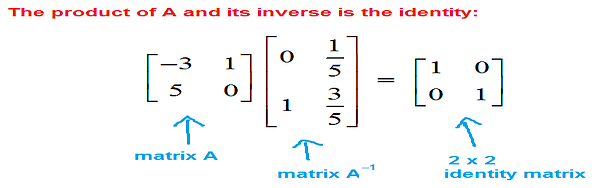
You must be well acquainted with the fact that when a number is multiplied with the inverse of that number, the result is One. Similarly, for the Matrix, when a matrix is multiplied with the inverse of that matrix, we get Identical Matrix.
The video below explains this:
Matrices Detailed Video Explanation:
Read More: Minors and Cofactors
Properties of Invertible Matrix
[Click Here for Sample Questions]
The properties of an Invertible Matrix A are listed below.
- (A−1)−1 = A
- (kA)−1 = k−1A−1 for any nonzero scalar k
- (Ax)+ = x+A−1 if A has orthonormal columns, where + denotes the Moore–Penrose inverse and x is a vector
- (AT)−1 = (A−1)T
- For any invertible n × n matrices A and B, (AB)−1 = B−1A−1. To be more specific, if A1, A2…, Ak is invertible n × n matrices, then (A1A2⋅⋅⋅Ak-1Ak)−1 = A−1kA−1k−1….A−12A−11
- det A−1 = (det A)−1
Example: Suppose there are two squared Matrix A and B, where B is the inverse matric of A.
A = \(\begin{bmatrix} 2 & 3 \\ 1 & 2 \end{bmatrix}\)
B = \(\begin{bmatrix} 2 & -3 \\ -1 & 2 \end{bmatrix}\)
AB = \(\begin{bmatrix} 2 & 3 \\ 1 & 2 \end{bmatrix}\) × \(\begin{bmatrix} 2 & -3 \\ -1 & 2 \end{bmatrix}\)
= \(\begin{bmatrix} 4-3 & -6+6 \\ 2-2 & -3+4 \end{bmatrix}\) = \(\begin{bmatrix} 1 & 0 \\ 0 & 1 \end{bmatrix}\) = I
Also, BA = \(\begin{bmatrix} 1 & 0 \\ 0 & 1 \end{bmatrix}\) = I
Thus, B is the inverse of A, A = B−1
Also Read:
Methods of Matrix Inversion
[Click Here for Sample Questions]
There are four methods of Matrix Inversion. They are:
- Gaussian Elimination
- Newton’s Method
- Cayley- Hamilton Method
- Eigen Decomposition Method.
There are two Theorems of Invertible Matrices. They are:
Theorem 1: (Uniqueness of inverse). If there exists an inverse of a matrix, it is unique.
We consider A = [ aij ] to be a square matrix of order m. Again we consider B and C to be two inverses of A. Now, we show that B = C.
As B is the inverse of A,
AB = BA = I ... (1)
And also, we have considered C is also the inverse of A
AC = CA = I ... (2)
Thus B = BI = B (AC) = (BA) C = IC = C
Theorem 2: If A and B are invertible matrices of the same order, then (AB) –1 = B–1 A–1
From the above definition of inverse of a matrix,
(AB) (AB)–1 = I
or A–1 (AB) (AB)–1 = A–1 I (Pre multiplying both sides by A–1)
or (A–1 A) B (AB)–1 = A–1 (Since A–1 I = A–1)
or IB (AB)–1 = A–1
or B (AB)–1 = A–1
or B–1 B (AB)–1 = B–1 A–1
or I (AB)–1 = B–1 A–1
Hence (AB)–1 = B–1 A–1
Read More: Singular Matrix
Things to Remember
- Invertible Matrix, which is also called nonsingular or nondegenerate matrix, is a type of square matrix that contains real or complex numbers.
- Matrix is formed by an array of numbers that are arranged in rows and columns.
- The sum total of rows and columns stand for m and n respectively.
- The dimension of a matrix is given by m × n.
- All the mathematical Operations such as Addition, Subtraction, Multiple, and division can be done using a matrix.
- But here, we multiply the inverse of the matrix, for the purpose of Division. This inverse matrix is called the Invertible Matrix.
Sample Questions
Ques. What is an identical Matrix? (2 Marks)
Ans. A matrix is called an Identity Matrix when the size of the matrix is n × n, where n is the row and column of the matrix. The n × n matrix has one on the main diagonal, and zeros elsewhere.
Ques. Does a rectangular Matrix possess an Inverse? (2 Marks)
Ans. A rectangular matrix does not possess an inverse matrix, since, for products BA and AB to be defined and to be equal, it is necessary that matrices A and B should be square matrices of the same order
Ques. What is the Application of Invertible Matrix? (2 Marks)
Ans. There is three application of Invertible Matrix, they are :
- Least-squares or Regression
- Simulations
- MIMO Wireless Communications
Ques. When a square matrix is not invertible, what is it called? (2 Marks)
Ans. The square matrix which is not invertible is called singular or degenerate. When the value of the determinant of a square matrix is zero, that matrix is then called a singular matrix.
Ques. What are the properties of Matrix Inverse? (3 Marks)
Ans. If A and B are the non-singular matrices, then the inverse matrix should have the following properties:
- (A-1)-1 =A
- (AB)-1 = A-1B-1
- (ABC)-1 = C-1B-1A-1
- (A1 A2….An)-1 = An-1An-1-1……A2-1A1-1
- (AT)-1 = (A-1)T
- (kA)-1 = (1/k)A-1
- AB = In, where A and B are inverse of each other.
- If A is a square matrix where n>0, then (A-1)n = A-n
Where A-n = (An)-1
Ques. What will be the value of ‘k’ if det(A-1) = (det A)k, if A is a 3 × 3 invertible matrix. (Delhi) (3 Marks)
Ans. We already know that,
A-1 = Adj A / |A|
Therefore,
|A-1| = |Adj A|/ |A|
= |A|3-1/| A|
[ Since, if A is a non singular matrix of order n, then |adj (A)| = |A|n-1]
= |A|2/ |A| = |A|
As we have |A-1| = |A|k Hence, k = 1.
Ques. If for any 2 × 2 square matrix A, A(adj A) = \(\begin{bmatrix} 8 & 0 \\ 0 & 8 \end{bmatrix}\) , then what will be the value of |A|. (All India) (3 Marks)
Ans. Solution 1,
Given, A (adj A) = \(\begin{bmatrix} 8 & 0 \\ 0 & 8 \end{bmatrix}\)
As we know that, A (adj A) = |A| – I
|A| . l = \(8 \begin{bmatrix} 1 & 0 \\ 0 & 1 \end{bmatrix}\)
⇒ |A| = 8
Solution 2,
Given that, A(adj A) = \(\begin{bmatrix} 8 & 0 \\ 0 & 8 \end{bmatrix}\)
⇒ A (adj A) = \(8 \begin{bmatrix} 1 & 0 \\ 0 & 1 \end{bmatrix}\)
⇒ A(adj A) = 8I2 …… (1)
As it is already known that for any square matrix A of order 2, we have
A (adj A) = |A| l2 ….. (2)
From equation (1) and (2), we have,
|A| = 8.
Ques. By using elementary row transformation (ERT), find the inverse of matrix A = \(\begin{bmatrix} 6 & 5 \\ 5 & 4 \end{bmatrix}\). (Foreign 2010; HOTS) (5 Marks)
Ans. First of all, put A = IA, then convert this matrix in the form I = BA, by applying elementary row transformation on A of LHS and I of RHS where B gives the inverse of A.
As it is given, A = \(\begin{bmatrix} 6 & 5 \\ 5 & 4 \end{bmatrix}\)
Let us consider, A = IA
⇒ \(\begin{bmatrix} 6 & 5 \\ 5 & 4 \end{bmatrix} = \begin{bmatrix} 1 & 0 \\ 0 & 1 \end{bmatrix} A\)
By applying R1 → R1 – R2, we get
\(\begin{bmatrix} 1 & 1 \\ 5 & 4 \end{bmatrix} = \begin{bmatrix} 1 & -1 \\ 0 & 1 \end{bmatrix} A\)
Applying R2 → R2 – 5R1, we get
\(\begin{bmatrix} 1 & 1 \\ 0 & -1 \end{bmatrix} = \begin{bmatrix} 1 & -1 \\ -5 & 6 \end{bmatrix} A\)
Applying R1 → R1 +R2, we get
\(\begin{bmatrix} 1 & 0 \\ 0 & -1 \end{bmatrix} = \begin{bmatrix} -4 & 5 \\ -5 & 6 \end{bmatrix} A\)
Now, applying R2 → (-1)R2, we get
\(\begin{bmatrix} 1 & 0 \\ 0 & 1 \end{bmatrix} = \begin{bmatrix} -4 & 5 \\ 5 & -6 \end{bmatrix} A\)
Hence,
A-1 = \(\begin{bmatrix} -4 & 5 \\ 5 & -6 \end{bmatrix}\) [∵ A-1A = I]
Ques. Using elementary row transformation, find inverse of matrix A = \(\begin{bmatrix} 2 & 5 \\ 1 & 3 \end{bmatrix}\) (Delhi 2010) (3 Marks)
Ans. Given,
A = \(\begin{bmatrix} 2 & 5 \\ 1 & 3 \end{bmatrix}\)
We can write,
A = IA
i.e.,
\(\begin{bmatrix} 2 & 5 \\ 1 & 3 \end{bmatrix} = \begin{bmatrix} 1 & 0 \\ 0 & 1 \end{bmatrix} A\)
\(\begin{bmatrix} 1 & 2 \\ 1 & 3 \end{bmatrix} = \begin{bmatrix} 1 & -1 \\ 0 & 1 \end{bmatrix} A \quad\left[R_{1} \rightarrow R_{1}-R_{2}\right]\)
\(\begin{bmatrix} 1 & 2 \\ 0 & 1 \end{bmatrix} = \begin{bmatrix} 1 & -1 \\ -1 & 2 \end{bmatrix} A \quad\left[R_{2} \rightarrow R_{2}-R_{1}\right]\)
\(\begin{bmatrix} 1 & 0 \\ 0 & 1 \end{bmatrix} = \begin{bmatrix} 3 & -5 \\ -1 & 2 \end{bmatrix} A \quad \left[R_{1} \rightarrow R_{1}-2 R_{2}\right]\)
\(\therefore \quad A^{-1} = \begin{bmatrix} 3 & -5 \\ -1 & 2 \end{bmatrix}\)
Ques. Find the inverse of the matrix \(\begin{bmatrix} -1 & 1 & 2 \\ 1 & 2 & 3 \\ 3 & 1 & 1 \end{bmatrix}\). (Delhi 2012) (5 Marks)
Ans. The given matrix is, A = \(\begin{bmatrix} -1 & 1 & 2 \\ 1 & 2 & 3 \\ 3 & 1 & 1 \end{bmatrix}\)
Let us assume, A = IA
⇒ \(\begin{bmatrix} -1 & 1 & 2 \\ 1 & 2 & 3 \\ 3 & 1 & 1 \end{bmatrix} = \begin{bmatrix} 1 & 0 & 0 \\ 0 & 1 & 0 \\ 0 & 0 & 1 \end{bmatrix} A\)
Applying R2 → R2 + R1, R3 → R3 + 3R1, we get
\(\begin{bmatrix} -1 & 1 & 2 \\ 0 & 3 & 5 \\ 0 & 4 & 7 \end{bmatrix} = \begin{bmatrix} 1 & 0 & 0 \\ 1 & 1 & 0 \\ 3 & 0 & 1 \end{bmatrix} A\)
And applying R1 → (-1) R1, we get
\(\begin{bmatrix} 1 & -1 & -2 \\ 0 & 3 & 5 \\ 0 & 4 & 7 \end{bmatrix} = \begin{bmatrix} -1 & 0 & 0 \\ 1 & 1 & 0 \\ 3 & 0 & 1 \end{bmatrix} A\)
Applying R2 → R2 – R3, we get
\(\begin{bmatrix} 1 & -1 & -2 \\ 0 & -1 & -2 \\ 0 & 4 & 7 \end{bmatrix} = \begin{bmatrix} -1 & 0 & 0 \\ -2 & 1 & -1 \\ 3 & 0 & 1 \end{bmatrix} A\)
Applying R1 → R1 – R2 and R3 → R3 + 4R2, we get
\(\begin{bmatrix} 1 & 0 & 0 \\ 0 & -1 & -2 \\ 0 & 0 & -1 \end{bmatrix} = \begin{bmatrix} 1 & -1 & 1 \\ -2 & 1 & -1 \\ -5 & 4 & -3 \end{bmatrix} A\)
Applying R2 → (-1)R2, we get
\(\begin{bmatrix} 1 & 0 & 0 \\ 0 & 1 & 2 \\ 0 & 0 & -1 \end{bmatrix} = \begin{bmatrix} 1 & -1 & 1 \\ 2 & -1 & 1 \\ -5 & 4 & -3 \end{bmatrix} A\)
Applying R2 → R2 + 2R3, we get
\(\begin{bmatrix} 1 & 0 & 0 \\ 0 & 1 & 0 \\ 0 & 0 & -1 \end{bmatrix} = \begin{bmatrix} 1 & -1 & 1 \\ -8 & 7 & -5 \\ -5 & 4 & -3 \end{bmatrix} A\)
Applying R3 → (-1)R3, we get
\(\begin{bmatrix} 1 & 0 & 0 \\ 0 & 1 & 0 \\ 0 & 0 & 1 \end{bmatrix} = \begin{bmatrix} 1 & -1 & 1 \\ -8 & 7 & -5 \\ 5 & -4 & 3 \end{bmatrix} A\)
which is of the form I = BA
Hence,
A-1 = \( \begin{bmatrix} 1 & -1 & 1 \\ -8 & 7 & -5 \\ 5 & -4 & 3 \end{bmatrix}\)
Ques. Find the inverse of the matrix \(\begin{bmatrix} 2 & 0 & -1 \\ 5 & 1 & 0 \\ 0 & 1 & 3 \end{bmatrix}\). (Foreign 2011) (5 Marks)
Ans. The given matrix is A = \(\begin{bmatrix} 2 & 0 & -1 \\ 5 & 1 & 0 \\ 0 & 1 & 3 \end{bmatrix}\)
Let A = IA
⇒ \(\begin{bmatrix} 2 & 0 & -1 \\ 5 & 1 & 0 \\ 0 & 1 & 3 \end{bmatrix} = \begin{bmatrix} 1 & 0 & 0 \\ 0 & 1 & 0 \\ 0 & 0 & 1 \end{bmatrix} A\)
Applying R1 → 3R1, we get
\(\begin{bmatrix} 6 & 0 & -3 \\ 5 & 1 & 0 \\ 0 & 1 & 3 \end{bmatrix} = \begin{bmatrix} 3 & 0 & 0 \\ 0 & 1 & 0 \\ 0 & 0 & 1 \end{bmatrix} A\)
Applying R1 → R1 – R2, we get
\(\begin{bmatrix} 1 & -1 & -3 \\ 5 & 1 & 0 \\ 0 & 1 & 3 \end{bmatrix}=\begin{bmatrix} 3 & -1 & 0 \\ 0 & 1 & 0 \\ 0 & 0 & 1 \end{bmatrix} A\)
Applying R1 → R1 + R3, we get
\(\begin{bmatrix} 1 & 0 & 0 \\ 5 & 1 & 0 \\ 0 & 1 & 3 \end{bmatrix}=\begin{bmatrix} 3 & -1 & 1 \\ 0 & 1 & 0 \\ 0 & 0 & 1 \end{bmatrix} A\)
Applying R2 → R2 – 5R1, we get
\(\begin{bmatrix} 1 & 0 & 0 \\ 0 & 1 & 0 \\ 0 & 1 & 3 \end{bmatrix}=\begin{bmatrix} 3 & -1 & 1 \\ -15 & 6 & -5 \\ 0 & 0 & 1 \end{bmatrix} A\)
Applying R3 → R3 – R2, we get
\(\begin{bmatrix} 1 & 0 & 0 \\ 0 & 1 & 0 \\ 0 & 0 & 3 \end{bmatrix}=\begin{bmatrix} 3 & -1 & 1 \\ -15 & 6 & -5 \\ 15 & -6 & 6 \end{bmatrix} A\)
Applying R3 → \(\frac{1}{3}\)R3, we get
\(\begin{bmatrix} 1 & 0 & 0 \\ 0 & 1 & 0 \\ 0 & 0 & 1 \end{bmatrix}=\begin{bmatrix} 3 & -1 & 1 \\ -15 & 6 & -5 \\ 5 & -2 & 2 \end{bmatrix} A\)
Hence,
\(A^{-1}=\begin{bmatrix}3 & -1 & 1 \\ -15 & 6 & -5 \\ 5 & -2 & 2\end{bmatrix}\)
For Latest Updates on Upcoming Board Exams, Click Here: https://t.me/class_10_12_board_updates
Check-Out:



Comments